Social Stratification
• Social Stratification – the division of the
society into layers of people who have
unequal amounts of people into different
socials levels or categories.
“Human differences exist among members of the
society on the basis of age, sex or gender; intelligence
and physical characteristics, such as body-build and
appearance, race or ethnic group, birth or family
name, education and power and prestige.”
All known societies evolve varied systems of classifying,
categorizing or ranking people into different social classes or
strata reflecting dimensions of abundance or deprivation
possession, of power or powerlessness, prestige or lack of it,
dominance or inferiority, the ‘haves’ and the ‘have-nots of
society.
 The ranking of people is the essence of Stratification:
the division of a society into
larger categories or strata of
people who have unequal
amounts of scarce but
desirable resources or
Ponopio (1989) defines social
stratification as the hierarchical
arrangement and establishment of
social categories that may evolve into
social groups together with statuses
and their corresponding roles.
Melvin Tumin defines social stratification
as “an arrangement of any social groups or
society into a hierarchy of positions that
are unequal with regard to power,
property, social evaluation and psychic
gratification.
Social stratification
is a sociological term for
the Hierarchial
arrangement of social
classes, castes, and strata
within a society
(Psycholgical Wikipedia).
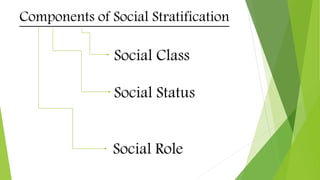
Components of Social Stratification
Social Class
Social Status
Social Role
Social Class
Refers to a Stratum or Category of a person to
have similar socio Economic privileges in the
Society.
It refers to the hierarchical distinction
between individuals or groups in societies or
culture.
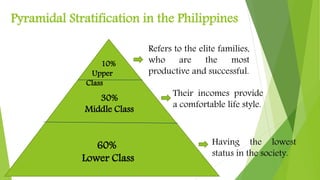
Pyramidal Stratification in the Philippines
30%
Middle Class
10%
Upper
Class
60%
Lower Class
Refers to the elite families,
who are the most
productive and successful.
Their incomes provide
a comfortable life style.
Having the lowest
status in the society.
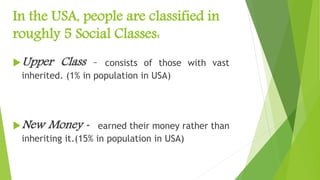
In the USA, people are classified in
roughly 5 Social Classes:
Upper Class – consists of those with vast
inherited. (1% in population in USA)
New Money - earned their money rather than
inheriting it.(15% in population in USA)
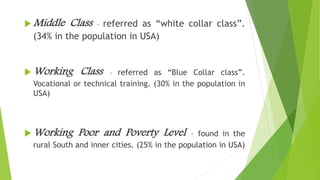
 Middle Class – referred as “white collar class”.
(34% in the population in USA)
 Working Class – referred as “Blue Collar class”.
Vocational or technical training. (30% in the population in
USA)
 Working Poor and Poverty Level – found in the
rural South and inner cities. (25% in the population in USA)
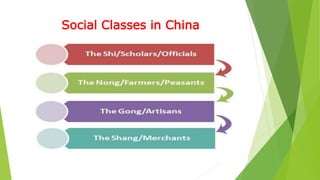
Social Classes in China
 Shi/Scholars/Ofiicials
 They had the rights to ride in chariots, carry weapons and
command battles.
 They were well educated too.
 They served in various job roles such as advisors, clerks,
overseers and scribes. They also served in various
administrative services.
 They performed various civil functions. The people of this
group gave examinations to get into various government
positions.
 They entered into governments of various levels such as
district, provincial and federal levels.
 The Nong/Farmers/Peasants
 They were considered as the valuable members
of the society.
 They held the second highest rank in the Chinese
social hierarchy.
 They also provided services to the nobles
 GONG – ARTISANS
 This was the class identified by the Chinese character
that stands for “labour/labor.”
 Artisans could be government employed or self-
employed, and those that were most successful could
become wealthy enough to hire apprentices or
laborers that they could manage.
 SHANG – MERCHANTS AND
TRADERS
They were lowest on the four rungs of the
ladder of ancient Chinese social hierarchy, due
to popular perception of these people as
greedy and immoral.
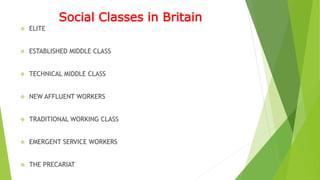
Social Classes in Britain
 ELITE
 ESTABLISHED MIDDLE CLASS
 TECHNICAL MIDDLE CLASS
 NEW AFFLUENT WORKERS
 TRADITIONAL WORKING CLASS
 EMERGENT SERVICE WORKERS
 THE PRECARIAT
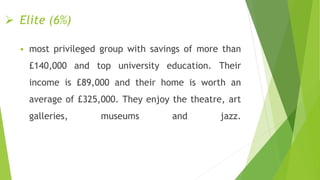
 Elite (6%)
 most privileged group with savings of more than
£140,000 and top university education. Their
income is £89,000 and their home is worth an
average of £325,000. They enjoy the theatre, art
galleries, museums and jazz.
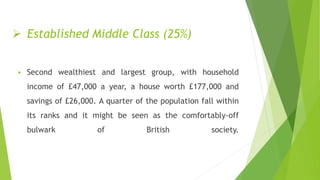
 Established Middle Class (25%)
 Second wealthiest and largest group, with household
income of £47,000 a year, a house worth £177,000 and
savings of £26,000. A quarter of the population fall within
its ranks and it might be seen as the comfortably-off
bulwark of British society.
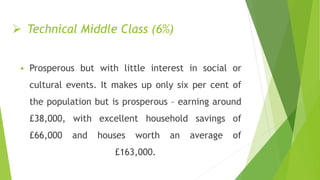
 Technical Middle Class (6%)
 Prosperous but with little interest in social or
cultural events. It makes up only six per cent of
the population but is prosperous – earning around
£38,000, with excellent household savings of
£66,000 and houses worth an average of
£163,000.
 New Affluent Workers (15%)
 Young group on moderate incomes, owning homes
worth £129,000 with small savings. They prefer
playing and watching sport, computer games and
social networking to traditional pastimes. Few
have been to university but most work in private
sector.
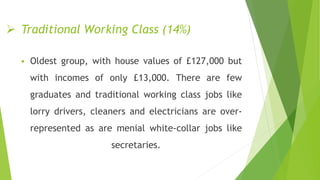
 Traditional Working Class (14%)
 Oldest group, with house values of £127,000 but
with incomes of only £13,000. There are few
graduates and traditional working class jobs like
lorry drivers, cleaners and electricians are over-
represented as are menial white-collar jobs like
secretaries.
 Emergent Service Workers (19%)
 New, young urban group with modest household
income of £21,000, likely to rent and only having
modest savings. They work usually in the service
sector, for example, bar work, chefs, customer
service occupations and call centre workers.
 The Precariate (15%)
 The poorest class, with a household income of
only £8,000, negligible savings, and likely to rent.
Most deprived on all measures including social and
cultural. They represent 15 per cent of the
population and tend to be located in old industrial
areas.
Social Status
Degree of honor or prestige attached to one’s
position in society. – Michelle Maiese
Refers to a social standing in a group or
person within a social class in the entire social
stratification system.
Ascribed Statuses – are those which are
assigned to the individual from birth and
involve little personal choice like age and
sex.
And also be base on class, caste, ethnic
and racial groupings.
Achieved Status - is acquired by choice or
through merit and individual effort and is
made possible through special abilities or
talents, performance or opportunity.
Social Role
 The third component of social stratification which
pertains to the concept that actions should be done
according to what the society has provided to citizens.
 Refers to the expected or actual behavior patterns that
correspond with status.
 Refers to the dynamic functions that attached to the
status.
Right is an exemption from a burden or the
special enjoyment of a benefit or advantage
Obligation is what one is required to do or not
to do in accordance with the rules of the society.
 There are different roles that society expects
from its members including gender stereotyping
(masculine roles and feminine roles).
Theories of Social Stratification
1. Conflict Theory – it is posits that
stratification is the result of the struggle
among people for scarce resources and
rewards, and that it persist in the society
because the “haves” are determined and
equipped to preserve their advantage by
dominating and exploiting the “have” –nots.
2. Functional Theory – it argues
that stratification is a necessary and an
inevitable social phenomenon in order
to channel suitable individuals in to
various occupations and hence in sure
that the essential task of group life are
performed.
Types of Social Stratification System
1. Open Class System – it has few impediments
to social mobility.
Social positions are awarded on the basis of
merit and qualifications, and rank is tide to
individual achievement and performance.
Provides for all forms of social mobility
2. Closed or Caste System – is based on
ascribed status that is determined at birth,
family origin, race, creed, color, sex and
other ascribed characteristics.
Members in the closed societies are locked
in their parents’ social position.
Individuals’ opportunities are limited
accordingly.
Thank You 

Social stratification

  • 1.
  • 2.
    • Social Stratification– the division of the society into layers of people who have unequal amounts of people into different socials levels or categories. “Human differences exist among members of the society on the basis of age, sex or gender; intelligence and physical characteristics, such as body-build and appearance, race or ethnic group, birth or family name, education and power and prestige.”
  • 3.
    All known societiesevolve varied systems of classifying, categorizing or ranking people into different social classes or strata reflecting dimensions of abundance or deprivation possession, of power or powerlessness, prestige or lack of it, dominance or inferiority, the ‘haves’ and the ‘have-nots of society.  The ranking of people is the essence of Stratification: the division of a society into larger categories or strata of people who have unequal amounts of scarce but desirable resources or
  • 4.
    Ponopio (1989) definessocial stratification as the hierarchical arrangement and establishment of social categories that may evolve into social groups together with statuses and their corresponding roles.
  • 5.
    Melvin Tumin definessocial stratification as “an arrangement of any social groups or society into a hierarchy of positions that are unequal with regard to power, property, social evaluation and psychic gratification.
  • 6.
    Social stratification is asociological term for the Hierarchial arrangement of social classes, castes, and strata within a society (Psycholgical Wikipedia).
  • 7.
    Components of SocialStratification Social Class Social Status Social Role
  • 8.
    Social Class Refers toa Stratum or Category of a person to have similar socio Economic privileges in the Society. It refers to the hierarchical distinction between individuals or groups in societies or culture.
  • 9.
    Pyramidal Stratification inthe Philippines 30% Middle Class 10% Upper Class 60% Lower Class Refers to the elite families, who are the most productive and successful. Their incomes provide a comfortable life style. Having the lowest status in the society.
  • 10.
    In the USA,people are classified in roughly 5 Social Classes: Upper Class – consists of those with vast inherited. (1% in population in USA) New Money - earned their money rather than inheriting it.(15% in population in USA)
  • 11.
     Middle Class– referred as “white collar class”. (34% in the population in USA)  Working Class – referred as “Blue Collar class”. Vocational or technical training. (30% in the population in USA)  Working Poor and Poverty Level – found in the rural South and inner cities. (25% in the population in USA)
  • 12.
  • 13.
     Shi/Scholars/Ofiicials  Theyhad the rights to ride in chariots, carry weapons and command battles.  They were well educated too.  They served in various job roles such as advisors, clerks, overseers and scribes. They also served in various administrative services.  They performed various civil functions. The people of this group gave examinations to get into various government positions.  They entered into governments of various levels such as district, provincial and federal levels.
  • 14.
     The Nong/Farmers/Peasants They were considered as the valuable members of the society.  They held the second highest rank in the Chinese social hierarchy.  They also provided services to the nobles
  • 15.
     GONG –ARTISANS  This was the class identified by the Chinese character that stands for “labour/labor.”  Artisans could be government employed or self- employed, and those that were most successful could become wealthy enough to hire apprentices or laborers that they could manage.
  • 16.
     SHANG –MERCHANTS AND TRADERS They were lowest on the four rungs of the ladder of ancient Chinese social hierarchy, due to popular perception of these people as greedy and immoral.
  • 17.
    Social Classes inBritain  ELITE  ESTABLISHED MIDDLE CLASS  TECHNICAL MIDDLE CLASS  NEW AFFLUENT WORKERS  TRADITIONAL WORKING CLASS  EMERGENT SERVICE WORKERS  THE PRECARIAT
  • 18.
     Elite (6%) most privileged group with savings of more than £140,000 and top university education. Their income is £89,000 and their home is worth an average of £325,000. They enjoy the theatre, art galleries, museums and jazz.
  • 19.
     Established MiddleClass (25%)  Second wealthiest and largest group, with household income of £47,000 a year, a house worth £177,000 and savings of £26,000. A quarter of the population fall within its ranks and it might be seen as the comfortably-off bulwark of British society.
  • 20.
     Technical MiddleClass (6%)  Prosperous but with little interest in social or cultural events. It makes up only six per cent of the population but is prosperous – earning around £38,000, with excellent household savings of £66,000 and houses worth an average of £163,000.
  • 21.
     New AffluentWorkers (15%)  Young group on moderate incomes, owning homes worth £129,000 with small savings. They prefer playing and watching sport, computer games and social networking to traditional pastimes. Few have been to university but most work in private sector.
  • 22.
     Traditional WorkingClass (14%)  Oldest group, with house values of £127,000 but with incomes of only £13,000. There are few graduates and traditional working class jobs like lorry drivers, cleaners and electricians are over- represented as are menial white-collar jobs like secretaries.
  • 23.
     Emergent ServiceWorkers (19%)  New, young urban group with modest household income of £21,000, likely to rent and only having modest savings. They work usually in the service sector, for example, bar work, chefs, customer service occupations and call centre workers.
  • 24.
     The Precariate(15%)  The poorest class, with a household income of only £8,000, negligible savings, and likely to rent. Most deprived on all measures including social and cultural. They represent 15 per cent of the population and tend to be located in old industrial areas.
  • 25.
    Social Status Degree ofhonor or prestige attached to one’s position in society. – Michelle Maiese Refers to a social standing in a group or person within a social class in the entire social stratification system.
  • 26.
    Ascribed Statuses –are those which are assigned to the individual from birth and involve little personal choice like age and sex. And also be base on class, caste, ethnic and racial groupings. Achieved Status - is acquired by choice or through merit and individual effort and is made possible through special abilities or talents, performance or opportunity.
  • 27.
    Social Role  Thethird component of social stratification which pertains to the concept that actions should be done according to what the society has provided to citizens.  Refers to the expected or actual behavior patterns that correspond with status.  Refers to the dynamic functions that attached to the status.
  • 28.
    Right is anexemption from a burden or the special enjoyment of a benefit or advantage Obligation is what one is required to do or not to do in accordance with the rules of the society.  There are different roles that society expects from its members including gender stereotyping (masculine roles and feminine roles).
  • 29.
    Theories of SocialStratification 1. Conflict Theory – it is posits that stratification is the result of the struggle among people for scarce resources and rewards, and that it persist in the society because the “haves” are determined and equipped to preserve their advantage by dominating and exploiting the “have” –nots.
  • 30.
    2. Functional Theory– it argues that stratification is a necessary and an inevitable social phenomenon in order to channel suitable individuals in to various occupations and hence in sure that the essential task of group life are performed.
  • 31.
    Types of SocialStratification System 1. Open Class System – it has few impediments to social mobility. Social positions are awarded on the basis of merit and qualifications, and rank is tide to individual achievement and performance. Provides for all forms of social mobility
  • 32.
    2. Closed orCaste System – is based on ascribed status that is determined at birth, family origin, race, creed, color, sex and other ascribed characteristics. Members in the closed societies are locked in their parents’ social position. Individuals’ opportunities are limited accordingly.
  • 33.

Editor's Notes

  • #14 They wore silk robes as an identification of their status
  • #16 They were like farmers in that they produced essential objects, but most of them did not have land of their own and so did not generate the revenue. However, they commanded more respect than merchants because the skills they had were handed down from father to son.