NANOGENERATOR

      Navin Kumar
      09EAXEC075
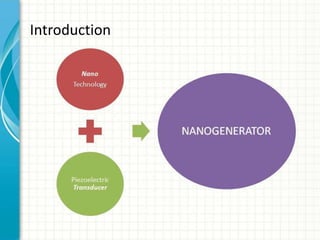
Piezoelectric Transducer
• Ability to create electrical potential when compressed,
  expanded or changed in shape (Mechanical energy to
  Electrical energy).
• The voltage generated can be quiet high.
• Made up of piezoelectric
  crystals like quartz and
  topaz.
• Unaffected by external
   electromagnetic fields.
• Can be used both as
  generators and actuators.
Introduction
Developers of Nanogenerators


  Dr. Zhong Lin (Z.L.) Wang and his colleagues at Georgia Institute of Technology,
  Georgia State, USA have made significant leaps in developing nanogenerators
  over the last decade.
A Nano Scale Piezoelectric Transducer
(Nanogenerator)
•   Harnesses the body's energy.
•   Made of Zinc Oxide (ZnO) wires called Nanowires.
•   Produces 45 millivolts whenever the zinc wire is pulled
    back and forth.
•   With simultaneous output from many nanowires, we
    can generate high
    power.
•   The wires have a
    diameter of 100 to
    300 nm and length of
    about 10 to 100
    micron.
Inside A Nanogenerator
•   Consists of an integrated
    circuit.
•   Components are made from
    ITO (Indium tin oxide) and a
    piezoelectric ceramic.
•   Nanowire bends and generates
    an electrical charge.
•   ITO electrode captures that
    charge.
•   Several electrodes capture
    power from millions of
    nanowires.
Inside A Nanogenerator
• Piezoelectric effect creates
  an electrical field inside the
  nanostructure.
• Relative displacement of
  cations with respect to
  anions in its crystalline
  structure.


                                   Potential distribution for a ZnO NW at
                                   a lateral bending force of 80
                                   nanonewtons is shown.
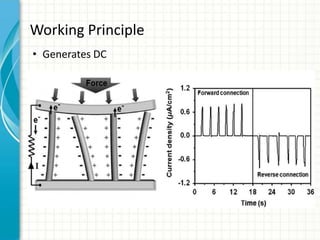
Working Principle
• Generates DC
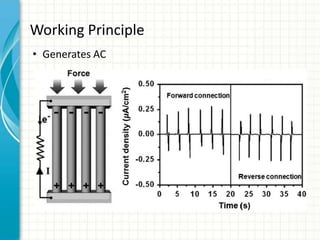
Working Principle
• Generates AC
Types of Nanogenerators
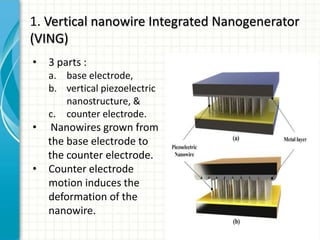
1. Vertical nanowire Integrated Nanogenerator
(VING)
•   3 parts :
    a. base electrode,
    b. vertical piezoelectric
       nanostructure, &
    c. counter electrode.
•    Nanowires grown from
    the base electrode to
    the counter electrode.
•   Counter electrode
    motion induces the
    deformation of the
    nanowire.
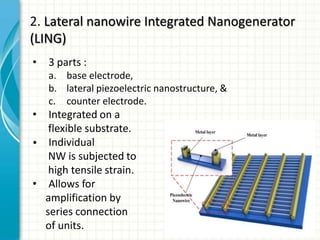
2. Lateral nanowire Integrated Nanogenerator
(LING)
•   3 parts :
    a. base electrode,
    b. lateral piezoelectric nanostructure, &
    c. counter electrode.
•  Integrated on a
   flexible substrate.
• Individual
   NW is subjected to
   high tensile strain.
• Allows for
  amplification by
  series connection
  of units.
DC Nanogenerator Driven by Ultrasonic Waves
                          •   Integrating a Platinum
                              (Pt) coated electrode
                              with vertically aligned
                              ZnO NW.
                          •   Pt enhances the
                              conductivity of the
                              electrode.
                          •   Nanowire arrays were
                              placed beneath a
                              zigzag metal
                              electrode with a small
                              gap.
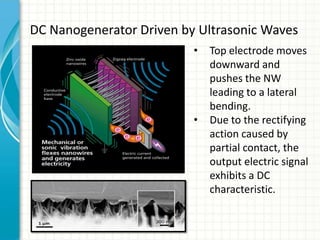
DC Nanogenerator Driven by Ultrasonic Waves
                          •   Top electrode moves
                              downward and
                              pushes the NW
                              leading to a lateral
                              bending.
                          •   Due to the rectifying
                              action caused by
                              partial contact, the
                              output electric signal
                              exhibits a DC
                              characteristic.
Sources which Nanogenerators can exploit
• For Large scale applications (from wherever periodic
  kinetic energy exists) :
   1. Wind,
   2. Ocean Waves.
• Small scale applications :
   1.   Tiny physical motion,
   2.   Inhalation of lung,
   3.   Heartbeat,
   4.   Muscle movement,
   i.e. Any kind of movement!!
Applications
• Powering conventional electronics :
  1. Light Emitting Diode (LED),
  2. Liquid Crystal Display (LCD), and
  3. Laser Diode.
• To power your personal gadgets
  and phones.
• Self-powered nano/micro
  devices.
• Implantable power devices.
• Smart Wearable Systems.
Applications
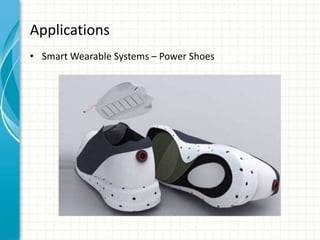
• Smart Wearable Systems – Power Shoes
Applications
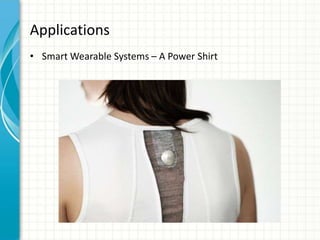
• Smart Wearable Systems – A Power Shirt
THANK YOU

Nanogenerator

  • 1.
    NANOGENERATOR Navin Kumar 09EAXEC075
  • 2.
    Piezoelectric Transducer • Abilityto create electrical potential when compressed, expanded or changed in shape (Mechanical energy to Electrical energy). • The voltage generated can be quiet high. • Made up of piezoelectric crystals like quartz and topaz. • Unaffected by external electromagnetic fields. • Can be used both as generators and actuators.
  • 3.
  • 4.
    Developers of Nanogenerators Dr. Zhong Lin (Z.L.) Wang and his colleagues at Georgia Institute of Technology, Georgia State, USA have made significant leaps in developing nanogenerators over the last decade.
  • 5.
    A Nano ScalePiezoelectric Transducer (Nanogenerator) • Harnesses the body's energy. • Made of Zinc Oxide (ZnO) wires called Nanowires. • Produces 45 millivolts whenever the zinc wire is pulled back and forth. • With simultaneous output from many nanowires, we can generate high power. • The wires have a diameter of 100 to 300 nm and length of about 10 to 100 micron.
  • 6.
    Inside A Nanogenerator • Consists of an integrated circuit. • Components are made from ITO (Indium tin oxide) and a piezoelectric ceramic. • Nanowire bends and generates an electrical charge. • ITO electrode captures that charge. • Several electrodes capture power from millions of nanowires.
  • 7.
    Inside A Nanogenerator •Piezoelectric effect creates an electrical field inside the nanostructure. • Relative displacement of cations with respect to anions in its crystalline structure. Potential distribution for a ZnO NW at a lateral bending force of 80 nanonewtons is shown.
  • 8.
  • 9.
  • 10.
  • 11.
    1. Vertical nanowireIntegrated Nanogenerator (VING) • 3 parts : a. base electrode, b. vertical piezoelectric nanostructure, & c. counter electrode. • Nanowires grown from the base electrode to the counter electrode. • Counter electrode motion induces the deformation of the nanowire.
  • 12.
    2. Lateral nanowireIntegrated Nanogenerator (LING) • 3 parts : a. base electrode, b. lateral piezoelectric nanostructure, & c. counter electrode. • Integrated on a flexible substrate. • Individual NW is subjected to high tensile strain. • Allows for amplification by series connection of units.
  • 13.
    DC Nanogenerator Drivenby Ultrasonic Waves • Integrating a Platinum (Pt) coated electrode with vertically aligned ZnO NW. • Pt enhances the conductivity of the electrode. • Nanowire arrays were placed beneath a zigzag metal electrode with a small gap.
  • 14.
    DC Nanogenerator Drivenby Ultrasonic Waves • Top electrode moves downward and pushes the NW leading to a lateral bending. • Due to the rectifying action caused by partial contact, the output electric signal exhibits a DC characteristic.
  • 15.
    Sources which Nanogeneratorscan exploit • For Large scale applications (from wherever periodic kinetic energy exists) : 1. Wind, 2. Ocean Waves. • Small scale applications : 1. Tiny physical motion, 2. Inhalation of lung, 3. Heartbeat, 4. Muscle movement, i.e. Any kind of movement!!
  • 16.
    Applications • Powering conventionalelectronics : 1. Light Emitting Diode (LED), 2. Liquid Crystal Display (LCD), and 3. Laser Diode. • To power your personal gadgets and phones. • Self-powered nano/micro devices. • Implantable power devices. • Smart Wearable Systems.
  • 17.
    Applications • Smart WearableSystems – Power Shoes
  • 18.
    Applications • Smart WearableSystems – A Power Shirt
  • 19.

Editor's Notes

  • #7 This is another option for an Overview slide.