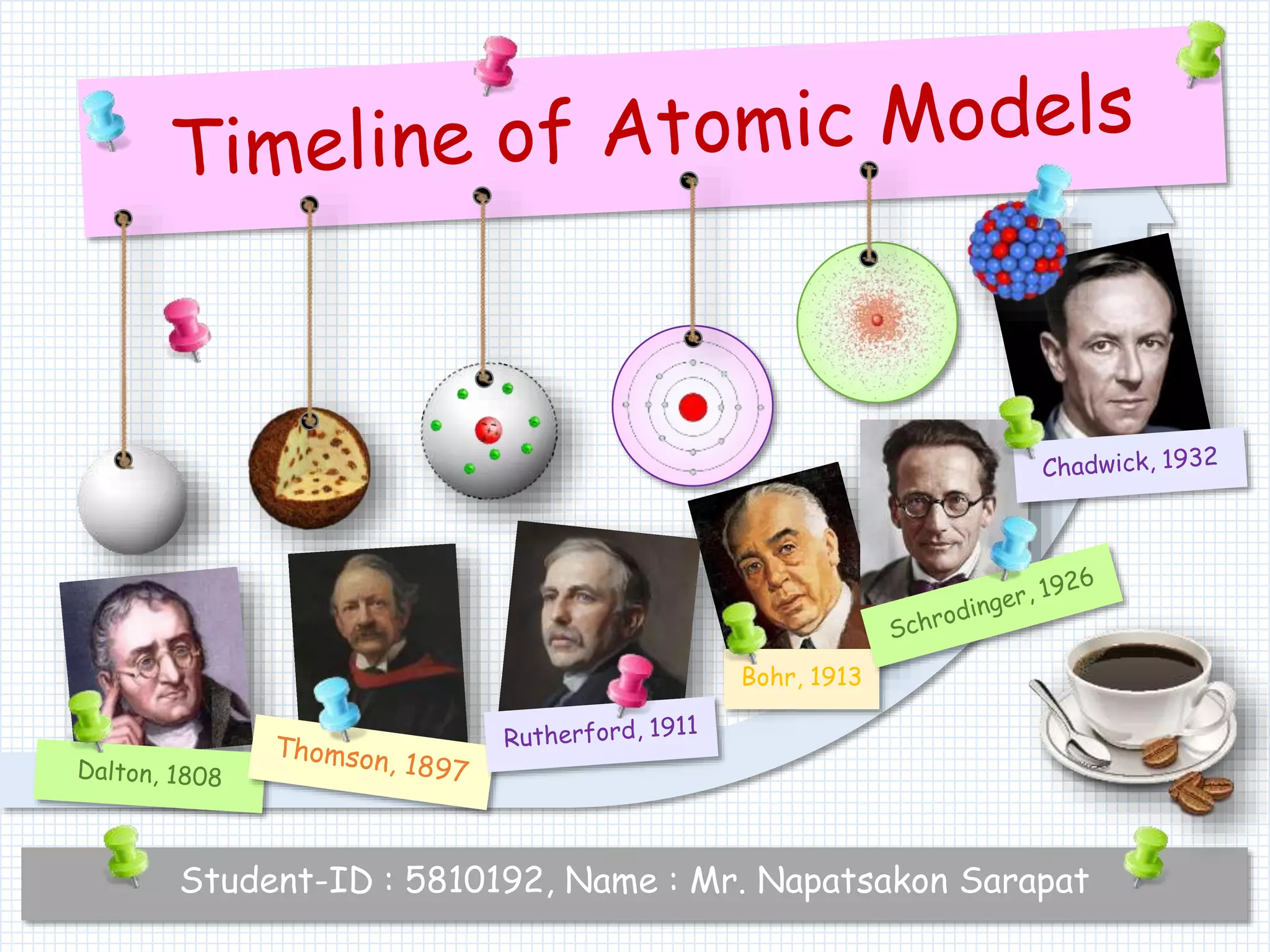
Bohr, 1913
Student-ID : 5810192, Name : Mr. Napatsakon Sarapat
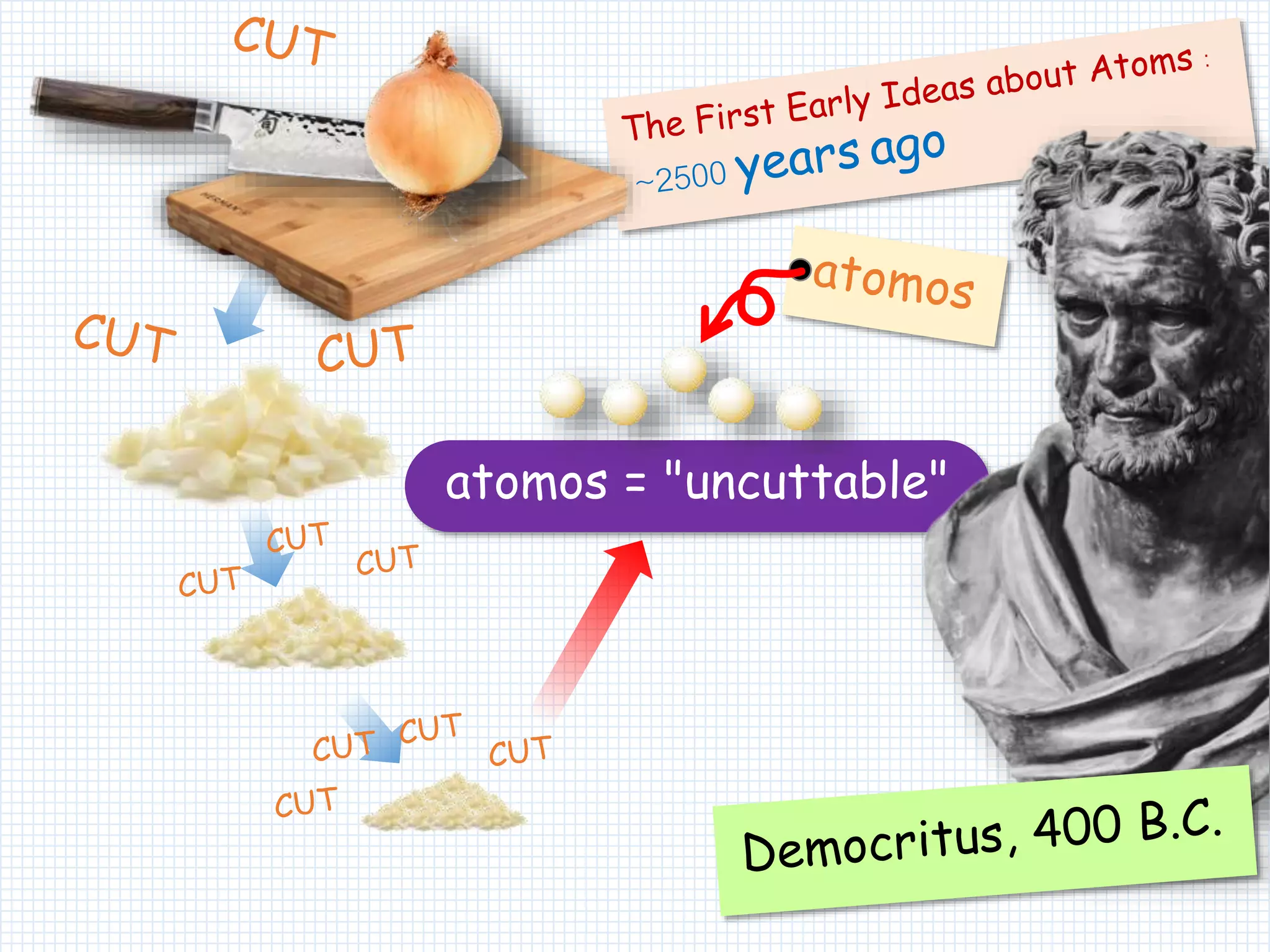
atomos = "uncuttable"
2A:B
B
Hydrogen
2A
Oxygen
Watter[H2O]
-
+
-
+
+-
-+ +
-
1897-J.J.Thomson
Helium gas
[-] Negative Charge
[+] Positive Charge
Unlike-sign charges attract.
e/me = - 1.758821011 C/kg
J.J. Thomson's experiment and the
charge-to-mass ratio of the electron
[+] Proton
[-] Electron
1907-Rutherford
Robert A. Millikan
-
-
-
Fg = mg
Fe = qE
1910-Millikan oil drop
e/me = - 1.758821011 C/kg
J.J. Thomson's experiment and the
charge-to-mass ratio of the electron
Newton's first law :
SF = 0 [Forces are Balanced]
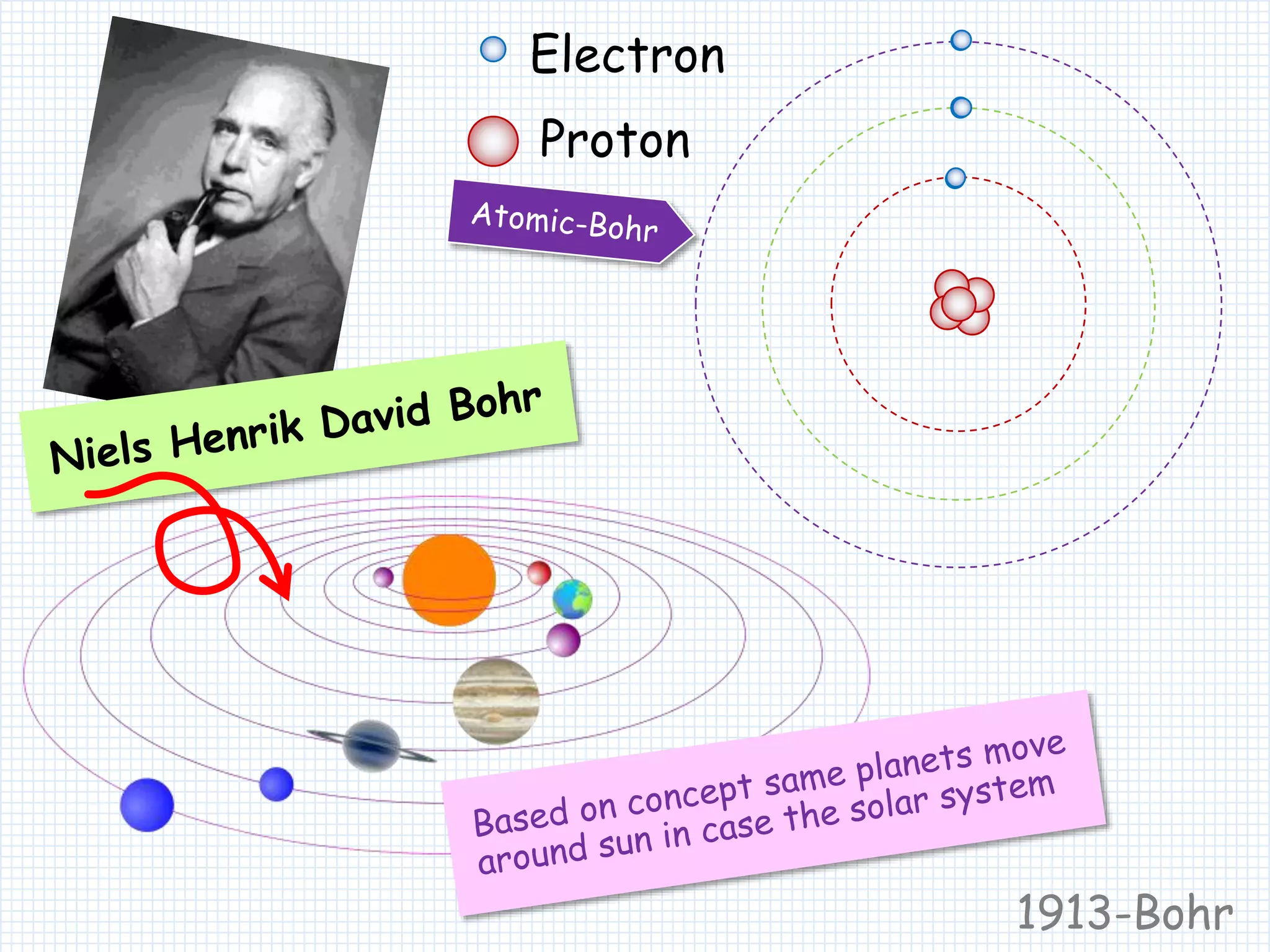
1913-Bohr
Proton
Electron
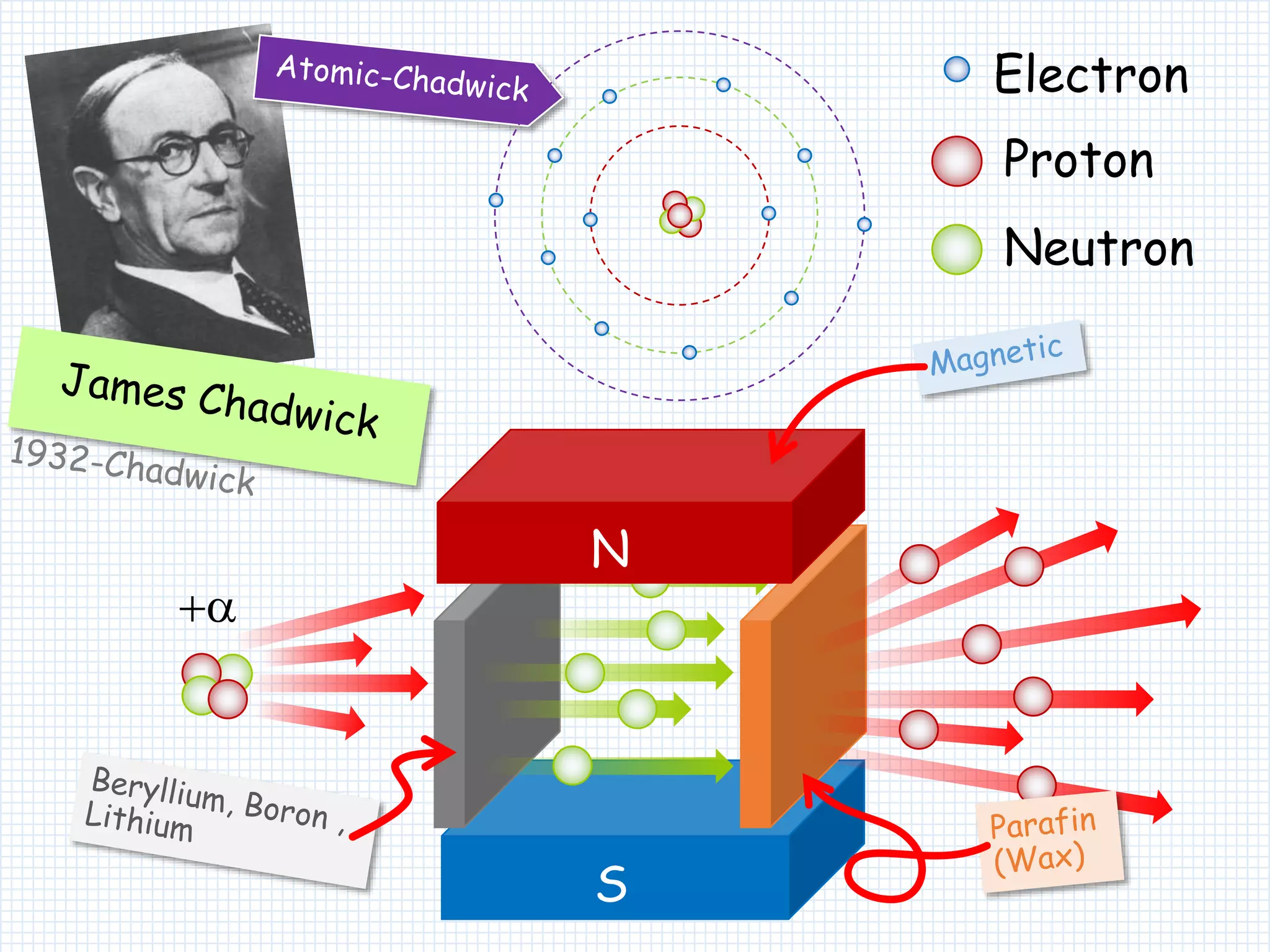
S
Proton
Electron
Neutron
+a
N
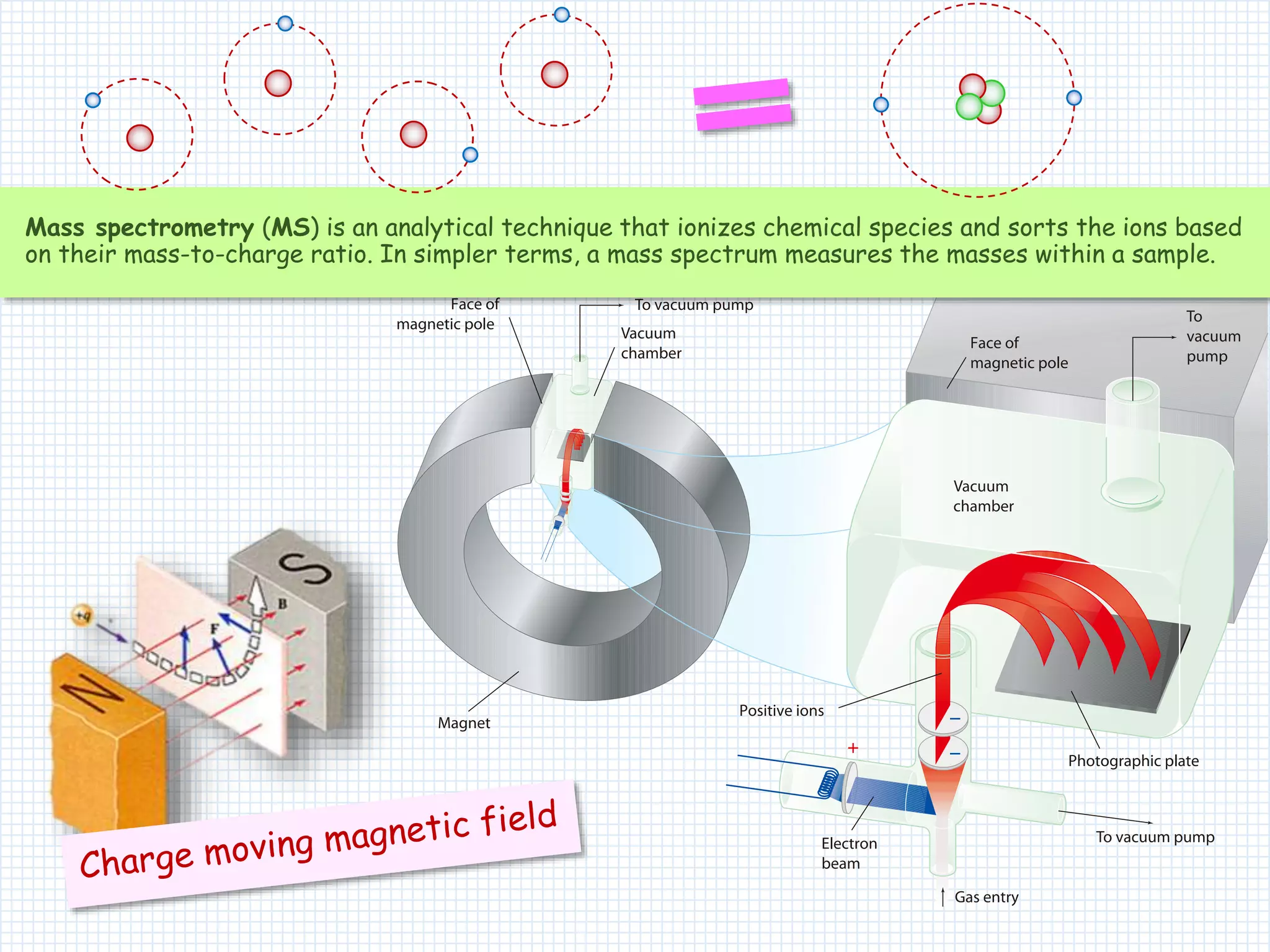
Mass spectrometry (MS) is an analytical technique that ionizes chemical species and sorts the ions based
on their mass-to-charge ratio. In simpler terms, a mass spectrum measures the masses within a sample.
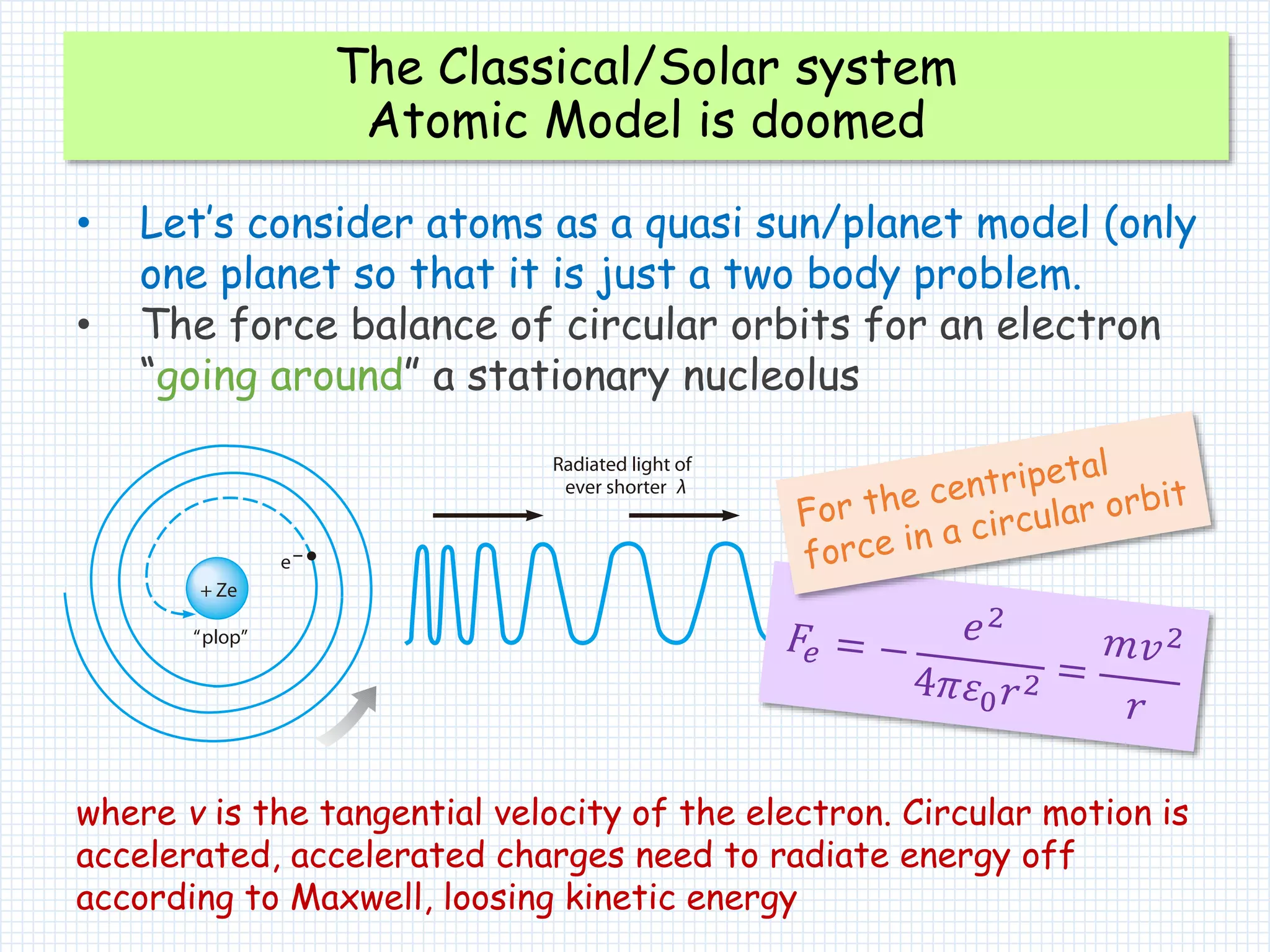
The Classical/Solar system
Atomic Model is doomed
• Let’s consider atoms as a quasi sun/planet model (only
one planet so that it is just a two body problem.
• The force balance of circular orbits for an electron
“going around” a stationary nucleolus
where v is the tangential velocity of the electron. Circular motion is
accelerated, accelerated charges need to radiate energy off
according to Maxwell, loosing kinetic energy
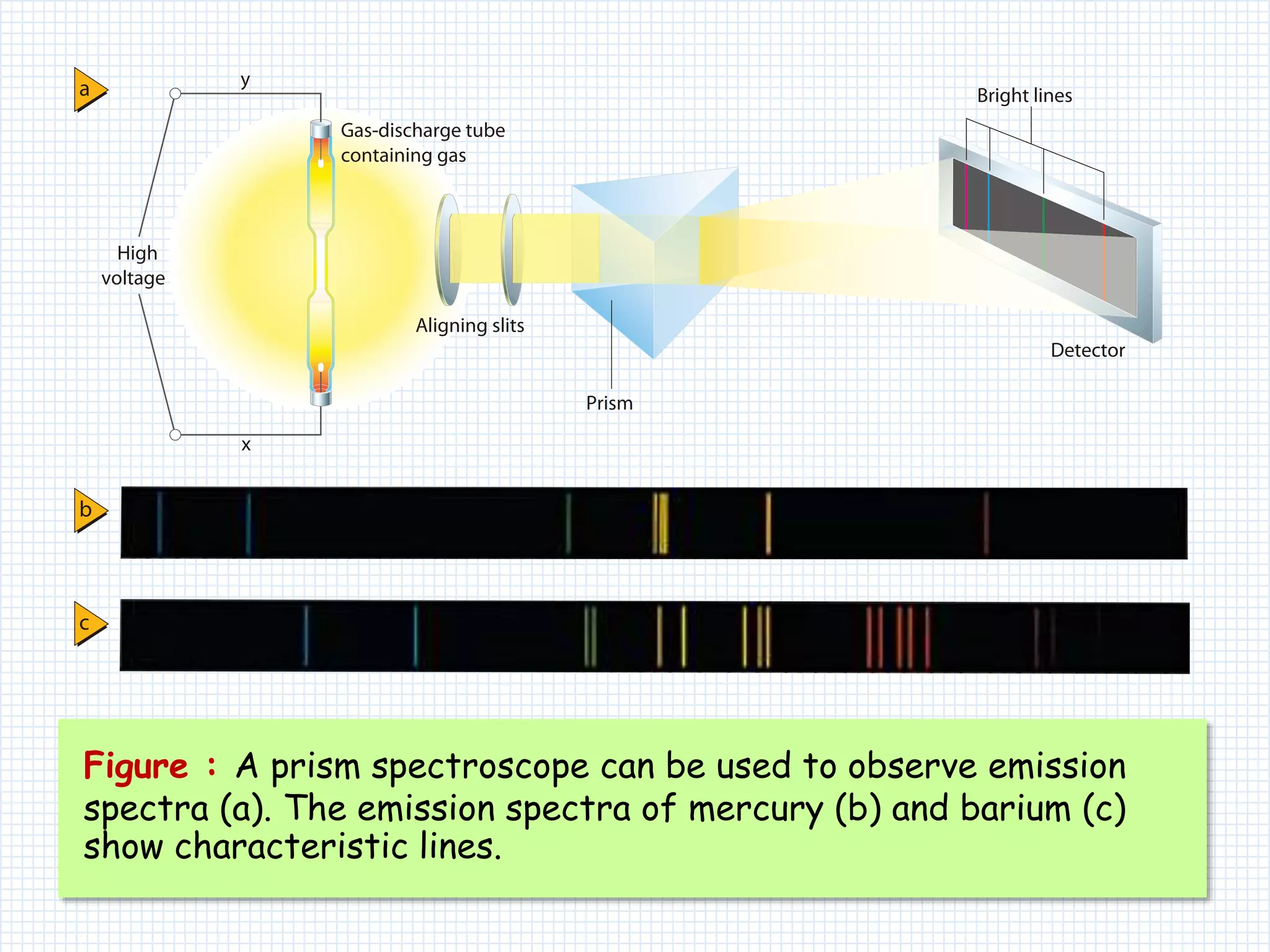
Figure : A prism spectroscope can be used to observe emission
spectra (a). The emission spectra of mercury (b) and barium (c)
show characteristic lines.
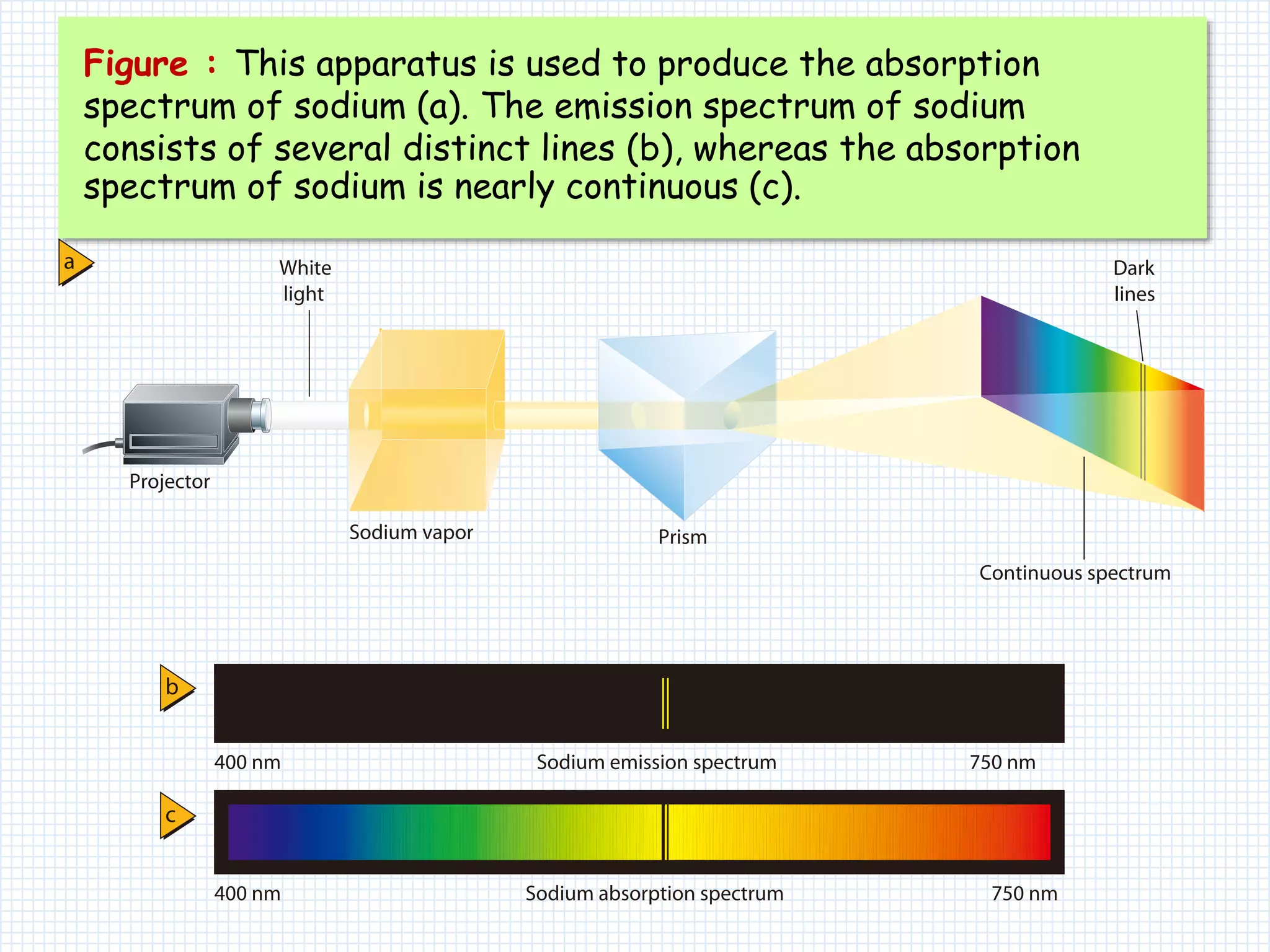
Figure : This apparatus is used to produce the absorption
spectrum of sodium (a). The emission spectrum of sodium
consists of several distinct lines (b), whereas the absorption
spectrum of sodium is nearly continuous (c).
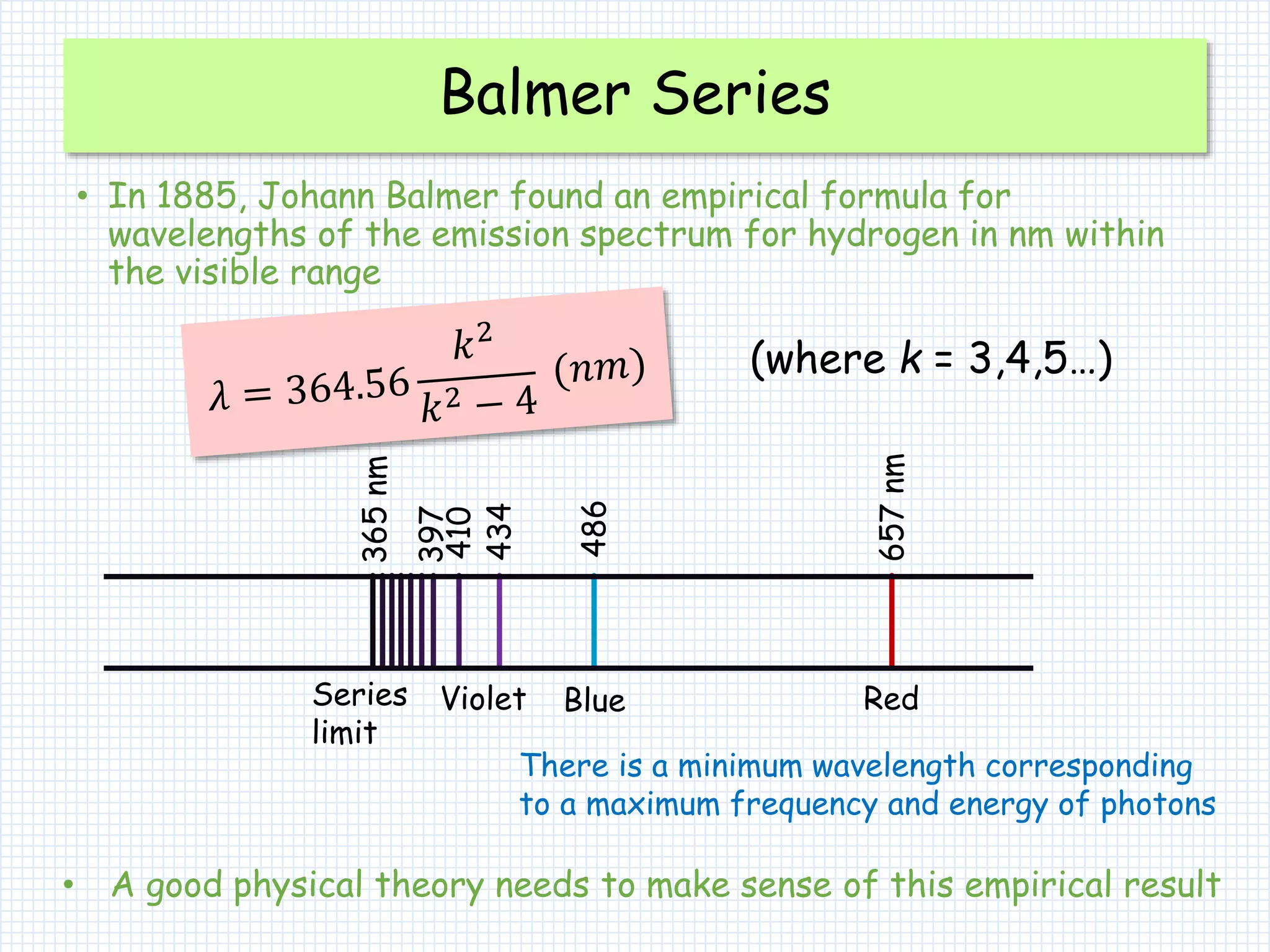
Balmer Series
• In 1885, Johann Balmer found an empirical formula for
wavelengths of the emission spectrum for hydrogen in nm within
the visible range
(where k = 3,4,5…)
• A good physical theory needs to make sense of this empirical result
There is a minimum wavelength corresponding
to a maximum frequency and energy of photons
657nm
Red
486
Blue
434
Violet
410
397
365nm
Series
limit
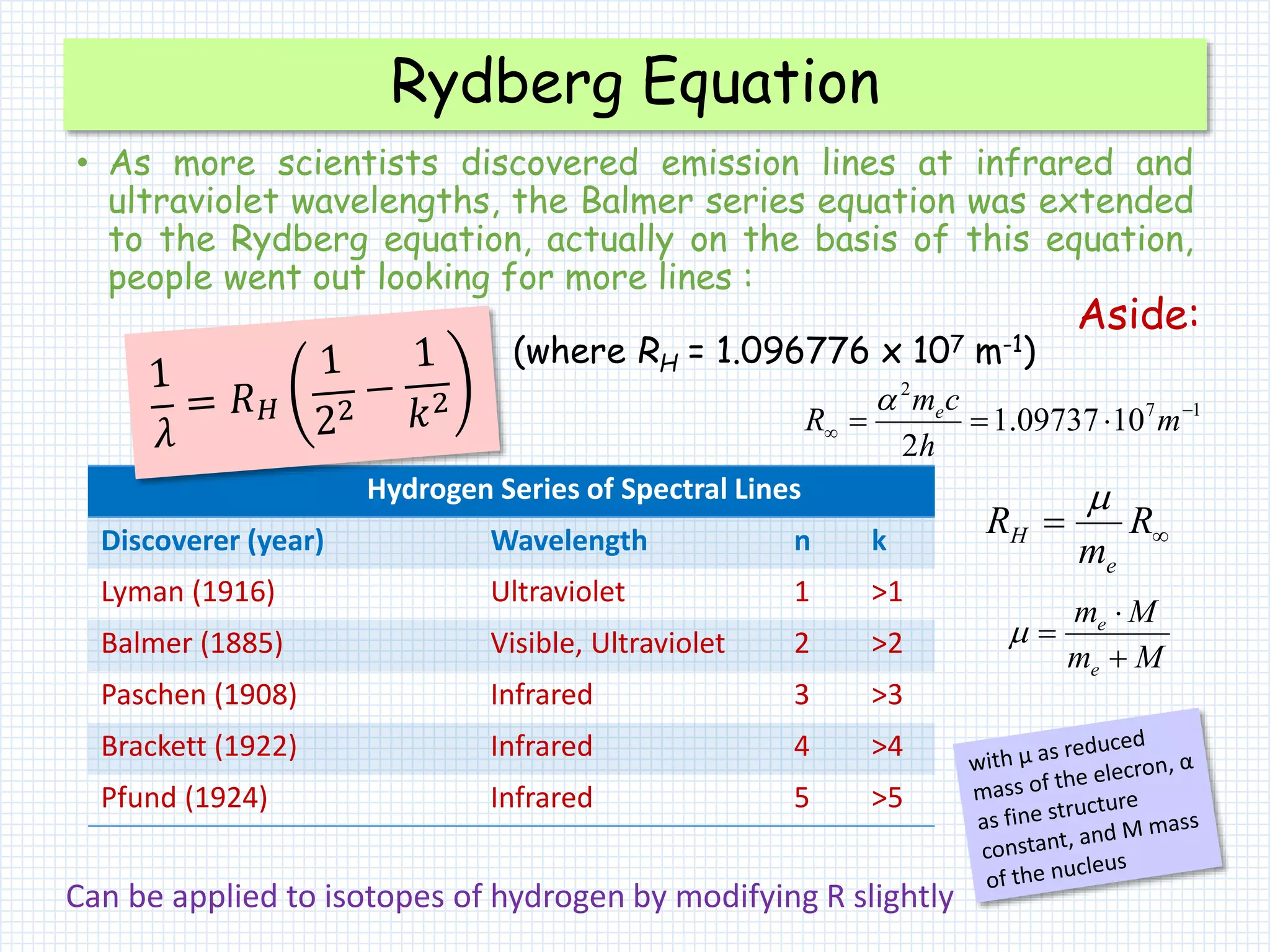
Rydberg Equation
• As more scientists discovered emission lines at infrared and
ultraviolet wavelengths, the Balmer series equation was extended
to the Rydberg equation, actually on the basis of this equation,
people went out looking for more lines :
(where RH = 1.096776 x 10⁷ m-1)
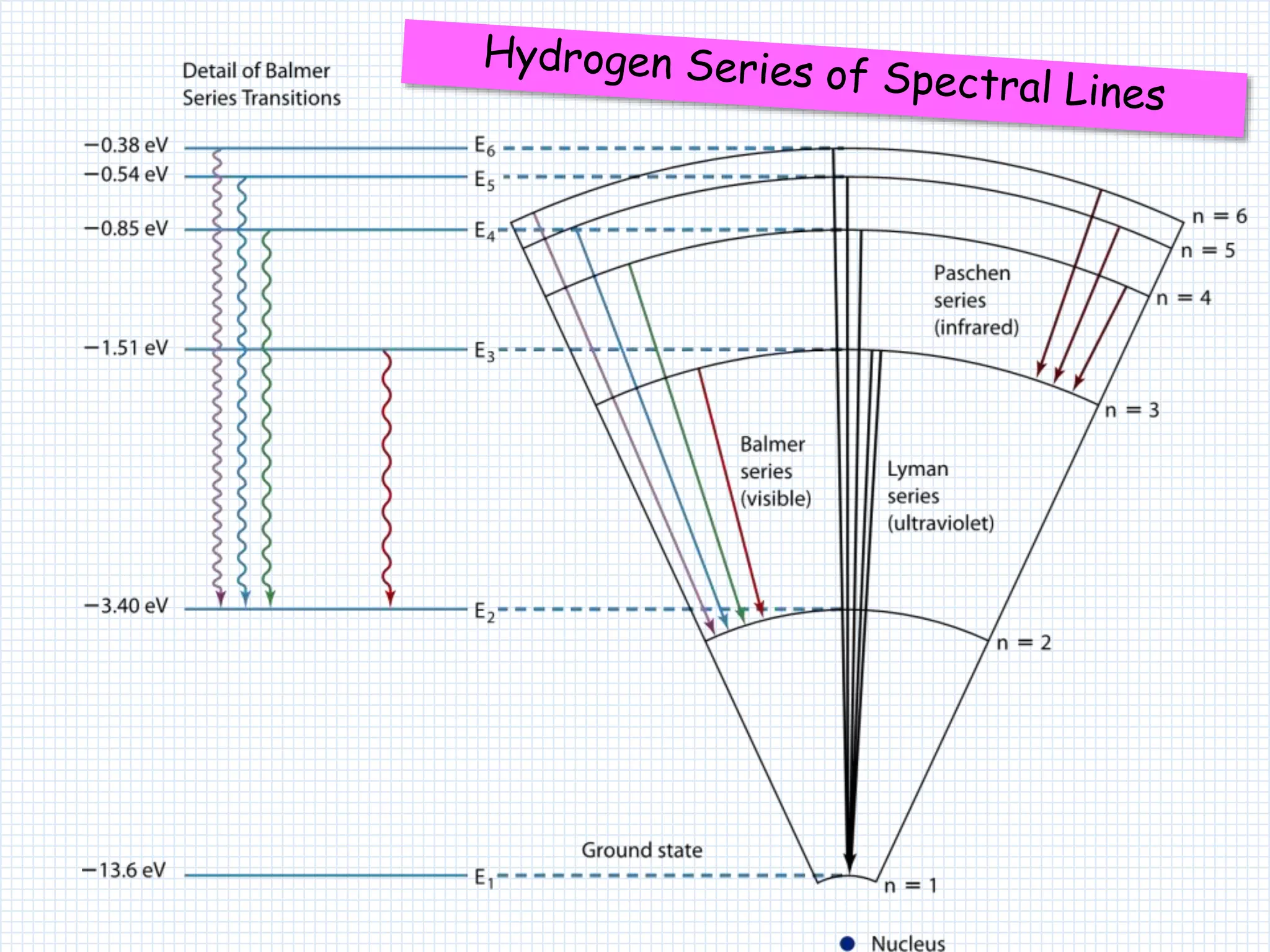
Hydrogen Series of Spectral Lines
Discoverer (year) Wavelength n k
Lyman (1916) Ultraviolet 1 >1
Balmer (1885) Visible, Ultraviolet 2 >2
Paschen (1908) Infrared 3 >3
Brackett (1922) Infrared 4 >4
Pfund (1924) Infrared 5 >5
Can be applied to isotopes of hydrogen by modifying R slightly
 R
m
R
e
H

17
2
1009737.1
2

  m
h
cm
R ea
Mm
Mm
e
e
+


Aside:
-
+
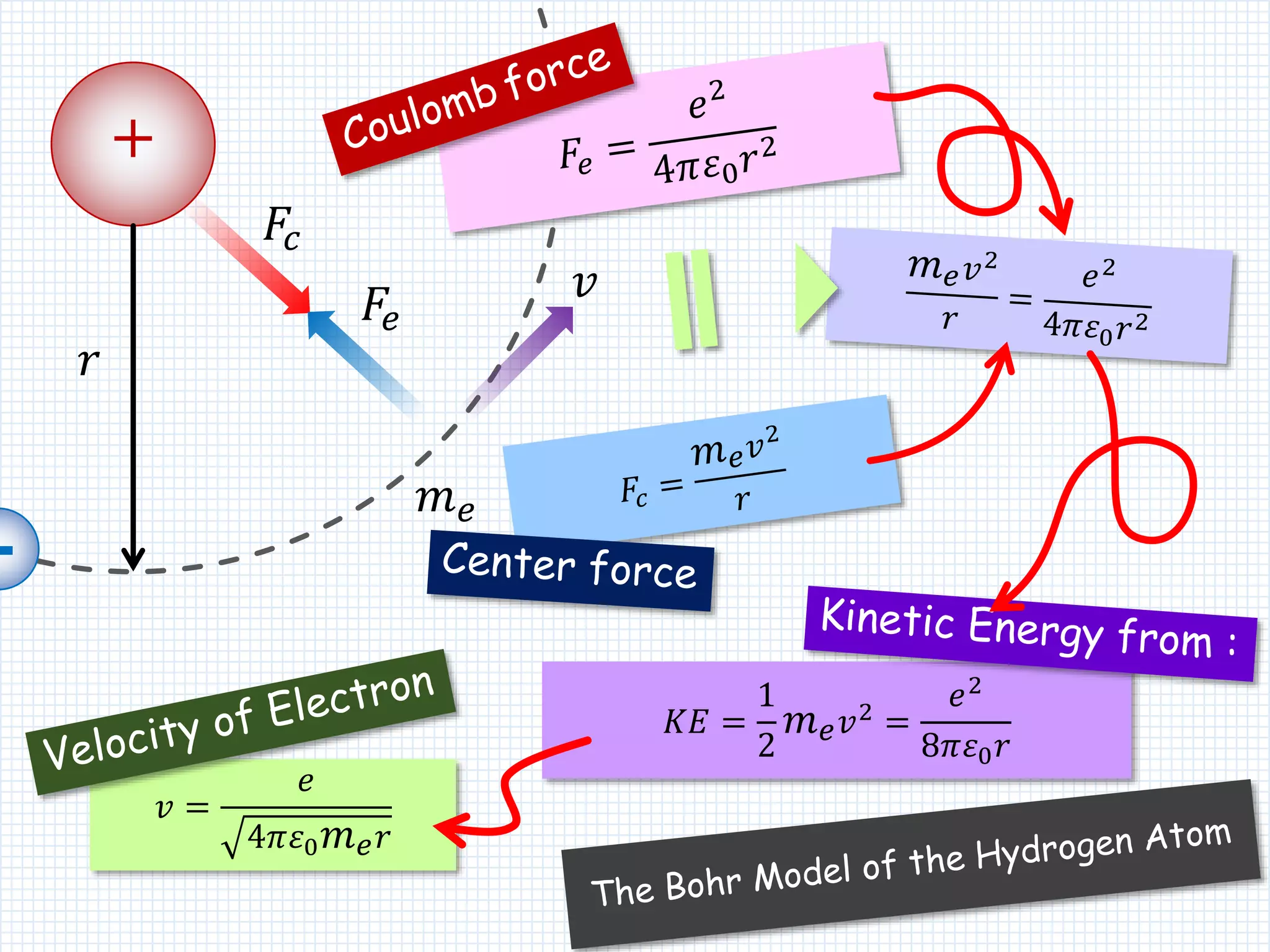
𝑣
𝑚 𝑒
𝐹𝑐
𝐹𝑒
𝑟
𝐾𝐸 =
1
2
𝑚 𝑒 𝑣2
=
𝑒2
8𝜋𝜀0 𝑟
𝑣 =
𝑒
4𝜋𝜀0 𝑚 𝑒 𝑟
-
-
-
-
+
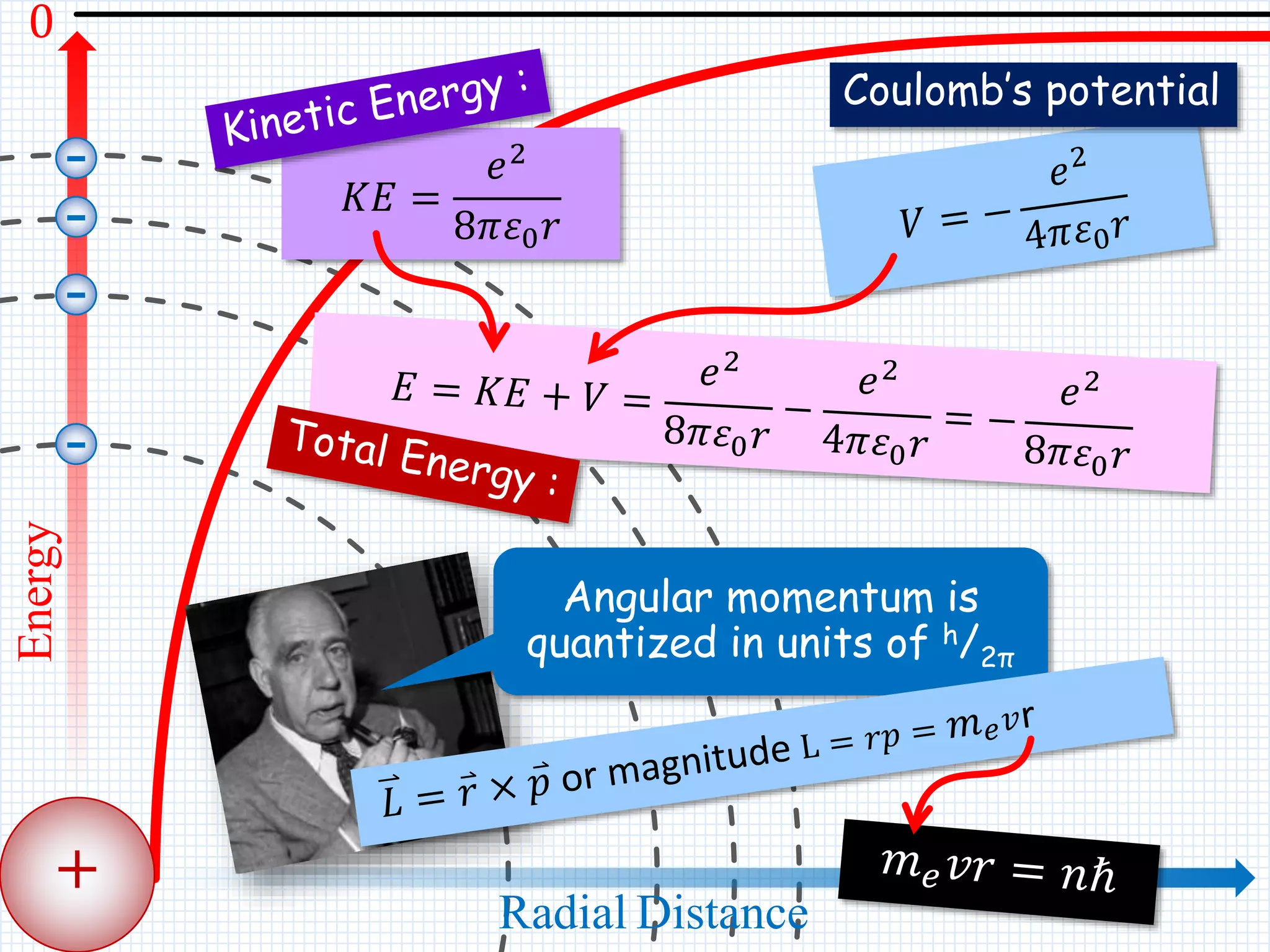
Coulomb’s potential
Energy
Radial Distance
𝐾𝐸 =
𝑒2
8𝜋𝜀0 𝑟
0
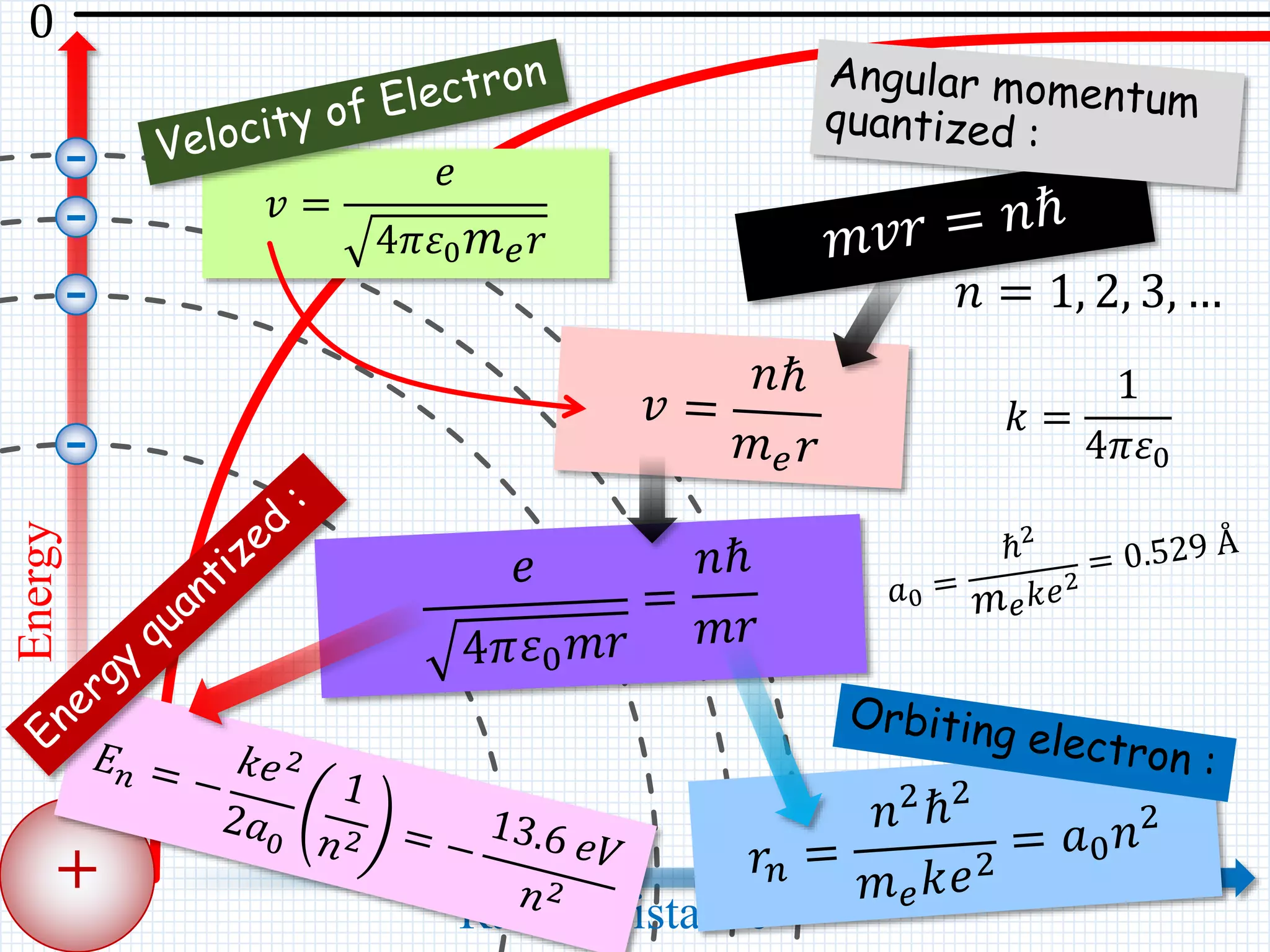
Angular momentum is
quantized in units of h/2π
-
-
-
-
+
Energy
Radial Distance
0
𝑣 =
𝑒
4𝜋𝜀0 𝑚 𝑒 𝑟
𝑛 = 1, 2, 3, …
𝑘 =
1
4𝜋𝜀0
+
Energy
Radial Distance
0
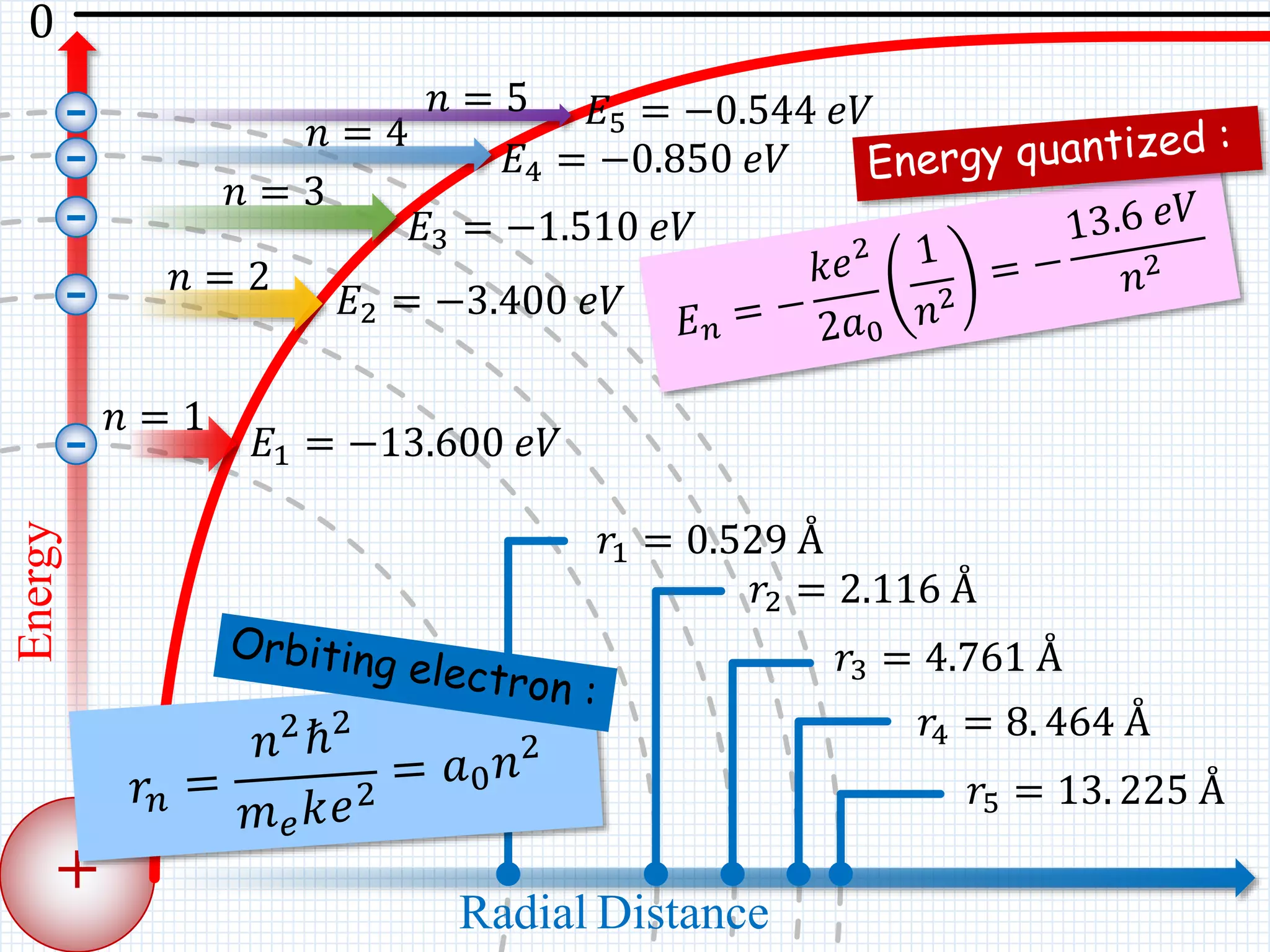
𝑟1 = 0.529 Å
𝑟2 = 2.116 Å
𝑟3 = 4.761 Å
𝑟4 = 8. 464 Å
𝑟5 = 13. 225 Å
𝑛 = 1
𝑛 = 2
𝑛 = 3
𝑛 = 4
𝐸4 = −0.850 𝑒𝑉
𝐸3 = −1.510 𝑒𝑉
𝐸2 = −3.400 𝑒𝑉
𝐸1 = −13.600 𝑒𝑉
𝑛 = 5 𝐸5 = −0.544 𝑒𝑉
-
-
-
-
-
+
Energy
Radial Distance
0
𝑛 = 1
𝑛 = 2
𝑛 = 3
𝑛 = 4
𝑛 = 5
-
-
-
-
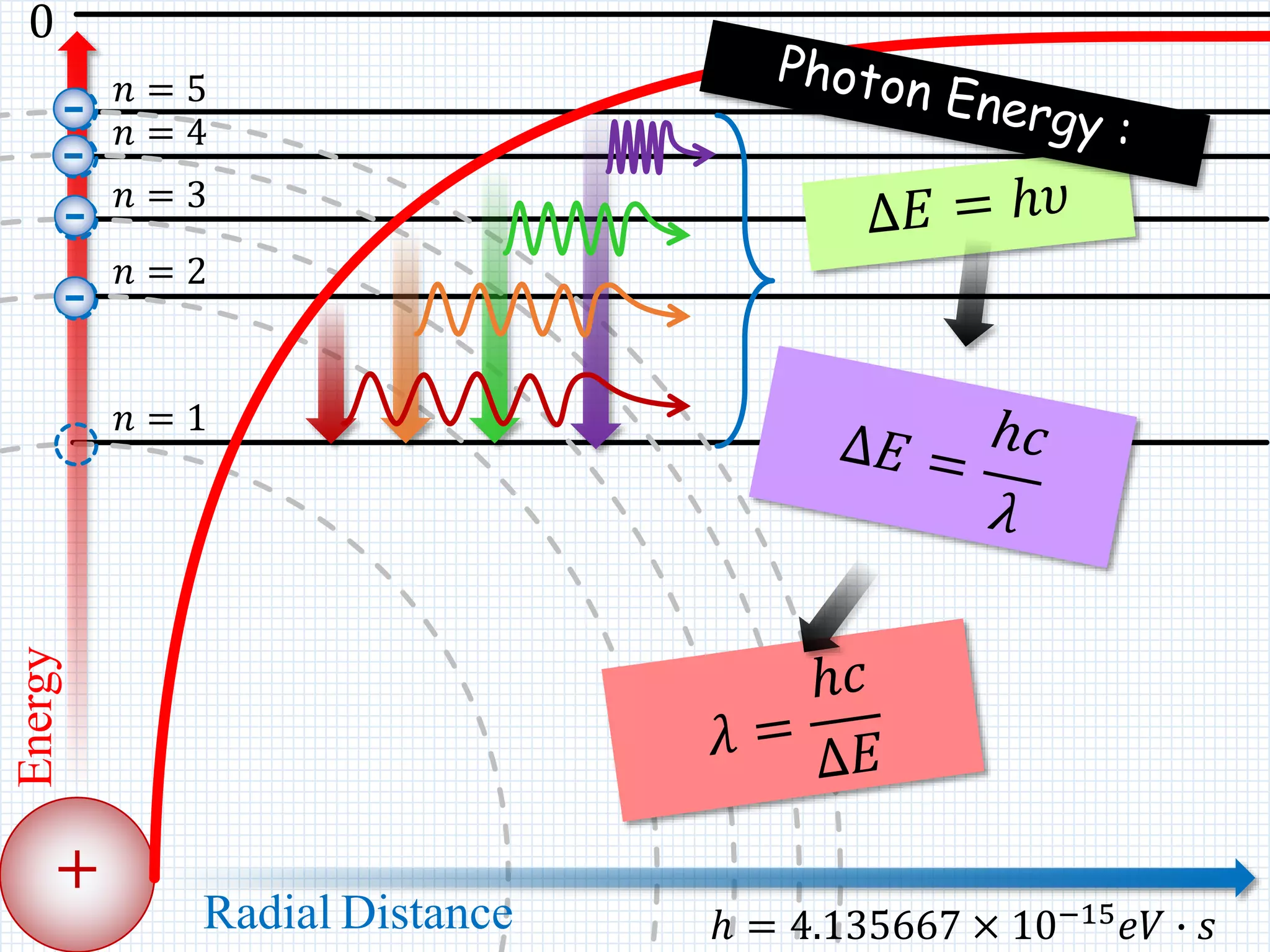
ℎ = 4.135667 × 10⁻¹⁵ 𝑒𝑉 ∙ 𝑠
+
Energy
Radial Distance
0
𝑛 = 1
𝑛 = 2
𝑛 = 3
𝑛 = 4
𝑛 = 5
-
-
-
-
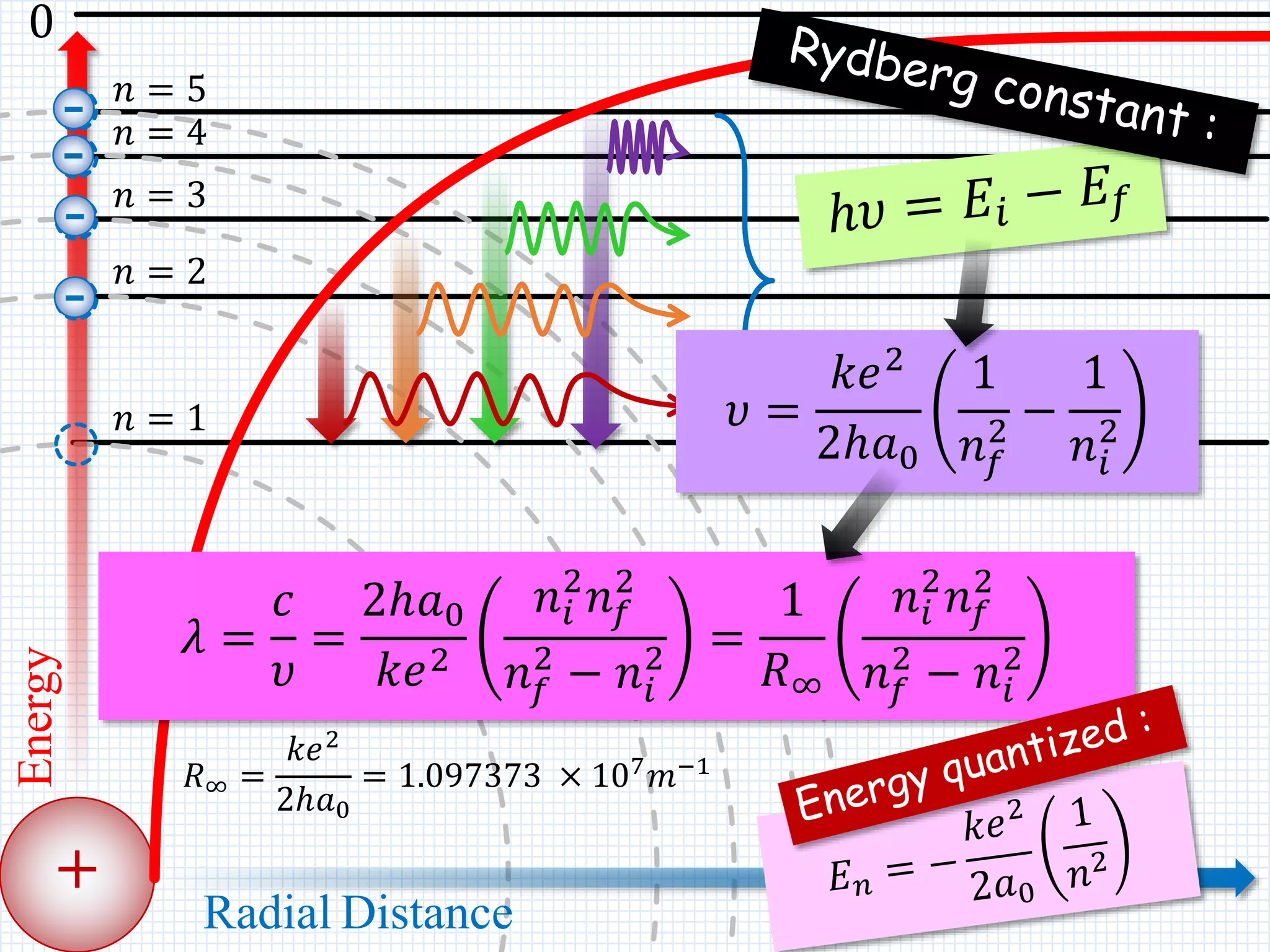
𝜐 =
𝑘𝑒2
2ℎ𝑎0
1
𝑛 𝑓
2 −
1
𝑛𝑖
2
𝜆 =
𝑐
𝜐
=
2ℎ𝑎0
𝑘𝑒2
𝑛𝑖
2
𝑛 𝑓
2
𝑛 𝑓
2
− 𝑛𝑖
2 =
1
𝑅∞
𝑛𝑖
2
𝑛 𝑓
2
𝑛 𝑓
2
− 𝑛𝑖
2
𝑅∞ =
𝑘𝑒2
2ℎ𝑎0
= 1.097373 × 10⁷
𝑚−1
+
Radial Distance
0
𝑛 = 1
𝑛 = 2
𝑛 = 3
𝑛 = 4
𝐸3 = −1.510 𝑒𝑉
𝐸2 = −3.400 𝑒𝑉
𝐸1 = −13.600 𝑒𝑉
𝑛 = 5 𝐸5 = −0.544 𝑒𝑉
-
𝐸4 = −0.850 𝑒𝑉
-
-
-
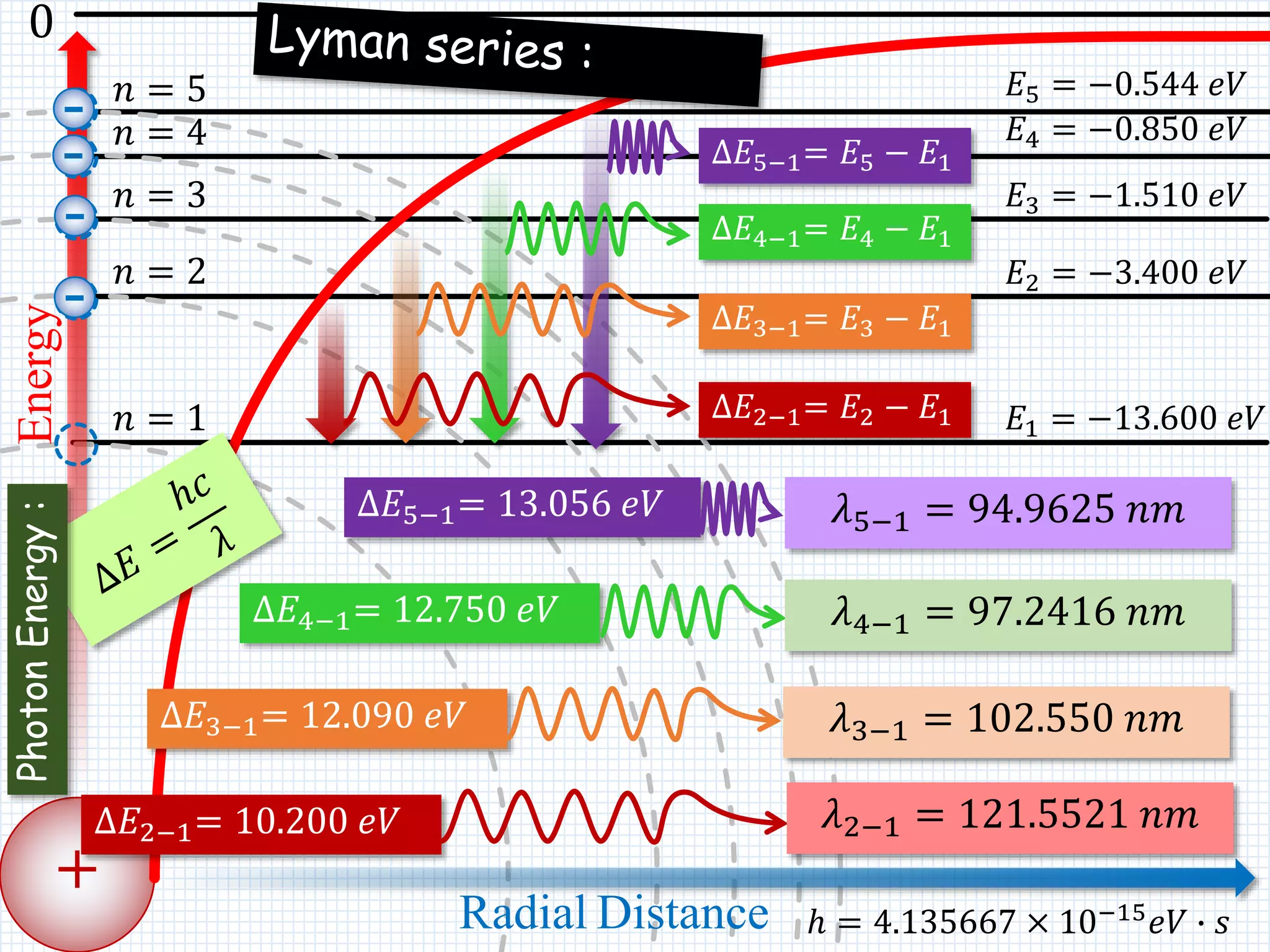
∆𝐸5−1= 13.056 𝑒𝑉
∆𝐸4−1= 12.750 𝑒𝑉
∆𝐸3−1= 12.090 𝑒𝑉
∆𝐸2−1= 10.200 𝑒𝑉
∆𝐸5−1= 𝐸5 − 𝐸1
∆𝐸4−1= 𝐸4 − 𝐸1
∆𝐸3−1= 𝐸3 − 𝐸1
∆𝐸2−1= 𝐸2 − 𝐸1
𝜆5−1 = 94.9625 𝑛𝑚
𝜆4−1 = 97.2416 𝑛𝑚
𝜆3−1 = 102.550 𝑛𝑚
𝜆2−1 = 121.5521 𝑛𝑚
PhotonEnergy:
ℎ = 4.135667 × 10⁻¹⁵
𝑒𝑉 ∙ 𝑠
Energy
+
Energy
Radial Distance
0
𝑛 =2
𝑛 = 3
𝑛 = 4
𝑛 = 5
𝐸3 = −1.510 𝑒𝑉
𝐸2 = −3.400 𝑒𝑉
𝑛 = 6
𝐸5 = −0.544 𝑒𝑉
-
𝐸4 = −0.850 𝑒𝑉
-
-
-
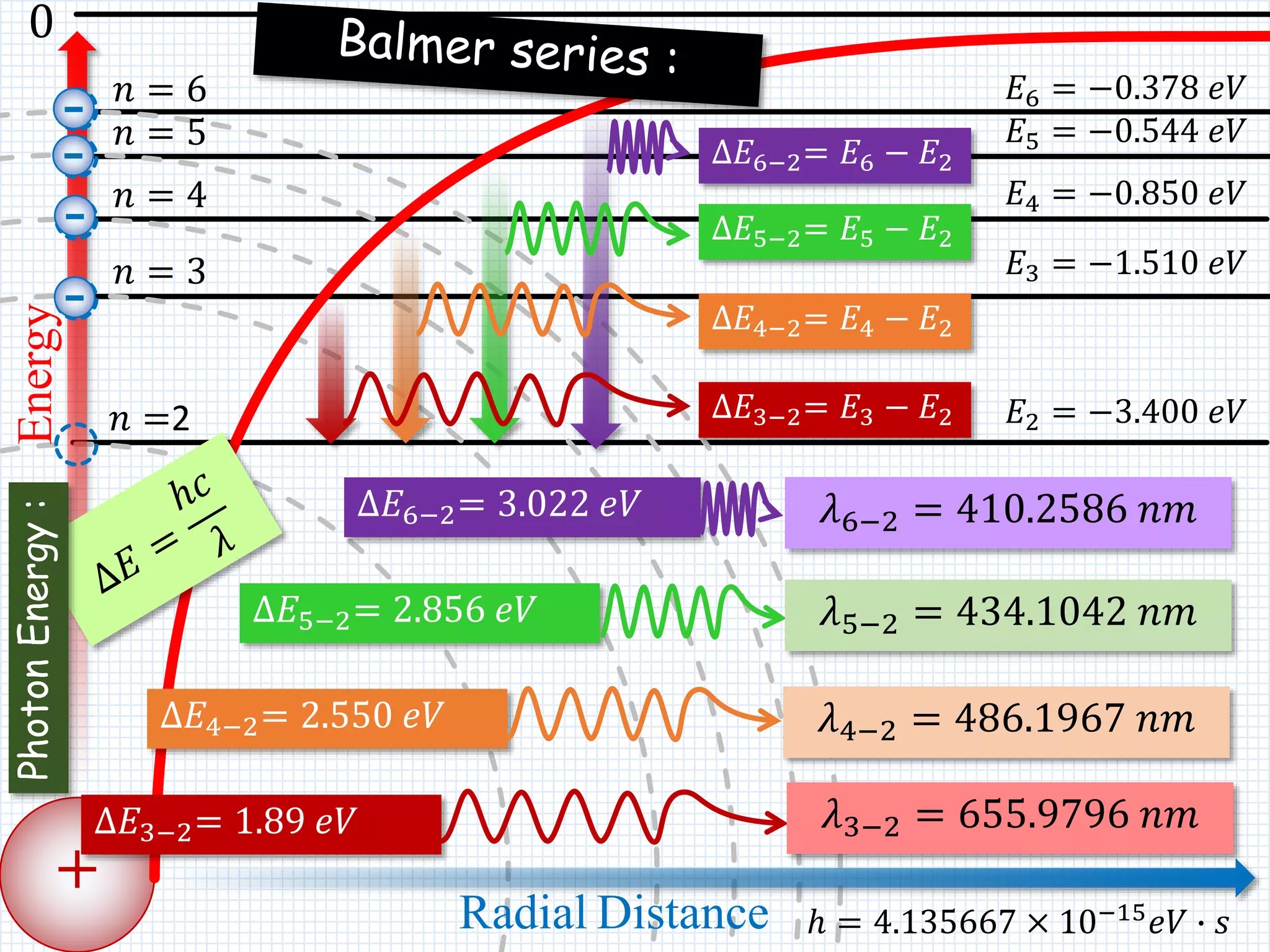
∆𝐸6−2= 3.022 𝑒𝑉
∆𝐸5−2= 2.856 𝑒𝑉
∆𝐸4−2= 2.550 𝑒𝑉
∆𝐸3−2= 1.89 𝑒𝑉
∆𝐸6−2= 𝐸6 − 𝐸2
∆𝐸5−2= 𝐸5 − 𝐸2
∆𝐸4−2= 𝐸4 − 𝐸2
∆𝐸3−2= 𝐸3 − 𝐸2
𝜆6−2 = 410.2586 𝑛𝑚
𝜆5−2 = 434.1042 𝑛𝑚
𝜆4−2 = 486.1967 𝑛𝑚
𝜆3−2 = 655.9796 𝑛𝑚
ℎ = 4.135667 × 10⁻¹⁵
𝑒𝑉 ∙ 𝑠
𝐸6 = −0.378 𝑒𝑉
PhotonEnergy:
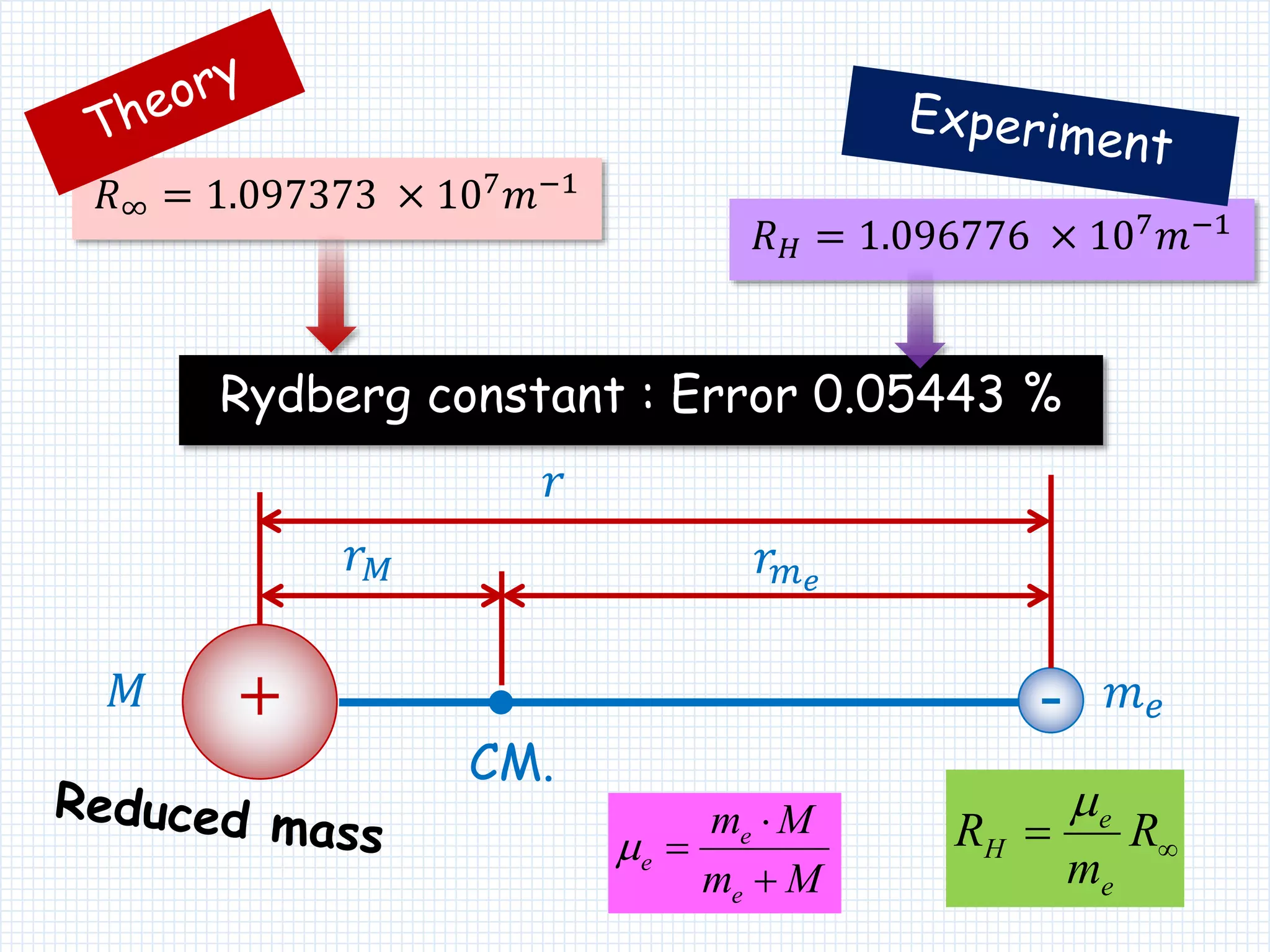
Rydberg constant : Error 0.05443 %
𝑅∞ = 1.097373 × 10⁷ 𝑚−1
𝑅 𝐻 = 1.096776 × 10⁷ 𝑚−1
+ -
Mm
Mm
e
e
e
+

  R
m
R
e
e
H

CM.
𝑟 𝑀 𝑟 𝑚 𝑒
𝑟
𝑀 𝑚 𝑒
-
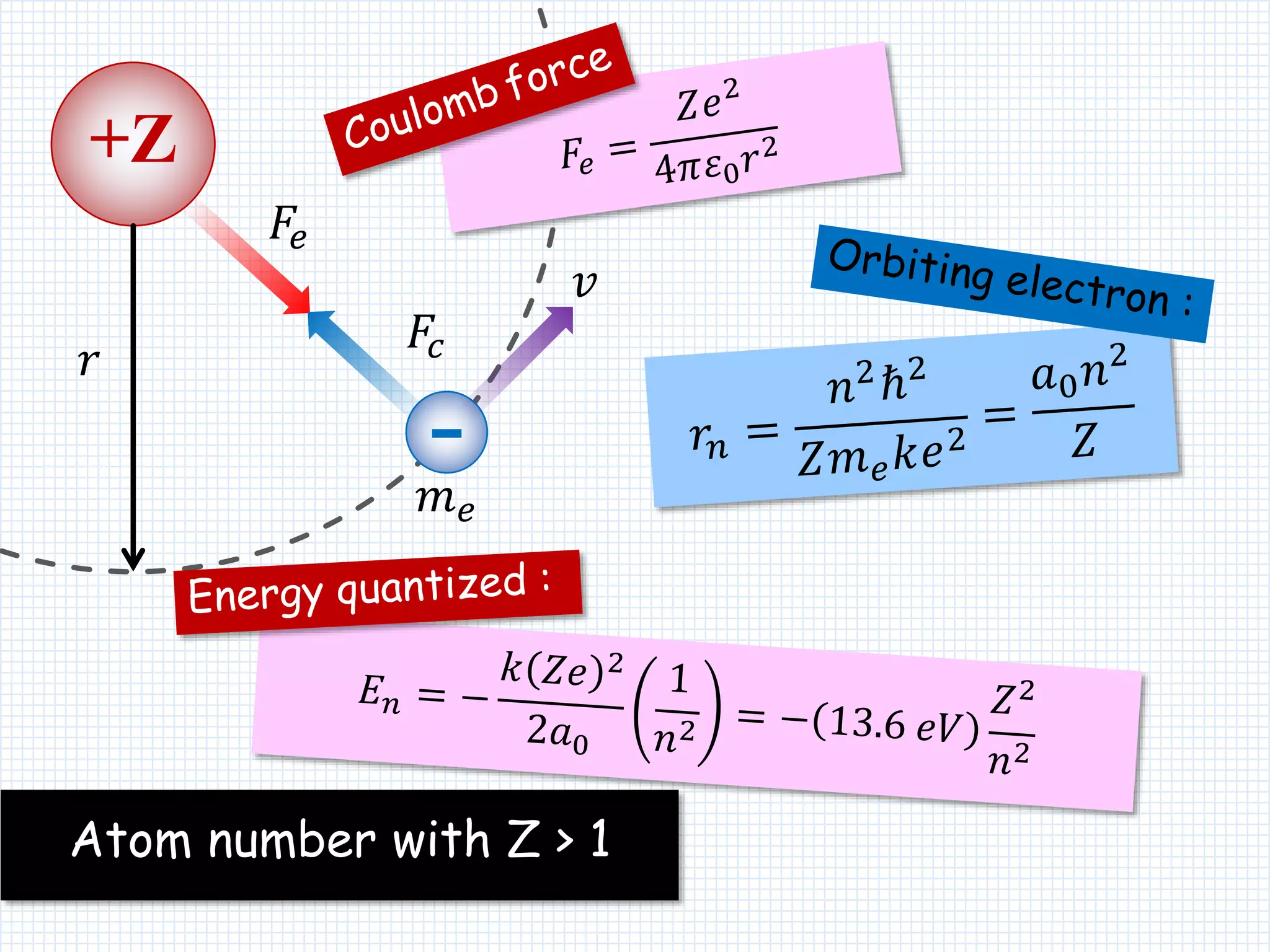
+Z
𝑣
𝑚 𝑒
𝐹𝑐
𝐹𝑒
𝑟
Atom number with Z > 1
+
Energy
Radial Distance
-
-
-
-
-
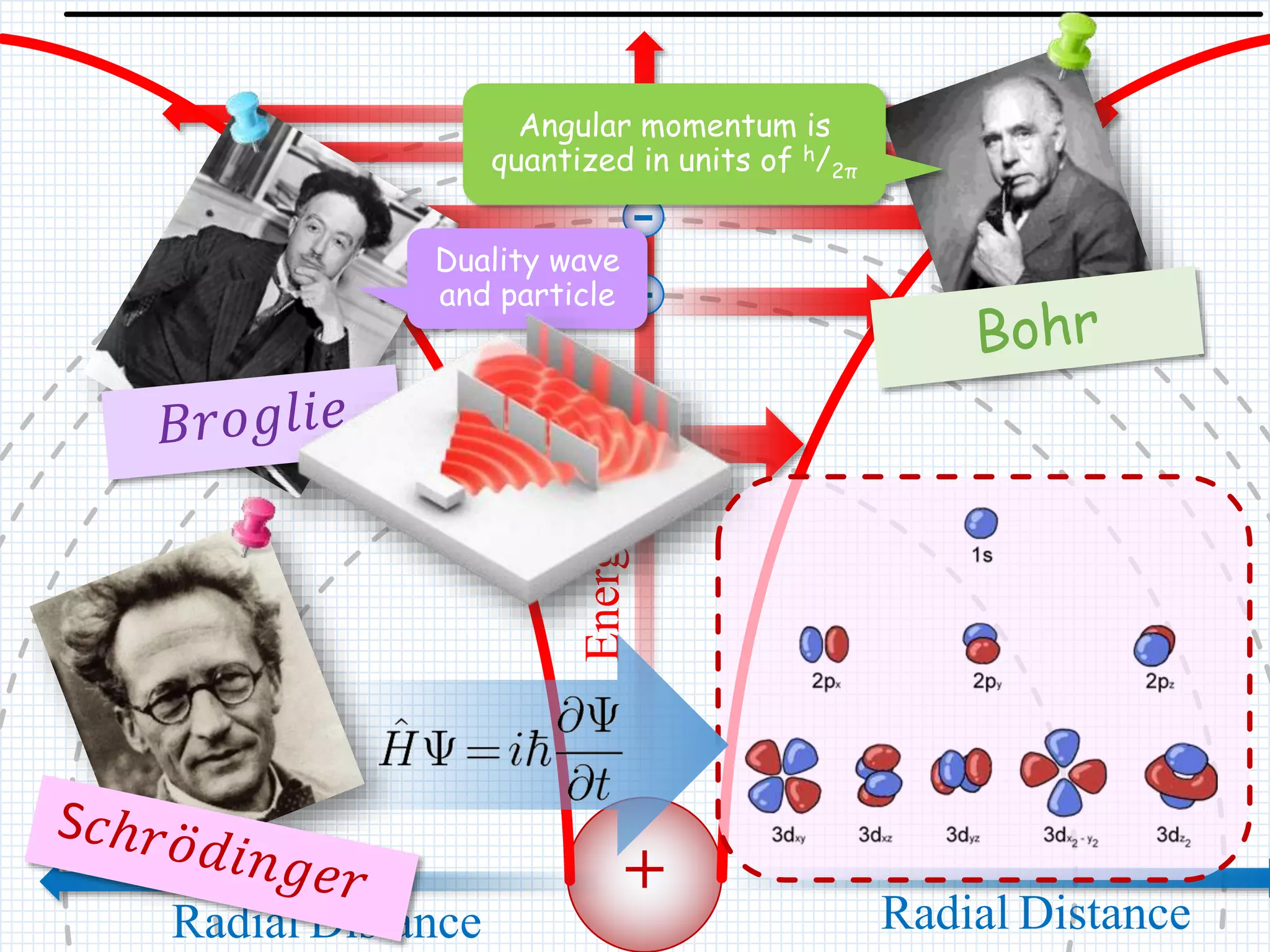
Radial Distance
Angular momentum is
quantized in units of h/2π
Duality wave
and particle
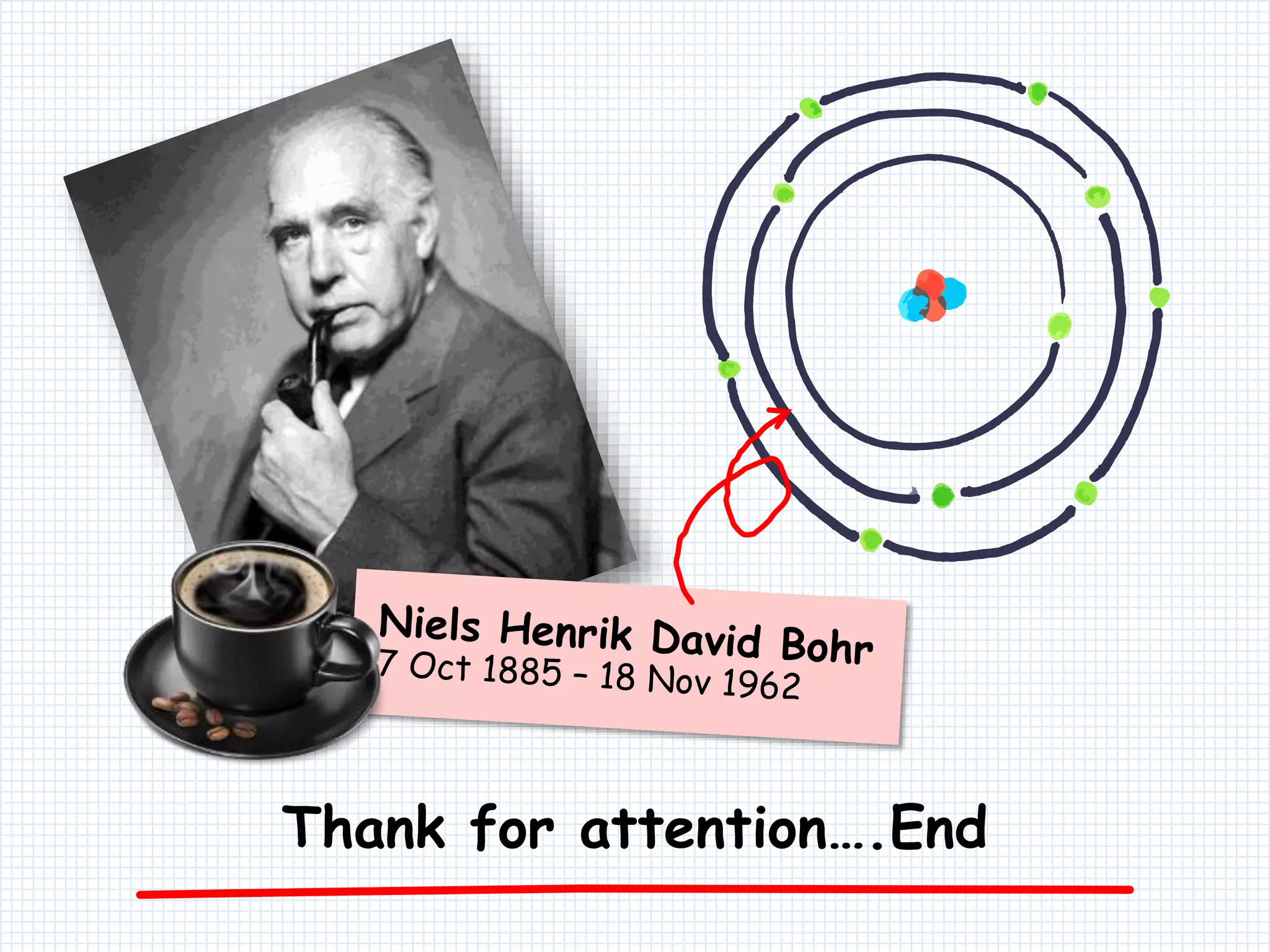
Thank for attention….End

Timeline of atomic models

  • 1.
    Bohr, 1913 Student-ID :5810192, Name : Mr. Napatsakon Sarapat
  • 2.
  • 3.
  • 4.
    - + - + +- -+ + - 1897-J.J.Thomson Helium gas [-]Negative Charge [+] Positive Charge Unlike-sign charges attract. e/me = - 1.758821011 C/kg J.J. Thomson's experiment and the charge-to-mass ratio of the electron
  • 5.
  • 6.
    Robert A. Millikan - - - Fg= mg Fe = qE 1910-Millikan oil drop e/me = - 1.758821011 C/kg J.J. Thomson's experiment and the charge-to-mass ratio of the electron Newton's first law : SF = 0 [Forces are Balanced]
  • 7.
  • 8.
  • 9.
    Mass spectrometry (MS)is an analytical technique that ionizes chemical species and sorts the ions based on their mass-to-charge ratio. In simpler terms, a mass spectrum measures the masses within a sample.
  • 10.
    The Classical/Solar system AtomicModel is doomed • Let’s consider atoms as a quasi sun/planet model (only one planet so that it is just a two body problem. • The force balance of circular orbits for an electron “going around” a stationary nucleolus where v is the tangential velocity of the electron. Circular motion is accelerated, accelerated charges need to radiate energy off according to Maxwell, loosing kinetic energy
  • 11.
    Figure : Aprism spectroscope can be used to observe emission spectra (a). The emission spectra of mercury (b) and barium (c) show characteristic lines.
  • 12.
    Figure : Thisapparatus is used to produce the absorption spectrum of sodium (a). The emission spectrum of sodium consists of several distinct lines (b), whereas the absorption spectrum of sodium is nearly continuous (c).
  • 13.
    Balmer Series • In1885, Johann Balmer found an empirical formula for wavelengths of the emission spectrum for hydrogen in nm within the visible range (where k = 3,4,5…) • A good physical theory needs to make sense of this empirical result There is a minimum wavelength corresponding to a maximum frequency and energy of photons 657nm Red 486 Blue 434 Violet 410 397 365nm Series limit
  • 14.
    Rydberg Equation • Asmore scientists discovered emission lines at infrared and ultraviolet wavelengths, the Balmer series equation was extended to the Rydberg equation, actually on the basis of this equation, people went out looking for more lines : (where RH = 1.096776 x 10⁷ m-1) Hydrogen Series of Spectral Lines Discoverer (year) Wavelength n k Lyman (1916) Ultraviolet 1 >1 Balmer (1885) Visible, Ultraviolet 2 >2 Paschen (1908) Infrared 3 >3 Brackett (1922) Infrared 4 >4 Pfund (1924) Infrared 5 >5 Can be applied to isotopes of hydrogen by modifying R slightly  R m R e H  17 2 1009737.1 2    m h cm R ea Mm Mm e e +   Aside:
  • 15.
    - + 𝑣 𝑚 𝑒 𝐹𝑐 𝐹𝑒 𝑟 𝐾𝐸 = 1 2 𝑚𝑒 𝑣2 = 𝑒2 8𝜋𝜀0 𝑟 𝑣 = 𝑒 4𝜋𝜀0 𝑚 𝑒 𝑟
  • 16.
    - - - - + Coulomb’s potential Energy Radial Distance 𝐾𝐸= 𝑒2 8𝜋𝜀0 𝑟 0 Angular momentum is quantized in units of h/2π
  • 17.
    - - - - + Energy Radial Distance 0 𝑣 = 𝑒 4𝜋𝜀0𝑚 𝑒 𝑟 𝑛 = 1, 2, 3, … 𝑘 = 1 4𝜋𝜀0
  • 18.
    + Energy Radial Distance 0 𝑟1 =0.529 Å 𝑟2 = 2.116 Å 𝑟3 = 4.761 Å 𝑟4 = 8. 464 Å 𝑟5 = 13. 225 Å 𝑛 = 1 𝑛 = 2 𝑛 = 3 𝑛 = 4 𝐸4 = −0.850 𝑒𝑉 𝐸3 = −1.510 𝑒𝑉 𝐸2 = −3.400 𝑒𝑉 𝐸1 = −13.600 𝑒𝑉 𝑛 = 5 𝐸5 = −0.544 𝑒𝑉 - - - - -
  • 19.
    + Energy Radial Distance 0 𝑛 =1 𝑛 = 2 𝑛 = 3 𝑛 = 4 𝑛 = 5 - - - - ℎ = 4.135667 × 10⁻¹⁵ 𝑒𝑉 ∙ 𝑠
  • 20.
    + Energy Radial Distance 0 𝑛 =1 𝑛 = 2 𝑛 = 3 𝑛 = 4 𝑛 = 5 - - - - 𝜐 = 𝑘𝑒2 2ℎ𝑎0 1 𝑛 𝑓 2 − 1 𝑛𝑖 2 𝜆 = 𝑐 𝜐 = 2ℎ𝑎0 𝑘𝑒2 𝑛𝑖 2 𝑛 𝑓 2 𝑛 𝑓 2 − 𝑛𝑖 2 = 1 𝑅∞ 𝑛𝑖 2 𝑛 𝑓 2 𝑛 𝑓 2 − 𝑛𝑖 2 𝑅∞ = 𝑘𝑒2 2ℎ𝑎0 = 1.097373 × 10⁷ 𝑚−1
  • 21.
    + Radial Distance 0 𝑛 =1 𝑛 = 2 𝑛 = 3 𝑛 = 4 𝐸3 = −1.510 𝑒𝑉 𝐸2 = −3.400 𝑒𝑉 𝐸1 = −13.600 𝑒𝑉 𝑛 = 5 𝐸5 = −0.544 𝑒𝑉 - 𝐸4 = −0.850 𝑒𝑉 - - - ∆𝐸5−1= 13.056 𝑒𝑉 ∆𝐸4−1= 12.750 𝑒𝑉 ∆𝐸3−1= 12.090 𝑒𝑉 ∆𝐸2−1= 10.200 𝑒𝑉 ∆𝐸5−1= 𝐸5 − 𝐸1 ∆𝐸4−1= 𝐸4 − 𝐸1 ∆𝐸3−1= 𝐸3 − 𝐸1 ∆𝐸2−1= 𝐸2 − 𝐸1 𝜆5−1 = 94.9625 𝑛𝑚 𝜆4−1 = 97.2416 𝑛𝑚 𝜆3−1 = 102.550 𝑛𝑚 𝜆2−1 = 121.5521 𝑛𝑚 PhotonEnergy: ℎ = 4.135667 × 10⁻¹⁵ 𝑒𝑉 ∙ 𝑠 Energy
  • 22.
    + Energy Radial Distance 0 𝑛 =2 𝑛= 3 𝑛 = 4 𝑛 = 5 𝐸3 = −1.510 𝑒𝑉 𝐸2 = −3.400 𝑒𝑉 𝑛 = 6 𝐸5 = −0.544 𝑒𝑉 - 𝐸4 = −0.850 𝑒𝑉 - - - ∆𝐸6−2= 3.022 𝑒𝑉 ∆𝐸5−2= 2.856 𝑒𝑉 ∆𝐸4−2= 2.550 𝑒𝑉 ∆𝐸3−2= 1.89 𝑒𝑉 ∆𝐸6−2= 𝐸6 − 𝐸2 ∆𝐸5−2= 𝐸5 − 𝐸2 ∆𝐸4−2= 𝐸4 − 𝐸2 ∆𝐸3−2= 𝐸3 − 𝐸2 𝜆6−2 = 410.2586 𝑛𝑚 𝜆5−2 = 434.1042 𝑛𝑚 𝜆4−2 = 486.1967 𝑛𝑚 𝜆3−2 = 655.9796 𝑛𝑚 ℎ = 4.135667 × 10⁻¹⁵ 𝑒𝑉 ∙ 𝑠 𝐸6 = −0.378 𝑒𝑉 PhotonEnergy:
  • 24.
    Rydberg constant :Error 0.05443 % 𝑅∞ = 1.097373 × 10⁷ 𝑚−1 𝑅 𝐻 = 1.096776 × 10⁷ 𝑚−1 + - Mm Mm e e e +    R m R e e H  CM. 𝑟 𝑀 𝑟 𝑚 𝑒 𝑟 𝑀 𝑚 𝑒
  • 25.
  • 26.
    + Energy Radial Distance - - - - - Radial Distance Angularmomentum is quantized in units of h/2π Duality wave and particle
  • 27.

Editor's Notes

  • #4 ratio
  • #6 All Most Alpha particle of walking in a straight line, But there are some diffraction from the original.