Modern Portfolio Theory

  Trading Software and Programming
Acedo  Fabia  Reyes  Sorbito  Vidamo
Modern Portfolio Theory
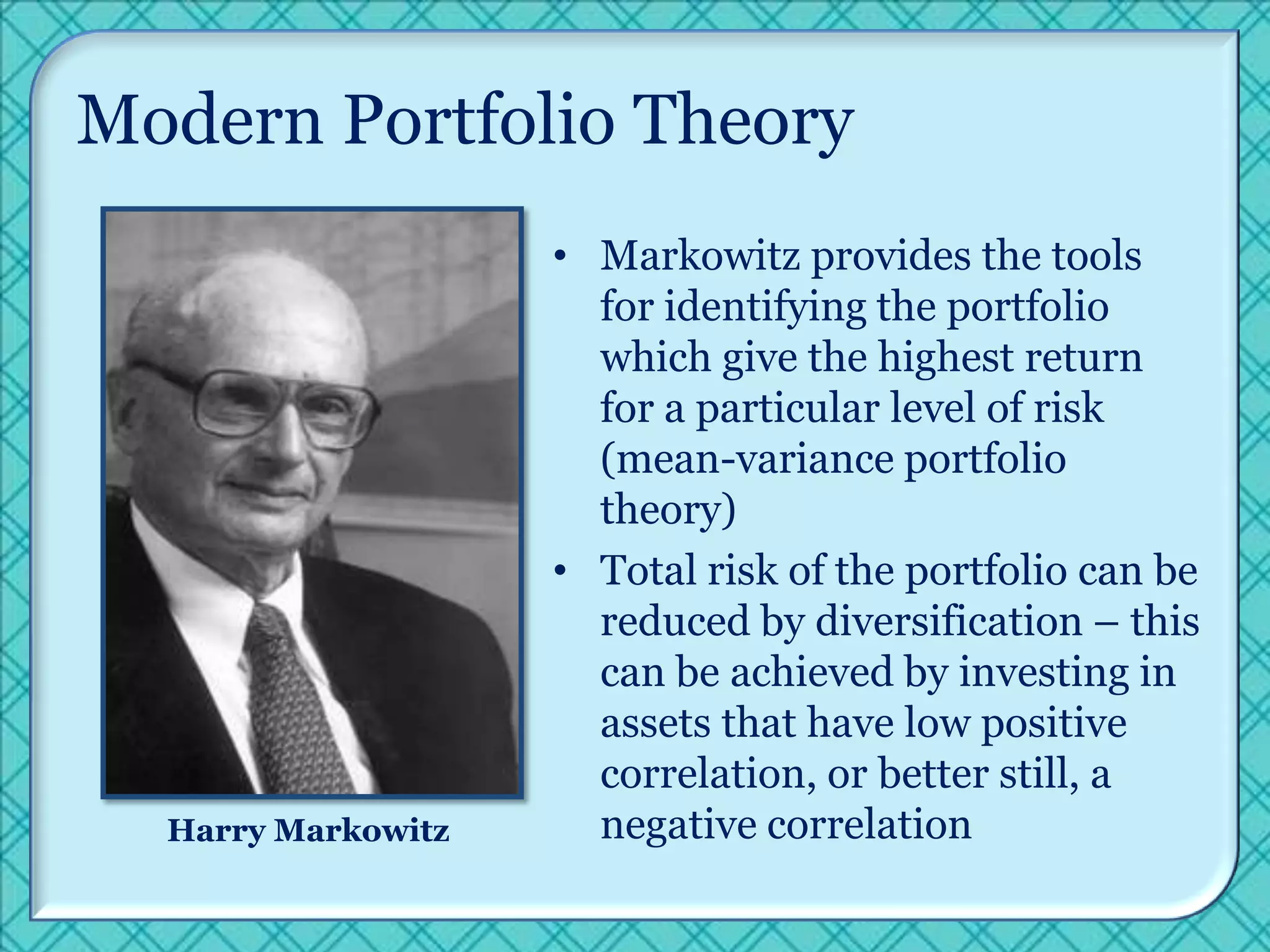
                    • Markowitz provides the tools
                      for identifying the portfolio
                      which give the highest return
                      for a particular level of risk
                      (mean-variance portfolio
                      theory)
                    • Total risk of the portfolio can be
                      reduced by diversification – this
                      can be achieved by investing in
                      assets that have low positive
                      correlation, or better still, a
  Harry Markowitz     negative correlation
Markowitz model assumptions
     • Investors consider each investment alternative as
       being presented by a probability distribution of
 1     expected returns over some holding period.

     • Investors maximize one-period expected
       utility, and their utility curves demonstrate
 2     diminishing marginal utility of wealth.


     • Investors estimate the risk of the portfolio on the
       basis of the variability of expected returns.
 3
Markowitz model assumptions
        • Investors base decisions solely on expected return and
          risk, so their utility curves are a function of expected
          return and the expected variance (or standard deviation)
 4        of returns only.


        • For a given level of risk, investors prefer higher returns
          to lower returns. Similarly, for a given level of expected
 5        returns, investors prefer less risk to more risk.


     Under these assumptions, a single asset or portfolio of assets is
       considered to be efficient if no other asset or portfolio of
      assets offers higher expected return with the same (or lower)
      risk, or lower risk with the same (or higher) expected return.
Mean variance optimization
Find the portfolio that that minimizes variance
for a given level of return, or maximizes return
for a given level of risk

Basic philosophy: don’t put all your eggs in one
basket! 

Key assumption: returns are normally
distributed
Mean variance optimization

                               Expected
            Standard            return of
           deviation of        each asset
            returns of
            each asset

                          Correlation
                           of returns
                            between
                             assets


         The Efficient Frontier
General Formulas
         Given: Wi is the percent of the portfolio in asset i
                 Ri is the possible rate of return for asset i
                 E(Ri) is the expected rate of return for asset i
                 Pi is the probability of the possible rate of return Ri
                                                         n
                   Expected Return      E RPort               Wi E Ri
                                                        i 1

                                                n
Measure of Risk


                                           2                            2
                      Variance                        Pi Ri    E Ri
                                                i 1

                                                n
                                                                            2
                  Standard Deviation                  P Ri
                                                       i        E Ri
                                               i 1
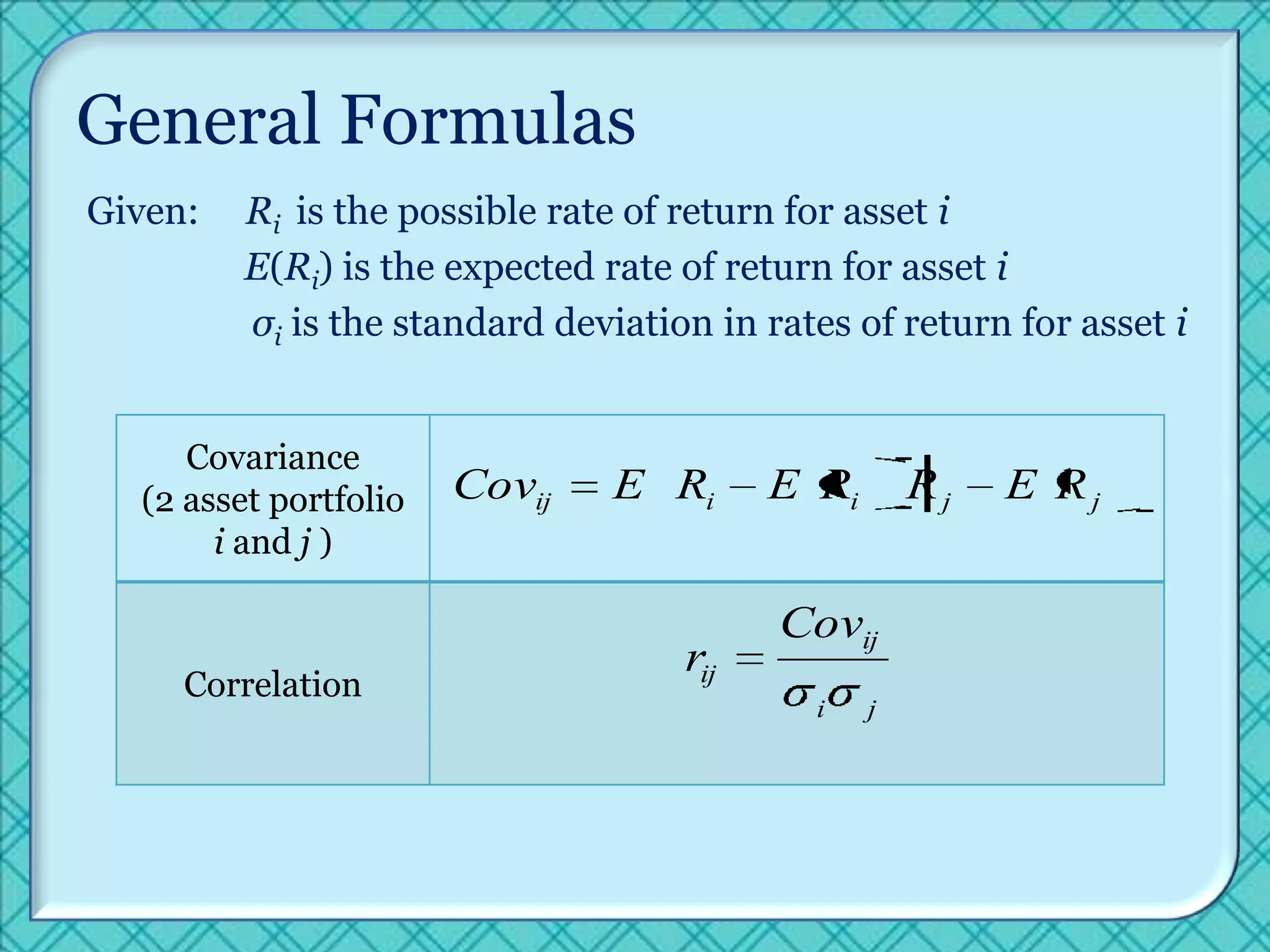
General Formulas
Given:   Ri is the possible rate of return for asset i
         E(Ri) is the expected rate of return for asset i
         σi is the standard deviation in rates of return for asset i


     Covariance
  (2 asset portfolio   Covij    E Ri      E Ri       Rj   E Rj
       i and j )

                                          Covij
                                    rij
     Correlation
                                            i    j
General Formulas
Given:   wi is the weights of the individual assets in the portfolio
         σ2i is the variance of the rate of return for asset i
         Covij is covariance bet the rates of return for
                 assets i and j, where Covij = rij σi σj

                              n                         n       n
                      2                   2    2
Portfolio Variance    port          w     i   i                     wi w j Covij
                              i 1                       i 1 j 1


                                    n                       n       n
     Portfolio
Standard Deviation     port               wi2      i
                                                    2
                                                                        wi w j Covij
                                    i 1                     i 1 j 1
Optimization problem

             cov11   cov12       cov1n
             cov21   cov22     cov2 n
         V
                               
             covn1   covn 2    covnn
Efficient frontier
Criticisms
Estimates relies on historical return data
and probability, assumption of normality


    Assumes all investors are rational, risk
    averse, maximize utility


         Assumes markets are efficient: assets are
         fairly valued or correctly priced


             No consideration for transaction cost or
             taxes
References
• Bodie, Kane and Marcus. Essentials of
  Investments, Eight Edition
• Brown,K. and Reilly, F. Investment Analysis and
  Portfolio Management
• Elton, E. and Gruber, M. Modern Portfolio
  Theory, 1950 to Date. Working Paper Series 1997.
• Wilmott, P. Paul FAQs Quantitative Finance
• www.investingdaily.com
• Berkelaar, Arjan. Portfolio Optimization powerpoint
  presentation

Modern portfolio theory

  • 1.
    Modern Portfolio Theory Trading Software and Programming Acedo  Fabia  Reyes  Sorbito  Vidamo
  • 2.
    Modern Portfolio Theory • Markowitz provides the tools for identifying the portfolio which give the highest return for a particular level of risk (mean-variance portfolio theory) • Total risk of the portfolio can be reduced by diversification – this can be achieved by investing in assets that have low positive correlation, or better still, a Harry Markowitz negative correlation
  • 3.
    Markowitz model assumptions • Investors consider each investment alternative as being presented by a probability distribution of 1 expected returns over some holding period. • Investors maximize one-period expected utility, and their utility curves demonstrate 2 diminishing marginal utility of wealth. • Investors estimate the risk of the portfolio on the basis of the variability of expected returns. 3
  • 4.
    Markowitz model assumptions • Investors base decisions solely on expected return and risk, so their utility curves are a function of expected return and the expected variance (or standard deviation) 4 of returns only. • For a given level of risk, investors prefer higher returns to lower returns. Similarly, for a given level of expected 5 returns, investors prefer less risk to more risk. Under these assumptions, a single asset or portfolio of assets is considered to be efficient if no other asset or portfolio of assets offers higher expected return with the same (or lower) risk, or lower risk with the same (or higher) expected return.
  • 5.
    Mean variance optimization Findthe portfolio that that minimizes variance for a given level of return, or maximizes return for a given level of risk Basic philosophy: don’t put all your eggs in one basket!  Key assumption: returns are normally distributed
  • 6.
    Mean variance optimization Expected Standard return of deviation of each asset returns of each asset Correlation of returns between assets The Efficient Frontier
  • 7.
    General Formulas Given: Wi is the percent of the portfolio in asset i Ri is the possible rate of return for asset i E(Ri) is the expected rate of return for asset i Pi is the probability of the possible rate of return Ri n Expected Return E RPort Wi E Ri i 1 n Measure of Risk 2 2 Variance Pi Ri E Ri i 1 n 2 Standard Deviation P Ri i E Ri i 1
  • 8.
    General Formulas Given: Ri is the possible rate of return for asset i E(Ri) is the expected rate of return for asset i σi is the standard deviation in rates of return for asset i Covariance (2 asset portfolio Covij E Ri E Ri Rj E Rj i and j ) Covij rij Correlation i j
  • 9.
    General Formulas Given: wi is the weights of the individual assets in the portfolio σ2i is the variance of the rate of return for asset i Covij is covariance bet the rates of return for assets i and j, where Covij = rij σi σj n n n 2 2 2 Portfolio Variance port w i i wi w j Covij i 1 i 1 j 1 n n n Portfolio Standard Deviation port wi2 i 2 wi w j Covij i 1 i 1 j 1
  • 10.
    Optimization problem cov11 cov12  cov1n cov21 cov22  cov2 n V     covn1 covn 2  covnn
  • 11.
  • 12.
    Criticisms Estimates relies onhistorical return data and probability, assumption of normality Assumes all investors are rational, risk averse, maximize utility Assumes markets are efficient: assets are fairly valued or correctly priced No consideration for transaction cost or taxes
  • 13.
    References • Bodie, Kaneand Marcus. Essentials of Investments, Eight Edition • Brown,K. and Reilly, F. Investment Analysis and Portfolio Management • Elton, E. and Gruber, M. Modern Portfolio Theory, 1950 to Date. Working Paper Series 1997. • Wilmott, P. Paul FAQs Quantitative Finance • www.investingdaily.com • Berkelaar, Arjan. Portfolio Optimization powerpoint presentation

Editor's Notes

  • #3 Introduced by Harry Markowitz in the 1950s
  • #11 Cov_11, cov_22, …, cov_nn = var_1, var_2, …, var_n
  • #12 Source: www.investingdaily.com