BOND IMMUNIZATION
PRESENTED BY
P.L.SATYAVANI
MBA,M.PHILL
A Bond is a debt instrument issued by
governments, corporations and other
entities in order to finance projects or
activities.
In essence, a bond is a loan
that investors make to the bonds issuer.
Immunization is a set of rules that is being
used for the purpose of minimizing the
impact of a change in interest rate of a
financial wealth.
3
Bond immunization is an investment
strategy used to minimize the interest rate
of bond investments by adjusting the
portfolio duration to match the investors
investment time horizon.
Immunization is a technique that makes
the bond portfolio holder to be relatively
stream of cash flows.
The bond interest rate risk from the
changes in the market interest rate.
The market rate effect the coupon rate and
the price of the bond . Immunization locks
in a fixed rate of return during the amount
of time an investor plans to keep the bond
without cashing it in.
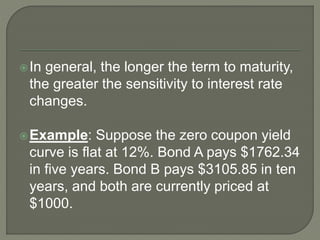
In general, the longer the term to maturity,
the greater the sensitivity to interest rate
changes.
Example: Suppose the zero coupon yield
curve is flat at 12%. Bond A pays $1762.34
in five years. Bond B pays $3105.85 in ten
years, and both are currently priced at
$1000.
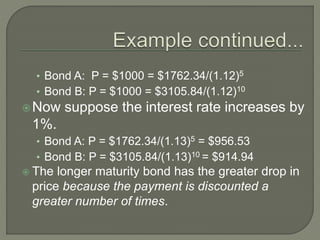
• Bond A: P = $1000 = $1762.34/(1.12)5
• Bond B: P = $1000 = $3105.84/(1.12)10
Now suppose the interest rate increases by
1%.
• Bond A: P = $1762.34/(1.13)5 = $956.53
• Bond B: P = $3105.84/(1.13)10 = $914.94
 The longer maturity bond has the greater drop in
price because the payment is discounted a
greater number of times.
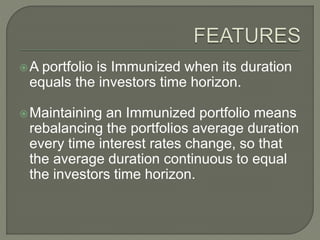
A portfolio is Immunized when its duration
equals the investors time horizon.
Maintaining an Immunized portfolio means
rebalancing the portfolios average duration
every time interest rates change, so that
the average duration continuous to equal
the investors time horizon.
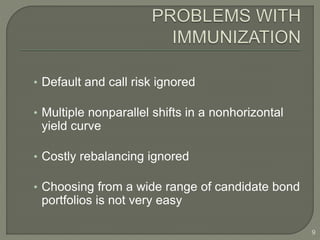
• Default and call risk ignored
• Multiple nonparallel shifts in a nonhorizontal
yield curve
• Costly rebalancing ignored
• Choosing from a wide range of candidate bond
portfolios is not very easy
9
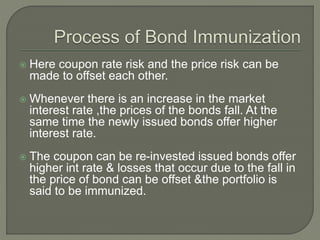
 Here coupon rate risk and the price risk can be
made to offset each other.
 Whenever there is an increase in the market
interest rate ,the prices of the bonds fall. At the
same time the newly issued bonds offer higher
interest rate.
 The coupon can be re-invested issued bonds offer
higher int rate & losses that occur due to the fall in
the price of bond can be offset &the portfolio is
said to be immunized.
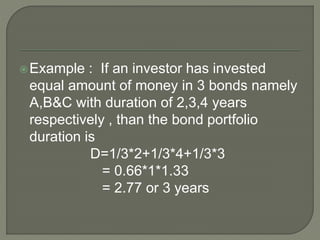
Example : If an investor has invested
equal amount of money in 3 bonds namely
A,B&C with duration of 2,3,4 years
respectively , than the bond portfolio
duration is
D=1/3*2+1/3*4+1/3*3
= 0.66*1*1.33
= 2.77 or 3 years
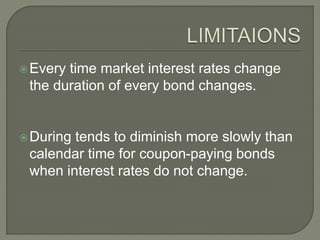
Every time market interest rates change
the duration of every bond changes.
During tends to diminish more slowly than
calendar time for coupon-paying bonds
when interest rates do not change.
Bond immunization

Bond immunization

  • 1.
  • 2.
    A Bond isa debt instrument issued by governments, corporations and other entities in order to finance projects or activities. In essence, a bond is a loan that investors make to the bonds issuer.
  • 3.
    Immunization is aset of rules that is being used for the purpose of minimizing the impact of a change in interest rate of a financial wealth. 3
  • 4.
    Bond immunization isan investment strategy used to minimize the interest rate of bond investments by adjusting the portfolio duration to match the investors investment time horizon.
  • 5.
    Immunization is atechnique that makes the bond portfolio holder to be relatively stream of cash flows. The bond interest rate risk from the changes in the market interest rate. The market rate effect the coupon rate and the price of the bond . Immunization locks in a fixed rate of return during the amount of time an investor plans to keep the bond without cashing it in.
  • 6.
    In general, thelonger the term to maturity, the greater the sensitivity to interest rate changes. Example: Suppose the zero coupon yield curve is flat at 12%. Bond A pays $1762.34 in five years. Bond B pays $3105.85 in ten years, and both are currently priced at $1000.
  • 7.
    • Bond A:P = $1000 = $1762.34/(1.12)5 • Bond B: P = $1000 = $3105.84/(1.12)10 Now suppose the interest rate increases by 1%. • Bond A: P = $1762.34/(1.13)5 = $956.53 • Bond B: P = $3105.84/(1.13)10 = $914.94  The longer maturity bond has the greater drop in price because the payment is discounted a greater number of times.
  • 8.
    A portfolio isImmunized when its duration equals the investors time horizon. Maintaining an Immunized portfolio means rebalancing the portfolios average duration every time interest rates change, so that the average duration continuous to equal the investors time horizon.
  • 9.
    • Default andcall risk ignored • Multiple nonparallel shifts in a nonhorizontal yield curve • Costly rebalancing ignored • Choosing from a wide range of candidate bond portfolios is not very easy 9
  • 10.
     Here couponrate risk and the price risk can be made to offset each other.  Whenever there is an increase in the market interest rate ,the prices of the bonds fall. At the same time the newly issued bonds offer higher interest rate.  The coupon can be re-invested issued bonds offer higher int rate & losses that occur due to the fall in the price of bond can be offset &the portfolio is said to be immunized.
  • 11.
    Example : Ifan investor has invested equal amount of money in 3 bonds namely A,B&C with duration of 2,3,4 years respectively , than the bond portfolio duration is D=1/3*2+1/3*4+1/3*3 = 0.66*1*1.33 = 2.77 or 3 years
  • 12.
    Every time marketinterest rates change the duration of every bond changes. During tends to diminish more slowly than calendar time for coupon-paying bonds when interest rates do not change.