


CHAPTER 7         Optimal Risky
                             Portfolios


                    Investments, 8th edition
                    Bodie, Kane and Marcus

                                                        Slides by Susan Hine

McGraw-Hill/Irwin           Copyright © 2009 by The McGraw-Hill Companies, Inc. All rights reserved.
Diversification and Portfolio Risk

• Market risk
  – Systematic or nondiversifiable
• Firm-specific risk
  – Diversifiable or nonsystematic


                                           7-2
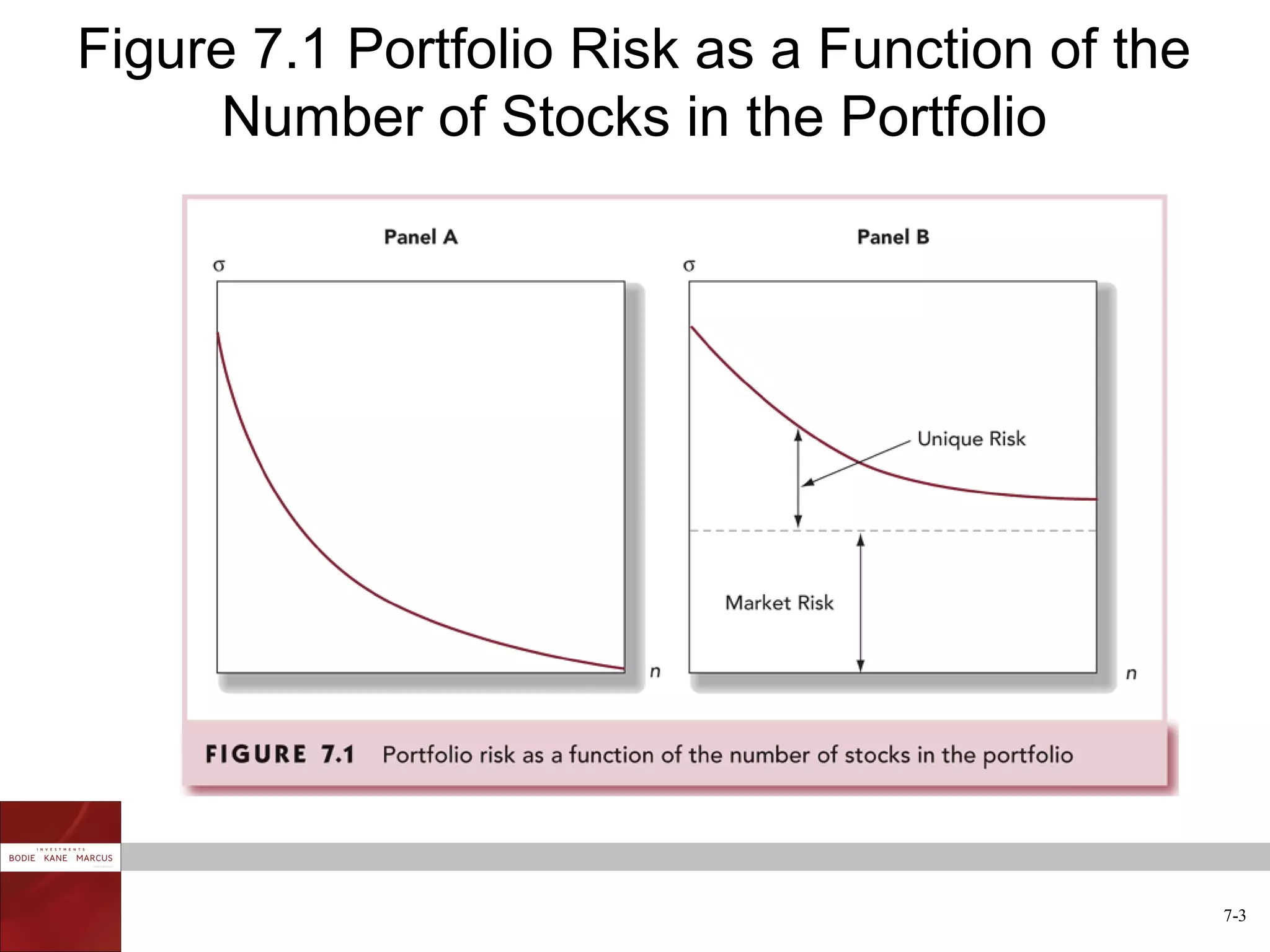
Figure 7.1 Portfolio Risk as a Function of the
      Number of Stocks in the Portfolio


                                                 7-3
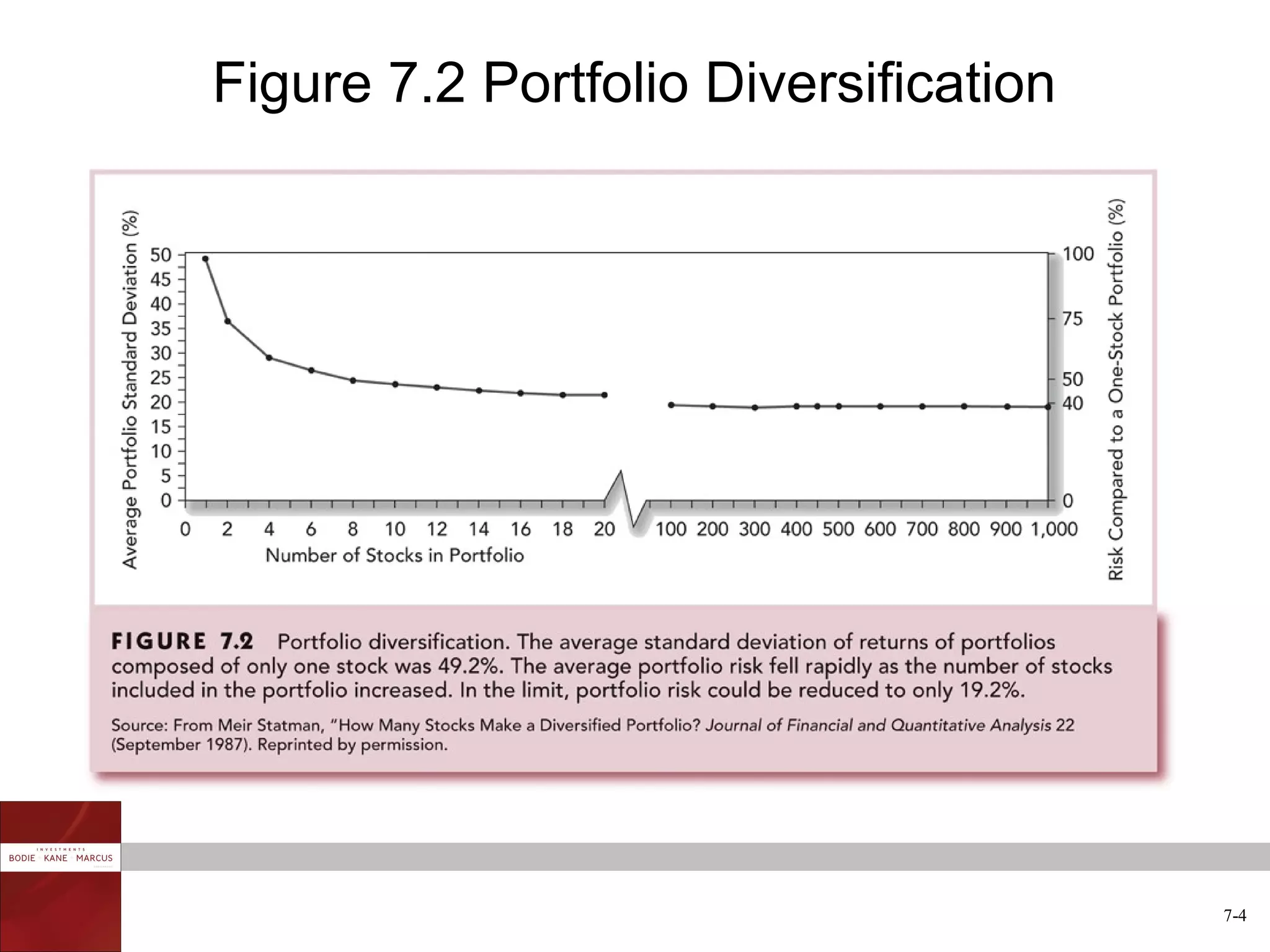
Figure 7.2 Portfolio Diversification


                                       7-4
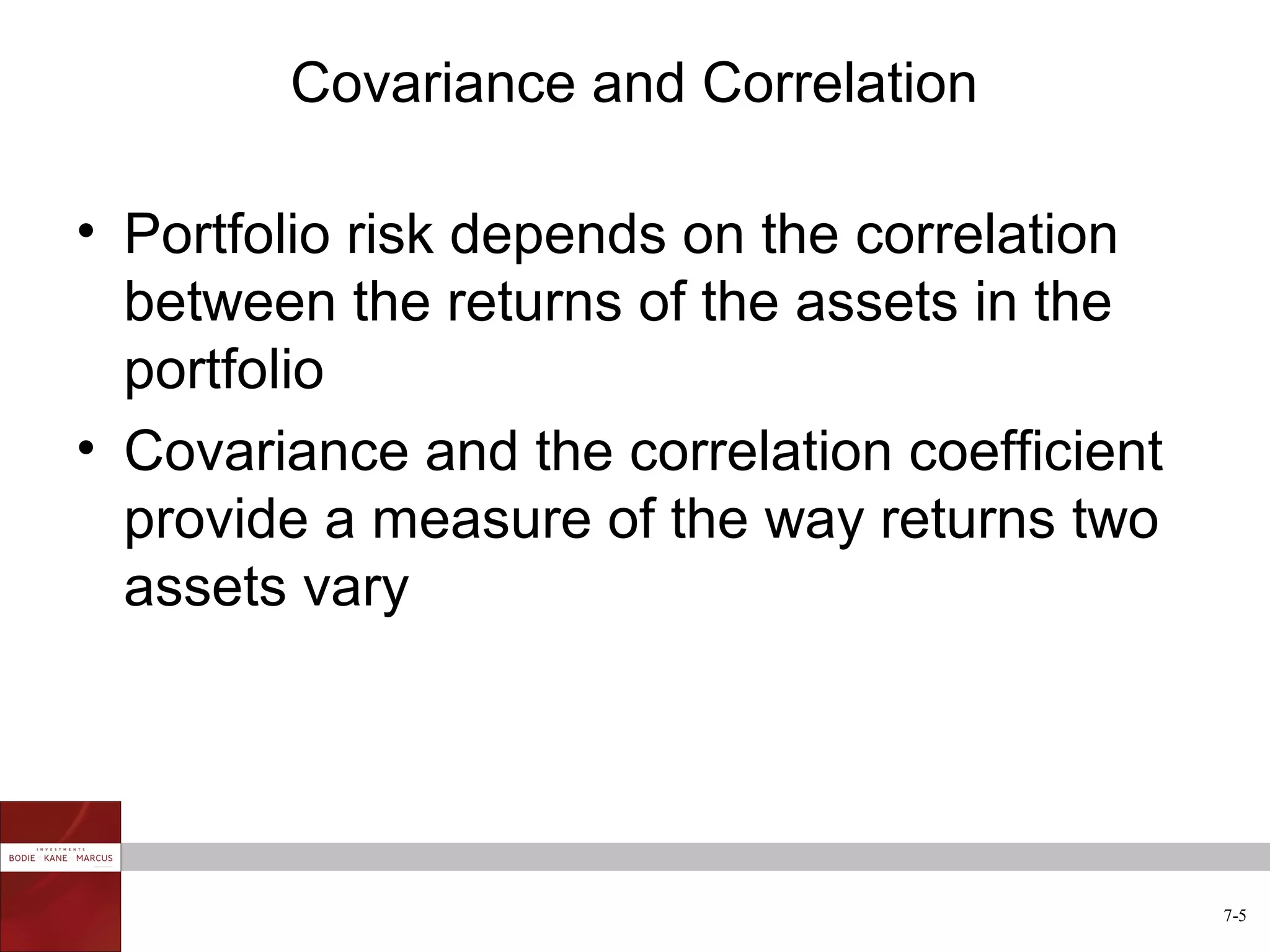
Covariance and Correlation

• Portfolio risk depends on the correlation
  between the returns of the assets in the
  portfolio
• Covariance and the correlation coefficient
  provide a measure of the way returns two
  assets vary


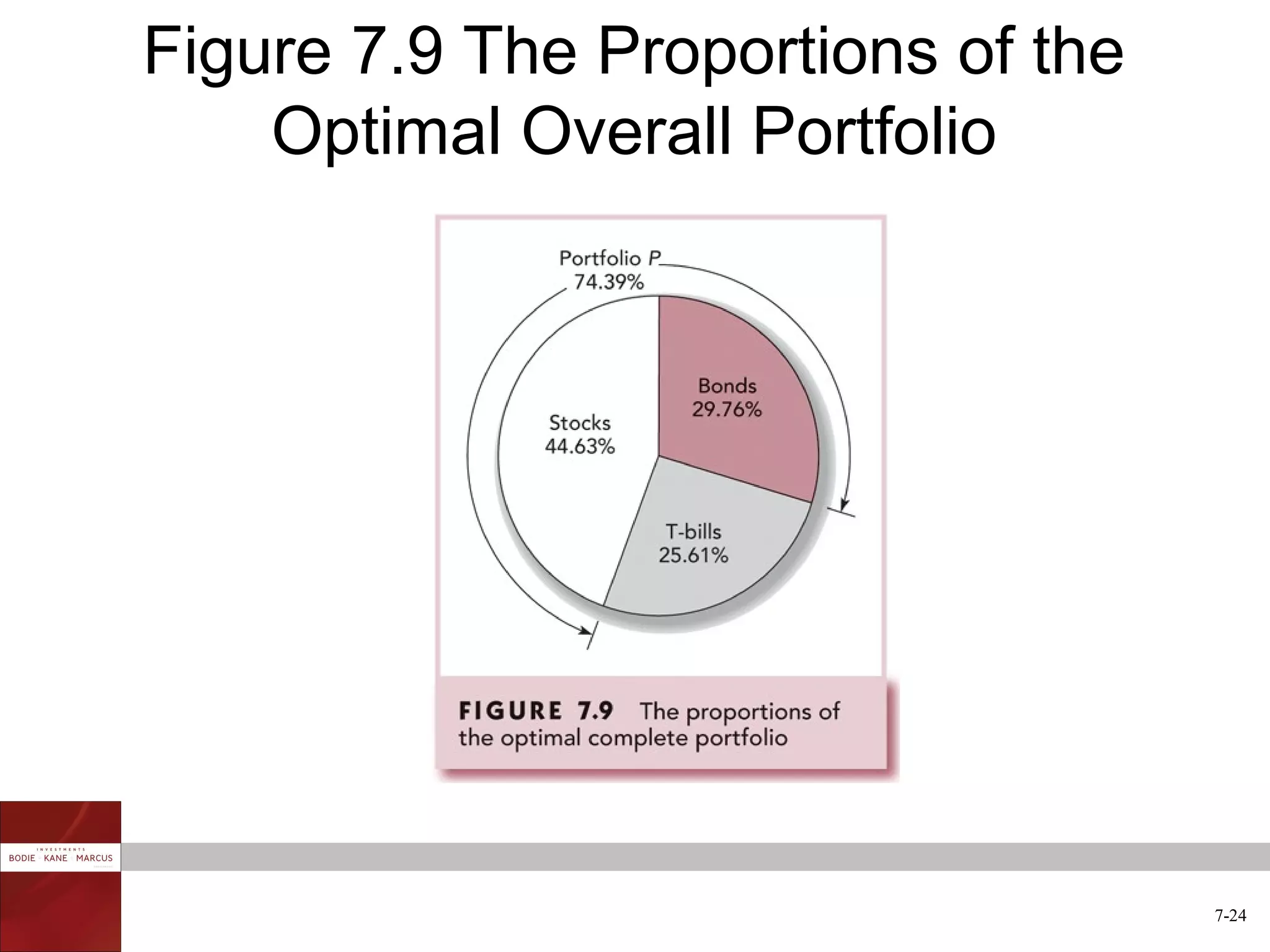
                                               7-5
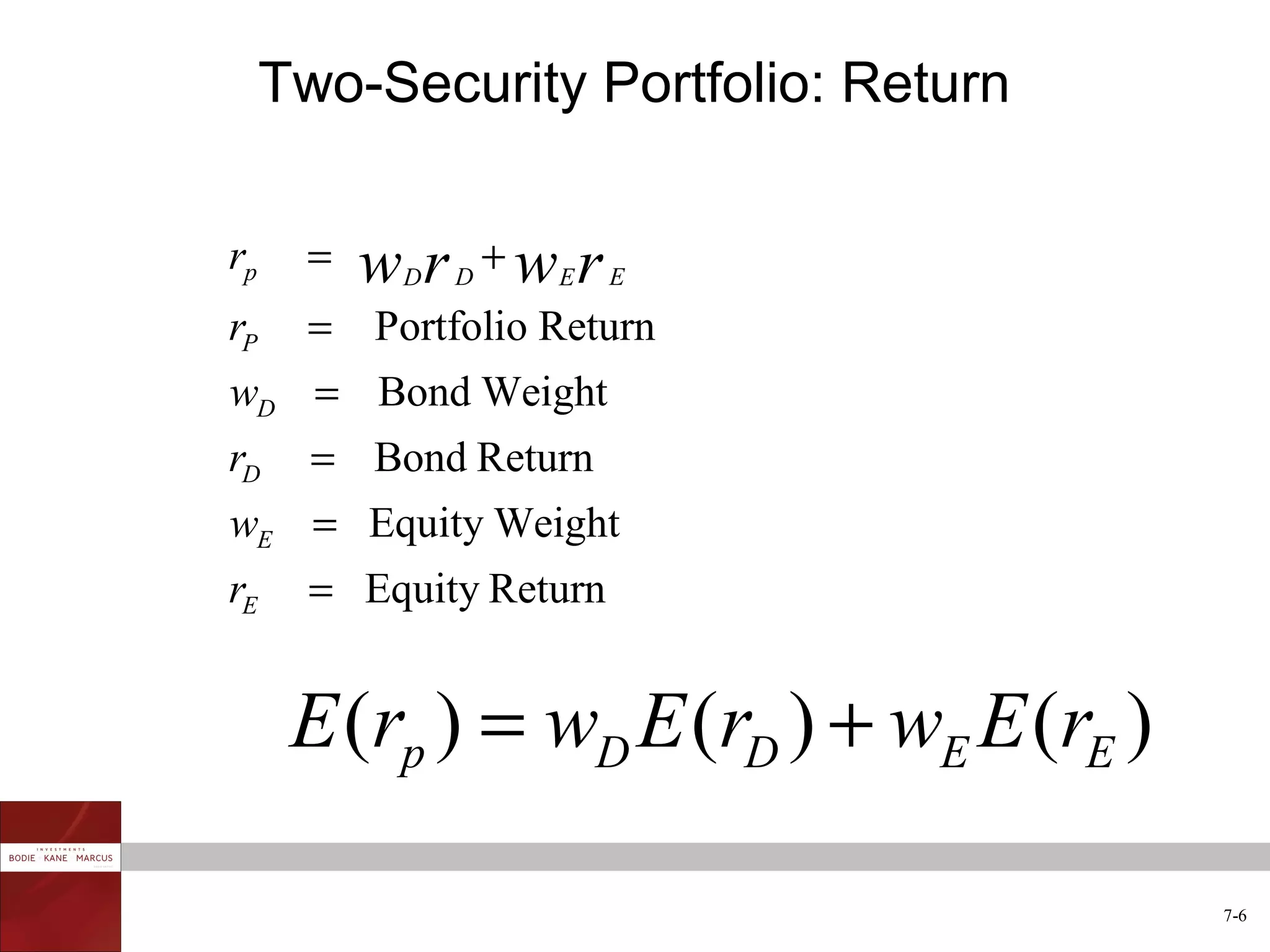
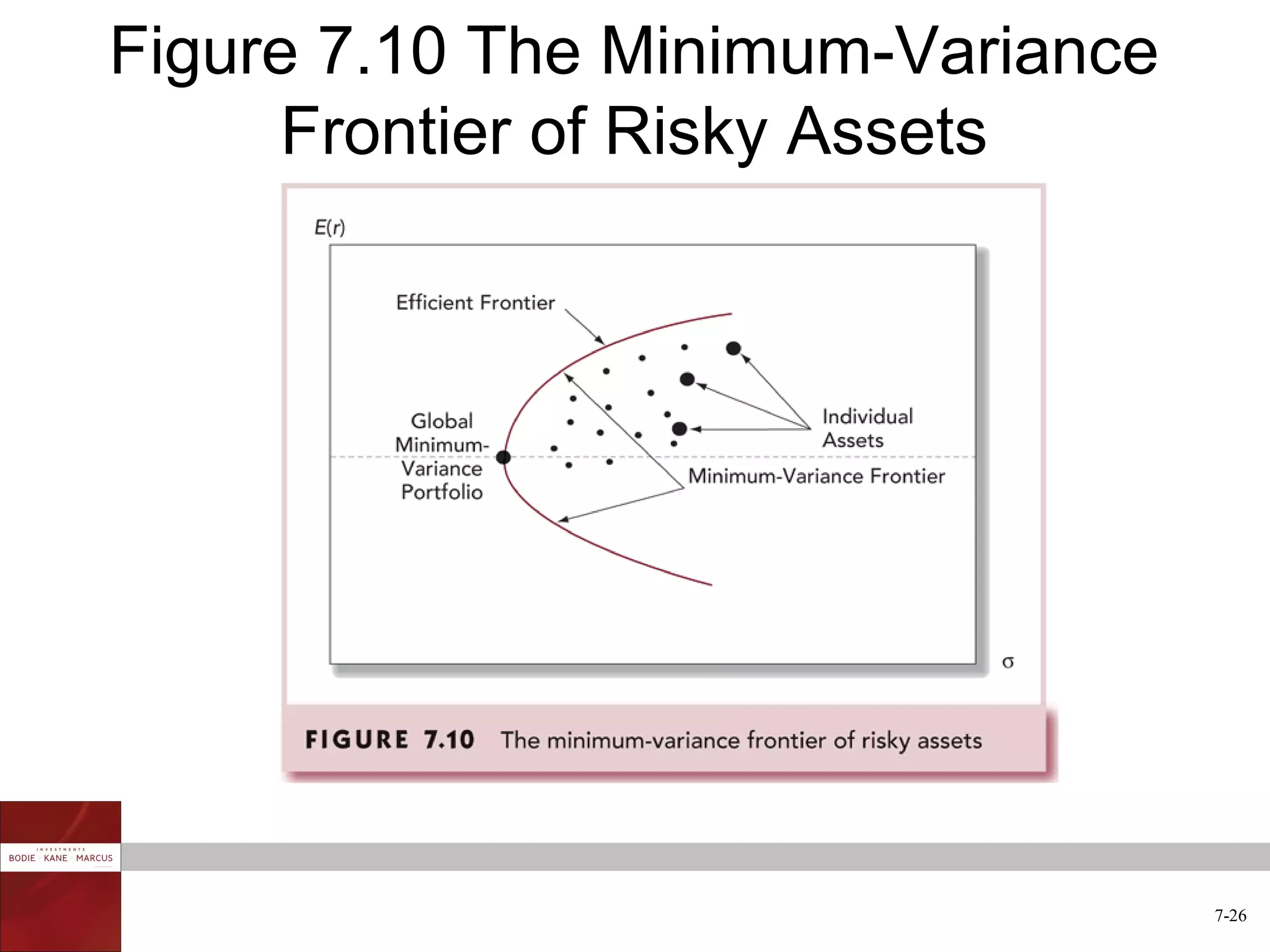
Two-Security Portfolio: Return

rp    =   wr
           D   D
                   + wEr E
rP    = Portfolio Return
wD = Bond Weight
rD     = Bond Return
wE = Equity Weight
rE     = Equity Return


      E (rp ) = wD E (rD ) + wE E (rE )

                                          7-6
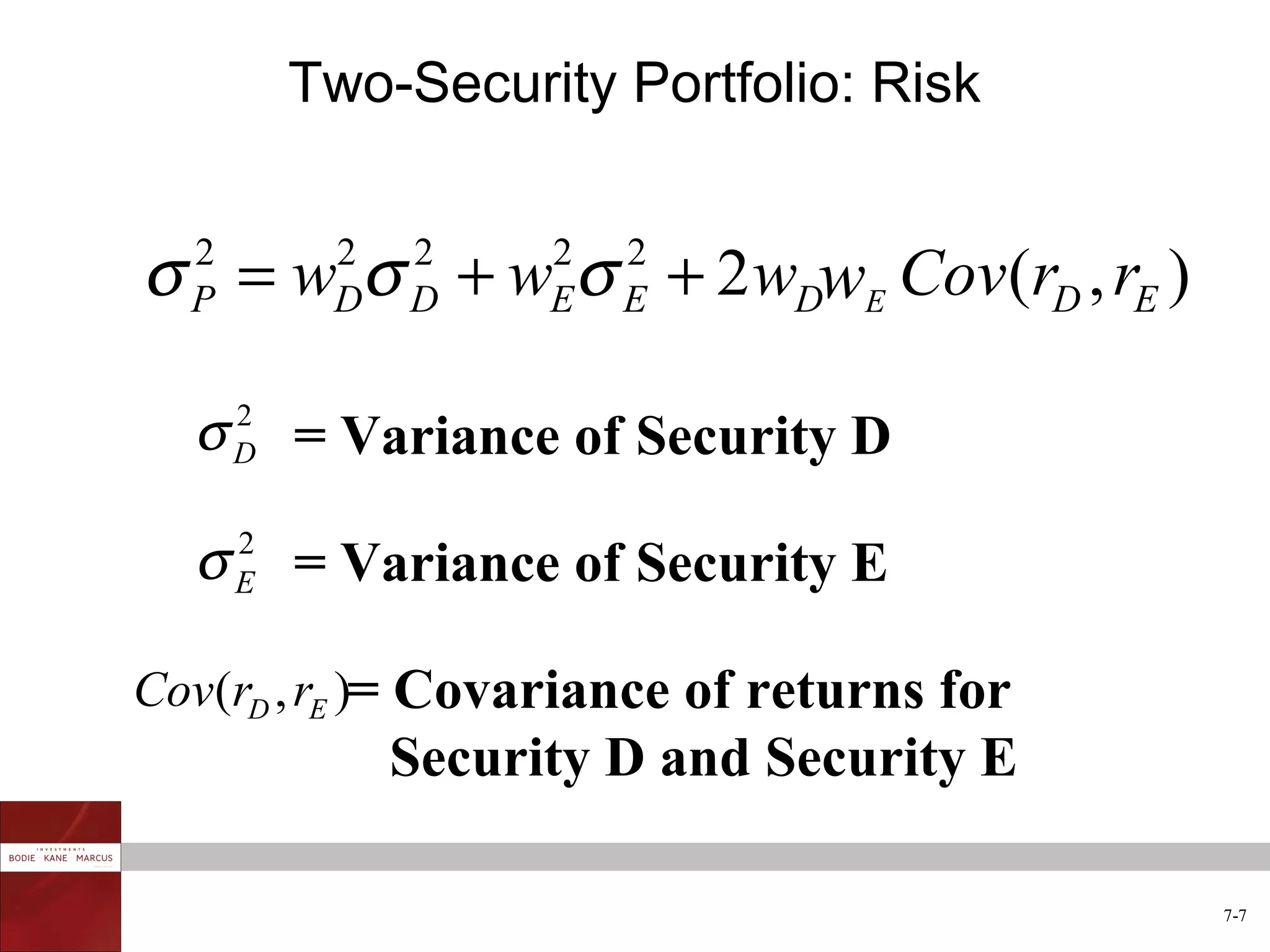
Two-Security Portfolio: Risk


σ = w σ + w σ + 2wDwE Cov(rD , rE )
  2
  P
           2
           D
               2
               D   σE2
                     E
                         2
                         E


  σ D = Variance of Security D
    2


  σ   2
      E   = Variance of Security E

Cov(rD , rE )= Covariance of returns for
               Security D and Security E

                                           7-7
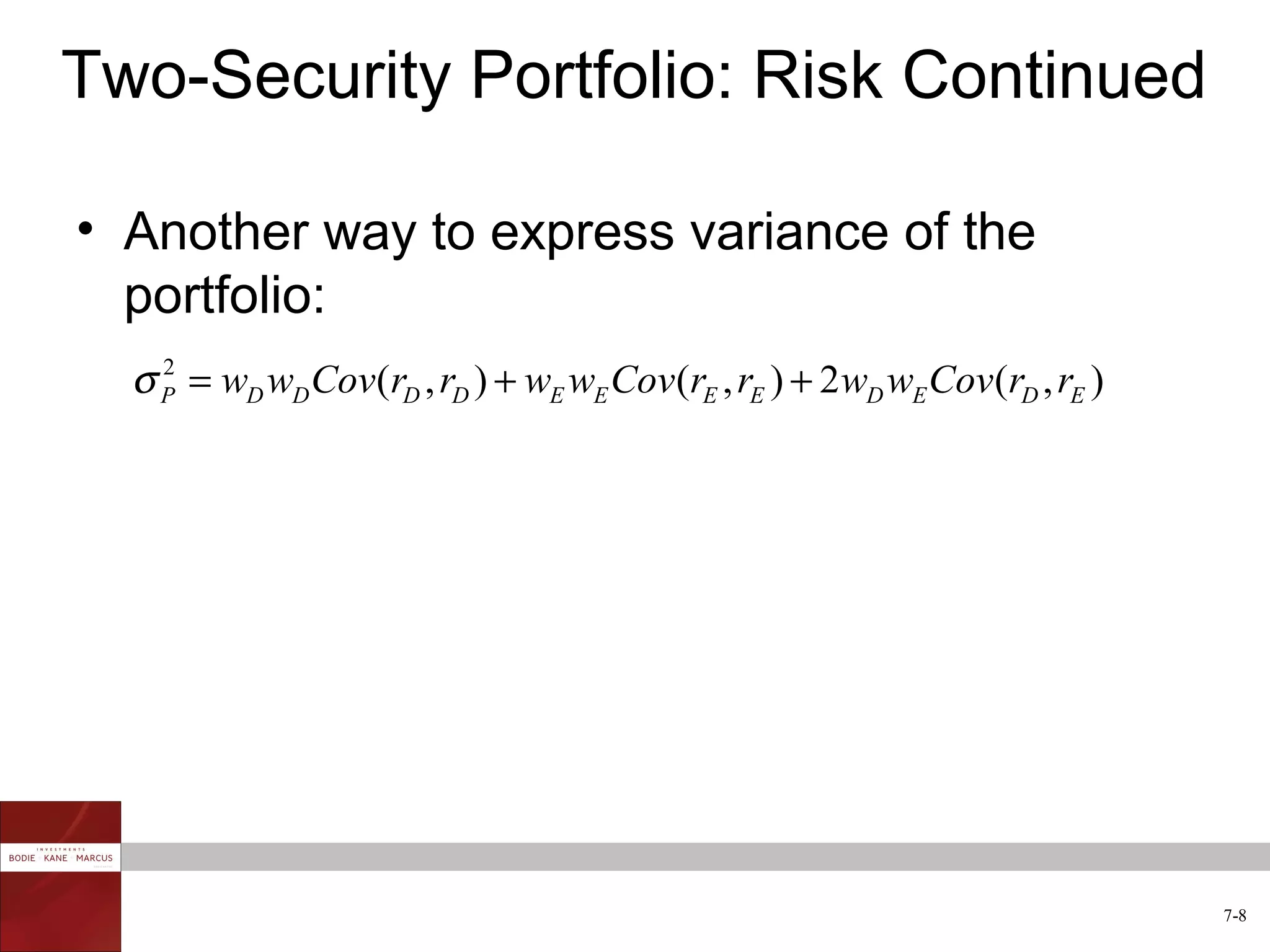
Two-Security Portfolio: Risk Continued

• Another way to express variance of the
  portfolio:
  σ P = wD wD Cov(rD , rD ) + wE wE Cov (rE , rE ) + 2wD wE Cov (rD , rE )
    2


                                                                             7-8
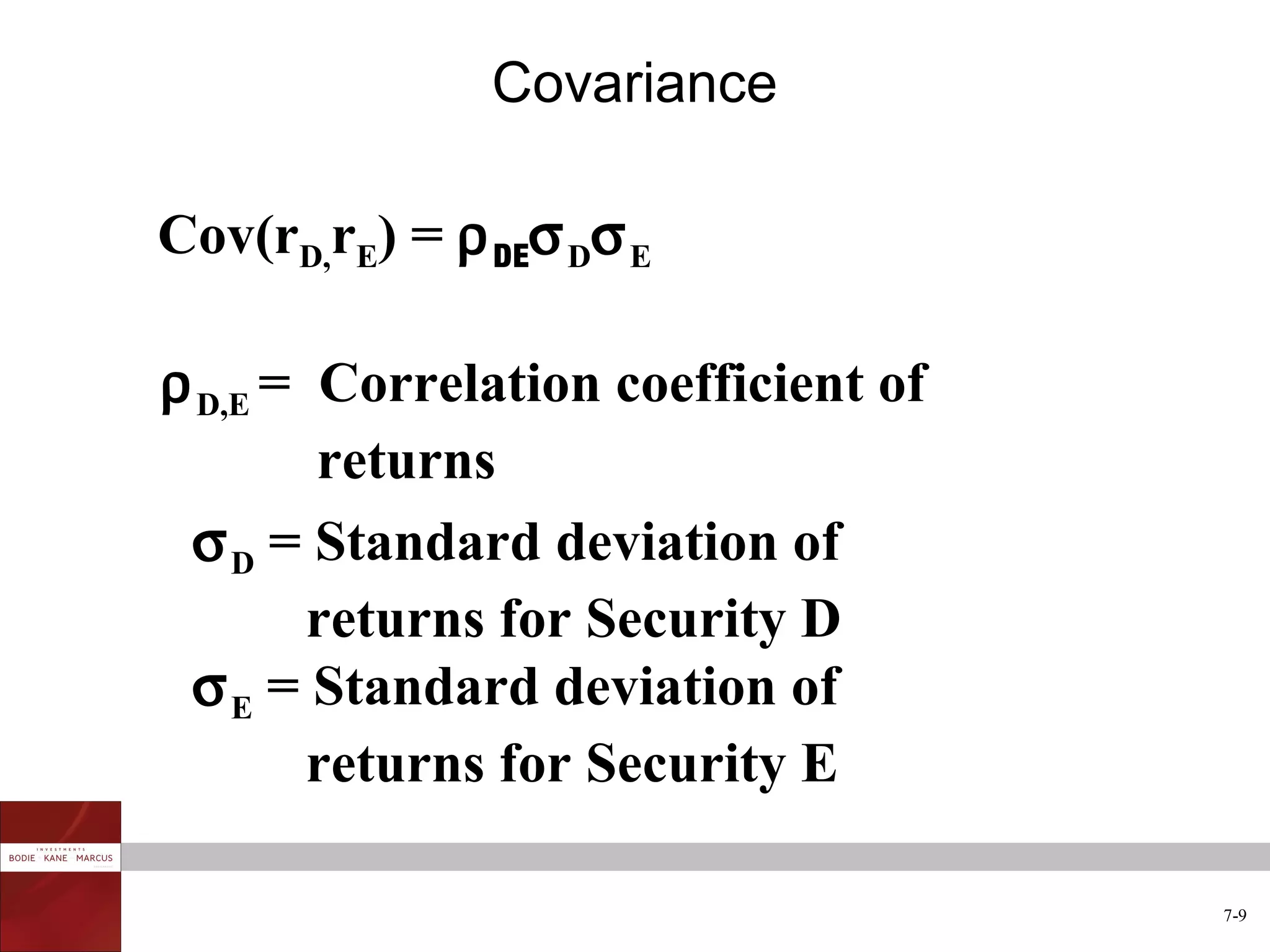
Covariance

Cov(rD,rE) = ρ DEσ Dσ E

ρ D,E = Correlation coefficient of
        returns
 σ D = Standard deviation of
        returns for Security D
 σ E = Standard deviation of
        returns for Security E

                                     7-9
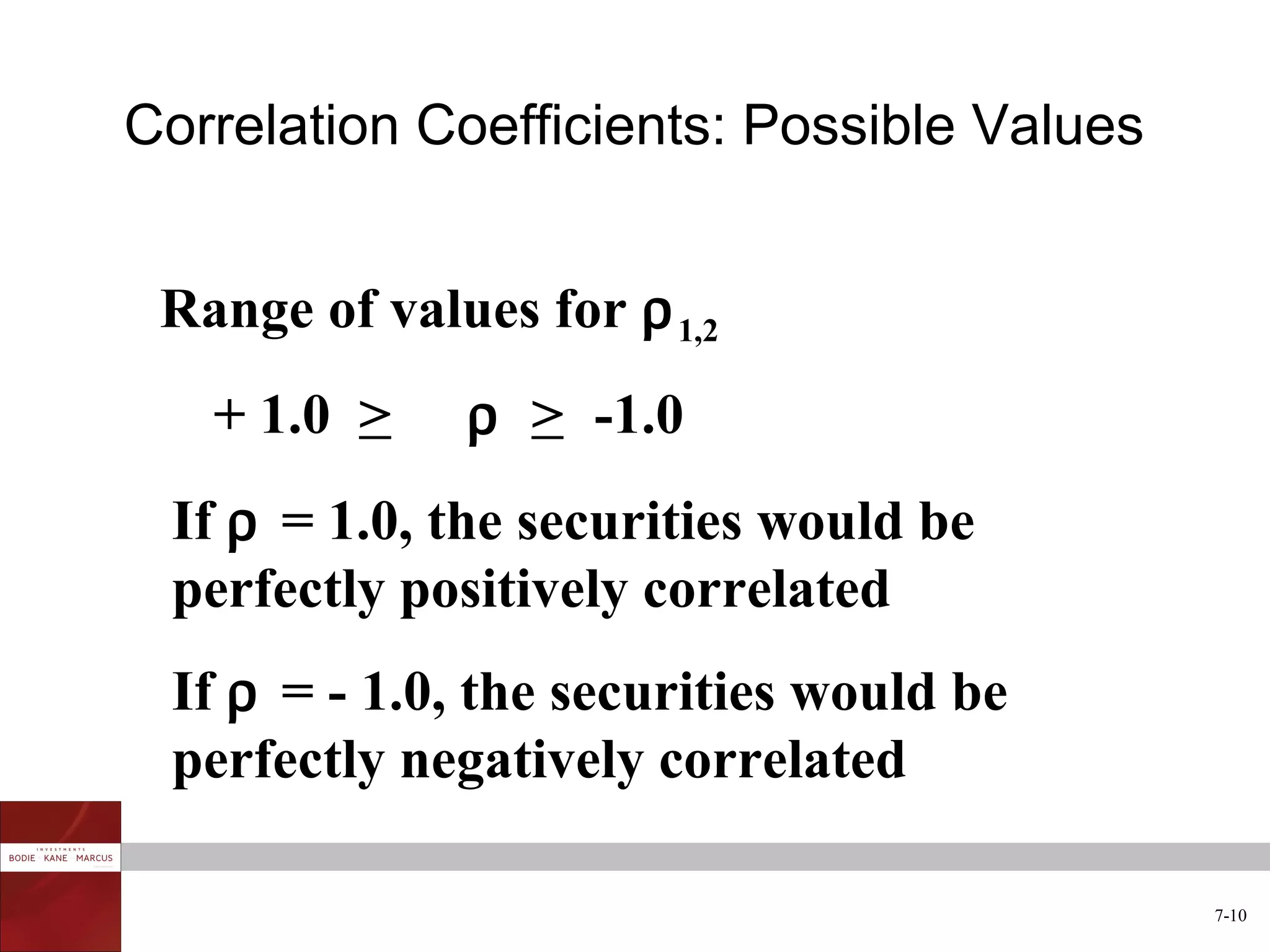
Correlation Coefficients: Possible Values


 Range of values for ρ 1,2
   + 1.0 >    ρ > -1.0
 If ρ = 1.0, the securities would be
 perfectly positively correlated
 If ρ = - 1.0, the securities would be
 perfectly negatively correlated

                                            7-10
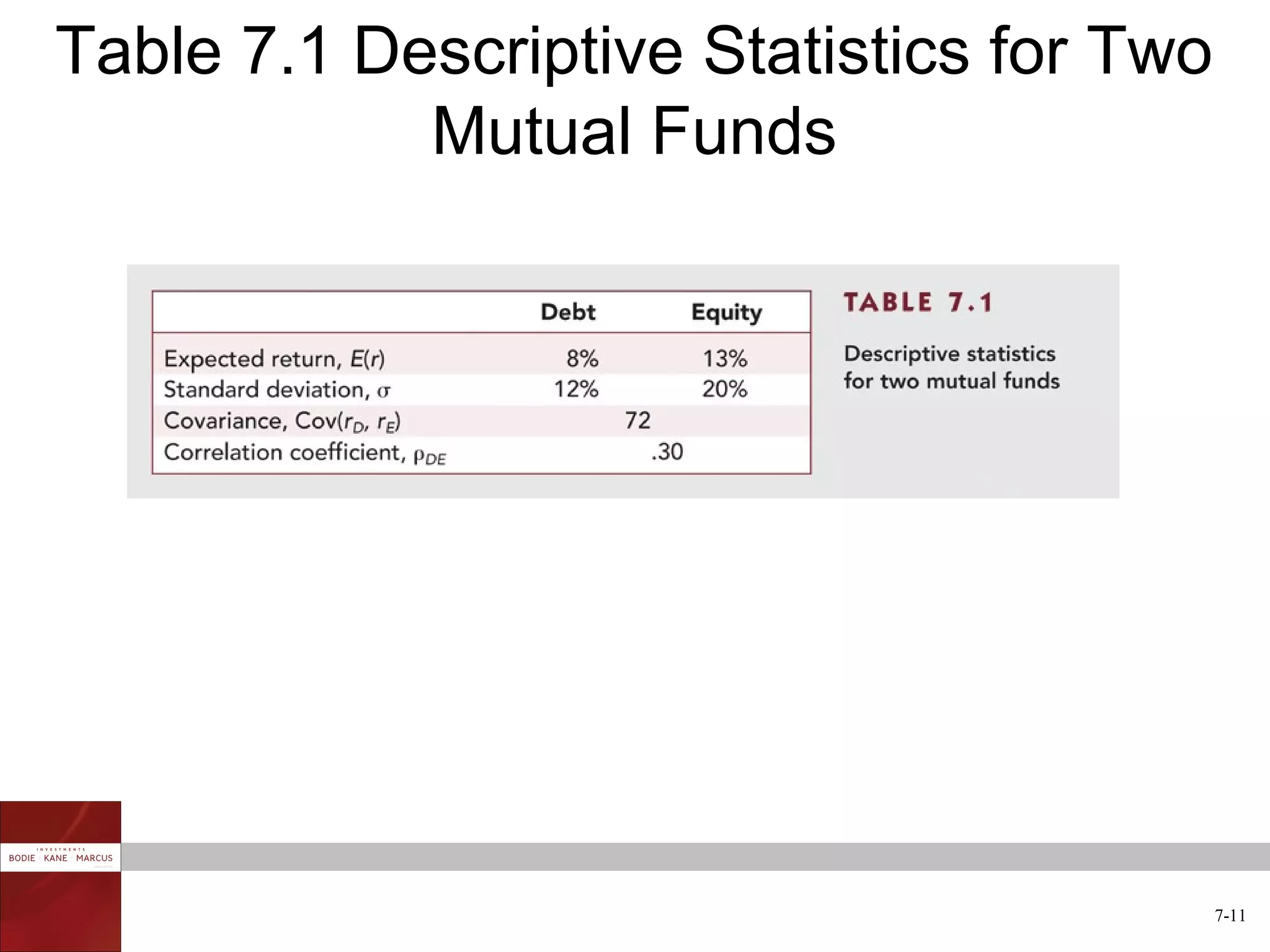
Table 7.1 Descriptive Statistics for Two
            Mutual Funds


                                           7-11
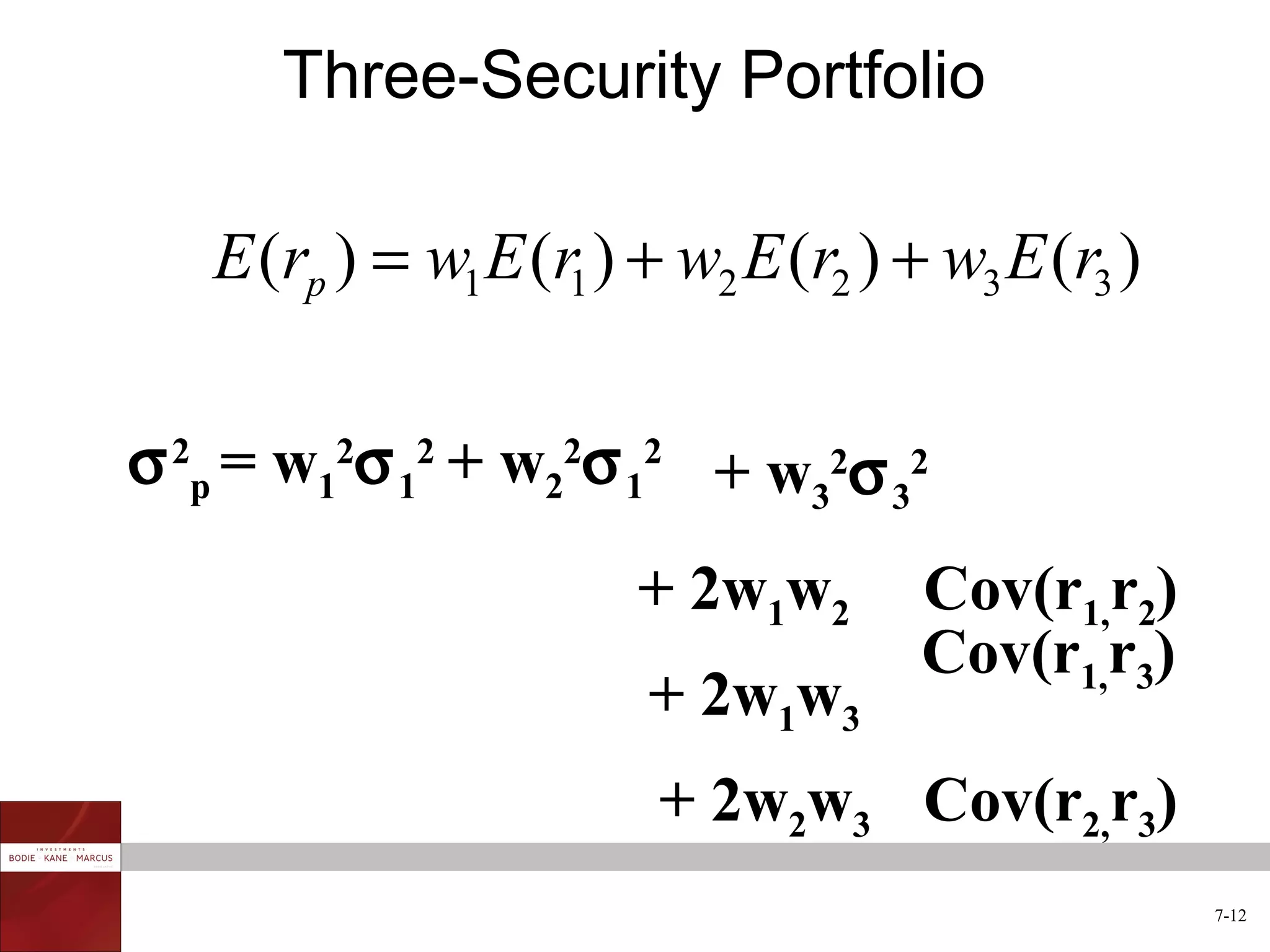
Three-Security Portfolio

   E (rp ) = w1 E (r1 ) + w2 E (r2 ) + w3 E (r3 )


σ 2p = w12σ 12 + w22σ 12 + w32σ 32

                        + 2w1w2       Cov(r1,r2)
                                      Cov(r1,r3)
                        + 2w1w3
                         + 2w2w3 Cov(r2,r3)
                                                    7-12
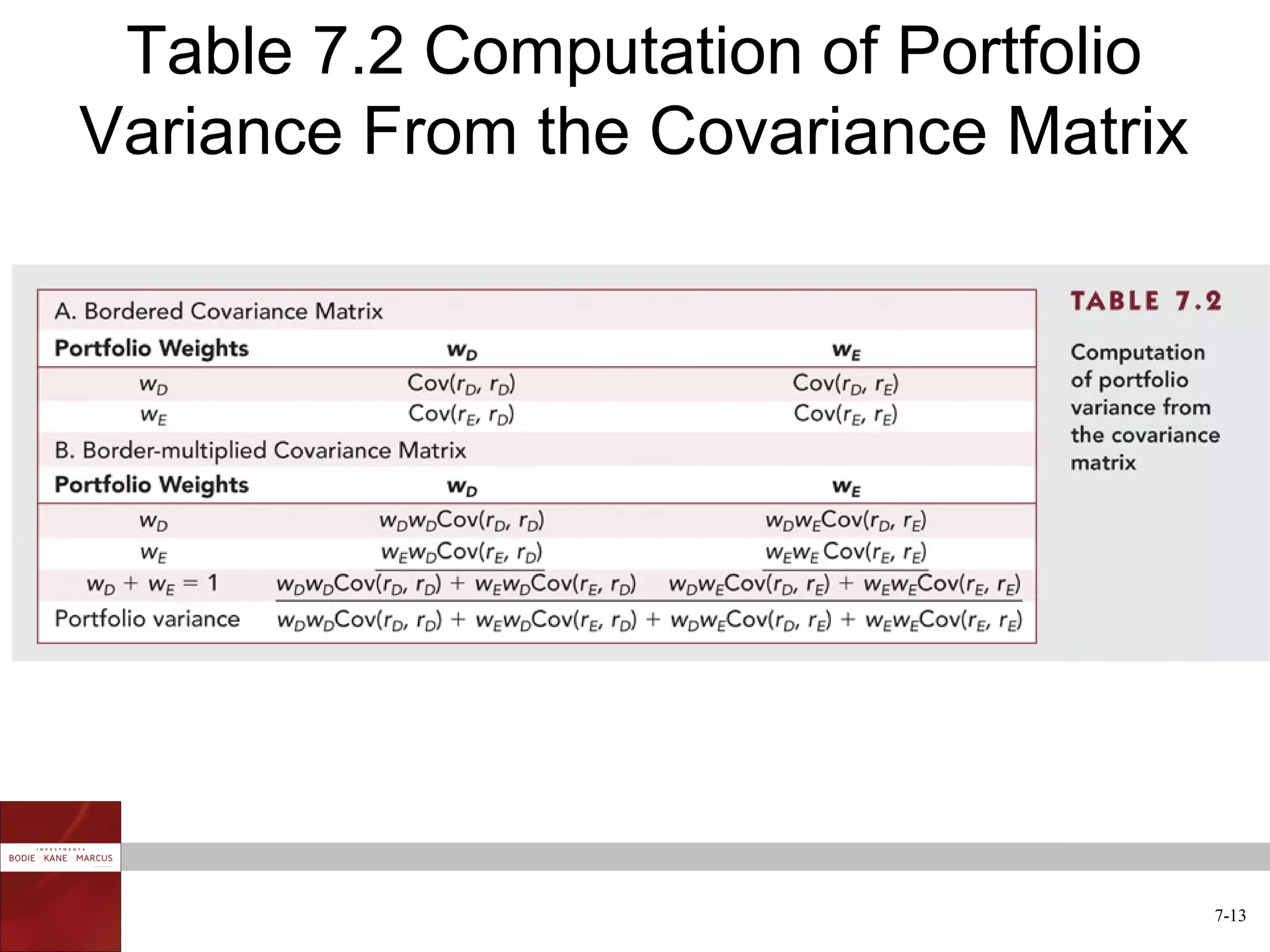
Table 7.2 Computation of Portfolio
Variance From the Covariance Matrix


                                      7-13
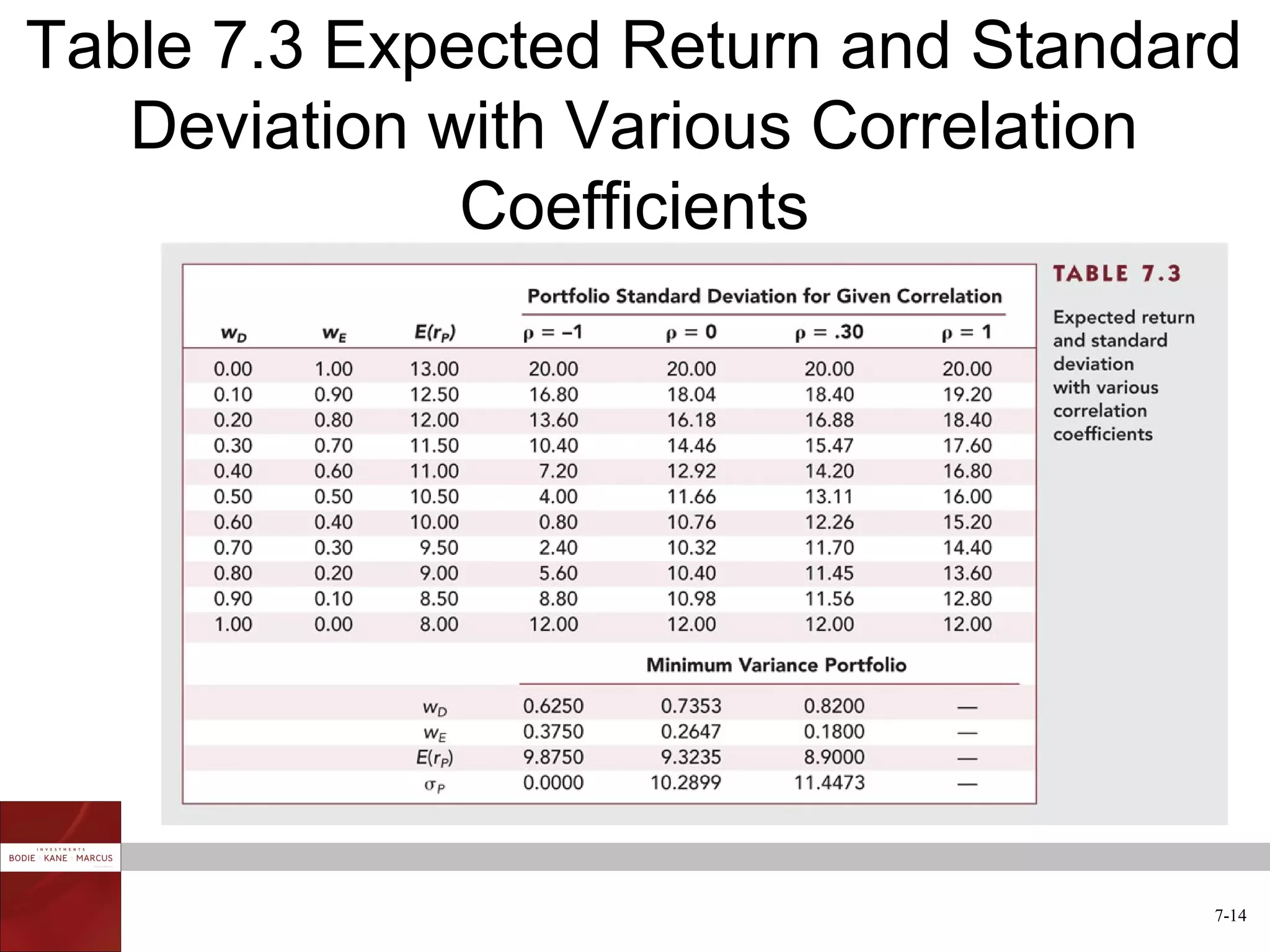
Table 7.3 Expected Return and Standard
   Deviation with Various Correlation
              Coefficients


                                     7-14
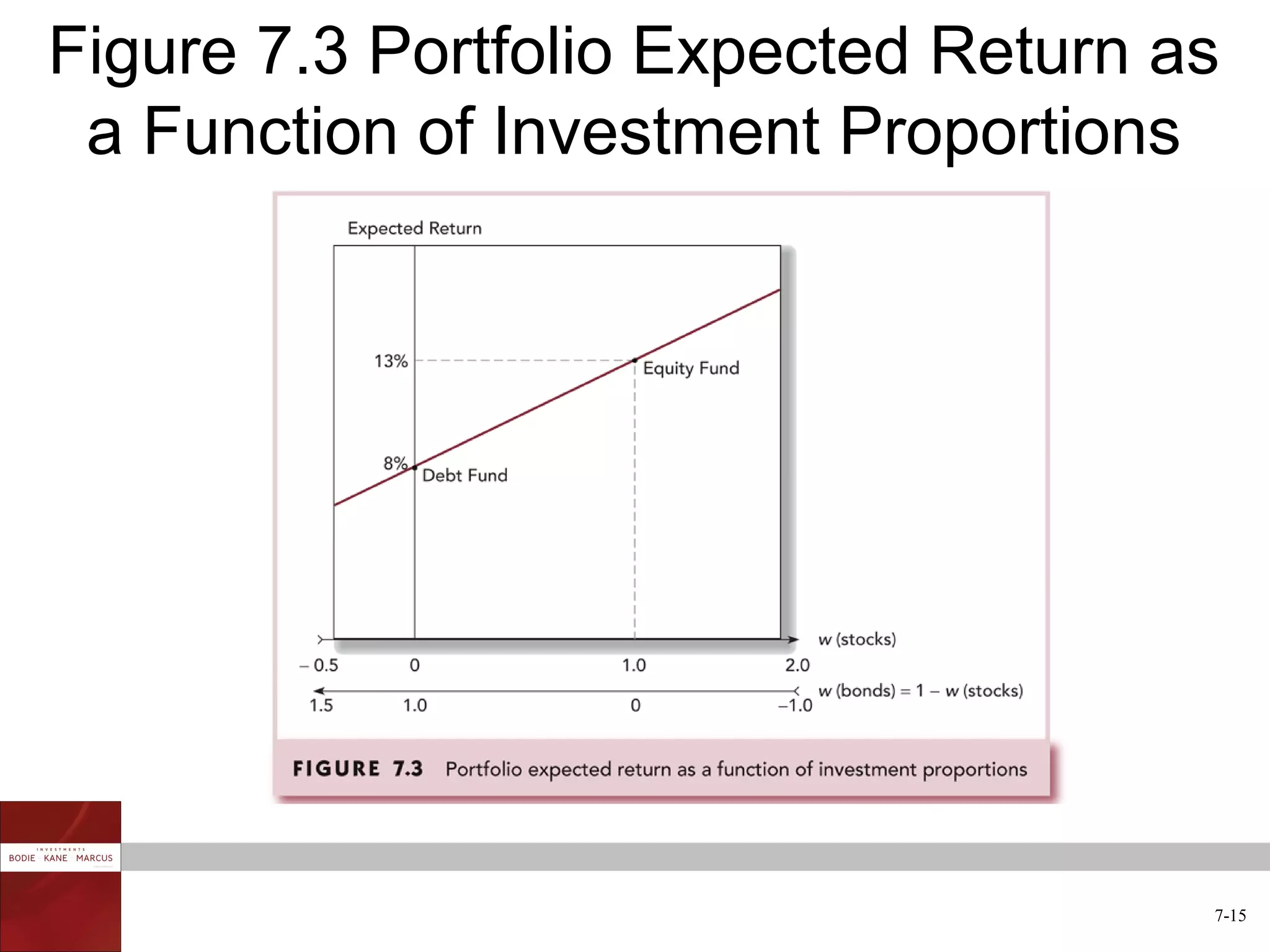
Figure 7.3 Portfolio Expected Return as
 a Function of Investment Proportions


                                      7-15
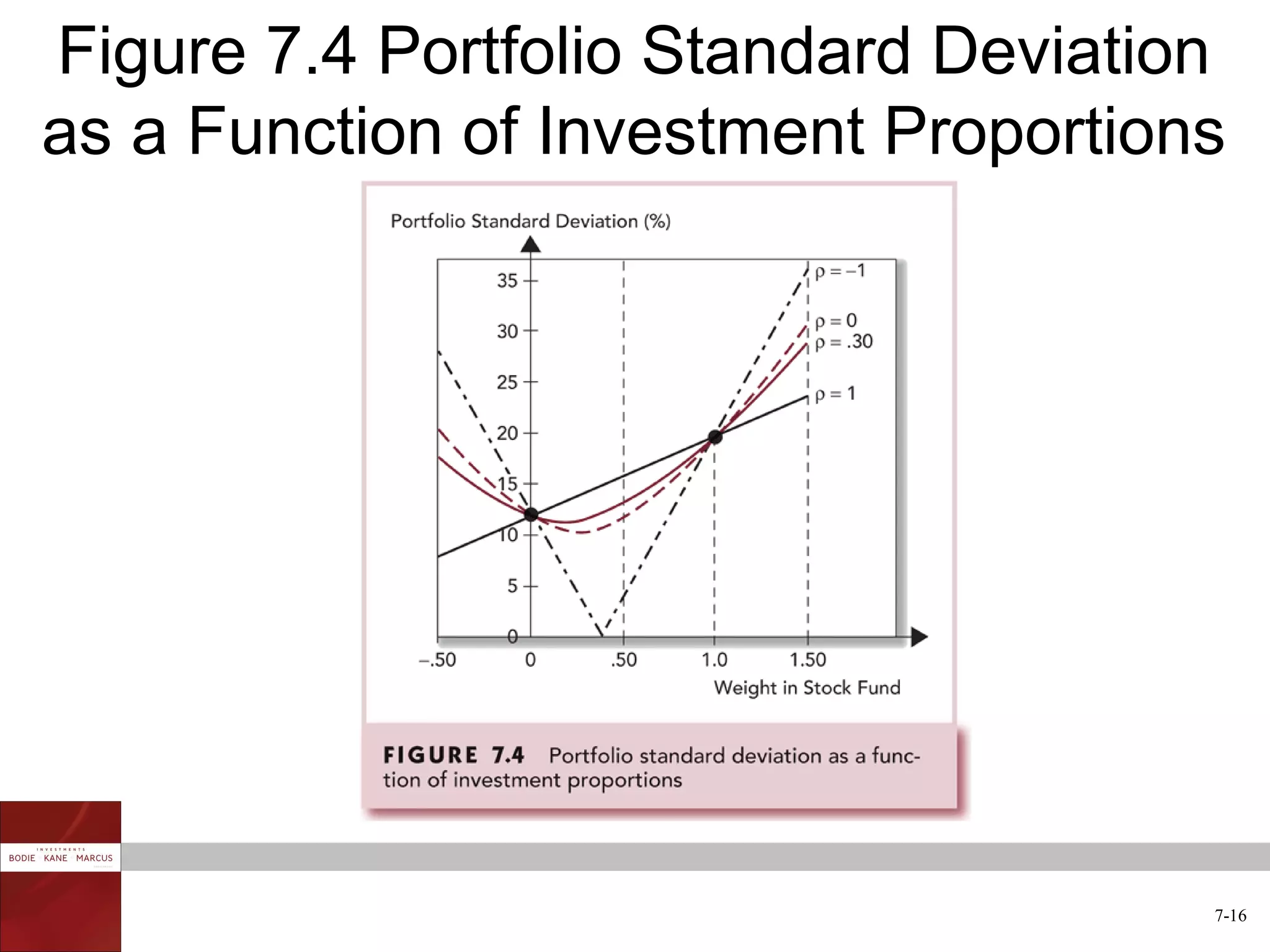
Figure 7.4 Portfolio Standard Deviation
as a Function of Investment Proportions


                                      7-16
Minimum Variance Portfolio as Depicted
            in Figure 7.4
 • Standard deviation is smaller than that of
   either of the individual component assets
 • Figure 7.3 and 7.4 combined demonstrate the
   relationship between portfolio risk


                                                 7-17
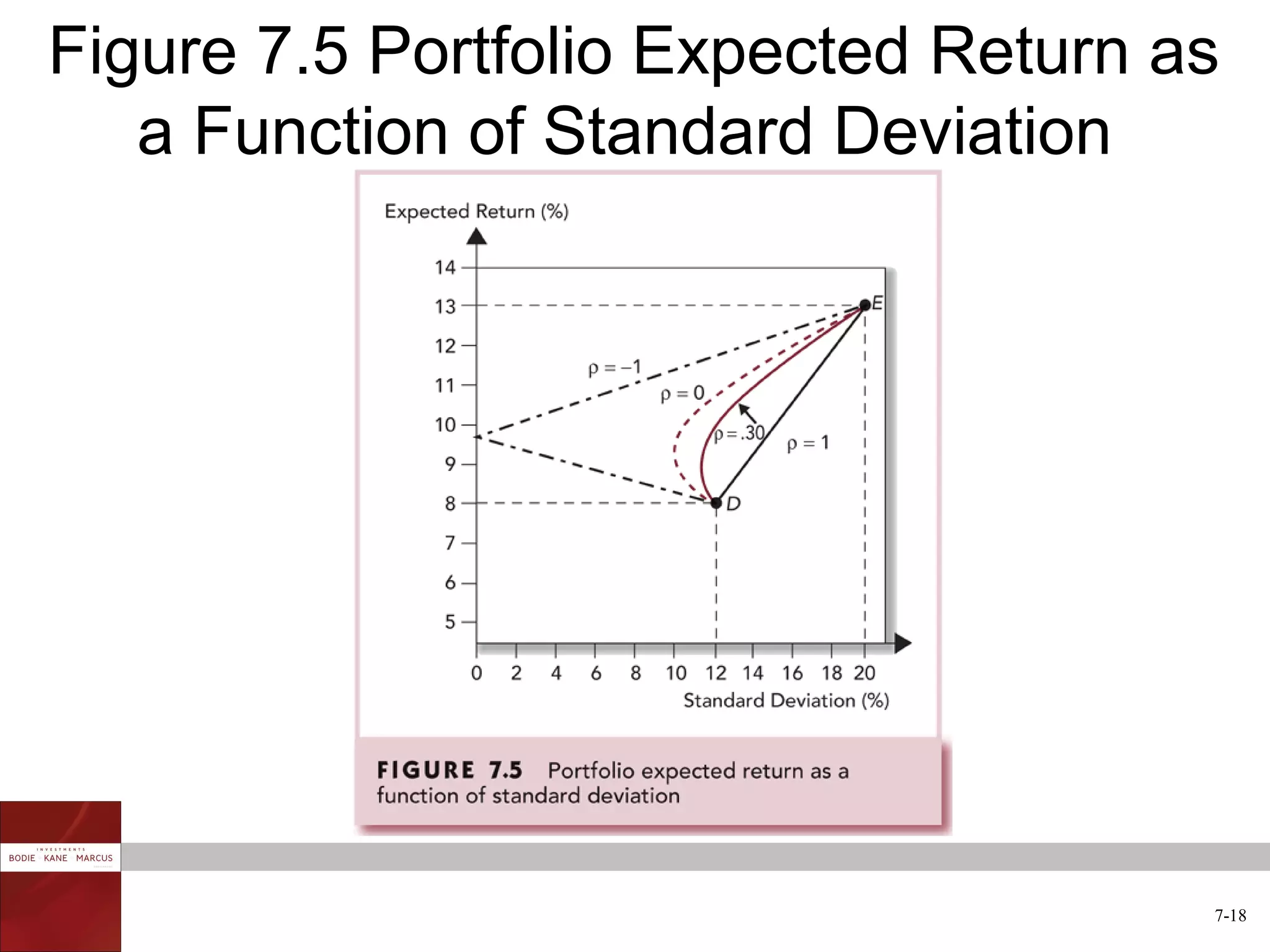
Figure 7.5 Portfolio Expected Return as
   a Function of Standard Deviation


                                      7-18
Correlation Effects

• The relationship depends on the correlation
  coefficient
• -1.0 < ρ < +1.0
• The smaller the correlation, the greater the
  risk reduction potential
• If ρ = +1.0, no risk reduction is possible


                                                 7-19
Figure 7.6 The Opportunity Set of the
   Debt and Equity Funds and Two
           Feasible CALs


                                        7-20
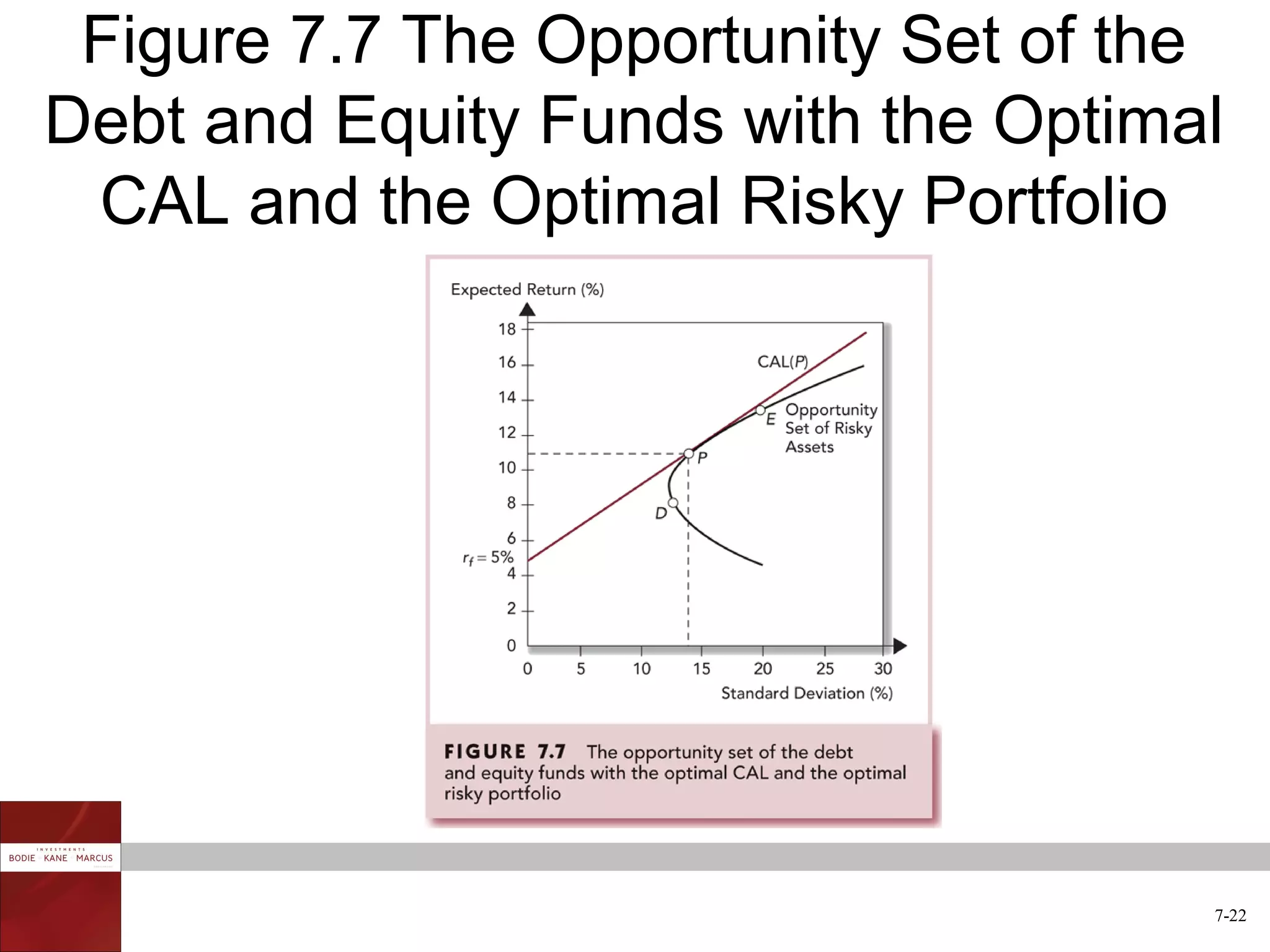
The Sharpe Ratio

• Maximize the slope of the CAL for any
  possible portfolio, p
• The objective function is the slope:

                   E (rP ) − rf
            SP =
                       σP


                                          7-21
Figure 7.7 The Opportunity Set of the
Debt and Equity Funds with the Optimal
 CAL and the Optimal Risky Portfolio


                                     7-22
Figure 7.8 Determination of the Optimal
            Overall Portfolio


                                      7-23
Figure 7.9 The Proportions of the
    Optimal Overall Portfolio


                                    7-24
Markowitz Portfolio Selection Model

• Security Selection
  – First step is to determine the risk-return
    opportunities available
  – All portfolios that lie on the minimum-
    variance frontier from the global minimum-
    variance portfolio and upward provide the
    best risk-return combinations


                                                 7-25
Figure 7.10 The Minimum-Variance
      Frontier of Risky Assets


                                   7-26
Markowitz Portfolio Selection Model
            Continued
• We now search for the CAL with the highest
  reward-to-variability ratio


                                               7-27
Figure 7.11 The Efficient Frontier of
Risky Assets with the Optimal CAL


                                        7-28
Markowitz Portfolio Selection Model
            Continued
• Now the individual chooses the appropriate
  mix between the optimal risky portfolio P and
  T-bills as in Figure 7.8
                  n     n
            σP = ∑
             2
                        ∑ w w Cov(r , r )
                               i   j   i   j
                 i =1   j =1


                                                  7-29
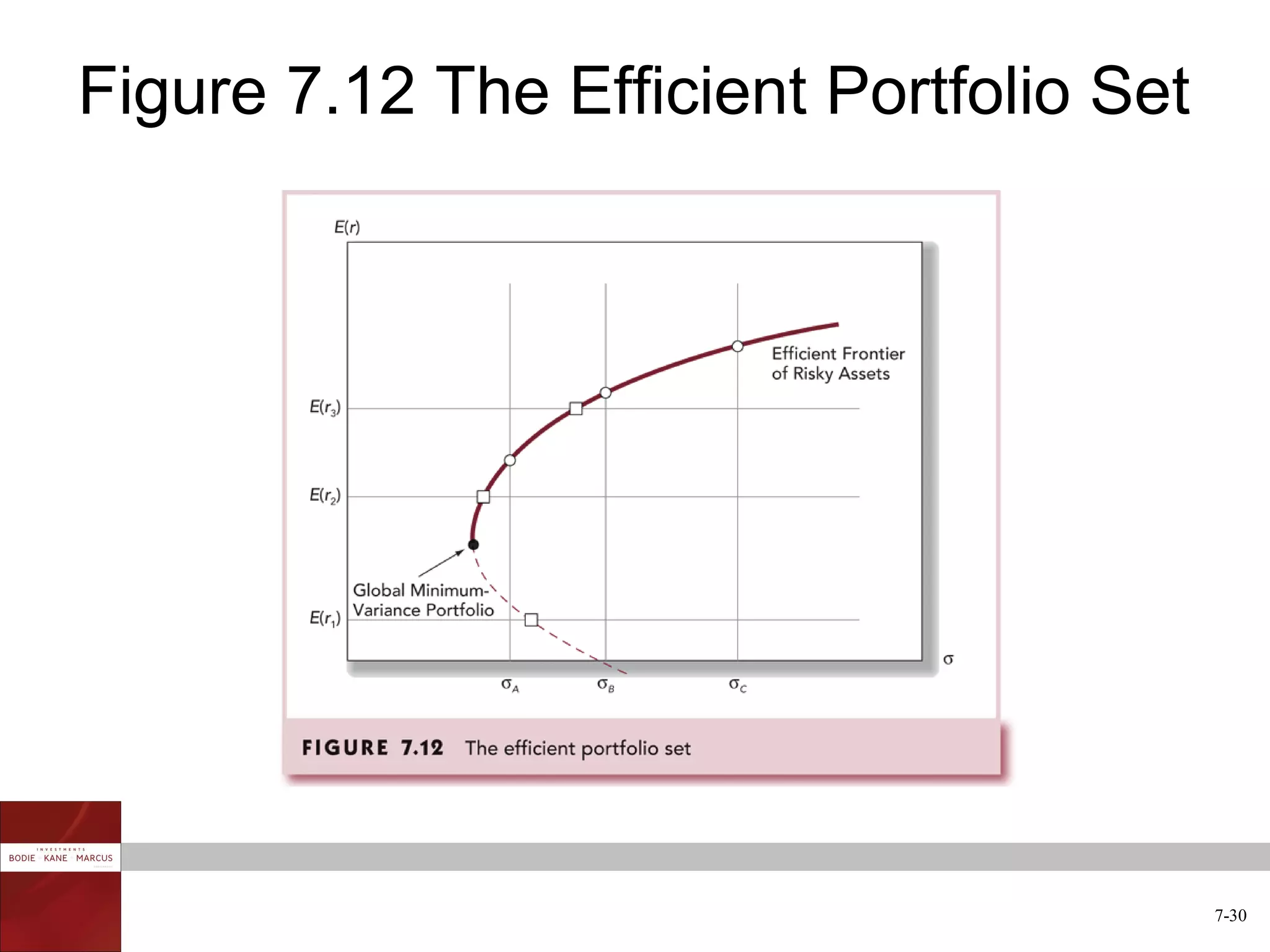
Figure 7.12 The Efficient Portfolio Set


                                          7-30
Capital Allocation and the Separation
               Property
• The separation property tells us that the
  portfolio choice problem may be separated
  into two independent tasks
   – Determination of the optimal risky portfolio
     is purely technical
   – Allocation of the complete portfolio to T-
     bills versus the risky portfolio depends on
     personal preference


                                                    7-31
Figure 7.13 Capital Allocation Lines with
Various Portfolios from the Efficient Set


                                        7-32
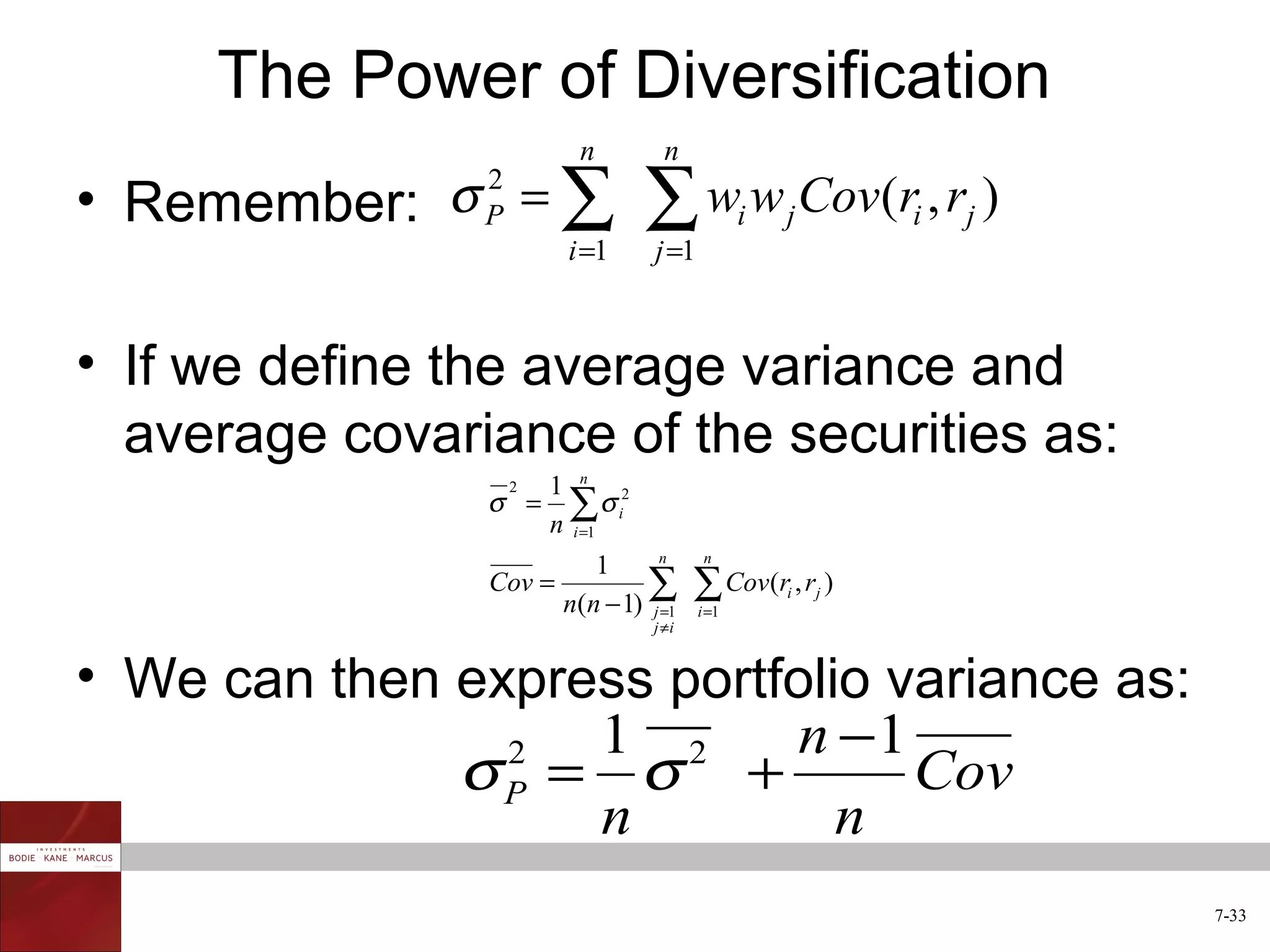
The Power of Diversification
                         n        n
• Remember: σ = ∑              ∑ w w Cov(r , r )
                2
                P                             i   j       i   j
                        i =1    j =1


• If we define the average variance and
  average covariance of the securities as:
                   1 n 2
                σ = ∑σ i
                    2

                   n i =1
                                n       n
                         1
                Cov =         ∑
                      n(n − 1) j =1
                                       ∑ Cov(r , r )
                                       i =1
                                                  i   j

                                j ≠i


• We can then express portfolio variance as:
                   1 2     n −1
              σP = σ +
                2
                                 Cov
                   n          n
                                                                  7-33
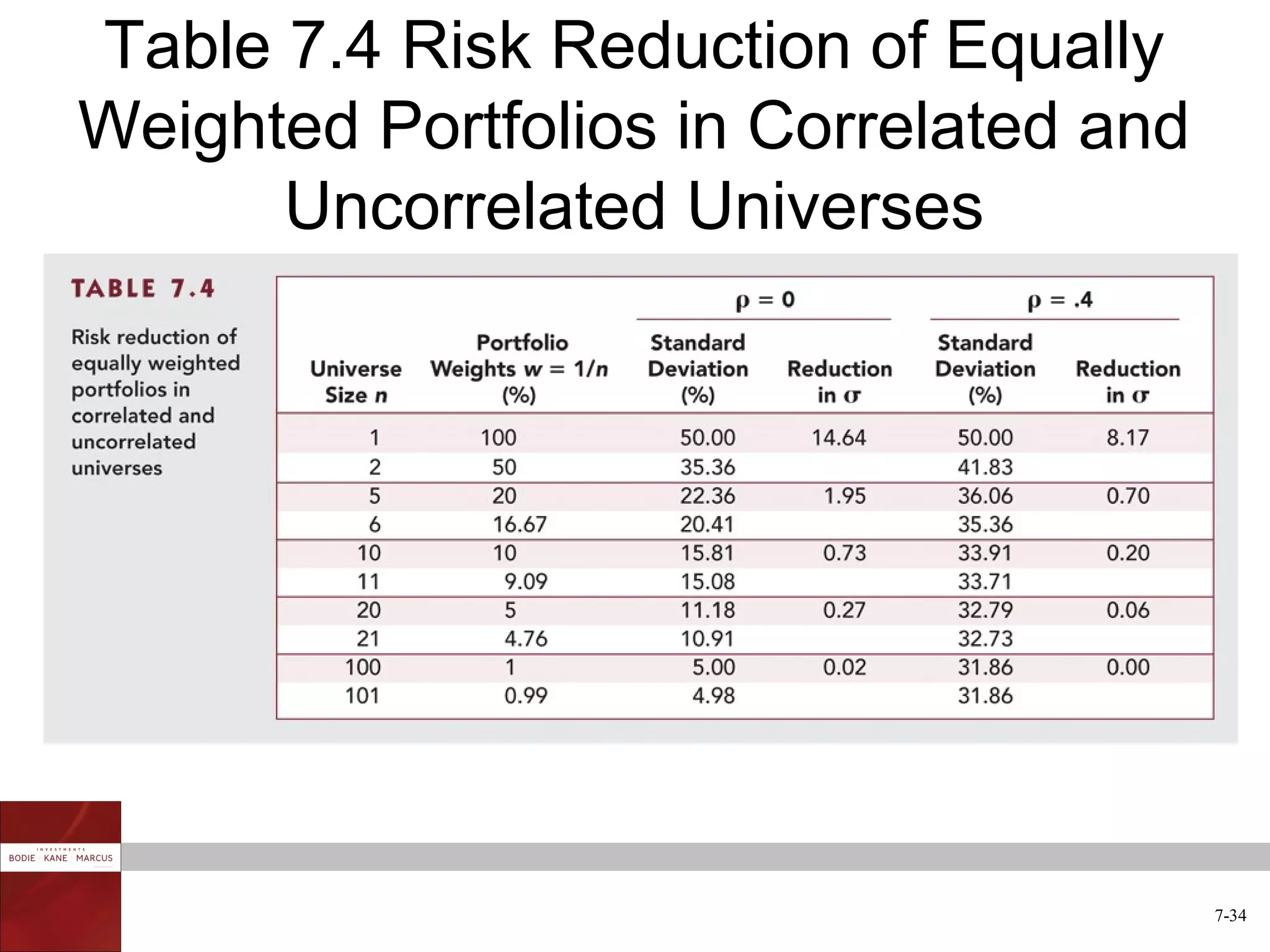
Table 7.4 Risk Reduction of Equally
Weighted Portfolios in Correlated and
      Uncorrelated Universes


                                        7-34
Risk Pooling, Risk Sharing and Risk in
            the Long Run
• Consider the following:
                            Loss: payout = $100,000
        p = .001


                            No Loss: payout = 0

        1 − p = .999


                                                      7-35
Risk Pooling and the Insurance Principle

 • Consider the variance of the portfolio:
              1 2
           σ = σ
            2
            P
              n
 • It seems that selling more policies causes
   risk to fall
 • Flaw is similar to the idea that long-term
   stock investment is less risky


                                                7-36
Risk Pooling and the Insurance Principle
               Continued
 • When we combine n uncorrelated
   insurance policies each with an expected
   profit of $ π, both expected total profit and
   SD grow in direct proportion to n:

      E (nπ ) = nE (π )
      Var (nπ ) = n Var (π ) = n σ
                      2              2   2


      SD(nπ ) = nσ
                                                   7-37
Risk Sharing

• What does explain the insurance business?
  – Risk sharing or the distribution of a fixed
    amount of risk among many investors


                                                  7-38

Chap007

  • 1.
    CHAPTER 7 Optimal Risky Portfolios Investments, 8th edition Bodie, Kane and Marcus Slides by Susan Hine McGraw-Hill/Irwin Copyright © 2009 by The McGraw-Hill Companies, Inc. All rights reserved.
  • 2.
    Diversification and PortfolioRisk • Market risk – Systematic or nondiversifiable • Firm-specific risk – Diversifiable or nonsystematic 7-2
  • 3.
    Figure 7.1 PortfolioRisk as a Function of the Number of Stocks in the Portfolio 7-3
  • 4.
    Figure 7.2 PortfolioDiversification 7-4
  • 5.
    Covariance and Correlation •Portfolio risk depends on the correlation between the returns of the assets in the portfolio • Covariance and the correlation coefficient provide a measure of the way returns two assets vary 7-5
  • 6.
    Two-Security Portfolio: Return rp = wr D D + wEr E rP = Portfolio Return wD = Bond Weight rD = Bond Return wE = Equity Weight rE = Equity Return E (rp ) = wD E (rD ) + wE E (rE ) 7-6
  • 7.
    Two-Security Portfolio: Risk σ= w σ + w σ + 2wDwE Cov(rD , rE ) 2 P 2 D 2 D σE2 E 2 E σ D = Variance of Security D 2 σ 2 E = Variance of Security E Cov(rD , rE )= Covariance of returns for Security D and Security E 7-7
  • 8.
    Two-Security Portfolio: RiskContinued • Another way to express variance of the portfolio: σ P = wD wD Cov(rD , rD ) + wE wE Cov (rE , rE ) + 2wD wE Cov (rD , rE ) 2 7-8
  • 9.
    Covariance Cov(rD,rE) = ρDEσ Dσ E ρ D,E = Correlation coefficient of returns σ D = Standard deviation of returns for Security D σ E = Standard deviation of returns for Security E 7-9
  • 10.
    Correlation Coefficients: PossibleValues Range of values for ρ 1,2 + 1.0 > ρ > -1.0 If ρ = 1.0, the securities would be perfectly positively correlated If ρ = - 1.0, the securities would be perfectly negatively correlated 7-10
  • 11.
    Table 7.1 DescriptiveStatistics for Two Mutual Funds 7-11
  • 12.
    Three-Security Portfolio E (rp ) = w1 E (r1 ) + w2 E (r2 ) + w3 E (r3 ) σ 2p = w12σ 12 + w22σ 12 + w32σ 32 + 2w1w2 Cov(r1,r2) Cov(r1,r3) + 2w1w3 + 2w2w3 Cov(r2,r3) 7-12
  • 13.
    Table 7.2 Computationof Portfolio Variance From the Covariance Matrix 7-13
  • 14.
    Table 7.3 ExpectedReturn and Standard Deviation with Various Correlation Coefficients 7-14
  • 15.
    Figure 7.3 PortfolioExpected Return as a Function of Investment Proportions 7-15
  • 16.
    Figure 7.4 PortfolioStandard Deviation as a Function of Investment Proportions 7-16
  • 17.
    Minimum Variance Portfolioas Depicted in Figure 7.4 • Standard deviation is smaller than that of either of the individual component assets • Figure 7.3 and 7.4 combined demonstrate the relationship between portfolio risk 7-17
  • 18.
    Figure 7.5 PortfolioExpected Return as a Function of Standard Deviation 7-18
  • 19.
    Correlation Effects • Therelationship depends on the correlation coefficient • -1.0 < ρ < +1.0 • The smaller the correlation, the greater the risk reduction potential • If ρ = +1.0, no risk reduction is possible 7-19
  • 20.
    Figure 7.6 TheOpportunity Set of the Debt and Equity Funds and Two Feasible CALs 7-20
  • 21.
    The Sharpe Ratio •Maximize the slope of the CAL for any possible portfolio, p • The objective function is the slope: E (rP ) − rf SP = σP 7-21
  • 22.
    Figure 7.7 TheOpportunity Set of the Debt and Equity Funds with the Optimal CAL and the Optimal Risky Portfolio 7-22
  • 23.
    Figure 7.8 Determinationof the Optimal Overall Portfolio 7-23
  • 24.
    Figure 7.9 TheProportions of the Optimal Overall Portfolio 7-24
  • 25.
    Markowitz Portfolio SelectionModel • Security Selection – First step is to determine the risk-return opportunities available – All portfolios that lie on the minimum- variance frontier from the global minimum- variance portfolio and upward provide the best risk-return combinations 7-25
  • 26.
    Figure 7.10 TheMinimum-Variance Frontier of Risky Assets 7-26
  • 27.
    Markowitz Portfolio SelectionModel Continued • We now search for the CAL with the highest reward-to-variability ratio 7-27
  • 28.
    Figure 7.11 TheEfficient Frontier of Risky Assets with the Optimal CAL 7-28
  • 29.
    Markowitz Portfolio SelectionModel Continued • Now the individual chooses the appropriate mix between the optimal risky portfolio P and T-bills as in Figure 7.8 n n σP = ∑ 2 ∑ w w Cov(r , r ) i j i j i =1 j =1 7-29
  • 30.
    Figure 7.12 TheEfficient Portfolio Set 7-30
  • 31.
    Capital Allocation andthe Separation Property • The separation property tells us that the portfolio choice problem may be separated into two independent tasks – Determination of the optimal risky portfolio is purely technical – Allocation of the complete portfolio to T- bills versus the risky portfolio depends on personal preference 7-31
  • 32.
    Figure 7.13 CapitalAllocation Lines with Various Portfolios from the Efficient Set 7-32
  • 33.
    The Power ofDiversification n n • Remember: σ = ∑ ∑ w w Cov(r , r ) 2 P i j i j i =1 j =1 • If we define the average variance and average covariance of the securities as: 1 n 2 σ = ∑σ i 2 n i =1 n n 1 Cov = ∑ n(n − 1) j =1 ∑ Cov(r , r ) i =1 i j j ≠i • We can then express portfolio variance as: 1 2 n −1 σP = σ + 2 Cov n n 7-33
  • 34.
    Table 7.4 RiskReduction of Equally Weighted Portfolios in Correlated and Uncorrelated Universes 7-34
  • 35.
    Risk Pooling, RiskSharing and Risk in the Long Run • Consider the following: Loss: payout = $100,000 p = .001 No Loss: payout = 0 1 − p = .999 7-35
  • 36.
    Risk Pooling andthe Insurance Principle • Consider the variance of the portfolio: 1 2 σ = σ 2 P n • It seems that selling more policies causes risk to fall • Flaw is similar to the idea that long-term stock investment is less risky 7-36
  • 37.
    Risk Pooling andthe Insurance Principle Continued • When we combine n uncorrelated insurance policies each with an expected profit of $ π, both expected total profit and SD grow in direct proportion to n: E (nπ ) = nE (π ) Var (nπ ) = n Var (π ) = n σ 2 2 2 SD(nπ ) = nσ 7-37
  • 38.
    Risk Sharing • Whatdoes explain the insurance business? – Risk sharing or the distribution of a fixed amount of risk among many investors 7-38