Bilinear forms
By
G.Nagalakshmi M.Sc., M.Phil.,
Assistant Professor,
V.V.Vanniaperumal College for Women,
Virudhunagar.
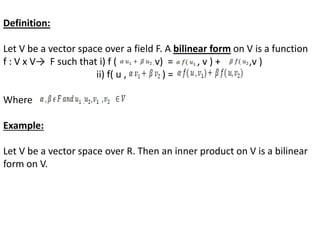
Definition:
Let V be a vector space over a field F. A bilinear form on V is a function
f : V x V→ F such that i) f ( v) = , v ) + ,v )
ii) f( u , ) =
Where
Example:
Let V be a vector space over R. Then an inner product on V is a bilinear
form on V.
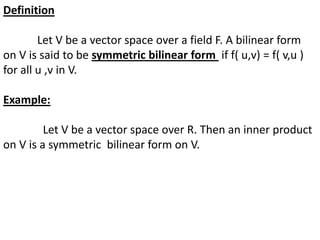
Definition
Let V be a vector space over a field F. A bilinear form
on V is said to be symmetric bilinear form if f( u,v) = f( v,u )
for all u ,v in V.
Example:
Let V be a vector space over R. Then an inner product
on V is a symmetric bilinear form on V.
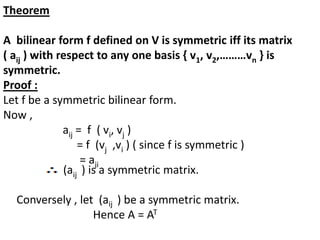
Theorem
A bilinear form f defined on V is symmetric iff its matrix
( aij ) with respect to any one basis { v1, v2,………vn } is
symmetric.
Proof :
Let f be a symmetric bilinear form.
Now ,
aij = f ( vi, vj )
= f (vj ,vi ) ( since f is symmetric )
= aji
(aij ) is a symmetric matrix.
Conversely , let (aij ) be a symmetric matrix.
Hence A = AT
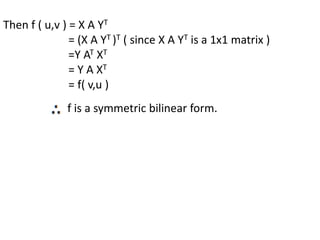
Then f ( u,v ) = X A YT
= (X A YT )T ( since X A YT is a 1x1 matrix )
=Y AT XT
= Y A XT
= f( v,u )
f is a symmetric bilinear form.
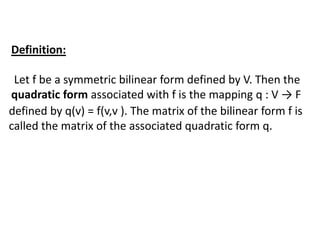
Definition:
Let f be a symmetric bilinear form defined by V. Then the
quadratic form associated with f is the mapping q : V → F
defined by q(v) = f(v,v ). The matrix of the bilinear form f is
called the matrix of the associated quadratic form q.
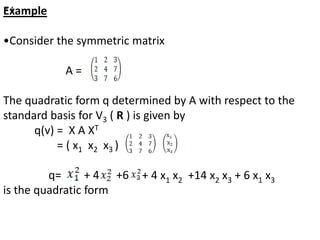
Example
•Consider the symmetric matrix
A =
The quadratic form q determined by A with respect to the
standard basis for V3 ( R ) is given by
q(v) = X A XT
= ( x1 x2 x3 )
q= + 4 +6
is the quadratic form
+ 4
+ 4 x1 x2 +14 x2 x3 + 6 x1 x3
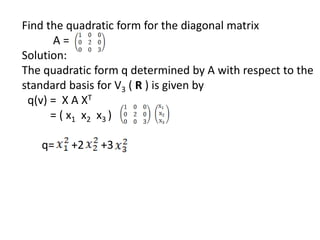
Find the quadratic form for the diagonal matrix
A =
Solution:
The quadratic form q determined by A with respect to the
standard basis for V3 ( R ) is given by
q(v) = X A XT
= ( x1 x2 x3 )
q= +2 +3
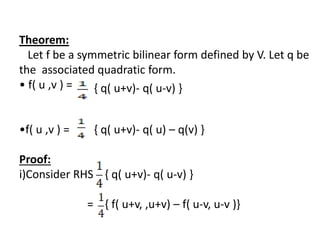
Theorem:
Let f be a symmetric bilinear form defined by V. Let q be
the associated quadratic form.
• f( u ,v ) =
•f( u ,v ) =
Proof:
i)Consider RHS { q( u+v)- q( u-v) }
= { f( u+v, ,u+v) – f( u-v, u-v )}
{ q( u+v)- q( u-v) }
{ q( u+v)- q( u) – q(v) }
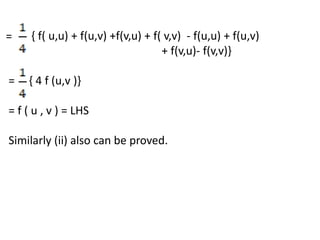
= { f( u,u) + f(u,v) +f(v,u) + f( v,v) - f(u,u) + f(u,v)
+ f(v,u)- f(v,v)}
= { 4 f (u,v )}
= f ( u , v ) = LHS
Similarly (ii) also can be proved.
Thank You

linear Algebra.pptx

  • 1.
    Bilinear forms By G.Nagalakshmi M.Sc.,M.Phil., Assistant Professor, V.V.Vanniaperumal College for Women, Virudhunagar.
  • 2.
    Definition: Let V bea vector space over a field F. A bilinear form on V is a function f : V x V→ F such that i) f ( v) = , v ) + ,v ) ii) f( u , ) = Where Example: Let V be a vector space over R. Then an inner product on V is a bilinear form on V.
  • 3.
    Definition Let V bea vector space over a field F. A bilinear form on V is said to be symmetric bilinear form if f( u,v) = f( v,u ) for all u ,v in V. Example: Let V be a vector space over R. Then an inner product on V is a symmetric bilinear form on V.
  • 4.
    Theorem A bilinear formf defined on V is symmetric iff its matrix ( aij ) with respect to any one basis { v1, v2,………vn } is symmetric. Proof : Let f be a symmetric bilinear form. Now , aij = f ( vi, vj ) = f (vj ,vi ) ( since f is symmetric ) = aji (aij ) is a symmetric matrix. Conversely , let (aij ) be a symmetric matrix. Hence A = AT
  • 5.
    Then f (u,v ) = X A YT = (X A YT )T ( since X A YT is a 1x1 matrix ) =Y AT XT = Y A XT = f( v,u ) f is a symmetric bilinear form.
  • 6.
    Definition: Let f bea symmetric bilinear form defined by V. Then the quadratic form associated with f is the mapping q : V → F defined by q(v) = f(v,v ). The matrix of the bilinear form f is called the matrix of the associated quadratic form q.
  • 7.
    Example •Consider the symmetricmatrix A = The quadratic form q determined by A with respect to the standard basis for V3 ( R ) is given by q(v) = X A XT = ( x1 x2 x3 ) q= + 4 +6 is the quadratic form + 4 + 4 x1 x2 +14 x2 x3 + 6 x1 x3
  • 8.
    Find the quadraticform for the diagonal matrix A = Solution: The quadratic form q determined by A with respect to the standard basis for V3 ( R ) is given by q(v) = X A XT = ( x1 x2 x3 ) q= +2 +3
  • 9.
    Theorem: Let f bea symmetric bilinear form defined by V. Let q be the associated quadratic form. • f( u ,v ) = •f( u ,v ) = Proof: i)Consider RHS { q( u+v)- q( u-v) } = { f( u+v, ,u+v) – f( u-v, u-v )} { q( u+v)- q( u-v) } { q( u+v)- q( u) – q(v) }
  • 10.
    = { f(u,u) + f(u,v) +f(v,u) + f( v,v) - f(u,u) + f(u,v) + f(v,u)- f(v,v)} = { 4 f (u,v )} = f ( u , v ) = LHS Similarly (ii) also can be proved.
  • 11.