Supplementary material
Compiled by M.Ed. Maria Luisa Mu, 2012-2013
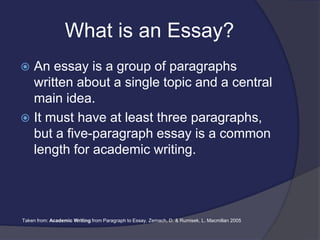
What is an Essay?
 An essay is a group of paragraphs
written about a single topic and a central
main idea.
 It must have at least three paragraphs,
but a five-paragraph essay is a common
length for academic writing.
Taken from: Academic Writing from Paragraph to Essay, Zemach, D. & Rumisek, L. Macmillan 2005
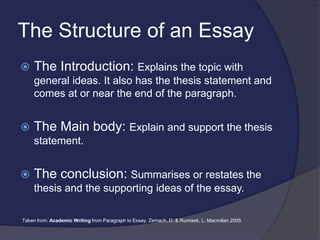
The Structure of an Essay
 The Introduction: Explains the topic with
general ideas. It also has the thesis statement and
comes at or near the end of the paragraph.
 The Main body: Explain and support the thesis
statement.
 The conclusion: Summarises or restates the
thesis and the supporting ideas of the essay.
Taken from: Academic Writing from Paragraph to Essay, Zemach, D. & Rumisek, L. Macmillan 2005
The Thesis Statement
 The thesis statement is the sentence that
tells the main idea of the whole essay.
 It can be compared to a topic sentence,
which gives the main idea of a paragraph.
 It usually comes at or near the end of the
introductory paragraph.
Taken from: Academic Writing from Paragraph to Essay, Zemach, D. & Rumisek, L. Macmillan 2005
The Introduction…
 … is usually five to ten sentences.
 … catches the reader´s interest.
 … gives the general topic of the essay.
 … gives background information about
the topic.
 … states the main point (thesis
statement) of the essay.
Taken from: Academic Writing from Paragraph to Essay, Zemach, D. & Rumisek, L. Macmillan 2005
How to make an introduction
interesting
 Include …
 …interesting facts or statistics.
 … a personal story or example.
 … an interesting quotation.
Taken from: Academic Writing from Paragraph to Essay, Zemach, D. & Rumisek, L. Macmillan 2005
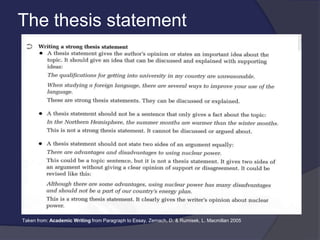
The thesis statement
Taken from: Academic Writing from Paragraph to Essay, Zemach, D. & Rumisek, L. Macmillan 2005
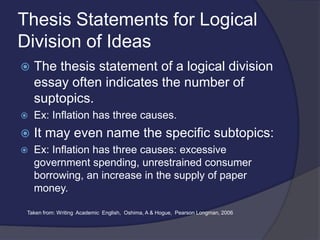
Thesis Statements for Logical
Division of Ideas
 The thesis statement of a logical division
essay often indicates the number of
suptopics.
 Ex: Inflation has three causes.
 It may even name the specific subtopics:
 Ex: Inflation has three causes: excessive
government spending, unrestrained consumer
borrowing, an increase in the supply of paper
money.
Taken from: Writing Academic English, Oshima, A & Hogue, Pearson Longman, 2006
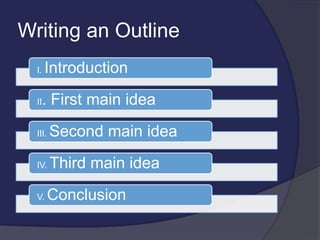
Writing an Outline
I. Introduction
II. First main idea
III. Second main idea
IV. Third main idea
V. Conclusion
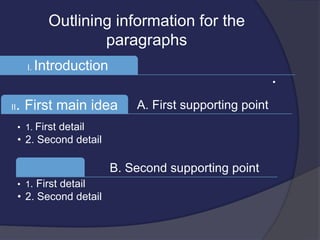
Outlining information for the
paragraphs
I. Introduction
•
A. First supporting pointII. First main idea
• 1. First detail
• 2. Second detail
B. Second supporting point
• 1. First detail
• 2. Second detail
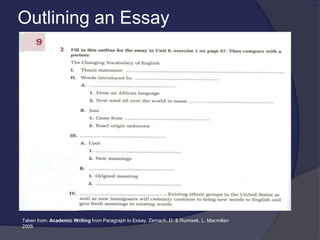
Outlining an Essay
Taken from: Academic Writing from Paragraph to Essay, Zemach, D. & Rumisek, L. Macmillan
2005
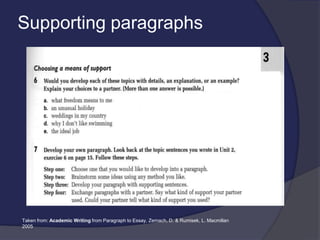
Supporting paragraphs
Taken from: Academic Writing from Paragraph to Essay, Zemach, D. & Rumisek, L. Macmillan
2005
Concluding PARAGRAPH
 The conclusion has three purposes:
 It signals the end of the essay starting
with a transition signal.
 It reminds your reader of your main
points by summarizing your subtopics or
paraphrasing your thesis.
 It leaves your reader with your final
thoughts on the topic.
Taken from: Writing Academic English, Oshima, A & Hogue, Pearson Longman, 2006
Techniques for a memorable
Conclusion:
 Make a prediction
 Suggest results or consequences
 Suggest a solution, make a
recommendation, or call for action
 Quote an authority on the topic
Taken from: Writing Academic English, Oshima, A & Hogue, Pearson Longman, 2006

Essay writing

  • 1.
    Supplementary material Compiled byM.Ed. Maria Luisa Mu, 2012-2013
  • 2.
    What is anEssay?  An essay is a group of paragraphs written about a single topic and a central main idea.  It must have at least three paragraphs, but a five-paragraph essay is a common length for academic writing. Taken from: Academic Writing from Paragraph to Essay, Zemach, D. & Rumisek, L. Macmillan 2005
  • 3.
    The Structure ofan Essay  The Introduction: Explains the topic with general ideas. It also has the thesis statement and comes at or near the end of the paragraph.  The Main body: Explain and support the thesis statement.  The conclusion: Summarises or restates the thesis and the supporting ideas of the essay. Taken from: Academic Writing from Paragraph to Essay, Zemach, D. & Rumisek, L. Macmillan 2005
  • 4.
    The Thesis Statement The thesis statement is the sentence that tells the main idea of the whole essay.  It can be compared to a topic sentence, which gives the main idea of a paragraph.  It usually comes at or near the end of the introductory paragraph. Taken from: Academic Writing from Paragraph to Essay, Zemach, D. & Rumisek, L. Macmillan 2005
  • 5.
    The Introduction…  …is usually five to ten sentences.  … catches the reader´s interest.  … gives the general topic of the essay.  … gives background information about the topic.  … states the main point (thesis statement) of the essay. Taken from: Academic Writing from Paragraph to Essay, Zemach, D. & Rumisek, L. Macmillan 2005
  • 6.
    How to makean introduction interesting  Include …  …interesting facts or statistics.  … a personal story or example.  … an interesting quotation. Taken from: Academic Writing from Paragraph to Essay, Zemach, D. & Rumisek, L. Macmillan 2005
  • 7.
    The thesis statement Takenfrom: Academic Writing from Paragraph to Essay, Zemach, D. & Rumisek, L. Macmillan 2005
  • 8.
    Thesis Statements forLogical Division of Ideas  The thesis statement of a logical division essay often indicates the number of suptopics.  Ex: Inflation has three causes.  It may even name the specific subtopics:  Ex: Inflation has three causes: excessive government spending, unrestrained consumer borrowing, an increase in the supply of paper money. Taken from: Writing Academic English, Oshima, A & Hogue, Pearson Longman, 2006
  • 9.
    Writing an Outline I.Introduction II. First main idea III. Second main idea IV. Third main idea V. Conclusion
  • 10.
    Outlining information forthe paragraphs I. Introduction • A. First supporting pointII. First main idea • 1. First detail • 2. Second detail B. Second supporting point • 1. First detail • 2. Second detail
  • 11.
    Outlining an Essay Takenfrom: Academic Writing from Paragraph to Essay, Zemach, D. & Rumisek, L. Macmillan 2005
  • 12.
    Supporting paragraphs Taken from:Academic Writing from Paragraph to Essay, Zemach, D. & Rumisek, L. Macmillan 2005
  • 13.
    Concluding PARAGRAPH  Theconclusion has three purposes:  It signals the end of the essay starting with a transition signal.  It reminds your reader of your main points by summarizing your subtopics or paraphrasing your thesis.  It leaves your reader with your final thoughts on the topic. Taken from: Writing Academic English, Oshima, A & Hogue, Pearson Longman, 2006
  • 14.
    Techniques for amemorable Conclusion:  Make a prediction  Suggest results or consequences  Suggest a solution, make a recommendation, or call for action  Quote an authority on the topic Taken from: Writing Academic English, Oshima, A & Hogue, Pearson Longman, 2006