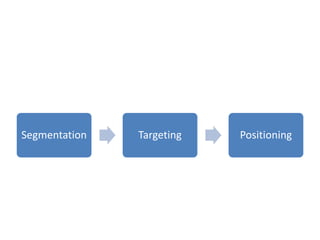
Segmentation Targeting Positioning
Market Segmentation
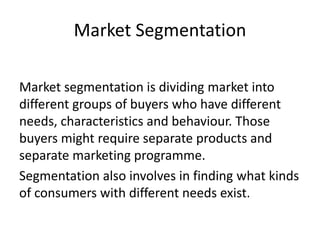
Market segmentation is dividing market into
different groups of buyers who have different
needs, characteristics and behaviour. Those
buyers might require separate products and
separate marketing programme.
Segmentation also involves in finding what kinds
of consumers with different needs exist.
Segmentation (cont…)
Processed involved in Segmentation
1.Identify the existing and future wants in the
current market
2.Examine the attributes that distinguish the
segments
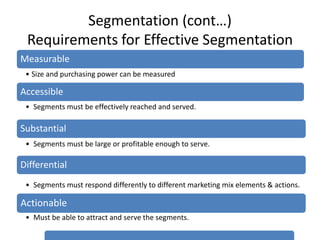
Segmentation (cont…)
Requirements for Effective Segmentation
Measurable
• Size and purchasing power can be measured
Accessible
• Segments must be effectively reached and served.
Substantial
• Segments must be large or profitable enough to serve.
Differential
• Segments must respond differently to different marketing mix elements & actions.
Actionable
• Must be able to attract and serve the segments.
Steps of segmentation
• Segmenting customer on geographic Biases
• Segmenting customer on demographic biases
• Segmenting customer on physiographic biases
• segmenting customer on behavioural biases
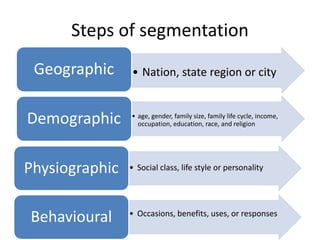
Steps of segmentation
• Nation, state region or cityGeographic
• age, gender, family size, family life cycle, income,
occupation, education, race, and religionDemographic
• Social class, life style or personalityPhysiographic
• Occasions, benefits, uses, or responses
Behavioural
Geographic segmentation
Devide different markets into different geographic units
• World Region or Country: North America, Western
Europe, European Union, Pacific Rim, Mexico, etc.
• Country Region: Pacific, Mountain, East Coast, etc.
• City or Metro Size: New York, San Francisco
• Population Density: rural, suburban, urban
• Climate: northern, southern, tropical, semi-tropical
Demographic segmentation
In demographic segmentation company divide
customers on the biases of.
age, gender, family size, family life cycle, income,
occupation, education, race, and religion.
Psychographic Segmentation
Psychographic segmentation divides a market
into different groups based on social class,
lifestyle, or personality characteristics.
The purpose of psychographic segmentation is
that people in same demographic segment have
different lifestyle and personality and they
demand different types of products
Behavioural segmentation
In behavioural segmentation customers are
divided into different groups on the basis of
Occasions or benefits etc.
-Occasions:
Different products are made for
different occasions.
-Benefits:
Different segments desire different
benefits from same products
Targeting
A company after defining its market segments,
company can enter in one or many segment.
Market targeting is the process of evaluating
each segment and selecting one or more
segments.
company select the most best segment to
target.
Targeting
Targeting can also defined as a group of people
for which an organization is created and offer its
products.
Positioning
Positioning is Placing a product in target
consumers minds relative to competing
products.
Positioning example
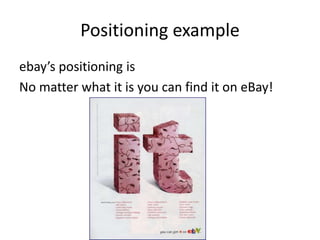
ebay’s positioning is
No matter what it is you can find it on eBay!
Positioning
Positioning is all
about
perception.
What people think about your product
Types of positioning
Attribute positioning
Size or number of years of existence of your
company
Types of positioning
Benefit positioning
Product is positioned as the leader in a certain
benefit.
for example Hyundai santro positioned its cars
as
“Simplest car to drive”
Types of positioning
Use or Application positioning
Positioning the product as best for use and
application .
Example: dowlance positioned its products as
“Dowlance reliable hai”
Telenor positioning is
“Telenor the smart call”
Types of positioning
Competitor positioning
The product claims to be better in some way
than a particular competitor .
Types of positioning
Quality and price positioning
The product is positioned as it is offering the
best price and best quality .
Example Big Bazar
REAL WORLD
EXAMPLE OF STP
The Coca-Cola company
The coca-cola company
Introduction
Coca Cola Company is the world’s leading
manufacturer, marketer, and distributor of soft
drinks. Coca Cola has more than 400 different
products line, total of 3,500 product mix.
segmentation
Coca-cola divide its customers on the basis of
• Geographic segmentation
• Demographic segmentation
• Psychographics segmentation
Geographic segmentation
On geographic basis coca-cola divide its
customers on the basis of age, group and
lifestyle etc. for example
- Oasis Juice made for the younger working
adults, between the ages of 20-30.
- Diet Coca-Cola targets adults between 30-50
who are health conscious but want the taste.
Geographic segmentation (cont…)
- Coca-Cola Zero targets teens that don't want
calories but want the taste
- Powerade sport drink targets athletes
between 13-27 ages
Geographic segmentation (cont…)
- Coca-cola 60% consumption is in summer and
40% in winter. Therefore company sales are
higher in summer. Therefore company focus in
hot areas in the world.
Demographic segmentation
• Age- 15-40 years old and also included 40
plus.
• Gender- targets both genders with wide
variety drinks.
• Income segments different income level. for
example by packaging for low level income the
company is selling returnable glass bottle for
high level income the company is selling coke
in tins.
Psychographics segmentation
- People who are brand conscious will not drink
less known brands. They will drink Coca-Cola
because it is a well known brand.
- Because Coca Cola is a recognized world brand,
people will drink it without hesitate.
Targeting
• Age : Coca-cola do not target any particular
age group but the main consumers are 12-30
year old people. Coca-cola main target is
youngsters.
• Gender : coca-cola do not produce its
products for an specific gender a research
shows that both genders use and like its
products almost 50/50
Targeting (cont…)
• Life style : no particular life style is targeted
but the most busy and mobile generation is
considered the most important consumer.
• Occupation : no occupation is targeted but
consumers are mainly students.
Positioning
Coca Cola has positioned itself within the world
soft drink market. Because it is working over 200
countries it was not possible to maintain this
positioning. They want to use a positioning to
give same image all around the world for this
purpose coca-cola made positioning as “Live on
the coke side of life”,.
Positioning (cont…)
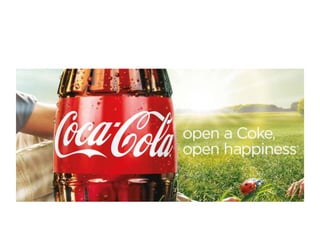
Coca-cola’s another positioning is “open
happiness” related to joy and happiness.
Now all around the world when the name of
Coke is mentioned the first thing that comes
into mind is fun and entertainment
Segmentation, targeting and positioning with example cocacola company

Segmentation, targeting and positioning with example cocacola company

  • 4.
  • 5.
    Market Segmentation Market segmentationis dividing market into different groups of buyers who have different needs, characteristics and behaviour. Those buyers might require separate products and separate marketing programme. Segmentation also involves in finding what kinds of consumers with different needs exist.
  • 6.
    Segmentation (cont…) Processed involvedin Segmentation 1.Identify the existing and future wants in the current market 2.Examine the attributes that distinguish the segments
  • 7.
    Segmentation (cont…) Requirements forEffective Segmentation Measurable • Size and purchasing power can be measured Accessible • Segments must be effectively reached and served. Substantial • Segments must be large or profitable enough to serve. Differential • Segments must respond differently to different marketing mix elements & actions. Actionable • Must be able to attract and serve the segments.
  • 8.
    Steps of segmentation •Segmenting customer on geographic Biases • Segmenting customer on demographic biases • Segmenting customer on physiographic biases • segmenting customer on behavioural biases
  • 9.
    Steps of segmentation •Nation, state region or cityGeographic • age, gender, family size, family life cycle, income, occupation, education, race, and religionDemographic • Social class, life style or personalityPhysiographic • Occasions, benefits, uses, or responses Behavioural
  • 10.
    Geographic segmentation Devide differentmarkets into different geographic units • World Region or Country: North America, Western Europe, European Union, Pacific Rim, Mexico, etc. • Country Region: Pacific, Mountain, East Coast, etc. • City or Metro Size: New York, San Francisco • Population Density: rural, suburban, urban • Climate: northern, southern, tropical, semi-tropical
  • 11.
    Demographic segmentation In demographicsegmentation company divide customers on the biases of. age, gender, family size, family life cycle, income, occupation, education, race, and religion.
  • 12.
    Psychographic Segmentation Psychographic segmentationdivides a market into different groups based on social class, lifestyle, or personality characteristics. The purpose of psychographic segmentation is that people in same demographic segment have different lifestyle and personality and they demand different types of products
  • 13.
    Behavioural segmentation In behaviouralsegmentation customers are divided into different groups on the basis of Occasions or benefits etc. -Occasions: Different products are made for different occasions. -Benefits: Different segments desire different benefits from same products
  • 14.
    Targeting A company afterdefining its market segments, company can enter in one or many segment. Market targeting is the process of evaluating each segment and selecting one or more segments. company select the most best segment to target.
  • 15.
    Targeting Targeting can alsodefined as a group of people for which an organization is created and offer its products.
  • 16.
    Positioning Positioning is Placinga product in target consumers minds relative to competing products.
  • 17.
    Positioning example ebay’s positioningis No matter what it is you can find it on eBay!
  • 18.
  • 19.
    Types of positioning Attributepositioning Size or number of years of existence of your company
  • 20.
    Types of positioning Benefitpositioning Product is positioned as the leader in a certain benefit. for example Hyundai santro positioned its cars as “Simplest car to drive”
  • 21.
    Types of positioning Useor Application positioning Positioning the product as best for use and application . Example: dowlance positioned its products as “Dowlance reliable hai” Telenor positioning is “Telenor the smart call”
  • 22.
    Types of positioning Competitorpositioning The product claims to be better in some way than a particular competitor .
  • 23.
    Types of positioning Qualityand price positioning The product is positioned as it is offering the best price and best quality . Example Big Bazar
  • 24.
    REAL WORLD EXAMPLE OFSTP The Coca-Cola company
  • 26.
    The coca-cola company Introduction CocaCola Company is the world’s leading manufacturer, marketer, and distributor of soft drinks. Coca Cola has more than 400 different products line, total of 3,500 product mix.
  • 27.
    segmentation Coca-cola divide itscustomers on the basis of • Geographic segmentation • Demographic segmentation • Psychographics segmentation
  • 28.
    Geographic segmentation On geographicbasis coca-cola divide its customers on the basis of age, group and lifestyle etc. for example - Oasis Juice made for the younger working adults, between the ages of 20-30. - Diet Coca-Cola targets adults between 30-50 who are health conscious but want the taste.
  • 29.
    Geographic segmentation (cont…) -Coca-Cola Zero targets teens that don't want calories but want the taste - Powerade sport drink targets athletes between 13-27 ages
  • 30.
    Geographic segmentation (cont…) -Coca-cola 60% consumption is in summer and 40% in winter. Therefore company sales are higher in summer. Therefore company focus in hot areas in the world.
  • 31.
    Demographic segmentation • Age-15-40 years old and also included 40 plus. • Gender- targets both genders with wide variety drinks. • Income segments different income level. for example by packaging for low level income the company is selling returnable glass bottle for high level income the company is selling coke in tins.
  • 32.
    Psychographics segmentation - Peoplewho are brand conscious will not drink less known brands. They will drink Coca-Cola because it is a well known brand. - Because Coca Cola is a recognized world brand, people will drink it without hesitate.
  • 33.
    Targeting • Age :Coca-cola do not target any particular age group but the main consumers are 12-30 year old people. Coca-cola main target is youngsters. • Gender : coca-cola do not produce its products for an specific gender a research shows that both genders use and like its products almost 50/50
  • 34.
    Targeting (cont…) • Lifestyle : no particular life style is targeted but the most busy and mobile generation is considered the most important consumer. • Occupation : no occupation is targeted but consumers are mainly students.
  • 35.
    Positioning Coca Cola haspositioned itself within the world soft drink market. Because it is working over 200 countries it was not possible to maintain this positioning. They want to use a positioning to give same image all around the world for this purpose coca-cola made positioning as “Live on the coke side of life”,.
  • 37.
    Positioning (cont…) Coca-cola’s anotherpositioning is “open happiness” related to joy and happiness. Now all around the world when the name of Coke is mentioned the first thing that comes into mind is fun and entertainment