Market Segmentation
Dr. Md Rizwan Alam
Prof.-Marketing and IB
1
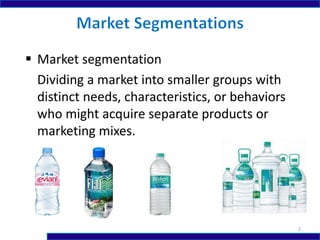
 Market segmentation
Dividing a market into smaller groups with
distinct needs, characteristics, or behaviors
who might acquire separate products or
marketing mixes.
2
 Demographic
 Geographic
 Psychographic
 Behavioral
Types of Market Segmentation
3
 Demographic Segmentation:
Dividing a market into groups based on variables
such as age, gender, family size, family lifecycle,
income, occupation, education, religion, race,
generation, and nationality.
Variables:
age: under 6,-11,12-19,20-34,35-49,50-64,65+
ex. Barbie, lady brid, BMW, laughter society
Task: list the brands for various age groups.
Demographic Segmentation
4
Gender: male, female
e.g. L’Oreal offers Men’s expert , Nivea Man
skin care, Nike with woman’s store
Family size: 1-2,3-4,5+
Family life cycle: young, single, married, no
children, married with children, older etc.
Eg. Housing, Automobiles
Income: Under $10,000;$10000- 20,000,etc.credit
cards holder, Cross Pen, Mont Blanc Pen
Occupation: professional and technical
Education: some high SSC, some Masters
Religion: Muslim, Christian, Eg. Mecca Cola, Pak
Race: Asian, Hispanic, Black, and White, eg. barbie
5
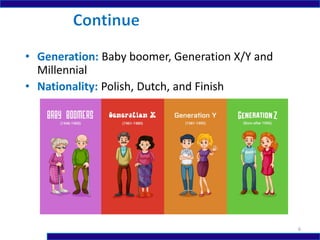
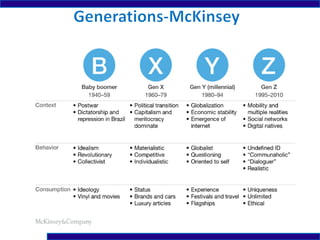
• Generation: Baby boomer, Generation X/Y and
Millennial
• Nationality: Polish, Dutch, and Finish
6
.
7
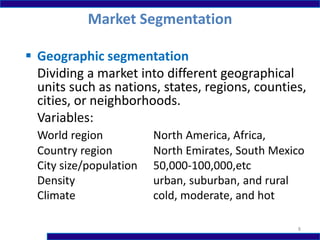
 Geographic segmentation
Dividing a market into different geographical
units such as nations, states, regions, counties,
cities, or neighborhoods.
Variables:
World region North America, Africa,
Country region North Emirates, South Mexico
City size/population 50,000-100,000,etc
Density urban, suburban, and rural
Climate cold, moderate, and hot
Market Segmentation
8
Market Segmentation
9
Geographic segmentation calls for dividing the
market into different geographical units such as
nations, states, regions, counties, cities, or
neighborhoods
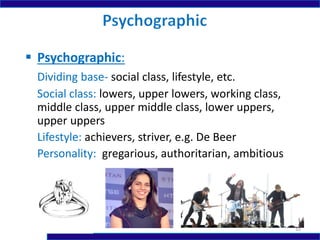
 Psychographic:
Dividing base- social class, lifestyle, etc.
Social class: lowers, upper lowers, working class,
middle class, upper middle class, lower uppers,
upper uppers
Lifestyle: achievers, striver, e.g. De Beer
Personality: gregarious, authoritarian, ambitious
10
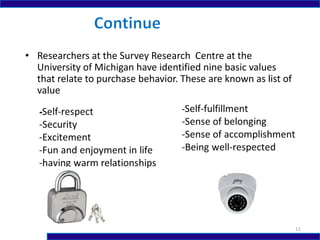
• Researchers at the Survey Research Centre at the
University of Michigan have identified nine basic values
that relate to purchase behavior. These are known as list of
value
11
12
 Behavioral
Occasion: Regular occasion, special occasion like
Eid, Easter, Valentine’s Day
Benefits: quality, service, economy, convenience,
speed, e.g. Laptop, iPod, Dettol Saop, toothpaste
User status: ex-user, potential user, first time user,
regular user,
User rates: light user, medium user, heavy user
also known as heavy half.
13
e.g. Burger King targets young population (age 18-
34) ,’super fans’ who account for almost half of all
customer visits.
• Loyalty status: none, medium, strong, absolute.
• Readiness stage: unaware, aware, inform,
interested, desirous, intending to buy,
• Attitude towards product: enthusiastic, positive,
indifferent, negative, hostile.
e.g. iPad, Mont Blanc
14
15
16
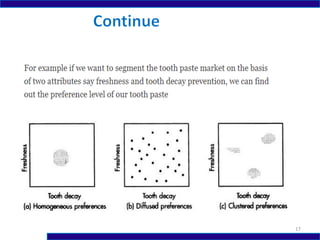
17
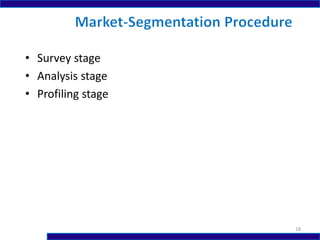
• Survey stage
• Analysis stage
• Profiling stage
18
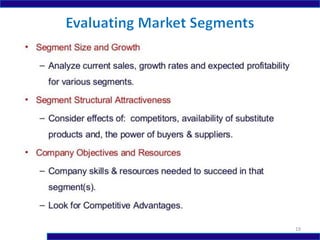
19
In targeting, the marketers evaluate the
attractiveness of each potential segment and decide
which of these groups they will invest resources
against to try to turn them into customers. The
customer group or groups selected are the firm’s
target market.
20
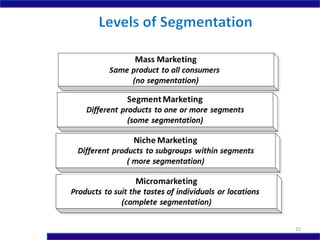
 Mass marketing/Undifferentiated
 Niche/Concentrated
 Multiples segment/differentiated
 Custom Marketing strategy
 Mass customization
21
 Aggregation strategy or undifferentiated (mass)
marketing is characterized by the following
elements:
- shotgun approach
- single segment
- marketing offerings-single product
- communication-single common program
- size
- cost minimization
e.g. staple products like salt and sugar
Target-Market Strategies
22
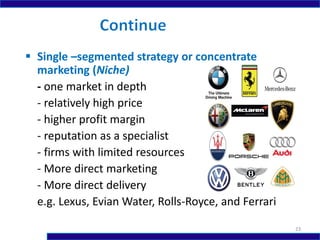
 Single –segmented strategy or concentrate
marketing (Niche)
- one market in depth
- relatively high price
- higher profit margin
- reputation as a specialist
- firms with limited resources
- More direct marketing
- More direct delivery
e.g. Lexus, Evian Water, Rolls-Royce, and Ferrari
23
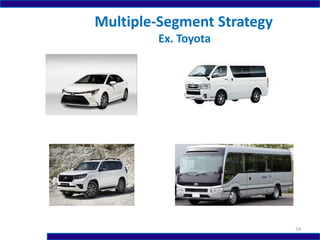
Multiple-Segment Strategy
Ex. Toyota
24
• Multiple-Segment/differentiated strategy
Under a multiple strategy, two or more different
groups of potentials customers are identified as target
markets. A separate marketing mix is developed to
reach each targeted segment.
e.g., Toyota Motors
- a greater sales volume
- useful for versatile customers
- helps to maintain status quo
- trades off economic cycles
Drawbacks:
- costly both in production and distribution
- difficult to fully penetrate
25
- a greater sales volume
- useful for versatile customers
- helps to maintain status quo
- trades off economic cycles
Drawbacks:
- costly both in production and distribution
- difficult to fully penetrate
26
• Custom marketing strategy: a marketing strategy
in which a firm develops a separate marketing mix
for each customer.
• Ex. HNI for bankers and Insurance companies
27
• Mass customisation: a marketing strategy in
which a firm modifies a basic good or service to
meet an individual customer’s needs.
Ex. The custom made sports shoes of NikeID cost just 20%
more than the shoes made from mass production.
Customers can get their name and photo printed on
the shoes to get personalized shoes.
Dell Computers company is one of the oldest and popular
examples of mass customization. Dell company started it’s
with the concept of mass customization. You can choose
the components that you want to include in your
computer and get your computer assembled as you want.
28
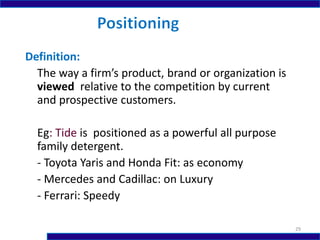
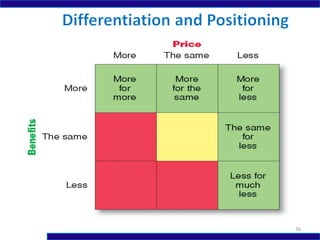
Definition:
The way a firm’s product, brand or organization is
viewed relative to the competition by current
and prospective customers.
Eg: Tide is positioned as a powerful all purpose
family detergent.
- Toyota Yaris and Honda Fit: as economy
- Mercedes and Cadillac: on Luxury
- Ferrari: Speedy
29
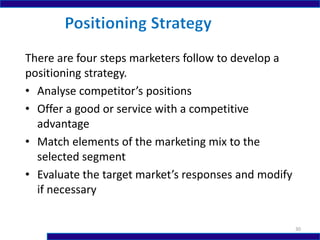
There are four steps marketers follow to develop a
positioning strategy.
• Analyse competitor’s positions
• Offer a good or service with a competitive
advantage
• Match elements of the marketing mix to the
selected segment
• Evaluate the target market’s responses and modify
if necessary
30
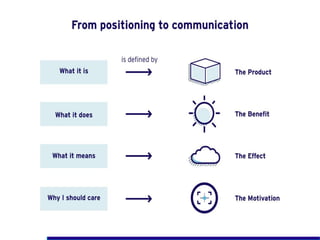
31
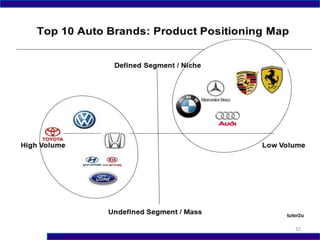
32
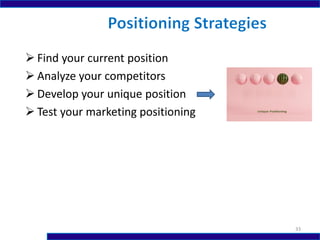
 Find your current position
 Analyze your competitors
 Develop your unique position
 Test your marketing positioning
33
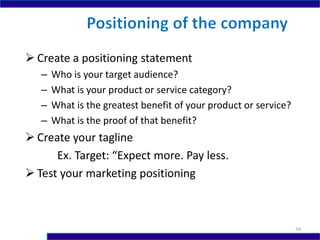
 Create a positioning statement
– Who is your target audience?
– What is your product or service category?
– What is the greatest benefit of your product or service?
– What is the proof of that benefit?
 Create your tagline
Ex. Target: “Expect more. Pay less.
 Test your marketing positioning
34
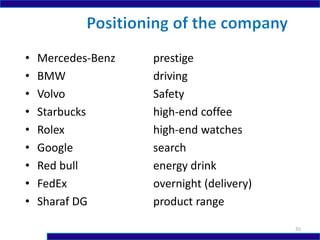
• Mercedes-Benz prestige
• BMW driving
• Volvo Safety
• Starbucks high-end coffee
• Rolex high-end watches
• Google search
• Red bull energy drink
• FedEx overnight (delivery)
• Sharaf DG product range
35
36
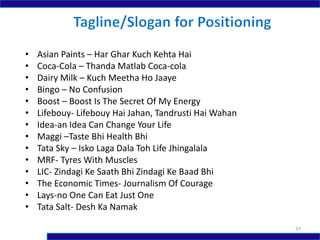
• Asian Paints – Har Ghar Kuch Kehta Hai
• Coca-Cola – Thanda Matlab Coca-cola
• Dairy Milk – Kuch Meetha Ho Jaaye
• Bingo – No Confusion
• Boost – Boost Is The Secret Of My Energy
• Lifebouy- Lifebouy Hai Jahan, Tandrusti Hai Wahan
• Idea-an Idea Can Change Your Life
• Maggi –Taste Bhi Health Bhi
• Tata Sky – Isko Laga Dala Toh Life Jhingalala
• MRF- Tyres With Muscles
• LIC- Zindagi Ke Saath Bhi Zindagi Ke Baad Bhi
• The Economic Times- Journalism Of Courage
• Lays-no One Can Eat Just One
• Tata Salt- Desh Ka Namak
37
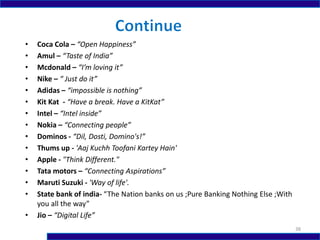
• Coca Cola – “Open Happiness”
• Amul – “Taste of India”
• Mcdonald – “I’m loving it”
• Nike – “ Just do it”
• Adidas – “impossible is nothing”
• Kit Kat - “Have a break. Have a KitKat”
• Intel – “Intel inside”
• Nokia – “Connecting people”
• Dominos - “Dil, Dosti, Domino's!”
• Thums up - 'Aaj Kuchh Toofani Kartey Hain'
• Apple - "Think Different."
• Tata motors – “Connecting Aspirations”
• Maruti Suzuki - 'Way of life'.
• State bank of india- “The Nation banks on us ;Pure Banking Nothing Else ;With
you all the way”
• Jio – “Digital Life”
38
39
40
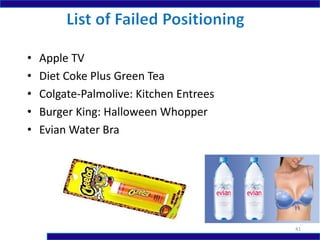
• Apple TV
• Diet Coke Plus Green Tea
• Colgate-Palmolive: Kitchen Entrees
• Burger King: Halloween Whopper
• Evian Water Bra
41
42
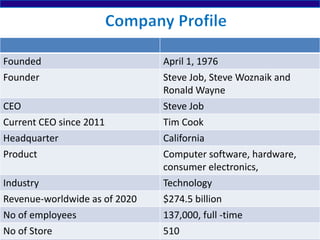
Founded April 1, 1976
Founder Steve Job, Steve Woznaik and
Ronald Wayne
CEO Steve Job
Current CEO since 2011 Tim Cook
Headquarter California
Product Computer software, hardware,
consumer electronics,
Industry Technology
Revenue-worldwide as of 2020 $274.5 billion
No of employees 137,000, full -time
No of Store 510
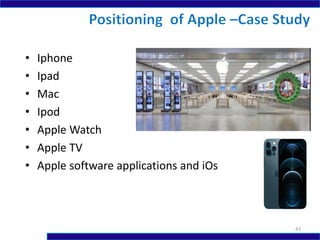
• Iphone
• Ipad
• Mac
• Ipod
• Apple Watch
• Apple TV
• Apple software applications and iOs
43
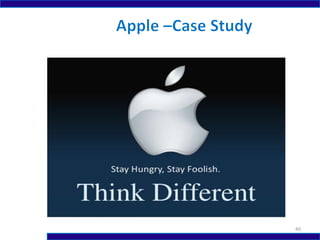
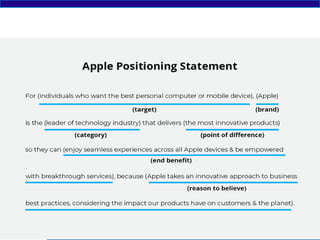
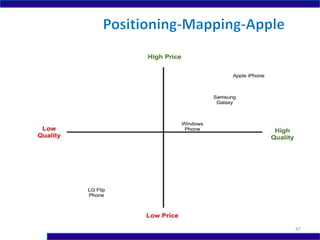
• Apple in general is positioned as a premium
product.
• Apple products are generally priced higher than
competition.
• This position has helped Apple a lot as it avoids
getting into price war. Instead of competing on
price, Apple can now compete on innovation and
unique value propositions.
44
• “Simple is different” – no overdoing in its product
design.
• Ex. From colorful iMac’s to iPods, iPhones, and iPads –
Apple has always added elegance to simplicity and this
is what has been liked by the customers and has
worked wonders for the brand.
• There is a popular saying that Simple is stylish
• positioning around three core tenets:
-Simplicity
-Creativity
-Humanity
45
46
47
48
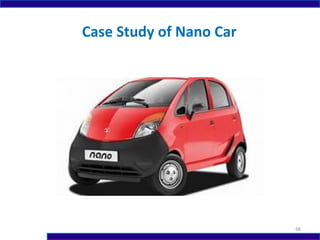
Case Study of Nano Car
• What is segmentation?
• What is the purpose of segmentation?
• Which one of the segmentations is mostly used?
• Which segmentation is more complex and
challenging?
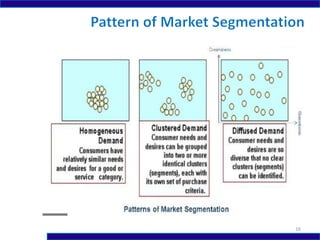
• Describe the patterns of segmentation.
• What is positioning?
• What is the purpose of positioning?
• Can you recall any ten tag lines?
• Why tagline is used by a company? Discuss.
49
Generations
https://www.mckinsey.com/industries/consumer-packaged-goods/our-
insights/true-gen-generation-z-and-its-implications-for-companies#
Positioning
https://learn.marsdd.com/article/positioning-creating-an-image-of-your
product-in-your-target-customers-mind/
Top 10 Failed Products From Famous Companies
https://listverse.com/2021/04/19/top-10-failed-products-from-famous-
companies/
Apple’s Positioning
http://arunkottolli.blogspot.com/2011/07/apples-market-
positioning.html#:~:text=Apple%20in%20general%20is%20positioned,i
nnovation%20and%20unique%20value%20propositions.
http://mybrandsquad.com/understand-the-brand-positioning-of-apple/
50
Case Study-Brand Positioning | Brand Repositioning | FMCG
Marketing | Sandeep Ray
https://www.youtube.com/watch?v=fWmMa8FGR4Q
Brand Analysis Presentation - Red Bull
https://www.youtube.com/watch?v=CBUANbspmZk
51
52

Market segmentation...STP 2021

  • 1.
    Market Segmentation Dr. MdRizwan Alam Prof.-Marketing and IB 1
  • 2.
     Market segmentation Dividinga market into smaller groups with distinct needs, characteristics, or behaviors who might acquire separate products or marketing mixes. 2
  • 3.
     Demographic  Geographic Psychographic  Behavioral Types of Market Segmentation 3
  • 4.
     Demographic Segmentation: Dividinga market into groups based on variables such as age, gender, family size, family lifecycle, income, occupation, education, religion, race, generation, and nationality. Variables: age: under 6,-11,12-19,20-34,35-49,50-64,65+ ex. Barbie, lady brid, BMW, laughter society Task: list the brands for various age groups. Demographic Segmentation 4
  • 5.
    Gender: male, female e.g.L’Oreal offers Men’s expert , Nivea Man skin care, Nike with woman’s store Family size: 1-2,3-4,5+ Family life cycle: young, single, married, no children, married with children, older etc. Eg. Housing, Automobiles Income: Under $10,000;$10000- 20,000,etc.credit cards holder, Cross Pen, Mont Blanc Pen Occupation: professional and technical Education: some high SSC, some Masters Religion: Muslim, Christian, Eg. Mecca Cola, Pak Race: Asian, Hispanic, Black, and White, eg. barbie 5
  • 6.
    • Generation: Babyboomer, Generation X/Y and Millennial • Nationality: Polish, Dutch, and Finish 6
  • 7.
  • 8.
     Geographic segmentation Dividinga market into different geographical units such as nations, states, regions, counties, cities, or neighborhoods. Variables: World region North America, Africa, Country region North Emirates, South Mexico City size/population 50,000-100,000,etc Density urban, suburban, and rural Climate cold, moderate, and hot Market Segmentation 8
  • 9.
    Market Segmentation 9 Geographic segmentationcalls for dividing the market into different geographical units such as nations, states, regions, counties, cities, or neighborhoods
  • 10.
     Psychographic: Dividing base-social class, lifestyle, etc. Social class: lowers, upper lowers, working class, middle class, upper middle class, lower uppers, upper uppers Lifestyle: achievers, striver, e.g. De Beer Personality: gregarious, authoritarian, ambitious 10
  • 11.
    • Researchers atthe Survey Research Centre at the University of Michigan have identified nine basic values that relate to purchase behavior. These are known as list of value 11
  • 12.
  • 13.
     Behavioral Occasion: Regularoccasion, special occasion like Eid, Easter, Valentine’s Day Benefits: quality, service, economy, convenience, speed, e.g. Laptop, iPod, Dettol Saop, toothpaste User status: ex-user, potential user, first time user, regular user, User rates: light user, medium user, heavy user also known as heavy half. 13
  • 14.
    e.g. Burger Kingtargets young population (age 18- 34) ,’super fans’ who account for almost half of all customer visits. • Loyalty status: none, medium, strong, absolute. • Readiness stage: unaware, aware, inform, interested, desirous, intending to buy, • Attitude towards product: enthusiastic, positive, indifferent, negative, hostile. e.g. iPad, Mont Blanc 14
  • 15.
  • 16.
  • 17.
  • 18.
    • Survey stage •Analysis stage • Profiling stage 18
  • 19.
  • 20.
    In targeting, themarketers evaluate the attractiveness of each potential segment and decide which of these groups they will invest resources against to try to turn them into customers. The customer group or groups selected are the firm’s target market. 20
  • 21.
     Mass marketing/Undifferentiated Niche/Concentrated  Multiples segment/differentiated  Custom Marketing strategy  Mass customization 21
  • 22.
     Aggregation strategyor undifferentiated (mass) marketing is characterized by the following elements: - shotgun approach - single segment - marketing offerings-single product - communication-single common program - size - cost minimization e.g. staple products like salt and sugar Target-Market Strategies 22
  • 23.
     Single –segmentedstrategy or concentrate marketing (Niche) - one market in depth - relatively high price - higher profit margin - reputation as a specialist - firms with limited resources - More direct marketing - More direct delivery e.g. Lexus, Evian Water, Rolls-Royce, and Ferrari 23
  • 24.
  • 25.
    • Multiple-Segment/differentiated strategy Undera multiple strategy, two or more different groups of potentials customers are identified as target markets. A separate marketing mix is developed to reach each targeted segment. e.g., Toyota Motors - a greater sales volume - useful for versatile customers - helps to maintain status quo - trades off economic cycles Drawbacks: - costly both in production and distribution - difficult to fully penetrate 25
  • 26.
    - a greatersales volume - useful for versatile customers - helps to maintain status quo - trades off economic cycles Drawbacks: - costly both in production and distribution - difficult to fully penetrate 26
  • 27.
    • Custom marketingstrategy: a marketing strategy in which a firm develops a separate marketing mix for each customer. • Ex. HNI for bankers and Insurance companies 27
  • 28.
    • Mass customisation:a marketing strategy in which a firm modifies a basic good or service to meet an individual customer’s needs. Ex. The custom made sports shoes of NikeID cost just 20% more than the shoes made from mass production. Customers can get their name and photo printed on the shoes to get personalized shoes. Dell Computers company is one of the oldest and popular examples of mass customization. Dell company started it’s with the concept of mass customization. You can choose the components that you want to include in your computer and get your computer assembled as you want. 28
  • 29.
    Definition: The way afirm’s product, brand or organization is viewed relative to the competition by current and prospective customers. Eg: Tide is positioned as a powerful all purpose family detergent. - Toyota Yaris and Honda Fit: as economy - Mercedes and Cadillac: on Luxury - Ferrari: Speedy 29
  • 30.
    There are foursteps marketers follow to develop a positioning strategy. • Analyse competitor’s positions • Offer a good or service with a competitive advantage • Match elements of the marketing mix to the selected segment • Evaluate the target market’s responses and modify if necessary 30
  • 31.
  • 32.
  • 33.
     Find yourcurrent position  Analyze your competitors  Develop your unique position  Test your marketing positioning 33
  • 34.
     Create apositioning statement – Who is your target audience? – What is your product or service category? – What is the greatest benefit of your product or service? – What is the proof of that benefit?  Create your tagline Ex. Target: “Expect more. Pay less.  Test your marketing positioning 34
  • 35.
    • Mercedes-Benz prestige •BMW driving • Volvo Safety • Starbucks high-end coffee • Rolex high-end watches • Google search • Red bull energy drink • FedEx overnight (delivery) • Sharaf DG product range 35
  • 36.
  • 37.
    • Asian Paints– Har Ghar Kuch Kehta Hai • Coca-Cola – Thanda Matlab Coca-cola • Dairy Milk – Kuch Meetha Ho Jaaye • Bingo – No Confusion • Boost – Boost Is The Secret Of My Energy • Lifebouy- Lifebouy Hai Jahan, Tandrusti Hai Wahan • Idea-an Idea Can Change Your Life • Maggi –Taste Bhi Health Bhi • Tata Sky – Isko Laga Dala Toh Life Jhingalala • MRF- Tyres With Muscles • LIC- Zindagi Ke Saath Bhi Zindagi Ke Baad Bhi • The Economic Times- Journalism Of Courage • Lays-no One Can Eat Just One • Tata Salt- Desh Ka Namak 37
  • 38.
    • Coca Cola– “Open Happiness” • Amul – “Taste of India” • Mcdonald – “I’m loving it” • Nike – “ Just do it” • Adidas – “impossible is nothing” • Kit Kat - “Have a break. Have a KitKat” • Intel – “Intel inside” • Nokia – “Connecting people” • Dominos - “Dil, Dosti, Domino's!” • Thums up - 'Aaj Kuchh Toofani Kartey Hain' • Apple - "Think Different." • Tata motors – “Connecting Aspirations” • Maruti Suzuki - 'Way of life'. • State bank of india- “The Nation banks on us ;Pure Banking Nothing Else ;With you all the way” • Jio – “Digital Life” 38
  • 39.
  • 40.
  • 41.
    • Apple TV •Diet Coke Plus Green Tea • Colgate-Palmolive: Kitchen Entrees • Burger King: Halloween Whopper • Evian Water Bra 41
  • 42.
    42 Founded April 1,1976 Founder Steve Job, Steve Woznaik and Ronald Wayne CEO Steve Job Current CEO since 2011 Tim Cook Headquarter California Product Computer software, hardware, consumer electronics, Industry Technology Revenue-worldwide as of 2020 $274.5 billion No of employees 137,000, full -time No of Store 510
  • 43.
    • Iphone • Ipad •Mac • Ipod • Apple Watch • Apple TV • Apple software applications and iOs 43
  • 44.
    • Apple ingeneral is positioned as a premium product. • Apple products are generally priced higher than competition. • This position has helped Apple a lot as it avoids getting into price war. Instead of competing on price, Apple can now compete on innovation and unique value propositions. 44
  • 45.
    • “Simple isdifferent” – no overdoing in its product design. • Ex. From colorful iMac’s to iPods, iPhones, and iPads – Apple has always added elegance to simplicity and this is what has been liked by the customers and has worked wonders for the brand. • There is a popular saying that Simple is stylish • positioning around three core tenets: -Simplicity -Creativity -Humanity 45
  • 46.
  • 47.
  • 48.
  • 49.
    • What issegmentation? • What is the purpose of segmentation? • Which one of the segmentations is mostly used? • Which segmentation is more complex and challenging? • Describe the patterns of segmentation. • What is positioning? • What is the purpose of positioning? • Can you recall any ten tag lines? • Why tagline is used by a company? Discuss. 49
  • 50.
    Generations https://www.mckinsey.com/industries/consumer-packaged-goods/our- insights/true-gen-generation-z-and-its-implications-for-companies# Positioning https://learn.marsdd.com/article/positioning-creating-an-image-of-your product-in-your-target-customers-mind/ Top 10 FailedProducts From Famous Companies https://listverse.com/2021/04/19/top-10-failed-products-from-famous- companies/ Apple’s Positioning http://arunkottolli.blogspot.com/2011/07/apples-market- positioning.html#:~:text=Apple%20in%20general%20is%20positioned,i nnovation%20and%20unique%20value%20propositions. http://mybrandsquad.com/understand-the-brand-positioning-of-apple/ 50
  • 51.
    Case Study-Brand Positioning| Brand Repositioning | FMCG Marketing | Sandeep Ray https://www.youtube.com/watch?v=fWmMa8FGR4Q Brand Analysis Presentation - Red Bull https://www.youtube.com/watch?v=CBUANbspmZk 51
  • 52.