SEGMENTATION TARGETING
POSITIONONG
Mukul Kumar Shrivastava
Assistant Professor
Topics of Discussion
Concept of Marketing 01
02
04
Differentiation in Segmentation
05
STP(Segmentation/Targeting/
Positioning)
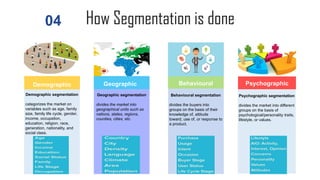
How Segmentation is done
06
Examples of Segmentation
Importance of Segmentation 07
Concept of Targeting 08
What is segmentation 03
Types of Targeting
Positioning
09
10
Positioning Factors
Benefits of STP
11
12
Concept of Marketing
01
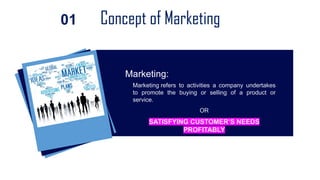
Marketing refers to activities a company undertakes
to promote the buying or selling of a product or
service.
OR
SATISFYING CUSTOMER’S NEEDS
PROFITABLY
Marketing:
STP( Segmentation Targeting Positioning)
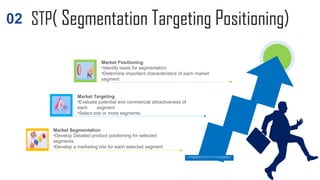
•Identify basis for segmentation
•Determine important characteristics of each market
segment
Market Positioning
•Evaluate potential and commercial attractiveness of
each segment
•Select one or more segments.
Market Targeting
•Develop Detailed product positioning for selected
segments
•Develop a marketing mix for each selected segment
Market Segmentation
02
What is Segmentation
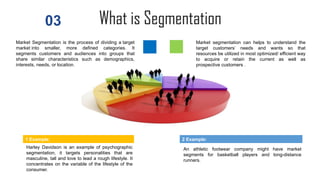
Market Segmentation is the process of dividing a target
market into smaller, more defined categories. It
segments customers and audiences into groups that
share similar characteristics such as demographics,
interests, needs, or location.
1 Example:
Harley Davidson is an example of psychographic
segmentation, it targets personalities that are
masculine, tall and love to lead a rough lifestyle. It
concentrates on the variable of the lifestyle of the
consumer.
03
Market segmentation can helps to understand the
target customers’ needs and wants so that
resources be utilized in most optimized/ efficient way
to acquire or retain the current as well as
prospective customers .
2 Example:
An athletic footwear company might have market
segments for basketball players and long-distance
runners.
How Segmentation is done
Geographic segmentation
divides the market into
geographical units such as
nations, states, regions,
counties, cities, etc.
Geographic
Psychographic segmentation
divides the market into different
groups on the basis of
psychological/personality traits,
lifestyle, or values.
Psychographic
Behavioural segmentation
divides the buyers into
groups on the basis of their
knowledge of, attitude
toward, use of, or response to
a product.
Behavioural
Demographic
Your Picture Here
Demographic segmentation
categorizes the market on
variables such as age, family
size, family life cycle, gender,
income, occupation,
education, religion, race,
generation, nationality, and
social class.
04
Income
Wise
Segmentation to reach Targeted Focused Customer-base
Targeted
Focused
Customer
Age
wise
Lifestyle
Wise
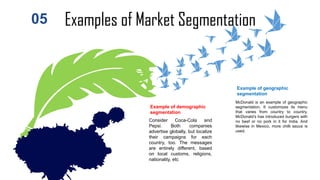
05 Examples of Market Segmentation
Example of demographic
segmentation
Consider Coca-Cola and
Pepsi. Both companies
advertise globally, but localize
their campaigns for each
country, too. The messages
are entirely different, based
on local customs, religions,
nationality, etc
Example of geographic
segmentation
McDonald is an example of geographic
segmentation. It customizes its menu
that varies from country to country.
McDonald’s has introduced burgers with
no beef or no pork in it for India. And
likewise in Mexico, more chilli sauce is
used.
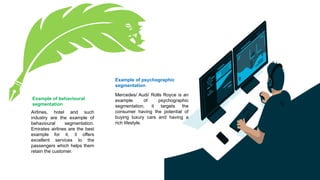
Example of behavioural
segmentation
Airlines, hotel and such
industry are the example of
behavioural segmentation.
Emirates airlines are the best
example for it, it offers
excellent services to the
passengers which helps them
retain the customer.
Example of psychographic
segmentation
Mercedes/ Audi/ Rolls Royce is an
example of psychographic
segmentation, it targets the
consumer having the potential of
buying luxury cars and having a
rich lifestyle.
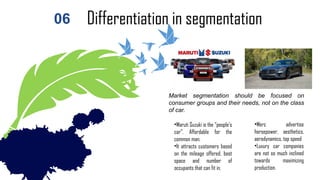
Differentiation in segmentation
Market segmentation should be focused on
consumer groups and their needs, not on the class
of car.
•Maruti Suzuki is the “people's
car”. Affordable for the
common man.
•It attracts customers based
on the mileage offered, boot
space and number of
occupants that can fit in.
•Merc advertise
horsepower, aesthetics,
aerodynamics, top speed
•Luxury car companies
are not so much inclined
towards maximizing
production.
06
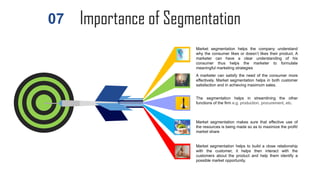
Importance of Segmentation
Market segmentation helps to build a close relationship
with the customer, it helps then interact with the
customers about the product and help them identify a
possible market opportunity.
Market segmentation helps the company understand
why the consumer likes or doesn’t likes their product. A
marketer can have a clear understanding of his
consumer thus helps the marketer to formulate
meaningful marketing strategies
A marketer can satisfy the need of the consumer more
effectively. Market segmentation helps in both customer
satisfaction and in achieving maximum sales.
The segmentation helps in streamlining the other
functions of the firm e.g. production, procurement, etc.
Market segmentation makes sure that effective use of
the resources is being made so as to maximize the profit/
market share
07
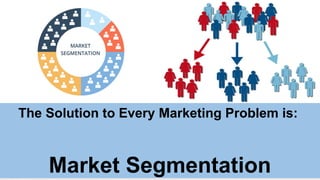
The Solution to Every Marketing Problem is:
Market Segmentation
Concept of Targeting
08
Targeting in marketing is a strategy that breaks a
large market into smaller segments to concentrate on
a specific group of customers within that audience.
OR
It helps to identify specific, defined group
within the market
Targeting:
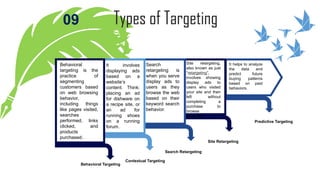
Types of Targeting
It involves
displaying ads
based on a
website’s
content. Think:
placing an ad
for dishware on
a recipe site, or
an ad for
running shoes
on a running
forum..
Search
retargeting is
when you serve
display ads to
users as they
browse the web
based on their
keyword search
behavior.
Site retargeting,
also known as just
“retargeting”,
involves showing
display ads to
users who visited
your site and then
left without
completing a
purchase to
browse
elsewhere..
It helps to analyze
the data and
predict future
buying patterns
based on past
behaviors. .
Contextual Targeting
Search Retargeting
Site Retargeting
Predictive Targeting
Behavioral
targeting is the
practice of
segmenting
customers based
on web browsing
behavior,
including things
like pages visited,
searches
performed, links
clicked, and
products
purchased..
Behavioral Targeting
09
Positioning
Positioning defines where your
product (item or service) stands in
relation to others offering similar
products and services in the
marketplace as well as the mind of the
consumer..
It provides product a USP(Unique
selling point).
A
good
positioning
makes
a
product
unique
10
Positioning Factors
Solve your
customer’s problem
and provide them
with genuine
benefits.
Functional
positioning:
Focus on the
emotional connection
that your customers
have with your
brand. .
Experiential
positioning:
Content Here
It enhance the self-
image,
belongingness, or
even ego of your
customers. The
luxury car industry is
a great example of
this – they serve the
same purpose as any
other car but they
also boost their
customer’s self-
esteem and image.
Symbolic
positioning
11
NOTE : The most successful product positioning is a combination
of all three factors.
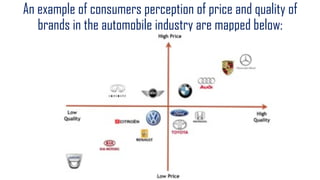
An example of consumers perception of price and quality of
brands in the automobile industry are mapped below:
Benefits of STP Marketing
5
3
3
2
Text
1
Your marketing mix becomes more crystalized and
yields higher return on investment because you’re no
longer wasting budget on channels that your
audience simply ignores;
Your brand messaging becomes more personal and
empathetic because you have your customer personas and
know exactly whom you’re talking to;
Your market research and product
innovation become more effective because you know
exactly whom to ask for advice and feedback in the
development phase.
add a unique zing.
12
THANK YOU

MKS_Segmentation-Targeting-Positioning.pptx

  • 1.
    SEGMENTATION TARGETING POSITIONONG Mukul KumarShrivastava Assistant Professor
  • 2.
    Topics of Discussion Conceptof Marketing 01 02 04 Differentiation in Segmentation 05 STP(Segmentation/Targeting/ Positioning) How Segmentation is done 06 Examples of Segmentation Importance of Segmentation 07 Concept of Targeting 08 What is segmentation 03 Types of Targeting Positioning 09 10 Positioning Factors Benefits of STP 11 12
  • 3.
    Concept of Marketing 01 Marketingrefers to activities a company undertakes to promote the buying or selling of a product or service. OR SATISFYING CUSTOMER’S NEEDS PROFITABLY Marketing:
  • 4.
    STP( Segmentation TargetingPositioning) •Identify basis for segmentation •Determine important characteristics of each market segment Market Positioning •Evaluate potential and commercial attractiveness of each segment •Select one or more segments. Market Targeting •Develop Detailed product positioning for selected segments •Develop a marketing mix for each selected segment Market Segmentation 02
  • 5.
    What is Segmentation MarketSegmentation is the process of dividing a target market into smaller, more defined categories. It segments customers and audiences into groups that share similar characteristics such as demographics, interests, needs, or location. 1 Example: Harley Davidson is an example of psychographic segmentation, it targets personalities that are masculine, tall and love to lead a rough lifestyle. It concentrates on the variable of the lifestyle of the consumer. 03 Market segmentation can helps to understand the target customers’ needs and wants so that resources be utilized in most optimized/ efficient way to acquire or retain the current as well as prospective customers . 2 Example: An athletic footwear company might have market segments for basketball players and long-distance runners.
  • 6.
    How Segmentation isdone Geographic segmentation divides the market into geographical units such as nations, states, regions, counties, cities, etc. Geographic Psychographic segmentation divides the market into different groups on the basis of psychological/personality traits, lifestyle, or values. Psychographic Behavioural segmentation divides the buyers into groups on the basis of their knowledge of, attitude toward, use of, or response to a product. Behavioural Demographic Your Picture Here Demographic segmentation categorizes the market on variables such as age, family size, family life cycle, gender, income, occupation, education, religion, race, generation, nationality, and social class. 04
  • 7.
    Income Wise Segmentation to reachTargeted Focused Customer-base Targeted Focused Customer Age wise Lifestyle Wise
  • 8.
    05 Examples ofMarket Segmentation Example of demographic segmentation Consider Coca-Cola and Pepsi. Both companies advertise globally, but localize their campaigns for each country, too. The messages are entirely different, based on local customs, religions, nationality, etc Example of geographic segmentation McDonald is an example of geographic segmentation. It customizes its menu that varies from country to country. McDonald’s has introduced burgers with no beef or no pork in it for India. And likewise in Mexico, more chilli sauce is used.
  • 9.
    Example of behavioural segmentation Airlines,hotel and such industry are the example of behavioural segmentation. Emirates airlines are the best example for it, it offers excellent services to the passengers which helps them retain the customer. Example of psychographic segmentation Mercedes/ Audi/ Rolls Royce is an example of psychographic segmentation, it targets the consumer having the potential of buying luxury cars and having a rich lifestyle.
  • 10.
    Differentiation in segmentation Marketsegmentation should be focused on consumer groups and their needs, not on the class of car. •Maruti Suzuki is the “people's car”. Affordable for the common man. •It attracts customers based on the mileage offered, boot space and number of occupants that can fit in. •Merc advertise horsepower, aesthetics, aerodynamics, top speed •Luxury car companies are not so much inclined towards maximizing production. 06
  • 11.
    Importance of Segmentation Marketsegmentation helps to build a close relationship with the customer, it helps then interact with the customers about the product and help them identify a possible market opportunity. Market segmentation helps the company understand why the consumer likes or doesn’t likes their product. A marketer can have a clear understanding of his consumer thus helps the marketer to formulate meaningful marketing strategies A marketer can satisfy the need of the consumer more effectively. Market segmentation helps in both customer satisfaction and in achieving maximum sales. The segmentation helps in streamlining the other functions of the firm e.g. production, procurement, etc. Market segmentation makes sure that effective use of the resources is being made so as to maximize the profit/ market share 07
  • 12.
    The Solution toEvery Marketing Problem is: Market Segmentation
  • 13.
    Concept of Targeting 08 Targetingin marketing is a strategy that breaks a large market into smaller segments to concentrate on a specific group of customers within that audience. OR It helps to identify specific, defined group within the market Targeting:
  • 14.
    Types of Targeting Itinvolves displaying ads based on a website’s content. Think: placing an ad for dishware on a recipe site, or an ad for running shoes on a running forum.. Search retargeting is when you serve display ads to users as they browse the web based on their keyword search behavior. Site retargeting, also known as just “retargeting”, involves showing display ads to users who visited your site and then left without completing a purchase to browse elsewhere.. It helps to analyze the data and predict future buying patterns based on past behaviors. . Contextual Targeting Search Retargeting Site Retargeting Predictive Targeting Behavioral targeting is the practice of segmenting customers based on web browsing behavior, including things like pages visited, searches performed, links clicked, and products purchased.. Behavioral Targeting 09
  • 15.
    Positioning Positioning defines whereyour product (item or service) stands in relation to others offering similar products and services in the marketplace as well as the mind of the consumer.. It provides product a USP(Unique selling point). A good positioning makes a product unique 10
  • 16.
    Positioning Factors Solve your customer’sproblem and provide them with genuine benefits. Functional positioning: Focus on the emotional connection that your customers have with your brand. . Experiential positioning: Content Here It enhance the self- image, belongingness, or even ego of your customers. The luxury car industry is a great example of this – they serve the same purpose as any other car but they also boost their customer’s self- esteem and image. Symbolic positioning 11 NOTE : The most successful product positioning is a combination of all three factors.
  • 17.
    An example ofconsumers perception of price and quality of brands in the automobile industry are mapped below:
  • 18.
    Benefits of STPMarketing 5 3 3 2 Text 1 Your marketing mix becomes more crystalized and yields higher return on investment because you’re no longer wasting budget on channels that your audience simply ignores; Your brand messaging becomes more personal and empathetic because you have your customer personas and know exactly whom you’re talking to; Your market research and product innovation become more effective because you know exactly whom to ask for advice and feedback in the development phase. add a unique zing. 12
  • 19.