What Is Multiculturalism?
• A simple explanation by Andrew Klavan - Multiculturalism
  Explained
Why Is It A Priority?
• Mutual tolerance of multiculturalism is a
  priority because it prevents a
  misconception of the values that are held
  by individuals in a vast multicultural
  society.
• Without such understanding and also a
  negative perception of ones cultural values
  will only exacerbate the current situation
Where Is It Practiced?
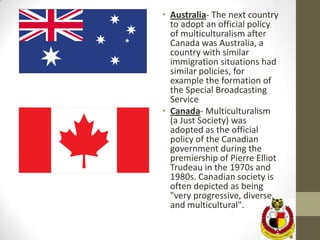
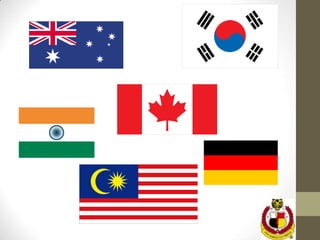
• Australia- The next country
  to adopt an official policy
  of multiculturalism after
  Canada was Australia, a
  country with similar
  immigration situations had
  similar policies, for
  example the formation of
  the Special Broadcasting
  Service
• Canada- Multiculturalism
  (a Just Society) was
  adopted as the official
  policy of the Canadian
  government during the
  premiership of Pierre Elliot
  Trudeau in the 1970s and
  1980s. Canadian society is
  often depicted as being
  "very progressive, diverse,
  and multicultural".
• Germany- In October
  2010, Angela Merkel told
  a meeting of younger
  members of her
  conservative Christian
  Democratic Union (CDU)
  party at Potsdam, near
  Berlin, that attempts to
  build a multicultural
  society in Germany had
  "utterly failed", stating:
  "The concept that we are
  now living side by side
  and are happy about it
  does not work".

• In short, the Chancellor
  deemed that is failed
  due to the disruption
  of economy
• South Korea-South Korea is
  among the world's most
  ethnically homogeneous
  nations.
• India-India is racially,
  culturally, linguistically,
  ethnically and religiously
  the most diverse country in
  the world. As per the 1961
  Census of India, the
  country is home to 1652
  mother tongues. The
  culture of India has been
  shaped by its long history,
  unique geography and
  diverse demography.
  India's languages, religions,
  dance, music, architecture
  and customs differ from
  place to place within the
  country, but nevertheless
  possess a commonality
• Malaysia-Malaysia is a multi-
  ethnic country, with Malays
  making up the majority, close to
  52% of the population. About
  24.6% of the population are
  Malaysians of Chinese descent.
  Malaysians of Indian descent
  comprise about 7% of the
  population. The remaining 10%
  comprises:
• Native East Malaysians, namely
  Bajau, Bidayuh, Dusun, Iban,
  Kadazan, Melanau, Orang Ulu,
  Sarawakian Malays, etc.
• Other native tribes of Peninsular
  Malaysia, such as the Orang Asli
  and Siamese people, and
• Non-native tribes of Peninsular
  Malaysia such as the Chettiars,
  the Peranakan and the
  Portuguese.
• The Malay Peninsula has a long
  history of international trade
  contacts, influencing its ethnic
  and religious composition.
The General Perception
In Favor.                             In Detest.
• A multicultural society ignites    • Attempts to build a multicultural society in
  a mutual perception of               Germany have "utterly failed", Chancellor
                                       Angela Merkel says.
  acceptance among individuals
  with differences that are well     • She said the so-called "multikulti" concept
                                       - where people would "live side-by-side"
  tolerated in a particular            happily - did not work, and immigrants
  society.                             needed to do more to integrate - including
                                       learning German.
• It helps people to understand
  the values , culture, traditions   • The comments come amid rising anti-
                                       immigration feeling in Germany.
  and perspectives
• Thus , resulting in a more         • A recent survey suggested more than 30%
                                       of people believed the country was
  open minded society towards          "overrun by foreigners".
  any kind of difference that
                                     • The study - by the Friedrich Ebert
  may suddenly be brought up           Foundation think-tank - also showed that
  in a society                         roughly the same number thought that
                                       some 16 million of Germany's immigrants
• The doctrine of                      or people with foreign origins had come to
                                       the country for its social benefits.
  multiculturalism rests on a
  belief that individuals of
  different cultural backgrounds
  can co-exist peacefully
How To Achieve?
• What we want currently is the
  understanding between nations and
  races.
• In order to learn and understand the
  other races, multiculturalism is crucial
  in achieving the said objective
• Thus, we must conquer the stalemate
  of mutual understanding
The Catch-22

•Ethnocentrism
•Dominant Ideology
•Arrogance of a Culture
Ethnocentrism
• Ethnocentrism- The tendency to view things
  from one’s cultures perspective

• The ethnocentric individual will judge other
  groups relative to his or her own particular
  ethnic group or culture, especially with concern
  to language, behaviour, customs, and religion.
  These ethnic distinctions and subdivisions serve
  to define each ethnicity's unique cultural
  identity.
Where it leads to..
• STEREOTYPES- that is a generalization or
  belief about a certain group of people
• From stereotypes to PREJUDICE- the
  notion of preconceived judgments.
Dominant Ideology

•Belief of a
 MAJORITY in a
 given society.
• The main problem against the dominant
  ideology that goes against
  multiculturalism is that it promotes a
  stereotypical view of things.
• Once a dominant ideology is challenged a
  difference. The media usually would
  support the dominant Ideology.
• For what reason….?
Arrogance of a Culture
• One of the many problems that
  people are facing today is the
  arrogance of a culture to accept
  others.
• In this example, people don’t see
  the relevance of multiculturalism.
Overcoming Cultural
Misunderstanding to Generate
Global Unity

• The diversity and the varied backgrounds of a
  nation is not an obstacle to peace and
  prosperity.
• Through education is a way to instill such
  awareness of misunderstanding.
• Providing exposure of other cultures through
  international summits.
Multiculturalism Contributes to the
Advancement of Society
• Through commerce.
• International peace.
• Mutual understanding of ones values and
  culture.
• An open minded resolution to the diversity
  in a society, perhaps nations.
• A more tighter relationship between races
The Succession of Multiculturalism
• In Malaysia’s melting pot of diverse
  culture and values, success of
  Malaysia today was due to the
  tolerance among its people.
• Without Multiculturalism ,There
  would be no understanding of culture
  and value. With no understanding ,
  there would be not mutual tolerance
A Clarification About a Melting Pot
of Society
• 1Malaysia is intended to provide a free and open forum to discuss
  the things that matter deeply to us as a Nation.
• It provides a chance to express and explore the many perspectives of
  our fellow citizens.
• What makes Malaysia unique is the diversity of our peoples.
• 1Malaysia’s goal is to preserve and enhance this unity in diversity
  which has always been our strength and remains our best hope for
  the future.
• Differences aside, human beings, regardless of their specific culture
  of origin, strive to provide the best they can for their family, and to
  live in as peaceful and harmonious a world as possible. These two
  goals unite us all. Multiculturalism makes the ideal and altruistic
  notion of loving our fellow man a tangible possibility, rather than a
  nebulous philosophical concept.
Le End
    I hope this speech will initiate
an open and vital dialogue
exploring difference in identity,
our purpose, and direction. I
encourage each of you to
understand multiculturalism and
the role we must play in its future.
Each of us – despite our
differences – shares a desire for
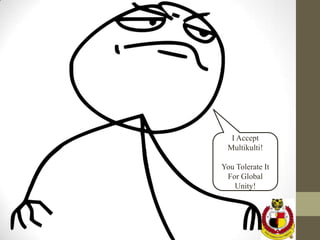
I Accept
 Multikulti!

You Tolerate It
 For Global
   Unity!

Multiculturalism

  • 2.
    What Is Multiculturalism? •A simple explanation by Andrew Klavan - Multiculturalism Explained
  • 3.
    Why Is ItA Priority? • Mutual tolerance of multiculturalism is a priority because it prevents a misconception of the values that are held by individuals in a vast multicultural society. • Without such understanding and also a negative perception of ones cultural values will only exacerbate the current situation
  • 4.
    Where Is ItPracticed?
  • 5.
    • Australia- Thenext country to adopt an official policy of multiculturalism after Canada was Australia, a country with similar immigration situations had similar policies, for example the formation of the Special Broadcasting Service • Canada- Multiculturalism (a Just Society) was adopted as the official policy of the Canadian government during the premiership of Pierre Elliot Trudeau in the 1970s and 1980s. Canadian society is often depicted as being "very progressive, diverse, and multicultural".
  • 6.
    • Germany- InOctober 2010, Angela Merkel told a meeting of younger members of her conservative Christian Democratic Union (CDU) party at Potsdam, near Berlin, that attempts to build a multicultural society in Germany had "utterly failed", stating: "The concept that we are now living side by side and are happy about it does not work". • In short, the Chancellor deemed that is failed due to the disruption of economy
  • 7.
    • South Korea-SouthKorea is among the world's most ethnically homogeneous nations. • India-India is racially, culturally, linguistically, ethnically and religiously the most diverse country in the world. As per the 1961 Census of India, the country is home to 1652 mother tongues. The culture of India has been shaped by its long history, unique geography and diverse demography. India's languages, religions, dance, music, architecture and customs differ from place to place within the country, but nevertheless possess a commonality
  • 8.
    • Malaysia-Malaysia isa multi- ethnic country, with Malays making up the majority, close to 52% of the population. About 24.6% of the population are Malaysians of Chinese descent. Malaysians of Indian descent comprise about 7% of the population. The remaining 10% comprises: • Native East Malaysians, namely Bajau, Bidayuh, Dusun, Iban, Kadazan, Melanau, Orang Ulu, Sarawakian Malays, etc. • Other native tribes of Peninsular Malaysia, such as the Orang Asli and Siamese people, and • Non-native tribes of Peninsular Malaysia such as the Chettiars, the Peranakan and the Portuguese. • The Malay Peninsula has a long history of international trade contacts, influencing its ethnic and religious composition.
  • 10.
  • 11.
    In Favor. In Detest. • A multicultural society ignites • Attempts to build a multicultural society in a mutual perception of Germany have "utterly failed", Chancellor Angela Merkel says. acceptance among individuals with differences that are well • She said the so-called "multikulti" concept - where people would "live side-by-side" tolerated in a particular happily - did not work, and immigrants society. needed to do more to integrate - including learning German. • It helps people to understand the values , culture, traditions • The comments come amid rising anti- immigration feeling in Germany. and perspectives • Thus , resulting in a more • A recent survey suggested more than 30% of people believed the country was open minded society towards "overrun by foreigners". any kind of difference that • The study - by the Friedrich Ebert may suddenly be brought up Foundation think-tank - also showed that in a society roughly the same number thought that some 16 million of Germany's immigrants • The doctrine of or people with foreign origins had come to the country for its social benefits. multiculturalism rests on a belief that individuals of different cultural backgrounds can co-exist peacefully
  • 12.
    How To Achieve? •What we want currently is the understanding between nations and races. • In order to learn and understand the other races, multiculturalism is crucial in achieving the said objective • Thus, we must conquer the stalemate of mutual understanding
  • 13.
  • 14.
    Ethnocentrism • Ethnocentrism- Thetendency to view things from one’s cultures perspective • The ethnocentric individual will judge other groups relative to his or her own particular ethnic group or culture, especially with concern to language, behaviour, customs, and religion. These ethnic distinctions and subdivisions serve to define each ethnicity's unique cultural identity.
  • 15.
    Where it leadsto.. • STEREOTYPES- that is a generalization or belief about a certain group of people • From stereotypes to PREJUDICE- the notion of preconceived judgments.
  • 16.
    Dominant Ideology •Belief ofa MAJORITY in a given society.
  • 17.
    • The mainproblem against the dominant ideology that goes against multiculturalism is that it promotes a stereotypical view of things. • Once a dominant ideology is challenged a difference. The media usually would support the dominant Ideology. • For what reason….?
  • 18.
    Arrogance of aCulture • One of the many problems that people are facing today is the arrogance of a culture to accept others. • In this example, people don’t see the relevance of multiculturalism.
  • 19.
    Overcoming Cultural Misunderstanding toGenerate Global Unity • The diversity and the varied backgrounds of a nation is not an obstacle to peace and prosperity. • Through education is a way to instill such awareness of misunderstanding. • Providing exposure of other cultures through international summits.
  • 20.
    Multiculturalism Contributes tothe Advancement of Society • Through commerce. • International peace. • Mutual understanding of ones values and culture. • An open minded resolution to the diversity in a society, perhaps nations. • A more tighter relationship between races
  • 21.
    The Succession ofMulticulturalism • In Malaysia’s melting pot of diverse culture and values, success of Malaysia today was due to the tolerance among its people. • Without Multiculturalism ,There would be no understanding of culture and value. With no understanding , there would be not mutual tolerance
  • 22.
    A Clarification Abouta Melting Pot of Society • 1Malaysia is intended to provide a free and open forum to discuss the things that matter deeply to us as a Nation. • It provides a chance to express and explore the many perspectives of our fellow citizens. • What makes Malaysia unique is the diversity of our peoples. • 1Malaysia’s goal is to preserve and enhance this unity in diversity which has always been our strength and remains our best hope for the future. • Differences aside, human beings, regardless of their specific culture of origin, strive to provide the best they can for their family, and to live in as peaceful and harmonious a world as possible. These two goals unite us all. Multiculturalism makes the ideal and altruistic notion of loving our fellow man a tangible possibility, rather than a nebulous philosophical concept.
  • 23.
    Le End I hope this speech will initiate an open and vital dialogue exploring difference in identity, our purpose, and direction. I encourage each of you to understand multiculturalism and the role we must play in its future. Each of us – despite our differences – shares a desire for
  • 24.
    I Accept Multikulti! YouTolerate It For Global Unity!

Editor's Notes

  • #15 Search for it in youtube