Occupational Therapy practice
Framework:
23 July 2014 Mohsen Eslampanah 2
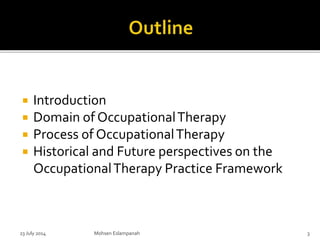
 Introduction
 Domain of OccupationalTherapy
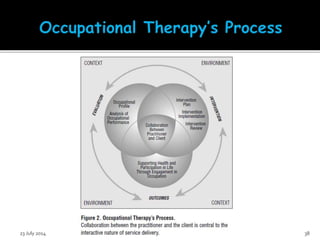
 Process of OccupationalTherapy
 Historical and Future perspectives on the
OccupationalTherapy Practice Framework
23 July 2014 Mohsen Eslampanah 3
 AOTA (AJOT)
 Promoting the health and participation of clients
through engagement in occupation.
 Not a Taxonomy, Theory, Model
 must be used in conjunction with the knowledge
and evidence relevant to occupation and
occupational therapy.
Mohsen Eslampanah 423 July 2014
23 July 2014Mohsen Eslampanah5
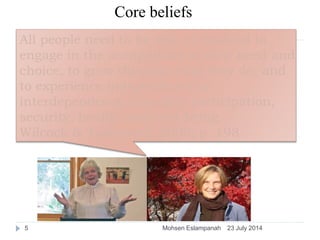
All people need to be able or enabled to
engage in the occupations of their need and
choice, to grow through what they do, and
to experience independence or
interdependence, equality, participation,
security, health, and well-being.
Wilcock & Townsend, 2008, p. 198
Core beliefs
1. Persons
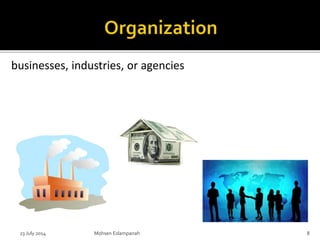
2. Organizations
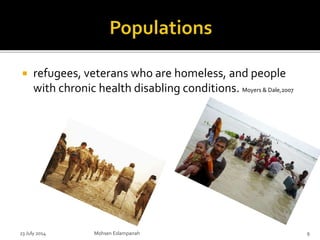
3. Populations within a community
23 July 2014 Mohsen Eslampanah 6
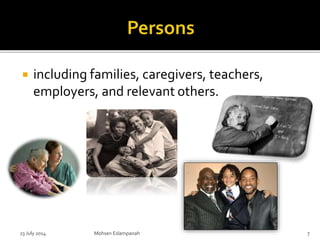
 including families, caregivers, teachers,
employers, and relevant others.
23 July 2014 Mohsen Eslampanah 7
23 July 2014 Mohsen Eslampanah 8
businesses, industries, or agencies
 refugees, veterans who are homeless, and people
with chronic health disabling conditions. Moyers & Dale,2007
23 July 2014 Mohsen Eslampanah 9
23 July 2014 Mohsen Eslampanah 10
23 July 2014 Mohsen Eslampanah 11
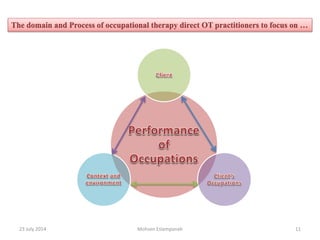
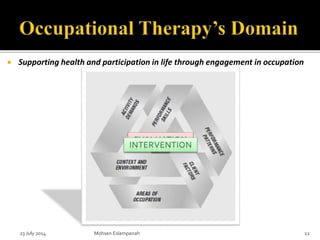
The domain and Process of occupational therapy direct OT practitioners to focus on …
 Supporting health and participation in life through engagement in occupation
23 July 2014 Mohsen Eslampanah 12
23 July 2014 Mohsen Eslampanah 13
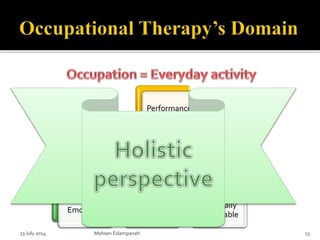
Performance
Subjective
Emotional psychological
Objective
Physically
observable
An interdisciplinary academic discipline in the
social and behavioral sciences dedicated to the
study of the form, function, and the meaning of
human occupations.
Zemke & clark, 1996
23 July 2014 Mohsen Eslampanah 14
23 July 2014 Mohsen Eslampanah 15
 Occupations often are shared.
Example:
1. Care giving => mothering
23 July 2014 Mohsen Eslampanah 16
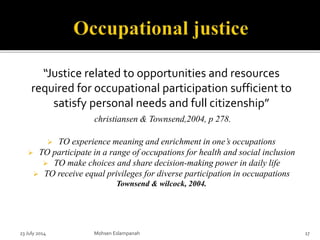
“Justice related to opportunities and resources
required for occupational participation sufficient to
satisfy personal needs and full citizenship”
christiansen & Townsend,2004, p 278.
 TO experience meaning and enrichment in one’s occupations
 TO participate in a range of occupations for health and social inclusion
 TO make choices and share decision-making power in daily life
 TO receive equal privileges for diverse participation in occuapations
Townsend & wilcock, 2004.
23 July 2014 Mohsen Eslampanah 17
23 July 2014 Mohsen Eslampanah 18
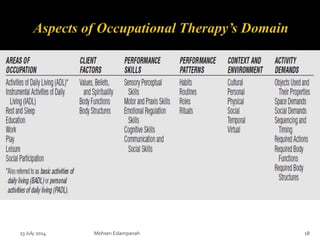
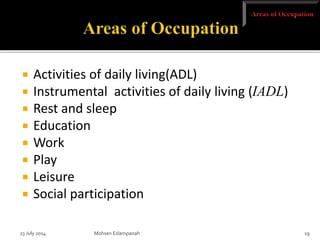
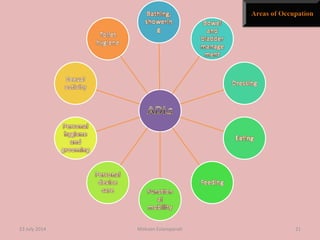
 Activities of daily living(ADL)
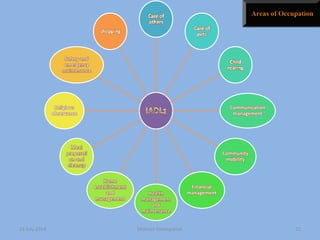
 Instrumental activities of daily living (IADL)
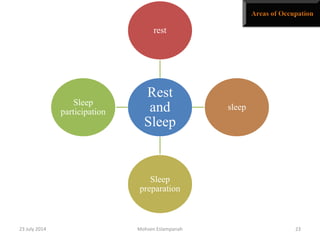
 Rest and sleep
 Education
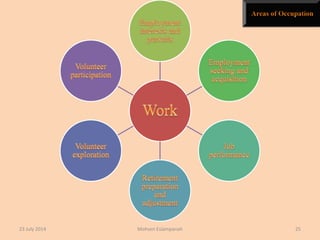
 Work
 Play
 Leisure
 Social participation
23 July 2014 Mohsen Eslampanah 19
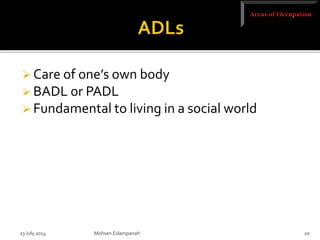
 Care of one’s own body
 BADL or PADL
 Fundamental to living in a social world
23 July 2014 Mohsen Eslampanah 20
23 July 2014 Mohsen Eslampanah 21
23 July 2014 Mohsen Eslampanah 22
Rest
and
Sleep
rest
sleep
Sleep
preparation
Sleep
participation
23 July 2014 Mohsen Eslampanah 23
23 July 2014 Mohsen Eslampanah 24
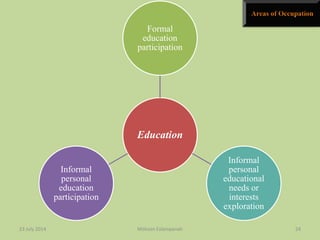
Education
Formal
education
participation
Informal
personal
educational
needs or
interests
exploration
Informal
personal
education
participation
23 July 2014 Mohsen Eslampanah 25
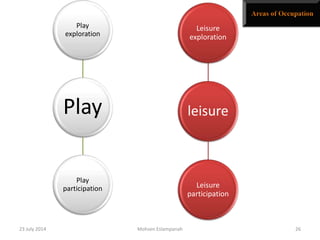
Play
Play
exploration
Play
participation
23 July 2014 Mohsen Eslampanah 26
leisure
Leisure
exploration
Leisure
participation
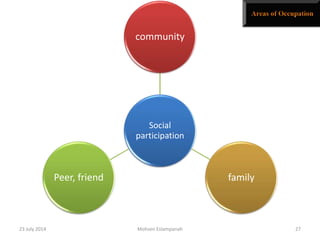
Social
participation
community
familyPeer, friend
23 July 2014 Mohsen Eslampanah 27
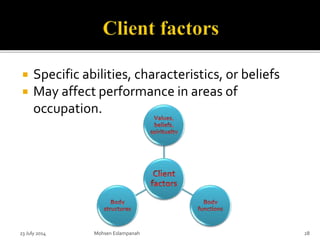
 Specific abilities, characteristics, or beliefs
 May affect performance in areas of
occupation.
23 July 2014 Mohsen Eslampanah 28
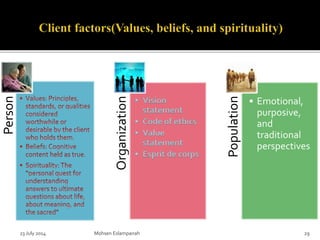
23 July 2014 Mohsen Eslampanah 29
Person
Organization
• Vision
statement
• Code of ethics
• Value
statement
• Esprit de corps
Population
• Emotional,
purposive,
and
traditional
perspectives
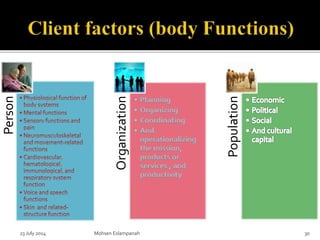
23 July 2014 Mohsen Eslampanah 30
Person
Organization
• Planning
• Organizing
• Coordinating
• And
operationalizing
the mission,
products or
services , and
productivity
Population
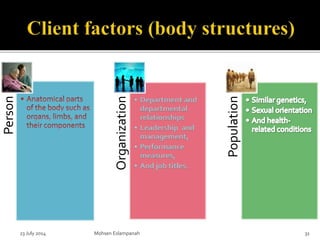
23 July 2014 Mohsen Eslampanah 31
Person
Organization
• Department and
departmental
relationships
• Leadership and
management,
• Performance
measures,
• And job titles.
Population
23 July 2014 Mohsen Eslampanah 32
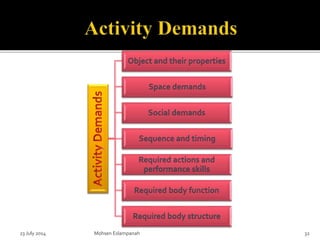
Object and their properties
Space demands
Social demands
Sequence and timing
Required actions and
performance skills
Required body function
Required body structure
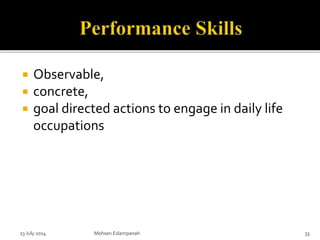
 Observable,
 concrete,
 goal directed actions to engage in daily life
occupations
23 July 2014 Mohsen Eslampanah 33
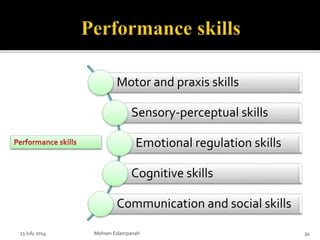
Motor and praxis skills
Sensory-perceptual skills
Emotional regulation skills
Cognitive skills
Communication and social skills
23 July 2014 Mohsen Eslampanah 34
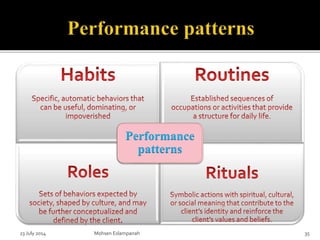
Performance
patterns
23 July 2014 Mohsen Eslampanah 35
23 July 2014 Mohsen Eslampanah 36
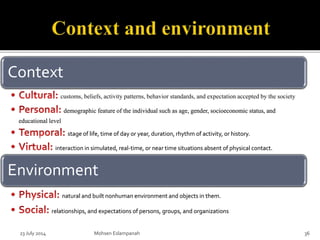
Context
customs, beliefs, activity patterns, behavior standards, and expectation accepted by the society
demographic feature of the individual such as age, gender, socioeconomic status, and
educational level
stage of life, time of day or year, duration, rhythm of activity, or history.
interaction in simulated, real-time, or near time situations absent of physical contact.
Environment
natural and built nonhuman environment and objects in them.
relationships, and expectations of persons, groups, and organizations
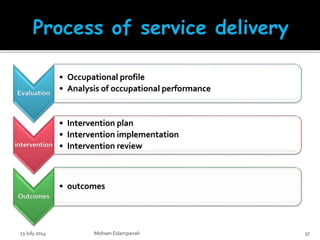
Evaluation
• Occupational profile
• Analysis of occupational performance
intervention
• Intervention plan
• Intervention implementation
• Intervention review
Outcomes
• outcomes
23 July 2014 Mohsen Eslampanah 37
23 July 2014 Mohsen Eslampanah 38
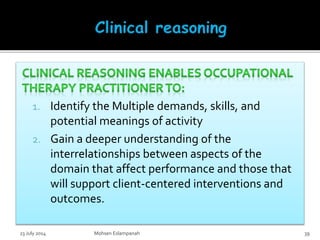
1. Identify the Multiple demands, skills, and
potential meanings of activity
2. Gain a deeper understanding of the
interrelationships between aspects of the
domain that affect performance and those that
will support client-centered interventions and
outcomes.
23 July 2014 Mohsen Eslampanah 39






23 July 2014 Mohsen Eslampanah 40









23 July 2014 Mohsen Eslampanah 41
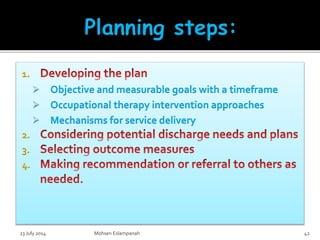
1.
 Objective and measurable goals with a timeframe
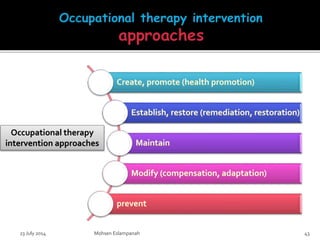
 Occupational therapy intervention approaches
 Mechanisms for service delivery
2.
3.
4.
23 July 2014 Mohsen Eslampanah 42
23 July 2014 Mohsen Eslampanah 43
Occupational therapy
intervention approaches
23 July 2014 Mohsen Eslampanah 44
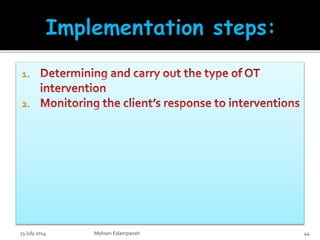
1.
2.
23 July 2014 Mohsen Eslampanah 45
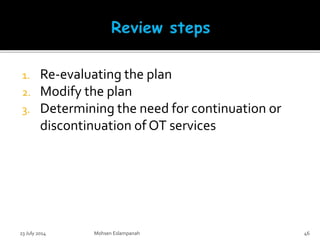
1. Re-evaluating the plan
2. Modify the plan
3. Determining the need for continuation or
discontinuation of OT services
23 July 2014 Mohsen Eslampanah 46
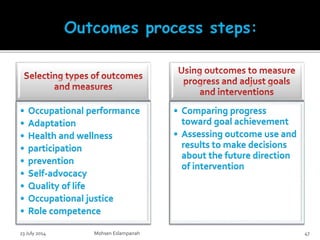
• Occupational performance
• Adaptation
• Health and wellness
• participation
• prevention
• Self-advocacy
• Quality of life
• Occupational justice
• Role competence
• Comparing progress
toward goal achievement
• Assessing outcome use and
results to make decisions
about the future direction
of intervention
23 July 2014 Mohsen Eslampanah 47
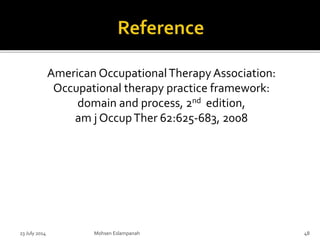
American OccupationalTherapy Association:
Occupational therapy practice framework:
domain and process, 2nd edition,
am j OccupTher 62:625-683, 2008
23 July 2014 Mohsen Eslampanah 48

Occupational Therapy Practice Framework :Domain & process 2nd Edition

  • 1.
  • 2.
    23 July 2014Mohsen Eslampanah 2
  • 3.
     Introduction  Domainof OccupationalTherapy  Process of OccupationalTherapy  Historical and Future perspectives on the OccupationalTherapy Practice Framework 23 July 2014 Mohsen Eslampanah 3
  • 4.
     AOTA (AJOT) Promoting the health and participation of clients through engagement in occupation.  Not a Taxonomy, Theory, Model  must be used in conjunction with the knowledge and evidence relevant to occupation and occupational therapy. Mohsen Eslampanah 423 July 2014
  • 5.
    23 July 2014MohsenEslampanah5 All people need to be able or enabled to engage in the occupations of their need and choice, to grow through what they do, and to experience independence or interdependence, equality, participation, security, health, and well-being. Wilcock & Townsend, 2008, p. 198 Core beliefs
  • 6.
    1. Persons 2. Organizations 3.Populations within a community 23 July 2014 Mohsen Eslampanah 6
  • 7.
     including families,caregivers, teachers, employers, and relevant others. 23 July 2014 Mohsen Eslampanah 7
  • 8.
    23 July 2014Mohsen Eslampanah 8 businesses, industries, or agencies
  • 9.
     refugees, veteranswho are homeless, and people with chronic health disabling conditions. Moyers & Dale,2007 23 July 2014 Mohsen Eslampanah 9
  • 10.
    23 July 2014Mohsen Eslampanah 10
  • 11.
    23 July 2014Mohsen Eslampanah 11 The domain and Process of occupational therapy direct OT practitioners to focus on …
  • 12.
     Supporting healthand participation in life through engagement in occupation 23 July 2014 Mohsen Eslampanah 12
  • 13.
    23 July 2014Mohsen Eslampanah 13 Performance Subjective Emotional psychological Objective Physically observable
  • 14.
    An interdisciplinary academicdiscipline in the social and behavioral sciences dedicated to the study of the form, function, and the meaning of human occupations. Zemke & clark, 1996 23 July 2014 Mohsen Eslampanah 14
  • 15.
    23 July 2014Mohsen Eslampanah 15
  • 16.
     Occupations oftenare shared. Example: 1. Care giving => mothering 23 July 2014 Mohsen Eslampanah 16
  • 17.
    “Justice related toopportunities and resources required for occupational participation sufficient to satisfy personal needs and full citizenship” christiansen & Townsend,2004, p 278.  TO experience meaning and enrichment in one’s occupations  TO participate in a range of occupations for health and social inclusion  TO make choices and share decision-making power in daily life  TO receive equal privileges for diverse participation in occuapations Townsend & wilcock, 2004. 23 July 2014 Mohsen Eslampanah 17
  • 18.
    23 July 2014Mohsen Eslampanah 18
  • 19.
     Activities ofdaily living(ADL)  Instrumental activities of daily living (IADL)  Rest and sleep  Education  Work  Play  Leisure  Social participation 23 July 2014 Mohsen Eslampanah 19
  • 20.
     Care ofone’s own body  BADL or PADL  Fundamental to living in a social world 23 July 2014 Mohsen Eslampanah 20
  • 21.
    23 July 2014Mohsen Eslampanah 21
  • 22.
    23 July 2014Mohsen Eslampanah 22
  • 23.
  • 24.
    23 July 2014Mohsen Eslampanah 24 Education Formal education participation Informal personal educational needs or interests exploration Informal personal education participation
  • 25.
    23 July 2014Mohsen Eslampanah 25
  • 26.
    Play Play exploration Play participation 23 July 2014Mohsen Eslampanah 26 leisure Leisure exploration Leisure participation
  • 27.
  • 28.
     Specific abilities,characteristics, or beliefs  May affect performance in areas of occupation. 23 July 2014 Mohsen Eslampanah 28
  • 29.
    23 July 2014Mohsen Eslampanah 29 Person Organization • Vision statement • Code of ethics • Value statement • Esprit de corps Population • Emotional, purposive, and traditional perspectives
  • 30.
    23 July 2014Mohsen Eslampanah 30 Person Organization • Planning • Organizing • Coordinating • And operationalizing the mission, products or services , and productivity Population
  • 31.
    23 July 2014Mohsen Eslampanah 31 Person Organization • Department and departmental relationships • Leadership and management, • Performance measures, • And job titles. Population
  • 32.
    23 July 2014Mohsen Eslampanah 32 Object and their properties Space demands Social demands Sequence and timing Required actions and performance skills Required body function Required body structure
  • 33.
     Observable,  concrete, goal directed actions to engage in daily life occupations 23 July 2014 Mohsen Eslampanah 33
  • 34.
    Motor and praxisskills Sensory-perceptual skills Emotional regulation skills Cognitive skills Communication and social skills 23 July 2014 Mohsen Eslampanah 34
  • 35.
  • 36.
    23 July 2014Mohsen Eslampanah 36 Context customs, beliefs, activity patterns, behavior standards, and expectation accepted by the society demographic feature of the individual such as age, gender, socioeconomic status, and educational level stage of life, time of day or year, duration, rhythm of activity, or history. interaction in simulated, real-time, or near time situations absent of physical contact. Environment natural and built nonhuman environment and objects in them. relationships, and expectations of persons, groups, and organizations
  • 37.
    Evaluation • Occupational profile •Analysis of occupational performance intervention • Intervention plan • Intervention implementation • Intervention review Outcomes • outcomes 23 July 2014 Mohsen Eslampanah 37
  • 38.
    23 July 2014Mohsen Eslampanah 38
  • 39.
    1. Identify theMultiple demands, skills, and potential meanings of activity 2. Gain a deeper understanding of the interrelationships between aspects of the domain that affect performance and those that will support client-centered interventions and outcomes. 23 July 2014 Mohsen Eslampanah 39
  • 40.
  • 41.
  • 42.
    1.  Objective andmeasurable goals with a timeframe  Occupational therapy intervention approaches  Mechanisms for service delivery 2. 3. 4. 23 July 2014 Mohsen Eslampanah 42
  • 43.
    23 July 2014Mohsen Eslampanah 43 Occupational therapy intervention approaches
  • 44.
    23 July 2014Mohsen Eslampanah 44 1. 2.
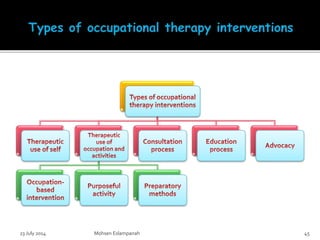
  • 45.
    23 July 2014Mohsen Eslampanah 45
  • 46.
    1. Re-evaluating theplan 2. Modify the plan 3. Determining the need for continuation or discontinuation of OT services 23 July 2014 Mohsen Eslampanah 46
  • 47.
    • Occupational performance •Adaptation • Health and wellness • participation • prevention • Self-advocacy • Quality of life • Occupational justice • Role competence • Comparing progress toward goal achievement • Assessing outcome use and results to make decisions about the future direction of intervention 23 July 2014 Mohsen Eslampanah 47
  • 48.
    American OccupationalTherapy Association: Occupationaltherapy practice framework: domain and process, 2nd edition, am j OccupTher 62:625-683, 2008 23 July 2014 Mohsen Eslampanah 48