1
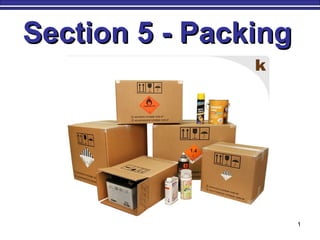
Section 5 - PackingSection 5 - Packing
2
Objectives
By the end of this section, you will be able to:
 Differentiate between UN Specification, Limited
Quantity, Excepted Quantity and Other
packagings;
 Locate and read applicable packing instruction in
IATA DGR Section 5
 Identify the maximum quantity permitted per inner
packaging
 Select the appropriate packaging
 Pack difference substance in same outer
packaging
 Apply the regulations regarding “Overpacks”
 De-code the UN Specification Package marking
and use the correct package for a particular
The key to safety
in transporting
dangerous goods
is the packaging.
Good packaging is
simply good
business.
• The packing instructions in
IATA DGR Section 5 give the
maximum permissible quantity per
inner packaging.
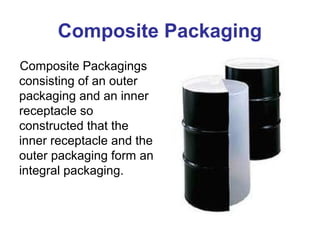
• The List of Dangerous Goods in
DGR 4.2 gives the maximum net
quantity permitted in each outer
package.
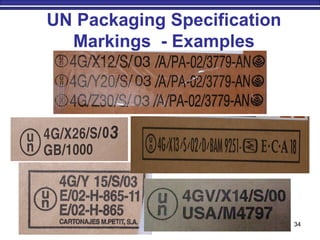
General Packing Requirements
• The Packing Group identifies the degree
of danger presented by the article for
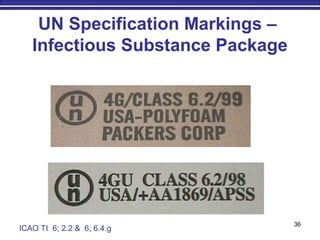
packing purposes, some classes of
dangerous goods are assigned to a
packing group depending upon the degree
of danger they represent. Those packing
groups are as follows.
M. Tayfour 6
General Packing RequirementsGeneral Packing Requirements
• Packing Group High Danger
• Packing Group Medium Danger
• Packing Group Low Danger
I
II
III
General Packing RequirementsGeneral Packing Requirements
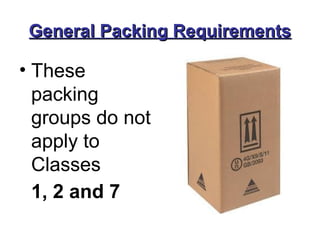
• These
packing
groups do not
apply to
Classes
1, 2 and 7
General PackingGeneral Packing
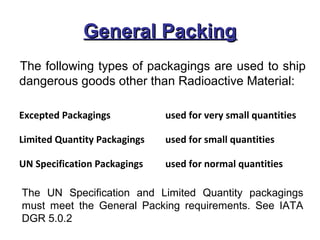
The following types of packagings are used to ship
dangerous goods other than Radioactive Material:
Excepted Packagings used for very small quantities
Limited Quantity Packagings used for small quantities
UN Specification Packagings used for normal quantities
The UN Specification and Limited Quantity packagings
must meet the General Packing requirements. See IATA
DGR 5.0.2
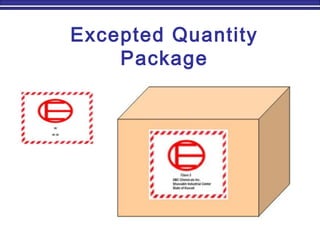
Excepted Packaging
• Some Dangerous Goods may be transported
under a simplified procedure. They are
marked with the label Dangerous Goods in
Excepted Quantities.
• The Cargo Handling Department is
responsible for checking the criteria of this
procedure. Such items may be excepted from
the marking, labling and documentation
requirements of these Regulations.
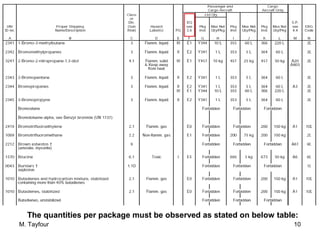
M. Tayfour 10
The quantities per package must be observed as stated on below table:
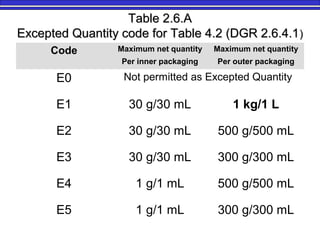
Table 2.6.ATable 2.6.A
Excepted Quantity code for Table 4.2 (DGR 2.6.4.1Excepted Quantity code for Table 4.2 (DGR 2.6.4.1))
Code Maximum net quantity
Per inner packaging
Maximum net quantity
Per outer packaging
E0 Not permitted as Excepted Quantity
E1 30 g/30 mL 1 kg/1 L
E2 30 g/30 mL 500 g/500 mL
E3 30 g/30 mL 300 g/300 mL
E4 1 g/1 mL 500 g/500 mL
E5 1 g/1 mL 300 g/300 mL
M. Tayfour 12
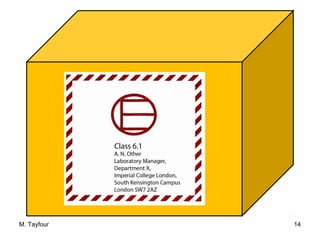
Minimum dimensions: 100 × 100 mm
Hatching and symbol of the same color, black or red, on white or suitable
contrasting background.
* The Class or, when assigned, the Division number (s) must be shown in
this location.
** The name of the shipper or of the consignee must be shown in this
location if not shown elsewhere on the package.
M. Tayfour 13
M. Tayfour 14
Excepted Quantity
Package
M. Tayfour 16
DGR 2.6 Excepted Quantities :DGR 2.6 Excepted Quantities :
•No shipper Declaration for Dangerous
Goods is not required (DGD).
•No (NOTOC).
•No use of Marking and Labelling.
•No use Acceptance Checklist.
•No use UN Specification Packing.
M. Tayfour 17
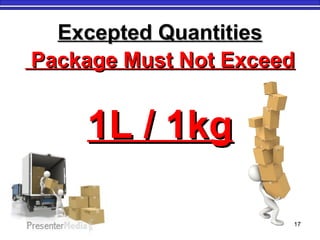
Excepted QuantitiesExcepted Quantities
Package Must Not ExceedPackage Must Not Exceed
1L / 1kg1L / 1kg
M. Tayfour 18
Dangerous Goods in Limited QuantitiesDangerous Goods in Limited Quantities
• Only dangerous goods which are
permitted on passenger aircraft and
which meet the criteria of the following
classes, divisions and packing groups
(if appropriate) may be carried under
the provisions for dangerous goods in
limited quantities.
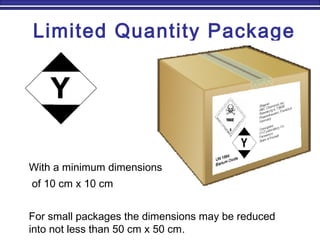
Limited Quantity Package
With a minimum dimensions
of 10 cm x 10 cm
For small packages the dimensions may be reduced
into not less than 50 cm x 50 cm.
M. Tayfour 20
The quantities per package must be observed as stated on below table:
M. Tayfour 21
Dangerous Goods in LimitedDangerous Goods in Limited
QuantitiesQuantities
• Single packaging's, including composite
packaging's are not permitted.
• Limited Quantity of dangerous goods
must be packaged in accordance with
the applicable Limited Quantity packing
instructions indicated in the column G of
the list of dangerous goods and which is
identified be the prefix “Y”.
M. Tayfour 22
Dangerous Goods in LimitedDangerous Goods in Limited
QuantitiesQuantities
• The net quantity per package must
not exceed the quantity specified in
column H of the list of DG against
the packing instruction number
identified in column G.
• the gross weight of “Limited
Quantity” package must not exceed
30 kg (66 lbs.)30 kg (66 lbs.)
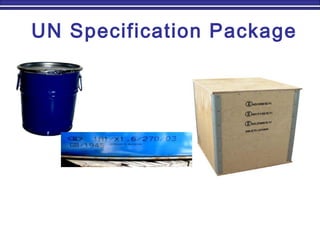
UN Specification Package
These packagings are subject to performance
tests designed to ensure that the package
tested will not lose any of their contents under
normal transport conditions. The severity of the
tests on a packaging is dependent on the
degree of danger of intended contents. The
degree of danger is indicated by the Packing
Group , UN Specification packagings are
normally tested by an institute authorized by
government authorities.
List of Packagings
• Table 5.0.B contains a list of the inner
packagings referenced in the packing
instructions. Table 5.0.C lists the UN
specification packagings used in air
transport by type and description together
with their specification codes. Also
included are the reference paragraph
numbers in which the design criteria are
specified.
Methods of Packing
• Combination Package
• Single Packagings
• Composite Packagings
Combination Packaging
Single Packaging
Composite Packaging
Composite Packagings
consisting of an outer
packaging and an inner
receptacle so
constructed that the
inner receptacle and the
outer packaging form an
integral packaging.
Over-pack
Strong outside fiberboard box or drum, a
wooden box or barrel, or a metal barrel or
drum
Salvage Packagings
• Special packagings into
which damaged,
defective, leaking or non-
conforming dangerous
goods packages, or
dangerous goods that
have spilled or leaked,
are placed for purposes
of transport for recovery
or disposal.
• See DGR Ref. 5.0.1.6 for
details
33
UN Packaging
Specification Markings
Package type
and material
PG level
kg: Max.
gross
weight
Specific
gravity
Solids or
combi-
nation
kPa:
pressure
Year of
Mfr.
Country Manufacturer
4G / Y 30 / S / 02 / USA / M1234
1A1 / Y 1.3 / 150 / 03 / GB / 3006
Packaging containing solids or inner receptacles
Single packaging containing liquids
u
n
34
UN Packaging Specification
Markings - Examples
35
UN Packaging Specification
Markings - Examples
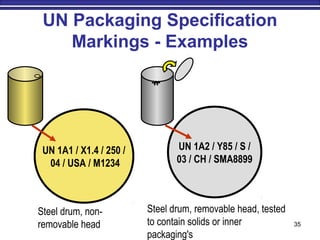
UN 1A1 / X1.4 / 250 /
04 / USA / M1234
UN 1A2 / Y85 / S /
03 / CH / SMA8899
Steel drum, non-
removable head
Steel drum, removable head, tested
to contain solids or inner
packaging's
36
UN Specification Markings –
Infectious Substance Package
ICAO TI 6; 2.2 & 6; 6.4.g
Other Type of Package
M. Tayfour 38
General Packing RequirementsGeneral Packing Requirements
• Packing Group High Danger
• Packing Group Medium Danger
• Packing Group Low Danger
I
II
III
These packing groups do not apply to
Classes 1, 2 or 7
Markings of Over-pack
• Proper Shipping Names;
• UN or ID numbers;
• Full name and address of the shipper and consignee;
• Net Quantity as applicable;
• Additional required markings for Class 1 Explosives,
Division 6.2 Infectious substances, Class 2 Refrigerated
liquefied gases, Biological substance, category B, and
chemical oxygen generators;
• The word “Salvage” when applicable.
Labeling of Over-pack
Example:
Package A: Camphor oil, UN 1130, 30 litre net
Package B: Butyronitrile, UN 2411, 1 litre net
Package C: Magnesium, UN 1869, 18 kilogram net
The Q value: the highest permitted net quantity per
package according to the formula, whereas Q
must not exceed 1
Note:
• The calculated “Q”
value must be
rounded up to the first
decimal place and
entered on the
Shipper’s Declaration.
UN
No.
Proper
Name
Class or
Division
Packing
Group
Packing
Instruction
Quantity
Offered
1500 Sodium
Nitrite
5.1 III 559
20 KGS
1690 Sodium
Fluoride,
solid
6.1 III 620 8 KGS
Q value:
What are the types of packages?
• ______________________________
• ______________________________
• ______________________________
• ______________________________
UN Specification Packaging's
Limited Quantity Packaging's
Excepted Quantity Packaging's
Other Packaging's
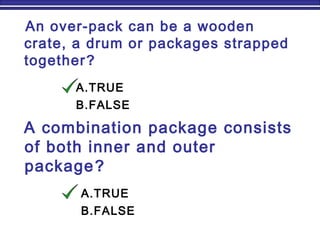
An over-pack can be a wooden
crate, a drum or packages strapped
together?
A.TRUE
B.FALSE
A combination package consists
of both inner and outer
package?
A.TRUE
B.FALSE
A single package requires no
outer packagings?
A.TRUE
B.FALSE
Some dangerous goods do
not require enclosure or
packaging?
A.TRUE
B.FALSE
64
SummarySummary
UN Specification packagings are different
from Limited Quantity packagings
• Locate and read the applicable packing
instructions in the DGR Section 5
• Identify the maximum quantity permitted
per inner packaging
• Select the appropriate packaging
• Ensure that the quantity and packing
group limitations for specification
packagings are met
65
SummarySummary
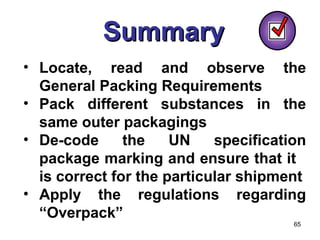
• Locate, read and observe the
General Packing Requirements
• Pack different substances in the
same outer packagings
• De-code the UN specification
package marking and ensure that it
is correct for the particular shipment
• Apply the regulations regarding
“Overpack”

Section 5 Packaging

  • 1.
    1 Section 5 -PackingSection 5 - Packing
  • 2.
    2 Objectives By the endof this section, you will be able to:  Differentiate between UN Specification, Limited Quantity, Excepted Quantity and Other packagings;  Locate and read applicable packing instruction in IATA DGR Section 5  Identify the maximum quantity permitted per inner packaging  Select the appropriate packaging  Pack difference substance in same outer packaging  Apply the regulations regarding “Overpacks”  De-code the UN Specification Package marking and use the correct package for a particular
  • 3.
    The key tosafety in transporting dangerous goods is the packaging. Good packaging is simply good business.
  • 4.
    • The packinginstructions in IATA DGR Section 5 give the maximum permissible quantity per inner packaging. • The List of Dangerous Goods in DGR 4.2 gives the maximum net quantity permitted in each outer package.
  • 5.
    General Packing Requirements •The Packing Group identifies the degree of danger presented by the article for packing purposes, some classes of dangerous goods are assigned to a packing group depending upon the degree of danger they represent. Those packing groups are as follows.
  • 6.
    M. Tayfour 6 GeneralPacking RequirementsGeneral Packing Requirements • Packing Group High Danger • Packing Group Medium Danger • Packing Group Low Danger I II III
  • 7.
    General Packing RequirementsGeneralPacking Requirements • These packing groups do not apply to Classes 1, 2 and 7
  • 8.
    General PackingGeneral Packing Thefollowing types of packagings are used to ship dangerous goods other than Radioactive Material: Excepted Packagings used for very small quantities Limited Quantity Packagings used for small quantities UN Specification Packagings used for normal quantities The UN Specification and Limited Quantity packagings must meet the General Packing requirements. See IATA DGR 5.0.2
  • 9.
    Excepted Packaging • SomeDangerous Goods may be transported under a simplified procedure. They are marked with the label Dangerous Goods in Excepted Quantities. • The Cargo Handling Department is responsible for checking the criteria of this procedure. Such items may be excepted from the marking, labling and documentation requirements of these Regulations.
  • 10.
    M. Tayfour 10 Thequantities per package must be observed as stated on below table:
  • 11.
    Table 2.6.ATable 2.6.A ExceptedQuantity code for Table 4.2 (DGR 2.6.4.1Excepted Quantity code for Table 4.2 (DGR 2.6.4.1)) Code Maximum net quantity Per inner packaging Maximum net quantity Per outer packaging E0 Not permitted as Excepted Quantity E1 30 g/30 mL 1 kg/1 L E2 30 g/30 mL 500 g/500 mL E3 30 g/30 mL 300 g/300 mL E4 1 g/1 mL 500 g/500 mL E5 1 g/1 mL 300 g/300 mL
  • 12.
    M. Tayfour 12 Minimumdimensions: 100 × 100 mm Hatching and symbol of the same color, black or red, on white or suitable contrasting background. * The Class or, when assigned, the Division number (s) must be shown in this location. ** The name of the shipper or of the consignee must be shown in this location if not shown elsewhere on the package.
  • 13.
  • 14.
  • 15.
  • 16.
    M. Tayfour 16 DGR2.6 Excepted Quantities :DGR 2.6 Excepted Quantities : •No shipper Declaration for Dangerous Goods is not required (DGD). •No (NOTOC). •No use of Marking and Labelling. •No use Acceptance Checklist. •No use UN Specification Packing.
  • 17.
    M. Tayfour 17 ExceptedQuantitiesExcepted Quantities Package Must Not ExceedPackage Must Not Exceed 1L / 1kg1L / 1kg
  • 18.
    M. Tayfour 18 DangerousGoods in Limited QuantitiesDangerous Goods in Limited Quantities • Only dangerous goods which are permitted on passenger aircraft and which meet the criteria of the following classes, divisions and packing groups (if appropriate) may be carried under the provisions for dangerous goods in limited quantities.
  • 19.
    Limited Quantity Package Witha minimum dimensions of 10 cm x 10 cm For small packages the dimensions may be reduced into not less than 50 cm x 50 cm.
  • 20.
    M. Tayfour 20 Thequantities per package must be observed as stated on below table:
  • 21.
    M. Tayfour 21 DangerousGoods in LimitedDangerous Goods in Limited QuantitiesQuantities • Single packaging's, including composite packaging's are not permitted. • Limited Quantity of dangerous goods must be packaged in accordance with the applicable Limited Quantity packing instructions indicated in the column G of the list of dangerous goods and which is identified be the prefix “Y”.
  • 22.
    M. Tayfour 22 DangerousGoods in LimitedDangerous Goods in Limited QuantitiesQuantities • The net quantity per package must not exceed the quantity specified in column H of the list of DG against the packing instruction number identified in column G. • the gross weight of “Limited Quantity” package must not exceed 30 kg (66 lbs.)30 kg (66 lbs.)
  • 23.
  • 24.
    UN Specification Package Thesepackagings are subject to performance tests designed to ensure that the package tested will not lose any of their contents under normal transport conditions. The severity of the tests on a packaging is dependent on the degree of danger of intended contents. The degree of danger is indicated by the Packing Group , UN Specification packagings are normally tested by an institute authorized by government authorities.
  • 25.
    List of Packagings •Table 5.0.B contains a list of the inner packagings referenced in the packing instructions. Table 5.0.C lists the UN specification packagings used in air transport by type and description together with their specification codes. Also included are the reference paragraph numbers in which the design criteria are specified.
  • 26.
    Methods of Packing •Combination Package • Single Packagings • Composite Packagings
  • 27.
  • 28.
  • 29.
    Composite Packaging Composite Packagings consistingof an outer packaging and an inner receptacle so constructed that the inner receptacle and the outer packaging form an integral packaging.
  • 30.
    Over-pack Strong outside fiberboardbox or drum, a wooden box or barrel, or a metal barrel or drum
  • 32.
    Salvage Packagings • Specialpackagings into which damaged, defective, leaking or non- conforming dangerous goods packages, or dangerous goods that have spilled or leaked, are placed for purposes of transport for recovery or disposal. • See DGR Ref. 5.0.1.6 for details
  • 33.
    33 UN Packaging Specification Markings Packagetype and material PG level kg: Max. gross weight Specific gravity Solids or combi- nation kPa: pressure Year of Mfr. Country Manufacturer 4G / Y 30 / S / 02 / USA / M1234 1A1 / Y 1.3 / 150 / 03 / GB / 3006 Packaging containing solids or inner receptacles Single packaging containing liquids u n
  • 34.
  • 35.
    35 UN Packaging Specification Markings- Examples UN 1A1 / X1.4 / 250 / 04 / USA / M1234 UN 1A2 / Y85 / S / 03 / CH / SMA8899 Steel drum, non- removable head Steel drum, removable head, tested to contain solids or inner packaging's
  • 36.
    36 UN Specification Markings– Infectious Substance Package ICAO TI 6; 2.2 & 6; 6.4.g
  • 37.
  • 38.
    M. Tayfour 38 GeneralPacking RequirementsGeneral Packing Requirements • Packing Group High Danger • Packing Group Medium Danger • Packing Group Low Danger I II III These packing groups do not apply to Classes 1, 2 or 7
  • 39.
    Markings of Over-pack •Proper Shipping Names; • UN or ID numbers; • Full name and address of the shipper and consignee; • Net Quantity as applicable; • Additional required markings for Class 1 Explosives, Division 6.2 Infectious substances, Class 2 Refrigerated liquefied gases, Biological substance, category B, and chemical oxygen generators; • The word “Salvage” when applicable.
  • 40.
    Labeling of Over-pack Example: PackageA: Camphor oil, UN 1130, 30 litre net Package B: Butyronitrile, UN 2411, 1 litre net Package C: Magnesium, UN 1869, 18 kilogram net
  • 42.
    The Q value:the highest permitted net quantity per package according to the formula, whereas Q must not exceed 1
  • 44.
    Note: • The calculated“Q” value must be rounded up to the first decimal place and entered on the Shipper’s Declaration.
  • 45.
  • 46.
    What are thetypes of packages? • ______________________________ • ______________________________ • ______________________________ • ______________________________ UN Specification Packaging's Limited Quantity Packaging's Excepted Quantity Packaging's Other Packaging's
  • 47.
    An over-pack canbe a wooden crate, a drum or packages strapped together? A.TRUE B.FALSE A combination package consists of both inner and outer package? A.TRUE B.FALSE
  • 48.
    A single packagerequires no outer packagings? A.TRUE B.FALSE Some dangerous goods do not require enclosure or packaging? A.TRUE B.FALSE
  • 49.
    64 SummarySummary UN Specification packagingsare different from Limited Quantity packagings • Locate and read the applicable packing instructions in the DGR Section 5 • Identify the maximum quantity permitted per inner packaging • Select the appropriate packaging • Ensure that the quantity and packing group limitations for specification packagings are met
  • 50.
    65 SummarySummary • Locate, readand observe the General Packing Requirements • Pack different substances in the same outer packagings • De-code the UN specification package marking and ensure that it is correct for the particular shipment • Apply the regulations regarding “Overpack”

Editor's Notes

  • #34 Go to Part 6, Chapter 1. On right side of page paragraphs 1.2.5 and 1.2.6 break down the package type codes (4 + G = Box, made of fiberboard) ASK: What would be the code for a: “Box mad of plywood” (4D) “Drum made out of steel” (1A) --Explain there’s more than one style of steel drum (1A1, 1A2) and tell the students to go to the next page… Go to Table 6-2 on next page. TAB this page. This is a handy chart of all UN packages used in the ICAO TI. ASK: What is a 1A1? --Steel drum, non-removable head. What is the code for a Jerrican, made pf plastic, with a non-removable head? --3H1 What is the code for a Multiwall, Water-resistant Paper Bag? --5M2 PROP: Show examples of UN packaging ( 4G fiberboard box, small 1A1 steel drum). Point out the UN specification codes marked on these packages. Go to Part 6, Chapter 2. TAB this page Paragraph 2.1 breaks down these UN specification codes. Review these. See “Note” at end of this Chapter. UN spec markings can be on one or multiple lines and the hash marks are optional.
  • #35 These are all UN specification markings for 4G fiberboard boxes. Notice that the letter following the year indicates different countries (USA, GB, E, D, A). These country codes are derived from the international country abbreviations used on automobiles in international traffic (in those little white oval decals). Look at 6; 2.1.1. Spec Marking Height for all UN packagings: at least 12 mm for packages 30 kg/L, at least 6 mm for smaller; but for packages 5 kg/L: “an appropriate size”.
  • #36 UN markings on drums will usually be stamped on the bottom. Larger drums (more than 30 kg gross mass) will also have the marking repeated somewhere more accessible (usually on a label or stamped on the side near the top). This 30-kg rule applies to all UN spec packages. The UN spec marking cannot go on the lid of a removable-head drum. Notice the different styles of UN spec markings on these two drums in the slide. The first, a UN1A1, is for a drum that will contain liquids; the second, a UN1A2, is for a drum that will contain solids or inner packagings. A UN1A2 will often have both kinds of markings since it can also be used as a single packaging for liquids (usually thick, viscous liquids like paints, adhesives, etc.).
  • #37 These are two examples of UN spec markings on an infectious substance package. The 2nd package has a “U”. This is similar to the “V” in a UN spec marking. It means that the package was tested with the most brittle types of inner packagings so the package can take just about any inner packaging the shipper has—but the shipper must still follow the instructions from the packaging manufacturer. UN4G is the most common but not the only type of UN infectious packaging. We have seen UN spec drums and bags as well with the Class 6.2 spec marking.
  • #49 Go to 4; 1.1.8 Explain that sometimes a shipper has two different DG going to the same destination so it makes sense to ship them in the same package (box, etc.). This can be done if: the goods are compatible and don’t need segregation (per 7; 2.2 and Table 7-1), the type of packaging used is allowed for both dangerous goods, and if the “Q Value” does not exceed 1.0. Look at the Q value formula in the book and then tell them to ignore it – it looks more complicated than it really is. Explain that the Q value is just a percentages game. Do the example on the slide. Then do another one with the students. Note that the example on the slide uses passenger aircraft net quantities. You can also do Q values with cargo aircraft net quantities or limited quantities if you meet the requirements of those packing instructions. The Q value is always rounded UP to the nearest tenth. Examples: .78 = .8, .73 = .8, and .91 = 1.0 Dry ice doesn’t count against the Q value.
  • #53 Package and Packaging are defined in 1; 3.1. have the students highlight these definitions.
  • #54 Each of these three pictures shows one package. These are also defined in 1; 3.1. A composite packaging is considered as a type of single packaging in the ICAO TI.
  • #55 Two versions of a 2-liter shipment.
  • #56 This picture shows two packages consolidated into one overpack. The “Overpack” is just for consolidation purposes it is not part of the packaging. However, later we’ll see that overpacks must receive markings and labels when those of the inside packages can’t be seen.
  • #57 Look up Acetone in the blue pages. LTD QTY will be covered later. Compare PI 305 with PI 307. PI 305 is good for Passenger AND Cargo aircraft. PI 307 can only be used for Cargo Aircraft. ASK: Does PI 305 lets us use a 5-liter drum of acetone? How about a 5-liter glass bottle inside a box? At this point we don’t know. Let’s go to PI 305 and find out.
  • #58 Go to PI 305. First sentence refers to General Packaging requirements of 4; 1. We’ll go there later. 2nd sentence refers to SINGLE PACKAGINGS not permitted. Show that COMBINATION PACKAGINGS are composed of the Inner Packagings and Outer Packagings. Both are listed by type. Any combination of these Inners and Outers can be used. Show that the Inner shows a quantity per inner packaging/receptacle. ASK: How much acetone can be in each glass bottle? --Glass bottles (not ampoules) are limited to one-liter each. ASK: When using PI 305, how much Acetone is allowed “per package” ? Answer: 5 liters (per Column 10 of the DGL). So, if you want to ship 5 liters of Acetone in glass bottles how many can go in one package? Answer: 5. (The “package” can contain 5 liters. Each glass bottle inner packaging can contain one liter.) What if plastic bottles are used? --Then the shipper can use one 5-liter bottle inside the outer packaging. What kind of outer packagings can be used? --Lots. Look at the list. We’ll cover packaging codes (4G, 1A2) a little later.
  • #59 Look at Acetone again in the DGL. If the shipper wants to ship more than 5 liters per package then they refer to PI 307, a packing instruction for Cargo Aircraft only. Column 12 of the DGL allows 60 Liters of Acetone in one package. Notice that single packagings are also allowed. So, up to a 60-liter drum could be used for Acetone on a Cargo Aircraft. NOW LOOK AT OTHER PACKING INSTRUCTIONS TO SEE DIFFERENT P.I. FORMATS Look up the P.I. for: “Hydrochloric Acid (PG II)” –notice how there are different requirements for different UN numbers. Look at the PPR’s and the “No” entries. Look up “Castor Beans” and “Vehicle, flammable liquid powered”
  • #60 Go to Part 6, Chapter 3. Briefly explain that these are construction standards for the packagings—including maximum size/volume. Go to Part 6, Chapter 4. Explain that this covers the performance testing of packages—what they must do to earn their UN specification marking. Explain that a UN-spec package must be used in the manner/configuration that it was tested. You can’t just substitute your own inner receptacles, cushioning material, tape, etc. 6; 4.1.6 contains an exception. This section allows the substitution of inner packagings under certain conditions. Highlight. Look at 6; 4.7.3 and discuss that test reports must be made available to the package user and to the inspector.
  • #61 Look up Acetone again and look at the Ltd Qty entry. Go to PI Y305
  • #62 Y305 does not send you to the general packaging requirements of Part 4, Chapter 1. Instead it sends you to Part 3, Chapter 4 –the Limited Quantity chapter. However, 3; 4.2.1 sends you back to the general packaging requirements of Part 4, Chapter 1 (excluding those requirements that have to do with UN specification packaging or tests and cargo aircraft packing instructions).
  • #63 Y305 requires smaller inner receptacles. Y305 requires intermediate packaging for some DG in glass inner receptacles.
  • #64 Y305 does not require UN specification packaging.