Complied by:
Prof. Vijaya Agarwala BE, MTech, PhD
Professor and Head, Center of Excellence Nanotechnology
&
Professor, Metallurgical and Materials Engineering and
IIT Roorkee
MT201B: Materials Science
L-3, T-1, P-0
4 credits: CWS-25%, MTE-25%, ETE-50%
Materials Science 2
lntroduction to Crystallography:
Crystal defects: point defects, line defects, dislocations surface defects
and volume defects;
Principles of Alloy Formation : primary and intermediate phases, their
formation, solid solutions, Hume Rothery rules,
Binary Equilibria: Binary phase diagrams involving isomorphous, eutectic,
peritectic and eutectoid reactions. phase rule, lever rule, effect of non-
equilibrium cooling on structure and distribution of phases. Some
common binary phase diagrams viz : Cu-Ni, Al-Si, Pb-Sn, Cu-Zn, Cu-Sn
and Fe-C and important alloys belonging to these systems;
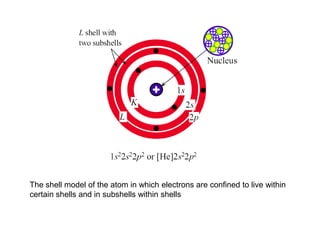
The shell model of the atom in which electrons are confined to live within
certain shells and in subshells within shells
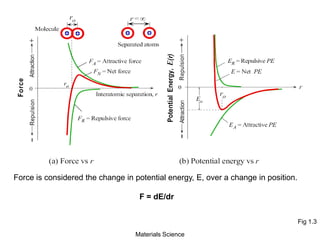
Fig 1.3
Materials Science
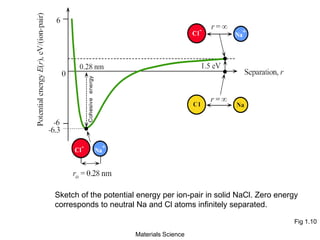
Force is considered the change in potential energy, E, over a change in position.
F = dE/dr
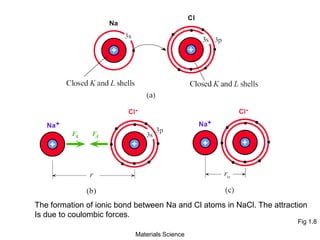
Fig 1.8
The formation of ionic bond between Na and Cl atoms in NaCl. The attraction
Is due to coulombic forces.
Materials Science
Fig 1.10
Sketch of the potential energy per ion-pair in solid NaCl. Zero energy
corresponds to neutral Na and Cl atoms infinitely separated.
Materials Science
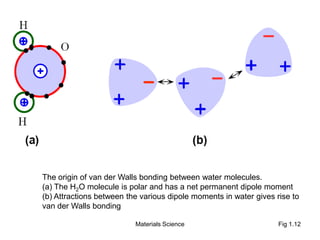
Materials Science Fig 1.12
The origin of van der Walls bonding between water molecules.
(a) The H2O molecule is polar and has a net permanent dipole moment
(b) Attractions between the various dipole moments in water gives rise to
van der Walls bonding
Materials Science 8
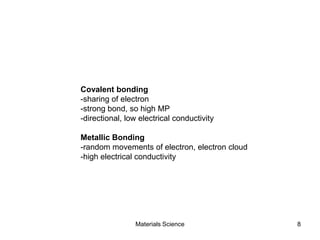
Covalent bonding
-sharing of electron
-strong bond, so high MP
-directional, low electrical conductivity
Metallic Bonding
-random movements of electron, electron cloud
-high electrical conductivity
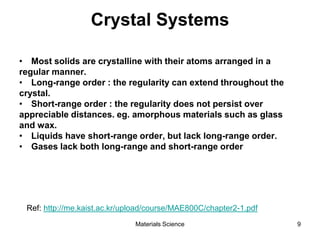
Crystal Systems
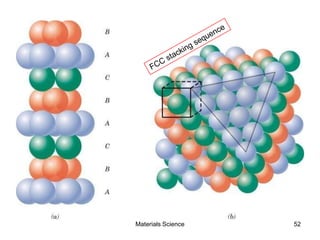
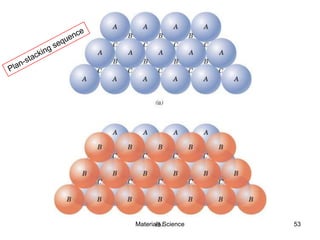
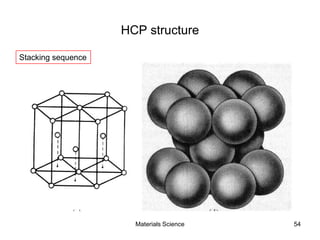
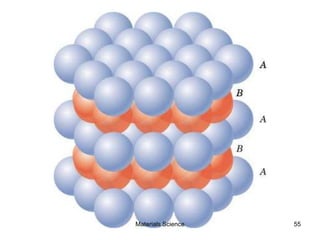
• Most solids are crystalline with their atoms arranged in a
regular manner.
• Long-range order : the regularity can extend throughout the
crystal.
• Short-range order : the regularity does not persist over
appreciable distances. eg. amorphous materials such as glass
and wax.
• Liquids have short-range order, but lack long-range order.
• Gases lack both long-range and short-range order
Ref: http://me.kaist.ac.kr/upload/course/MAE800C/chapter2-1.pdf
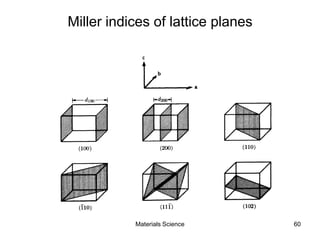
9Materials Science
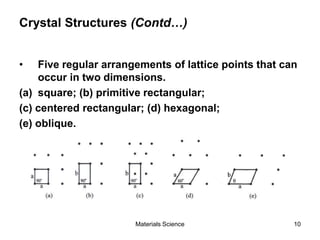
Crystal Structures (Contd…)
• Five regular arrangements of lattice points that can
occur in two dimensions.
(a) square; (b) primitive rectangular;
(c) centered rectangular; (d) hexagonal;
(e) oblique.
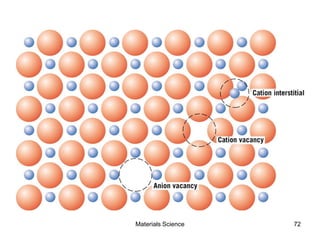
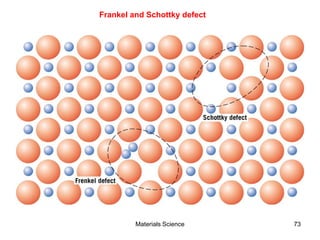
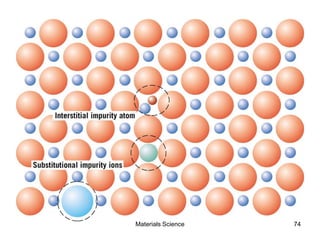
10Materials Science
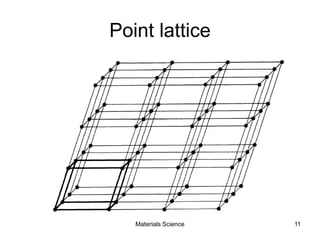
Point lattice
11Materials Science
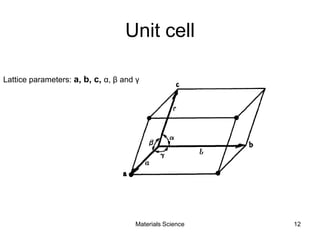
Unit cell
Lattice parameters: a, b, c, α, β and γ
12Materials Science
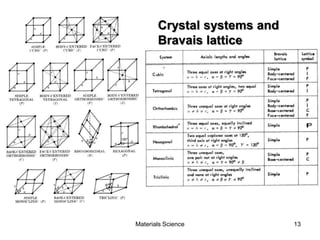
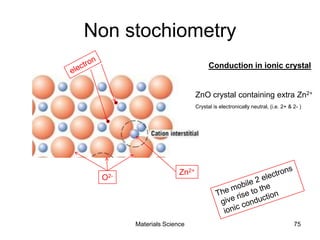
Crystal systems and
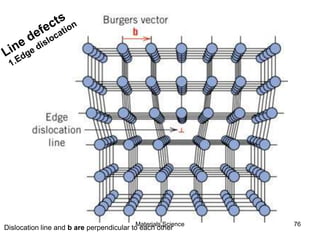
Bravais lattice
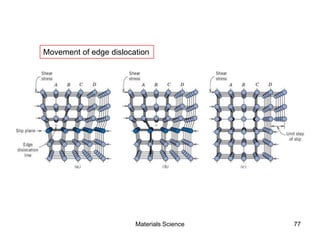
13Materials Science
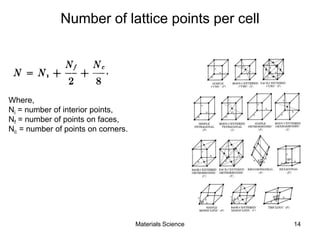
Number of lattice points per cell
Where,
Ni = number of interior points,
Nf = number of points on faces,
Nc = number of points on corners.
14Materials Science
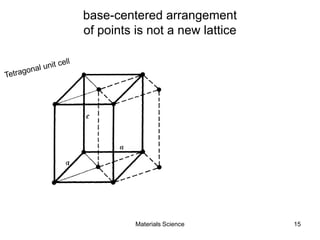
base-centered arrangement
of points is not a new lattice
15Materials Science
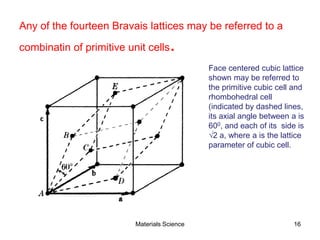
Any of the fourteen Bravais lattices may be referred to a
combinatin of primitive unit cells.
Face centered cubic lattice
shown may be referred to
the primitive cubic cell and
rhombohedral cell
(indicated by dashed lines,
its axial angle between a is
600, and each of its side is
√2 a, where a is the lattice
parameter of cubic cell.
16Materials Science
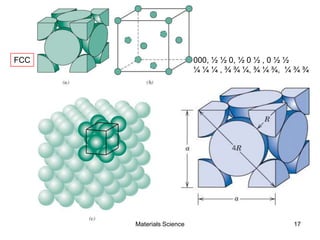
FCC
17Materials Science
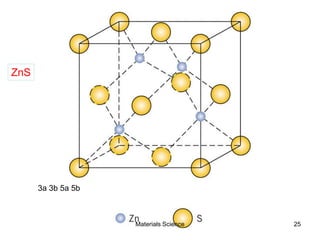
000, ½ ½ 0, ½ 0 ½ , 0 ½ ½
¼ ¼ ¼ , ¾ ¾ ¼, ¾ ¼ ¾, ¼ ¾ ¾
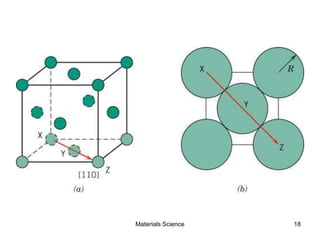
18Materials Science
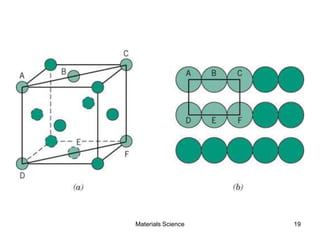
19Materials Science
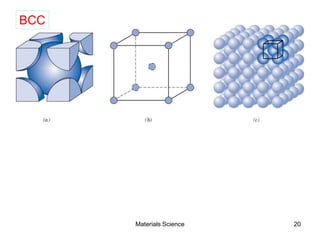
20Materials Science
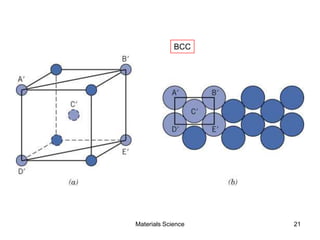
BCC
BCC
21Materials Science
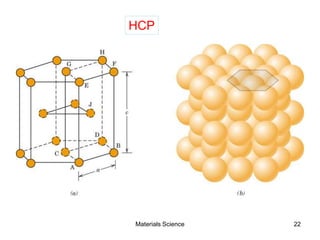
HCP
22Materials Science
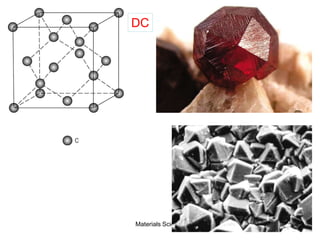
DC
23Materials Science
Materials Science 24
A C G H
D F I J
G
H
I
J
x
Z
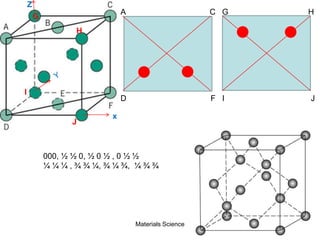
000, ½ ½ 0, ½ 0 ½ , 0 ½ ½
¼ ¼ ¼ , ¾ ¾ ¼, ¾ ¼ ¾, ¼ ¾ ¾
ZnS
25Materials Science
3a 3b 5a 5b
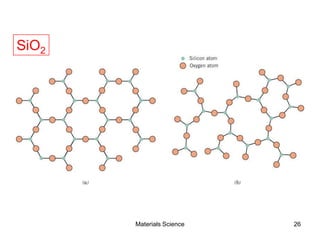
SiO2
26Materials Science
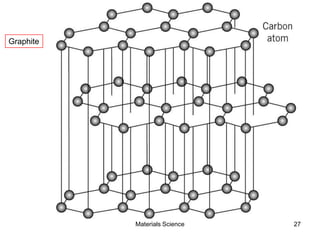
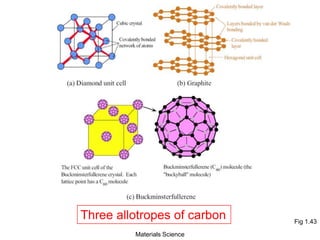
Graphite
27Materials Science
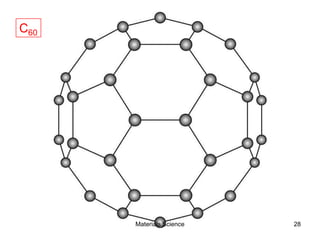
C60
28Materials Science
Fig 1.43
Three allotropes of carbon
Materials Science
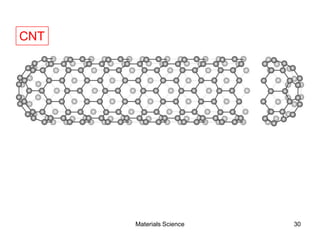
CNT
30Materials Science
31
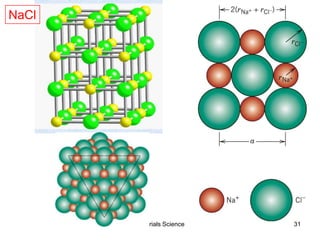
NaCl
Materials Science
Coordination number
Number of nearest neighbors of an atom in the crystal lattice
32Materials Science
5
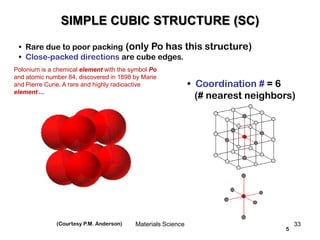
• Rare due to poor packing (only Po has this structure)
• Close-packed directions are cube edges.
• Coordination # = 6
(# nearest neighbors)
(Courtesy P.M. Anderson)
SIMPLE CUBIC STRUCTURE (SC)
33Materials Science
Polonium is a chemical element with the symbol Po
and atomic number 84, discovered in 1898 by Marie
and Pierre Curie. A rare and highly radioactive
element ...
6
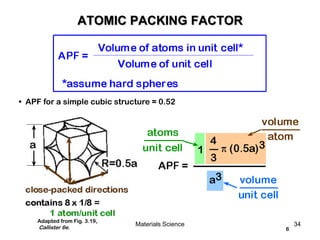
• APF for a simple cubic structure = 0.52
Adapted from Fig. 3.19,
Callister 6e.
ATOMIC PACKING FACTOR
34Materials Science
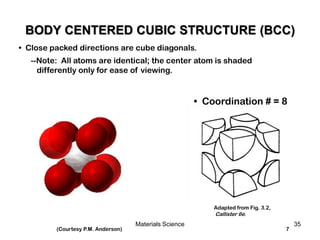
• Coordination # = 8
7
Adapted from Fig. 3.2,
Callister 6e.
(Courtesy P.M. Anderson)
• Close packed directions are cube diagonals.
--Note: All atoms are identical; the center atom is shaded
differently only for ease of viewing.
BODY CENTERED CUBIC STRUCTURE (BCC)
35Materials Science
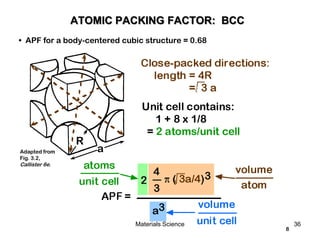
a
R
8
• APF for a body-centered cubic structure = 0.68
Unit cell contains:
1 + 8 x 1/8
= 2 atoms/unit cell
Adapted from
Fig. 3.2,
Callister 6e.
ATOMIC PACKING FACTOR: BCC
36Materials Science
9
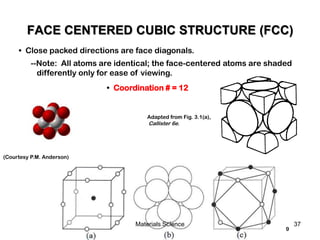
• Coordination # = 12
Adapted from Fig. 3.1(a),
Callister 6e.
(Courtesy P.M. Anderson)
• Close packed directions are face diagonals.
--Note: All atoms are identical; the face-centered atoms are shaded
differently only for ease of viewing.
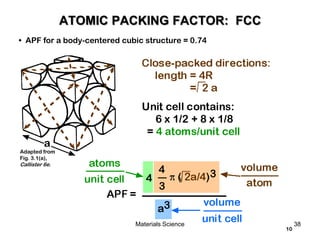
FACE CENTERED CUBIC STRUCTURE (FCC)
37Materials Science
Unit cell contains:
6 x 1/2 + 8 x 1/8
= 4 atoms/unit cell
a
10
• APF for a body-centered cubic structure = 0.74
Adapted from
Fig. 3.1(a),
Callister 6e.
ATOMIC PACKING FACTOR: FCC
38Materials Science
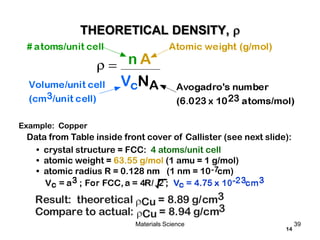
14
Example: Copper
Data from Table inside front cover of Callister (see next slide):
• crystal structure = FCC: 4 atoms/unit cell
• atomic weight = 63.55 g/mol (1 amu = 1 g/mol)
• atomic radius R = 0.128 nm (1 nm = 10 cm)-7
Compare to actual: Cu = 8.94 g/cm3
Result: theoretical Cu = 8.89 g/cm3
THEORETICAL DENSITY,
39Materials Science
15
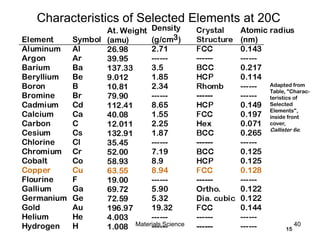
Element
Aluminum
Argon
Barium
Beryllium
Boron
Bromine
Cadmium
Calcium
Carbon
Cesium
Chlorine
Chromium
Cobalt
Copper
Flourine
Gallium
Germanium
Gold
Helium
Hydrogen
Symbol
Al
Ar
Ba
Be
B
Br
Cd
Ca
C
Cs
Cl
Cr
Co
Cu
F
Ga
Ge
Au
He
H
At. Weight
(amu)
26.98
39.95
137.33
9.012
10.81
79.90
112.41
40.08
12.011
132.91
35.45
52.00
58.93
63.55
19.00
69.72
72.59
196.97
4.003
1.008
Atomic radius
(nm)
0.143
------
0.217
0.114
------
------
0.149
0.197
0.071
0.265
------
0.125
0.125
0.128
------
0.122
0.122
0.144
------
------
Density
(g/cm3)
2.71
------
3.5
1.85
2.34
------
8.65
1.55
2.25
1.87
------
7.19
8.9
8.94
------
5.90
5.32
19.32
------
------
Adapted from
Table, "Charac-
teristics of
Selected
Elements",
inside front
cover,
Callister 6e.
Characteristics of Selected Elements at 20C
40Materials Science
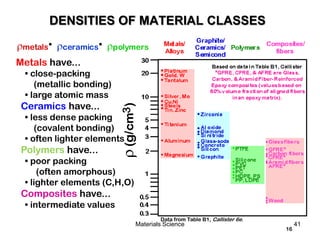
metals• ceramics• polymers
16
Metals have...
• close-packing
(metallic bonding)
• large atomic mass
Ceramics have...
• less dense packing
(covalent bonding)
• often lighter elements
Polymers have...
• poor packing
(often amorphous)
• lighter elements (C,H,O)
Composites have...
• intermediate values
Data from Table B1, Callister 6e.
DENSITIES OF MATERIAL CLASSES
41Materials Science
Materials Science 42
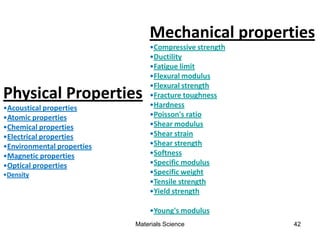
Physical Properties
•Acoustical properties
•Atomic properties
•Chemical properties
•Electrical properties
•Environmental properties
•Magnetic properties
•Optical properties
•Density
Mechanical properties
•Compressive strength
•Ductility
•Fatigue limit
•Flexural modulus
•Flexural strength
•Fracture toughness
•Hardness
•Poisson's ratio
•Shear modulus
•Shear strain
•Shear strength
•Softness
•Specific modulus
•Specific weight
•Tensile strength
•Yield strength
•Young's modulus
18
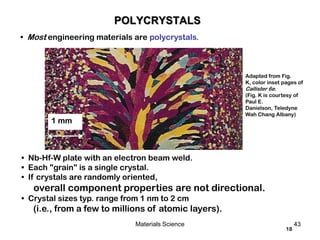
• Most engineering materials are polycrystals.
• Nb-Hf-W plate with an electron beam weld.
• Each "grain" is a single crystal.
• If crystals are randomly oriented,
overall component properties are not directional.
• Crystal sizes typ. range from 1 nm to 2 cm
(i.e., from a few to millions of atomic layers).
Adapted from Fig.
K, color inset pages of
Callister 6e.
(Fig. K is courtesy of
Paul E.
Danielson, Teledyne
Wah Chang Albany)
1 mm
POLYCRYSTALS
43Materials Science
19
• Single Crystals
-Properties vary with
direction: anisotropic.
-Example: the modulus
of elasticity (E) in BCC iron:
• Polycrystals
-Properties may/may not
vary with direction.
-If grains are randomly
oriented: isotropic.
(Epoly iron = 210 GPa)
-If grains are textured,
anisotropic.
200 m
Data from Table
3.3, Callister 6e.
(Source of data is
R.W.
Hertzberg, Deformatio
n and Fracture
Mechanics of
Engineering
Materials, 3rd
ed., John Wiley and
Sons, 1989.)
Adapted from Fig.
4.12(b), Callister 6e.
(Fig. 4.12(b) is
courtesy of L.C. Smith
and C. Brady, the
National Bureau of
Standards,
Washington, DC [now
the National Institute
of Standards and
Technology,
Gaithersburg, MD].)
SINGLE VS POLYCRYSTALS
44Materials Science
Face-Centered Cubic
Nanoparticles
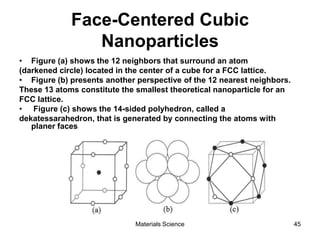
• Figure (a) shows the 12 neighbors that surround an atom
(darkened circle) located in the center of a cube for a FCC lattice.
• Figure (b) presents another perspective of the 12 nearest neighbors.
These 13 atoms constitute the smallest theoretical nanoparticle for an
FCC lattice.
• Figure (c) shows the 14-sided polyhedron, called a
dekatessarahedron, that is generated by connecting the atoms with
planer faces
45Materials Science
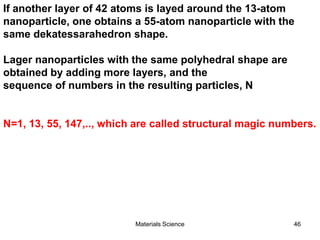
If another layer of 42 atoms is layed around the 13-atom
nanoparticle, one obtains a 55-atom nanoparticle with the
same dekatessarahedron shape.
Lager nanoparticles with the same polyhedral shape are
obtained by adding more layers, and the
sequence of numbers in the resulting particles, N
N=1, 13, 55, 147,.., which are called structural magic numbers.
46Materials Science
Atoms in nano clusters
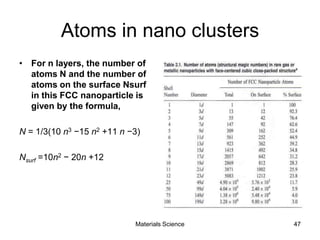
• For n layers, the number of
atoms N and the number of
atoms on the surface Nsurf
in this FCC nanoparticle is
given by the formula,
N = 1/3(10 n3 −15 n2 +11 n −3)
Nsurf =10n2 − 20n +12
47Materials Science
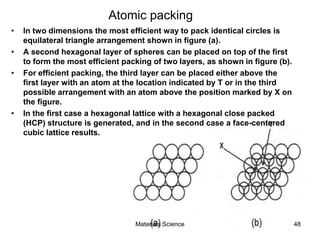
Atomic packing
• In two dimensions the most efficient way to pack identical circles is
equilateral triangle arrangement shown in figure (a).
• A second hexagonal layer of spheres can be placed on top of the first
to form the most efficient packing of two layers, as shown in figure (b).
• For efficient packing, the third layer can be placed either above the
first layer with an atom at the location indicated by T or in the third
possible arrangement with an atom above the position marked by X on
the figure.
• In the first case a hexagonal lattice with a hexagonal close packed
(HCP) structure is generated, and in the second case a face-centered
cubic lattice results.
48Materials Science
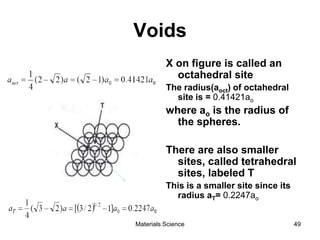
Voids
X on figure is called an
octahedral site
The radius(aoct) of octahedral
site is = 0.41421ao
where ao is the radius of
the spheres.
There are also smaller
sites, called tetrahedral
sites, labeled T
This is a smaller site since its
radius aT= 0.2247ao
49Materials Science
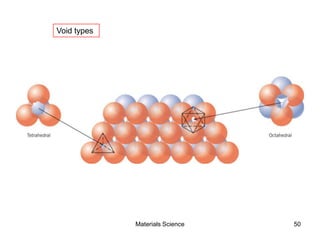
Void types
50Materials Science
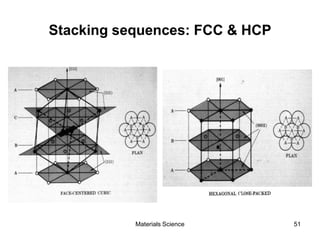
Stacking sequences: FCC & HCP
51Materials Science
52Materials Science
53Materials Science
HCP structure
54
Stacking sequence
Materials Science
55Materials Science
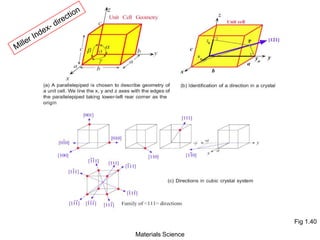
Fig 1.40
Materials Science
Lattice
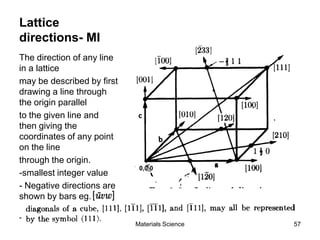
directions- MI
The direction of any line
in a lattice
may be described by first
drawing a line through
the origin parallel
to the given line and
then giving the
coordinates of any point
on the line
through the origin.
-smallest integer value
- Negative directions are
shown by bars eg.
0,0,0
-
57Materials Science
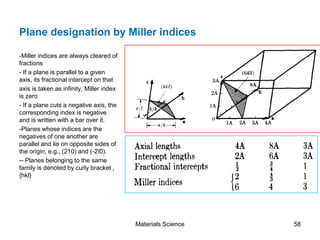
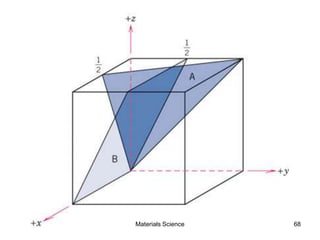
Plane designation by Miller indices
-Miller indices are always cleared of
fractions
- If a plane is parallel to a given
axis, its fractional intercept on that
axis is taken as infinity, Miller index
is zero
- If a plane cuts a negative axis, the
corresponding index is negative
and is written with a bar over it.
-Planes whose indices are the
negatives of one another are
parallel and lie on opposite sides of
the origin, e.g., (210) and (-2ī0).
-- Planes belonging to the same
family is denoted by curly bracket ,
{hkl}
58Materials Science
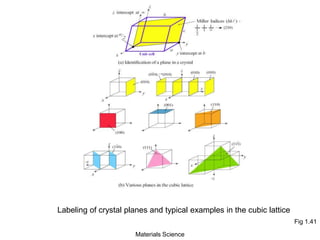
Fig 1.41
Labeling of crystal planes and typical examples in the cubic lattice
Materials Science
Miller indices of lattice planes
60Materials Science
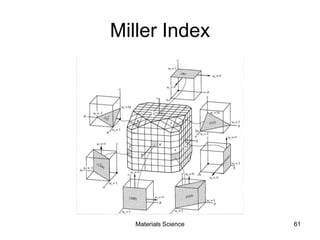
Miller Index
61Materials Science
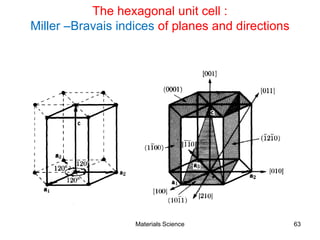
The hexagonal unit cell :
Miller –Bravais indices of planes and directions
63Materials Science
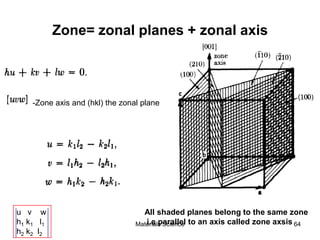
Zone= zonal planes + zonal axis
-Zone axis and (hkl) the zonal plane
All shaded planes belong to the same zone
i.e parallel to an axis called zone axsis 64Materials Science
u v w
h1 k1 l1
h2 k2 l2
68Materials Science
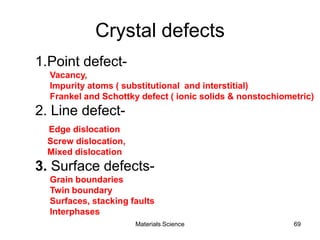
Crystal defects
69
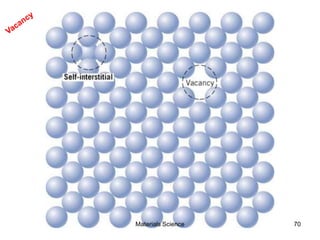
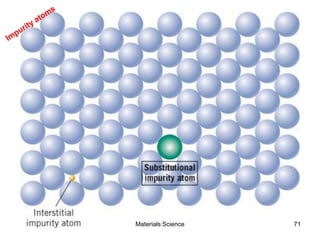
1.Point defect-
Vacancy,
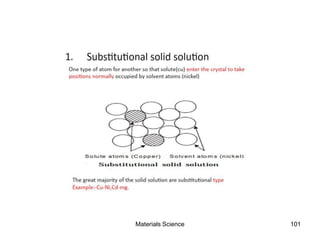
Impurity atoms ( substitutional and interstitial)
Frankel and Schottky defect ( ionic solids & nonstochiometric)
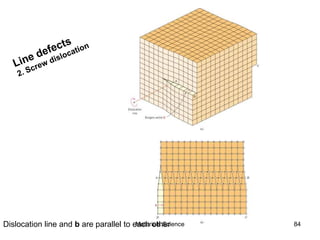
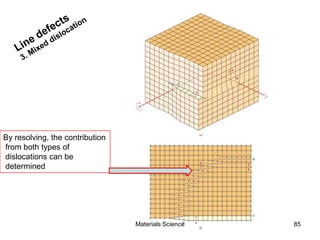
2. Line defect-
Edge dislocation
Screw dislocation,
Mixed dislocation
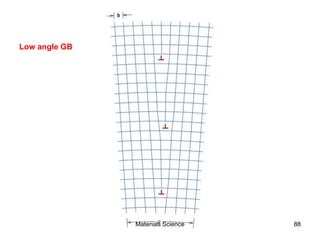
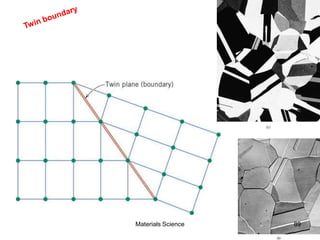
3. Surface defects-
Grain boundaries
Twin boundary
Surfaces, stacking faults
Interphases
Materials Science
70Materials Science
71Materials Science
72Materials Science
Frankel and Schottky defect
73Materials Science
74Materials Science
Non stochiometry
75
Conduction in ionic crystal
ZnO crystal containing extra Zn2+
Crystal is electronically neutral, (i.e. 2+ & 2- )
Zn2+
O2-
Materials Science
Dislocation line and b are perpendicular to each other
76Materials Science
Movement of edge dislocation
77Materials Science
78Materials Science
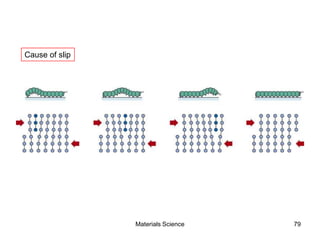
Cause of slip
79Materials Science
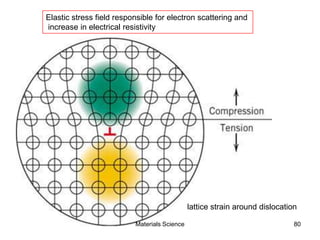
Elastic stress field responsible for electron scattering and
increase in electrical resistivity
lattice strain around dislocation
80Materials Science
81Materials Science
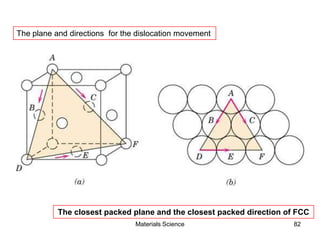
The closest packed plane and the closest packed direction of FCC
The plane and directions for the dislocation movement
82Materials Science
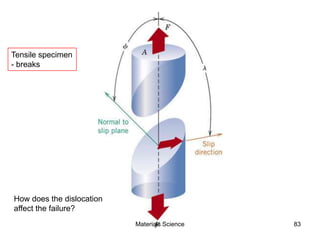
Tensile specimen
- breaks
How does the dislocation
affect the failure?
83Materials Science
Dislocation line and b are parallel to each other 84Materials Science
By resolving, the contribution
from both types of
dislocations can be
determined
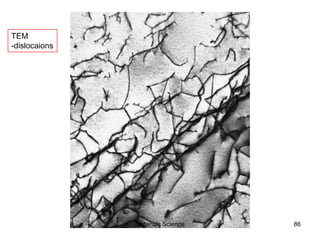
85Materials Science
TEM
-dislocaions
86Materials Science
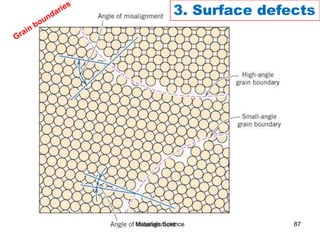
3. Surface defects
87Materials Science
Low angle GB
88Materials Science
89Materials Science
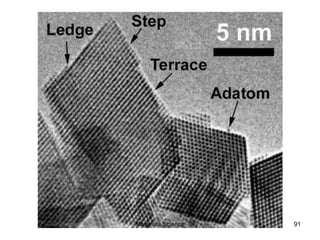
91Materials Science
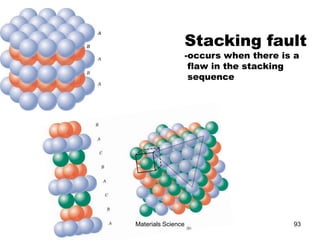
Stacking fault
-occurs when there is a
flaw in the stacking
sequence
93Materials Science
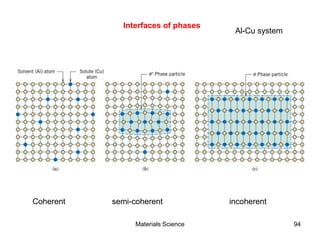
Interfaces of phases
Coherent semi-coherent incoherent
Al-Cu system
94Materials Science
Materials Science 95
Materials Science 96
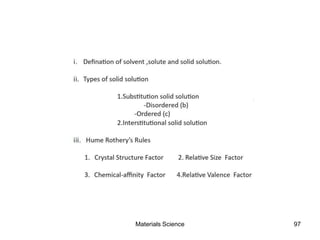
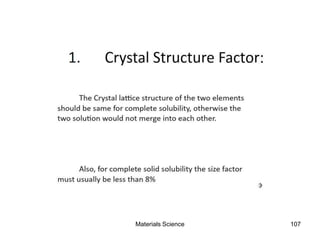
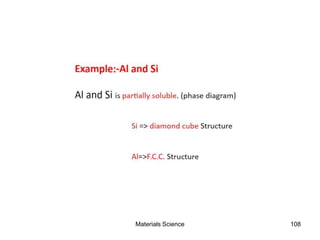
Principles of Alloy Formation :
primary and intermediate phases,
their formation,
solid solutions,
Hume Rothery rule
Materials Science 97
Materials Science 98
Materials Science 99
Materials Science 100
Materials Science 101
Materials Science 102
Materials Science 103
Materials Science 104
Materials Science 105
Materials Science 106
Materials Science 107
Materials Science 108
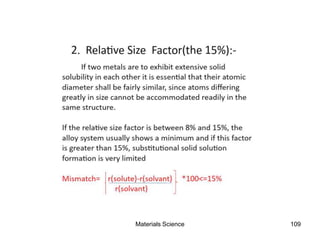
Materials Science 109
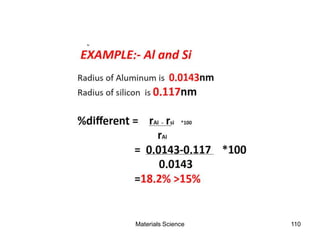
Materials Science 110
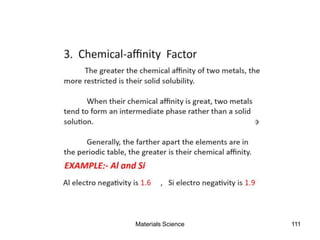
Materials Science 111
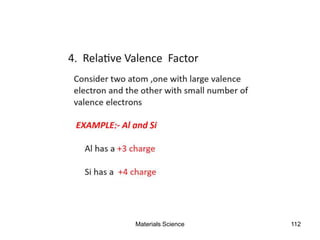
Materials Science 112
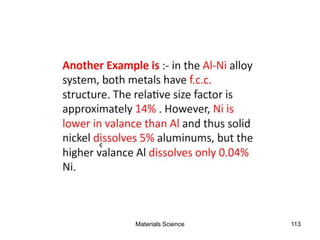
Materials Science 113
Materials Science 114
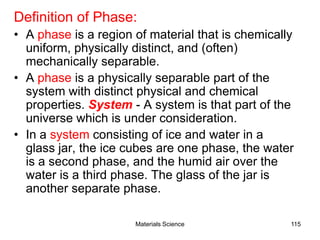
Definition of Phase:
• A phase is a region of material that is chemically
uniform, physically distinct, and (often)
mechanically separable.
• A phase is a physically separable part of the
system with distinct physical and chemical
properties. System - A system is that part of the
universe which is under consideration.
• In a system consisting of ice and water in a
glass jar, the ice cubes are one phase, the water
is a second phase, and the humid air over the
water is a third phase. The glass of the jar is
another separate phase.
115Materials Science
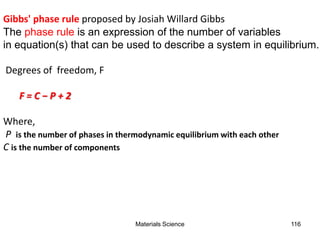
Gibbs' phase rule proposed by Josiah Willard Gibbs
The phase rule is an expression of the number of variables
in equation(s) that can be used to describe a system in equilibrium.
Degrees of freedom, F
F = C − P + 2
Where,
P is the number of phases in thermodynamic equilibrium with each other
C is the number of components
116Materials Science
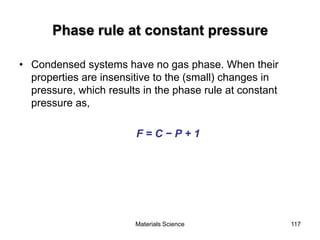
Phase rule at constant pressure
• Condensed systems have no gas phase. When their
properties are insensitive to the (small) changes in
pressure, which results in the phase rule at constant
pressure as,
F = C − P + 1
117Materials Science
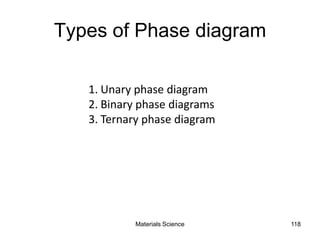
Types of Phase diagram
118
1. Unary phase diagram
2. Binary phase diagrams
3. Ternary phase diagram
Materials Science
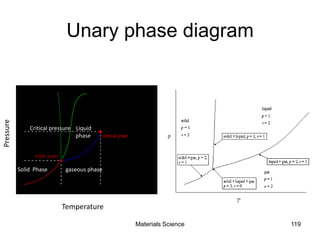
Unary phase diagram
Critical pressure Liquid
phase
Pressure
Temperature
Solid Phase gaseous phase
119Materials Science
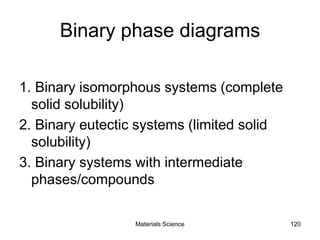
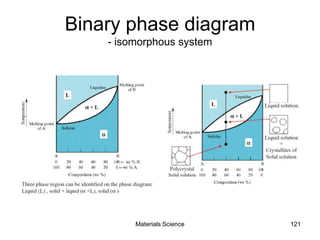
Binary phase diagrams
1. Binary isomorphous systems (complete
solid solubility)
2. Binary eutectic systems (limited solid
solubility)
3. Binary systems with intermediate
phases/compounds
120Materials Science
Binary phase diagram
- isomorphous system
121Materials Science
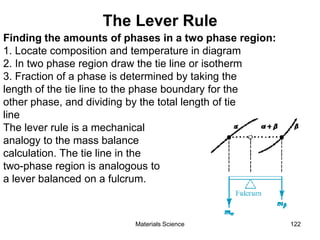
The Lever Rule
Finding the amounts of phases in a two phase region:
1. Locate composition and temperature in diagram
2. In two phase region draw the tie line or isotherm
3. Fraction of a phase is determined by taking the
length of the tie line to the phase boundary for the
other phase, and dividing by the total length of tie
line
The lever rule is a mechanical
analogy to the mass balance
calculation. The tie line in the
two-phase region is analogous to
a lever balanced on a fulcrum.
122Materials Science
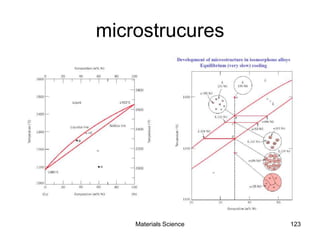
microstrucures
123Materials Science
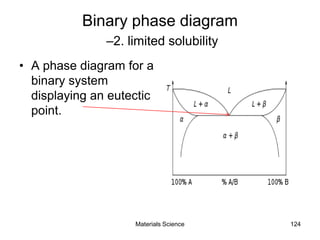
Binary phase diagram
–2. limited solubility
• A phase diagram for a
binary system
displaying an eutectic
point.
124Materials Science
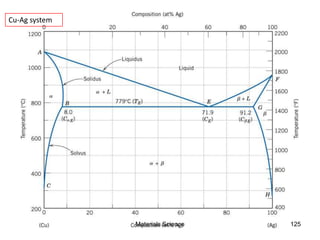
Cu-Ag system
125Materials Science
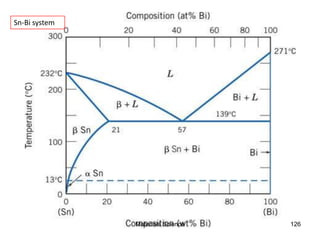
Sn-Bi system
126Materials Science
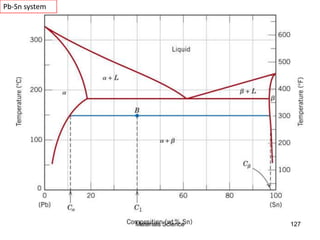
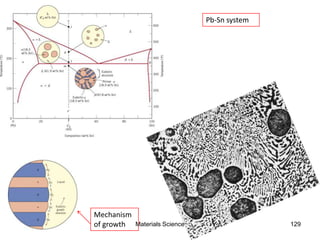
Pb-Sn system
127Materials Science
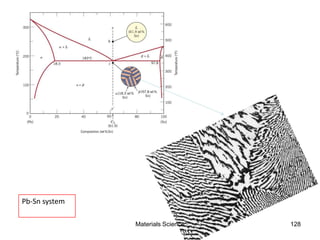
Pb-Sn system
128Materials Science
Mechanism
of growth
Pb-Sn system
129Materials Science
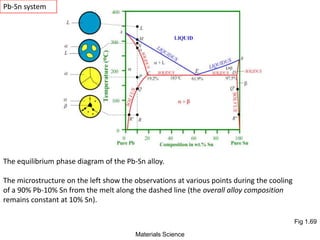
Fig 1.69
Materials Science
The equilibrium phase diagram of the Pb-Sn alloy.
The microstructure on the left show the observations at various points during the cooling
of a 90% Pb-10% Sn from the melt along the dashed line (the overall alloy composition
remains constant at 10% Sn).
Pb-Sn system
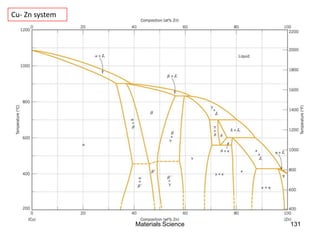
Cu- Zn system
131Materials Science
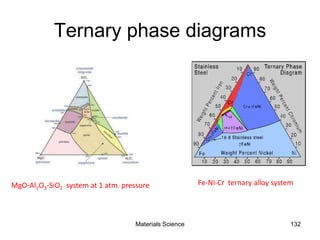
Ternary phase diagrams
MgO-Al2O3-SiO2 system at 1 atm. pressure Fe-Ni-Cr ternary alloy system
132Materials Science
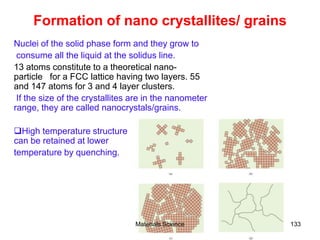
Formation of nano crystallites/ grains
Nuclei of the solid phase form and they grow to
consume all the liquid at the solidus line.
13 atoms constitute to a theoretical nano-
particle for a FCC lattice having two layers. 55
and 147 atoms for 3 and 4 layer clusters.
If the size of the crystallites are in the nanometer
range, they are called nanocrystals/grains.
High temperature structure
can be retained at lower
temperature by quenching.
133Materials Science
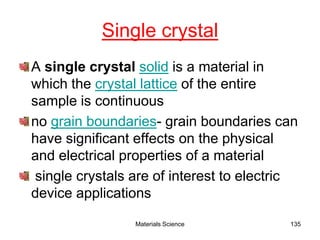
Single crystal
A single crystal solid is a material in
which the crystal lattice of the entire
sample is continuous
no grain boundaries- grain boundaries can
have significant effects on the physical
and electrical properties of a material
single crystals are of interest to electric
device applications
135Materials Science

Crystalography

  • 1.
    Complied by: Prof. VijayaAgarwala BE, MTech, PhD Professor and Head, Center of Excellence Nanotechnology & Professor, Metallurgical and Materials Engineering and IIT Roorkee MT201B: Materials Science L-3, T-1, P-0 4 credits: CWS-25%, MTE-25%, ETE-50%
  • 2.
    Materials Science 2 lntroductionto Crystallography: Crystal defects: point defects, line defects, dislocations surface defects and volume defects; Principles of Alloy Formation : primary and intermediate phases, their formation, solid solutions, Hume Rothery rules, Binary Equilibria: Binary phase diagrams involving isomorphous, eutectic, peritectic and eutectoid reactions. phase rule, lever rule, effect of non- equilibrium cooling on structure and distribution of phases. Some common binary phase diagrams viz : Cu-Ni, Al-Si, Pb-Sn, Cu-Zn, Cu-Sn and Fe-C and important alloys belonging to these systems;
  • 3.
    The shell modelof the atom in which electrons are confined to live within certain shells and in subshells within shells
  • 4.
    Fig 1.3 Materials Science Forceis considered the change in potential energy, E, over a change in position. F = dE/dr
  • 5.
    Fig 1.8 The formationof ionic bond between Na and Cl atoms in NaCl. The attraction Is due to coulombic forces. Materials Science
  • 6.
    Fig 1.10 Sketch ofthe potential energy per ion-pair in solid NaCl. Zero energy corresponds to neutral Na and Cl atoms infinitely separated. Materials Science
  • 7.
    Materials Science Fig1.12 The origin of van der Walls bonding between water molecules. (a) The H2O molecule is polar and has a net permanent dipole moment (b) Attractions between the various dipole moments in water gives rise to van der Walls bonding
  • 8.
    Materials Science 8 Covalentbonding -sharing of electron -strong bond, so high MP -directional, low electrical conductivity Metallic Bonding -random movements of electron, electron cloud -high electrical conductivity
  • 9.
    Crystal Systems • Mostsolids are crystalline with their atoms arranged in a regular manner. • Long-range order : the regularity can extend throughout the crystal. • Short-range order : the regularity does not persist over appreciable distances. eg. amorphous materials such as glass and wax. • Liquids have short-range order, but lack long-range order. • Gases lack both long-range and short-range order Ref: http://me.kaist.ac.kr/upload/course/MAE800C/chapter2-1.pdf 9Materials Science
  • 10.
    Crystal Structures (Contd…) •Five regular arrangements of lattice points that can occur in two dimensions. (a) square; (b) primitive rectangular; (c) centered rectangular; (d) hexagonal; (e) oblique. 10Materials Science
  • 11.
  • 12.
    Unit cell Lattice parameters:a, b, c, α, β and γ 12Materials Science
  • 13.
    Crystal systems and Bravaislattice 13Materials Science
  • 14.
    Number of latticepoints per cell Where, Ni = number of interior points, Nf = number of points on faces, Nc = number of points on corners. 14Materials Science
  • 15.
    base-centered arrangement of pointsis not a new lattice 15Materials Science
  • 16.
    Any of thefourteen Bravais lattices may be referred to a combinatin of primitive unit cells. Face centered cubic lattice shown may be referred to the primitive cubic cell and rhombohedral cell (indicated by dashed lines, its axial angle between a is 600, and each of its side is √2 a, where a is the lattice parameter of cubic cell. 16Materials Science
  • 17.
    FCC 17Materials Science 000, ½½ 0, ½ 0 ½ , 0 ½ ½ ¼ ¼ ¼ , ¾ ¾ ¼, ¾ ¼ ¾, ¼ ¾ ¾
  • 18.
  • 19.
  • 20.
  • 21.
  • 22.
  • 23.
  • 24.
    Materials Science 24 AC G H D F I J G H I J x Z 000, ½ ½ 0, ½ 0 ½ , 0 ½ ½ ¼ ¼ ¼ , ¾ ¾ ¼, ¾ ¼ ¾, ¼ ¾ ¾
  • 25.
  • 26.
  • 27.
  • 28.
  • 29.
    Fig 1.43 Three allotropesof carbon Materials Science
  • 30.
  • 31.
  • 32.
    Coordination number Number ofnearest neighbors of an atom in the crystal lattice 32Materials Science
  • 33.
    5 • Rare dueto poor packing (only Po has this structure) • Close-packed directions are cube edges. • Coordination # = 6 (# nearest neighbors) (Courtesy P.M. Anderson) SIMPLE CUBIC STRUCTURE (SC) 33Materials Science Polonium is a chemical element with the symbol Po and atomic number 84, discovered in 1898 by Marie and Pierre Curie. A rare and highly radioactive element ...
  • 34.
    6 • APF fora simple cubic structure = 0.52 Adapted from Fig. 3.19, Callister 6e. ATOMIC PACKING FACTOR 34Materials Science
  • 35.
    • Coordination #= 8 7 Adapted from Fig. 3.2, Callister 6e. (Courtesy P.M. Anderson) • Close packed directions are cube diagonals. --Note: All atoms are identical; the center atom is shaded differently only for ease of viewing. BODY CENTERED CUBIC STRUCTURE (BCC) 35Materials Science
  • 36.
    a R 8 • APF fora body-centered cubic structure = 0.68 Unit cell contains: 1 + 8 x 1/8 = 2 atoms/unit cell Adapted from Fig. 3.2, Callister 6e. ATOMIC PACKING FACTOR: BCC 36Materials Science
  • 37.
    9 • Coordination #= 12 Adapted from Fig. 3.1(a), Callister 6e. (Courtesy P.M. Anderson) • Close packed directions are face diagonals. --Note: All atoms are identical; the face-centered atoms are shaded differently only for ease of viewing. FACE CENTERED CUBIC STRUCTURE (FCC) 37Materials Science
  • 38.
    Unit cell contains: 6x 1/2 + 8 x 1/8 = 4 atoms/unit cell a 10 • APF for a body-centered cubic structure = 0.74 Adapted from Fig. 3.1(a), Callister 6e. ATOMIC PACKING FACTOR: FCC 38Materials Science
  • 39.
    14 Example: Copper Data fromTable inside front cover of Callister (see next slide): • crystal structure = FCC: 4 atoms/unit cell • atomic weight = 63.55 g/mol (1 amu = 1 g/mol) • atomic radius R = 0.128 nm (1 nm = 10 cm)-7 Compare to actual: Cu = 8.94 g/cm3 Result: theoretical Cu = 8.89 g/cm3 THEORETICAL DENSITY, 39Materials Science
  • 40.
    15 Element Aluminum Argon Barium Beryllium Boron Bromine Cadmium Calcium Carbon Cesium Chlorine Chromium Cobalt Copper Flourine Gallium Germanium Gold Helium Hydrogen Symbol Al Ar Ba Be B Br Cd Ca C Cs Cl Cr Co Cu F Ga Ge Au He H At. Weight (amu) 26.98 39.95 137.33 9.012 10.81 79.90 112.41 40.08 12.011 132.91 35.45 52.00 58.93 63.55 19.00 69.72 72.59 196.97 4.003 1.008 Atomic radius (nm) 0.143 ------ 0.217 0.114 ------ ------ 0.149 0.197 0.071 0.265 ------ 0.125 0.125 0.128 ------ 0.122 0.122 0.144 ------ ------ Density (g/cm3) 2.71 ------ 3.5 1.85 2.34 ------ 8.65 1.55 2.25 1.87 ------ 7.19 8.9 8.94 ------ 5.90 5.32 19.32 ------ ------ Adaptedfrom Table, "Charac- teristics of Selected Elements", inside front cover, Callister 6e. Characteristics of Selected Elements at 20C 40Materials Science
  • 41.
    metals• ceramics• polymers 16 Metalshave... • close-packing (metallic bonding) • large atomic mass Ceramics have... • less dense packing (covalent bonding) • often lighter elements Polymers have... • poor packing (often amorphous) • lighter elements (C,H,O) Composites have... • intermediate values Data from Table B1, Callister 6e. DENSITIES OF MATERIAL CLASSES 41Materials Science
  • 42.
    Materials Science 42 PhysicalProperties •Acoustical properties •Atomic properties •Chemical properties •Electrical properties •Environmental properties •Magnetic properties •Optical properties •Density Mechanical properties •Compressive strength •Ductility •Fatigue limit •Flexural modulus •Flexural strength •Fracture toughness •Hardness •Poisson's ratio •Shear modulus •Shear strain •Shear strength •Softness •Specific modulus •Specific weight •Tensile strength •Yield strength •Young's modulus
  • 43.
    18 • Most engineeringmaterials are polycrystals. • Nb-Hf-W plate with an electron beam weld. • Each "grain" is a single crystal. • If crystals are randomly oriented, overall component properties are not directional. • Crystal sizes typ. range from 1 nm to 2 cm (i.e., from a few to millions of atomic layers). Adapted from Fig. K, color inset pages of Callister 6e. (Fig. K is courtesy of Paul E. Danielson, Teledyne Wah Chang Albany) 1 mm POLYCRYSTALS 43Materials Science
  • 44.
    19 • Single Crystals -Propertiesvary with direction: anisotropic. -Example: the modulus of elasticity (E) in BCC iron: • Polycrystals -Properties may/may not vary with direction. -If grains are randomly oriented: isotropic. (Epoly iron = 210 GPa) -If grains are textured, anisotropic. 200 m Data from Table 3.3, Callister 6e. (Source of data is R.W. Hertzberg, Deformatio n and Fracture Mechanics of Engineering Materials, 3rd ed., John Wiley and Sons, 1989.) Adapted from Fig. 4.12(b), Callister 6e. (Fig. 4.12(b) is courtesy of L.C. Smith and C. Brady, the National Bureau of Standards, Washington, DC [now the National Institute of Standards and Technology, Gaithersburg, MD].) SINGLE VS POLYCRYSTALS 44Materials Science
  • 45.
    Face-Centered Cubic Nanoparticles • Figure(a) shows the 12 neighbors that surround an atom (darkened circle) located in the center of a cube for a FCC lattice. • Figure (b) presents another perspective of the 12 nearest neighbors. These 13 atoms constitute the smallest theoretical nanoparticle for an FCC lattice. • Figure (c) shows the 14-sided polyhedron, called a dekatessarahedron, that is generated by connecting the atoms with planer faces 45Materials Science
  • 46.
    If another layerof 42 atoms is layed around the 13-atom nanoparticle, one obtains a 55-atom nanoparticle with the same dekatessarahedron shape. Lager nanoparticles with the same polyhedral shape are obtained by adding more layers, and the sequence of numbers in the resulting particles, N N=1, 13, 55, 147,.., which are called structural magic numbers. 46Materials Science
  • 47.
    Atoms in nanoclusters • For n layers, the number of atoms N and the number of atoms on the surface Nsurf in this FCC nanoparticle is given by the formula, N = 1/3(10 n3 −15 n2 +11 n −3) Nsurf =10n2 − 20n +12 47Materials Science
  • 48.
    Atomic packing • Intwo dimensions the most efficient way to pack identical circles is equilateral triangle arrangement shown in figure (a). • A second hexagonal layer of spheres can be placed on top of the first to form the most efficient packing of two layers, as shown in figure (b). • For efficient packing, the third layer can be placed either above the first layer with an atom at the location indicated by T or in the third possible arrangement with an atom above the position marked by X on the figure. • In the first case a hexagonal lattice with a hexagonal close packed (HCP) structure is generated, and in the second case a face-centered cubic lattice results. 48Materials Science
  • 49.
    Voids X on figureis called an octahedral site The radius(aoct) of octahedral site is = 0.41421ao where ao is the radius of the spheres. There are also smaller sites, called tetrahedral sites, labeled T This is a smaller site since its radius aT= 0.2247ao 49Materials Science
  • 50.
  • 51.
    Stacking sequences: FCC& HCP 51Materials Science
  • 52.
  • 53.
  • 54.
  • 55.
  • 56.
  • 57.
    Lattice directions- MI The directionof any line in a lattice may be described by first drawing a line through the origin parallel to the given line and then giving the coordinates of any point on the line through the origin. -smallest integer value - Negative directions are shown by bars eg. 0,0,0 - 57Materials Science
  • 58.
    Plane designation byMiller indices -Miller indices are always cleared of fractions - If a plane is parallel to a given axis, its fractional intercept on that axis is taken as infinity, Miller index is zero - If a plane cuts a negative axis, the corresponding index is negative and is written with a bar over it. -Planes whose indices are the negatives of one another are parallel and lie on opposite sides of the origin, e.g., (210) and (-2ī0). -- Planes belonging to the same family is denoted by curly bracket , {hkl} 58Materials Science
  • 59.
    Fig 1.41 Labeling ofcrystal planes and typical examples in the cubic lattice Materials Science
  • 60.
    Miller indices oflattice planes 60Materials Science
  • 61.
  • 62.
    The hexagonal unitcell : Miller –Bravais indices of planes and directions 63Materials Science
  • 63.
    Zone= zonal planes+ zonal axis -Zone axis and (hkl) the zonal plane All shaded planes belong to the same zone i.e parallel to an axis called zone axsis 64Materials Science u v w h1 k1 l1 h2 k2 l2
  • 64.
  • 65.
    Crystal defects 69 1.Point defect- Vacancy, Impurityatoms ( substitutional and interstitial) Frankel and Schottky defect ( ionic solids & nonstochiometric) 2. Line defect- Edge dislocation Screw dislocation, Mixed dislocation 3. Surface defects- Grain boundaries Twin boundary Surfaces, stacking faults Interphases Materials Science
  • 66.
  • 67.
  • 68.
  • 69.
    Frankel and Schottkydefect 73Materials Science
  • 70.
  • 71.
    Non stochiometry 75 Conduction inionic crystal ZnO crystal containing extra Zn2+ Crystal is electronically neutral, (i.e. 2+ & 2- ) Zn2+ O2- Materials Science
  • 72.
    Dislocation line andb are perpendicular to each other 76Materials Science
  • 73.
    Movement of edgedislocation 77Materials Science
  • 74.
  • 75.
  • 76.
    Elastic stress fieldresponsible for electron scattering and increase in electrical resistivity lattice strain around dislocation 80Materials Science
  • 77.
  • 78.
    The closest packedplane and the closest packed direction of FCC The plane and directions for the dislocation movement 82Materials Science
  • 79.
    Tensile specimen - breaks Howdoes the dislocation affect the failure? 83Materials Science
  • 80.
    Dislocation line andb are parallel to each other 84Materials Science
  • 81.
    By resolving, thecontribution from both types of dislocations can be determined 85Materials Science
  • 82.
  • 83.
  • 84.
  • 85.
  • 86.
  • 87.
    Stacking fault -occurs whenthere is a flaw in the stacking sequence 93Materials Science
  • 88.
    Interfaces of phases Coherentsemi-coherent incoherent Al-Cu system 94Materials Science
  • 89.
  • 90.
    Materials Science 96 Principlesof Alloy Formation : primary and intermediate phases, their formation, solid solutions, Hume Rothery rule
  • 91.
  • 92.
  • 93.
  • 94.
  • 95.
  • 96.
  • 97.
  • 98.
  • 99.
  • 100.
  • 101.
  • 102.
  • 103.
  • 104.
  • 105.
  • 106.
  • 107.
  • 108.
  • 109.
    Definition of Phase: •A phase is a region of material that is chemically uniform, physically distinct, and (often) mechanically separable. • A phase is a physically separable part of the system with distinct physical and chemical properties. System - A system is that part of the universe which is under consideration. • In a system consisting of ice and water in a glass jar, the ice cubes are one phase, the water is a second phase, and the humid air over the water is a third phase. The glass of the jar is another separate phase. 115Materials Science
  • 110.
    Gibbs' phase ruleproposed by Josiah Willard Gibbs The phase rule is an expression of the number of variables in equation(s) that can be used to describe a system in equilibrium. Degrees of freedom, F F = C − P + 2 Where, P is the number of phases in thermodynamic equilibrium with each other C is the number of components 116Materials Science
  • 111.
    Phase rule atconstant pressure • Condensed systems have no gas phase. When their properties are insensitive to the (small) changes in pressure, which results in the phase rule at constant pressure as, F = C − P + 1 117Materials Science
  • 112.
    Types of Phasediagram 118 1. Unary phase diagram 2. Binary phase diagrams 3. Ternary phase diagram Materials Science
  • 113.
    Unary phase diagram Criticalpressure Liquid phase Pressure Temperature Solid Phase gaseous phase 119Materials Science
  • 114.
    Binary phase diagrams 1.Binary isomorphous systems (complete solid solubility) 2. Binary eutectic systems (limited solid solubility) 3. Binary systems with intermediate phases/compounds 120Materials Science
  • 115.
    Binary phase diagram -isomorphous system 121Materials Science
  • 116.
    The Lever Rule Findingthe amounts of phases in a two phase region: 1. Locate composition and temperature in diagram 2. In two phase region draw the tie line or isotherm 3. Fraction of a phase is determined by taking the length of the tie line to the phase boundary for the other phase, and dividing by the total length of tie line The lever rule is a mechanical analogy to the mass balance calculation. The tie line in the two-phase region is analogous to a lever balanced on a fulcrum. 122Materials Science
  • 117.
  • 118.
    Binary phase diagram –2.limited solubility • A phase diagram for a binary system displaying an eutectic point. 124Materials Science
  • 119.
  • 120.
  • 121.
  • 122.
  • 123.
  • 124.
    Fig 1.69 Materials Science Theequilibrium phase diagram of the Pb-Sn alloy. The microstructure on the left show the observations at various points during the cooling of a 90% Pb-10% Sn from the melt along the dashed line (the overall alloy composition remains constant at 10% Sn). Pb-Sn system
  • 125.
  • 126.
    Ternary phase diagrams MgO-Al2O3-SiO2system at 1 atm. pressure Fe-Ni-Cr ternary alloy system 132Materials Science
  • 127.
    Formation of nanocrystallites/ grains Nuclei of the solid phase form and they grow to consume all the liquid at the solidus line. 13 atoms constitute to a theoretical nano- particle for a FCC lattice having two layers. 55 and 147 atoms for 3 and 4 layer clusters. If the size of the crystallites are in the nanometer range, they are called nanocrystals/grains. High temperature structure can be retained at lower temperature by quenching. 133Materials Science
  • 128.
    Single crystal A singlecrystal solid is a material in which the crystal lattice of the entire sample is continuous no grain boundaries- grain boundaries can have significant effects on the physical and electrical properties of a material single crystals are of interest to electric device applications 135Materials Science