MULTI-FUNCTION PHASED ARRAY RADAR 
SatyanarayanaS
AGENDA 
• 
Evolution of RADAR Technology 
• 
Issues and Challenges 
• 
Phased Array RADARS 
• 
Components of a Phased Array RADAR 
• 
Future Technologies
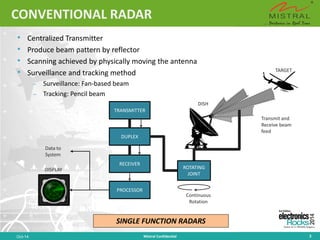
CONVENTIONAL RADAR 
Oct-14 Mistral Confidential 3 
• 
Centralized Transmitter 
• 
Produce beam pattern by reflector 
• 
Scanning achieved by physically moving the antenna 
• 
Surveillance and tracking method 
– 
Surveillance: Fan-based beam 
– 
Tracking: Pencil beam 
DISPLAY 
TARGET 
Transmit and Receive beam feed 
ROTATING JOINT 
TRANSMITTER 
DUPLEX 
RECEIVER 
PROCESSOR 
Data to System 
DISH 
Continuous Rotation 
SINGLE FUNCTION RADARS
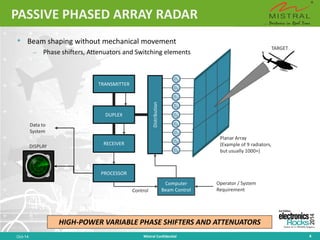
PASSIVE PHASED ARRAY RADAR 
Oct-14 Mistral Confidential 4 
• 
Beam shaping without mechanical movement 
– 
Phase shifters, Attenuators and Switching elements 
HIGH-POWER VARIABLE PHASE SHIFTERS AND ATTENUATORS 
DISPLAY 
TARGET 
Planar Array (Example of 9 radiators, but usually 1000+) 
Distribution 
TRANSMITTER 
DUPLEX 
RECEIVER 
PROCESSOR 
Data to System 
Operator / System Requirement 
D1 
D2 
D3 
D4 
D5 
D6 
D7 
D8 
D9 
Computer Beam Control 
Control
ISSUES & CHALLENGES 
• 
ISSUES 
– 
80% of the effective RF power is lost 
– 
95% of prime power is lost 
– 
20% of RF power is used for detection 
• 
CHALLENGES 
– 
Intense jamming 
– 
Severe clutter 
– 
Very low RADAR cross section 
– 
Rapid reaction/updates 
– 
Multiple Targets 
– 
Mobility/Transportability 
Oct-14 Mistral Confidential 5
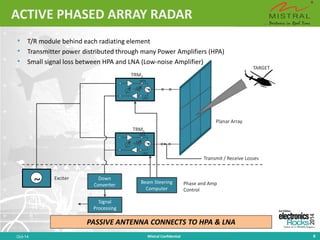
ACTIVE PHASED ARRAY RADAR 
Oct-14 Mistral Confidential 6 
• 
T/R module behind each radiating element 
• 
Transmitter power distributed through many Power Amplifiers (HPA) 
• 
Small signal loss between HPA and LNA (Low-noise Amplifier) 
PASSIVE ANTENNA CONNECTS TO HPA & LNA 
HPA 
LNA 
HPA 
LNA 
TRM1 
TARGET 
Planar Array 
Phase and Amp Control 
Beam Steering Computer 
Exciter 
TRMn 
Down Converter 
Transmit / Receive Losses 
Signal Processing
ADVANTAGES 
Oct-14 Mistral Confidential 7 
• 
Waveguide can be replaced with low-loss cables 
• 
No tube warm-up time 
• 
Replace tube technologies with solid-state technology 
• 
Improved detection sensitivity by improving noise figure 
• 
MTBF better for solid-state electronics than tubes 
• 
Graceful degradation performance with component failures 
• 
Improved detection sensitivity in the presence of clutter 
• 
Prime power requirements are also greatly reduced 
ACTIVE SYSTEMS WITH HIGH DUTY CYCLE / LOW PEAK POWER
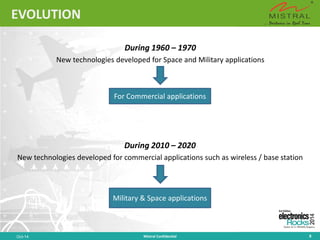
EVOLUTION 
During 1960 –1970 
New technologies developed for Space and Military applications 
Oct-14 Mistral Confidential 8 
For Commercial applications 
Military & Space applications 
During 2010 –2020 
New technologies developed for commercial applications such as wireless / base station
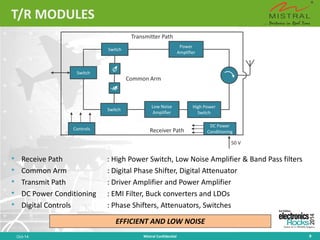
T/R MODULES 
• 
Receive Path: High Power Switch, Low Noise Amplifier & Band Pass filters 
• 
Common Arm: Digital Phase Shifter, Digital Attenuator 
• 
Transmit Path: Driver Amplifier and Power Amplifier 
• 
DC Power Conditioning: EMI Filter, Buck converters and LDOs 
• 
Digital Controls: Phase Shifters, Attenuators, Switches 
Oct-14 Mistral Confidential 9 
Switch 
High Power Switch 
Power Amplifier 
Switch 
Low Noise Amplifier 
Transmitter Path 
Receiver Path 
Controls 
DC Power Conditioning 
Switch 
50 V 
Common Arm 
EFFICIENT AND LOW NOISE
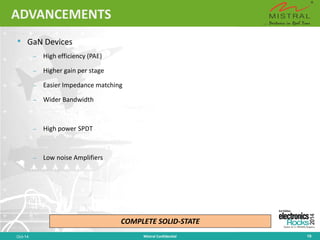
ADVANCEMENTS 
• 
GaNDevices 
– 
High efficiency (PAE) 
– 
Higher gain per stage 
– 
Easier Impedance matching 
– 
Wider Bandwidth 
– 
High power SPDT 
– 
Low noise Amplifiers 
Oct-14 Mistral Confidential 10 
COMPLETE SOLID-STATE
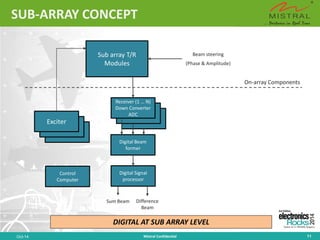
SUB-ARRAY CONCEPT 
Oct-14 Mistral Confidential 11 
DIGITAL AT SUB ARRAY LEVEL 
Sub array T/R Modules 
Beam steering 
(Phase & Amplitude) 
On-array Components 
Receiver (1 … N) Down Converter ADC 
Digital Beam former 
Exciter 
Digital Signal processor 
Sum Beam 
Difference Beam 
Control Computer
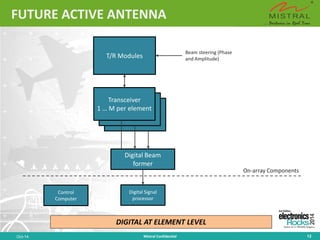
FUTURE ACTIVE ANTENNA 
Oct-14 Mistral Confidential 12 
T/R Modules 
Beam steering (Phase and Amplitude) 
On-array Components 
Transceiver 
1 … M per element 
Digital Beam former 
Digital Signal processor 
Control Computer 
DIGITAL AT ELEMENT LEVEL
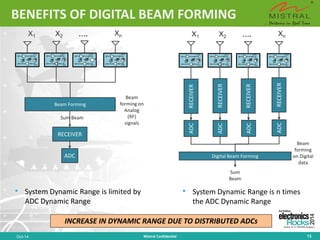
BENEFITS OF DIGITAL BEAM FORMING 
Oct-14 Mistral Confidential 13 
INCREASE IN DYNAMIC RANGE DUE TO DISTRIBUTED ADCs 
HPA 
LNA 
HPA 
LNA 
HPA 
LNA 
HPA 
LNA 
RECEIVER 
RECEIVER 
RECEIVER 
RECEIVER 
ADC 
ADC 
ADC 
ADC 
Digital Beam Forming 
Sum Beam 
X1 
X2 
Xn 
…. 
Beam forming on Digital data 
• 
System Dynamic Range is n times the ADC Dynamic Range 
HPA 
LNA 
HPA 
LNA 
HPA 
LNA 
HPA 
LNA 
Beam Forming 
Sum Beam 
X1 
X2 
Xn 
…. 
Beam forming on Analog (RF) signals 
RECEIVER 
ADC 
• 
System Dynamic Range is limited by ADC Dynamic Range
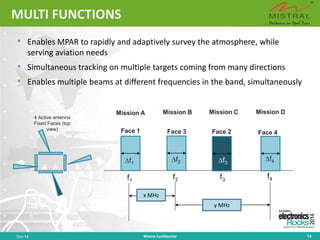
MULTI FUNCTIONS 
• 
Enables MPAR to rapidly and adaptively survey the atmosphere, while serving aviation needs 
• 
Simultaneous tracking on multiple targets coming from many directions 
• 
Enables multiple beams at different frequencies in the band, simultaneously 
Oct-14 Mistral Confidential 14 
4 Active antenna Fixed Faces (top view) 
Mission A 
Mission B 
Mission C 
Face 1 
Face 3 
Face 2 
Face 4 
Mission D 
Δf1 
Δf2 
Δf3 
Δf4 
f1 
f2 
f3 
f4 
x MHz 
y MHz
COST OPTIMIZATION 
• 
Scalable Array size 
– 
Enables same array hardware for multiple aperture configurations 
• 
Tile architecture 
– 
Reduce interconnections, simplify assembly and test processes 
• 
Low-peak Power 
– 
Allows standard surface mount packages 
• 
Exploit Wireless Industry Technology 
– 
Leverages commercial manufacturing and test processes 
• 
Replace existing RADARs that are used for weather and aircraft surveillance with MPAR 
– 
Reduced maintenance and improved availability [Higher power transmitter and mechanism for pointing the antenna] 
– 
Savings in uniform maintenance can be very substantial 
Oct-14 Mistral Confidential 15
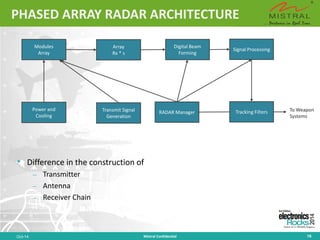
PHASED ARRAY RADAR ARCHITECTURE 
• 
Difference in the construction of 
– 
Transmitter 
– 
Antenna 
– 
Receiver Chain 
Oct-14 Mistral Confidential 16 
ModulesArray 
RADAR Manager 
Digital Beam Forming 
Array 
Rx * s 
Transmit Signal Generation 
Power and Cooling 
Signal Processing 
Tracking Filters 
To Weapon Systems
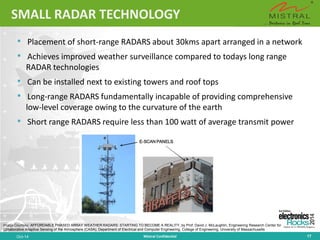
SMALL RADAR TECHNOLOGY 
• 
Placement of short-range RADARS about 30kms apart arranged in a network 
• 
Achieves improved weather surveillance compared to todays long range RADAR technologies 
• 
Can be installed next to existing towers and roof tops 
• 
Long-range RADARS fundamentally incapable of providing comprehensive low-level coverage owing to the curvature of the earth 
• 
Short range RADARS require less than 100 watt of average transmit power 
Oct-14 Mistral Confidential 17 
Image Courtsey: AFFORDABLE PHASED ARRAY WEATHER RADARS: STARTING TO BECOME A REALITY, by Prof. David J. McLaughlin, Engineering Research Center for Collaborative Adaptive Sensing of the Atmosphere (CASA), Department of Electrical and Computer Engineering, College of Engineering, University of Massachusetts
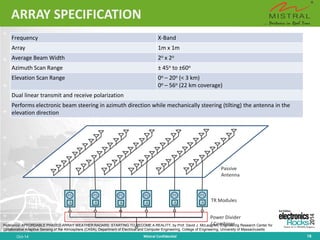
ARRAY SPECIFICATION 
Oct-14 Mistral Confidential 18 
Frequency 
X-Band 
Array 
1m x 1m 
Average Beam Width 
2ox 2o 
Azimuth Scan Range 
±45oto ±60o 
Elevation Scan Range 
0o–20o(< 3 km) 
0o–56o(22 km coverage) 
Dual linear transmit and receive polarization 
Performs electronic beam steering in azimuth direction while mechanically steering (tilting) the antenna in the elevation direction 
TR Modules 
PS 
A 
PS 
A 
PS 
A 
PS 
A 
PS 
A 
PS 
A 
Passive Antenna 
Power Divider / Combiner 
Reference: AFFORDABLE PHASED ARRAY WEATHER RADARS: STARTING TO BECOME A REALITY, by Prof. David J. McLaughlin, Engineering Research Center for Collaborative Adaptive Sensing of the Atmosphere (CASA), Department of Electrical and Computer Engineering, College of Engineering, University of Massachusetts
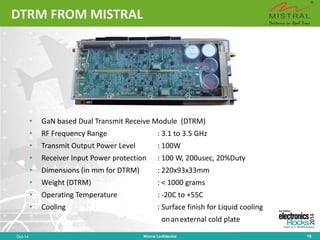
DTRM FROM MISTRAL 
• 
GaN based Dual Transmit Receive Module (DTRM) 
• 
RF Frequency Range: 3.1 to 3.5 GHz 
• 
Transmit Output Power Level: 100W 
• 
Receiver Input Power protection: 100 W, 200usec, 20%Duty 
• 
Dimensions (in mm for DTRM): 220x93x33mm 
• 
Weight (DTRM): < 1000 grams 
• 
Operating Temperature: -20C to +55C 
• 
Cooling: Surface finish for Liquid cooling 
onanexternal cold plate 
Oct-14 Mistral Confidential 19
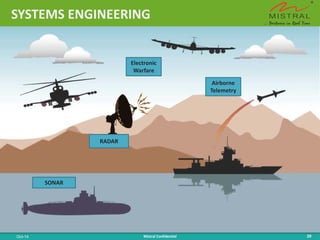
SYSTEMS ENGINEERING 
Oct-14 
Mistral Confidential 
20 
Complex Application Platforms 
Liquid-cooled, Air-cooled and 
Conduction-cooled systems 
Integration of Multi-Vendor COTS Solutions, 
SW, HW and RF Engineering 
Qualification and Field Trials 
Production, Deployment and Maintenance 
1 
2 
3 
4 
5 
Electronic Warfare 
Airborne Telemetry 
SONAR 
RADAR
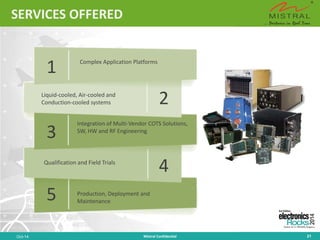
SERVICES OFFERED 
Oct-14 Mistral Confidential 21 
Complex Application Platforms 
Liquid-cooled, Air-cooled and Conduction-cooled systems 
Integration of Multi-Vendor COTS Solutions, SW, HW and RF Engineering 
Qualification and Field Trials 
Production, Deployment and Maintenance 
1 
2 
3 
4 
5
THANK YOU 
Oct-14 Mistral Confidential 22
Mistral Solutions Pvt. Ltd., 
No.60, 'Adarsh Regent', 
100 Ft. Ring Road, Domlur Ext, 
Bangalore - 56 0 071 India 
Tel: +91-80-3091 2600 
Mistral Solutions Inc., 
4633 Old Ironsides Drive, 
Suite 410, 
Santa Clara, CA 95054, USA 
Phone: +1-408-705-2240 
E-mail: info@mistralsolutions.com

Multi-Funtion Phased Array Radar

  • 1.
    MULTI-FUNCTION PHASED ARRAYRADAR SatyanarayanaS
  • 2.
    AGENDA • Evolutionof RADAR Technology • Issues and Challenges • Phased Array RADARS • Components of a Phased Array RADAR • Future Technologies
  • 3.
    CONVENTIONAL RADAR Oct-14Mistral Confidential 3 • Centralized Transmitter • Produce beam pattern by reflector • Scanning achieved by physically moving the antenna • Surveillance and tracking method – Surveillance: Fan-based beam – Tracking: Pencil beam DISPLAY TARGET Transmit and Receive beam feed ROTATING JOINT TRANSMITTER DUPLEX RECEIVER PROCESSOR Data to System DISH Continuous Rotation SINGLE FUNCTION RADARS
  • 4.
    PASSIVE PHASED ARRAYRADAR Oct-14 Mistral Confidential 4 • Beam shaping without mechanical movement – Phase shifters, Attenuators and Switching elements HIGH-POWER VARIABLE PHASE SHIFTERS AND ATTENUATORS DISPLAY TARGET Planar Array (Example of 9 radiators, but usually 1000+) Distribution TRANSMITTER DUPLEX RECEIVER PROCESSOR Data to System Operator / System Requirement D1 D2 D3 D4 D5 D6 D7 D8 D9 Computer Beam Control Control
  • 5.
    ISSUES & CHALLENGES • ISSUES – 80% of the effective RF power is lost – 95% of prime power is lost – 20% of RF power is used for detection • CHALLENGES – Intense jamming – Severe clutter – Very low RADAR cross section – Rapid reaction/updates – Multiple Targets – Mobility/Transportability Oct-14 Mistral Confidential 5
  • 6.
    ACTIVE PHASED ARRAYRADAR Oct-14 Mistral Confidential 6 • T/R module behind each radiating element • Transmitter power distributed through many Power Amplifiers (HPA) • Small signal loss between HPA and LNA (Low-noise Amplifier) PASSIVE ANTENNA CONNECTS TO HPA & LNA HPA LNA HPA LNA TRM1 TARGET Planar Array Phase and Amp Control Beam Steering Computer Exciter TRMn Down Converter Transmit / Receive Losses Signal Processing
  • 7.
    ADVANTAGES Oct-14 MistralConfidential 7 • Waveguide can be replaced with low-loss cables • No tube warm-up time • Replace tube technologies with solid-state technology • Improved detection sensitivity by improving noise figure • MTBF better for solid-state electronics than tubes • Graceful degradation performance with component failures • Improved detection sensitivity in the presence of clutter • Prime power requirements are also greatly reduced ACTIVE SYSTEMS WITH HIGH DUTY CYCLE / LOW PEAK POWER
  • 8.
    EVOLUTION During 1960–1970 New technologies developed for Space and Military applications Oct-14 Mistral Confidential 8 For Commercial applications Military & Space applications During 2010 –2020 New technologies developed for commercial applications such as wireless / base station
  • 9.
    T/R MODULES • Receive Path: High Power Switch, Low Noise Amplifier & Band Pass filters • Common Arm: Digital Phase Shifter, Digital Attenuator • Transmit Path: Driver Amplifier and Power Amplifier • DC Power Conditioning: EMI Filter, Buck converters and LDOs • Digital Controls: Phase Shifters, Attenuators, Switches Oct-14 Mistral Confidential 9 Switch High Power Switch Power Amplifier Switch Low Noise Amplifier Transmitter Path Receiver Path Controls DC Power Conditioning Switch 50 V Common Arm EFFICIENT AND LOW NOISE
  • 10.
    ADVANCEMENTS • GaNDevices – High efficiency (PAE) – Higher gain per stage – Easier Impedance matching – Wider Bandwidth – High power SPDT – Low noise Amplifiers Oct-14 Mistral Confidential 10 COMPLETE SOLID-STATE
  • 11.
    SUB-ARRAY CONCEPT Oct-14Mistral Confidential 11 DIGITAL AT SUB ARRAY LEVEL Sub array T/R Modules Beam steering (Phase & Amplitude) On-array Components Receiver (1 … N) Down Converter ADC Digital Beam former Exciter Digital Signal processor Sum Beam Difference Beam Control Computer
  • 12.
    FUTURE ACTIVE ANTENNA Oct-14 Mistral Confidential 12 T/R Modules Beam steering (Phase and Amplitude) On-array Components Transceiver 1 … M per element Digital Beam former Digital Signal processor Control Computer DIGITAL AT ELEMENT LEVEL
  • 13.
    BENEFITS OF DIGITALBEAM FORMING Oct-14 Mistral Confidential 13 INCREASE IN DYNAMIC RANGE DUE TO DISTRIBUTED ADCs HPA LNA HPA LNA HPA LNA HPA LNA RECEIVER RECEIVER RECEIVER RECEIVER ADC ADC ADC ADC Digital Beam Forming Sum Beam X1 X2 Xn …. Beam forming on Digital data • System Dynamic Range is n times the ADC Dynamic Range HPA LNA HPA LNA HPA LNA HPA LNA Beam Forming Sum Beam X1 X2 Xn …. Beam forming on Analog (RF) signals RECEIVER ADC • System Dynamic Range is limited by ADC Dynamic Range
  • 14.
    MULTI FUNCTIONS • Enables MPAR to rapidly and adaptively survey the atmosphere, while serving aviation needs • Simultaneous tracking on multiple targets coming from many directions • Enables multiple beams at different frequencies in the band, simultaneously Oct-14 Mistral Confidential 14 4 Active antenna Fixed Faces (top view) Mission A Mission B Mission C Face 1 Face 3 Face 2 Face 4 Mission D Δf1 Δf2 Δf3 Δf4 f1 f2 f3 f4 x MHz y MHz
  • 15.
    COST OPTIMIZATION • Scalable Array size – Enables same array hardware for multiple aperture configurations • Tile architecture – Reduce interconnections, simplify assembly and test processes • Low-peak Power – Allows standard surface mount packages • Exploit Wireless Industry Technology – Leverages commercial manufacturing and test processes • Replace existing RADARs that are used for weather and aircraft surveillance with MPAR – Reduced maintenance and improved availability [Higher power transmitter and mechanism for pointing the antenna] – Savings in uniform maintenance can be very substantial Oct-14 Mistral Confidential 15
  • 16.
    PHASED ARRAY RADARARCHITECTURE • Difference in the construction of – Transmitter – Antenna – Receiver Chain Oct-14 Mistral Confidential 16 ModulesArray RADAR Manager Digital Beam Forming Array Rx * s Transmit Signal Generation Power and Cooling Signal Processing Tracking Filters To Weapon Systems
  • 17.
    SMALL RADAR TECHNOLOGY • Placement of short-range RADARS about 30kms apart arranged in a network • Achieves improved weather surveillance compared to todays long range RADAR technologies • Can be installed next to existing towers and roof tops • Long-range RADARS fundamentally incapable of providing comprehensive low-level coverage owing to the curvature of the earth • Short range RADARS require less than 100 watt of average transmit power Oct-14 Mistral Confidential 17 Image Courtsey: AFFORDABLE PHASED ARRAY WEATHER RADARS: STARTING TO BECOME A REALITY, by Prof. David J. McLaughlin, Engineering Research Center for Collaborative Adaptive Sensing of the Atmosphere (CASA), Department of Electrical and Computer Engineering, College of Engineering, University of Massachusetts
  • 18.
    ARRAY SPECIFICATION Oct-14Mistral Confidential 18 Frequency X-Band Array 1m x 1m Average Beam Width 2ox 2o Azimuth Scan Range ±45oto ±60o Elevation Scan Range 0o–20o(< 3 km) 0o–56o(22 km coverage) Dual linear transmit and receive polarization Performs electronic beam steering in azimuth direction while mechanically steering (tilting) the antenna in the elevation direction TR Modules PS A PS A PS A PS A PS A PS A Passive Antenna Power Divider / Combiner Reference: AFFORDABLE PHASED ARRAY WEATHER RADARS: STARTING TO BECOME A REALITY, by Prof. David J. McLaughlin, Engineering Research Center for Collaborative Adaptive Sensing of the Atmosphere (CASA), Department of Electrical and Computer Engineering, College of Engineering, University of Massachusetts
  • 19.
    DTRM FROM MISTRAL • GaN based Dual Transmit Receive Module (DTRM) • RF Frequency Range: 3.1 to 3.5 GHz • Transmit Output Power Level: 100W • Receiver Input Power protection: 100 W, 200usec, 20%Duty • Dimensions (in mm for DTRM): 220x93x33mm • Weight (DTRM): < 1000 grams • Operating Temperature: -20C to +55C • Cooling: Surface finish for Liquid cooling onanexternal cold plate Oct-14 Mistral Confidential 19
  • 20.
    SYSTEMS ENGINEERING Oct-14 Mistral Confidential 20 Complex Application Platforms Liquid-cooled, Air-cooled and Conduction-cooled systems Integration of Multi-Vendor COTS Solutions, SW, HW and RF Engineering Qualification and Field Trials Production, Deployment and Maintenance 1 2 3 4 5 Electronic Warfare Airborne Telemetry SONAR RADAR
  • 21.
    SERVICES OFFERED Oct-14Mistral Confidential 21 Complex Application Platforms Liquid-cooled, Air-cooled and Conduction-cooled systems Integration of Multi-Vendor COTS Solutions, SW, HW and RF Engineering Qualification and Field Trials Production, Deployment and Maintenance 1 2 3 4 5
  • 22.
    THANK YOU Oct-14Mistral Confidential 22
  • 23.
    Mistral Solutions Pvt.Ltd., No.60, 'Adarsh Regent', 100 Ft. Ring Road, Domlur Ext, Bangalore - 56 0 071 India Tel: +91-80-3091 2600 Mistral Solutions Inc., 4633 Old Ironsides Drive, Suite 410, Santa Clara, CA 95054, USA Phone: +1-408-705-2240 E-mail: info@mistralsolutions.com