Section 4.5
              Optimization Problems

                     V63.0121.021, Calculus I

                          New York University


                       November 23, 2010


Announcements

   Turn in HW anytime between now and November 24, 2pm
   No Thursday recitation this week
   Quiz 5 on §§4.1–4.4 next week in recitation

                                                .   .   .   .   .   .
Announcements


         Turn in HW anytime
         between now and
         November 24, 2pm
         No Thursday recitation this
         week
         Quiz 5 on §§4.1–4.4 next
         week in recitation


                                                                      .   .   .      .      .     .

 V63.0121.021, Calculus I (NYU)   Section 4.5 Optimization Problems           November 23, 2010       2 / 31
Objectives


         Given a problem requiring
         optimization, identify the
         objective functions,
         variables, and constraints.
         Solve optimization
         problems with calculus.


                                                                      .   .   .      .      .     .

 V63.0121.021, Calculus I (NYU)   Section 4.5 Optimization Problems           November 23, 2010       3 / 31
Outline


Leading by Example


The Text in the Box


More Examples


                                                                      .   .   .      .      .     .

 V63.0121.021, Calculus I (NYU)   Section 4.5 Optimization Problems           November 23, 2010       4 / 31
Leading by Example


Example
What is the rectangle of fixed perimeter with maximum area?


                                                                      .   .   .      .      .     .

 V63.0121.021, Calculus I (NYU)   Section 4.5 Optimization Problems           November 23, 2010       5 / 31
Leading by Example


Example
What is the rectangle of fixed perimeter with maximum area?

Solution

      Draw a rectangle.


                                    .


                                                                      .   .   .      .      .     .

 V63.0121.021, Calculus I (NYU)   Section 4.5 Optimization Problems           November 23, 2010       5 / 31
Leading by Example


Example
What is the rectangle of fixed perimeter with maximum area?

Solution

      Draw a rectangle.


                                    .
                                                  ℓ


                                                                      .   .   .      .      .     .

 V63.0121.021, Calculus I (NYU)   Section 4.5 Optimization Problems           November 23, 2010       5 / 31
Leading by Example


Example
What is the rectangle of fixed perimeter with maximum area?

Solution

      Draw a rectangle.


                                                                      w

                                    .
                                                  ℓ


                                                                      .   .   .      .      .     .

 V63.0121.021, Calculus I (NYU)   Section 4.5 Optimization Problems           November 23, 2010       5 / 31
Solution Continued

      Let its length be ℓ and its width be w. The objective function is
      area A = ℓw.


                                                                      .   .   .      .      .     .

 V63.0121.021, Calculus I (NYU)   Section 4.5 Optimization Problems           November 23, 2010       6 / 31
Solution Continued

      Let its length be ℓ and its width be w. The objective function is
      area A = ℓw.
      This is a function of two variables, not one. But the perimeter is
      fixed.


                                                                      .   .   .      .      .     .

 V63.0121.021, Calculus I (NYU)   Section 4.5 Optimization Problems           November 23, 2010       6 / 31
Solution Continued

      Let its length be ℓ and its width be w. The objective function is
      area A = ℓw.
      This is a function of two variables, not one. But the perimeter is
      fixed.
                                         p − 2w
      Since p = 2ℓ + 2w, we have ℓ =            ,
                                            2


                                                                      .   .   .      .      .     .

 V63.0121.021, Calculus I (NYU)   Section 4.5 Optimization Problems           November 23, 2010       6 / 31
Solution Continued

      Let its length be ℓ and its width be w. The objective function is
      area A = ℓw.
      This is a function of two variables, not one. But the perimeter is
      fixed.
                                         p − 2w
      Since p = 2ℓ + 2w, we have ℓ =            , so
                                            2
                                  p − 2w      1             1
                   A = ℓw =              · w = (p − 2w)(w) = pw − w2
                                     2        2             2


                                                                        .   .   .      .      .     .

 V63.0121.021, Calculus I (NYU)     Section 4.5 Optimization Problems           November 23, 2010       6 / 31
Solution Continued

      Let its length be ℓ and its width be w. The objective function is
      area A = ℓw.
      This is a function of two variables, not one. But the perimeter is
      fixed.
                                         p − 2w
      Since p = 2ℓ + 2w, we have ℓ =            , so
                                            2
                                  p − 2w      1             1
                   A = ℓw =              · w = (p − 2w)(w) = pw − w2
                                     2        2             2


      Now we have A as a function of w alone (p is constant).


                                                                        .   .   .      .      .     .

 V63.0121.021, Calculus I (NYU)     Section 4.5 Optimization Problems           November 23, 2010       6 / 31
Solution Continued

      Let its length be ℓ and its width be w. The objective function is
      area A = ℓw.
      This is a function of two variables, not one. But the perimeter is
      fixed.
                                         p − 2w
      Since p = 2ℓ + 2w, we have ℓ =            , so
                                            2
                                  p − 2w      1             1
                   A = ℓw =              · w = (p − 2w)(w) = pw − w2
                                     2        2             2


      Now we have A as a function of w alone (p is constant).
      The natural domain of this function is [0, p/2] (we want to make
      sure A(w) ≥ 0).

                                                                        .   .   .      .      .     .

 V63.0121.021, Calculus I (NYU)     Section 4.5 Optimization Problems           November 23, 2010       6 / 31
Solution Concluded

                                                                          1
We use the Closed Interval Method for A(w) =                                pw − w2 on [0, p/2].
                                                                          2
      At the endpoints, A(0) = A(p/2) = 0.


                                                                      .      .   .      .      .     .

 V63.0121.021, Calculus I (NYU)   Section 4.5 Optimization Problems              November 23, 2010       7 / 31
Solution Concluded

                                                                          1
We use the Closed Interval Method for A(w) =                                pw − w2 on [0, p/2].
                                                                          2
      At the endpoints, A(0) = A(p/2) = 0.
                                           dA  1
      To find the critical points, we find    = p − 2w.
                                           dw  2


                                                                      .      .   .      .      .     .

 V63.0121.021, Calculus I (NYU)   Section 4.5 Optimization Problems              November 23, 2010       7 / 31
Solution Concluded

                                                                          1
We use the Closed Interval Method for A(w) =                                pw − w2 on [0, p/2].
                                                                          2
      At the endpoints, A(0) = A(p/2) = 0.
                                           dA  1
      To find the critical points, we find    = p − 2w.
                                           dw  2
      The critical points are when

                                        1               p
                                  0=      p − 2w =⇒ w =
                                        2               4


                                                                      .      .   .      .      .     .

 V63.0121.021, Calculus I (NYU)   Section 4.5 Optimization Problems              November 23, 2010       7 / 31
Solution Concluded

                                                                          1
We use the Closed Interval Method for A(w) =                                pw − w2 on [0, p/2].
                                                                          2
      At the endpoints, A(0) = A(p/2) = 0.
                                           dA  1
      To find the critical points, we find    = p − 2w.
                                           dw  2
      The critical points are when

                                        1               p
                                  0=      p − 2w =⇒ w =
                                        2               4


      Since this is the only critical point, it must be the maximum. In this
                p
      case ℓ = as well.
                4


                                                                      .      .   .      .      .     .

 V63.0121.021, Calculus I (NYU)   Section 4.5 Optimization Problems              November 23, 2010       7 / 31
Solution Concluded

                                                                          1
We use the Closed Interval Method for A(w) =                                pw − w2 on [0, p/2].
                                                                          2
      At the endpoints, A(0) = A(p/2) = 0.
                                           dA  1
      To find the critical points, we find    = p − 2w.
                                           dw  2
      The critical points are when

                                        1               p
                                  0=      p − 2w =⇒ w =
                                        2               4


      Since this is the only critical point, it must be the maximum. In this
                p
      case ℓ = as well.
                4
      We have a square! The maximal area is A(p/4) = p2 /16.

                                                                      .      .   .      .      .     .

 V63.0121.021, Calculus I (NYU)   Section 4.5 Optimization Problems              November 23, 2010       7 / 31
Outline


Leading by Example


The Text in the Box


More Examples


                                                                      .   .   .      .      .     .

 V63.0121.021, Calculus I (NYU)   Section 4.5 Optimization Problems           November 23, 2010       8 / 31
Strategies for Problem Solving


  1. Understand the problem
  2. Devise a plan
  3. Carry out the plan
  4. Review and extend


                                                                 György Pólya
                                                             (Hungarian, 1887–1985)
                                                                      .   .   .      .      .     .

 V63.0121.021, Calculus I (NYU)   Section 4.5 Optimization Problems           November 23, 2010       9 / 31
The Text in the Box


 1. Understand the Problem. What is known? What is unknown?
    What are the conditions?


                                                                      .   .    .      .      .    .

 V63.0121.021, Calculus I (NYU)   Section 4.5 Optimization Problems           November 23, 2010   10 / 31
The Text in the Box


 1. Understand the Problem. What is known? What is unknown?
    What are the conditions?
 2. Draw a diagram.


                                                                      .   .    .      .      .    .

 V63.0121.021, Calculus I (NYU)   Section 4.5 Optimization Problems           November 23, 2010   10 / 31
The Text in the Box


 1. Understand the Problem. What is known? What is unknown?
    What are the conditions?
 2. Draw a diagram.
 3. Introduce Notation.


                                                                      .   .    .      .      .    .

 V63.0121.021, Calculus I (NYU)   Section 4.5 Optimization Problems           November 23, 2010   10 / 31
The Text in the Box


 1. Understand the Problem. What is known? What is unknown?
    What are the conditions?
 2. Draw a diagram.
 3. Introduce Notation.
 4. Express the “objective function” Q in terms of the other symbols


                                                                      .   .    .      .      .    .

 V63.0121.021, Calculus I (NYU)   Section 4.5 Optimization Problems           November 23, 2010   10 / 31
The Text in the Box


 1. Understand the Problem. What is known? What is unknown?
    What are the conditions?
 2. Draw a diagram.
 3. Introduce Notation.
 4. Express the “objective function” Q in terms of the other symbols
 5. If Q is a function of more than one “decision variable”, use the
    given information to eliminate all but one of them.


                                                                      .   .    .      .      .    .

 V63.0121.021, Calculus I (NYU)   Section 4.5 Optimization Problems           November 23, 2010   10 / 31
The Text in the Box


 1. Understand the Problem. What is known? What is unknown?
    What are the conditions?
 2. Draw a diagram.
 3. Introduce Notation.
 4. Express the “objective function” Q in terms of the other symbols
 5. If Q is a function of more than one “decision variable”, use the
    given information to eliminate all but one of them.
 6. Find the absolute maximum (or minimum, depending on the
    problem) of the function on its domain.


                                                                      .   .    .      .      .    .

 V63.0121.021, Calculus I (NYU)   Section 4.5 Optimization Problems           November 23, 2010   10 / 31
Polya's Method in Kindergarten
                                  Name    [_
                                  Problem Solving Strategy
                                  Draw a Picture
                                         Kathy had a box of 8 crayons.
                                         She gave some crayons away.
                                         She has 5 left.
                                         How many crayons did Kathy give away?

                                   UNDERSTAND
                                                                           •
                                         What do you want to find out?
                                         Draw a line under the question.


                                         You can draw a picture
                                         to solve the problem.


                                                                                     What number do I
                                                                                     add to 5 to get 8?
                                                                                        8 -     = 5
                                                                           crayons     5 + 3 = 8

                                   CHECK
                                         Does your answer make sense?
                                         Explain.
                                                                                 What number
                                         Draw a picture to solve the problem.   do I add to 3
                                         Write how many were given away.         to make 10?

                                         I. I had 10 pencils.                             ft   ft                ft   A
                                            I gave some away.                         13 ill
                                                                                      i   :i
                                                                                                    I
                                                                                                    '•'        I I
                                            I have 3 left. How many                       i?        «
                                                                                          11        I

                                            pencils did I give away?                                I
                                                                                                          .   H 11
                                                                                                                          .    .      .      .    .
                                                                                                              M i l

 V63.0121.021, Calculus I (NYU)                ~7 Section 4.5 Optimization Problems
                                                                                 U U           U U> U U
                                                                                                                              November 23, 2010   11 / 31
Recall: The Closed Interval Method
See Section 4.1


The Closed Interval Method
To find the extreme values of a function f on [a, b], we need to:
       Evaluate f at the endpoints a and b
       Evaluate f at the critical points x where either f′ (x) = 0 or f is not
       differentiable at x.
       The points with the largest function value are the global maximum
       points
       The points with the smallest/most negative function value are the
       global minimum points.


                                                                       .   .    .      .      .    .

  V63.0121.021, Calculus I (NYU)   Section 4.5 Optimization Problems           November 23, 2010   12 / 31
Recall: The First Derivative Test
See Section 4.3

Theorem (The First Derivative Test)
Let f be continuous on (a, b) and c a critical point of f in (a, b).
       If f′ changes from negative to positive at c, then c is a local
       minimum.
       If f′ changes from positive to negative at c, then c is a local
       maximum.
       If f′ does not change sign at c, then c is not a local extremum.


                                                                       .   .    .      .      .    .

  V63.0121.021, Calculus I (NYU)   Section 4.5 Optimization Problems           November 23, 2010   13 / 31
Recall: The First Derivative Test
See Section 4.3

Theorem (The First Derivative Test)
Let f be continuous on (a, b) and c a critical point of f in (a, b).
       If f′ changes from negative to positive at c, then c is a local
       minimum.
       If f′ changes from positive to negative at c, then c is a local
       maximum.
       If f′ does not change sign at c, then c is not a local extremum.

Corollary

       If f′ < 0 for all x < c and f′ (x) > 0 for all x > c, then c is the global
       minimum of f on (a, b).
       If f′ < 0 for all x > c and f′ (x) > 0 for all x < c, then c is the global
       maximum of f on (a, b).
                                                                       .   .    .      .      .    .

  V63.0121.021, Calculus I (NYU)   Section 4.5 Optimization Problems           November 23, 2010   13 / 31
Recall: The Second Derivative Test
See Section 4.3

Theorem (The Second Derivative Test)
Let f, f′ , and f′′ be continuous on [a, b]. Let c be in (a, b) with f′ (c) = 0.
       If f′′ (c) < 0, then f(c) is a local maximum.
       If f′′ (c) > 0, then f(c) is a local minimum.


                                                                       .   .    .      .      .    .

  V63.0121.021, Calculus I (NYU)   Section 4.5 Optimization Problems           November 23, 2010   14 / 31
Recall: The Second Derivative Test
See Section 4.3

Theorem (The Second Derivative Test)
Let f, f′ , and f′′ be continuous on [a, b]. Let c be in (a, b) with f′ (c) = 0.
       If f′′ (c) < 0, then f(c) is a local maximum.
       If f′′ (c) > 0, then f(c) is a local minimum.

Warning
If f′′ (c) = 0, the second derivative test is inconclusive (this does not
mean c is neither; we just don’t know yet).


                                                                       .   .    .      .      .    .

  V63.0121.021, Calculus I (NYU)   Section 4.5 Optimization Problems           November 23, 2010   14 / 31
Recall: The Second Derivative Test
See Section 4.3

Theorem (The Second Derivative Test)
Let f, f′ , and f′′ be continuous on [a, b]. Let c be in (a, b) with f′ (c) = 0.
       If f′′ (c) < 0, then f(c) is a local maximum.
       If f′′ (c) > 0, then f(c) is a local minimum.

Warning
If f′′ (c) = 0, the second derivative test is inconclusive (this does not
mean c is neither; we just don’t know yet).

Corollary

       If f′ (c) = 0 and f′′ (x) > 0 for all x, then c is the global minimum of f
       If f′ (c) = 0 and f′′ (x) < 0 for all x, then c is the global maximum of f
                                                                       .   .    .      .      .    .

  V63.0121.021, Calculus I (NYU)   Section 4.5 Optimization Problems           November 23, 2010   14 / 31
Which to use when?

            CIM                         1DT                               2DT
 Pro        – no need for               – works on                        – works on
            inequalities                non-closed,                       non-closed,
            – gets global               non-bounded                       non-bounded
            extrema                     intervals                         intervals
            automatically               – only one derivative             – no need for
                                                                          inequalities
 Con        – only for closed           – Uses inequalities               – More derivatives
            bounded intervals           – More work at                    – less conclusive
                                        boundary than CIM                 than 1DT
                                                                          – more work at
                                                                          boundary than CIM


                                                                      .   .    .      .      .    .

 V63.0121.021, Calculus I (NYU)   Section 4.5 Optimization Problems           November 23, 2010   15 / 31
Which to use when?

            CIM                         1DT                               2DT
 Pro        – no need for               – works on                        – works on
            inequalities                non-closed,                       non-closed,
            – gets global               non-bounded                       non-bounded
            extrema                     intervals                         intervals
            automatically               – only one derivative             – no need for
                                                                          inequalities
 Con        – only for closed           – Uses inequalities               – More derivatives
            bounded intervals           – More work at                    – less conclusive
                                        boundary than CIM                 than 1DT
                                                                          – more work at
                                                                          boundary than CIM

      Use CIM if it applies: the domain is a closed, bounded interval
      If domain is not closed or not bounded, use 2DT if you like to take
      derivatives, or 1DT if you like to compare signs.
                                                                      .   .    .      .      .    .

 V63.0121.021, Calculus I (NYU)   Section 4.5 Optimization Problems           November 23, 2010   15 / 31
Outline


Leading by Example


The Text in the Box


More Examples


                                                                      .   .    .      .      .    .

 V63.0121.021, Calculus I (NYU)   Section 4.5 Optimization Problems           November 23, 2010   16 / 31
Another Example


Example (The Best Fencing Plan)
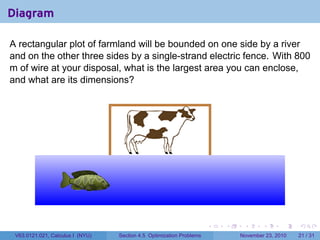
A rectangular plot of farmland will be bounded on one side by a river
and on the other three sides by a single-strand electric fence. With
800m of wire at your disposal, what is the largest area you can
enclose, and what are its dimensions?


                                                                      .   .    .      .      .    .

 V63.0121.021, Calculus I (NYU)   Section 4.5 Optimization Problems           November 23, 2010   17 / 31
Solution

 1. Everybody understand?


                                                                      .   .    .      .      .    .

 V63.0121.021, Calculus I (NYU)   Section 4.5 Optimization Problems           November 23, 2010   18 / 31
Another Example


Example (The Best Fencing Plan)
A rectangular plot of farmland will be bounded on one side by a river
and on the other three sides by a single-strand electric fence. With
800m of wire at your disposal, what is the largest area you can
enclose, and what are its dimensions?


                                                                      .   .    .      .      .    .

 V63.0121.021, Calculus I (NYU)   Section 4.5 Optimization Problems           November 23, 2010   19 / 31
Another Example


Example (The Best Fencing Plan)
A rectangular plot of farmland will be bounded on one side by a river
and on the other three sides by a single-strand electric fence. With
800m of wire at your disposal, what is the largest area you can
enclose, and what are its dimensions?

      Known: amount of fence used
      Unknown: area enclosed


                                                                      .   .    .      .      .    .

 V63.0121.021, Calculus I (NYU)   Section 4.5 Optimization Problems           November 23, 2010   19 / 31
Another Example


Example (The Best Fencing Plan)
A rectangular plot of farmland will be bounded on one side by a river
and on the other three sides by a single-strand electric fence. With
800m of wire at your disposal, what is the largest area you can
enclose, and what are its dimensions?

      Known: amount of fence used
      Unknown: area enclosed
      Objective: maximize area
      Constraint: fixed fence length


                                                                      .   .    .      .      .    .

 V63.0121.021, Calculus I (NYU)   Section 4.5 Optimization Problems           November 23, 2010   19 / 31
Solution

 1. Everybody understand?


                                                                      .   .    .      .      .    .

 V63.0121.021, Calculus I (NYU)   Section 4.5 Optimization Problems           November 23, 2010   20 / 31
Solution

 1. Everybody understand?
 2. Draw a diagram.


                                                                      .   .    .      .      .    .

 V63.0121.021, Calculus I (NYU)   Section 4.5 Optimization Problems           November 23, 2010   20 / 31
Diagram

A rectangular plot of farmland will be bounded on one side by a river
and on the other three sides by a single-strand electric fence. With 800
m of wire at your disposal, what is the largest area you can enclose,
and what are its dimensions?


                                  .

                                                      .


                                                                          .   .    .      .      .    .

 V63.0121.021, Calculus I (NYU)       Section 4.5 Optimization Problems           November 23, 2010   21 / 31
Solution

 1. Everybody understand?
 2. Draw a diagram.


                                                                      .   .    .      .      .    .

 V63.0121.021, Calculus I (NYU)   Section 4.5 Optimization Problems           November 23, 2010   22 / 31
Solution

 1. Everybody understand?
 2. Draw a diagram.
 3. Length and width are ℓ and w. Length of wire used is p.


                                                                      .   .    .      .      .    .

 V63.0121.021, Calculus I (NYU)   Section 4.5 Optimization Problems           November 23, 2010   22 / 31
Diagram

A rectangular plot of farmland will be bounded on one side by a river
and on the other three sides by a single-strand electric fence. With 800
m of wire at your disposal, what is the largest area you can enclose,
and what are its dimensions?


                                  .

                                                      .


                                                                          .   .    .      .      .    .

 V63.0121.021, Calculus I (NYU)       Section 4.5 Optimization Problems           November 23, 2010   23 / 31
Diagram

A rectangular plot of farmland will be bounded on one side by a river
and on the other three sides by a single-strand electric fence. With 800
m of wire at your disposal, what is the largest area you can enclose,
and what are its dimensions?
                                                         ℓ


                                  w

                                      .

                                                          .


                                                                              .   .    .      .      .    .

 V63.0121.021, Calculus I (NYU)           Section 4.5 Optimization Problems           November 23, 2010   23 / 31
Solution

 1. Everybody understand?
 2. Draw a diagram.
 3. Length and width are ℓ and w. Length of wire used is p.


                                                                      .   .    .      .      .    .

 V63.0121.021, Calculus I (NYU)   Section 4.5 Optimization Problems           November 23, 2010   24 / 31
Solution

 1. Everybody understand?
 2. Draw a diagram.
 3. Length and width are ℓ and w. Length of wire used is p.
 4. Q = area = ℓw.


                                                                      .   .    .      .      .    .

 V63.0121.021, Calculus I (NYU)   Section 4.5 Optimization Problems           November 23, 2010   24 / 31
Solution

 1. Everybody understand?
 2. Draw a diagram.
 3. Length and width are ℓ and w. Length of wire used is p.
 4. Q = area = ℓw.
 5. Since p = ℓ + 2w, we have ℓ = p − 2w and so

                                  Q(w) = (p − 2w)(w) = pw − 2w2

      The domain of Q is [0, p/2]


                                                                         .   .    .      .      .    .

 V63.0121.021, Calculus I (NYU)      Section 4.5 Optimization Problems           November 23, 2010   24 / 31
Solution

 1. Everybody understand?
 2. Draw a diagram.
 3. Length and width are ℓ and w. Length of wire used is p.
 4. Q = area = ℓw.
 5. Since p = ℓ + 2w, we have ℓ = p − 2w and so

                                  Q(w) = (p − 2w)(w) = pw − 2w2

    The domain of Q is [0, p/2]
    dQ                                 p
 6.    = p − 4w, which is zero when w = .
    dw                                 4


                                                                         .   .    .      .      .    .

 V63.0121.021, Calculus I (NYU)      Section 4.5 Optimization Problems           November 23, 2010   24 / 31
Solution

 1. Everybody understand?
 2. Draw a diagram.
 3. Length and width are ℓ and w. Length of wire used is p.
 4. Q = area = ℓw.
 5. Since p = ℓ + 2w, we have ℓ = p − 2w and so

                                  Q(w) = (p − 2w)(w) = pw − 2w2

    The domain of Q is [0, p/2]
    dQ                                 p
 6.    = p − 4w, which is zero when w = . Q(0) = Q(p/2) = 0, but
    dw                                 4
                              (p)            p     p2   p2
                          Q           =p·      −2·    =    = 80, 000m2
                                  4          4     16   8
      so the critical point is the absolute maximum.
                                                                           .   .    .      .      .    .

 V63.0121.021, Calculus I (NYU)        Section 4.5 Optimization Problems           November 23, 2010   24 / 31
Your turn

Example (The shortest fence)
A 216m2 rectangular pea patch is to be enclosed by a fence and
divided into two equal parts by another fence parallel to one of its
sides. What dimensions for the outer rectangle will require the smallest
total length of fence? How much fence will be needed?


                                                                      .   .    .      .      .    .

 V63.0121.021, Calculus I (NYU)   Section 4.5 Optimization Problems           November 23, 2010   25 / 31
Your turn

Example (The shortest fence)
A 216m2 rectangular pea patch is to be enclosed by a fence and
divided into two equal parts by another fence parallel to one of its
sides. What dimensions for the outer rectangle will require the smallest
total length of fence? How much fence will be needed?

Solution
Let the length and width of the pea patch be ℓ and w. The amount of
fence needed is f = 2ℓ + 3w. Since ℓw = A, a constant, we have
                                                  A
                                    f(w) = 2        + 3w.
                                                  w
The domain is all positive numbers.

                                                                      .   .    .      .      .    .

 V63.0121.021, Calculus I (NYU)   Section 4.5 Optimization Problems           November 23, 2010   25 / 31
Diagram


                          w


                                  .
                                                        ℓ

                             f = 2ℓ + 3w                    A = ℓw ≡ 216


                                                                          .   .    .      .      .    .

 V63.0121.021, Calculus I (NYU)       Section 4.5 Optimization Problems           November 23, 2010   26 / 31
Solution (Continued)
                                                                          2A
 We need to find the minimum value of f(w) =                                 + 3w on (0, ∞).
                                                                          w


                                                                      .      .    .      .      .    .

 V63.0121.021, Calculus I (NYU)   Section 4.5 Optimization Problems              November 23, 2010   27 / 31
Solution (Continued)
                                                                          2A
 We need to find the minimum value of f(w) =                                 + 3w on (0, ∞).
                                                                          w
      We have
                              df    2A
                                  =− 2 +3
                              dw    w
                             √
                               2A
      which is zero when w =      .
                                3


                                                                      .      .    .      .      .    .

 V63.0121.021, Calculus I (NYU)   Section 4.5 Optimization Problems              November 23, 2010   27 / 31
Solution (Continued)
                                                                          2A
 We need to find the minimum value of f(w) =                                 + 3w on (0, ∞).
                                                                          w
      We have
                                 df        2A
                                      =− 2 +3
                                 dw        w
                                √
                                   2A
      which is zero when w =           .
                                    3
      Since f′′ (w) = 4Aw−3 , which is positive for all positive w, the
      critical point is a minimum, in fact the global minimum.


                                                                      .      .    .      .      .    .

 V63.0121.021, Calculus I (NYU)   Section 4.5 Optimization Problems              November 23, 2010   27 / 31
Solution (Continued)
                                                                          2A
 We need to find the minimum value of f(w) =                                 + 3w on (0, ∞).
                                                                          w
      We have
                                  df        2A
                                      =− 2 +3
                                  dw        w
                                 √
                                   2A
      which is zero when w =           .
                                    3
      Since f′′ (w) = 4Aw−3 , which is positive for all positive w, the
      critical point is a minimum, in fact the global minimum.
                                              √
                                                2A
      So the area is minimized when w =            = 12 and
                 √                               3
            A      3A
      ℓ= =              = 18. The amount of fence needed is
            w        2
            (√ )            √        √
                2A            3A         2A     √        √
          f            =2·       +3          = 2 6A = 2 6 · 216 = 72m
                 3             2          3                           .      .    .      .      .    .

 V63.0121.021, Calculus I (NYU)   Section 4.5 Optimization Problems              November 23, 2010   27 / 31
Try this one


Example
An advertisement consists of a rectangular printed region plus 1 in
margins on the sides and 1.5 in margins on the top and bottom. If the
total area of the advertisement is to be 120 in2 , what dimensions should
the advertisement be to maximize the area of the printed region?


                                                                      .   .    .      .      .    .

 V63.0121.021, Calculus I (NYU)   Section 4.5 Optimization Problems           November 23, 2010   28 / 31
Try this one


Example
An advertisement consists of a rectangular printed region plus 1 in
margins on the sides and 1.5 in margins on the top and bottom. If the
total area of the advertisement is to be 120 in2 , what dimensions should
the advertisement be to maximize the area of the printed region?

Answer
                                  √         √
The optimal paper dimensions are 4 5 in by 6 5 in.


                                                                      .   .    .      .      .    .

 V63.0121.021, Calculus I (NYU)   Section 4.5 Optimization Problems           November 23, 2010   28 / 31
Solution
Let the dimensions of the
printed region be x and y, P                                                      1.5 cm
the printed area, and A the                                           Lorem ipsum dolor sit amet,
                                                                      consectetur adipiscing elit. Nam
paper area. We wish to                                                dapibus vehicula mollis. Proin nec
                                                                      tristique mi.      Pellentesque quis
maximize P = xy subject to                                            placerat dolor. Praesent a nisl diam.
the constraint that                                                   Phasellus ut elit eu ligula accumsan
                                                                      euismod.        Nunc condimentum
                                                                      lacinia risus a sodales. Morbi nunc
                                                                      risus, tincidunt in tristique sit amet,
  A = (x + 2)(y + 3) ≡ 120


                                                           1 cm


                                                                                                                1 cm
                                                    y                 ultrices eu eros. Proin pellentesque
                                                                      aliquam nibh ut lobortis.         Ut et
                                                                      sollicitudin ipsum.      Proin gravida
Isolating y in A ≡ 120 gives                                          ligula eget odio molestie rhoncus
                                                                      sed nec massa. In ante lorem,
     120                                                              imperdiet eget tincidunt at, pharetra
y=         − 3 which yields                                           sit amet felis.      Nunc nisi velit,
     x+2                                                              tempus ac suscipit quis, blandit
                                                                      vitae mauris. Vestibulum ante ipsum
       (          )                                                   primis in faucibus orci luctus et
         120           120x                                       .   ultrices posuere cubilia Curae;
P=x            −3 =          −3x
         x+2           x+2                                                        1.5 cm
The domain of P is (0, ∞).                                                              x
                                                                           .        .        .       .          .      .

 V63.0121.021, Calculus I (NYU)   Section 4.5 Optimization Problems                         November 23, 2010          29 / 31
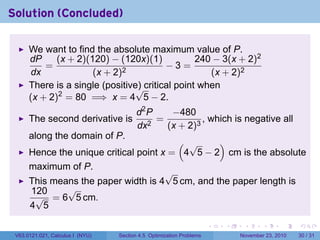
Solution (Concluded)

      We want to find the absolute maximum value of P.
      dP     (x + 2)(120) − (120x)(1)            240 − 3(x + 2)2
          =                              −3=
      dx              (x + 2)2                      (x + 2)2
      There is a single (positive) critical point when
                                 √
      (x + 2)2 = 80 =⇒ x = 4 5 − 2.
                                         d2 P    −480
      The second derivative is              2
                                              =          , which is negative all
                                         dx     (x + 2)3
      along the domain of P.
                                         ( √     )
      Hence the unique critical point x = 4 5 − 2 cm is the absolute
      maximum of P.
                                       √
      This means the paper width is 4 5 cm, and the paper length is
      120     √
       √ = 6 5 cm.
      4 5

                                                                      .   .    .      .      .    .

 V63.0121.021, Calculus I (NYU)   Section 4.5 Optimization Problems           November 23, 2010   30 / 31
Summary

                                                          Name    [_
                                                          Problem Solving Strategy
                                                          Draw a Picture
                                                                 Kathy had a box of 8 crayons.
                                                                 She gave some crayons away.
                                                                 She has 5 left.
                                                                 How many crayons did Kathy give away?


      Remember the checklist                               UNDERSTAND

                                                                 What do you want to find out?
                                                                                                    •


                                                                 Draw a line under the question.
      Ask yourself: what is the
      objective?                                                 You can draw a picture
                                                                 to solve the problem.

      Remember your geometry:
                                                                                                                  What number do I
                                                                                                                  add to 5 to get 8?
                                                                                                                     8 -     = 5
              similar triangles                                                                     crayons         5 + 3 = 8


              right triangles                              CHECK
                                                                 Does your answer make sense?
              trigonometric functions                            Explain.
                                                                                                         What number
                                                                 Draw a picture to solve the problem.   do I add to 3
                                                                 Write how many were given away.         to make 10?

                                                                 I. I had 10 pencils.                                  ft   ft                ft   A
                                                                    I gave some away.                              13 ill
                                                                                                                   i   :i
                                                                                                                                 I
                                                                                                                                 '•'        I I
                                                                    I have 3 left. How many                            i?        «
                                                                                                                       11        I

                                                                    pencils did I give away?                                     I
                                                                                                                                           H 11
                                                                                                                                           M i l
                                                                       ~7                                          U U U U> U U


                                                                            .        .          .             .                        .               .

V63.0121.021, Calculus I (NYU)   Section 4.5 Optimization Problems                             November 23, 2010                                       31 / 31

Lesson 22: Optimization (Section 021 slides)

  • 1.
    Section 4.5 Optimization Problems V63.0121.021, Calculus I New York University November 23, 2010 Announcements Turn in HW anytime between now and November 24, 2pm No Thursday recitation this week Quiz 5 on §§4.1–4.4 next week in recitation . . . . . .
  • 2.
    Announcements Turn in HW anytime between now and November 24, 2pm No Thursday recitation this week Quiz 5 on §§4.1–4.4 next week in recitation . . . . . . V63.0121.021, Calculus I (NYU) Section 4.5 Optimization Problems November 23, 2010 2 / 31
  • 3.
    Objectives Given a problem requiring optimization, identify the objective functions, variables, and constraints. Solve optimization problems with calculus. . . . . . . V63.0121.021, Calculus I (NYU) Section 4.5 Optimization Problems November 23, 2010 3 / 31
  • 4.
    Outline Leading by Example TheText in the Box More Examples . . . . . . V63.0121.021, Calculus I (NYU) Section 4.5 Optimization Problems November 23, 2010 4 / 31
  • 5.
    Leading by Example Example Whatis the rectangle of fixed perimeter with maximum area? . . . . . . V63.0121.021, Calculus I (NYU) Section 4.5 Optimization Problems November 23, 2010 5 / 31
  • 6.
    Leading by Example Example Whatis the rectangle of fixed perimeter with maximum area? Solution Draw a rectangle. . . . . . . . V63.0121.021, Calculus I (NYU) Section 4.5 Optimization Problems November 23, 2010 5 / 31
  • 7.
    Leading by Example Example Whatis the rectangle of fixed perimeter with maximum area? Solution Draw a rectangle. . ℓ . . . . . . V63.0121.021, Calculus I (NYU) Section 4.5 Optimization Problems November 23, 2010 5 / 31
  • 8.
    Leading by Example Example Whatis the rectangle of fixed perimeter with maximum area? Solution Draw a rectangle. w . ℓ . . . . . . V63.0121.021, Calculus I (NYU) Section 4.5 Optimization Problems November 23, 2010 5 / 31
  • 9.
    Solution Continued Let its length be ℓ and its width be w. The objective function is area A = ℓw. . . . . . . V63.0121.021, Calculus I (NYU) Section 4.5 Optimization Problems November 23, 2010 6 / 31
  • 10.
    Solution Continued Let its length be ℓ and its width be w. The objective function is area A = ℓw. This is a function of two variables, not one. But the perimeter is fixed. . . . . . . V63.0121.021, Calculus I (NYU) Section 4.5 Optimization Problems November 23, 2010 6 / 31
  • 11.
    Solution Continued Let its length be ℓ and its width be w. The objective function is area A = ℓw. This is a function of two variables, not one. But the perimeter is fixed. p − 2w Since p = 2ℓ + 2w, we have ℓ = , 2 . . . . . . V63.0121.021, Calculus I (NYU) Section 4.5 Optimization Problems November 23, 2010 6 / 31
  • 12.
    Solution Continued Let its length be ℓ and its width be w. The objective function is area A = ℓw. This is a function of two variables, not one. But the perimeter is fixed. p − 2w Since p = 2ℓ + 2w, we have ℓ = , so 2 p − 2w 1 1 A = ℓw = · w = (p − 2w)(w) = pw − w2 2 2 2 . . . . . . V63.0121.021, Calculus I (NYU) Section 4.5 Optimization Problems November 23, 2010 6 / 31
  • 13.
    Solution Continued Let its length be ℓ and its width be w. The objective function is area A = ℓw. This is a function of two variables, not one. But the perimeter is fixed. p − 2w Since p = 2ℓ + 2w, we have ℓ = , so 2 p − 2w 1 1 A = ℓw = · w = (p − 2w)(w) = pw − w2 2 2 2 Now we have A as a function of w alone (p is constant). . . . . . . V63.0121.021, Calculus I (NYU) Section 4.5 Optimization Problems November 23, 2010 6 / 31
  • 14.
    Solution Continued Let its length be ℓ and its width be w. The objective function is area A = ℓw. This is a function of two variables, not one. But the perimeter is fixed. p − 2w Since p = 2ℓ + 2w, we have ℓ = , so 2 p − 2w 1 1 A = ℓw = · w = (p − 2w)(w) = pw − w2 2 2 2 Now we have A as a function of w alone (p is constant). The natural domain of this function is [0, p/2] (we want to make sure A(w) ≥ 0). . . . . . . V63.0121.021, Calculus I (NYU) Section 4.5 Optimization Problems November 23, 2010 6 / 31
  • 15.
    Solution Concluded 1 We use the Closed Interval Method for A(w) = pw − w2 on [0, p/2]. 2 At the endpoints, A(0) = A(p/2) = 0. . . . . . . V63.0121.021, Calculus I (NYU) Section 4.5 Optimization Problems November 23, 2010 7 / 31
  • 16.
    Solution Concluded 1 We use the Closed Interval Method for A(w) = pw − w2 on [0, p/2]. 2 At the endpoints, A(0) = A(p/2) = 0. dA 1 To find the critical points, we find = p − 2w. dw 2 . . . . . . V63.0121.021, Calculus I (NYU) Section 4.5 Optimization Problems November 23, 2010 7 / 31
  • 17.
    Solution Concluded 1 We use the Closed Interval Method for A(w) = pw − w2 on [0, p/2]. 2 At the endpoints, A(0) = A(p/2) = 0. dA 1 To find the critical points, we find = p − 2w. dw 2 The critical points are when 1 p 0= p − 2w =⇒ w = 2 4 . . . . . . V63.0121.021, Calculus I (NYU) Section 4.5 Optimization Problems November 23, 2010 7 / 31
  • 18.
    Solution Concluded 1 We use the Closed Interval Method for A(w) = pw − w2 on [0, p/2]. 2 At the endpoints, A(0) = A(p/2) = 0. dA 1 To find the critical points, we find = p − 2w. dw 2 The critical points are when 1 p 0= p − 2w =⇒ w = 2 4 Since this is the only critical point, it must be the maximum. In this p case ℓ = as well. 4 . . . . . . V63.0121.021, Calculus I (NYU) Section 4.5 Optimization Problems November 23, 2010 7 / 31
  • 19.
    Solution Concluded 1 We use the Closed Interval Method for A(w) = pw − w2 on [0, p/2]. 2 At the endpoints, A(0) = A(p/2) = 0. dA 1 To find the critical points, we find = p − 2w. dw 2 The critical points are when 1 p 0= p − 2w =⇒ w = 2 4 Since this is the only critical point, it must be the maximum. In this p case ℓ = as well. 4 We have a square! The maximal area is A(p/4) = p2 /16. . . . . . . V63.0121.021, Calculus I (NYU) Section 4.5 Optimization Problems November 23, 2010 7 / 31
  • 20.
    Outline Leading by Example TheText in the Box More Examples . . . . . . V63.0121.021, Calculus I (NYU) Section 4.5 Optimization Problems November 23, 2010 8 / 31
  • 21.
    Strategies for ProblemSolving 1. Understand the problem 2. Devise a plan 3. Carry out the plan 4. Review and extend György Pólya (Hungarian, 1887–1985) . . . . . . V63.0121.021, Calculus I (NYU) Section 4.5 Optimization Problems November 23, 2010 9 / 31
  • 22.
    The Text inthe Box 1. Understand the Problem. What is known? What is unknown? What are the conditions? . . . . . . V63.0121.021, Calculus I (NYU) Section 4.5 Optimization Problems November 23, 2010 10 / 31
  • 23.
    The Text inthe Box 1. Understand the Problem. What is known? What is unknown? What are the conditions? 2. Draw a diagram. . . . . . . V63.0121.021, Calculus I (NYU) Section 4.5 Optimization Problems November 23, 2010 10 / 31
  • 24.
    The Text inthe Box 1. Understand the Problem. What is known? What is unknown? What are the conditions? 2. Draw a diagram. 3. Introduce Notation. . . . . . . V63.0121.021, Calculus I (NYU) Section 4.5 Optimization Problems November 23, 2010 10 / 31
  • 25.
    The Text inthe Box 1. Understand the Problem. What is known? What is unknown? What are the conditions? 2. Draw a diagram. 3. Introduce Notation. 4. Express the “objective function” Q in terms of the other symbols . . . . . . V63.0121.021, Calculus I (NYU) Section 4.5 Optimization Problems November 23, 2010 10 / 31
  • 26.
    The Text inthe Box 1. Understand the Problem. What is known? What is unknown? What are the conditions? 2. Draw a diagram. 3. Introduce Notation. 4. Express the “objective function” Q in terms of the other symbols 5. If Q is a function of more than one “decision variable”, use the given information to eliminate all but one of them. . . . . . . V63.0121.021, Calculus I (NYU) Section 4.5 Optimization Problems November 23, 2010 10 / 31
  • 27.
    The Text inthe Box 1. Understand the Problem. What is known? What is unknown? What are the conditions? 2. Draw a diagram. 3. Introduce Notation. 4. Express the “objective function” Q in terms of the other symbols 5. If Q is a function of more than one “decision variable”, use the given information to eliminate all but one of them. 6. Find the absolute maximum (or minimum, depending on the problem) of the function on its domain. . . . . . . V63.0121.021, Calculus I (NYU) Section 4.5 Optimization Problems November 23, 2010 10 / 31
  • 28.
    Polya's Method inKindergarten Name [_ Problem Solving Strategy Draw a Picture Kathy had a box of 8 crayons. She gave some crayons away. She has 5 left. How many crayons did Kathy give away? UNDERSTAND • What do you want to find out? Draw a line under the question. You can draw a picture to solve the problem. What number do I add to 5 to get 8? 8 - = 5 crayons 5 + 3 = 8 CHECK Does your answer make sense? Explain. What number Draw a picture to solve the problem. do I add to 3 Write how many were given away. to make 10? I. I had 10 pencils. ft ft ft A I gave some away. 13 ill i :i I '•' I I I have 3 left. How many i? « 11 I pencils did I give away? I . H 11 . . . . . M i l V63.0121.021, Calculus I (NYU) ~7 Section 4.5 Optimization Problems U U U U> U U November 23, 2010 11 / 31
  • 29.
    Recall: The ClosedInterval Method See Section 4.1 The Closed Interval Method To find the extreme values of a function f on [a, b], we need to: Evaluate f at the endpoints a and b Evaluate f at the critical points x where either f′ (x) = 0 or f is not differentiable at x. The points with the largest function value are the global maximum points The points with the smallest/most negative function value are the global minimum points. . . . . . . V63.0121.021, Calculus I (NYU) Section 4.5 Optimization Problems November 23, 2010 12 / 31
  • 30.
    Recall: The FirstDerivative Test See Section 4.3 Theorem (The First Derivative Test) Let f be continuous on (a, b) and c a critical point of f in (a, b). If f′ changes from negative to positive at c, then c is a local minimum. If f′ changes from positive to negative at c, then c is a local maximum. If f′ does not change sign at c, then c is not a local extremum. . . . . . . V63.0121.021, Calculus I (NYU) Section 4.5 Optimization Problems November 23, 2010 13 / 31
  • 31.
    Recall: The FirstDerivative Test See Section 4.3 Theorem (The First Derivative Test) Let f be continuous on (a, b) and c a critical point of f in (a, b). If f′ changes from negative to positive at c, then c is a local minimum. If f′ changes from positive to negative at c, then c is a local maximum. If f′ does not change sign at c, then c is not a local extremum. Corollary If f′ < 0 for all x < c and f′ (x) > 0 for all x > c, then c is the global minimum of f on (a, b). If f′ < 0 for all x > c and f′ (x) > 0 for all x < c, then c is the global maximum of f on (a, b). . . . . . . V63.0121.021, Calculus I (NYU) Section 4.5 Optimization Problems November 23, 2010 13 / 31
  • 32.
    Recall: The SecondDerivative Test See Section 4.3 Theorem (The Second Derivative Test) Let f, f′ , and f′′ be continuous on [a, b]. Let c be in (a, b) with f′ (c) = 0. If f′′ (c) < 0, then f(c) is a local maximum. If f′′ (c) > 0, then f(c) is a local minimum. . . . . . . V63.0121.021, Calculus I (NYU) Section 4.5 Optimization Problems November 23, 2010 14 / 31
  • 33.
    Recall: The SecondDerivative Test See Section 4.3 Theorem (The Second Derivative Test) Let f, f′ , and f′′ be continuous on [a, b]. Let c be in (a, b) with f′ (c) = 0. If f′′ (c) < 0, then f(c) is a local maximum. If f′′ (c) > 0, then f(c) is a local minimum. Warning If f′′ (c) = 0, the second derivative test is inconclusive (this does not mean c is neither; we just don’t know yet). . . . . . . V63.0121.021, Calculus I (NYU) Section 4.5 Optimization Problems November 23, 2010 14 / 31
  • 34.
    Recall: The SecondDerivative Test See Section 4.3 Theorem (The Second Derivative Test) Let f, f′ , and f′′ be continuous on [a, b]. Let c be in (a, b) with f′ (c) = 0. If f′′ (c) < 0, then f(c) is a local maximum. If f′′ (c) > 0, then f(c) is a local minimum. Warning If f′′ (c) = 0, the second derivative test is inconclusive (this does not mean c is neither; we just don’t know yet). Corollary If f′ (c) = 0 and f′′ (x) > 0 for all x, then c is the global minimum of f If f′ (c) = 0 and f′′ (x) < 0 for all x, then c is the global maximum of f . . . . . . V63.0121.021, Calculus I (NYU) Section 4.5 Optimization Problems November 23, 2010 14 / 31
  • 35.
    Which to usewhen? CIM 1DT 2DT Pro – no need for – works on – works on inequalities non-closed, non-closed, – gets global non-bounded non-bounded extrema intervals intervals automatically – only one derivative – no need for inequalities Con – only for closed – Uses inequalities – More derivatives bounded intervals – More work at – less conclusive boundary than CIM than 1DT – more work at boundary than CIM . . . . . . V63.0121.021, Calculus I (NYU) Section 4.5 Optimization Problems November 23, 2010 15 / 31
  • 36.
    Which to usewhen? CIM 1DT 2DT Pro – no need for – works on – works on inequalities non-closed, non-closed, – gets global non-bounded non-bounded extrema intervals intervals automatically – only one derivative – no need for inequalities Con – only for closed – Uses inequalities – More derivatives bounded intervals – More work at – less conclusive boundary than CIM than 1DT – more work at boundary than CIM Use CIM if it applies: the domain is a closed, bounded interval If domain is not closed or not bounded, use 2DT if you like to take derivatives, or 1DT if you like to compare signs. . . . . . . V63.0121.021, Calculus I (NYU) Section 4.5 Optimization Problems November 23, 2010 15 / 31
  • 37.
    Outline Leading by Example TheText in the Box More Examples . . . . . . V63.0121.021, Calculus I (NYU) Section 4.5 Optimization Problems November 23, 2010 16 / 31
  • 38.
    Another Example Example (TheBest Fencing Plan) A rectangular plot of farmland will be bounded on one side by a river and on the other three sides by a single-strand electric fence. With 800m of wire at your disposal, what is the largest area you can enclose, and what are its dimensions? . . . . . . V63.0121.021, Calculus I (NYU) Section 4.5 Optimization Problems November 23, 2010 17 / 31
  • 39.
    Solution 1. Everybodyunderstand? . . . . . . V63.0121.021, Calculus I (NYU) Section 4.5 Optimization Problems November 23, 2010 18 / 31
  • 40.
    Another Example Example (TheBest Fencing Plan) A rectangular plot of farmland will be bounded on one side by a river and on the other three sides by a single-strand electric fence. With 800m of wire at your disposal, what is the largest area you can enclose, and what are its dimensions? . . . . . . V63.0121.021, Calculus I (NYU) Section 4.5 Optimization Problems November 23, 2010 19 / 31
  • 41.
    Another Example Example (TheBest Fencing Plan) A rectangular plot of farmland will be bounded on one side by a river and on the other three sides by a single-strand electric fence. With 800m of wire at your disposal, what is the largest area you can enclose, and what are its dimensions? Known: amount of fence used Unknown: area enclosed . . . . . . V63.0121.021, Calculus I (NYU) Section 4.5 Optimization Problems November 23, 2010 19 / 31
  • 42.
    Another Example Example (TheBest Fencing Plan) A rectangular plot of farmland will be bounded on one side by a river and on the other three sides by a single-strand electric fence. With 800m of wire at your disposal, what is the largest area you can enclose, and what are its dimensions? Known: amount of fence used Unknown: area enclosed Objective: maximize area Constraint: fixed fence length . . . . . . V63.0121.021, Calculus I (NYU) Section 4.5 Optimization Problems November 23, 2010 19 / 31
  • 43.
    Solution 1. Everybodyunderstand? . . . . . . V63.0121.021, Calculus I (NYU) Section 4.5 Optimization Problems November 23, 2010 20 / 31
  • 44.
    Solution 1. Everybodyunderstand? 2. Draw a diagram. . . . . . . V63.0121.021, Calculus I (NYU) Section 4.5 Optimization Problems November 23, 2010 20 / 31
  • 45.
    Diagram A rectangular plotof farmland will be bounded on one side by a river and on the other three sides by a single-strand electric fence. With 800 m of wire at your disposal, what is the largest area you can enclose, and what are its dimensions? . . . . . . . . V63.0121.021, Calculus I (NYU) Section 4.5 Optimization Problems November 23, 2010 21 / 31
  • 46.
    Solution 1. Everybodyunderstand? 2. Draw a diagram. . . . . . . V63.0121.021, Calculus I (NYU) Section 4.5 Optimization Problems November 23, 2010 22 / 31
  • 47.
    Solution 1. Everybodyunderstand? 2. Draw a diagram. 3. Length and width are ℓ and w. Length of wire used is p. . . . . . . V63.0121.021, Calculus I (NYU) Section 4.5 Optimization Problems November 23, 2010 22 / 31
  • 48.
    Diagram A rectangular plotof farmland will be bounded on one side by a river and on the other three sides by a single-strand electric fence. With 800 m of wire at your disposal, what is the largest area you can enclose, and what are its dimensions? . . . . . . . . V63.0121.021, Calculus I (NYU) Section 4.5 Optimization Problems November 23, 2010 23 / 31
  • 49.
    Diagram A rectangular plotof farmland will be bounded on one side by a river and on the other three sides by a single-strand electric fence. With 800 m of wire at your disposal, what is the largest area you can enclose, and what are its dimensions? ℓ w . . . . . . . . V63.0121.021, Calculus I (NYU) Section 4.5 Optimization Problems November 23, 2010 23 / 31
  • 50.
    Solution 1. Everybodyunderstand? 2. Draw a diagram. 3. Length and width are ℓ and w. Length of wire used is p. . . . . . . V63.0121.021, Calculus I (NYU) Section 4.5 Optimization Problems November 23, 2010 24 / 31
  • 51.
    Solution 1. Everybodyunderstand? 2. Draw a diagram. 3. Length and width are ℓ and w. Length of wire used is p. 4. Q = area = ℓw. . . . . . . V63.0121.021, Calculus I (NYU) Section 4.5 Optimization Problems November 23, 2010 24 / 31
  • 52.
    Solution 1. Everybodyunderstand? 2. Draw a diagram. 3. Length and width are ℓ and w. Length of wire used is p. 4. Q = area = ℓw. 5. Since p = ℓ + 2w, we have ℓ = p − 2w and so Q(w) = (p − 2w)(w) = pw − 2w2 The domain of Q is [0, p/2] . . . . . . V63.0121.021, Calculus I (NYU) Section 4.5 Optimization Problems November 23, 2010 24 / 31
  • 53.
    Solution 1. Everybodyunderstand? 2. Draw a diagram. 3. Length and width are ℓ and w. Length of wire used is p. 4. Q = area = ℓw. 5. Since p = ℓ + 2w, we have ℓ = p − 2w and so Q(w) = (p − 2w)(w) = pw − 2w2 The domain of Q is [0, p/2] dQ p 6. = p − 4w, which is zero when w = . dw 4 . . . . . . V63.0121.021, Calculus I (NYU) Section 4.5 Optimization Problems November 23, 2010 24 / 31
  • 54.
    Solution 1. Everybodyunderstand? 2. Draw a diagram. 3. Length and width are ℓ and w. Length of wire used is p. 4. Q = area = ℓw. 5. Since p = ℓ + 2w, we have ℓ = p − 2w and so Q(w) = (p − 2w)(w) = pw − 2w2 The domain of Q is [0, p/2] dQ p 6. = p − 4w, which is zero when w = . Q(0) = Q(p/2) = 0, but dw 4 (p) p p2 p2 Q =p· −2· = = 80, 000m2 4 4 16 8 so the critical point is the absolute maximum. . . . . . . V63.0121.021, Calculus I (NYU) Section 4.5 Optimization Problems November 23, 2010 24 / 31
  • 55.
    Your turn Example (Theshortest fence) A 216m2 rectangular pea patch is to be enclosed by a fence and divided into two equal parts by another fence parallel to one of its sides. What dimensions for the outer rectangle will require the smallest total length of fence? How much fence will be needed? . . . . . . V63.0121.021, Calculus I (NYU) Section 4.5 Optimization Problems November 23, 2010 25 / 31
  • 56.
    Your turn Example (Theshortest fence) A 216m2 rectangular pea patch is to be enclosed by a fence and divided into two equal parts by another fence parallel to one of its sides. What dimensions for the outer rectangle will require the smallest total length of fence? How much fence will be needed? Solution Let the length and width of the pea patch be ℓ and w. The amount of fence needed is f = 2ℓ + 3w. Since ℓw = A, a constant, we have A f(w) = 2 + 3w. w The domain is all positive numbers. . . . . . . V63.0121.021, Calculus I (NYU) Section 4.5 Optimization Problems November 23, 2010 25 / 31
  • 57.
    Diagram w . ℓ f = 2ℓ + 3w A = ℓw ≡ 216 . . . . . . V63.0121.021, Calculus I (NYU) Section 4.5 Optimization Problems November 23, 2010 26 / 31
  • 58.
    Solution (Continued) 2A We need to find the minimum value of f(w) = + 3w on (0, ∞). w . . . . . . V63.0121.021, Calculus I (NYU) Section 4.5 Optimization Problems November 23, 2010 27 / 31
  • 59.
    Solution (Continued) 2A We need to find the minimum value of f(w) = + 3w on (0, ∞). w We have df 2A =− 2 +3 dw w √ 2A which is zero when w = . 3 . . . . . . V63.0121.021, Calculus I (NYU) Section 4.5 Optimization Problems November 23, 2010 27 / 31
  • 60.
    Solution (Continued) 2A We need to find the minimum value of f(w) = + 3w on (0, ∞). w We have df 2A =− 2 +3 dw w √ 2A which is zero when w = . 3 Since f′′ (w) = 4Aw−3 , which is positive for all positive w, the critical point is a minimum, in fact the global minimum. . . . . . . V63.0121.021, Calculus I (NYU) Section 4.5 Optimization Problems November 23, 2010 27 / 31
  • 61.
    Solution (Continued) 2A We need to find the minimum value of f(w) = + 3w on (0, ∞). w We have df 2A =− 2 +3 dw w √ 2A which is zero when w = . 3 Since f′′ (w) = 4Aw−3 , which is positive for all positive w, the critical point is a minimum, in fact the global minimum. √ 2A So the area is minimized when w = = 12 and √ 3 A 3A ℓ= = = 18. The amount of fence needed is w 2 (√ ) √ √ 2A 3A 2A √ √ f =2· +3 = 2 6A = 2 6 · 216 = 72m 3 2 3 . . . . . . V63.0121.021, Calculus I (NYU) Section 4.5 Optimization Problems November 23, 2010 27 / 31
  • 62.
    Try this one Example Anadvertisement consists of a rectangular printed region plus 1 in margins on the sides and 1.5 in margins on the top and bottom. If the total area of the advertisement is to be 120 in2 , what dimensions should the advertisement be to maximize the area of the printed region? . . . . . . V63.0121.021, Calculus I (NYU) Section 4.5 Optimization Problems November 23, 2010 28 / 31
  • 63.
    Try this one Example Anadvertisement consists of a rectangular printed region plus 1 in margins on the sides and 1.5 in margins on the top and bottom. If the total area of the advertisement is to be 120 in2 , what dimensions should the advertisement be to maximize the area of the printed region? Answer √ √ The optimal paper dimensions are 4 5 in by 6 5 in. . . . . . . V63.0121.021, Calculus I (NYU) Section 4.5 Optimization Problems November 23, 2010 28 / 31
  • 64.
    Solution Let the dimensionsof the printed region be x and y, P 1.5 cm the printed area, and A the Lorem ipsum dolor sit amet, consectetur adipiscing elit. Nam paper area. We wish to dapibus vehicula mollis. Proin nec tristique mi. Pellentesque quis maximize P = xy subject to placerat dolor. Praesent a nisl diam. the constraint that Phasellus ut elit eu ligula accumsan euismod. Nunc condimentum lacinia risus a sodales. Morbi nunc risus, tincidunt in tristique sit amet, A = (x + 2)(y + 3) ≡ 120 1 cm 1 cm y ultrices eu eros. Proin pellentesque aliquam nibh ut lobortis. Ut et sollicitudin ipsum. Proin gravida Isolating y in A ≡ 120 gives ligula eget odio molestie rhoncus sed nec massa. In ante lorem, 120 imperdiet eget tincidunt at, pharetra y= − 3 which yields sit amet felis. Nunc nisi velit, x+2 tempus ac suscipit quis, blandit vitae mauris. Vestibulum ante ipsum ( ) primis in faucibus orci luctus et 120 120x . ultrices posuere cubilia Curae; P=x −3 = −3x x+2 x+2 1.5 cm The domain of P is (0, ∞). x . . . . . . V63.0121.021, Calculus I (NYU) Section 4.5 Optimization Problems November 23, 2010 29 / 31
  • 65.
    Solution (Concluded) We want to find the absolute maximum value of P. dP (x + 2)(120) − (120x)(1) 240 − 3(x + 2)2 = −3= dx (x + 2)2 (x + 2)2 There is a single (positive) critical point when √ (x + 2)2 = 80 =⇒ x = 4 5 − 2. d2 P −480 The second derivative is 2 = , which is negative all dx (x + 2)3 along the domain of P. ( √ ) Hence the unique critical point x = 4 5 − 2 cm is the absolute maximum of P. √ This means the paper width is 4 5 cm, and the paper length is 120 √ √ = 6 5 cm. 4 5 . . . . . . V63.0121.021, Calculus I (NYU) Section 4.5 Optimization Problems November 23, 2010 30 / 31
  • 66.
    Summary Name [_ Problem Solving Strategy Draw a Picture Kathy had a box of 8 crayons. She gave some crayons away. She has 5 left. How many crayons did Kathy give away? Remember the checklist UNDERSTAND What do you want to find out? • Draw a line under the question. Ask yourself: what is the objective? You can draw a picture to solve the problem. Remember your geometry: What number do I add to 5 to get 8? 8 - = 5 similar triangles crayons 5 + 3 = 8 right triangles CHECK Does your answer make sense? trigonometric functions Explain. What number Draw a picture to solve the problem. do I add to 3 Write how many were given away. to make 10? I. I had 10 pencils. ft ft ft A I gave some away. 13 ill i :i I '•' I I I have 3 left. How many i? « 11 I pencils did I give away? I H 11 M i l ~7 U U U U> U U . . . . . . V63.0121.021, Calculus I (NYU) Section 4.5 Optimization Problems November 23, 2010 31 / 31