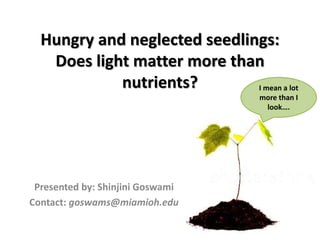
I mean a lot
more than I
look….
Hungry and neglected seedlings:
Does light matter more than
nutrients?
Presented by: Shinjini Goswami
Contact: goswams@miamioh.edu
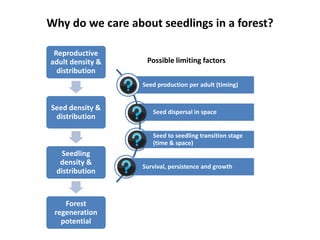
Why do we care about seedlings in a forest?
Reproductive
adult density &
distribution
Seed density &
distribution
Seedling
density &
distribution
Forest
regeneration
potential
Seed production per adult (timing)
Seed dispersal in space
Seed to seedling transition stage
(time & space)
Survival, persistence and growth
Possible limiting factors
Why do we care about seedlings in a forest?
Reproductive
adult density &
distribution
Seed density &
distribution
Seedling
density &
distribution
Forest
regeneration
potential
Seed production per adult (timing)
Seed dispersal in space
Seed to seedling transition stage
(time & space)
Survival, persistence and growth
Possible limiting factors
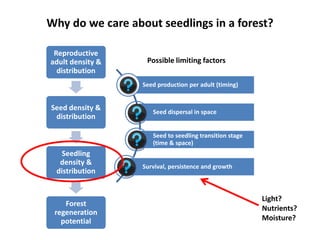
Light?
Nutrients?
Moisture?
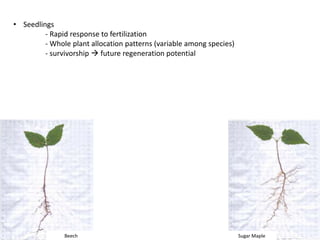
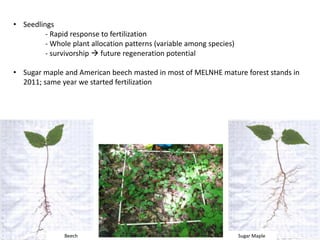
• Seedlings
- Rapid response to fertilization
- Whole plant allocation patterns (variable among species)
- survivorship  future regeneration potential
Sugar MapleBeech
• Seedlings
- Rapid response to fertilization
- Whole plant allocation patterns (variable among species)
- survivorship  future regeneration potential
• Sugar maple and American beech masted in most of MELNHE mature forest stands in
2011; same year we started fertilization
Sugar MapleBeech
Questions:
• Does seedling allocation respond to nutrient, light, or water
resources?
• Which resources most influence survivorship?
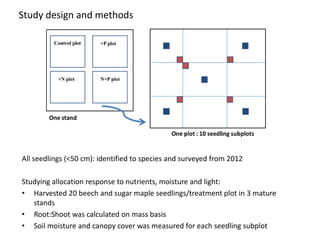
All seedlings (<50 cm): identified to species and surveyed from 2012
Studying allocation response to nutrients, moisture and light:
• Harvested 20 beech and sugar maple seedlings/treatment plot in 3 mature
stands
• Root:Shoot was calculated on mass basis
• Soil moisture and canopy cover was measured for each seedling subplot
Study design and methods
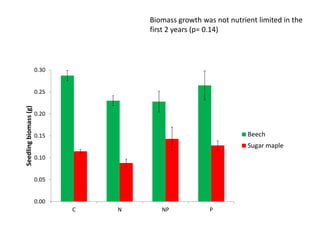
0.00
0.05
0.10
0.15
0.20
0.25
0.30
C N NP P
Seedlingbiomass(g)
Beech
Sugar maple
Biomass growth was not nutrient limited in the
first 2 years (p= 0.14)
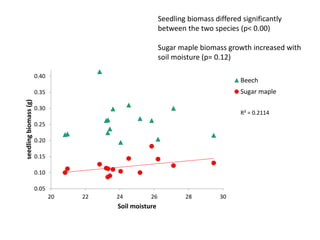
R² = 0.2114
0.05
0.10
0.15
0.20
0.25
0.30
0.35
0.40
20 22 24 26 28 30
seedlingbiomass(g)
Soil moisture
Beech
Sugar maple
Seedling biomass differed significantly
between the two species (p< 0.00)
Sugar maple biomass growth increased with
soil moisture (p= 0.12)
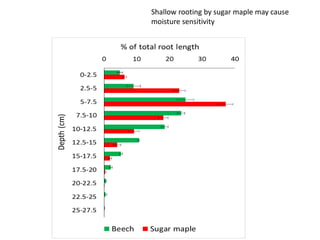
Shallow rooting by sugar maple may cause
moisture sensitivity
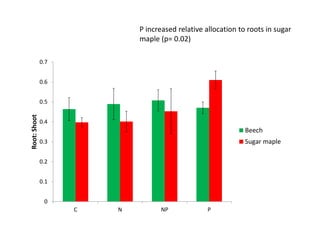
P increased relative allocation to roots in sugar
maple (p= 0.02)
0
0.1
0.2
0.3
0.4
0.5
0.6
0.7
C N NP P
Root:Shoot
Beech
Sugar maple
0
5
10
15
20
25
30
35
C N NP P
Seedlingsurvivorship(%)
Beech
Sugar maple
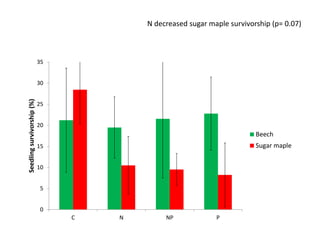
N decreased sugar maple survivorship (p= 0.07)
0
10
20
30
40
50
60
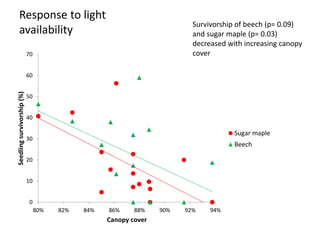
70
80% 82% 84% 86% 88% 90% 92% 94%
Seedlingsurvivorship(%)
Canopy cover
Sugar maple
Beech
Survivorship of beech (p= 0.09)
and sugar maple (p= 0.03)
decreased with increasing canopy
cover
Response to light
availability
Conclusions
• Beech seedlings are relatively non-plastic with respect to the variables
measured
• Seedling survivorship depends on light availability but not strongly
• It is unclear why fertilizing with N reduces survivorship.
• Seedling mortality at earlier life stages might be mostly stochastic; possibly
under the canopy environmental variables are not important at this life
stage

Shoestring2014 10-light

  • 1.
    I mean alot more than I look…. Hungry and neglected seedlings: Does light matter more than nutrients? Presented by: Shinjini Goswami Contact: goswams@miamioh.edu
  • 2.
    Why do wecare about seedlings in a forest? Reproductive adult density & distribution Seed density & distribution Seedling density & distribution Forest regeneration potential Seed production per adult (timing) Seed dispersal in space Seed to seedling transition stage (time & space) Survival, persistence and growth Possible limiting factors
  • 3.
    Why do wecare about seedlings in a forest? Reproductive adult density & distribution Seed density & distribution Seedling density & distribution Forest regeneration potential Seed production per adult (timing) Seed dispersal in space Seed to seedling transition stage (time & space) Survival, persistence and growth Possible limiting factors Light? Nutrients? Moisture?
  • 4.
    • Seedlings - Rapidresponse to fertilization - Whole plant allocation patterns (variable among species) - survivorship  future regeneration potential Sugar MapleBeech
  • 5.
    • Seedlings - Rapidresponse to fertilization - Whole plant allocation patterns (variable among species) - survivorship  future regeneration potential • Sugar maple and American beech masted in most of MELNHE mature forest stands in 2011; same year we started fertilization Sugar MapleBeech
  • 6.
    Questions: • Does seedlingallocation respond to nutrient, light, or water resources? • Which resources most influence survivorship?
  • 7.
    All seedlings (<50cm): identified to species and surveyed from 2012 Studying allocation response to nutrients, moisture and light: • Harvested 20 beech and sugar maple seedlings/treatment plot in 3 mature stands • Root:Shoot was calculated on mass basis • Soil moisture and canopy cover was measured for each seedling subplot Study design and methods
  • 8.
    0.00 0.05 0.10 0.15 0.20 0.25 0.30 C N NPP Seedlingbiomass(g) Beech Sugar maple Biomass growth was not nutrient limited in the first 2 years (p= 0.14)
  • 9.
    R² = 0.2114 0.05 0.10 0.15 0.20 0.25 0.30 0.35 0.40 2022 24 26 28 30 seedlingbiomass(g) Soil moisture Beech Sugar maple Seedling biomass differed significantly between the two species (p< 0.00) Sugar maple biomass growth increased with soil moisture (p= 0.12)
  • 10.
    Shallow rooting bysugar maple may cause moisture sensitivity
  • 11.
    P increased relativeallocation to roots in sugar maple (p= 0.02) 0 0.1 0.2 0.3 0.4 0.5 0.6 0.7 C N NP P Root:Shoot Beech Sugar maple
  • 12.
    0 5 10 15 20 25 30 35 C N NPP Seedlingsurvivorship(%) Beech Sugar maple N decreased sugar maple survivorship (p= 0.07)
  • 13.
    0 10 20 30 40 50 60 70 80% 82% 84%86% 88% 90% 92% 94% Seedlingsurvivorship(%) Canopy cover Sugar maple Beech Survivorship of beech (p= 0.09) and sugar maple (p= 0.03) decreased with increasing canopy cover Response to light availability
  • 14.
    Conclusions • Beech seedlingsare relatively non-plastic with respect to the variables measured • Seedling survivorship depends on light availability but not strongly • It is unclear why fertilizing with N reduces survivorship. • Seedling mortality at earlier life stages might be mostly stochastic; possibly under the canopy environmental variables are not important at this life stage

Editor's Notes

  • #3 The minimum light availability under which plants respond to nutrient availability varies between species, but some sps can respond in shade of <1% daylight, indicating a possibility of nutrient limitation even in highly shaded conditions
  • #4 The minimum light availability under which plants respond to nutrient availability varies between species, but some sps can respond in shade of <1% daylight, indicating a possibility of nutrient limitation even in highly shaded conditions
  • #5 provided an opportunity to study species-specific traits by which seedlings of different species utilize nutrients and to test effects on growth and survivorship
  • #6 provided an opportunity to study species-specific traits by which seedlings of different species utilize nutrients and to test effects on growth and survivorship
  • #7 Shade tolerant species like beech and sugar maple are flexible in preferentially allocating to above- and belowground growth. Variable allocation  nutrient limitation; Alleviating belowground resource limitations: reduce plant root: shoot
  • #10 Sugar maple biomass did not increase with light availability (p=0.4)
  • #11 More deeply rooted beech are likely to be less sensitive to drying of the surface soil, which could have contributed to higher beech survivorship.
  • #12 follows biomass pattern; P affects root:shoot; this might be affecting total biomass but it is not clear
  • #13 the pattern was the same in all stands and we need a design that reduces effect of site differences
  • #14 Sugar maple survivorship increased with light; however biomass did not increase with light (p=0.4). Biomass and survivorship were not correlated (p=0.6)
  • #15 This might result due to increased allocation to roots for alleviating belowground nutrient limitation, in turn decreasing allocation to aboveground tissues, thus decreasing reduced photosynthetic capacity to sustain growth and survival