Prairie Restoration
Blake Alldredge
Texas A&M AgriLife Extension Service
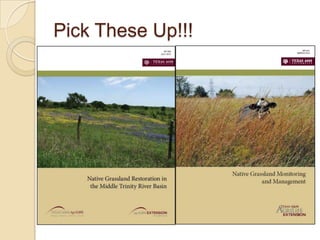
Pick These Up!!!
What Is Native Prairie?
 Mixture of native grasses and forbs
(aka weeds)
 Prairie specific
wildlife, soil, geology, and fire are
important
 Texas was 75% prairie and savanna
 Less than 1% of 20 million acres
remains!
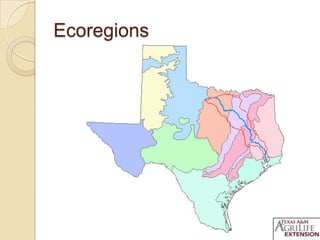
Ecoregions
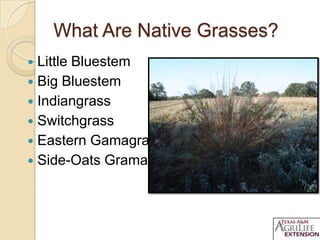
What Are Native Grasses?
 Little Bluestem
 Big Bluestem
 Indiangrass
 Switchgrass
 Eastern Gamagrass
 Side-Oats Grama
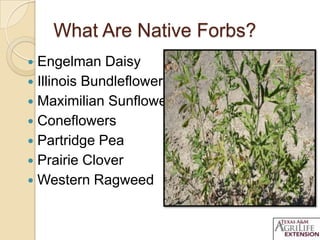
What Are Native Forbs?
 Engelman Daisy
 Illinois Bundleflower
 Maximilian Sunflower
 Coneflowers
 Partridge Pea
 Prairie Clover
 Western Ragweed
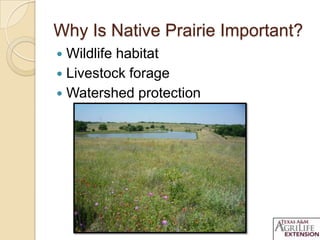
Why Is Native Prairie Important?
 Wildlife habitat
 Livestock forage
 Watershed protection
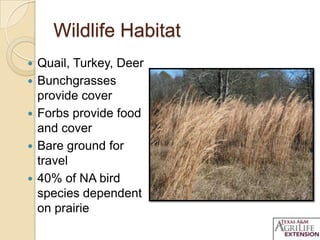
Wildlife Habitat
 Quail, Turkey, Deer
 Bunchgrasses
provide cover
 Forbs provide food
and cover
 Bare ground for
travel
 40% of NA bird
species dependent
on prairie
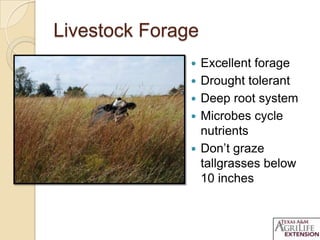
Livestock Forage
 Excellent forage
 Drought tolerant
 Deep root system
 Microbes cycle
nutrients
 Don’t graze
tallgrasses below
10 inches
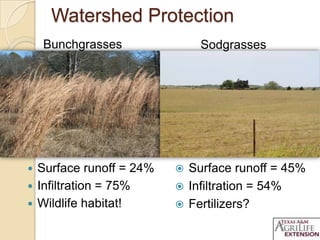
Watershed Protection
 Surface runoff = 24%
 Infiltration = 75%
 Wildlife habitat!
Bunchgrasses Sodgrasses
 Surface runoff = 45%
 Infiltration = 54%
 Fertilizers?
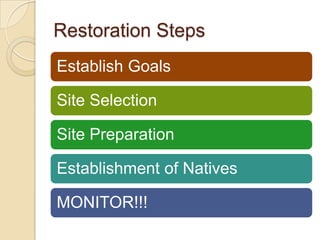
Restoration Steps
Establish Goals
Site Selection
Site Preparation
Establishment of Natives
MONITOR!!!
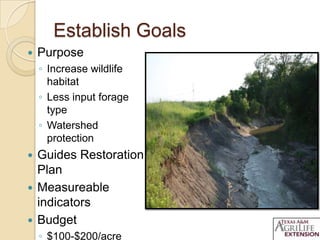
Establish Goals
 Purpose
◦ Increase wildlife
habitat
◦ Less input forage
type
◦ Watershed
protection
 Guides Restoration
Plan
 Measureable
indicators
 Budget
◦ $100-$200/acre
Site Selection
 Inventory of
property
 Connect to existing
habitat
 Easements, riparia
n areas, fencelines
 Examine soils
(Web Soil Survey)
 10% of land per
year or every other
year
Trinity River Information Management
System
 Accessible
 Interactive
 Watershed
scale (local to
regional)
 Soils, vegetation
, elevation, strea
m data
 Restoration
potential
trims.tamu.edu
Site Preparation
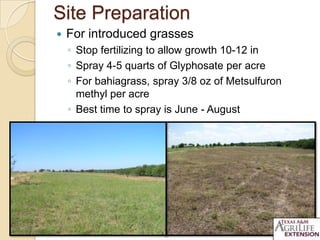
 For introduced grasses
◦ Stop fertilizing to allow growth 10-12 in
◦ Spray 4-5 quarts of Glyphosate per acre
◦ For bahiagrass, spray 3/8 oz of Metsulfuron
methyl per acre
◦ Best time to spray is June - August
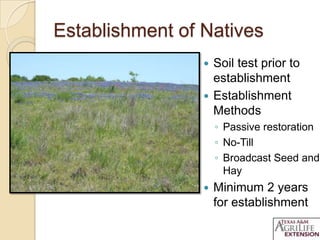
Establishment of Natives
 Soil test prior to
establishment
 Establishment
Methods
◦ Passive restoration
◦ No-Till
◦ Broadcast Seed and
Hay
 Minimum 2 years
for establishment
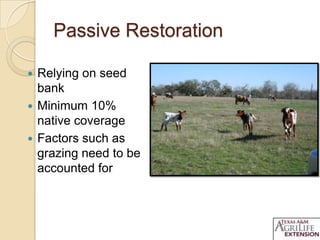
Passive Restoration
 Relying on seed
bank
 Minimum 10%
native coverage
 Factors such as
grazing need to be
accounted for
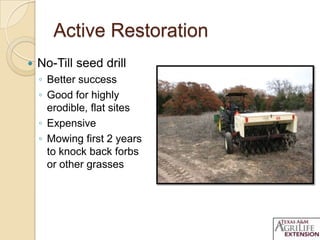
Active Restoration
 No-Till seed drill
◦ Better success
◦ Good for highly
erodible, flat sites
◦ Expensive
◦ Mowing first 2 years
to knock back forbs
or other grasses
Active Restoration
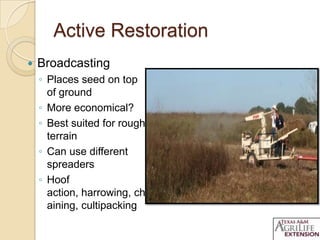
 Broadcasting
◦ Places seed on top
of ground
◦ More economical?
◦ Best suited for rough
terrain
◦ Can use different
spreaders
◦ Hoof
action, harrowing, ch
aining, cultipacking
Seed Selection
 Match with soil properties in your area
◦ Ecological Site Descriptions
 Within 100 miles E/W, 200 miles N/S
 Pure Live Seed (PLS) - % of bulk seed
material that is live, viable seed
 Recommended seeding rates are 20
live seed per ft2
 Most seed mix seeding rates vary
from 3-5 pounds PLS per acre
Seeding
 Depth critical because seed
germination requires good seed to soil
contact, with sufficient moisture and
light
 Plant ¼ to ½ inch deep
 Best time to plant is late fall to early
spring
 Need 30 days of adequate soil
moisture to germinate
 Don’t plant during drought conditions!
Considerations
 Post-restoration
Plan
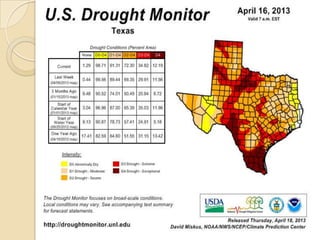
 Drought impacts on
seeding and prices
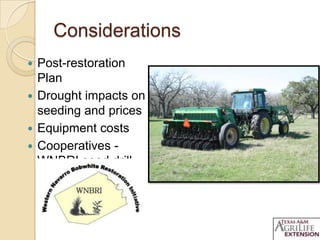
 Equipment costs
 Cooperatives -
WNBRI seed drill
Monitoring
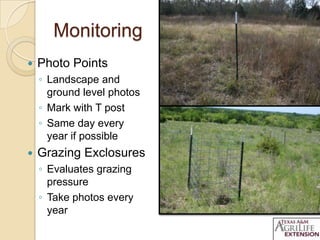
 Photo Points
◦ Landscape and
ground level photos
◦ Mark with T post
◦ Same day every
year if possible
 Grazing Exclosures
◦ Evaluates grazing
pressure
◦ Take photos every
year
Monitoring
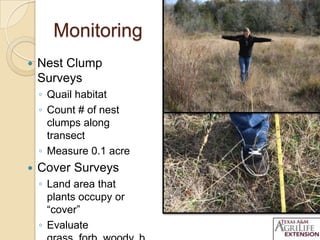
 Nest Clump
Surveys
◦ Quail habitat
◦ Count # of nest
clumps along
transect
◦ Measure 0.1 acre
 Cover Surveys
◦ Land area that
plants occupy or
“cover”
◦ Evaluate
Monitoring
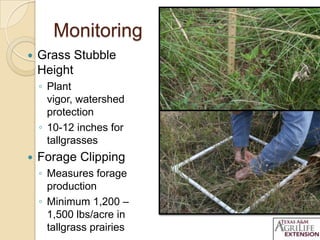
 Grass Stubble
Height
◦ Plant
vigor, watershed
protection
◦ 10-12 inches for
tallgrasses
 Forage Clipping
◦ Measures forage
production
◦ Minimum 1,200 –
1,500 lbs/acre in
tallgrass prairies
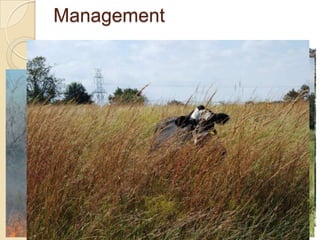
Management
Questions?

Prairie Restoration

  • 1.
    Prairie Restoration Blake Alldredge TexasA&M AgriLife Extension Service
  • 2.
  • 3.
    What Is NativePrairie?  Mixture of native grasses and forbs (aka weeds)  Prairie specific wildlife, soil, geology, and fire are important  Texas was 75% prairie and savanna  Less than 1% of 20 million acres remains!
  • 4.
  • 5.
    What Are NativeGrasses?  Little Bluestem  Big Bluestem  Indiangrass  Switchgrass  Eastern Gamagrass  Side-Oats Grama
  • 6.
    What Are NativeForbs?  Engelman Daisy  Illinois Bundleflower  Maximilian Sunflower  Coneflowers  Partridge Pea  Prairie Clover  Western Ragweed
  • 7.
    Why Is NativePrairie Important?  Wildlife habitat  Livestock forage  Watershed protection
  • 8.
    Wildlife Habitat  Quail,Turkey, Deer  Bunchgrasses provide cover  Forbs provide food and cover  Bare ground for travel  40% of NA bird species dependent on prairie
  • 9.
    Livestock Forage  Excellentforage  Drought tolerant  Deep root system  Microbes cycle nutrients  Don’t graze tallgrasses below 10 inches
  • 10.
    Watershed Protection  Surfacerunoff = 24%  Infiltration = 75%  Wildlife habitat! Bunchgrasses Sodgrasses  Surface runoff = 45%  Infiltration = 54%  Fertilizers?
  • 11.
    Restoration Steps Establish Goals SiteSelection Site Preparation Establishment of Natives MONITOR!!!
  • 12.
    Establish Goals  Purpose ◦Increase wildlife habitat ◦ Less input forage type ◦ Watershed protection  Guides Restoration Plan  Measureable indicators  Budget ◦ $100-$200/acre
  • 13.
    Site Selection  Inventoryof property  Connect to existing habitat  Easements, riparia n areas, fencelines  Examine soils (Web Soil Survey)  10% of land per year or every other year
  • 15.
    Trinity River InformationManagement System  Accessible  Interactive  Watershed scale (local to regional)  Soils, vegetation , elevation, strea m data  Restoration potential trims.tamu.edu
  • 17.
    Site Preparation  Forintroduced grasses ◦ Stop fertilizing to allow growth 10-12 in ◦ Spray 4-5 quarts of Glyphosate per acre ◦ For bahiagrass, spray 3/8 oz of Metsulfuron methyl per acre ◦ Best time to spray is June - August
  • 18.
    Establishment of Natives Soil test prior to establishment  Establishment Methods ◦ Passive restoration ◦ No-Till ◦ Broadcast Seed and Hay  Minimum 2 years for establishment
  • 19.
    Passive Restoration  Relyingon seed bank  Minimum 10% native coverage  Factors such as grazing need to be accounted for
  • 20.
    Active Restoration  No-Tillseed drill ◦ Better success ◦ Good for highly erodible, flat sites ◦ Expensive ◦ Mowing first 2 years to knock back forbs or other grasses
  • 21.
    Active Restoration  Broadcasting ◦Places seed on top of ground ◦ More economical? ◦ Best suited for rough terrain ◦ Can use different spreaders ◦ Hoof action, harrowing, ch aining, cultipacking
  • 22.
    Seed Selection  Matchwith soil properties in your area ◦ Ecological Site Descriptions  Within 100 miles E/W, 200 miles N/S  Pure Live Seed (PLS) - % of bulk seed material that is live, viable seed  Recommended seeding rates are 20 live seed per ft2  Most seed mix seeding rates vary from 3-5 pounds PLS per acre
  • 23.
    Seeding  Depth criticalbecause seed germination requires good seed to soil contact, with sufficient moisture and light  Plant ¼ to ½ inch deep  Best time to plant is late fall to early spring  Need 30 days of adequate soil moisture to germinate  Don’t plant during drought conditions!
  • 25.
    Considerations  Post-restoration Plan  Droughtimpacts on seeding and prices  Equipment costs  Cooperatives - WNBRI seed drill
  • 26.
    Monitoring  Photo Points ◦Landscape and ground level photos ◦ Mark with T post ◦ Same day every year if possible  Grazing Exclosures ◦ Evaluates grazing pressure ◦ Take photos every year
  • 27.
    Monitoring  Nest Clump Surveys ◦Quail habitat ◦ Count # of nest clumps along transect ◦ Measure 0.1 acre  Cover Surveys ◦ Land area that plants occupy or “cover” ◦ Evaluate
  • 28.
    Monitoring  Grass Stubble Height ◦Plant vigor, watershed protection ◦ 10-12 inches for tallgrasses  Forage Clipping ◦ Measures forage production ◦ Minimum 1,200 – 1,500 lbs/acre in tallgrass prairies
  • 29.
  • 30.

Editor's Notes

  • #5 Point out the various ecoregions
  • #11 A study done a few years ago compared runoff, erosion, and infiltration rates on native bunchgrasses vssodgrasses like bermuda. Based on 4 inch rainfall rate in 30 minutes bunchgrasses had lower runoff and erosion and greater infiltration. This means more water stays in the soil where it fell and can promote greater grass production in the future. But for those with pastures and hay fields, leave more residue on the ground and don’t let grasses like bermuda get eaten to less than 4-6 inches, and runoff and erosion can be reduced that way as well.These are benefits of natives vs. introduced
  • #12 Now that I’ve convinced you to restore prairies, I will discuss some general steps to take in your restoration plan. Work with your TPWD, NRCS biologists and county extension agents because they have the local expertise to help you develop this plan.
  • #13 Establishing goals is vital to a restoration project and will help determine which activities need to be implemented and in the correct sequence. There are many reasons to restore native prairies, increasing wildlife habitat which could help diversify ranch income, a less input forage source, or to control erosion prone areas and other watershed protection objectives. Set up measureable indicators that you can use to assess the success of the project. For example, you might say once you reach 50% cover of native grasses, then you can start managing by using burning or grazing to promote more coverage. These indicators can be developed with local biologists. Develop a budget for the project that you can afford. You don’t want to buy herbicide and spray and then realize you cant buy seed! Once you know how much you can spend, you can then focus on priority areas. There are many cost share programs available thru NRCS, TPWD, and others that can provide some financial assistance for these projects.
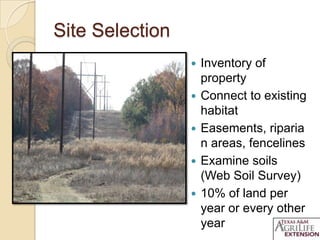
  • #14 Take an inventory of your property to see which areas might be best suited for restoration and to select priority areas. If any exists, connect to existing prairie habitat on your property or surrounding properties (WHF example). If no habitat exists, good places to start are powerline easements, riparian areas, fencelines that can serve as corridors. (Discuss photo) It is best to examine your soils on web soil survey to see what will grow best there and to develop your seed mix to match that. NRCS or TPWD biologists can help with this too. It’s recommended that you not restore more than 10% of your land every year or every other year so that, especially for cattle producers, your not putting yourself out of business. It takes 2-3 years before you’ll get a good stand of native grasses, so patience is needed. In drought years, may take longer.
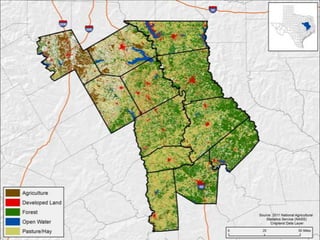
  • #15 From a regional standpoint, I would focus on western navarro county and limestone county, but local scales may be much different.Hard to tell at this scale good areas to restore. Need web soil survey and TRIMS on your property
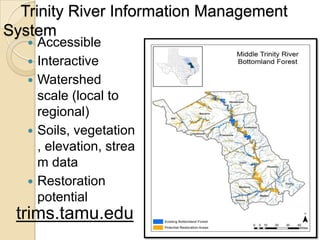
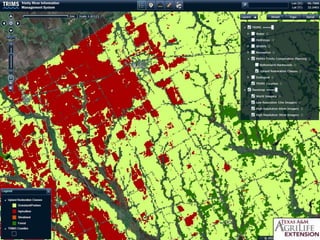
  • #16 A great tool that has come out is the Trinity River Information Management System, or TRIMS, developed by the Texas A&M Institute of Renewable Natural Resources. This is similar to a GIS program but is available for free on the web at www.trims.tamu.edu. On this interactive website, you can zoom to your specific piece of land, or look at a watershed as a whole. Features on this website allow you to determine soil and vegetation types on the land, measure land area, access elevation and stream gauge data, and others all in the overall goal of conservation planning. On this site, you can determine areas that are best suited for restoration.Replace screen shot, maybe with amy teaching someone at screen
  • #17 Point out areas that they may want to start (riparian areas) and avoid cropland. Talk about ease of restoring classes
  • #19 Mycorrhizae and other soil organisms