Module 4:FLIP-FLOP
Quote of the day
“Never think you are nothing, never
think you are everything, but think you
are something and achieve anything”.
― Albert Einstein
Sequential and combinational circuits
• A digital circuit whose output depends on only
applied input is combinational circuit.
• Digital circuits studied until now are
combinational circuits
• A digital circuit whose output not only
depends on applied input but also depends
on the present state of output is Sequential
circuit.
• Sequential circuit has memory.
• Flip-flop is a basic element of sequential
circuit.
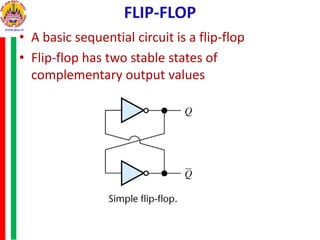
FLIP-FLOP
• A basic sequential circuit is a flip-flop
• Flip-flop has two stable states of
complementary output values
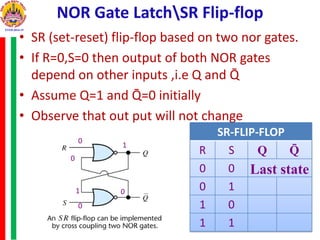
NOR Gate LatchSR Flip-flop
• SR (set-reset) flip-flop based on two nor gates.
• If R=0,S=0 then output of both NOR gates
depend on other inputs ,i.e Q and Q̄
• Assume Q=0 and Q̄=1 initially
• Observe that out put will not change
0
0
SR-FLIP-FLOP
R S Q Q̄
0 0
0 1
1 0
1 1
1
0
0
1
NOR Gate LatchSR Flip-flop
• SR (set-reset) flip-flop based on two nor gates.
• If R=0,S=0 then output of both NOR gates
depend on other inputs ,i.e Q and Q̄
• Assume Q=1 and Q̄=0 initially
• Observe that out put will not change
0
0
SR-FLIP-FLOP
R S Q Q̄
0 0
0 1
1 0
1 1
0
1
1
0
Last state
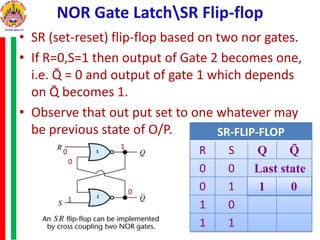
NOR Gate LatchSR Flip-flop
• SR (set-reset) flip-flop based on two nor gates.
• If R=0,S=1 then output of Gate 2 becomes one,
i.e. Q̄ = 0 and output of gate 1 which depends
on Q̄ becomes 1.
• Observe that out put set to one whatever may
be previous state of O/P. SR-FLIP-FLOP
R S Q Q̄
0 0 Last state
0 1
1 0
1 1
0
1
0
1
0
1 0
NOR Gate LatchSR Flip-flop
• SR (set-reset) flip-flop based on two nor gates.
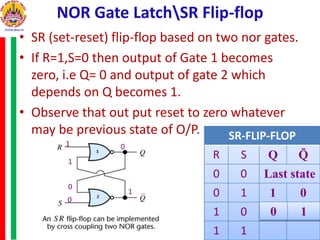
• If R=1,S=0 then output of Gate 1 becomes
zero, i.e Q= 0 and output of gate 2 which
depends on Q becomes 1.
• Observe that out put reset to zero whatever
may be previous state of O/P. SR-FLIP-FLOP
R S Q Q̄
0 0 Last state
0 1 1 0
1 0
1 1
1
0
1
01
0 1
0
NOR Gate LatchSR Flip-flop
• SR (set-reset) flip-flop based on two nor gates.
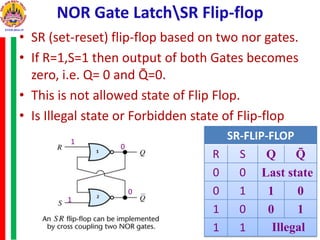
• If R=1,S=1 then output of both Gates becomes
zero, i.e. Q= 0 and Q̄=0.
• This is not allowed state of Flip Flop.
• Is Illegal state or Forbidden state of Flip-flop
SR-FLIP-FLOP
R S Q Q̄
0 0 Last state
0 1 1 0
1 0 0 1
1 1
1
0
0
1
Illegal
NAND Gate LatchS̄R̄ Flip-flop
• S̄R̄ (set-reset) flip-flop based on two nor gates.
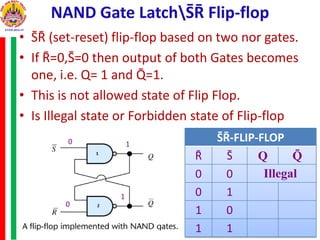
• If R̄=0,S̄=0 then output of both Gates becomes
one, i.e. Q= 1 and Q̄=1.
• This is not allowed state of Flip Flop.
• Is Illegal state or Forbidden state of Flip-flop
S̄R̄-FLIP-FLOP
R̄ S̄ Q Q̄
0 0
0 1
1 0
1 1
0
0
1
1
Illegal
NAND Gate LatchS̄R̄ Flip-flop
• S̄R̄ (set-reset) flip-flop based on two nor gates.
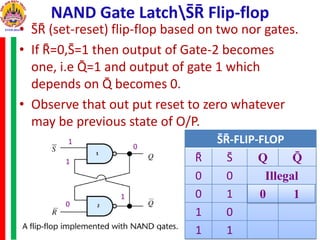
• If R̄=0,S̄=1 then output of Gate-2 becomes
one, i.e Q̄=1 and output of gate 1 which
depends on Q̄ becomes 0.
• Observe that out put reset to zero whatever
may be previous state of O/P.
S̄R̄-FLIP-FLOP
R̄ S̄ Q Q̄
0 0 Illegal
0 1
1 0
1 1
1
0
1
1
0
0 1
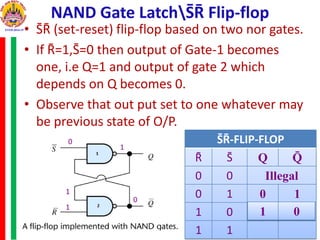
NAND Gate LatchS̄R̄ Flip-flop
• S̄R̄ (set-reset) flip-flop based on two nor gates.
• If R̄=1,S̄=0 then output of Gate-1 becomes
one, i.e Q=1 and output of gate 2 which
depends on Q becomes 0.
• Observe that out put set to one whatever may
be previous state of O/P.
S̄R̄-FLIP-FLOP
R̄ S̄ Q Q̄
0 0 Illegal
0 1 0 1
1 0
1 1
0
1
1
1
0
1 0
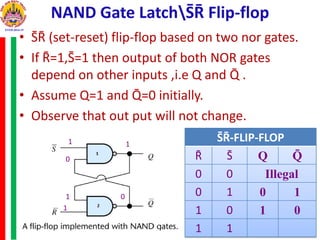
NAND Gate LatchS̄R̄ Flip-flop
• S̄R̄ (set-reset) flip-flop based on two nor gates.
• If R̄=1,S̄=1 then output of both NOR gates
depend on other inputs ,i.e Q and Q̄ .
• Assume Q=1 and Q̄=0 initially.
• Observe that out put will not change.
S̄R̄-FLIP-FLOP
R̄ S̄ Q Q̄
0 0 Illegal
0 1 0 1
1 0 1 0
1 1
1
1
1
01
0
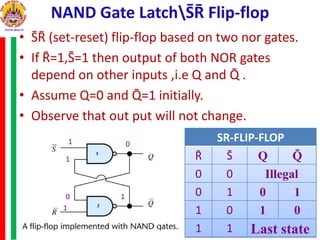
NAND Gate LatchS̄R̄ Flip-flop
• S̄R̄ (set-reset) flip-flop based on two nor gates.
• If R̄=1,S̄=1 then output of both NOR gates
depend on other inputs ,i.e Q and Q̄ .
• Assume Q=0 and Q̄=1 initially.
• Observe that out put will not change.
SR-FLIP-FLOP
R̄ S̄ Q Q̄
0 0 Illegal
0 1 0 1
1 0 1 0
1 1
1
1
0
10
1
Last state
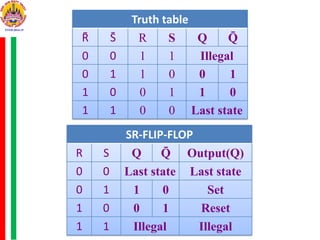
Truth table
R̄ S̄ R S Q Q̄
0 0 1 1 Illegal
0 1 1 0 0 1
1 0 0 1 1 0
1 1 0 0 Last state
SR-FLIP-FLOP
R S Q Q̄ Output(Q)
0 0 Last state Last state
0 1 1 0 Set
1 0 0 1 Reset
1 1 Illegal Illegal
Flip-Flop
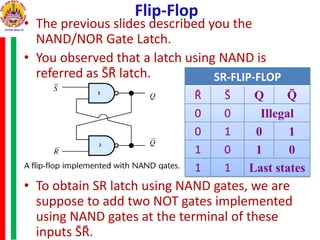
• The previous slides described you the
NAND/NOR Gate Latch.
• You observed that a latch using NAND is
referred as S̄R̄ latch.
• To obtain SR latch using NAND gates, we are
suppose to add two NOT gates implemented
using NAND gates at the terminal of these
inputs S̄R̄.
SR-FLIP-FLOP
R̄ S̄ Q Q̄
0 0 Illegal
0 1 0 1
1 0 1 0
1 1 Last states
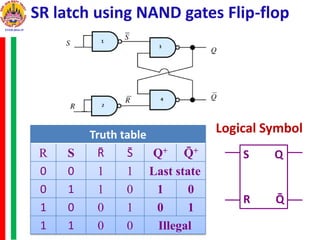
SR latch using NAND gates Flip-flop
Truth table
R S R̄ S̄ Q+ Q̄ +
0 0 1 1 Last state
0 1 1 0 1 0
1 0 0 1 0 1
1 1 0 0 Illegal
S Q
R Q̄
Logical Symbol
Gated Flip-Flops
• In the latches observed till now output responds
immediately to the changes in input.
• In many digital systems it is required that the
circuit responds only at some prescribed time,
decided by another input called the enable or
clock input.
• A Flip-Flop which immediately responds to the
changes of input in spite of enable or clock
input is referred as latch.
• Some flip-flops responds to the changes of input
during the edges of the clock inputs.
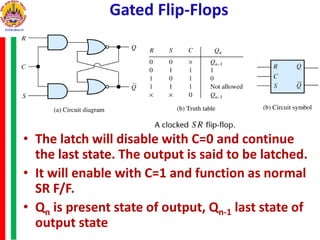
Gated Flip-Flops
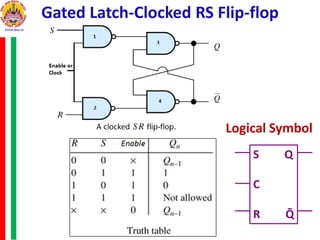
• The latch will disable with C=0 and continue
the last state. The output is said to be latched.
• It will enable with C=1 and function as normal
SR F/F.
• Qn is present state of output, Qn-1 last state of
output state
Gated Latch-Clocked RS Flip-flop
S Q
C
R Q̄
Logical Symbol
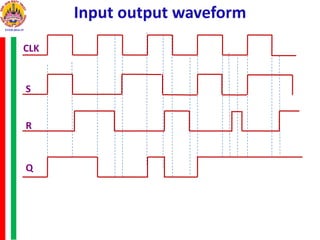
Input output waveform
CLK
S
R
Q

Flip flop

  • 1.
    Module 4:FLIP-FLOP Quote ofthe day “Never think you are nothing, never think you are everything, but think you are something and achieve anything”. ― Albert Einstein
  • 2.
    Sequential and combinationalcircuits • A digital circuit whose output depends on only applied input is combinational circuit. • Digital circuits studied until now are combinational circuits • A digital circuit whose output not only depends on applied input but also depends on the present state of output is Sequential circuit. • Sequential circuit has memory. • Flip-flop is a basic element of sequential circuit.
  • 3.
    FLIP-FLOP • A basicsequential circuit is a flip-flop • Flip-flop has two stable states of complementary output values
  • 4.
    NOR Gate LatchSRFlip-flop • SR (set-reset) flip-flop based on two nor gates. • If R=0,S=0 then output of both NOR gates depend on other inputs ,i.e Q and Q̄ • Assume Q=0 and Q̄=1 initially • Observe that out put will not change 0 0 SR-FLIP-FLOP R S Q Q̄ 0 0 0 1 1 0 1 1 1 0 0 1
  • 5.
    NOR Gate LatchSRFlip-flop • SR (set-reset) flip-flop based on two nor gates. • If R=0,S=0 then output of both NOR gates depend on other inputs ,i.e Q and Q̄ • Assume Q=1 and Q̄=0 initially • Observe that out put will not change 0 0 SR-FLIP-FLOP R S Q Q̄ 0 0 0 1 1 0 1 1 0 1 1 0 Last state
  • 6.
    NOR Gate LatchSRFlip-flop • SR (set-reset) flip-flop based on two nor gates. • If R=0,S=1 then output of Gate 2 becomes one, i.e. Q̄ = 0 and output of gate 1 which depends on Q̄ becomes 1. • Observe that out put set to one whatever may be previous state of O/P. SR-FLIP-FLOP R S Q Q̄ 0 0 Last state 0 1 1 0 1 1 0 1 0 1 0 1 0
  • 7.
    NOR Gate LatchSRFlip-flop • SR (set-reset) flip-flop based on two nor gates. • If R=1,S=0 then output of Gate 1 becomes zero, i.e Q= 0 and output of gate 2 which depends on Q becomes 1. • Observe that out put reset to zero whatever may be previous state of O/P. SR-FLIP-FLOP R S Q Q̄ 0 0 Last state 0 1 1 0 1 0 1 1 1 0 1 01 0 1 0
  • 8.
    NOR Gate LatchSRFlip-flop • SR (set-reset) flip-flop based on two nor gates. • If R=1,S=1 then output of both Gates becomes zero, i.e. Q= 0 and Q̄=0. • This is not allowed state of Flip Flop. • Is Illegal state or Forbidden state of Flip-flop SR-FLIP-FLOP R S Q Q̄ 0 0 Last state 0 1 1 0 1 0 0 1 1 1 1 0 0 1 Illegal
  • 9.
    NAND Gate LatchS̄R̄Flip-flop • S̄R̄ (set-reset) flip-flop based on two nor gates. • If R̄=0,S̄=0 then output of both Gates becomes one, i.e. Q= 1 and Q̄=1. • This is not allowed state of Flip Flop. • Is Illegal state or Forbidden state of Flip-flop S̄R̄-FLIP-FLOP R̄ S̄ Q Q̄ 0 0 0 1 1 0 1 1 0 0 1 1 Illegal
  • 10.
    NAND Gate LatchS̄R̄Flip-flop • S̄R̄ (set-reset) flip-flop based on two nor gates. • If R̄=0,S̄=1 then output of Gate-2 becomes one, i.e Q̄=1 and output of gate 1 which depends on Q̄ becomes 0. • Observe that out put reset to zero whatever may be previous state of O/P. S̄R̄-FLIP-FLOP R̄ S̄ Q Q̄ 0 0 Illegal 0 1 1 0 1 1 1 0 1 1 0 0 1
  • 11.
    NAND Gate LatchS̄R̄Flip-flop • S̄R̄ (set-reset) flip-flop based on two nor gates. • If R̄=1,S̄=0 then output of Gate-1 becomes one, i.e Q=1 and output of gate 2 which depends on Q becomes 0. • Observe that out put set to one whatever may be previous state of O/P. S̄R̄-FLIP-FLOP R̄ S̄ Q Q̄ 0 0 Illegal 0 1 0 1 1 0 1 1 0 1 1 1 0 1 0
  • 12.
    NAND Gate LatchS̄R̄Flip-flop • S̄R̄ (set-reset) flip-flop based on two nor gates. • If R̄=1,S̄=1 then output of both NOR gates depend on other inputs ,i.e Q and Q̄ . • Assume Q=1 and Q̄=0 initially. • Observe that out put will not change. S̄R̄-FLIP-FLOP R̄ S̄ Q Q̄ 0 0 Illegal 0 1 0 1 1 0 1 0 1 1 1 1 1 01 0
  • 13.
    NAND Gate LatchS̄R̄Flip-flop • S̄R̄ (set-reset) flip-flop based on two nor gates. • If R̄=1,S̄=1 then output of both NOR gates depend on other inputs ,i.e Q and Q̄ . • Assume Q=0 and Q̄=1 initially. • Observe that out put will not change. SR-FLIP-FLOP R̄ S̄ Q Q̄ 0 0 Illegal 0 1 0 1 1 0 1 0 1 1 1 1 0 10 1 Last state
  • 14.
    Truth table R̄ S̄R S Q Q̄ 0 0 1 1 Illegal 0 1 1 0 0 1 1 0 0 1 1 0 1 1 0 0 Last state SR-FLIP-FLOP R S Q Q̄ Output(Q) 0 0 Last state Last state 0 1 1 0 Set 1 0 0 1 Reset 1 1 Illegal Illegal
  • 15.
    Flip-Flop • The previousslides described you the NAND/NOR Gate Latch. • You observed that a latch using NAND is referred as S̄R̄ latch. • To obtain SR latch using NAND gates, we are suppose to add two NOT gates implemented using NAND gates at the terminal of these inputs S̄R̄. SR-FLIP-FLOP R̄ S̄ Q Q̄ 0 0 Illegal 0 1 0 1 1 0 1 0 1 1 Last states
  • 16.
    SR latch usingNAND gates Flip-flop Truth table R S R̄ S̄ Q+ Q̄ + 0 0 1 1 Last state 0 1 1 0 1 0 1 0 0 1 0 1 1 1 0 0 Illegal S Q R Q̄ Logical Symbol
  • 17.
    Gated Flip-Flops • Inthe latches observed till now output responds immediately to the changes in input. • In many digital systems it is required that the circuit responds only at some prescribed time, decided by another input called the enable or clock input. • A Flip-Flop which immediately responds to the changes of input in spite of enable or clock input is referred as latch. • Some flip-flops responds to the changes of input during the edges of the clock inputs.
  • 18.
    Gated Flip-Flops • Thelatch will disable with C=0 and continue the last state. The output is said to be latched. • It will enable with C=1 and function as normal SR F/F. • Qn is present state of output, Qn-1 last state of output state
  • 19.
    Gated Latch-Clocked RSFlip-flop S Q C R Q̄ Logical Symbol
  • 20.