Flow Efficiency
A digital operations strategy
Principal Consultant
marcio.sete@elabor8.com.au
Marcio Sete
@marciosete
Principal Consultant
marcio.sete@elabor8.com.au
Marcio Sete
@marciosete
Resource Efficiency
vs
Flow Efficiency
Managing for
predictability and flow
Defined Process
vs
Empirical Process
Final reflection
Resource Efficiency vs Flow Efficiency
Two different operations strategy
Alison thinks she has a cancer
@marciosete This is Lean: Resolving the Efficiency Paradox - Niklas Modig and Pär Åhlström
Sarah feels a lump in her breast
@marciosete This is Lean: Resolving the Efficiency Paradox - Niklas Modig and Pär Åhlström
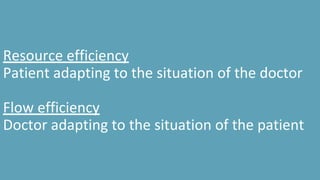
Resource efficiency
Patient adapting to the situation of the doctor
Flow efficiency
Doctor adapting to the situation of the patient
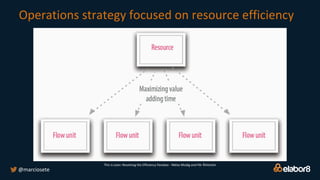
Operations strategy focused on resource efficiency
@marciosete
This is Lean: Resolving the Efficiency Paradox - Niklas Modig and Pär Åhlström
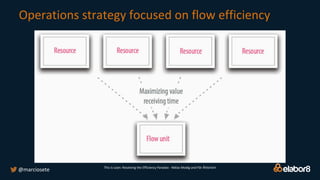
Operations strategy focused on flow efficiency
@marciosete This is Lean: Resolving the Efficiency Paradox - Niklas Modig and Pär Åhlström
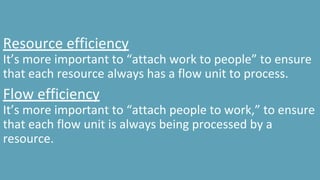
Resource efficiency
It’s more important to “attach work to people” to ensure
that each resource always has a flow unit to process.
Flow efficiency
It’s more important to “attach people to work,” to ensure
that each flow unit is always being processed by a
resource.
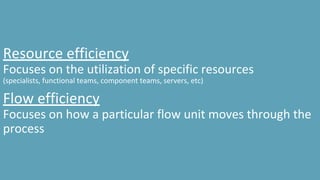
Resource efficiency
Focuses on the utilization of specific resources
(specialists, functional teams, component teams, servers, etc)
Flow efficiency
Focuses on how a particular flow unit moves through the
process
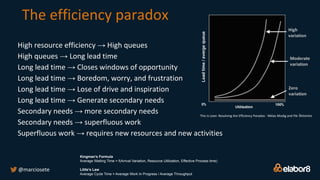
The efficiency paradox
@marciosete
High resource efficiency → High queues
High queues → Long lead time
Long lead time → Closes windows of opportunity
Long lead time → Boredom, worry, and frustration
Long lead time → Lose of drive and inspiration
Long lead time → Generate secondary needs
Secondary needs → more secondary needs
Secondary needs → superfluous work
Superfluous work → requires new resources and new activities
Kingman’s Formula
Average Waiting Time = f(Arrival Variation, Resource Utilization, Effective Process time)
Little’s Law
Average Cycle Time = Average Work In Progress / Average Throughput
This is Lean: Resolving the Efficiency Paradox - Niklas Modig and Pär Åhlström
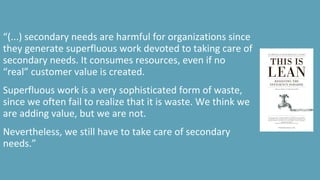
“(...) secondary needs are harmful for organizations since
they generate superfluous work devoted to taking care of
secondary needs. It consumes resources, even if no
“real” customer value is created.
Superfluous work is a very sophisticated form of waste,
since we often fail to realize that it is waste. We think we
are adding value, but we are not.
Nevertheless, we still have to take care of secondary
needs.”
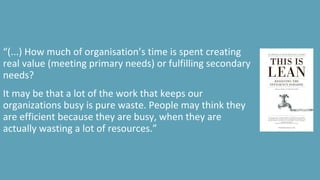
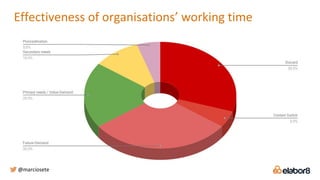
“(...) How much of organisation’s time is spent creating
real value (meeting primary needs) or fulfilling secondary
needs?
It may be that a lot of the work that keeps our
organizations busy is pure waste. People may think they
are efficient because they are busy, when they are
actually wasting a lot of resources.”
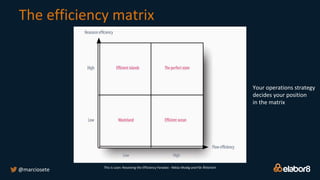
The efficiency matrix
@marciosete
Your operations strategy
decides your position
in the matrix
This is Lean: Resolving the Efficiency Paradox - Niklas Modig and Pär Åhlström
An operations strategy on
either resource or flow efficiency
has to do with the cost of delay
of satisfying the customer need
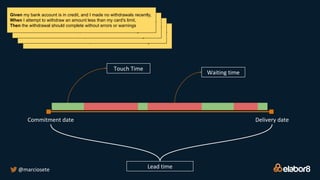
Given my bank account is in credit, and I made no withdrawals recently,
When I attempt to withdraw an amount less than my card's limit,
Then the withdrawal should complete without errors or warnings
Given my bank account is in credit, and I made no withdrawals recently,
When I attempt to withdraw an amount less than my card's limit,
Then the withdrawal should complete without errors or warnings
Given my bank account is in credit, and I made no withdrawals recently,
When I attempt to withdraw an amount less than my card's limit,
Then the withdrawal should complete without errors or warnings
Given my bank account is in credit, and I made no withdrawals recently,
When I attempt to withdraw an amount less than my card's limit,
Then the withdrawal should complete without errors or warnings
Lead time
Commitment date Delivery date
Waiting time
Touch Time
@marciosete
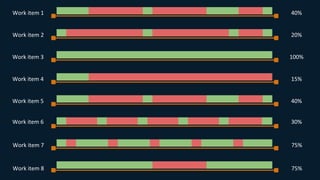
40%
20%
100%
15%
40%
30%
75%
75%
Work item 1
Work item 2
Work item 3
Work item 4
Work item 5
Work item 6
Work item 7
Work item 8
Flow efficiency looks at the density of the
value transfer from a resource to a flow unit.
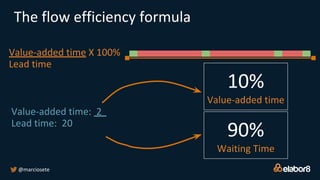
Value-added time X 100%
Lead time
Value-added time: 2 .
Lead time: 20
10%
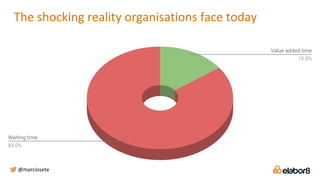
Value-added time
90%
Waiting Time
The flow efficiency formula
@marciosete
@marciosete
The shocking reality organisations face today
@marciosete
Effectiveness of organisations’ working time
The big sources of delay
1. Operating Model Design (Phased approach, teams design, cadences)
2. Dependencies (shared services, other teams, specialists or vendors)
3. Too much work-in-progress
4. Team liquidity
5. Manual and repetitive work
6. Earlier commitment
@marciosete
Defined Process vs Empirical Process
Mindsets that leads to two different operations strategy
@marciosete
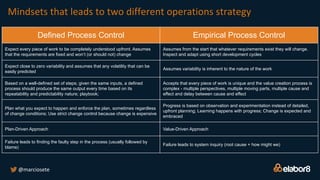
Defined Process Control Empirical Process Control
Expect every piece of work to be completely understood upfront. Assumes
that the requirements are fixed and won’t (or should not) change
Assumes from the start that whatever requirements exist they will change.
Inspect and adapt using short development cycles
Expect close to zero variability and assumes that any volatility that can be
easily predicted
Assumes variability is inherent to the nature of the work
Based on a well-defined set of steps; given the same inputs, a defined
process should produce the same output every time based on its
repeatability and predictability nature; playbook;
Accepts that every piece of work is unique and the value creation process is
complex - multiple perspectives, multiple moving parts, multiple cause and
effect and delay between cause and effect
Plan what you expect to happen and enforce the plan, sometimes regardless
of change conditions; Use strict change control because change is expensive
Progress is based on observation and experimentation instead of detailed,
upfront planning; Learning happens with progress; Change is expected and
embraced
Plan-Driven Approach Value-Driven Approach
Failure leads to finding the faulty step in the process (usually followed by
blame)
Failure leads to system inquiry (root cause + how might we)
Mindsets that leads to two different operations strategy
Managing for
predictability and flow
@marciosete
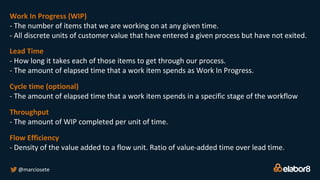
Work In Progress (WIP)
- The number of items that we are working on at any given time.
- All discrete units of customer value that have entered a given process but have not exited.
Lead Time
- How long it takes each of those items to get through our process.
- The amount of elapsed time that a work item spends as Work In Progress.
Cycle time (optional)
- The amount of elapsed time that a work item spends in a specific stage of the workflow
Throughput
- The amount of WIP completed per unit of time.
Flow Efficiency
- Density of the value added to a flow unit. Ratio of value-added time over lead time.
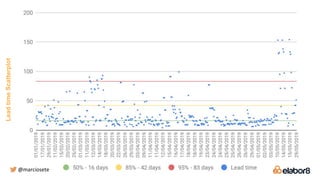
LeadtimeScatterplot
@marciosete
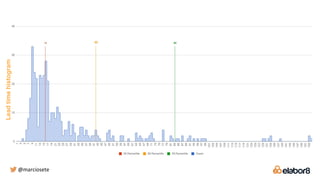
Leadtimehistogram
@marciosete
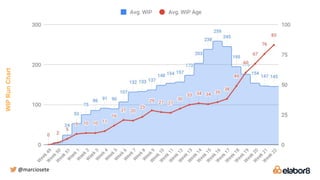
WIPRunChart
@marciosete
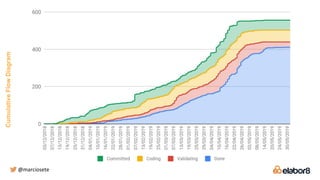
CumulativeFlowDiagram
@marciosete
ThroughputRunChart
@marciosete
@marciosete
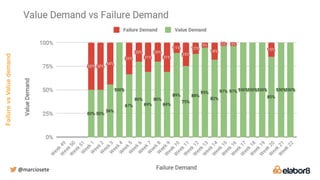
FailurevsValuedemand
MonteCarloSimulation-WHEN
@marciosete
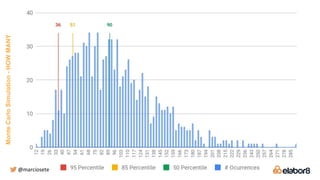
MonteCarloSimulation-HOWMANY
@marciosete
Final reflection...
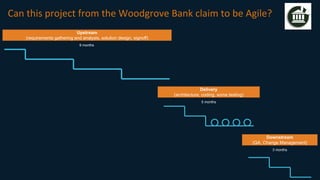
Upstream
(requirements gathering and analysis, solution design, signoff)
9 months
Delivery
(architecture, coding, some testing)
5 months
Downstream
(QA, Change Management)
3 months
Can this project from the Woodgrove Bank claim to be Agile?
Big
design
upfront
Agile
Just-in-
time
Yearly
Quarterly
Monthly
Fortnightly
Weekly
Daily
Hourly
Replenishment Frequency
(Responsiveness)
Pre-CI
CI
CD
Yearly
Quarterly
Monthly
Fortnightly
Weekly
Daily
Hourly
Release Frequency
(Customer experience)
145
Fast
Slow
Customer Lead time
(time-to-market)
21 days
29%
High
Low
Predictability
(Business Confidence)
85%
Pre-CI
CI
CD
Yearly
Quarterly
Monthly
Fortnightly
Weekly
Daily
Hourly
Deployment Frequency
(Antifragility)
<10%
High
Low
Flow Efficiency
(Way of working)
40%
Quality
(Software Craftsmanship)
HighLow
80%
53% 47%
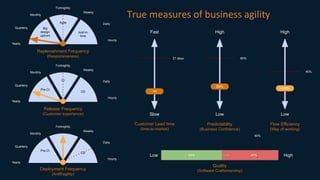
True measures of business agility
@marciosete
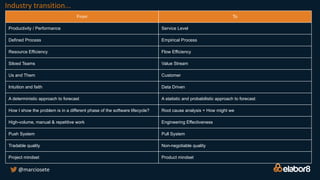
From To
Productivity / Performance Service Level
Defined Process Empirical Process
Resource Efficiency Flow Efficiency
Siloed Teams Value Stream
Us and Them Customer
Intuition and faith Data Driven
A deterministic approach to forecast A statistic and probabilistic approach to forecast
How I show the problem is in a different phase of the software lifecycle? Root cause analysis + How might we
High-volume, manual & repetitive work Engineering Effectiveness
Push System Pull System
Tradable quality Non-negotiable quality
Project mindset Product mindset
Industry transition...
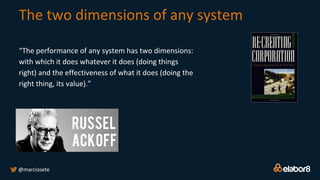
The two dimensions of any system
@marciosete
“The performance of any system has two dimensions:
with which it does whatever it does (doing things
right) and the effectiveness of what it does (doing the
right thing, its value).”
The two dimensions of any system
@marciosete
“(...) this should be taken together because the
righter we do the wrong thing, the wronger we
become. It is better to do the right thing wrong than
the wrong thing right. When we do the right thing
wrong, we make a mistake that can be corrected;
hence, we learn how to be more effective.”
The two dimensions of any system
@marciosete
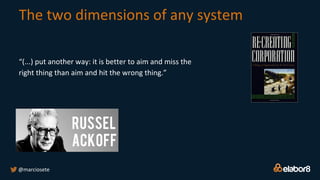
“(...) put another way: it is better to aim and miss the
right thing than aim and hit the wrong thing.”
Principal Consultant
https://www.linkedin.com/in/marciosete
https://twitter.com/elabor8
https://twitter.com/marciosete
https://medium.com/@Elabor8
https://medium.com/@marciosete
Thank you! Obrigado!
www.elabor8.com.au
marcio.sete@elabor8.com.au
Marcio Sete

Flow efficiency - a digital operations strategy

  • 1.
    Flow Efficiency A digitaloperations strategy Principal Consultant marcio.sete@elabor8.com.au Marcio Sete @marciosete
  • 2.
    Principal Consultant marcio.sete@elabor8.com.au Marcio Sete @marciosete ResourceEfficiency vs Flow Efficiency Managing for predictability and flow Defined Process vs Empirical Process Final reflection
  • 3.
    Resource Efficiency vsFlow Efficiency Two different operations strategy
  • 4.
    Alison thinks shehas a cancer @marciosete This is Lean: Resolving the Efficiency Paradox - Niklas Modig and Pär Åhlström
  • 5.
    Sarah feels alump in her breast @marciosete This is Lean: Resolving the Efficiency Paradox - Niklas Modig and Pär Åhlström
  • 6.
    Resource efficiency Patient adaptingto the situation of the doctor Flow efficiency Doctor adapting to the situation of the patient
  • 7.
    Operations strategy focusedon resource efficiency @marciosete This is Lean: Resolving the Efficiency Paradox - Niklas Modig and Pär Åhlström
  • 8.
    Operations strategy focusedon flow efficiency @marciosete This is Lean: Resolving the Efficiency Paradox - Niklas Modig and Pär Åhlström
  • 9.
    Resource efficiency It’s moreimportant to “attach work to people” to ensure that each resource always has a flow unit to process. Flow efficiency It’s more important to “attach people to work,” to ensure that each flow unit is always being processed by a resource.
  • 10.
    Resource efficiency Focuses onthe utilization of specific resources (specialists, functional teams, component teams, servers, etc) Flow efficiency Focuses on how a particular flow unit moves through the process
  • 11.
    The efficiency paradox @marciosete Highresource efficiency → High queues High queues → Long lead time Long lead time → Closes windows of opportunity Long lead time → Boredom, worry, and frustration Long lead time → Lose of drive and inspiration Long lead time → Generate secondary needs Secondary needs → more secondary needs Secondary needs → superfluous work Superfluous work → requires new resources and new activities Kingman’s Formula Average Waiting Time = f(Arrival Variation, Resource Utilization, Effective Process time) Little’s Law Average Cycle Time = Average Work In Progress / Average Throughput This is Lean: Resolving the Efficiency Paradox - Niklas Modig and Pär Åhlström
  • 12.
    “(...) secondary needsare harmful for organizations since they generate superfluous work devoted to taking care of secondary needs. It consumes resources, even if no “real” customer value is created. Superfluous work is a very sophisticated form of waste, since we often fail to realize that it is waste. We think we are adding value, but we are not. Nevertheless, we still have to take care of secondary needs.”
  • 13.
    “(...) How muchof organisation’s time is spent creating real value (meeting primary needs) or fulfilling secondary needs? It may be that a lot of the work that keeps our organizations busy is pure waste. People may think they are efficient because they are busy, when they are actually wasting a lot of resources.”
  • 14.
    The efficiency matrix @marciosete Youroperations strategy decides your position in the matrix This is Lean: Resolving the Efficiency Paradox - Niklas Modig and Pär Åhlström
  • 15.
    An operations strategyon either resource or flow efficiency has to do with the cost of delay of satisfying the customer need
  • 16.
    Given my bankaccount is in credit, and I made no withdrawals recently, When I attempt to withdraw an amount less than my card's limit, Then the withdrawal should complete without errors or warnings Given my bank account is in credit, and I made no withdrawals recently, When I attempt to withdraw an amount less than my card's limit, Then the withdrawal should complete without errors or warnings Given my bank account is in credit, and I made no withdrawals recently, When I attempt to withdraw an amount less than my card's limit, Then the withdrawal should complete without errors or warnings Given my bank account is in credit, and I made no withdrawals recently, When I attempt to withdraw an amount less than my card's limit, Then the withdrawal should complete without errors or warnings Lead time Commitment date Delivery date Waiting time Touch Time @marciosete
  • 17.
    40% 20% 100% 15% 40% 30% 75% 75% Work item 1 Workitem 2 Work item 3 Work item 4 Work item 5 Work item 6 Work item 7 Work item 8
  • 18.
    Flow efficiency looksat the density of the value transfer from a resource to a flow unit.
  • 19.
    Value-added time X100% Lead time Value-added time: 2 . Lead time: 20 10% Value-added time 90% Waiting Time The flow efficiency formula @marciosete
  • 20.
    @marciosete The shocking realityorganisations face today
  • 21.
  • 22.
    The big sourcesof delay 1. Operating Model Design (Phased approach, teams design, cadences) 2. Dependencies (shared services, other teams, specialists or vendors) 3. Too much work-in-progress 4. Team liquidity 5. Manual and repetitive work 6. Earlier commitment @marciosete
  • 23.
    Defined Process vsEmpirical Process Mindsets that leads to two different operations strategy
  • 24.
    @marciosete Defined Process ControlEmpirical Process Control Expect every piece of work to be completely understood upfront. Assumes that the requirements are fixed and won’t (or should not) change Assumes from the start that whatever requirements exist they will change. Inspect and adapt using short development cycles Expect close to zero variability and assumes that any volatility that can be easily predicted Assumes variability is inherent to the nature of the work Based on a well-defined set of steps; given the same inputs, a defined process should produce the same output every time based on its repeatability and predictability nature; playbook; Accepts that every piece of work is unique and the value creation process is complex - multiple perspectives, multiple moving parts, multiple cause and effect and delay between cause and effect Plan what you expect to happen and enforce the plan, sometimes regardless of change conditions; Use strict change control because change is expensive Progress is based on observation and experimentation instead of detailed, upfront planning; Learning happens with progress; Change is expected and embraced Plan-Driven Approach Value-Driven Approach Failure leads to finding the faulty step in the process (usually followed by blame) Failure leads to system inquiry (root cause + how might we) Mindsets that leads to two different operations strategy
  • 25.
  • 26.
    @marciosete Work In Progress(WIP) - The number of items that we are working on at any given time. - All discrete units of customer value that have entered a given process but have not exited. Lead Time - How long it takes each of those items to get through our process. - The amount of elapsed time that a work item spends as Work In Progress. Cycle time (optional) - The amount of elapsed time that a work item spends in a specific stage of the workflow Throughput - The amount of WIP completed per unit of time. Flow Efficiency - Density of the value added to a flow unit. Ratio of value-added time over lead time.
  • 27.
  • 28.
  • 29.
  • 30.
  • 32.
  • 33.
  • 34.
  • 35.
  • 36.
  • 37.
    Upstream (requirements gathering andanalysis, solution design, signoff) 9 months Delivery (architecture, coding, some testing) 5 months Downstream (QA, Change Management) 3 months Can this project from the Woodgrove Bank claim to be Agile?
  • 38.
    Big design upfront Agile Just-in- time Yearly Quarterly Monthly Fortnightly Weekly Daily Hourly Replenishment Frequency (Responsiveness) Pre-CI CI CD Yearly Quarterly Monthly Fortnightly Weekly Daily Hourly Release Frequency (Customerexperience) 145 Fast Slow Customer Lead time (time-to-market) 21 days 29% High Low Predictability (Business Confidence) 85% Pre-CI CI CD Yearly Quarterly Monthly Fortnightly Weekly Daily Hourly Deployment Frequency (Antifragility) <10% High Low Flow Efficiency (Way of working) 40% Quality (Software Craftsmanship) HighLow 80% 53% 47% True measures of business agility
  • 39.
    @marciosete From To Productivity /Performance Service Level Defined Process Empirical Process Resource Efficiency Flow Efficiency Siloed Teams Value Stream Us and Them Customer Intuition and faith Data Driven A deterministic approach to forecast A statistic and probabilistic approach to forecast How I show the problem is in a different phase of the software lifecycle? Root cause analysis + How might we High-volume, manual & repetitive work Engineering Effectiveness Push System Pull System Tradable quality Non-negotiable quality Project mindset Product mindset Industry transition...
  • 40.
    The two dimensionsof any system @marciosete “The performance of any system has two dimensions: with which it does whatever it does (doing things right) and the effectiveness of what it does (doing the right thing, its value).”
  • 41.
    The two dimensionsof any system @marciosete “(...) this should be taken together because the righter we do the wrong thing, the wronger we become. It is better to do the right thing wrong than the wrong thing right. When we do the right thing wrong, we make a mistake that can be corrected; hence, we learn how to be more effective.”
  • 42.
    The two dimensionsof any system @marciosete “(...) put another way: it is better to aim and miss the right thing than aim and hit the wrong thing.”
  • 43.