MANOJ TAMANG 1
WAREHOUSE KPI
What is a KPI?
A Key Performance Indicator (KPI) is measurable value that demonstrates how effectively an
organization is achieving its key business objectives. It is a type of performance measurement that
evaluates the success of an organization in which it engages.
What is Warehouse KPI?
A warehouse KPI is a specific metric used to evaluate the efficiency, effectiveness, and performance
of various warehouse operations. It helps to monitor and improves various warehouse processes such as
Inventory Management, Order Fulfillment, Labor Productivity, and Overall Operational Efficiency.
Warehouse KPI's
1) Inventory KPI
Inventory KPI is all about monitoring and analyzing the movement and level of stock stored in a
Warehouse.
a) Inventory Accuracy: - The process of matching the amount of system tracked inventory and the
amount of physically available inventory.
Formula: Inventory as tracked by System / Physically available Inventory
b) Shrinkage: - It is the measurement of mismatch in inventory due to various factors like theft, damage,
or miscalculations.
Formula: (Cost of recorded Inventory-Cost of Physically Available Inventory) / Cost of recorded
inventory
c) Carrying Cost of Inventory: - It is the measurement of costs spend for Owning, Storing and Holding
Inventory over a period of time.
Formula: Total carrying cost / Overall inventory cost
d) Inventory Turnover: - It is the measurement of inventory sales frequency.
Formula: Cost of Goods Sold / Average Inventory OR No. of Sales Made / Average Inventory
e) Inventory to Sales Ratio: - It is the measurement of stock levels against the Sales within a Month.
Formula: EOM inventory balance / Sales for the Month
MANOJ TAMANG 2
WAREHOUSE KPI
2) Receiving KPIs
Receiving KPI is the measurement of receiving performance and productivity at the time of
receiving stock.
a) Cost of Receiving per Line: - It is the measurement of total amount spent on receiving the stock.
Formula: Total Cost of Receiving / Total no. of items in each receiving line
b) Receiving Productivity: - It is the measurement of volume of products received by a warehouse clerk
per hour.
c) Receiving Accuracy: - It is the proportionate measurement in between the received and to be received
quantity of a product.
Formula: (No. of correctly received items / Total no. of expected items) * 100%
d) Receiving Cycle Time: - It is the measurement of average time taken to process received stock.
Formula: Total time spent on sorting received stock / Total no. of received items
3) Put away KPIs
Put away KPI is the measurement of accuracy, time, and cost spent to store the inventory on
designated place after receiving.
a) Put away Cost per Line: - It is the measurement of cost to put away a line items on a Purchase Order.
Formula: Total Cost of Put away / Total Line Items
b) Put away Productivity: - It is the measurement of volume of stock put away by a warehouse clerk per
hour.
c) Put away Accuracy: - It is the measurement of percentage of number of items put away accurately at
the designated location.
Formula: (Inventory Put Away Correctly / Total Inventory Put Away) * 100%
d) Labor and Equipment Utilization: - It is the measurement of percentage of the labor and equipment
utilized during the put away process.
e) Put away Cycle Time: - It is the measurement of average time taken to put away the items.
MANOJ TAMANG 3
WAREHOUSE KPI
4) Order Management KPIs
Order Management KPI measures the smoothness of each processed order.
a) Order Lead Time: - It is the measurement of time taken to fulfill the order from the time of order
placement.
b) Fulfillment Accuracy Rate: - It is the measurement of numbers of orders that have been successfully
delivered on time, consisting of right items.
Formula: Orders completed without issues / Total orders received
c) Back Order Rate: - It is the ratio of unfulfilled order from the total orders.
Formula: Total backorders / Total orders
d) Cost per Order: - It is the measurement of total cost spent to fulfill a order.
Formula: Total fulfillment costs / Total no. of orders
5) Pick and Pack KPIs
a) Picking and Packing Cost: - The measurement of the cost incurred per order line, including handling,
labelling, relabeling, and packing.
b) Picking and Packing Productivity: - The measurement of number of orders line that have been picked
and packed per hour.
c) Picking and Packing Accuracy: - The percentage of orders picked and packed without error.
d) Picking and Packing Cycle Time: - It is the measurement of total time taken to pick and pack each
order.
e) Labor and Equipment Utilization: - It is the calculation of the percentage of labor and pick / pack
equipment out of the total labor and equipment utilized during the process.
6) Safety KPIs
Safety KPIs helps to prevent possible accidents in the Warehouse in future.
a) Accidents per Year: - It is the measurement of notable accidents that cost time and money in a year.
b) Time Since Last Accidents: - It is the indicator that shows you how much time it's been since the last
accident.
MANOJ TAMANG 4
WAREHOUSE KPI
7) Cultural KPIs
a) Average Training Time per Employee: - It is the measurement of how much time an employee
dedicates to onboarding, preparing for job and improving the skills and knowledge by training.
Formula: Total Training Hours / Total no. of Employees Participating in Training
b) Employee Turnover Rate: - It is a measurement of employee turnover ratio within the company over
a period of time.
Formula: (No. of employees who have left / Average no. of Employees) * 100%
c) Manager Satisfaction Score: - It is the process of determining how the employees are engaged, how
satisfied they are with their job, and how loyal there are likely to be.
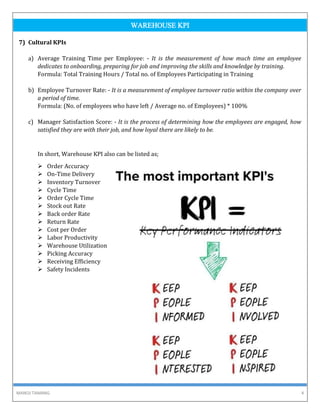
In short, Warehouse KPI also can be listed as;
 Order Accuracy
 On-Time Delivery
 Inventory Turnover
 Cycle Time
 Order Cycle Time
 Stock out Rate
 Back order Rate
 Return Rate
 Cost per Order
 Labor Productivity
 Warehouse Utilization
 Picking Accuracy
 Receiving Efficiency
 Safety Incidents
MANOJ TAMANG 5
WAREHOUSE KPI
IMPORTANCE OF KPI IN WAREHOUSE
Key Performance Indicator (KPI) plays a vital role in warehouse management for several reasons.
It helps in assessing the efficiency, productivity, and overall performance of warehouse operations. Some
measure importance of KPI in warehouse are as follows;
1. Operational Efficiency
KPI helps to monitor various aspects of operations such as accuracy, picking and packing speed,
and inventory turnover. It helps in highlighting the areas that are performing well and those that
need improvement.
2. Inventory Management
KPI helps in managing stock levels effectively, reducing excess inventory, and minimizing stock
outs, leading to better inventory control and cost savings.
3. Employee Performance
KPI helps to evaluate employee performance. It helps to recognize high performers and encourage
them to perform better and also helps to provide feedback and facilitate trainings for those who
needs improvement.
4. Financial Performance
KPI helps to identify cost-saving opportunities and improve overall profitability as it involves in
labor costs, storage costs, and shipping costs.
5. Customer Satisfaction
Monitoring KPIs like order accuracy, on-time delivery, and return rate ensures that the warehouse
meets customer expectations. Meeting customer expectations boost on customer satisfaction.
6. Strategic Planning
KPIs provide concrete data that can be used for strategic planning and decision-making. This helps
in setting realistic goals, forecasting future needs, and making informed investments in technology
and infrastructure.
7. Compliance and Quality Control
KPIs ensures that the warehouse operations comply with regulatory requirements and followed
the procedures to maintain the standard and quality.
In summary, KPIs in warehouse operations are vital for measuring performance, controlling
operations, enhancing customer satisfaction, managing costs, making informed decisions,
motivating employees and managing risks.

Warehouse KPIs - Mastering warehouse efficiency

  • 1.
    MANOJ TAMANG 1 WAREHOUSEKPI What is a KPI? A Key Performance Indicator (KPI) is measurable value that demonstrates how effectively an organization is achieving its key business objectives. It is a type of performance measurement that evaluates the success of an organization in which it engages. What is Warehouse KPI? A warehouse KPI is a specific metric used to evaluate the efficiency, effectiveness, and performance of various warehouse operations. It helps to monitor and improves various warehouse processes such as Inventory Management, Order Fulfillment, Labor Productivity, and Overall Operational Efficiency. Warehouse KPI's 1) Inventory KPI Inventory KPI is all about monitoring and analyzing the movement and level of stock stored in a Warehouse. a) Inventory Accuracy: - The process of matching the amount of system tracked inventory and the amount of physically available inventory. Formula: Inventory as tracked by System / Physically available Inventory b) Shrinkage: - It is the measurement of mismatch in inventory due to various factors like theft, damage, or miscalculations. Formula: (Cost of recorded Inventory-Cost of Physically Available Inventory) / Cost of recorded inventory c) Carrying Cost of Inventory: - It is the measurement of costs spend for Owning, Storing and Holding Inventory over a period of time. Formula: Total carrying cost / Overall inventory cost d) Inventory Turnover: - It is the measurement of inventory sales frequency. Formula: Cost of Goods Sold / Average Inventory OR No. of Sales Made / Average Inventory e) Inventory to Sales Ratio: - It is the measurement of stock levels against the Sales within a Month. Formula: EOM inventory balance / Sales for the Month
  • 2.
    MANOJ TAMANG 2 WAREHOUSEKPI 2) Receiving KPIs Receiving KPI is the measurement of receiving performance and productivity at the time of receiving stock. a) Cost of Receiving per Line: - It is the measurement of total amount spent on receiving the stock. Formula: Total Cost of Receiving / Total no. of items in each receiving line b) Receiving Productivity: - It is the measurement of volume of products received by a warehouse clerk per hour. c) Receiving Accuracy: - It is the proportionate measurement in between the received and to be received quantity of a product. Formula: (No. of correctly received items / Total no. of expected items) * 100% d) Receiving Cycle Time: - It is the measurement of average time taken to process received stock. Formula: Total time spent on sorting received stock / Total no. of received items 3) Put away KPIs Put away KPI is the measurement of accuracy, time, and cost spent to store the inventory on designated place after receiving. a) Put away Cost per Line: - It is the measurement of cost to put away a line items on a Purchase Order. Formula: Total Cost of Put away / Total Line Items b) Put away Productivity: - It is the measurement of volume of stock put away by a warehouse clerk per hour. c) Put away Accuracy: - It is the measurement of percentage of number of items put away accurately at the designated location. Formula: (Inventory Put Away Correctly / Total Inventory Put Away) * 100% d) Labor and Equipment Utilization: - It is the measurement of percentage of the labor and equipment utilized during the put away process. e) Put away Cycle Time: - It is the measurement of average time taken to put away the items.
  • 3.
    MANOJ TAMANG 3 WAREHOUSEKPI 4) Order Management KPIs Order Management KPI measures the smoothness of each processed order. a) Order Lead Time: - It is the measurement of time taken to fulfill the order from the time of order placement. b) Fulfillment Accuracy Rate: - It is the measurement of numbers of orders that have been successfully delivered on time, consisting of right items. Formula: Orders completed without issues / Total orders received c) Back Order Rate: - It is the ratio of unfulfilled order from the total orders. Formula: Total backorders / Total orders d) Cost per Order: - It is the measurement of total cost spent to fulfill a order. Formula: Total fulfillment costs / Total no. of orders 5) Pick and Pack KPIs a) Picking and Packing Cost: - The measurement of the cost incurred per order line, including handling, labelling, relabeling, and packing. b) Picking and Packing Productivity: - The measurement of number of orders line that have been picked and packed per hour. c) Picking and Packing Accuracy: - The percentage of orders picked and packed without error. d) Picking and Packing Cycle Time: - It is the measurement of total time taken to pick and pack each order. e) Labor and Equipment Utilization: - It is the calculation of the percentage of labor and pick / pack equipment out of the total labor and equipment utilized during the process. 6) Safety KPIs Safety KPIs helps to prevent possible accidents in the Warehouse in future. a) Accidents per Year: - It is the measurement of notable accidents that cost time and money in a year. b) Time Since Last Accidents: - It is the indicator that shows you how much time it's been since the last accident.
  • 4.
    MANOJ TAMANG 4 WAREHOUSEKPI 7) Cultural KPIs a) Average Training Time per Employee: - It is the measurement of how much time an employee dedicates to onboarding, preparing for job and improving the skills and knowledge by training. Formula: Total Training Hours / Total no. of Employees Participating in Training b) Employee Turnover Rate: - It is a measurement of employee turnover ratio within the company over a period of time. Formula: (No. of employees who have left / Average no. of Employees) * 100% c) Manager Satisfaction Score: - It is the process of determining how the employees are engaged, how satisfied they are with their job, and how loyal there are likely to be. In short, Warehouse KPI also can be listed as;  Order Accuracy  On-Time Delivery  Inventory Turnover  Cycle Time  Order Cycle Time  Stock out Rate  Back order Rate  Return Rate  Cost per Order  Labor Productivity  Warehouse Utilization  Picking Accuracy  Receiving Efficiency  Safety Incidents
  • 5.
    MANOJ TAMANG 5 WAREHOUSEKPI IMPORTANCE OF KPI IN WAREHOUSE Key Performance Indicator (KPI) plays a vital role in warehouse management for several reasons. It helps in assessing the efficiency, productivity, and overall performance of warehouse operations. Some measure importance of KPI in warehouse are as follows; 1. Operational Efficiency KPI helps to monitor various aspects of operations such as accuracy, picking and packing speed, and inventory turnover. It helps in highlighting the areas that are performing well and those that need improvement. 2. Inventory Management KPI helps in managing stock levels effectively, reducing excess inventory, and minimizing stock outs, leading to better inventory control and cost savings. 3. Employee Performance KPI helps to evaluate employee performance. It helps to recognize high performers and encourage them to perform better and also helps to provide feedback and facilitate trainings for those who needs improvement. 4. Financial Performance KPI helps to identify cost-saving opportunities and improve overall profitability as it involves in labor costs, storage costs, and shipping costs. 5. Customer Satisfaction Monitoring KPIs like order accuracy, on-time delivery, and return rate ensures that the warehouse meets customer expectations. Meeting customer expectations boost on customer satisfaction. 6. Strategic Planning KPIs provide concrete data that can be used for strategic planning and decision-making. This helps in setting realistic goals, forecasting future needs, and making informed investments in technology and infrastructure. 7. Compliance and Quality Control KPIs ensures that the warehouse operations comply with regulatory requirements and followed the procedures to maintain the standard and quality. In summary, KPIs in warehouse operations are vital for measuring performance, controlling operations, enhancing customer satisfaction, managing costs, making informed decisions, motivating employees and managing risks.