Page 1
Page 2
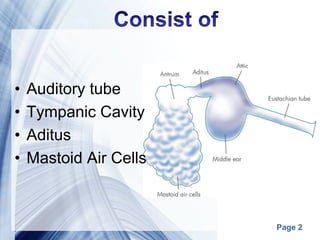
• Auditory tube
• Tympanic Cavity
• Aditus
• Mastoid Air Cells
Page 3
Page 4
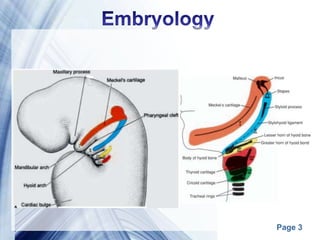
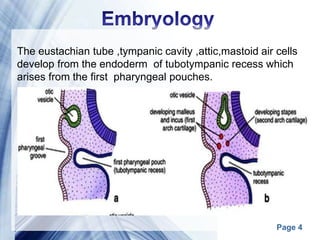
The eustachian tube ,tympanic cavity ,attic,mastoid air cells
develop from the endoderm of tubotympanic recess which
arises from the first pharyngeal pouches.
Page 5
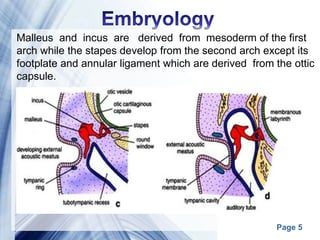
Malleus and incus are derived from mesoderm of the first
arch while the stapes develop from the second arch except its
footplate and annular ligament which are derived from the ottic
capsule.
Page 6
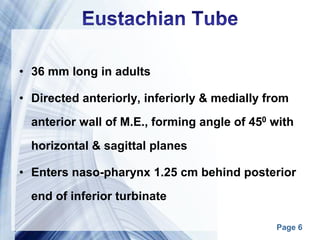
• 36 mm long in adults
• Directed anteriorly, inferiorly & medially from
anterior wall of M.E., forming angle of 450 with
horizontal & sagittal planes
• Enters naso-pharynx 1.25 cm behind posterior
end of inferior turbinate
Page 7
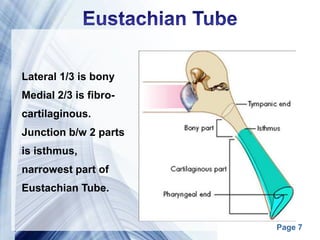
Lateral 1/3 is bony
Medial 2/3 is fibro-
cartilaginous.
Junction b/w 2 parts
is isthmus,
narrowest part of
Eustachian Tube.
Page 8
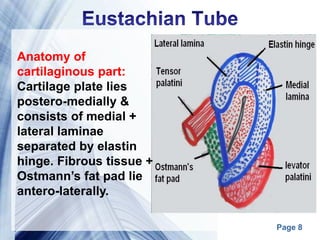
Anatomy of
cartilaginous part:
Cartilage plate lies
postero-medially &
consists of medial +
lateral laminae
separated by elastin
hinge. Fibrous tissue +
Ostmann’s fat pad lie
antero-laterally.
Page 9
CHARACTERISTIC ADULT INFANT
Length 36 mm 18mm
Angle with horizontal 45° 10°
Lumen Narrow Wide
Angulation at Isthmus Present Absent
Cartilage Rigid Flaccid
Elastic recoil Effective Ineffective
Ostmann’s fat More Less
Difference in adult & infant<7years ET
Page 10
Blood supply of ET:
• Ascending pharyngeal artery
• Middle meningeal artery
• Artery of pterygoid canal
• Veins drain into pterygoid venous plexus
Page 11
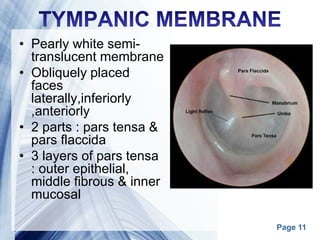
• Pearly white semi-
translucent membrane
• Obliquely placed
faces
laterally,inferiorly
,anteriorly
• 2 parts : pars tensa &
pars flaccida
• 3 layers of pars tensa
: outer epithelial,
middle fibrous & inner
mucosal
Page 12
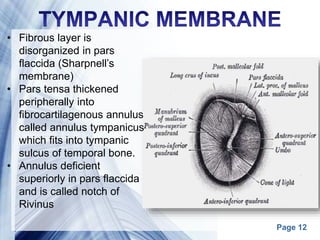
• Fibrous layer is
disorganized in pars
flaccida (Sharpnell’s
membrane)
• Pars tensa thickened
peripherally into
fibrocartilagenous annulus
called annulus tympanicus
which fits into tympanic
sulcus of temporal bone.
• Annulus deficient
superiorly in pars flaccida
and is called notch of
Rivinus
Page 13
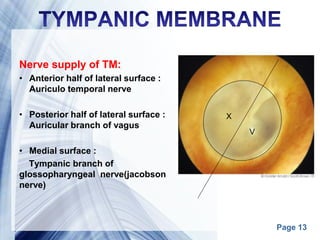
Nerve supply of TM:
• Anterior half of lateral surface :
Auriculo temporal nerve
• Posterior half of lateral surface :
Auricular branch of vagus
• Medial surface :
Tympanic branch of
glossopharyngeal nerve(jacobson
nerve)
V
X
Page 14
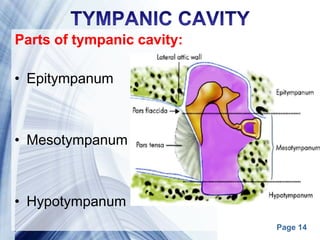
• Epitympanum
• Mesotympanum
• Hypotympanum
Parts of tympanic cavity:
Page 15
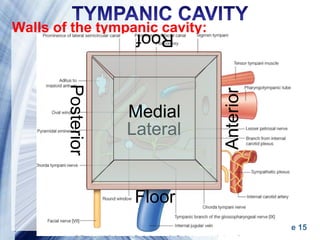
Walls of the tympanic cavity:
Lateral
Medial
Posterior
Anterior
Roof
Floor
Page 16
ROOF
• Thin plate of bone called TEGMEN
TYMPANI .
• It also extends posteriorly to form the roof
of the aditus and antrum.
• It seperates tympanic cavity from the
middle cranial fossa.
Page 17
The floor
• Thin plate of bone which seperates
tympanic cavity from the jugular bulb.
• Near the medial border of the floor is a
small aperture, through which the
tympanic branch from the
glossopharyngeal nerve [IX] enters the
middle ear
Page 18
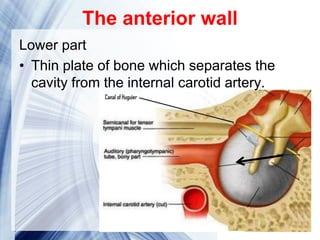
The anterior wall
Lower part
• Thin plate of bone which separates the
cavity from the internal carotid artery.
Page 19
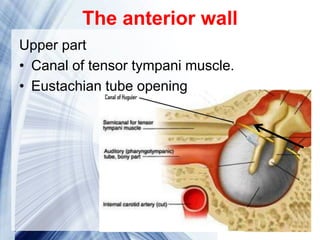
The anterior wall
Upper part
• Canal of tensor tympani muscle.
• Eustachian tube opening
Page 20
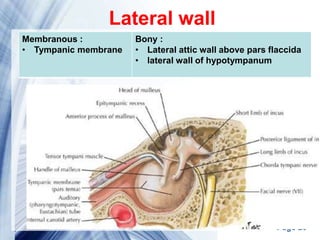
Lateral wall
Bony :
• Lateral attic wall above pars flaccida
• lateral wall of hypotympanum
Membranous :
• Tympanic membrane
Page 21
Medial wall
• Promontory
• Oval window
• Round window
• Tympanic part of bony facial nerve canal
• Lateral semicircular canal
• Processus cochlearformis
Page 22
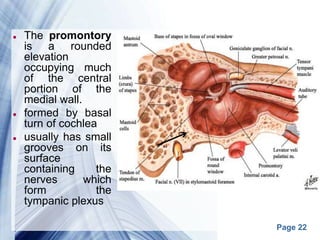
 The promontory
is a rounded
elevation
occupying much
of the central
portion of the
medial wall.
 formed by basal
turn of cochlea
 usually has small
grooves on its
surface
containing the
nerves which
form the
tympanic plexus
Page 23
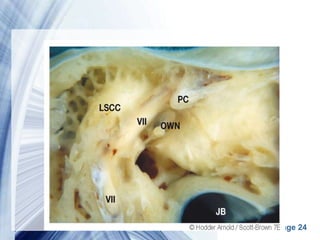
Oval window
 lies Behind and above the promontory
 A kidney-shaped opening that connects
the tympanic cavity with the vestibule.
 Close by a footplate of the stapes.
 Its size average 3.25 mm long and 1.75
mm wide.
Page 24
Page 25
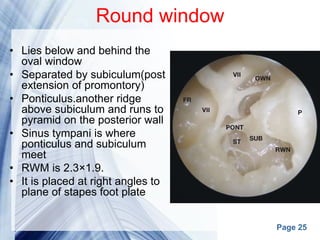
Round window
• Lies below and behind the
oval window
• Separated by subiculum(post
extension of promontory)
• Ponticulus.another ridge
above subiculum and runs to
pyramid on the posterior wall
• Sinus tympani is where
ponticulus and subiculum
meet
• RWM is 2.3×1.9.
• It is placed at right angles to
plane of stapes foot plate
Page 26
Facial nerve canal
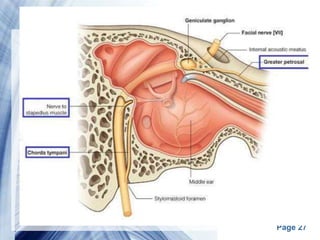
• The facial nerve canal (or Fallopian canal) runs
above the promontory and oval window in an
anteroposterior direction.
• The facial nerve canal is marked anteriorly by the
processus cochleariformis, a curved projection
of bone, concave anteriorly, which houses the
tendon of the tensor tympani muscle as it turns
laterally to the handle of the malleus.
• The region above the level of the facial nerve canal
forms the medial wall of the epitympanum.
• Behind the oval window, the facial canal starts to
turn inferiorly as it begins its descent in the
posterior wall of the tympanic cavity.
Page 27
Page 28
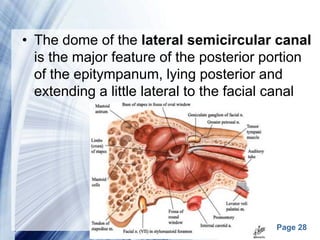
• The dome of the lateral semicircular canal
is the major feature of the posterior portion
of the epitympanum, lying posterior and
extending a little lateral to the facial canal
Page 29
Posterior wall
• Aditus ad antrum
• Fossa incudis for short process of incus
• Bulge produced by lateral semicircular canal
• Pyramidal eminence for stapedius tendon
• Buldge produced by vertical part of facial
nerve
• Sinus tympani
• Facial recess
Page 30
Page 31
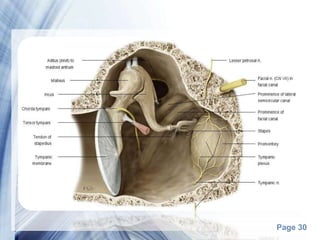
 The posterior wall is wider above than below.
 Upper part a large irregular opening - the aditus ad antrum,
that leads back from the posterior epitympanum into the
mastoid antrum.
 Below the aditus is a small depression, the fossa incudis,
which houses the short process of the incus and its
suspensory ligament.
 Below the fossa incudis and medial to the opening of the
chorda tympani nerve is the pyramid, a small hollow conical
projection with its apex pointing anteriorly.
 This houses the stapedius muscle and tendon, which inserts
into the posterior aspect of the head of stapes.
 The canal within the pyramid curves downwards and
backwards to join the descending portion of the facial nerve
canal.
Page 32
Facial Recess
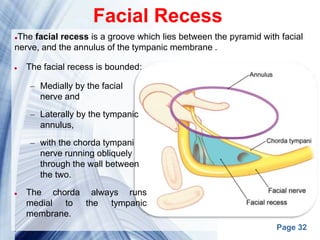
 The facial recess is bounded:
– Medially by the facial
nerve and
– Laterally by the tympanic
annulus,
– with the chorda tympani
nerve running obliquely
through the wall between
the two.
 The chorda always runs
medial to the tympanic
membrane.
The facial recess is a groove which lies between the pyramid with facial
nerve, and the annulus of the tympanic membrane .
Page 33
Facial Recess
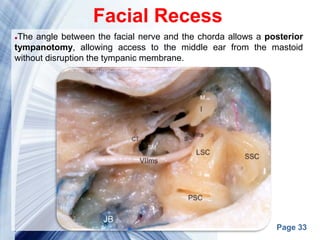
The angle between the facial nerve and the chorda allows a posterior
tympanotomy, allowing access to the middle ear from the mastoid
without disruption the tympanic membrane.
Page 34
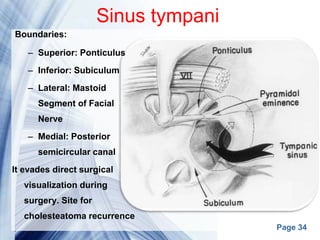
Sinus tympani
Boundaries:
– Superior: Ponticulus
– Inferior: Subiculum
– Lateral: Mastoid
Segment of Facial
Nerve
– Medial: Posterior
semicircular canal
It evades direct surgical
visualization during
surgery. Site for
cholesteatoma recurrence
Page 35
Contents of middle ear cavity
• Air
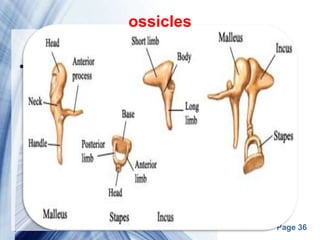
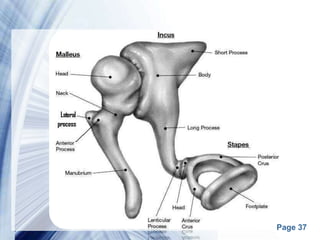
• 3 ossicles : malleus, incus and stapes
• 2 muscles : tensor tympani & stapedius
• 2 nerves : chorda tympani & tympanic
plexus
• Mucosal folds & ligaments
• Blood vessels
Page 36
•
ossicles
Page 37
Page 38
MUSCLE ORIGIN INSERTION NERVE
SUPPLY
ACTION
Tensor
typmani
Cartilaginous
part of ET, its
own bony
canal
Upper part of
handle of
malleus
Branch from
mandibular
nerve [V3]
tensing
tympanic
membrane to
reduce the
force of
vibrations in
response to
loud noises
Muscles of the middle ear
Page 39
Stapedius pyramidal
eminence
Neck of
stapes
Branch of
facial nerve
[VII]
pulls the
stapes
posteriorly
and prevents
excessive
oscillation in
loud noises
Page 40
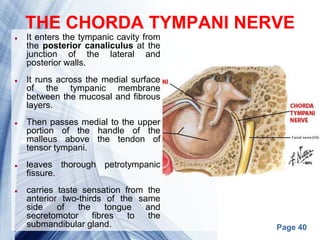
THE CHORDA TYMPANI NERVE
 It enters the tympanic cavity from
the posterior canaliculus at the
junction of the lateral and
posterior walls.
 It runs across the medial surface
of the tympanic membrane
between the mucosal and fibrous
layers.
 Then passes medial to the upper
portion of the handle of the
malleus above the tendon of
tensor tympani.
 leaves thorough petrotympanic
fissure.
 carries taste sensation from the
anterior two-thirds of the same
side of the tongue and
secretomotor fibres to the
submandibular gland.
Page 41
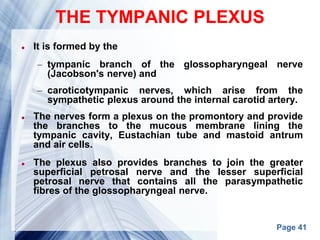
THE TYMPANIC PLEXUS
 It is formed by the
– tympanic branch of the glossopharyngeal nerve
(Jacobson's nerve) and
– caroticotympanic nerves, which arise from the
sympathetic plexus around the internal carotid artery.
 The nerves form a plexus on the promontory and provide
the branches to the mucous membrane lining the
tympanic cavity, Eustachian tube and mastoid antrum
and air cells.
 The plexus also provides branches to join the greater
superficial petrosal nerve and the lesser superficial
petrosal nerve that contains all the parasympathetic
fibres of the glossopharyngeal nerve.
Page 42
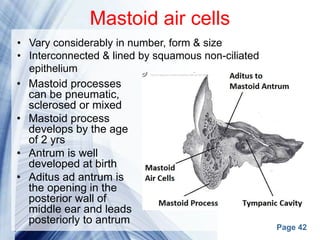
Mastoid air cells
• Mastoid processes
can be pneumatic,
sclerosed or mixed
• Mastoid process
develops by the age
of 2 yrs
• Antrum is well
developed at birth
• Aditus ad antrum is
the opening in the
posterior wall of
middle ear and leads
posteriorly to antrum
• Vary considerably in number, form & size
• Interconnected & lined by squamous non-ciliated
epithelium
Page 43
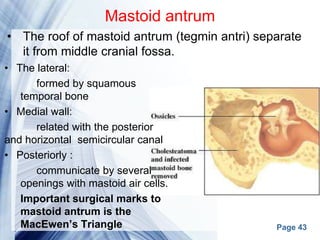
Mastoid antrum
• The lateral:
formed by squamous
temporal bone
• Medial wall:
related with the posterior
and horizontal semicircular canal
• Posteriorly :
communicate by several
openings with mastoid air cells.
Important surgical marks to
mastoid antrum is the
MacEwen’s Triangle
• The roof of mastoid antrum (tegmin antri) separate
it from middle cranial fossa.
Page 44
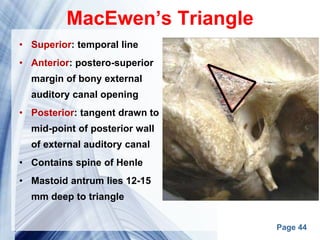
MacEwen’s Triangle
• Superior: temporal line
• Anterior: postero-superior
margin of bony external
auditory canal opening
• Posterior: tangent drawn to
mid-point of posterior wall
of external auditory canal
• Contains spine of Henle
• Mastoid antrum lies 12-15
mm deep to triangle
Page 45
Mucosa Of Middle Ear Cleft
• Mucus membrane of the nasopharynx is
continuous with that of middle ear ,aditus and
antrum.
• Mucus secreting
• Respiratory type
• Cilia bearing
• Lines the bony wall of the tympanic cavity
and wraps the middle ear structure_ossicles
,muscles ligaments and nerves like
peritoneum wraps viscera of the abdomen.
Page 46
Blood supply
• Arteries :
Middle ear is supplied by the following
1)Two main arteries
a)Anterior tympanic branch of maxillary artery
b)Stylomastoid branch of posterior auricular artery
2)Four minor arteries
a)Petrosal branch of middle meningeal artery
b)Superior tympanic branch of middle meningeal artery
c)Branch of artery of pterygoid canal
d)Tympanic branch of internal carotid
• Veins :
Pterygoid venous plexus
Superior petrosal sinus
Page 47
Lymphatic drainage
• Middle ear :
Retropharyngeal & parotid nodes
• ET :
Retropharyngeal group of nodes
Page 48
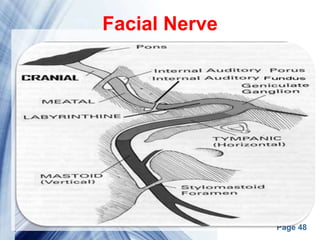
Facial Nerve
Page 49
• Meatal segment : 8-10 mm
• Labyrinthine segment : 4 mm
• Tympanic segment : 11 mm
• Mastoid segment : 13 mm
Page 50
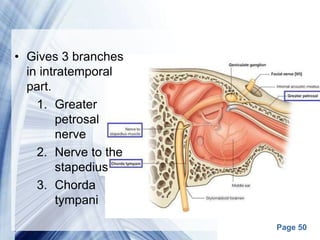
• Gives 3 branches
in intratemporal
part.
1. Greater
petrosal
nerve
2. Nerve to the
stapedius
3. Chorda
tympani
Page 51
Surgical landmarks of facial nerve
• Processus cochleariformis
• Oval window and horizontal canal
• Short process of the incus
• Pyramid
• Digastric ridge: just deep to or medial to
the mastoid tip anterior to that is the tip of
the facial nerve
Page 52
• Cartilaginous pointer: sharp traingular
piece of cartillage of pinna and points to
the nerve which lies 1 cm deep .
Page 53

Middle ear anatomy

  • 1.
  • 2.
    Page 2 • Auditorytube • Tympanic Cavity • Aditus • Mastoid Air Cells
  • 3.
  • 4.
    Page 4 The eustachiantube ,tympanic cavity ,attic,mastoid air cells develop from the endoderm of tubotympanic recess which arises from the first pharyngeal pouches.
  • 5.
    Page 5 Malleus andincus are derived from mesoderm of the first arch while the stapes develop from the second arch except its footplate and annular ligament which are derived from the ottic capsule.
  • 6.
    Page 6 • 36mm long in adults • Directed anteriorly, inferiorly & medially from anterior wall of M.E., forming angle of 450 with horizontal & sagittal planes • Enters naso-pharynx 1.25 cm behind posterior end of inferior turbinate
  • 7.
    Page 7 Lateral 1/3is bony Medial 2/3 is fibro- cartilaginous. Junction b/w 2 parts is isthmus, narrowest part of Eustachian Tube.
  • 8.
    Page 8 Anatomy of cartilaginouspart: Cartilage plate lies postero-medially & consists of medial + lateral laminae separated by elastin hinge. Fibrous tissue + Ostmann’s fat pad lie antero-laterally.
  • 9.
    Page 9 CHARACTERISTIC ADULTINFANT Length 36 mm 18mm Angle with horizontal 45° 10° Lumen Narrow Wide Angulation at Isthmus Present Absent Cartilage Rigid Flaccid Elastic recoil Effective Ineffective Ostmann’s fat More Less Difference in adult & infant<7years ET
  • 10.
    Page 10 Blood supplyof ET: • Ascending pharyngeal artery • Middle meningeal artery • Artery of pterygoid canal • Veins drain into pterygoid venous plexus
  • 11.
    Page 11 • Pearlywhite semi- translucent membrane • Obliquely placed faces laterally,inferiorly ,anteriorly • 2 parts : pars tensa & pars flaccida • 3 layers of pars tensa : outer epithelial, middle fibrous & inner mucosal
  • 12.
    Page 12 • Fibrouslayer is disorganized in pars flaccida (Sharpnell’s membrane) • Pars tensa thickened peripherally into fibrocartilagenous annulus called annulus tympanicus which fits into tympanic sulcus of temporal bone. • Annulus deficient superiorly in pars flaccida and is called notch of Rivinus
  • 13.
    Page 13 Nerve supplyof TM: • Anterior half of lateral surface : Auriculo temporal nerve • Posterior half of lateral surface : Auricular branch of vagus • Medial surface : Tympanic branch of glossopharyngeal nerve(jacobson nerve) V X
  • 14.
    Page 14 • Epitympanum •Mesotympanum • Hypotympanum Parts of tympanic cavity:
  • 15.
    Page 15 Walls ofthe tympanic cavity: Lateral Medial Posterior Anterior Roof Floor
  • 16.
    Page 16 ROOF • Thinplate of bone called TEGMEN TYMPANI . • It also extends posteriorly to form the roof of the aditus and antrum. • It seperates tympanic cavity from the middle cranial fossa.
  • 17.
    Page 17 The floor •Thin plate of bone which seperates tympanic cavity from the jugular bulb. • Near the medial border of the floor is a small aperture, through which the tympanic branch from the glossopharyngeal nerve [IX] enters the middle ear
  • 18.
    Page 18 The anteriorwall Lower part • Thin plate of bone which separates the cavity from the internal carotid artery.
  • 19.
    Page 19 The anteriorwall Upper part • Canal of tensor tympani muscle. • Eustachian tube opening
  • 20.
    Page 20 Lateral wall Bony: • Lateral attic wall above pars flaccida • lateral wall of hypotympanum Membranous : • Tympanic membrane
  • 21.
    Page 21 Medial wall •Promontory • Oval window • Round window • Tympanic part of bony facial nerve canal • Lateral semicircular canal • Processus cochlearformis
  • 22.
    Page 22  Thepromontory is a rounded elevation occupying much of the central portion of the medial wall.  formed by basal turn of cochlea  usually has small grooves on its surface containing the nerves which form the tympanic plexus
  • 23.
    Page 23 Oval window lies Behind and above the promontory  A kidney-shaped opening that connects the tympanic cavity with the vestibule.  Close by a footplate of the stapes.  Its size average 3.25 mm long and 1.75 mm wide.
  • 24.
  • 25.
    Page 25 Round window •Lies below and behind the oval window • Separated by subiculum(post extension of promontory) • Ponticulus.another ridge above subiculum and runs to pyramid on the posterior wall • Sinus tympani is where ponticulus and subiculum meet • RWM is 2.3×1.9. • It is placed at right angles to plane of stapes foot plate
  • 26.
    Page 26 Facial nervecanal • The facial nerve canal (or Fallopian canal) runs above the promontory and oval window in an anteroposterior direction. • The facial nerve canal is marked anteriorly by the processus cochleariformis, a curved projection of bone, concave anteriorly, which houses the tendon of the tensor tympani muscle as it turns laterally to the handle of the malleus. • The region above the level of the facial nerve canal forms the medial wall of the epitympanum. • Behind the oval window, the facial canal starts to turn inferiorly as it begins its descent in the posterior wall of the tympanic cavity.
  • 27.
  • 28.
    Page 28 • Thedome of the lateral semicircular canal is the major feature of the posterior portion of the epitympanum, lying posterior and extending a little lateral to the facial canal
  • 29.
    Page 29 Posterior wall •Aditus ad antrum • Fossa incudis for short process of incus • Bulge produced by lateral semicircular canal • Pyramidal eminence for stapedius tendon • Buldge produced by vertical part of facial nerve • Sinus tympani • Facial recess
  • 30.
  • 31.
    Page 31  Theposterior wall is wider above than below.  Upper part a large irregular opening - the aditus ad antrum, that leads back from the posterior epitympanum into the mastoid antrum.  Below the aditus is a small depression, the fossa incudis, which houses the short process of the incus and its suspensory ligament.  Below the fossa incudis and medial to the opening of the chorda tympani nerve is the pyramid, a small hollow conical projection with its apex pointing anteriorly.  This houses the stapedius muscle and tendon, which inserts into the posterior aspect of the head of stapes.  The canal within the pyramid curves downwards and backwards to join the descending portion of the facial nerve canal.
  • 32.
    Page 32 Facial Recess The facial recess is bounded: – Medially by the facial nerve and – Laterally by the tympanic annulus, – with the chorda tympani nerve running obliquely through the wall between the two.  The chorda always runs medial to the tympanic membrane. The facial recess is a groove which lies between the pyramid with facial nerve, and the annulus of the tympanic membrane .
  • 33.
    Page 33 Facial Recess Theangle between the facial nerve and the chorda allows a posterior tympanotomy, allowing access to the middle ear from the mastoid without disruption the tympanic membrane.
  • 34.
    Page 34 Sinus tympani Boundaries: –Superior: Ponticulus – Inferior: Subiculum – Lateral: Mastoid Segment of Facial Nerve – Medial: Posterior semicircular canal It evades direct surgical visualization during surgery. Site for cholesteatoma recurrence
  • 35.
    Page 35 Contents ofmiddle ear cavity • Air • 3 ossicles : malleus, incus and stapes • 2 muscles : tensor tympani & stapedius • 2 nerves : chorda tympani & tympanic plexus • Mucosal folds & ligaments • Blood vessels
  • 36.
  • 37.
  • 38.
    Page 38 MUSCLE ORIGININSERTION NERVE SUPPLY ACTION Tensor typmani Cartilaginous part of ET, its own bony canal Upper part of handle of malleus Branch from mandibular nerve [V3] tensing tympanic membrane to reduce the force of vibrations in response to loud noises Muscles of the middle ear
  • 39.
    Page 39 Stapedius pyramidal eminence Neckof stapes Branch of facial nerve [VII] pulls the stapes posteriorly and prevents excessive oscillation in loud noises
  • 40.
    Page 40 THE CHORDATYMPANI NERVE  It enters the tympanic cavity from the posterior canaliculus at the junction of the lateral and posterior walls.  It runs across the medial surface of the tympanic membrane between the mucosal and fibrous layers.  Then passes medial to the upper portion of the handle of the malleus above the tendon of tensor tympani.  leaves thorough petrotympanic fissure.  carries taste sensation from the anterior two-thirds of the same side of the tongue and secretomotor fibres to the submandibular gland.
  • 41.
    Page 41 THE TYMPANICPLEXUS  It is formed by the – tympanic branch of the glossopharyngeal nerve (Jacobson's nerve) and – caroticotympanic nerves, which arise from the sympathetic plexus around the internal carotid artery.  The nerves form a plexus on the promontory and provide the branches to the mucous membrane lining the tympanic cavity, Eustachian tube and mastoid antrum and air cells.  The plexus also provides branches to join the greater superficial petrosal nerve and the lesser superficial petrosal nerve that contains all the parasympathetic fibres of the glossopharyngeal nerve.
  • 42.
    Page 42 Mastoid aircells • Mastoid processes can be pneumatic, sclerosed or mixed • Mastoid process develops by the age of 2 yrs • Antrum is well developed at birth • Aditus ad antrum is the opening in the posterior wall of middle ear and leads posteriorly to antrum • Vary considerably in number, form & size • Interconnected & lined by squamous non-ciliated epithelium
  • 43.
    Page 43 Mastoid antrum •The lateral: formed by squamous temporal bone • Medial wall: related with the posterior and horizontal semicircular canal • Posteriorly : communicate by several openings with mastoid air cells. Important surgical marks to mastoid antrum is the MacEwen’s Triangle • The roof of mastoid antrum (tegmin antri) separate it from middle cranial fossa.
  • 44.
    Page 44 MacEwen’s Triangle •Superior: temporal line • Anterior: postero-superior margin of bony external auditory canal opening • Posterior: tangent drawn to mid-point of posterior wall of external auditory canal • Contains spine of Henle • Mastoid antrum lies 12-15 mm deep to triangle
  • 45.
    Page 45 Mucosa OfMiddle Ear Cleft • Mucus membrane of the nasopharynx is continuous with that of middle ear ,aditus and antrum. • Mucus secreting • Respiratory type • Cilia bearing • Lines the bony wall of the tympanic cavity and wraps the middle ear structure_ossicles ,muscles ligaments and nerves like peritoneum wraps viscera of the abdomen.
  • 46.
    Page 46 Blood supply •Arteries : Middle ear is supplied by the following 1)Two main arteries a)Anterior tympanic branch of maxillary artery b)Stylomastoid branch of posterior auricular artery 2)Four minor arteries a)Petrosal branch of middle meningeal artery b)Superior tympanic branch of middle meningeal artery c)Branch of artery of pterygoid canal d)Tympanic branch of internal carotid • Veins : Pterygoid venous plexus Superior petrosal sinus
  • 47.
    Page 47 Lymphatic drainage •Middle ear : Retropharyngeal & parotid nodes • ET : Retropharyngeal group of nodes
  • 48.
  • 49.
    Page 49 • Meatalsegment : 8-10 mm • Labyrinthine segment : 4 mm • Tympanic segment : 11 mm • Mastoid segment : 13 mm
  • 50.
    Page 50 • Gives3 branches in intratemporal part. 1. Greater petrosal nerve 2. Nerve to the stapedius 3. Chorda tympani
  • 51.
    Page 51 Surgical landmarksof facial nerve • Processus cochleariformis • Oval window and horizontal canal • Short process of the incus • Pyramid • Digastric ridge: just deep to or medial to the mastoid tip anterior to that is the tip of the facial nerve
  • 52.
    Page 52 • Cartilaginouspointer: sharp traingular piece of cartillage of pinna and points to the nerve which lies 1 cm deep .
  • 53.