-Maheshwari
Das
Meghana BS
Wave propagation is any of the ways in
which waves travel. With respect to the
direction of the oscillation relative to
the propagation direction, we can
distinguish between
longitudinal wave and transverse waves.
For
electromagnetic waves, propagation may
occur in a vacuum as well as in a material
medium.
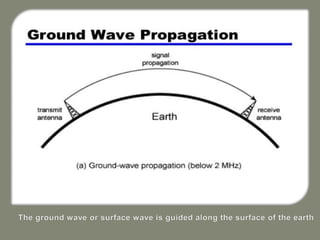
Propagation of radio waves from
a radiating transmitting antenna
to the receiving antenna may
take place in one of the
following routes:
1. Ground wave propagation
2. Sky wave propagation
3. Space wave propagation
Sky-wave propagation
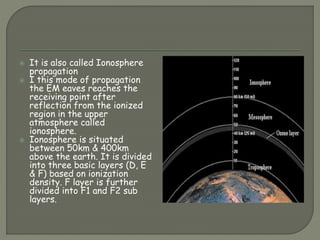
 It is also called Ionosphere
propagation
 I this mode of propagation
the EM eaves reaches the
receiving point after
reflection from the ionized
region in the upper
atmosphere called
ionosphere.
 Ionosphere is situated
between 50km & 400km
above the earth. It is divided
into three basic layers (D, E
& F) based on ionization
density. F layer is further
divided into F1 and F2 sub
layers.
 D & E layers are
weekly ionized &
exist only during day
light hours. They
tend to observe
medium waves .
 The primary effect
of F layers is to
cause refraction of
Radio waves.
Ionosphere
propagation
permits extremely
long distance
communication
3MHz-30MHz
range
Above 30MHz
frequency signals
are not reflected.
 Most long-distance
shortwave radio
communication—between
3 and 30 MHz—is a
result of sky
wave propagation.
 Since the early 1920s
amateur radio operators
, limited to lower
transmitter power than
broadcast stations, have
taken advantage of sky
wave for long distance
communication.
 The signal received are
subjected to fading, in
which signal strength
varies with time.
 The receiving point, a
large number of waves
follow a different
number of paths
Short wave, AM radio
broadcast.
Long distance, point to point
communication.
Extremely long distance
communication using multi-hope
propagation.
Sky wave propogation

Sky wave propogation

  • 1.
  • 2.
    Wave propagation isany of the ways in which waves travel. With respect to the direction of the oscillation relative to the propagation direction, we can distinguish between longitudinal wave and transverse waves. For electromagnetic waves, propagation may occur in a vacuum as well as in a material medium.
  • 5.
    Propagation of radiowaves from a radiating transmitting antenna to the receiving antenna may take place in one of the following routes: 1. Ground wave propagation 2. Sky wave propagation 3. Space wave propagation
  • 10.
  • 11.
     It isalso called Ionosphere propagation  I this mode of propagation the EM eaves reaches the receiving point after reflection from the ionized region in the upper atmosphere called ionosphere.  Ionosphere is situated between 50km & 400km above the earth. It is divided into three basic layers (D, E & F) based on ionization density. F layer is further divided into F1 and F2 sub layers.
  • 13.
     D &E layers are weekly ionized & exist only during day light hours. They tend to observe medium waves .  The primary effect of F layers is to cause refraction of Radio waves.
  • 15.
  • 16.
     Most long-distance shortwaveradio communication—between 3 and 30 MHz—is a result of sky wave propagation.  Since the early 1920s amateur radio operators , limited to lower transmitter power than broadcast stations, have taken advantage of sky wave for long distance communication.  The signal received are subjected to fading, in which signal strength varies with time.  The receiving point, a large number of waves follow a different number of paths
  • 17.
    Short wave, AMradio broadcast. Long distance, point to point communication. Extremely long distance communication using multi-hope propagation.