Radio propagation model
• The mode of propagation of electromagnetic
waves in the atmosphere and in free space
may be divided in to the following three
categories −
• Line of sight (LOS) propagation
• Ground wave propagation
• Sky wave propagation
Line of Sight (LOS) Propagation
• Among the modes of propagation, this line-of-
sight propagation is the one, which we
commonly notice. In the line-of-sight
communication, as the name implies, the
wave travels a minimum distance of sight.
Which means it travels to the distance up to
which a naked eye can see. Now what
happens after that? We need to employ an
amplifier cum transmitter here to amplify the
signal and transmit again.
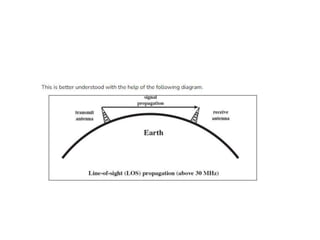
• The figure depicts this mode of propagation
very clearly. The line-of-sight propagation will
not be smooth if there occurs any obstacle in
its transmission path. As the signal can travel
only to lesser distances in this mode, this
transmission is used
for infrared or microwave transmissions
Ground Wave Propagation
• Ground wave propagation of the wave follows
the contour of earth. Such a wave is called
as direct wave. The wave sometimes bends
due to the Earth’s magnetic field and gets
reflected to the receiver. Such a wave can be
termed as reflected wave.
• The above figure depicts ground wave
propagation. The wave when propagates
through the Earth’s atmosphere is known
as ground wave. The direct wave and
reflected wave together contribute the signal
at the receiver station. When the wave finally
reaches the receiver, the lags are cancelled
out. In addition, the signal is filtered to avoid
distortion and amplified for clear output.
Sky Wave Propagation
• Sky wave propagation is preferred when the
wave has to travel a longer distance. Here the
wave is projected onto the sky and it is again
reflected back onto the earth.
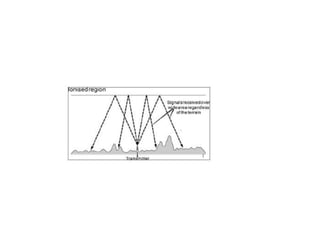
• The sky wave propagation is well depicted in the above
picture. Here the waves are shown to be transmitted from
one place and where it is received by many receivers.
Hence, it is an example of broadcasting.
• The waves, which are transmitted from the transmitter
antenna, are reflected from the ionosphere. It consists of
several layers of charged particles ranging in altitude from
30- 250 miles above the surface of the earth. Such a travel
of the wave from transmitter to the ionosphere and from
there to the receiver on Earth is known as Sky Wave
Propagation. Ionosphere is the ionized layer around the
Earth’s atmosphere, which is suitable for sky wave
propagation.

Radio propagation model...pptx

  • 1.
  • 2.
    • The modeof propagation of electromagnetic waves in the atmosphere and in free space may be divided in to the following three categories − • Line of sight (LOS) propagation • Ground wave propagation • Sky wave propagation
  • 3.
    Line of Sight(LOS) Propagation • Among the modes of propagation, this line-of- sight propagation is the one, which we commonly notice. In the line-of-sight communication, as the name implies, the wave travels a minimum distance of sight. Which means it travels to the distance up to which a naked eye can see. Now what happens after that? We need to employ an amplifier cum transmitter here to amplify the signal and transmit again.
  • 5.
    • The figuredepicts this mode of propagation very clearly. The line-of-sight propagation will not be smooth if there occurs any obstacle in its transmission path. As the signal can travel only to lesser distances in this mode, this transmission is used for infrared or microwave transmissions
  • 6.
    Ground Wave Propagation •Ground wave propagation of the wave follows the contour of earth. Such a wave is called as direct wave. The wave sometimes bends due to the Earth’s magnetic field and gets reflected to the receiver. Such a wave can be termed as reflected wave.
  • 8.
    • The abovefigure depicts ground wave propagation. The wave when propagates through the Earth’s atmosphere is known as ground wave. The direct wave and reflected wave together contribute the signal at the receiver station. When the wave finally reaches the receiver, the lags are cancelled out. In addition, the signal is filtered to avoid distortion and amplified for clear output.
  • 9.
    Sky Wave Propagation •Sky wave propagation is preferred when the wave has to travel a longer distance. Here the wave is projected onto the sky and it is again reflected back onto the earth.
  • 11.
    • The skywave propagation is well depicted in the above picture. Here the waves are shown to be transmitted from one place and where it is received by many receivers. Hence, it is an example of broadcasting. • The waves, which are transmitted from the transmitter antenna, are reflected from the ionosphere. It consists of several layers of charged particles ranging in altitude from 30- 250 miles above the surface of the earth. Such a travel of the wave from transmitter to the ionosphere and from there to the receiver on Earth is known as Sky Wave Propagation. Ionosphere is the ionized layer around the Earth’s atmosphere, which is suitable for sky wave propagation.