ILP32 Performance
on AArch64
Chris Tyler
Hong (Michael) Huang
Glaser Lo
Seneca College
Centre for Development of Open Technology
Who
What
Where
Why
Results
Who
Chris Tyler
Industrial Research Chair
Open Source Technology for Emerging Platforms
(OSTEP)
Seneca College
Centre for Development of Open Technology
(CDOT)
Who
We do applied research into the potential
of energy-efficient datacentres based on
ARM hardware and open source software.
What
LP64 ILP32
Integer 32 bits 32 bits
Long Integer 64 bits 32 bits
Pointer 64 bits 32 bits
What
ILP32 affects the syscall and procedure interfaces,
and therefore touches:
kernel
gcc
binutils
libraries
Where
LEAP Project
leapproject.ca
A distribution we built for ARM64 testing; based
on CentOS7 with local changes. Both the distro
and access to the buildsystem are publicly
available.
Where
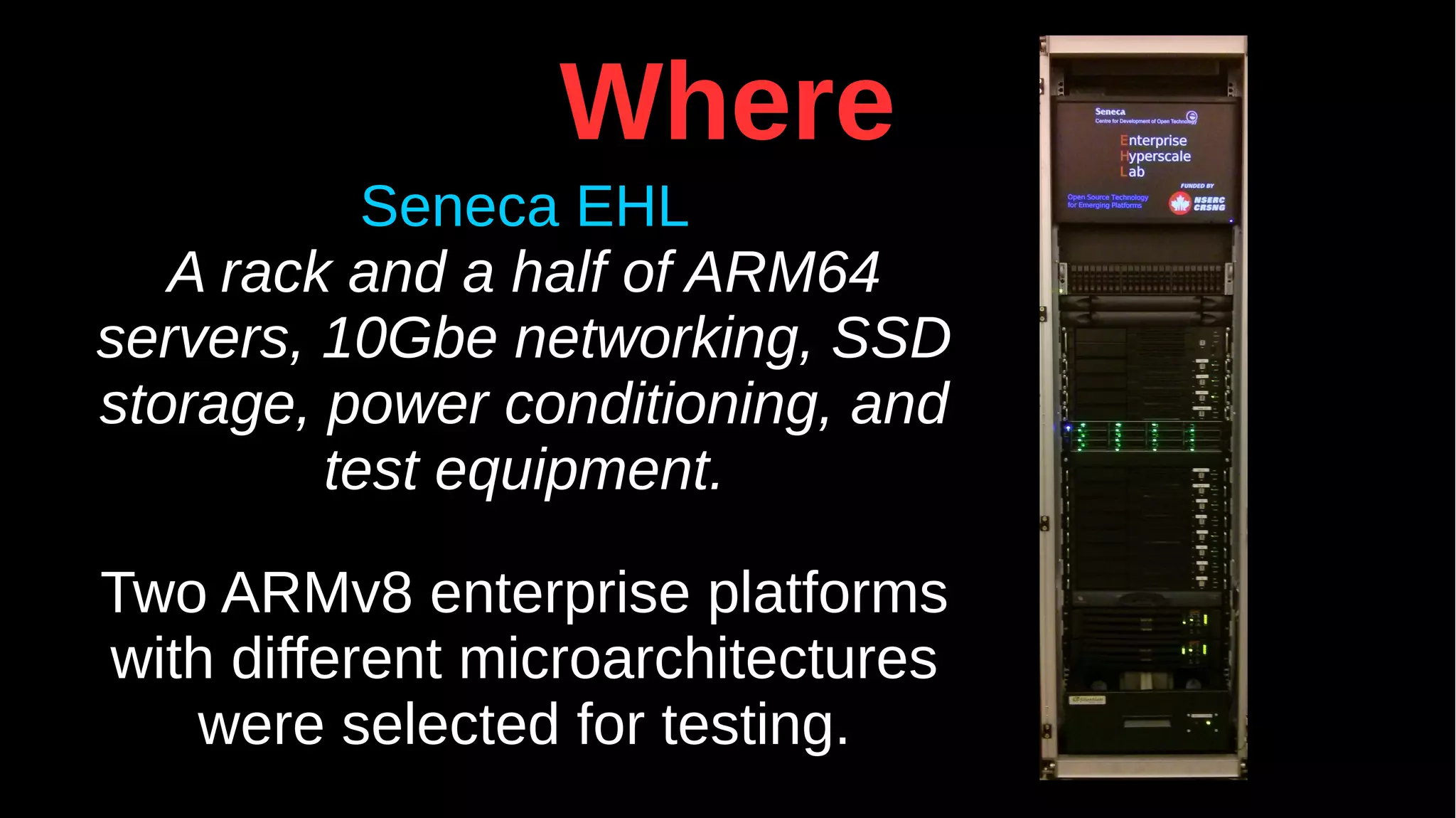
Seneca EHL
A rack and a half of ARM64
servers, 10Gbe networking, SSD
storage, power conditioning, and
test equipment.
Two ARMv8 enterprise platforms
with different microarchitectures
were selected for testing.
Why?!
“They” Want ILP32
Who are they, and
why do they want ILP32?
Why?!
1. To look good on benchmarks.
Want improved performance.
2. To run old code unmodified.
Want minimal performance loss.
The Pieces
Linaro gcc 4.9.4 (+2 patches)
Kernel 4.3 (+2015.11 ILP32
LKML patches – Cavium via
LKML)
The Pieces
Docker Container
The Pieces
SPECint 2006
The Results
Every enterprise system we have was
received under a benchmark embargo.
Even the “Commercially Available” ones.
What I'm going to share is therefore the relative
performance of ILP32 compared to an LP64
baseline, on each of the two selected platforms.
The Results
-20.000
-10.000
0.000
10.000
20.000
30.000
40.000
50.000
60.000
70.000
ILP32 Performance Impact
Platform A
Platform B
Benchmark
ImprovementofILP32overLP64(%)
The Results
ILP32 wins on memory utilization and cache
packing when there are a lot of pointers.
ILP32 loses when these advantages are
overwhelmed by munging overhead.
Why?!
1. To look good on benchmarks.
Want improved performance.
2. To run old code unmodified.
Want minimal performance loss.
The Results
1. To look good on benchmarks.
ILP32 looks slightly better than LP64
on benchmarks.
2. To run old code unmodified.
ILP32 will allow you to use most of the
performance of AArch64 without changes.
Do We Care? Enough?
A lot of code to maintain for little gain.
(OTOH: The pieces have all been written)
Chris Tyler
chris.tyler@senecacollege.ca
http://leapproject.ca

BKK16-305B ILP32 Performance on AArch64