Copyright © 2018 Arm Limited
Dong Wei
Linaro Connect HKG
March 2018
Arm ServerReady
Update
Confidential © Arm 2017
Server Architecture
3
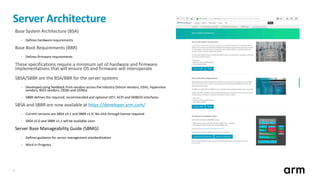
Base System Architecture (BSA)
• Defines hardware requirements
Base Boot Requirements (BBR)
• Defines firmware requirements
These specifications require a minimum set of hardware and firmware
implementations that will ensure OS and firmware will interoperate
SBSA/SBBR are the BSA/BBR for the server systems
• Developed using feedback from vendors across the industry (Silicon vendors, OSVs, Hypervisor
vendors, BIOS vendors, OEMs and ODMs)
• SBBR defines the required, recommended and optional UEFI, ACPI and SMBIOS interfaces
SBSA and SBBR are now available at https://developer.arm.com/
• Current versions are SBSA v3.1 and SBBR v1.0. No click through license required.
• SBSA v5.0 and SBBR v1.1 will be available soon
Server Base Manageability Guide (SBMG)
• Defines guidance for server management standardization
• Work In Progress
Server Architecture
4
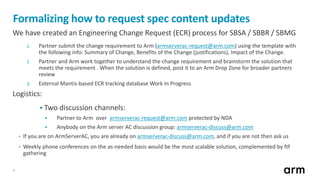
We have created an Engineering Change Request (ECR) process for SBSA / SBBR / SBMG
1. Partner submit the change requirement to Arm (armserverac-request@arm.com) using the template with
the following info: Summary of Change, Benefits of the Change (justifications), Impact of the Change.
2. Partner and Arm work together to understand the change requirement and brainstorm the solution that
meets the requirement . When the solution is defined, post it to an Arm Drop Zone for broader partners
review
3. External Mantis-based ECR tracking database Work In Progress
Logistics:
 Two discussion channels:
 Partner to Arm over armserverac-request@arm.com protected by NDA
 Anybody on the Arm server AC discussion group: armserverac-discuss@arm.com
• If you are on ArmServerAC, you are already on armserverac-discuss@arm.com, and if you are not then ask us
• Weekly phone conferences on the as-needed basis would be the most scalable solution, complemented by ftf
gathering
Formalizing how to request spec content updates
5
SBSA Status
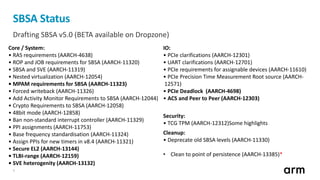
Drafting SBSA v5.0 (BETA available on Dropzone)
Core / System:
• RAS requirements (AARCH-4638)
• ROP and JOB requirements for SBSA (AARCH-11320)
• SBSA and SVE (AARCH-11319)
• Nested virtualization (AARCH-12054)
• MPAM requirements for SBSA (AARCH-11323)
• Forced writeback (AARCH-11326)
• Add Activity Monitor Requirements to SBSA (AARCH-12044)
• Crypto Requirements to SBSA (AARCH-12058)
• 48bit mode (AARCH-12858)
• Ban non-standard interrupt controller (AARCH-11329)
• PPI assignments (AARCH-11753)
• Base frequency standardisation (AARCH-11324)
• Assign PPIs for new timers in v8.4 (AARCH-11321)
• Secure EL2 (AARCH-13144)
• TLBI-range (AARCH-12159)
• SVE heterogenity (AARCH-13132)
IO:
• PCIe clarifications (AARCH-12301)
• UART clarifications (AARCH-12701)
• PCIe requirements for assignable devices (AARCH-11610)
• PCIe Precision Time Measurement Root source (AARCH-
12571)
• PCIe Deadlock (AARCH-4698)
• ACS and Peer to Peer (AARCH-12303)
Security:
• TCG TPM (AARCH-12312)Some highlights
Cleanup:
• Deprecate old SBSA levels (AARCH-11330)
• Clean to point of persistence (AARCH-13385)*
6
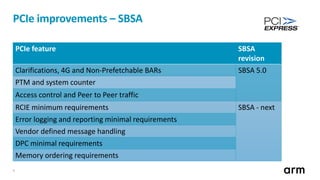
PCIe improvements – SBSA
PCIe feature SBSA
revision
Clarifications, 4G and Non-Prefetchable BARs SBSA 5.0
PTM and system counter
Access control and Peer to Peer traffic
RCIE minimum requirements SBSA - next
Error logging and reporting minimal requirements
Vendor defined message handling
DPC minimal requirements
Memory ordering requirements
7
Additional work on PCIe
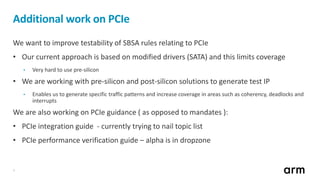
We want to improve testability of SBSA rules relating to PCIe
• Our current approach is based on modified drivers (SATA) and this limits coverage
• Very hard to use pre-silicon
• We are working with pre-silicon and post-silicon solutions to generate test IP
• Enables us to generate specific traffic patterns and increase coverage in areas such as coherency, deadlocks and
interrupts
We are also working on PCIe guidance ( as opposed to mandates ):
• PCIe integration guide - currently trying to nail topic list
• PCIe performance verification guide – alpha is in dropzone
8
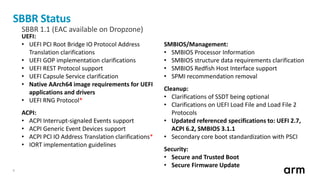
SBBR Status
SBBR 1.1 (EAC available on Dropzone)
UEFI:
• UEFI PCI Root Bridge IO Protocol Address
Translation clarifications
• UEFI GOP implementation clarifications
• UEFI REST Protocol support
• UEFI Capsule Service clarification
• Native AArch64 image requirements for UEFI
applications and drivers
• UEFI RNG Protocol*
ACPI:
• ACPI Interrupt-signaled Events support
• ACPI Generic Event Devices support
• ACPI PCI IO Address Translation clarifications*
• IORT implementation guidelines
SMBIOS/Management:
• SMBIOS Processor Information
• SMBIOS structure data requirements clarification
• SMBIOS Redfish Host Interface support
• SPMI recommendation removal
Cleanup:
• Clarifications of SSDT being optional
• Clarifications on UEFI Load File and Load File 2
Protocols
• Updated referenced specifications to: UEFI 2.7,
ACPI 6.2, SMBIOS 3.1.1
• Secondary core boot standardization with PSCI
Security:
• Secure and Trusted Boot
• Secure Firmware Update
9
UEFI Option ROM Availability
Architecturally Arm requires the support of AArch64 native binary UEFI drivers
Arm testing room will be open at UEFI Plugfest next week to provide:
• Real HW Setup in which to test native AArch64 drivers
• Help and suggestions on how to get your driver recompiled for AArch64
Arm is creating a “getting started guide” and a list of off-the-shelf systems that can be
used for continuous testing
Arm is collecting a list of vendors/cards with AArch64 drivers:
• Contact us (uefi@arm.com) if you would like to be on it or if you’d like more
information
10
Secure Server Profile
What are included:
• Verified Boot (Reset - Arm TF - UEFI Secure Boot -OS)
• Measured Boot (TPM, TCG Trusted Boot)
• Secure Firmware Update
What else?
11
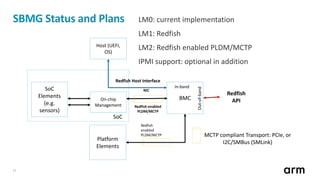
SBMG Status and Plans
Host (UEFI,
OS)
SoC
Elements
(e.g.
sensors)
On-chip
Management
BMC
Redfish
API
Redfish Host Interface
Redfish enabled
PLDM/MCTP
Redfish
enabled
PLDM/MCTP
Platform
Elements
MCTP compliant Transport: PCIe, or
I2C/SMBus (SMLink)
In-band
Out-of-band
SoC
NIC
LM0: current implementation
LM1: Redfish
LM2: Redfish enabled PLDM/MCTP
IPMI support: optional in addition
12
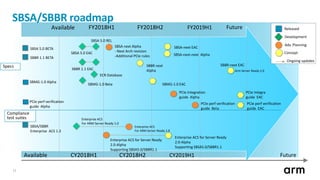
SBSA/SBBR roadmap
CY2018H1 CY2018H2 CY2019H1Available Future
SBSA 5.0 BETA
SBBR 1.1 BETA
SBSA 5.0 EAC
SBSA-next EAC
SBBR-next EACSpecs
Enterprise ACS
For ARM Server Ready 1.0
Arm Server Ready 2.0
FY2018H1 FY2018H2 FY2019H1Available Future Released
Development
Adv. Planning
Concept
Ongoing updates
SBSA/SBBR
Enterprise ACS 1.3
Compliance
test suites
SBBR 1.1 EAC
SBSA 5.0 REL
ECR Database
SBBR next
Alpha
SBSA next Alpha
- Next Arch revision
-Additional PCIe rules
Enterprise ACS
For ARM Server Ready 1.0
Enterprise ACS for Server Ready
2.0-Alpha
Supporting SBSA5.0/SBBR1.1
Enterprise ACS for Server Ready
2.0-Alpha
Supporting SBSA5.0/SBBR1.1
SBMG-1.0 Alpha
SBMG-1.0 Beta SBMG-1.0 EAC
PCIe perf verification
guide Alpha
PCIe perf verification
guide Beta
PCIe Integration
guide Alpha
PCIe perf verification
guide EAC
PCIe Integra
guide EAC
SBSA-next-next Alpha
Confidential © Arm 2018
14
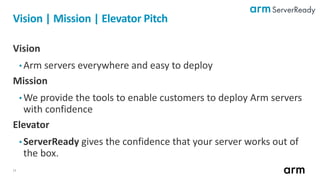
Vision | Mission | Elevator Pitch
Vision
• Arm servers everywhere and easy to deploy
Mission
• We provide the tools to enable customers to deploy Arm servers
with confidence
Elevator
• ServerReady gives the confidence that your server works out of
the box.
15
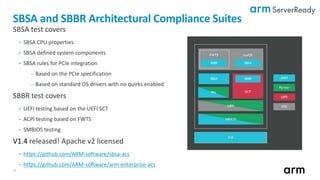
SBSA test covers
• SBSA CPU properties
• SBSA defined system components
• SBSA rules for PCIe integration
– Based on the PCIe specification
– Based on standard OS drivers with no quirks enabled
SBBR test covers
• UEFI testing based on the UEFI SCT
• ACPI testing based on FWTS
• SMBIOS testing
V1.4 released! Apache v2 licensed
• https://github.com/ARM-software/sbsa-acs
• https://github.com/ARM-software/arm-enterprise-acs
SBSA and SBBR Architectural Compliance Suites
16
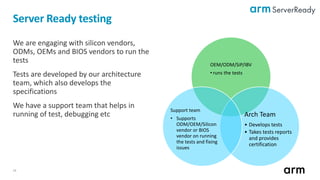
Server Ready testing
OEM/ODM/SiP/IBV
• runs the tests
Arch Team
• Develops tests
• Takes tests reports
and provides
certification
Support team
• Supports
ODM/OEM/Silicon
vendor or BIOS
vendor on running
the tests and fixing
issues
We are engaging with silicon vendors,
ODMs, OEMs and BIOS vendors to run the
tests
Tests are developed by our architecture
team, which also develops the
specifications
We have a support team that helps in
running of test, debugging etc
17
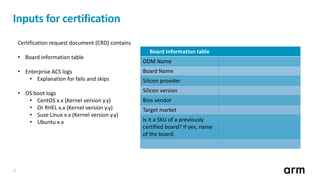
Inputs for certification
Certification request document (CRD) contains
• Board information table
• Enterprise ACS logs
• Explanation for fails and skips
• OS boot logs
• CentOS x.x (Kernel version y.y)
• Or RHEL x.x (Kernel version y.y)
• Suse Linux x.x (Kernel version y.y)
• Ubuntu x.x
Board Information table
ODM Name
Board Name
Silicon provider
Silicon version
Bios vendor
Target market
Is it a SKU of a previously
certified board? If yes, name
of the board.
18
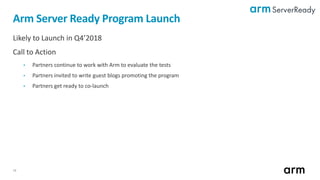
Likely to Launch in Q4’2018
Call to Action
• Partners continue to work with Arm to evaluate the tests
• Partners invited to write guest blogs promoting the program
• Partners get ready to co-launch
Arm Server Ready Program Launch
1919
The trademarks featured in this
presentation are registered and/or
unregistered trademarks of Arm
Limited (or its subsidiaries) in the EU
and/or elsewhere. All rights
reserved. All other marks featured
may be trademarks of their
respective owners.
202020
Thank You!
Danke!
Merci!
谢谢!
ありがとう!
Gracias!
Kiitos!

HKG18-317 - Arm Server Ready Program

  • 1.
    Copyright © 2018Arm Limited Dong Wei Linaro Connect HKG March 2018 Arm ServerReady Update
  • 2.
    Confidential © Arm2017 Server Architecture
  • 3.
    3 Base System Architecture(BSA) • Defines hardware requirements Base Boot Requirements (BBR) • Defines firmware requirements These specifications require a minimum set of hardware and firmware implementations that will ensure OS and firmware will interoperate SBSA/SBBR are the BSA/BBR for the server systems • Developed using feedback from vendors across the industry (Silicon vendors, OSVs, Hypervisor vendors, BIOS vendors, OEMs and ODMs) • SBBR defines the required, recommended and optional UEFI, ACPI and SMBIOS interfaces SBSA and SBBR are now available at https://developer.arm.com/ • Current versions are SBSA v3.1 and SBBR v1.0. No click through license required. • SBSA v5.0 and SBBR v1.1 will be available soon Server Base Manageability Guide (SBMG) • Defines guidance for server management standardization • Work In Progress Server Architecture
  • 4.
    4 We have createdan Engineering Change Request (ECR) process for SBSA / SBBR / SBMG 1. Partner submit the change requirement to Arm (armserverac-request@arm.com) using the template with the following info: Summary of Change, Benefits of the Change (justifications), Impact of the Change. 2. Partner and Arm work together to understand the change requirement and brainstorm the solution that meets the requirement . When the solution is defined, post it to an Arm Drop Zone for broader partners review 3. External Mantis-based ECR tracking database Work In Progress Logistics:  Two discussion channels:  Partner to Arm over armserverac-request@arm.com protected by NDA  Anybody on the Arm server AC discussion group: armserverac-discuss@arm.com • If you are on ArmServerAC, you are already on armserverac-discuss@arm.com, and if you are not then ask us • Weekly phone conferences on the as-needed basis would be the most scalable solution, complemented by ftf gathering Formalizing how to request spec content updates
  • 5.
    5 SBSA Status Drafting SBSAv5.0 (BETA available on Dropzone) Core / System: • RAS requirements (AARCH-4638) • ROP and JOB requirements for SBSA (AARCH-11320) • SBSA and SVE (AARCH-11319) • Nested virtualization (AARCH-12054) • MPAM requirements for SBSA (AARCH-11323) • Forced writeback (AARCH-11326) • Add Activity Monitor Requirements to SBSA (AARCH-12044) • Crypto Requirements to SBSA (AARCH-12058) • 48bit mode (AARCH-12858) • Ban non-standard interrupt controller (AARCH-11329) • PPI assignments (AARCH-11753) • Base frequency standardisation (AARCH-11324) • Assign PPIs for new timers in v8.4 (AARCH-11321) • Secure EL2 (AARCH-13144) • TLBI-range (AARCH-12159) • SVE heterogenity (AARCH-13132) IO: • PCIe clarifications (AARCH-12301) • UART clarifications (AARCH-12701) • PCIe requirements for assignable devices (AARCH-11610) • PCIe Precision Time Measurement Root source (AARCH- 12571) • PCIe Deadlock (AARCH-4698) • ACS and Peer to Peer (AARCH-12303) Security: • TCG TPM (AARCH-12312)Some highlights Cleanup: • Deprecate old SBSA levels (AARCH-11330) • Clean to point of persistence (AARCH-13385)*
  • 6.
    6 PCIe improvements –SBSA PCIe feature SBSA revision Clarifications, 4G and Non-Prefetchable BARs SBSA 5.0 PTM and system counter Access control and Peer to Peer traffic RCIE minimum requirements SBSA - next Error logging and reporting minimal requirements Vendor defined message handling DPC minimal requirements Memory ordering requirements
  • 7.
    7 Additional work onPCIe We want to improve testability of SBSA rules relating to PCIe • Our current approach is based on modified drivers (SATA) and this limits coverage • Very hard to use pre-silicon • We are working with pre-silicon and post-silicon solutions to generate test IP • Enables us to generate specific traffic patterns and increase coverage in areas such as coherency, deadlocks and interrupts We are also working on PCIe guidance ( as opposed to mandates ): • PCIe integration guide - currently trying to nail topic list • PCIe performance verification guide – alpha is in dropzone
  • 8.
    8 SBBR Status SBBR 1.1(EAC available on Dropzone) UEFI: • UEFI PCI Root Bridge IO Protocol Address Translation clarifications • UEFI GOP implementation clarifications • UEFI REST Protocol support • UEFI Capsule Service clarification • Native AArch64 image requirements for UEFI applications and drivers • UEFI RNG Protocol* ACPI: • ACPI Interrupt-signaled Events support • ACPI Generic Event Devices support • ACPI PCI IO Address Translation clarifications* • IORT implementation guidelines SMBIOS/Management: • SMBIOS Processor Information • SMBIOS structure data requirements clarification • SMBIOS Redfish Host Interface support • SPMI recommendation removal Cleanup: • Clarifications of SSDT being optional • Clarifications on UEFI Load File and Load File 2 Protocols • Updated referenced specifications to: UEFI 2.7, ACPI 6.2, SMBIOS 3.1.1 • Secondary core boot standardization with PSCI Security: • Secure and Trusted Boot • Secure Firmware Update
  • 9.
    9 UEFI Option ROMAvailability Architecturally Arm requires the support of AArch64 native binary UEFI drivers Arm testing room will be open at UEFI Plugfest next week to provide: • Real HW Setup in which to test native AArch64 drivers • Help and suggestions on how to get your driver recompiled for AArch64 Arm is creating a “getting started guide” and a list of off-the-shelf systems that can be used for continuous testing Arm is collecting a list of vendors/cards with AArch64 drivers: • Contact us (uefi@arm.com) if you would like to be on it or if you’d like more information
  • 10.
    10 Secure Server Profile Whatare included: • Verified Boot (Reset - Arm TF - UEFI Secure Boot -OS) • Measured Boot (TPM, TCG Trusted Boot) • Secure Firmware Update What else?
  • 11.
    11 SBMG Status andPlans Host (UEFI, OS) SoC Elements (e.g. sensors) On-chip Management BMC Redfish API Redfish Host Interface Redfish enabled PLDM/MCTP Redfish enabled PLDM/MCTP Platform Elements MCTP compliant Transport: PCIe, or I2C/SMBus (SMLink) In-band Out-of-band SoC NIC LM0: current implementation LM1: Redfish LM2: Redfish enabled PLDM/MCTP IPMI support: optional in addition
  • 12.
    12 SBSA/SBBR roadmap CY2018H1 CY2018H2CY2019H1Available Future SBSA 5.0 BETA SBBR 1.1 BETA SBSA 5.0 EAC SBSA-next EAC SBBR-next EACSpecs Enterprise ACS For ARM Server Ready 1.0 Arm Server Ready 2.0 FY2018H1 FY2018H2 FY2019H1Available Future Released Development Adv. Planning Concept Ongoing updates SBSA/SBBR Enterprise ACS 1.3 Compliance test suites SBBR 1.1 EAC SBSA 5.0 REL ECR Database SBBR next Alpha SBSA next Alpha - Next Arch revision -Additional PCIe rules Enterprise ACS For ARM Server Ready 1.0 Enterprise ACS for Server Ready 2.0-Alpha Supporting SBSA5.0/SBBR1.1 Enterprise ACS for Server Ready 2.0-Alpha Supporting SBSA5.0/SBBR1.1 SBMG-1.0 Alpha SBMG-1.0 Beta SBMG-1.0 EAC PCIe perf verification guide Alpha PCIe perf verification guide Beta PCIe Integration guide Alpha PCIe perf verification guide EAC PCIe Integra guide EAC SBSA-next-next Alpha
  • 13.
  • 14.
    14 Vision | Mission| Elevator Pitch Vision • Arm servers everywhere and easy to deploy Mission • We provide the tools to enable customers to deploy Arm servers with confidence Elevator • ServerReady gives the confidence that your server works out of the box.
  • 15.
    15 SBSA test covers •SBSA CPU properties • SBSA defined system components • SBSA rules for PCIe integration – Based on the PCIe specification – Based on standard OS drivers with no quirks enabled SBBR test covers • UEFI testing based on the UEFI SCT • ACPI testing based on FWTS • SMBIOS testing V1.4 released! Apache v2 licensed • https://github.com/ARM-software/sbsa-acs • https://github.com/ARM-software/arm-enterprise-acs SBSA and SBBR Architectural Compliance Suites
  • 16.
    16 Server Ready testing OEM/ODM/SiP/IBV •runs the tests Arch Team • Develops tests • Takes tests reports and provides certification Support team • Supports ODM/OEM/Silicon vendor or BIOS vendor on running the tests and fixing issues We are engaging with silicon vendors, ODMs, OEMs and BIOS vendors to run the tests Tests are developed by our architecture team, which also develops the specifications We have a support team that helps in running of test, debugging etc
  • 17.
    17 Inputs for certification Certificationrequest document (CRD) contains • Board information table • Enterprise ACS logs • Explanation for fails and skips • OS boot logs • CentOS x.x (Kernel version y.y) • Or RHEL x.x (Kernel version y.y) • Suse Linux x.x (Kernel version y.y) • Ubuntu x.x Board Information table ODM Name Board Name Silicon provider Silicon version Bios vendor Target market Is it a SKU of a previously certified board? If yes, name of the board.
  • 18.
    18 Likely to Launchin Q4’2018 Call to Action • Partners continue to work with Arm to evaluate the tests • Partners invited to write guest blogs promoting the program • Partners get ready to co-launch Arm Server Ready Program Launch
  • 19.
    1919 The trademarks featuredin this presentation are registered and/or unregistered trademarks of Arm Limited (or its subsidiaries) in the EU and/or elsewhere. All rights reserved. All other marks featured may be trademarks of their respective owners.
  • 20.