INTRA OPERATIVE
HYPOXEMIA
Presenter: Dr.T.Kumar
Moderator : Dr.Sreevani
HYPOXIA
 Failure of oxygenation at the tissue level.
 Hypoxemia is defined as a condition where arterial oxygen
tension (Pao2) is below normal (normal Pao2 = 80–100
mmHg).
 Hypoxia and hypoxemia may or may not occur together
 Nevertheless, hypoxemia is by far the most
common cause of tissue hypoxia.
Classification:
 Hypoxemic hypoxia: Insufficient oxygen reaching the
blood
 Stagnant or circulatory hypoxia: Decreased blood
flow to the tissues
 Anaemic hypoxia: Decreased oxygen carrying
capacity of blood
 Histotoxic hypoxia: Impaired utilisation of oxygen by
the tissues
Causes of Hypoxemia :
Classified into two
I.Problems with oxygen delivery system
• at the level of central oxygen supplies
• at the level of pipeline distributing system
• at the level of oxygen cylinders attached to
anaesthesia machine
• at the level of anaesthesia machine
• at the level of anaesthesia ventilator
• at the level of anaesthesia circuit
• at the level of endotracheal tube
At level of central Oxygen
 Liquid tank may be filled with nitrogen or argon
 Gasleak
 Inadequate pressure at central supply
 Decreased oxygen level at the tank
 Depleted cylinders
 Failure of master alarm system
At the level of pipeline distributing system
 Leak
 Contamination of gases
 Cross connection
 Connecting wrong hose to Oxygen yoke
 Inadvertent switching of schrader adapter of piped lines
At the level of 0xygen cylinders attached to
anaesthesia machine
 Empty cylinders
 Substitution of non oxygen cylinder at the yoke
 Insufficiently opened cylinder
At the level of anaesthesia
machine
 Incorrect setting of flow meter
 Crack in the oxygen flow meter tubes
 Transposition of rotameter tubes
 Leak in machine
At the level of anaesthesia Ventilator
 Low tidal volume
 Low respiratory rate
 Inadequate minute volume
 Disconnection of tubing
At the level of the anaesthesia
circuit
 Disconnection
 Leak
At the level of Endotracheal tube
 Esophageal intubation
 Endobrochial intubation
 Accidental extubation
 Kinking of tube
 Tube obstructing opening of rt. Upper lobe
bronchus
II.Problems with patient
• Hypoventilation
• Reduced functional residual capacity
• Increased airway resistance
• Atelectasis
• Absorption atelectasis
• Diffusion defect
• Shunt
• Inhibition of hypoxic pulmonary vasoconstriction
• Poor oxygen delivery yo tissues
• Increased oxygen demand
A.Hypoventilation :
 A Spontaneously anaesthetised patient may
hypoventilate due to drug induced respiratory
depression.
 In patient who is paralysed and ventilated ,
hypoventilation may occur due to inadequate
IPPV
B.Reduced functional residual capacity:
 Induction of GA will cause reduction in FRC by 15-20%
invariably
 This will be more in patients with preexisting lung
disease, obese patients.
 The reduction FRC is continued in post operative
period.
 Decreased FRC causes increase in PAO2 –PaO2
gradient.
 The reduction in FRC may be restored normal by
application of PEEP.
C. Increased airway resistance
 Due to following factors
a.Reduction in FRC
b.Decrease in calibre of airways
c.Endotracheal intubation
d.Anaesthesia apparatus
e.Laryngospasm
f.Obstruction of ETT
D.Atelectasis
 It is a condition of alveolar collapse .
 It may be micro atelectasis,macro atelectasis or
lobar collapse.
 Leads to V/Q mismatch , R-L shunting and
arterial hypoxemia
 Atelectasis occur due to airways secretions,
compression packs, wedge and prolonged
procedures
 PEEP may be useful in such situation
E. Absorption atelectasis
 Alveloar collapse occur when the patient is getting
high FiO2.
 When PAO2 rises , the rate at which O2 moves from
the alveoli to capillary blood increases.
 When the absorption rate is more than the inspired
flow gases , lung unit collapses
 So, absorption atelectasis occurs when
a. Fio2 is high ;
b. V/Q is low ;
c. time of exposure of lung unit low V/Q ratio to high FiO2
is long
d. CvO2 is low
F. Diffusion defect:
 Even though adequate oxygen is supplied to the
alveoli, defect at alveloar level which prevents its
absorption in to blood
 This is due to
a.Thickened alveloar membrane
b.Thickening of air-blood interface
c.Inflammation
d.Edema
e.Fibrosis or loss of alveolar surface area
(Eg:sarcoidosis ,Emphysema)
G.Shunt:
I) inadequate ventilation :
a. Absorption atelectasis
b. Airway secretions
c. Pulmonary aspiration
d. Pulmonary edema
e. Inhibition of HPV- vasodilators(SNP, NTG)
II)Inadequate perfusion :
a. ASD/VSD
b. Patent foramen ovale
c. Pulmonary embolism
H. Inhibtion of hypoxic pulmonary
vasoconstriction (HPV)
 It is a protective phenomenon. When PaO2
decreases in a region pulmonary vasoconstriction
occurs at that particular region.
 HPV diverts blood flow from the hypoxic regions of
the lung to better ventilated normoxic regions , thus
decreases V/Q mismatch maintaning PaO2
 Inhibition of HPV lead to arterial hypoxemia
 Factors inhibit HPV
a.Inhaled anaesthetics
b. vasodilators(SNP, NTG)
c.Hypocapnia
d.Hypothermia
e. Thrombo embolism
I. Poor oxygen delivery to
tissues:
 Due to following
a.Systemic hypo perfusion
b. Embolus
c.Sepis
d.Local problems ( cold limb , reynaud phenomenon ,
sickle cell disease )
J. Increase oxygen demand :
a.Malignant hyperpyrexia
b.Shivering
c.Sepsis
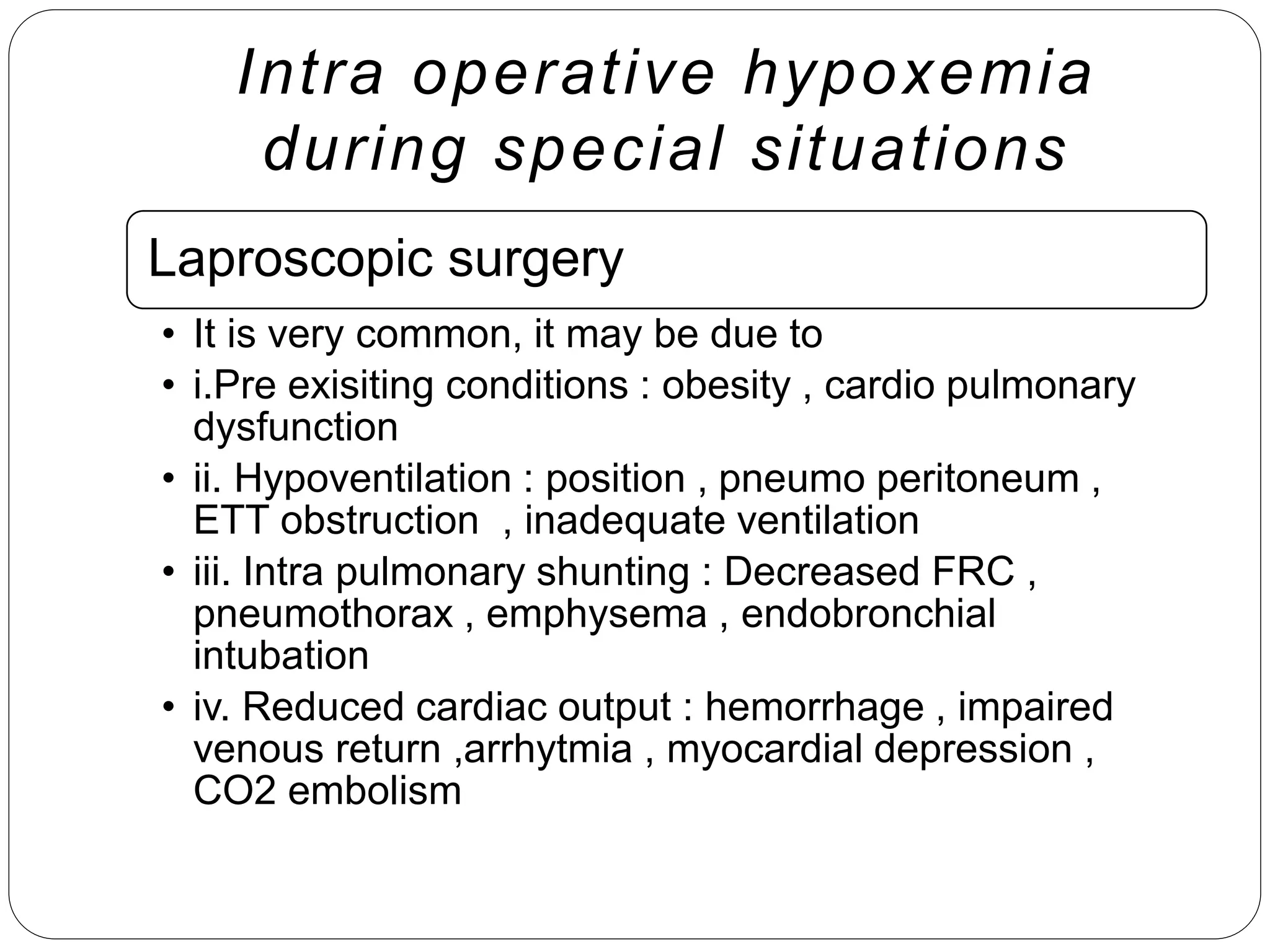
Intra operative hypoxemia
during special situations
Laproscopic surgery
• It is very common, it may be due to
• i.Pre exisiting conditions : obesity , cardio pulmonary
dysfunction
• ii. Hypoventilation : position , pneumo peritoneum ,
ETT obstruction , inadequate ventilation
• iii. Intra pulmonary shunting : Decreased FRC ,
pneumothorax , emphysema , endobronchial
intubation
• iv. Reduced cardiac output : hemorrhage , impaired
venous return ,arrhytmia , myocardial depression ,
CO2 embolism
Pneumothorax:
• Causes decreases in FRC
• Pts with previous COPD ,blunt injury chest
• suspect this following central line insertion
• Treat immediately by decompressing pleural cavity
with an open cannula in 2nd intercostal space
midclavicular line
• ASPIRATON of gastric contents during induction can
be prevented by doing RSI APPLYING CRICOID
PRESSURE
In Children
Neonates & infants are prone for more rapid
desaturation
• Smaller diameter of airways
• Chestwall & airway are highly compliant
• Increased oxygen consumption
• Premature infants have deficient surfactant
• Difference in airway anatomy – difficult intubation, mask
ventilation
• Early fatigue & apnoea due to lack of type 1 muscle fibres
In pregnancy
• FRC reduced by 20% , oxygen reserve
decreased
• Oxygen consumption increased by 20%
• More prone for precipitous fall in PaO2 even
after brief period of apnoea
• Difficult intubation , difficult ventilation ,
aspiration worsen the situation
• Preoxygention is must , rapid sequence
induction is prefered using sellick’s maneuver
In elderly
More prone hemoglobin desaturation
• Compromised respiratory system ( loss of elastin ,
reduced compliance,increased residual volume ,
loss of vital capacity , impaired efficiency of gas
exchange, increased work of breathing )
• Compromised cardio vascular system
• Prolonged drug effect seen after sedatives ,
narcotics& muscle relaxants
In obese patients,
• Difficult mask ventilation, difficult
laryngoscopy,difficult intubation
• Decreased lung volumes & capacities
FRC,ERV,VC.
• ERV is the only oxygen reserve.
• Preoxygenation is less effective
• FRC is further reduced in supine position
• More sensitive to depressant effects of
hypnotics & opioids
 During one lung ventilation
Hypoxemia occurs in almost all cases during one lung
ventilation
This is due to V/Q mismatch , because the non-dependent
lung is not ventilated but continues to get perfused .
Measures to be taken to maintain oxygenation during OLV
1. Two lung ventilation as long as possible
2. High FiO2=1.0
3. Begin OLV with Vt=10ml/kg
4. Adjust RR so that PaCO2 =40mm of hg
5. Monitor oxygenation & ventilation continously
6. Non-dependent lung CPAP
7. Depedent lung PEEP
8. Intermittent two lung ventilation
9. Clamp pulmonary artery as soon as possible
Diffusion hypoxia (Fink’s effect )
• It occurs at the end of G.A when N20 :O2 is switched off
and patient allowed to breathe air .
• N2O 31 times more soluble than nitrogen.
• For every one molecule of nitrogen entering into blood from
alveoli , 31 molecules of N2O enters into alveoli from blood.
• The alveolar oxygen is diluted and hypoxemia results.
• This is more common during first 5-10 minutes of recovery .
• Administration of 100% O2 is essential to overcome this
situation
Diagnosis:
 During early days of anaesthesia , defective
oxygenation of the patient was identified by cyanosis
&dark blood in the surgical field .
 Cyanosis occurs when the deoxygenated hb is >5g
/100ml
 Appreciation of blusih dicolouration is a subjective
phenomenon.
 Cyanosis usually observed when Hb saturation is
85%.this corresponds to PaO2 of 45-50mm hg in
adults 35-40mm hg in infants
 Cyanosis may be observed when there is no
hypoxemia Eg : methemoglobinemia
 Cyanosis may not be apparent in the presence of
anaemia or peripheral vasoconstriction
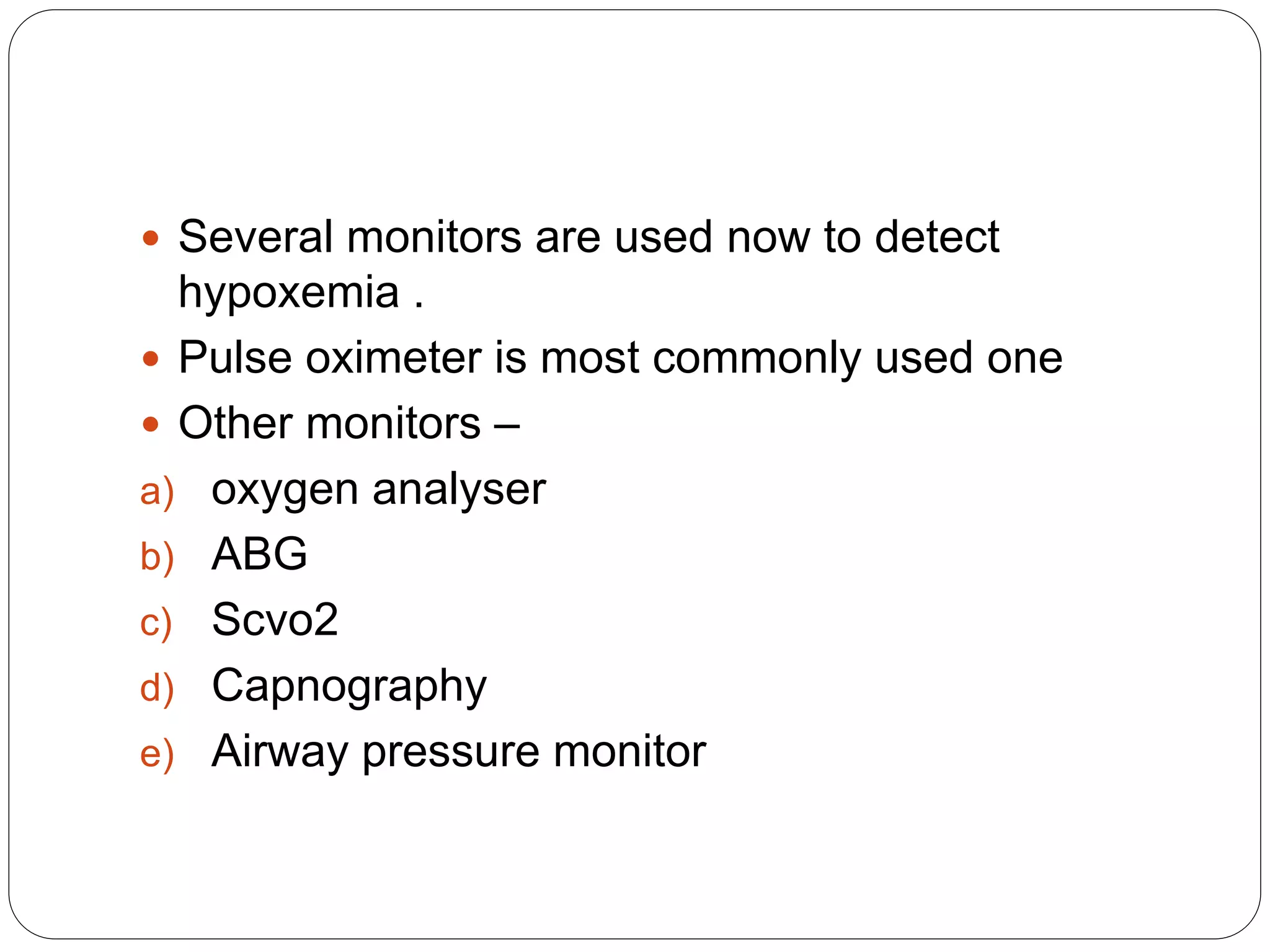
 Several monitors are used now to detect
hypoxemia .
 Pulse oximeter is most commonly used one
 Other monitors –
a) oxygen analyser
b) ABG
c) Scvo2
d) Capnography
e) Airway pressure monitor
ASA monitoring standards
 Standard I –states that a qualified anaesthesia
provider will be present with the patient throughout
the anesthetic
 Standard II-the patients oxygenation ,ventilation
,circulation & temperature will be continously
monitored
 Assesment of oxygenation involves two parts:
1. Measurement of inspired gas with an oxygen
analyzer
2. Assessment of haemoglobin saturation with a pulse
oximeter and observation of skin colour
Oxygen analyser placement :
The sensor should be placed on the inspiratory side of
the system , it should be upright or tilted slightly to
prevent moisture from accumulating membrane.
Management
a.Expose the chest, & all airway
connections
b.Give 100%O2(FiO2=1.0)
c.Hand ventilation
d.Confirm FiO2
e. Confirm ETT position
(auscultation,endobronchial, obstruction)
f. Check the ventilator pattern is correct
g. Find out the leak
h.Decreased FRC – hyperventilate gently with PEEP
i.Absorption Atelectasis – decrease FiO2, remove
secretions
j.Increased airway resistance- deepen anaesthesia,
salbutamol nebulisation , volatile anaesthetics, inj.
Aminophylline infusion
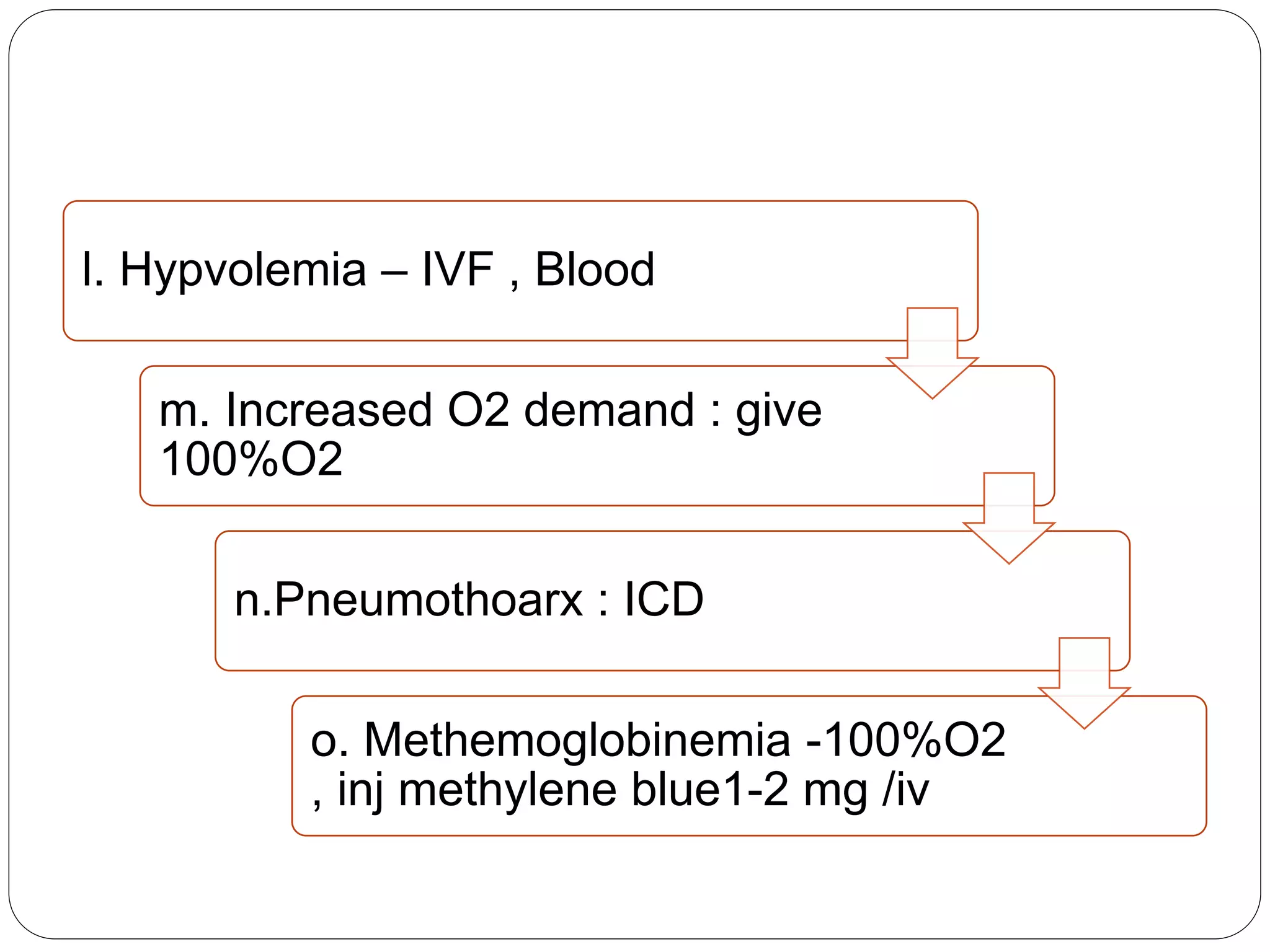
l. Hypvolemia – IVF , Blood
m. Increased O2 demand : give
100%O2
n.Pneumothoarx : ICD
o. Methemoglobinemia -100%O2
, inj methylene blue1-2 mg /iv
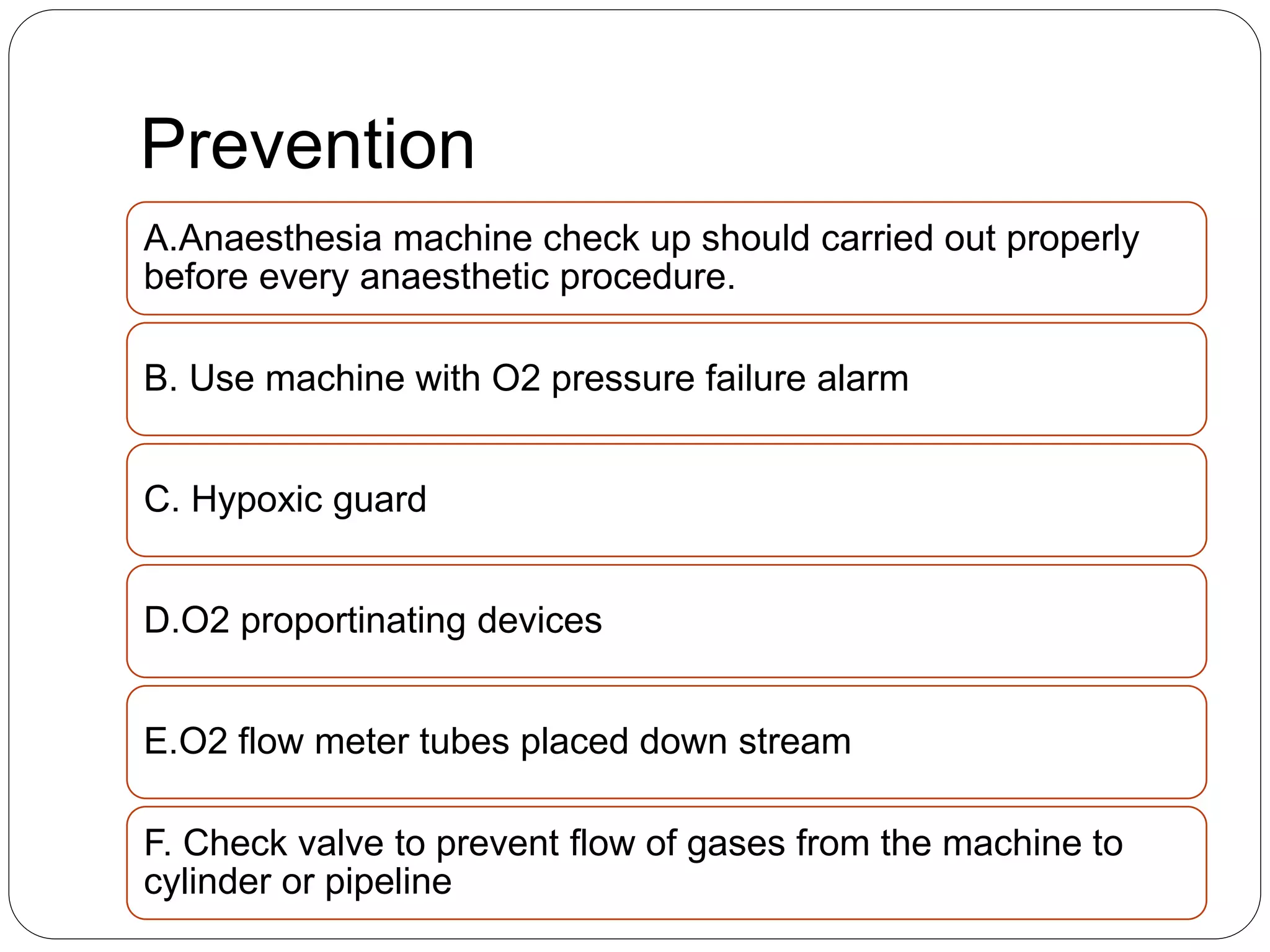
Prevention
A.Anaesthesia machine check up should carried out properly
before every anaesthetic procedure.
B. Use machine with O2 pressure failure alarm
C. Hypoxic guard
D.O2 proportinating devices
E.O2 flow meter tubes placed down stream
F. Check valve to prevent flow of gases from the machine to
cylinder or pipeline
Intra operative hypoxia and hypercarbia

Intra operative hypoxia and hypercarbia

  • 1.
  • 2.
    HYPOXIA  Failure ofoxygenation at the tissue level.  Hypoxemia is defined as a condition where arterial oxygen tension (Pao2) is below normal (normal Pao2 = 80–100 mmHg).  Hypoxia and hypoxemia may or may not occur together  Nevertheless, hypoxemia is by far the most common cause of tissue hypoxia.
  • 3.
    Classification:  Hypoxemic hypoxia:Insufficient oxygen reaching the blood  Stagnant or circulatory hypoxia: Decreased blood flow to the tissues  Anaemic hypoxia: Decreased oxygen carrying capacity of blood  Histotoxic hypoxia: Impaired utilisation of oxygen by the tissues
  • 4.
    Causes of Hypoxemia: Classified into two I.Problems with oxygen delivery system • at the level of central oxygen supplies • at the level of pipeline distributing system • at the level of oxygen cylinders attached to anaesthesia machine • at the level of anaesthesia machine • at the level of anaesthesia ventilator • at the level of anaesthesia circuit • at the level of endotracheal tube
  • 5.
    At level ofcentral Oxygen  Liquid tank may be filled with nitrogen or argon  Gasleak  Inadequate pressure at central supply  Decreased oxygen level at the tank  Depleted cylinders  Failure of master alarm system
  • 6.
    At the levelof pipeline distributing system  Leak  Contamination of gases  Cross connection  Connecting wrong hose to Oxygen yoke  Inadvertent switching of schrader adapter of piped lines At the level of 0xygen cylinders attached to anaesthesia machine  Empty cylinders  Substitution of non oxygen cylinder at the yoke  Insufficiently opened cylinder
  • 7.
    At the levelof anaesthesia machine  Incorrect setting of flow meter  Crack in the oxygen flow meter tubes  Transposition of rotameter tubes  Leak in machine At the level of anaesthesia Ventilator  Low tidal volume  Low respiratory rate  Inadequate minute volume  Disconnection of tubing
  • 8.
    At the levelof the anaesthesia circuit  Disconnection  Leak At the level of Endotracheal tube  Esophageal intubation  Endobrochial intubation  Accidental extubation  Kinking of tube  Tube obstructing opening of rt. Upper lobe bronchus
  • 9.
    II.Problems with patient •Hypoventilation • Reduced functional residual capacity • Increased airway resistance • Atelectasis • Absorption atelectasis • Diffusion defect • Shunt • Inhibition of hypoxic pulmonary vasoconstriction • Poor oxygen delivery yo tissues • Increased oxygen demand
  • 10.
    A.Hypoventilation :  ASpontaneously anaesthetised patient may hypoventilate due to drug induced respiratory depression.  In patient who is paralysed and ventilated , hypoventilation may occur due to inadequate IPPV
  • 11.
    B.Reduced functional residualcapacity:  Induction of GA will cause reduction in FRC by 15-20% invariably  This will be more in patients with preexisting lung disease, obese patients.  The reduction FRC is continued in post operative period.  Decreased FRC causes increase in PAO2 –PaO2 gradient.  The reduction in FRC may be restored normal by application of PEEP.
  • 12.
    C. Increased airwayresistance  Due to following factors a.Reduction in FRC b.Decrease in calibre of airways c.Endotracheal intubation d.Anaesthesia apparatus e.Laryngospasm f.Obstruction of ETT
  • 13.
    D.Atelectasis  It isa condition of alveolar collapse .  It may be micro atelectasis,macro atelectasis or lobar collapse.  Leads to V/Q mismatch , R-L shunting and arterial hypoxemia  Atelectasis occur due to airways secretions, compression packs, wedge and prolonged procedures  PEEP may be useful in such situation
  • 14.
    E. Absorption atelectasis Alveloar collapse occur when the patient is getting high FiO2.  When PAO2 rises , the rate at which O2 moves from the alveoli to capillary blood increases.  When the absorption rate is more than the inspired flow gases , lung unit collapses  So, absorption atelectasis occurs when a. Fio2 is high ; b. V/Q is low ; c. time of exposure of lung unit low V/Q ratio to high FiO2 is long d. CvO2 is low
  • 15.
    F. Diffusion defect: Even though adequate oxygen is supplied to the alveoli, defect at alveloar level which prevents its absorption in to blood  This is due to a.Thickened alveloar membrane b.Thickening of air-blood interface c.Inflammation d.Edema e.Fibrosis or loss of alveolar surface area (Eg:sarcoidosis ,Emphysema)
  • 16.
    G.Shunt: I) inadequate ventilation: a. Absorption atelectasis b. Airway secretions c. Pulmonary aspiration d. Pulmonary edema e. Inhibition of HPV- vasodilators(SNP, NTG) II)Inadequate perfusion : a. ASD/VSD b. Patent foramen ovale c. Pulmonary embolism
  • 17.
    H. Inhibtion ofhypoxic pulmonary vasoconstriction (HPV)  It is a protective phenomenon. When PaO2 decreases in a region pulmonary vasoconstriction occurs at that particular region.  HPV diverts blood flow from the hypoxic regions of the lung to better ventilated normoxic regions , thus decreases V/Q mismatch maintaning PaO2  Inhibition of HPV lead to arterial hypoxemia  Factors inhibit HPV a.Inhaled anaesthetics b. vasodilators(SNP, NTG) c.Hypocapnia d.Hypothermia e. Thrombo embolism
  • 18.
    I. Poor oxygendelivery to tissues:  Due to following a.Systemic hypo perfusion b. Embolus c.Sepis d.Local problems ( cold limb , reynaud phenomenon , sickle cell disease ) J. Increase oxygen demand : a.Malignant hyperpyrexia b.Shivering c.Sepsis
  • 19.
    Intra operative hypoxemia duringspecial situations Laproscopic surgery • It is very common, it may be due to • i.Pre exisiting conditions : obesity , cardio pulmonary dysfunction • ii. Hypoventilation : position , pneumo peritoneum , ETT obstruction , inadequate ventilation • iii. Intra pulmonary shunting : Decreased FRC , pneumothorax , emphysema , endobronchial intubation • iv. Reduced cardiac output : hemorrhage , impaired venous return ,arrhytmia , myocardial depression , CO2 embolism
  • 20.
    Pneumothorax: • Causes decreasesin FRC • Pts with previous COPD ,blunt injury chest • suspect this following central line insertion • Treat immediately by decompressing pleural cavity with an open cannula in 2nd intercostal space midclavicular line • ASPIRATON of gastric contents during induction can be prevented by doing RSI APPLYING CRICOID PRESSURE
  • 21.
    In Children Neonates &infants are prone for more rapid desaturation • Smaller diameter of airways • Chestwall & airway are highly compliant • Increased oxygen consumption • Premature infants have deficient surfactant • Difference in airway anatomy – difficult intubation, mask ventilation • Early fatigue & apnoea due to lack of type 1 muscle fibres
  • 22.
    In pregnancy • FRCreduced by 20% , oxygen reserve decreased • Oxygen consumption increased by 20% • More prone for precipitous fall in PaO2 even after brief period of apnoea • Difficult intubation , difficult ventilation , aspiration worsen the situation • Preoxygention is must , rapid sequence induction is prefered using sellick’s maneuver
  • 23.
    In elderly More pronehemoglobin desaturation • Compromised respiratory system ( loss of elastin , reduced compliance,increased residual volume , loss of vital capacity , impaired efficiency of gas exchange, increased work of breathing ) • Compromised cardio vascular system • Prolonged drug effect seen after sedatives , narcotics& muscle relaxants
  • 24.
    In obese patients, •Difficult mask ventilation, difficult laryngoscopy,difficult intubation • Decreased lung volumes & capacities FRC,ERV,VC. • ERV is the only oxygen reserve. • Preoxygenation is less effective • FRC is further reduced in supine position • More sensitive to depressant effects of hypnotics & opioids
  • 25.
     During onelung ventilation Hypoxemia occurs in almost all cases during one lung ventilation This is due to V/Q mismatch , because the non-dependent lung is not ventilated but continues to get perfused . Measures to be taken to maintain oxygenation during OLV 1. Two lung ventilation as long as possible 2. High FiO2=1.0 3. Begin OLV with Vt=10ml/kg 4. Adjust RR so that PaCO2 =40mm of hg 5. Monitor oxygenation & ventilation continously 6. Non-dependent lung CPAP 7. Depedent lung PEEP 8. Intermittent two lung ventilation 9. Clamp pulmonary artery as soon as possible
  • 26.
    Diffusion hypoxia (Fink’seffect ) • It occurs at the end of G.A when N20 :O2 is switched off and patient allowed to breathe air . • N2O 31 times more soluble than nitrogen. • For every one molecule of nitrogen entering into blood from alveoli , 31 molecules of N2O enters into alveoli from blood. • The alveolar oxygen is diluted and hypoxemia results. • This is more common during first 5-10 minutes of recovery . • Administration of 100% O2 is essential to overcome this situation
  • 27.
    Diagnosis:  During earlydays of anaesthesia , defective oxygenation of the patient was identified by cyanosis &dark blood in the surgical field .  Cyanosis occurs when the deoxygenated hb is >5g /100ml  Appreciation of blusih dicolouration is a subjective phenomenon.  Cyanosis usually observed when Hb saturation is 85%.this corresponds to PaO2 of 45-50mm hg in adults 35-40mm hg in infants  Cyanosis may be observed when there is no hypoxemia Eg : methemoglobinemia  Cyanosis may not be apparent in the presence of anaemia or peripheral vasoconstriction
  • 28.
     Several monitorsare used now to detect hypoxemia .  Pulse oximeter is most commonly used one  Other monitors – a) oxygen analyser b) ABG c) Scvo2 d) Capnography e) Airway pressure monitor
  • 29.
    ASA monitoring standards Standard I –states that a qualified anaesthesia provider will be present with the patient throughout the anesthetic  Standard II-the patients oxygenation ,ventilation ,circulation & temperature will be continously monitored  Assesment of oxygenation involves two parts: 1. Measurement of inspired gas with an oxygen analyzer 2. Assessment of haemoglobin saturation with a pulse oximeter and observation of skin colour Oxygen analyser placement : The sensor should be placed on the inspiratory side of the system , it should be upright or tilted slightly to prevent moisture from accumulating membrane.
  • 30.
    Management a.Expose the chest,& all airway connections b.Give 100%O2(FiO2=1.0) c.Hand ventilation d.Confirm FiO2 e. Confirm ETT position (auscultation,endobronchial, obstruction)
  • 31.
    f. Check theventilator pattern is correct g. Find out the leak h.Decreased FRC – hyperventilate gently with PEEP i.Absorption Atelectasis – decrease FiO2, remove secretions j.Increased airway resistance- deepen anaesthesia, salbutamol nebulisation , volatile anaesthetics, inj. Aminophylline infusion
  • 32.
    l. Hypvolemia –IVF , Blood m. Increased O2 demand : give 100%O2 n.Pneumothoarx : ICD o. Methemoglobinemia -100%O2 , inj methylene blue1-2 mg /iv
  • 33.
    Prevention A.Anaesthesia machine checkup should carried out properly before every anaesthetic procedure. B. Use machine with O2 pressure failure alarm C. Hypoxic guard D.O2 proportinating devices E.O2 flow meter tubes placed down stream F. Check valve to prevent flow of gases from the machine to cylinder or pipeline