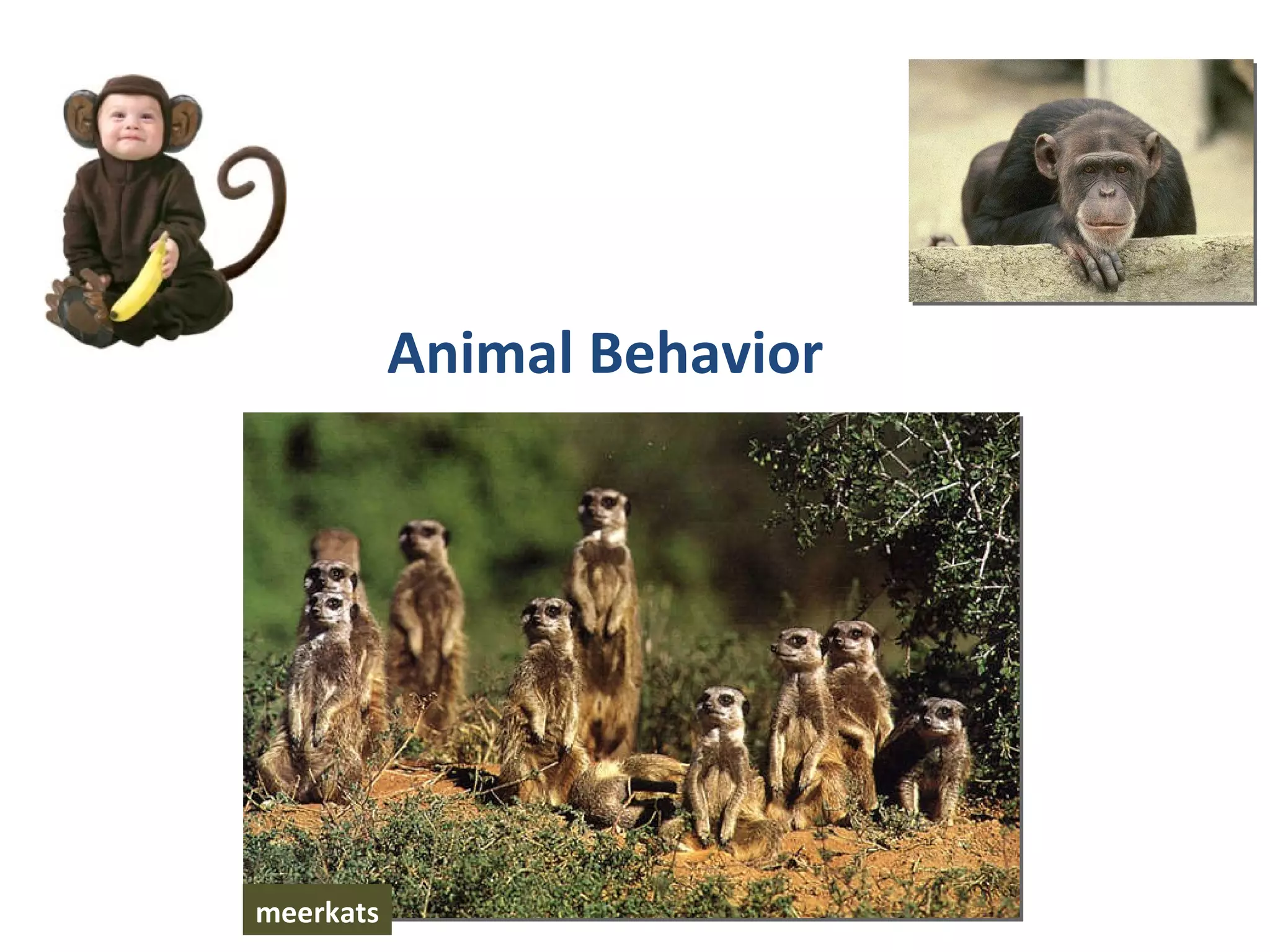
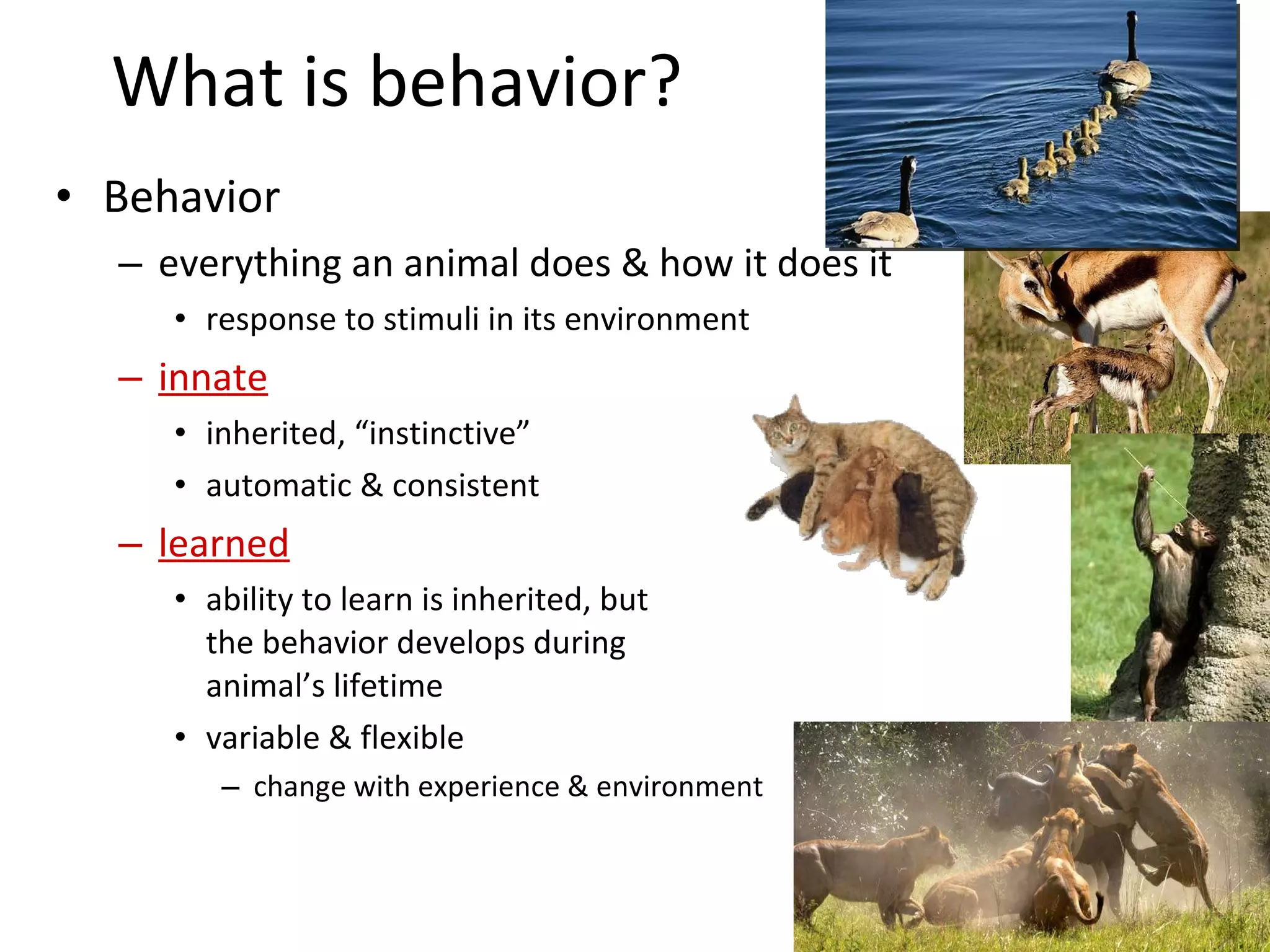
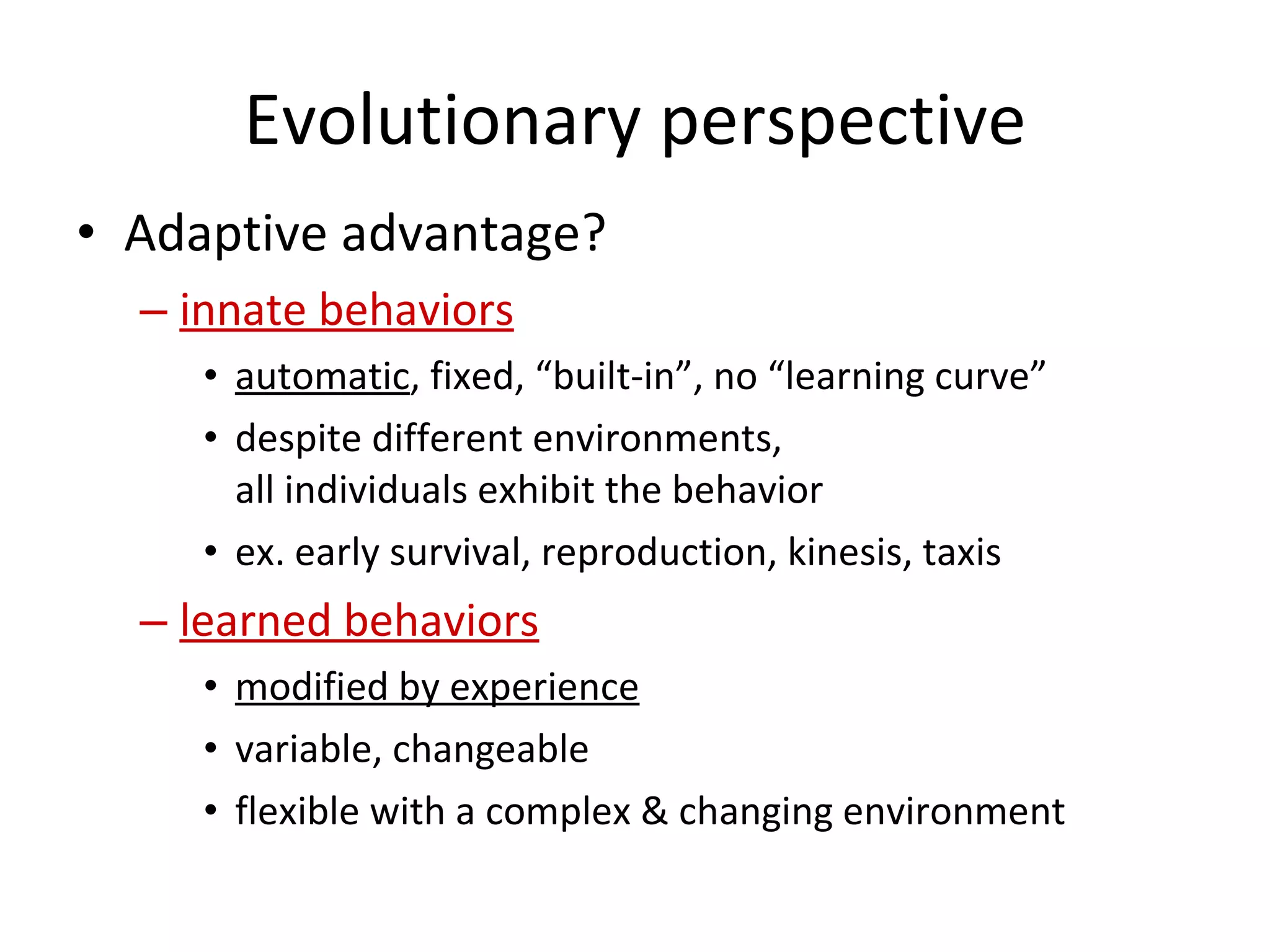
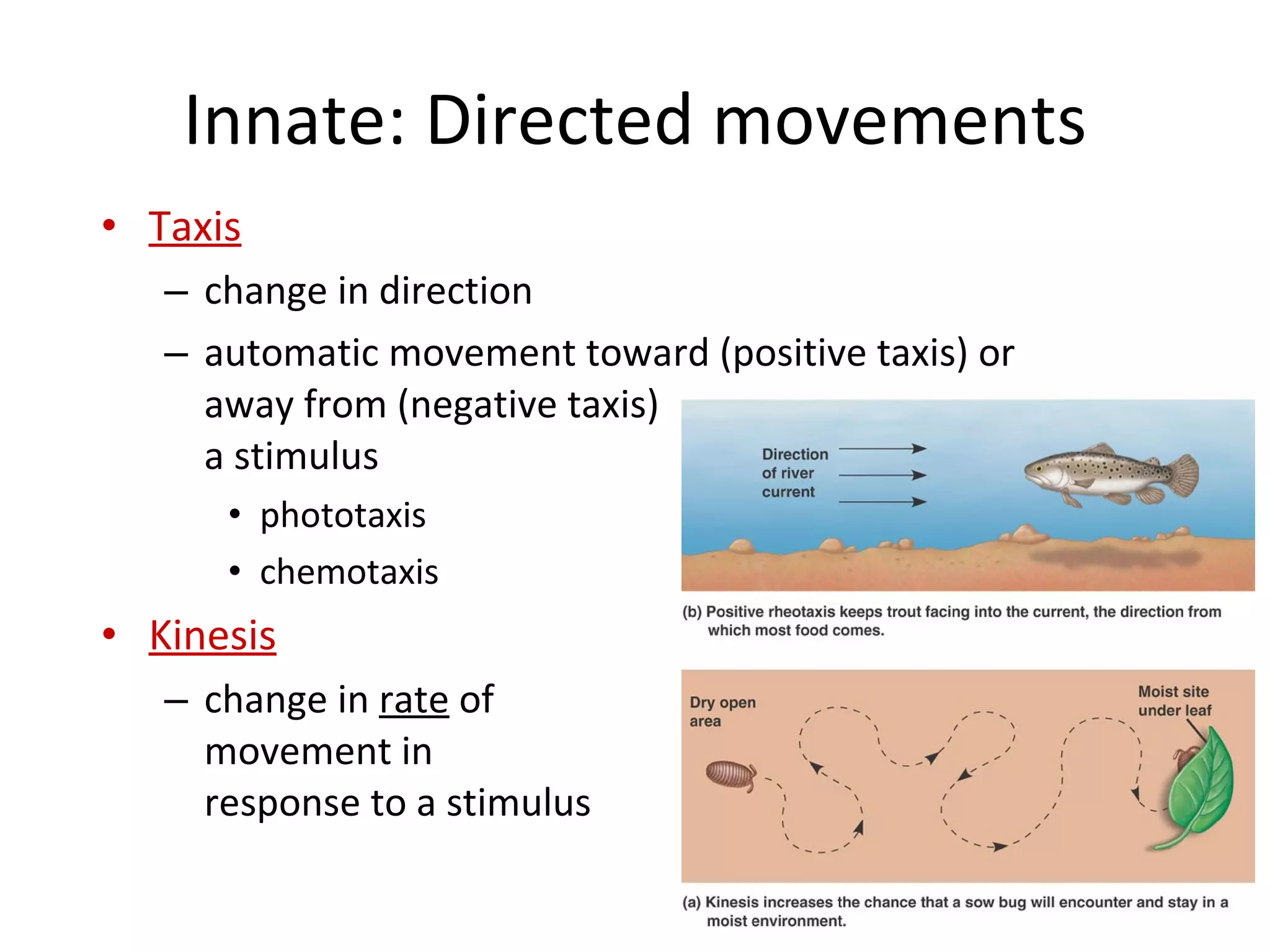
Animal Behavior  meerkats
What is behavior? Behavior everything an animal does & how it does it response to stimuli in its environment innate inherited, “instinctive” automatic & consistent learned ability to learn is inherited, but  the behavior develops during  animal’s lifetime variable & flexible change with experience & environment
Evolutionary perspective Adaptive advantage? innate behaviors   automatic , fixed, “built-in”, no “learning curve” despite different environments,  all individuals exhibit the behavior ex. early survival, reproduction, kinesis, taxis  learned behaviors modified by experience variable, changeable  flexible with a complex & changing environment
Innate: Directed movements Taxis change in direction automatic movement toward (positive taxis) or  away from (negative taxis)  a stimulus phototaxis chemotaxis Kinesis change in  rate  of  movement in  response to a stimulus
Complex Innate behaviors Migration “ migratory restlessness” seen in birds bred & raised in captivity navigate by sun, stars, Earth magnetic fields  ancient  fly-ways Monarch migration Sandpiper Bobolink Golden plover
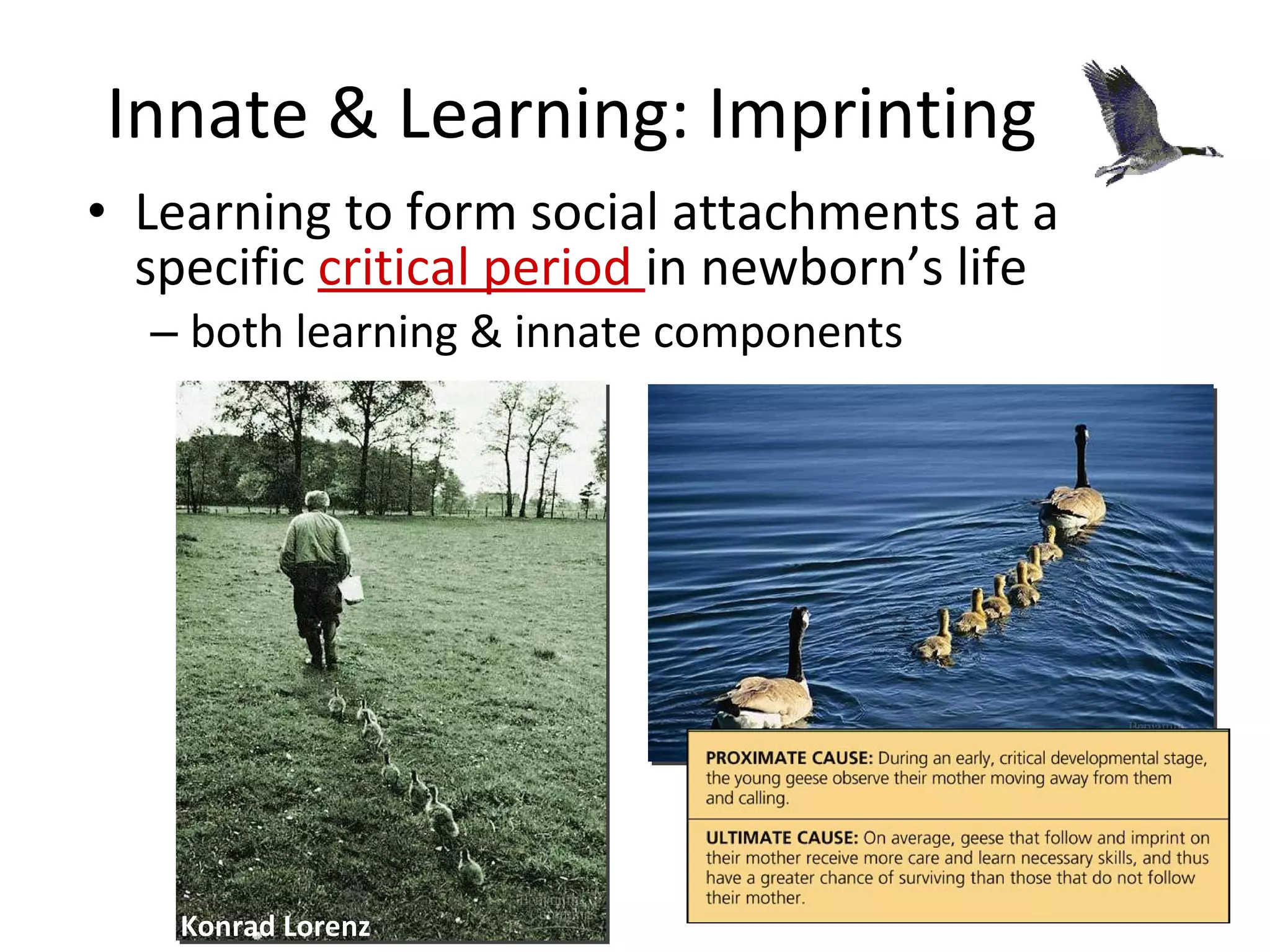
Innate & Learning: Imprinting Learning to form social attachments at a specific  critical period  in newborn’s life both learning & innate components Konrad Lorenz
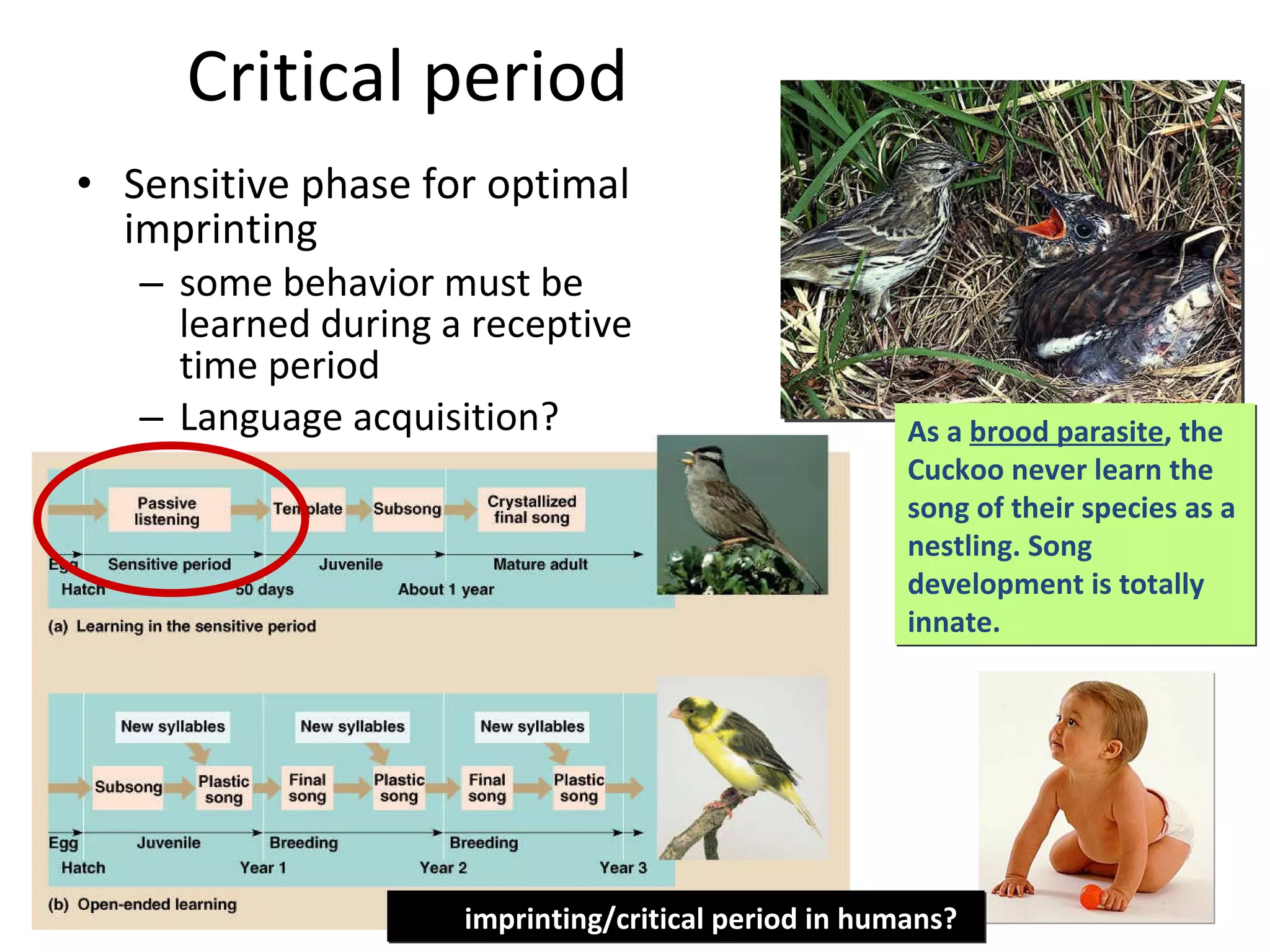
Critical period Sensitive phase for optimal imprinting some behavior must be learned during a receptive time period  Language acquisition? As a  brood parasite , the Cuckoo never learn the song of their species as a nestling. Song development is totally innate.  imprinting/critical period in humans?
Learned behavior Associative learning learning to associate  a stimulus with a consequence  operant conditioning trial & error learning associate behavior with reward or punishment ex:  learning what to eat classical conditioning Pavlovian conditioning associate a “neutral stimulus” with a “significant stimulus”
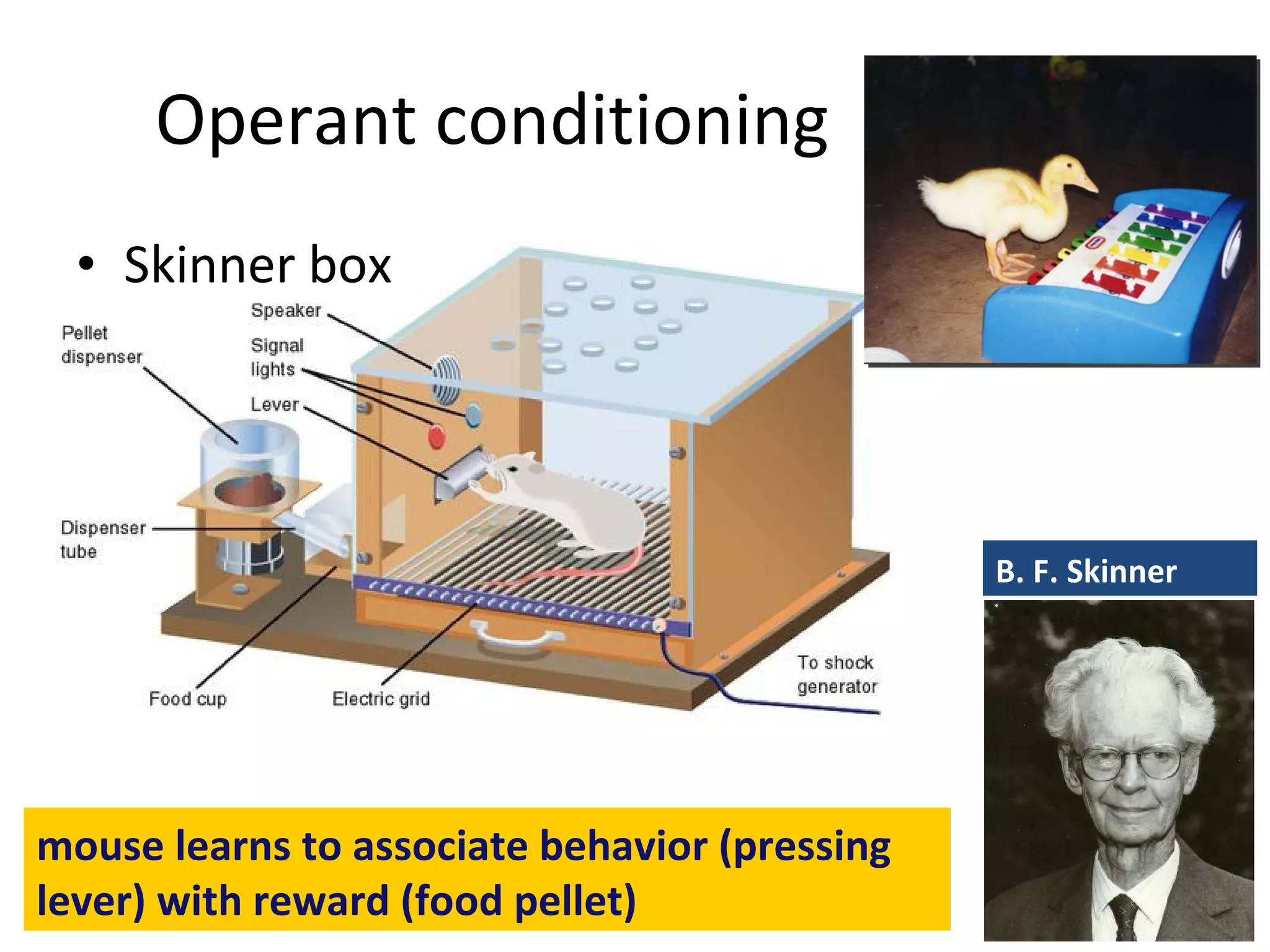
Operant conditioning Skinner box mouse learns to associate behavior (pressing lever) with reward (food pellet) B. F. Skinner
Classical conditioning Ivan Pavlov’s dogs connect reflex behavior (salivating at sight of food) to associated stimulus (ringing bell)
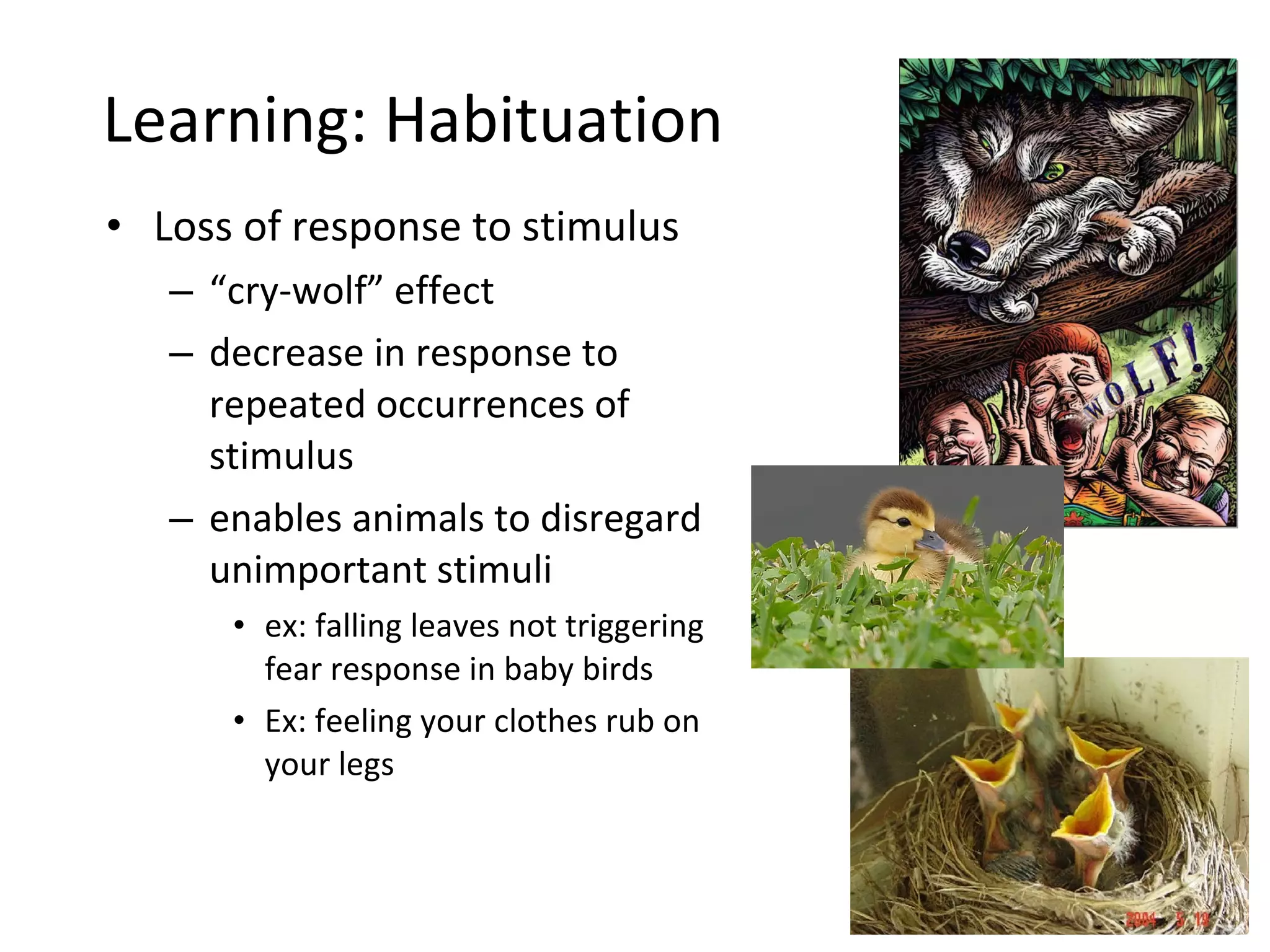
Learning: Habituation Loss of response to stimulus “ cry-wolf” effect decrease in response to repeated occurrences of stimulus enables animals to disregard unimportant stimuli ex: falling leaves not triggering fear response in baby birds Ex: feeling your clothes rub on your legs
Learning: Problem-solving Do other animals reason? tool use problem-solving chimpanzee sea otter crow
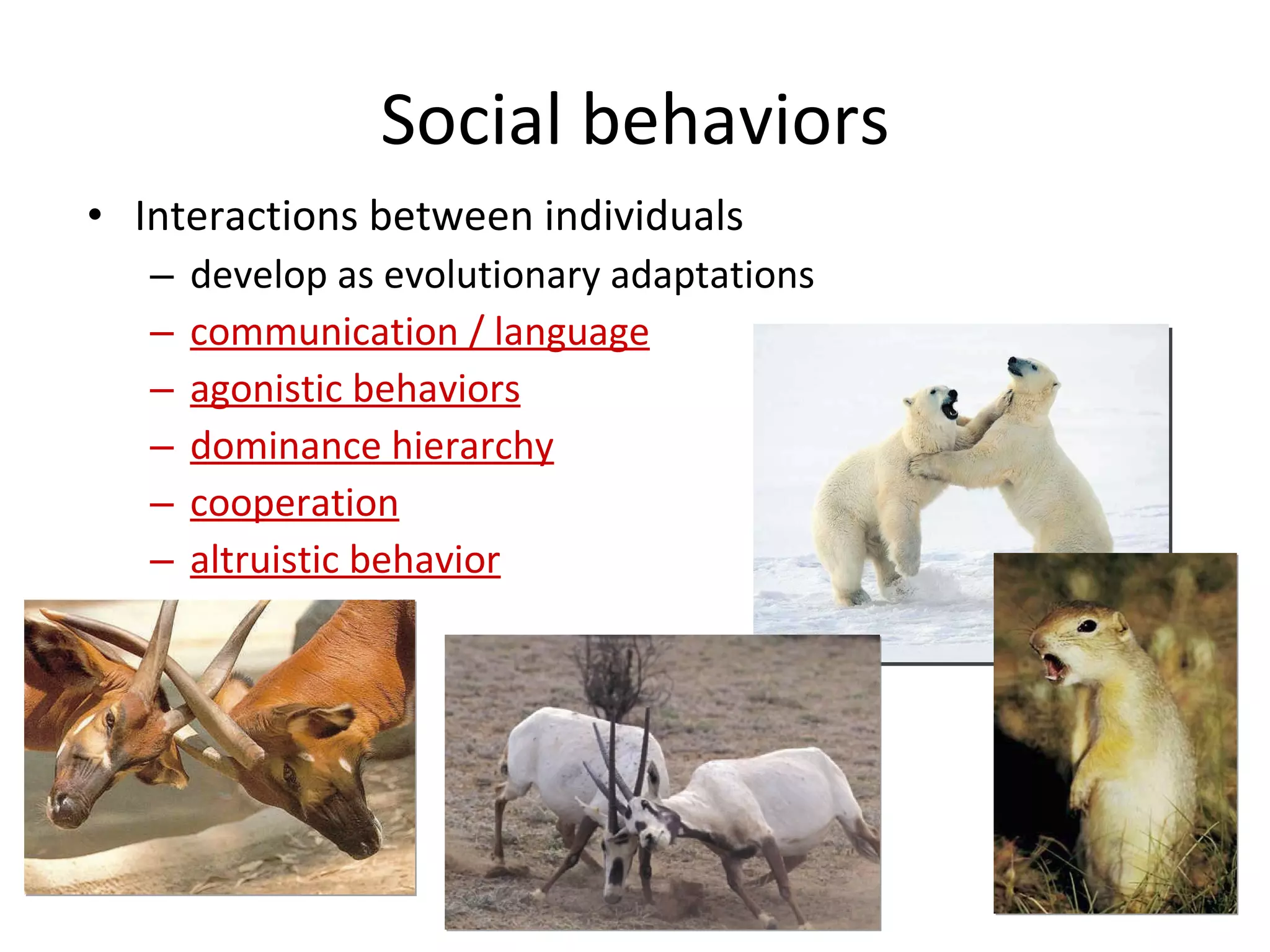
Social behaviors Interactions between individuals develop as evolutionary adaptations communication / language agonistic behaviors dominance hierarchy cooperation altruistic behavior
Language Honey bee communication  dance to communicate location of food source Bird, insect songs Mating ritual
Social interaction requires COMMUNICATION Pheromones chemical signal that stimulates a response from other individuals alarm pheromones to alert others of nearby predators sex pheromones for mating rituals
Social behaviors Agonistic behaviors threatening & submissive rituals symbolic, usually no harm done ex:  territoriality, competitor aggression
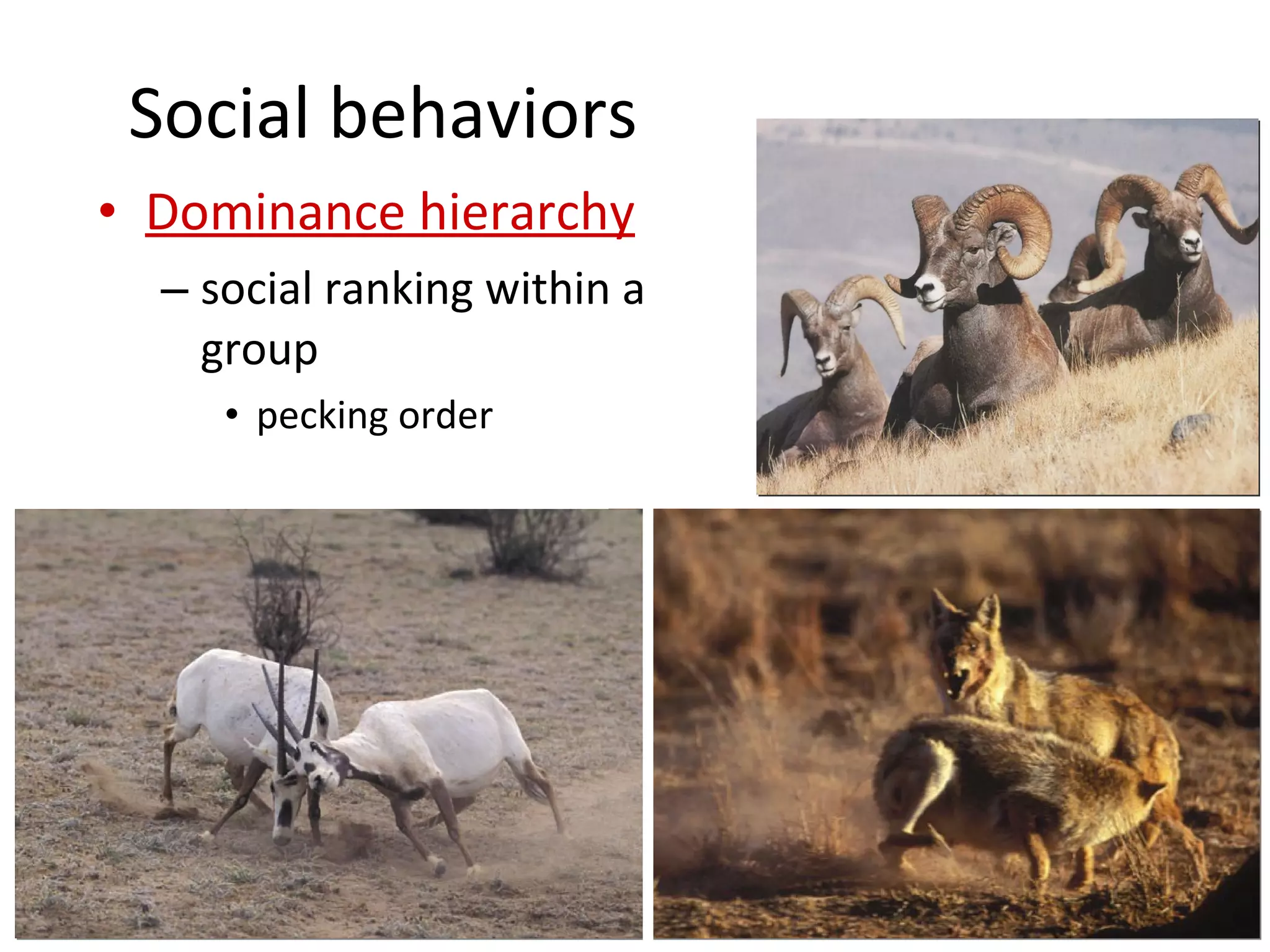
Social behaviors  Dominance hierarchy social ranking within a group  pecking order
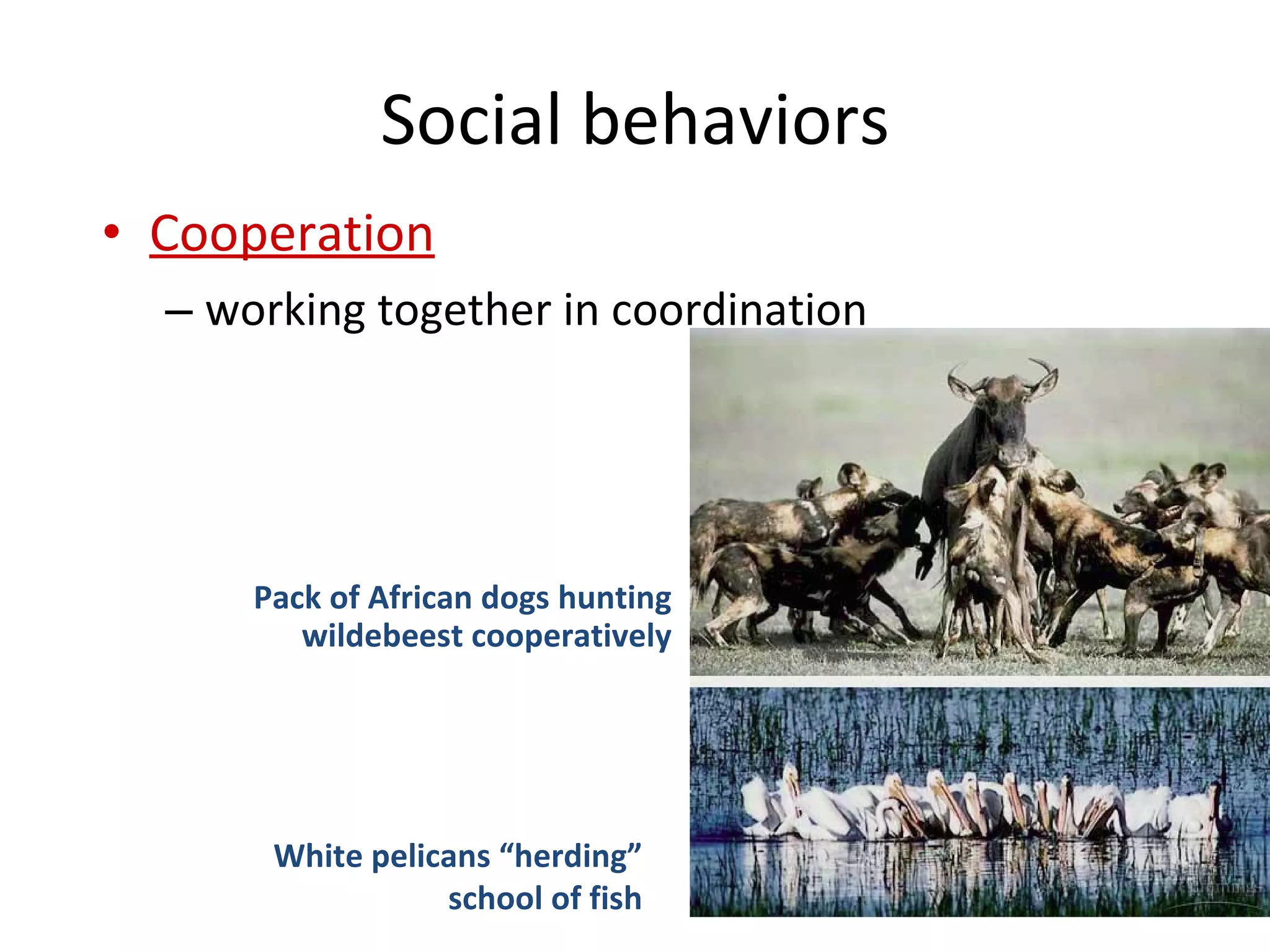
Social behaviors Cooperation working together in coordination Pack of African dogs hunting wildebeest cooperatively White pelicans “herding” school of fish
Social behaviors Altruistic behavior reduces individual fitness but  increases fitness of recipient Self-lessness kin selection increasing survival of close relatives passes  these genes on to the next generation How can this be of adaptive value? Belding ground squirrel I would lay  down my life for 2 brothers or 8 cousins !
Colonial mammals Naked mole rats underground colony, tunnels queen, breeding males, non-breeding workers hairless, blind “ Picture a hot dog that's been left in a microwave a little too long…add some buck teeth at one end, and you've got a fairly good idea of what a Naked Mole Rat looks like.” convergent evolution : bees, ants, termites…  mole rats are also colonial  species
2008-2009 Any  Questions??

Animal Behavior

  • 1.
  • 2.
    What is behavior?Behavior everything an animal does & how it does it response to stimuli in its environment innate inherited, “instinctive” automatic & consistent learned ability to learn is inherited, but the behavior develops during animal’s lifetime variable & flexible change with experience & environment
  • 3.
    Evolutionary perspective Adaptiveadvantage? innate behaviors automatic , fixed, “built-in”, no “learning curve” despite different environments, all individuals exhibit the behavior ex. early survival, reproduction, kinesis, taxis learned behaviors modified by experience variable, changeable flexible with a complex & changing environment
  • 4.
    Innate: Directed movementsTaxis change in direction automatic movement toward (positive taxis) or away from (negative taxis) a stimulus phototaxis chemotaxis Kinesis change in rate of movement in response to a stimulus
  • 5.
    Complex Innate behaviorsMigration “ migratory restlessness” seen in birds bred & raised in captivity navigate by sun, stars, Earth magnetic fields ancient fly-ways Monarch migration Sandpiper Bobolink Golden plover
  • 6.
    Innate & Learning:Imprinting Learning to form social attachments at a specific critical period in newborn’s life both learning & innate components Konrad Lorenz
  • 7.
    Critical period Sensitivephase for optimal imprinting some behavior must be learned during a receptive time period Language acquisition? As a brood parasite , the Cuckoo never learn the song of their species as a nestling. Song development is totally innate. imprinting/critical period in humans?
  • 8.
    Learned behavior Associativelearning learning to associate a stimulus with a consequence operant conditioning trial & error learning associate behavior with reward or punishment ex: learning what to eat classical conditioning Pavlovian conditioning associate a “neutral stimulus” with a “significant stimulus”
  • 9.
    Operant conditioning Skinnerbox mouse learns to associate behavior (pressing lever) with reward (food pellet) B. F. Skinner
  • 10.
    Classical conditioning IvanPavlov’s dogs connect reflex behavior (salivating at sight of food) to associated stimulus (ringing bell)
  • 11.
    Learning: Habituation Lossof response to stimulus “ cry-wolf” effect decrease in response to repeated occurrences of stimulus enables animals to disregard unimportant stimuli ex: falling leaves not triggering fear response in baby birds Ex: feeling your clothes rub on your legs
  • 12.
    Learning: Problem-solving Doother animals reason? tool use problem-solving chimpanzee sea otter crow
  • 13.
    Social behaviors Interactionsbetween individuals develop as evolutionary adaptations communication / language agonistic behaviors dominance hierarchy cooperation altruistic behavior
  • 14.
    Language Honey beecommunication dance to communicate location of food source Bird, insect songs Mating ritual
  • 15.
    Social interaction requiresCOMMUNICATION Pheromones chemical signal that stimulates a response from other individuals alarm pheromones to alert others of nearby predators sex pheromones for mating rituals
  • 16.
    Social behaviors Agonisticbehaviors threatening & submissive rituals symbolic, usually no harm done ex: territoriality, competitor aggression
  • 17.
    Social behaviors Dominance hierarchy social ranking within a group pecking order
  • 18.
    Social behaviors Cooperationworking together in coordination Pack of African dogs hunting wildebeest cooperatively White pelicans “herding” school of fish
  • 19.
    Social behaviors Altruisticbehavior reduces individual fitness but increases fitness of recipient Self-lessness kin selection increasing survival of close relatives passes these genes on to the next generation How can this be of adaptive value? Belding ground squirrel I would lay down my life for 2 brothers or 8 cousins !
  • 20.
    Colonial mammals Nakedmole rats underground colony, tunnels queen, breeding males, non-breeding workers hairless, blind “ Picture a hot dog that's been left in a microwave a little too long…add some buck teeth at one end, and you've got a fairly good idea of what a Naked Mole Rat looks like.” convergent evolution : bees, ants, termites… mole rats are also colonial species
  • 21.
    2008-2009 Any Questions??

Editor's Notes

  • #5 The sow bugs become more active in dry areas and less active in humid areas. Though sow bugs do not move toward or away from specific conditions, their increased movement under dry conditions increases the chance that they will leave a dry area and encounter a moist area. And since they slow down in a moist area, they tend to stay there once they encounter it. In contrast to a kinesis, a taxis is a more or less automatic, oriented movement toward (a positive taxis) or away from (a negative taxis) some stimulus. For example, many stream fish, such as trout, exhibit positive rheotaxis (from the Greek rheos, current); they automatically swim or orient themselves in an upstream direction (toward the current). This taxis keeps the fish from being swept away and keeps them facing the direction from which food will come.
  • #6 Bird migration, a behavior that is largely under genetic control. Each spring, migrating western sandpipers (Calidris mauri), such as those shown here, migrate from their wintering grounds, which may be as far south as Peru, to their breeding grounds in Alaska. In the autumn, they return to the wintering grounds.
  • #7 But how do the young know on whom—or what—to imprint? How do young geese know that they should follow the mother goose? The tendency to respond is innate in the birds; the outside world provides the imprinting stimulus, something to which the response will be directed. Experiments with many species of waterfowl indicate that they have no innate recognition of “mother.” They respond to and identify with the first object they encounter that has certain key characteristics. In classic experiments done in the 1930s, Konrad Lorenz showed that the most important imprinting stimulus in graylag geese is movement of an object away from the young. When incubator–hatched goslings spent their first few hours with Lorenz rather than with a goose, they imprinted on him, and from then on, they steadfastly followed him and showed no recognition of their biological mother or other adults of their own species. Again, there are both proximate and ultimate explanations
  • #15 View Waggle Dance AVI file: waggledance180x135.avi
  • #17 View Lifewire territoriality video: “ lizards cost of defending-lifewire.swf” Review setting up a behavior experiment: