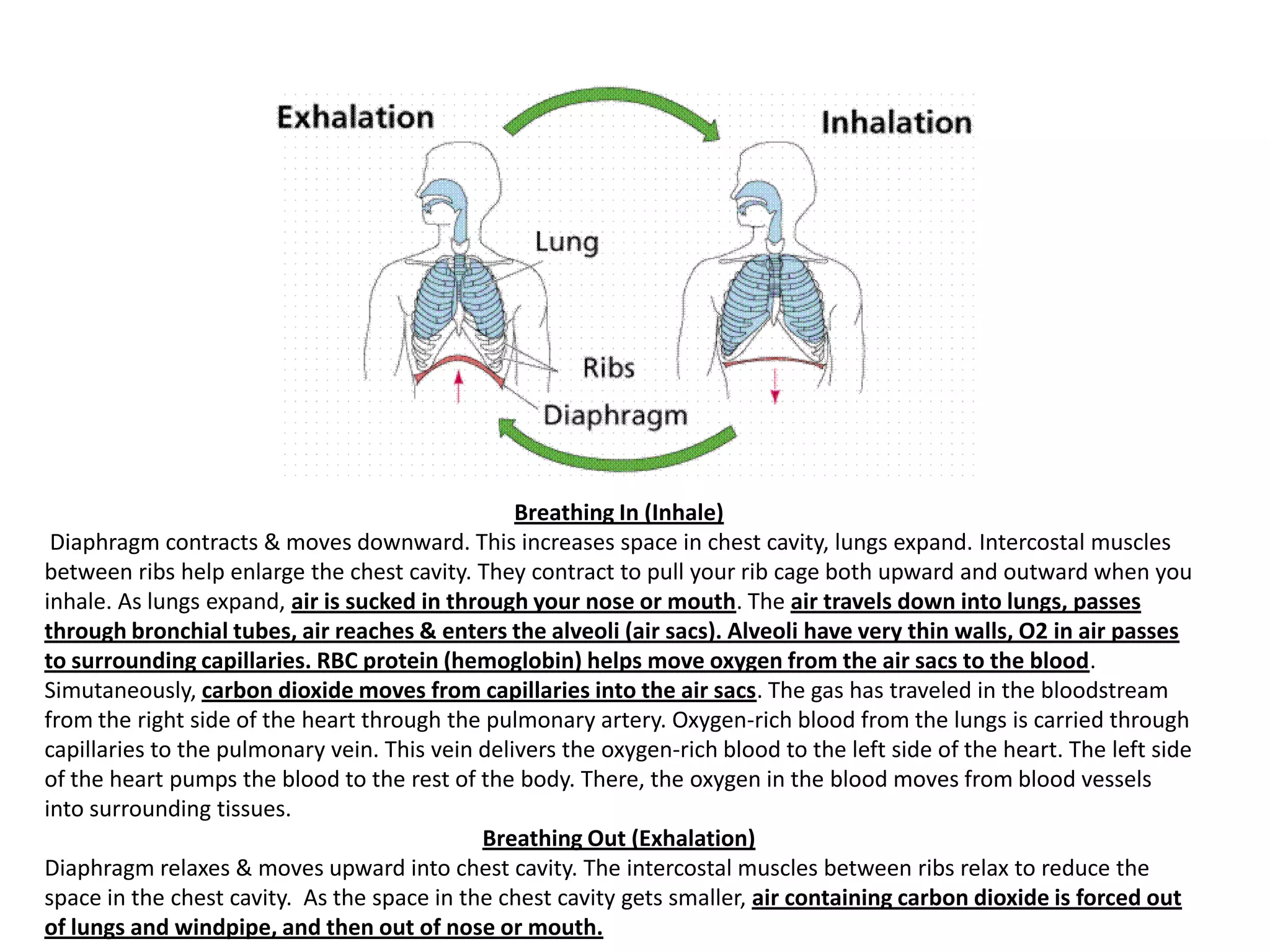
Breathing In (Inhale) Diaphragm contracts & moves downward. This increases space in chest cavity, lungs expand. Intercostal muscles between ribs help enlarge the chest cavity. They contract to pull your rib cage both upward and outward when you inhale. As lungs expand, air is sucked in through your nose or mouth. The air travels down into lungs, passes through bronchial tubes, air reaches & enters the alveoli (air sacs). Alveoli have very thin walls, O2 in air passes to surrounding capillaries. RBC protein (hemoglobin) helps move oxygen from the air sacs to the blood. Simutaneously, carbon dioxide moves from capillaries into the air sacs. The gas has traveled in the bloodstream from the right side of the heart through the pulmonary artery. Oxygen-rich blood from the lungs is carried through capillaries to the pulmonary vein. This vein delivers the oxygen-rich blood to the left side of the heart. The left side of the heart pumps the blood to the rest of the body. There, the oxygen in the blood moves from blood vessels into surrounding tissues. Breathing Out (Exhalation)Diaphragm relaxes & moves upward into chest cavity. The intercostal muscles between ribs relax to reduce the space in the chest cavity.  As the space in the chest cavity gets smaller, air containing carbon dioxide is forced out of lungs and windpipe, and then out of nose or mouth.

Inhalation exhalation

  • 1.
    Breathing In (Inhale)Diaphragm contracts & moves downward. This increases space in chest cavity, lungs expand. Intercostal muscles between ribs help enlarge the chest cavity. They contract to pull your rib cage both upward and outward when you inhale. As lungs expand, air is sucked in through your nose or mouth. The air travels down into lungs, passes through bronchial tubes, air reaches & enters the alveoli (air sacs). Alveoli have very thin walls, O2 in air passes to surrounding capillaries. RBC protein (hemoglobin) helps move oxygen from the air sacs to the blood. Simutaneously, carbon dioxide moves from capillaries into the air sacs. The gas has traveled in the bloodstream from the right side of the heart through the pulmonary artery. Oxygen-rich blood from the lungs is carried through capillaries to the pulmonary vein. This vein delivers the oxygen-rich blood to the left side of the heart. The left side of the heart pumps the blood to the rest of the body. There, the oxygen in the blood moves from blood vessels into surrounding tissues. Breathing Out (Exhalation)Diaphragm relaxes & moves upward into chest cavity. The intercostal muscles between ribs relax to reduce the space in the chest cavity. As the space in the chest cavity gets smaller, air containing carbon dioxide is forced out of lungs and windpipe, and then out of nose or mouth.