Temporal relations: some possibilities

2.4 CONTEXT
Temporal relations in Syntax: some facts

3.3 CONTEXT
Temporal relations: some possibilities
2.4 CONTEXT
• How two events are ordered may depend on the situation.
 Husband are expected to go before their wives when entering a restaurant.
 Husband will yield to their wives when entering their home.
 ‘husband entering before wife’
 ‘wife entering before husbands’

• So, neither of the two orders holds in all situations but each holds under
certain conditions.
Temporal relations: some possibilities
2.4 CONTEXT
• The order of words can be similarly context-dependent.
E.g
 Sam has read the paper. - Statement
 Has Sam read the paper? - Question
 The star-shaped kite glided through the air.
 The attractive, brilliant singer received a standing ovation.

 une table ronde (French)- round table
 une femme américaine (French )- American woman
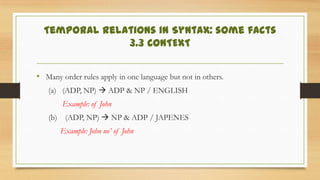
Temporal relations in Syntax: some facts
3.3 CONTEXT
• Many order rules apply in one language but not in others.
(a) (ADP, NP)  ADP & NP / ENGLISH

Example: of John
(b) (ADP, NP)  NP & ADP / JAPENES
Example: John no’ of John
Adpositional Phrase
• An adpositional phrase is a linguistics term defining a syntactic category that
includes prepositional phrases, postpositional phrases, and circumpositional phrases.

• Language syntax treats adpositional phrases as units that act as
arguments or adjuncts.

• Adpositional phrases contain an adposition (preposition, postposition, or
circumposition) as head and usually a complement such as a noun phrase.
Nouns with Prepositions
• A noun by adding a prepositional phrase after it.
Example
 Four men on holiday were in the car.

 A sound behind him made him turn.
 She gave a brief account of her interview.
 There was a picture of them both in the newspaper.
Verbs with Prepositions
• Many verbs that are used without an object are normally followed by a
prepositional phrase.
Example:
 The land belongs to a rich family.
 She then referred to the Minister’s
 They agreed on a plan of action.
Adjectives with Prepositions
• Some adjectives can be used alone, or followed by a particular preposition.
• Used alone, or with ‘of ’ to specify the cause of a feeling
Example:
 They may feel jealous of your success
 I was terrified of her.

• Used alone, or with ‘of ’ to specify the person who has a quality
Example:
 That was clever of you.
 I turned the job down, which was stupid of me.
Adverbs with Preposition
• Use a prepositional phrase as an adverb to modify a verb, an adjective, or
another adverb.
Example:
 A leader assists in problem solving.
 A motivated employee completes all assignments. with enthusiasm
Postpositional Phrases
• Postpositional elements are frequent in head-final languages such as Basque, Estonian, Finnish,
Georgian, Korean, Japanese, Hindi, Urdu, Bengali and Tamil.

• The word or other morpheme that corresponds to an English preposition occurs after its complement,
hence the name postposition.

• The following examples are from Japanese, where the case markers perform a role similar to that of
adpositions:
a. ..mise ni
store to = 'to the store‘

b. ..ie kara
house from = 'from the house'

c. ..hashi de
chopsticks with = 'with chopsticks' or 'on the bridge'
Circumpositional Phrases
• Circumpositional phrases involve both a preposition and a postposition, where by the

complement appears between the two.
• English has at least one circumpositional construction, e.g.
a. From now on, he won't help.
German has more of them, e.g.
b. Von mir aus kannst du das machen.
From me out can you that do = 'As far as I'm concerned, you can do it.'
c. Um der Freundschaft willen sollst du es machen.
around the friendship sake should you it do = 'For the sake of friendship, you should
do it.'
In the addition to the choice of language, structural characteristics of sentences
may also limit the applicability of a rule. This is illustrated in (2).
(a) The plane should arrive at 6 pm.
When should the plane arrive?
(b) All papers must be in by Friday.
When must all paper be in?
• In declarative sentences, the order is subject before auxiliary; in (certain)
interrogative sentences, it is auxiliary before subject.

• The choice between the two orders in conditioned by the presence and
absence of the question words when or where.

• Certain additional restriction aside, the relevant rule, with both intrasentential and language context specified, is given in (3).

• (AUX, SBJ)  AUX & SBJ / #WHQ--------------English
Context in syntax

Context in syntax

  • 1.
    Temporal relations: somepossibilities 2.4 CONTEXT Temporal relations in Syntax: some facts 3.3 CONTEXT
  • 2.
    Temporal relations: somepossibilities 2.4 CONTEXT • How two events are ordered may depend on the situation.  Husband are expected to go before their wives when entering a restaurant.  Husband will yield to their wives when entering their home.  ‘husband entering before wife’  ‘wife entering before husbands’ • So, neither of the two orders holds in all situations but each holds under certain conditions.
  • 3.
    Temporal relations: somepossibilities 2.4 CONTEXT • The order of words can be similarly context-dependent. E.g  Sam has read the paper. - Statement  Has Sam read the paper? - Question  The star-shaped kite glided through the air.  The attractive, brilliant singer received a standing ovation.  une table ronde (French)- round table  une femme américaine (French )- American woman
  • 4.
    Temporal relations inSyntax: some facts 3.3 CONTEXT • Many order rules apply in one language but not in others. (a) (ADP, NP)  ADP & NP / ENGLISH Example: of John (b) (ADP, NP)  NP & ADP / JAPENES Example: John no’ of John
  • 5.
    Adpositional Phrase • Anadpositional phrase is a linguistics term defining a syntactic category that includes prepositional phrases, postpositional phrases, and circumpositional phrases. • Language syntax treats adpositional phrases as units that act as arguments or adjuncts. • Adpositional phrases contain an adposition (preposition, postposition, or circumposition) as head and usually a complement such as a noun phrase.
  • 6.
    Nouns with Prepositions •A noun by adding a prepositional phrase after it. Example  Four men on holiday were in the car.  A sound behind him made him turn.  She gave a brief account of her interview.  There was a picture of them both in the newspaper.
  • 7.
    Verbs with Prepositions •Many verbs that are used without an object are normally followed by a prepositional phrase. Example:  The land belongs to a rich family.  She then referred to the Minister’s  They agreed on a plan of action.
  • 8.
    Adjectives with Prepositions •Some adjectives can be used alone, or followed by a particular preposition. • Used alone, or with ‘of ’ to specify the cause of a feeling Example:  They may feel jealous of your success  I was terrified of her. • Used alone, or with ‘of ’ to specify the person who has a quality Example:  That was clever of you.  I turned the job down, which was stupid of me.
  • 9.
    Adverbs with Preposition •Use a prepositional phrase as an adverb to modify a verb, an adjective, or another adverb. Example:  A leader assists in problem solving.  A motivated employee completes all assignments. with enthusiasm
  • 10.
    Postpositional Phrases • Postpositionalelements are frequent in head-final languages such as Basque, Estonian, Finnish, Georgian, Korean, Japanese, Hindi, Urdu, Bengali and Tamil. • The word or other morpheme that corresponds to an English preposition occurs after its complement, hence the name postposition. • The following examples are from Japanese, where the case markers perform a role similar to that of adpositions: a. ..mise ni store to = 'to the store‘ b. ..ie kara house from = 'from the house' c. ..hashi de chopsticks with = 'with chopsticks' or 'on the bridge'
  • 11.
    Circumpositional Phrases • Circumpositionalphrases involve both a preposition and a postposition, where by the complement appears between the two. • English has at least one circumpositional construction, e.g. a. From now on, he won't help. German has more of them, e.g. b. Von mir aus kannst du das machen. From me out can you that do = 'As far as I'm concerned, you can do it.' c. Um der Freundschaft willen sollst du es machen. around the friendship sake should you it do = 'For the sake of friendship, you should do it.'
  • 12.
    In the additionto the choice of language, structural characteristics of sentences may also limit the applicability of a rule. This is illustrated in (2). (a) The plane should arrive at 6 pm. When should the plane arrive? (b) All papers must be in by Friday. When must all paper be in?
  • 13.
    • In declarativesentences, the order is subject before auxiliary; in (certain) interrogative sentences, it is auxiliary before subject. • The choice between the two orders in conditioned by the presence and absence of the question words when or where. • Certain additional restriction aside, the relevant rule, with both intrasentential and language context specified, is given in (3). • (AUX, SBJ)  AUX & SBJ / #WHQ--------------English