By: Amisha A Patel
M.E.Electronics & Communication Engg
 Prepositions are short words that are normally
placed either before or after a Noun to indicate the
location or position of a Noun.
 It shows the relation of a Noun/ProNoun to
something else (Noun/Verb/AdVerb).
 For example,
The bird is on the tree. (Relation between two
Nouns)
 In this example the Preposition, “on” is showing
the relation between the two Nouns bird and tree.
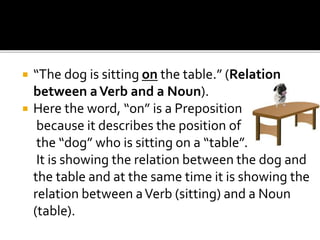
 “The dog is sitting on the table.” (Relation
between aVerb and a Noun).
 Here the word, “on” is a Preposition
because it describes the position of
the “dog” who is sitting on a “table”.
It is showing the relation between the dog and
the table and at the same time it is showing the
relation between aVerb (sitting) and a Noun
(table).
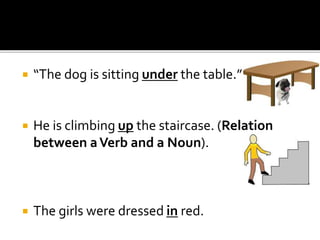
 “The dog is sitting under the table.”
 He is climbing up the staircase. (Relation
between aVerb and a Noun).
 The girls were dressed in red.
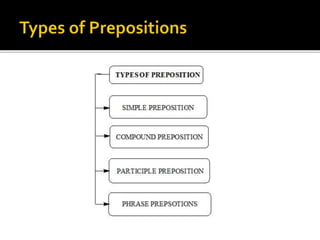
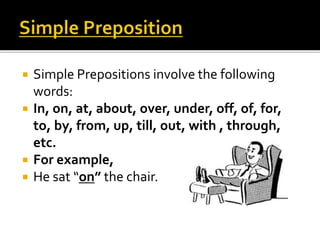
 Simple Prepositions involve the following
words:
 In, on, at, about, over, under, off, of, for,
to, by, from, up, till, out, with , through,
etc.
 For example,
 He sat “on” the chair.
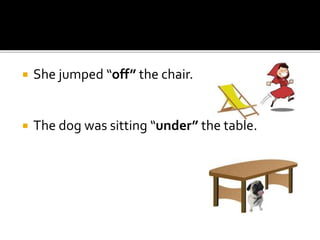
 She jumped “off” the chair.
 The dog was sitting “under” the table.
 Compound Prepositions are
the Prepositions formed by prefixing
the Preposition to a Noun, an Adjective or an
Adverb.
 Compound Prepositions involve the following
words:
 Without (with + out), within (with + in), inside
(in + side), outside (out + side), into (in + to),
below (be + low), behind (be + hind), between,
along, around, across, beyond, about, etc.
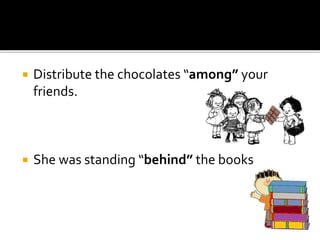
 Distribute the chocolates “among” your
friends.
 She was standing “behind” the books
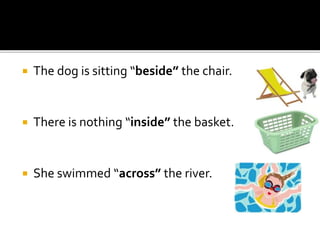
 The dog is sitting “beside” the chair.
 There is nothing “inside” the basket.
 She swimmed “across” the river.
 Participle Prepositions are the present participles of
Verbs that behave like Prepositions.
 These Prepositions are formed by suffixing aVerb with
-ed or –ing.
 Participle Prepositions involve the following words:
 Assuming, barring, considering, during, given,
notwithstanding, provided, regarding, and
respected.
 For example,
 Regarding your queries, please consult the respective
department.
 I am not getting any other reference concerning this topic.
 Phrase Prepositions are group of words that
behave like Prepositions.
 Phrase Prepositions involve the following phrases:
 On behalf of, instead of, because of, by means
of, with regard to, on behalf of, instead of, on
account of, in opposition to, for the sake of etc.
 For example,
 You should study “instead of” wasting time watching
T.V.
 You should stay “away from” strangers.
 Many a time same words are used as
Prepositions and sometimes as Adverbs as
well.
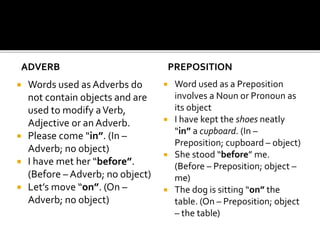
ADVERB
 Words used as Adverbs do
not contain objects and are
used to modify aVerb,
Adjective or an Adverb.
 Please come “in”. (In –
Adverb; no object)
 I have met her “before”.
(Before – Adverb; no object)
 Let’s move “on”. (On –
Adverb; no object)
PREPOSITION
 Word used as a Preposition
involves a Noun or Pronoun as
its object
 I have kept the shoes neatly
“in” a cupboard. (In –
Preposition; cupboard – object)
 She stood “before” me.
(Before – Preposition; object –
me)
 The dog is sitting “on” the
table. (On – Preposition; object
– the table)
 The words that come after the Preposition
are act as object to the Preposition.
 For example,
 The bird is “on” the tree.
 The object for a Preposition could be a Noun,
pronoun, clause or an Adverb.
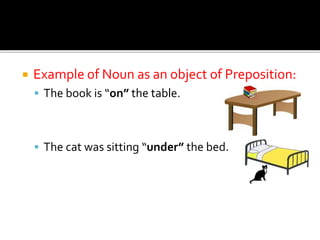
 Example of Noun as an object of Preposition:
 The book is “on” the table.
 The cat was sitting “under” the bed.
 Example of Pronoun as an object of Preposition:
 The professor looked “at” him angrily.
 He is sitting “in” the room.
 Clause is refers to a group of words having some
meaning. It also has a subject and a predicate.
Example of clause as an object of Preposition:
 There is no use of paying attention “to” what she
did.
 You should be shameful “for” what you did.
 Example of Adverbs as an object of
Preposition:
 She must have met him “by”
 Your negligence is going “to” pay you one day.
Thank you

English grammer preposition

  • 1.
    By: Amisha APatel M.E.Electronics & Communication Engg
  • 2.
     Prepositions areshort words that are normally placed either before or after a Noun to indicate the location or position of a Noun.  It shows the relation of a Noun/ProNoun to something else (Noun/Verb/AdVerb).  For example, The bird is on the tree. (Relation between two Nouns)  In this example the Preposition, “on” is showing the relation between the two Nouns bird and tree.
  • 3.
     “The dogis sitting on the table.” (Relation between aVerb and a Noun).  Here the word, “on” is a Preposition because it describes the position of the “dog” who is sitting on a “table”. It is showing the relation between the dog and the table and at the same time it is showing the relation between aVerb (sitting) and a Noun (table).
  • 4.
     “The dogis sitting under the table.”  He is climbing up the staircase. (Relation between aVerb and a Noun).  The girls were dressed in red.
  • 6.
     Simple Prepositionsinvolve the following words:  In, on, at, about, over, under, off, of, for, to, by, from, up, till, out, with , through, etc.  For example,  He sat “on” the chair.
  • 7.
     She jumped“off” the chair.  The dog was sitting “under” the table.
  • 8.
     Compound Prepositionsare the Prepositions formed by prefixing the Preposition to a Noun, an Adjective or an Adverb.  Compound Prepositions involve the following words:  Without (with + out), within (with + in), inside (in + side), outside (out + side), into (in + to), below (be + low), behind (be + hind), between, along, around, across, beyond, about, etc.
  • 9.
     Distribute thechocolates “among” your friends.  She was standing “behind” the books
  • 10.
     The dogis sitting “beside” the chair.  There is nothing “inside” the basket.  She swimmed “across” the river.
  • 11.
     Participle Prepositionsare the present participles of Verbs that behave like Prepositions.  These Prepositions are formed by suffixing aVerb with -ed or –ing.  Participle Prepositions involve the following words:  Assuming, barring, considering, during, given, notwithstanding, provided, regarding, and respected.  For example,  Regarding your queries, please consult the respective department.  I am not getting any other reference concerning this topic.
  • 12.
     Phrase Prepositionsare group of words that behave like Prepositions.  Phrase Prepositions involve the following phrases:  On behalf of, instead of, because of, by means of, with regard to, on behalf of, instead of, on account of, in opposition to, for the sake of etc.  For example,  You should study “instead of” wasting time watching T.V.  You should stay “away from” strangers.
  • 13.
     Many atime same words are used as Prepositions and sometimes as Adverbs as well.
  • 14.
    ADVERB  Words usedas Adverbs do not contain objects and are used to modify aVerb, Adjective or an Adverb.  Please come “in”. (In – Adverb; no object)  I have met her “before”. (Before – Adverb; no object)  Let’s move “on”. (On – Adverb; no object) PREPOSITION  Word used as a Preposition involves a Noun or Pronoun as its object  I have kept the shoes neatly “in” a cupboard. (In – Preposition; cupboard – object)  She stood “before” me. (Before – Preposition; object – me)  The dog is sitting “on” the table. (On – Preposition; object – the table)
  • 15.
     The wordsthat come after the Preposition are act as object to the Preposition.  For example,  The bird is “on” the tree.  The object for a Preposition could be a Noun, pronoun, clause or an Adverb.
  • 16.
     Example ofNoun as an object of Preposition:  The book is “on” the table.  The cat was sitting “under” the bed.
  • 17.
     Example ofPronoun as an object of Preposition:  The professor looked “at” him angrily.  He is sitting “in” the room.  Clause is refers to a group of words having some meaning. It also has a subject and a predicate. Example of clause as an object of Preposition:  There is no use of paying attention “to” what she did.  You should be shameful “for” what you did.
  • 18.
     Example ofAdverbs as an object of Preposition:  She must have met him “by”  Your negligence is going “to” pay you one day.
  • 19.