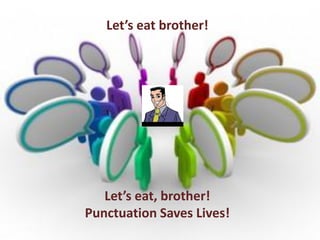
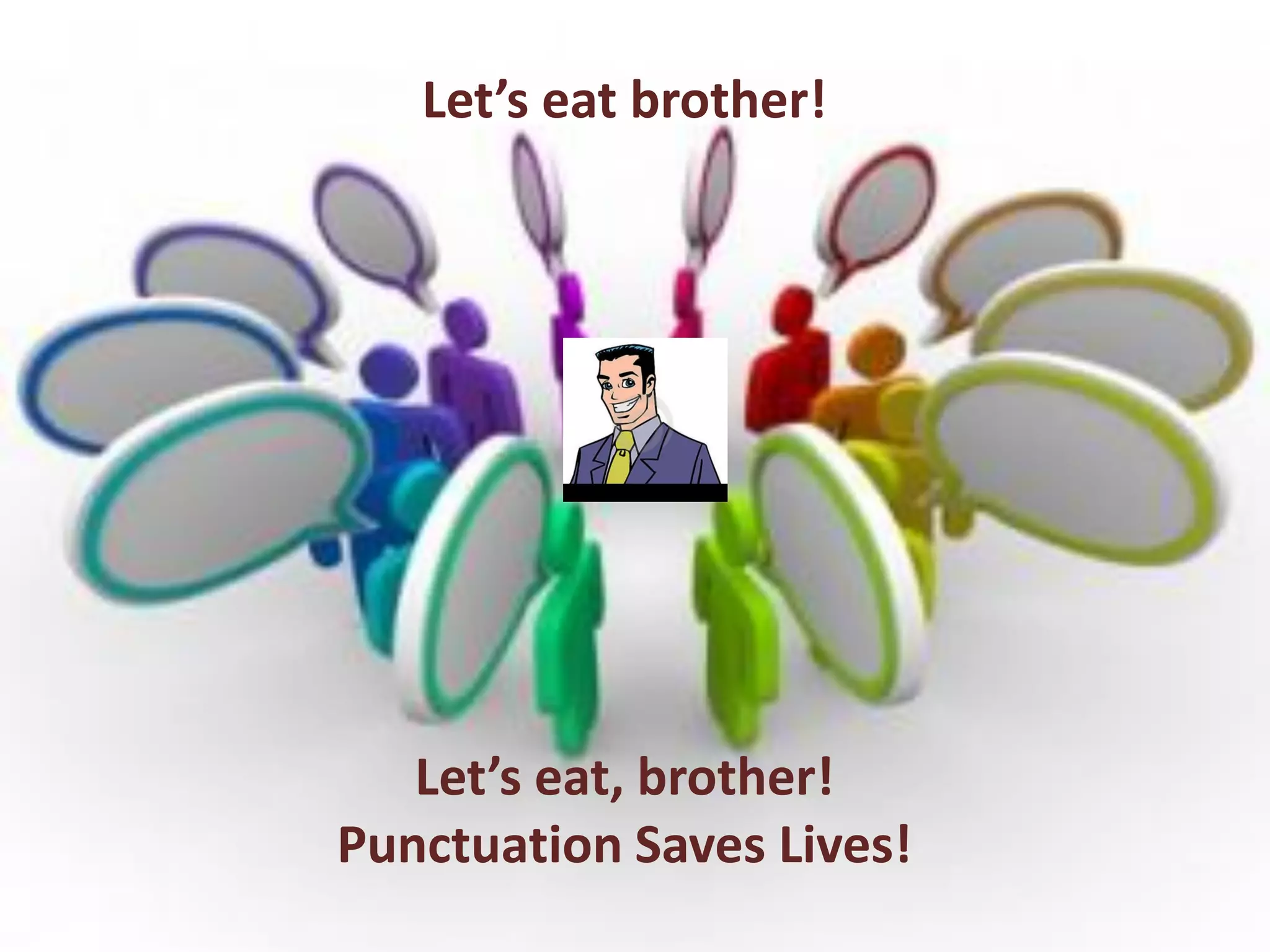
Let’s eat brother!

Let’s eat, brother!
Punctuation Saves Lives!
Managing Internal
Communication
Facilitated by: Ashak Hossan
Exercise Sheet:02
Answers
1
2

3
4
5
6
7
8
9

10
11

Full Stop
Commas
Semicolon
Colon
Apostrophe
Hyphen
Dash
Brackets
Inverted Commas
Exclamation mark
Question mark

a

?
;
:
!

b

A'

c

,
‘x’ / ‘’x‘’
[]{}()
.

a
b

c
d

d
a

b
c
.

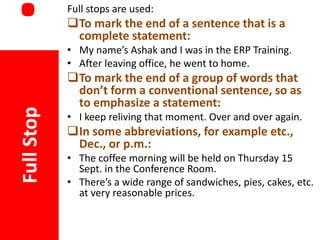
Full stops are used:

To mark the end of a sentence that is a
complete statement:

Full Stop

• My name’s Ashak and I was in the ERP Training.
• After leaving office, he went to home.

To mark the end of a group of words that
don’t form a conventional sentence, so as
to emphasize a statement:
• I keep reliving that moment. Over and over again.

In some abbreviations, for example etc.,
Dec., or p.m.:
• The coffee morning will be held on Thursday 15
Sept. in the Conference Room.
• There’s a wide range of sandwiches, pies, cakes, etc.
at very reasonable prices.
,

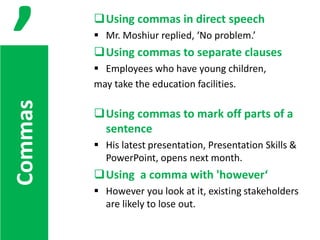
Using commas in direct speech
 Mr. Moshiur replied, ‘No problem.’

Using commas to separate clauses

Commas

 Employees who have young children,
may take the education facilities.

Using commas to mark off parts of a
sentence
 His latest presentation, Presentation Skills &
PowerPoint, opens next month.

Using a comma with 'however‘
 However you look at it, existing stakeholders
are likely to lose out.
Semicolon

;
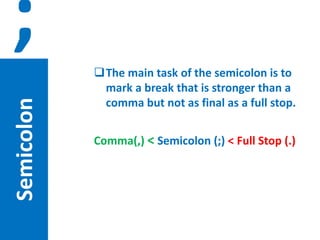
The main task of the semicolon is to
mark a break that is stronger than a
comma but not as final as a full stop.

Comma(,) < Semicolon (;) < Full Stop (.)
Colon

:

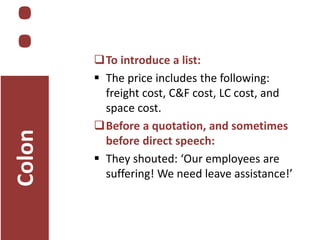
To introduce a list:
 The price includes the following:
freight cost, C&F cost, LC cost, and
space cost.
Before a quotation, and sometimes
before direct speech:
 They shouted: ‘Our employees are
suffering! We need leave assistance!’
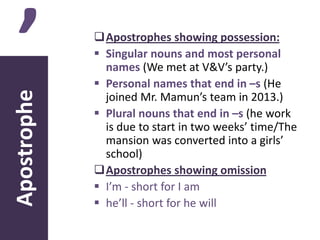
Apostrophe

’

Apostrophes showing possession:
 Singular nouns and most personal
names (We met at V&V’s party.)
 Personal names that end in –s (He
joined Mr. Mamun’s team in 2013.)
 Plural nouns that end in –s (he work
is due to start in two weeks’ time/The
mansion was converted into a girls’
school)
Apostrophes showing omission
 I’m - short for I am
 he’ll - short for he will
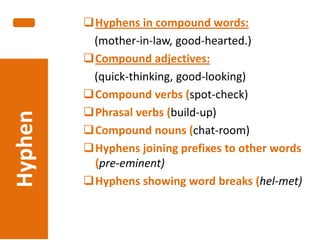
Hyphen

-

Hyphens in compound words:
(mother-in-law, good-hearted.)
Compound adjectives:
(quick-thinking, good-looking)
Compound verbs (spot-check)
Phrasal verbs (build-up)
Compound nouns (chat-room)
Hyphens joining prefixes to other words
(pre-eminent)
Hyphens showing word breaks (hel-met)
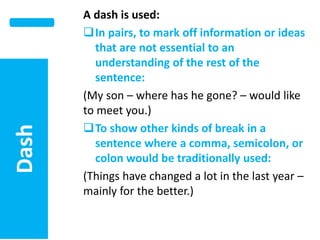
Dash

–

A dash is used:
In pairs, to mark off information or ideas
that are not essential to an
understanding of the rest of the
sentence:
(My son – where has he gone? – would like
to meet you.)
To show other kinds of break in a
sentence where a comma, semicolon, or
colon would be traditionally used:
(Things have changed a lot in the last year –
mainly for the better.)
()[]

Round brackets
(also called parentheses) are mainly used to
separate off information that isn’t essential to the
meaning of the rest of the sentence.
(There are several books on the subject (see page
120)

Brackets

Square brackets:
(Square brackets are mainly used to enclose words
added by someone other than the original writer
or speaker, typically in order to clarify the
situation:)

He [Team Member] can’t prove they did it.
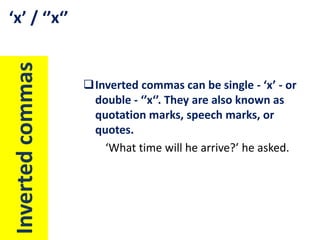
Inverted commas

‘x’ / ‘’x‘’

Inverted commas can be single - ‘x’ - or
double - ‘’x‘’. They are also known as
quotation marks, speech marks, or
quotes.
‘What time will he arrive?’ he asked.
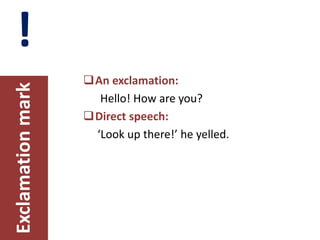
Exclamation mark

!
An exclamation:
Hello! How are you?
Direct speech:
‘Look up there!’ he yelled.
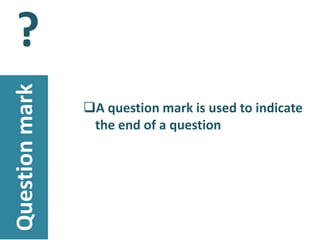
Question mark

?
A question mark is used to indicate
the end of a question
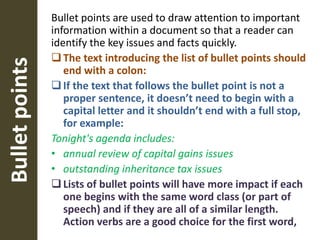
Bullet points

Bullet points are used to draw attention to important
information within a document so that a reader can
identify the key issues and facts quickly.
 The text introducing the list of bullet points should
end with a colon:
 If the text that follows the bullet point is not a
proper sentence, it doesn’t need to begin with a
capital letter and it shouldn’t end with a full stop,
for example:
Tonight's agenda includes:
• annual review of capital gains issues
• outstanding inheritance tax issues
 Lists of bullet points will have more impact if each
one begins with the same word class (or part of
speech) and if they are all of a similar length.
Action verbs are a good choice for the first word,
Source:
http://www.oxforddictionaries.com/

Punctuation in action

  • 1.
    Let’s eat brother! Let’seat, brother! Punctuation Saves Lives!
  • 2.
  • 4.
    Exercise Sheet:02 Answers 1 2 3 4 5 6 7 8 9 10 11 Full Stop Commas Semicolon Colon Apostrophe Hyphen Dash Brackets InvertedCommas Exclamation mark Question mark a ? ; : ! b A' c , ‘x’ / ‘’x‘’ []{}() . a b c d d a b c
  • 5.
    . Full stops areused: To mark the end of a sentence that is a complete statement: Full Stop • My name’s Ashak and I was in the ERP Training. • After leaving office, he went to home. To mark the end of a group of words that don’t form a conventional sentence, so as to emphasize a statement: • I keep reliving that moment. Over and over again. In some abbreviations, for example etc., Dec., or p.m.: • The coffee morning will be held on Thursday 15 Sept. in the Conference Room. • There’s a wide range of sandwiches, pies, cakes, etc. at very reasonable prices.
  • 6.
    , Using commas indirect speech  Mr. Moshiur replied, ‘No problem.’ Using commas to separate clauses Commas  Employees who have young children, may take the education facilities. Using commas to mark off parts of a sentence  His latest presentation, Presentation Skills & PowerPoint, opens next month. Using a comma with 'however‘  However you look at it, existing stakeholders are likely to lose out.
  • 7.
    Semicolon ; The main taskof the semicolon is to mark a break that is stronger than a comma but not as final as a full stop. Comma(,) < Semicolon (;) < Full Stop (.)
  • 8.
    Colon : To introduce alist:  The price includes the following: freight cost, C&F cost, LC cost, and space cost. Before a quotation, and sometimes before direct speech:  They shouted: ‘Our employees are suffering! We need leave assistance!’
  • 9.
    Apostrophe ’ Apostrophes showing possession: Singular nouns and most personal names (We met at V&V’s party.)  Personal names that end in –s (He joined Mr. Mamun’s team in 2013.)  Plural nouns that end in –s (he work is due to start in two weeks’ time/The mansion was converted into a girls’ school) Apostrophes showing omission  I’m - short for I am  he’ll - short for he will
  • 10.
    Hyphen - Hyphens in compoundwords: (mother-in-law, good-hearted.) Compound adjectives: (quick-thinking, good-looking) Compound verbs (spot-check) Phrasal verbs (build-up) Compound nouns (chat-room) Hyphens joining prefixes to other words (pre-eminent) Hyphens showing word breaks (hel-met)
  • 11.
    Dash – A dash isused: In pairs, to mark off information or ideas that are not essential to an understanding of the rest of the sentence: (My son – where has he gone? – would like to meet you.) To show other kinds of break in a sentence where a comma, semicolon, or colon would be traditionally used: (Things have changed a lot in the last year – mainly for the better.)
  • 12.
    ()[] Round brackets (also calledparentheses) are mainly used to separate off information that isn’t essential to the meaning of the rest of the sentence. (There are several books on the subject (see page 120) Brackets Square brackets: (Square brackets are mainly used to enclose words added by someone other than the original writer or speaker, typically in order to clarify the situation:) He [Team Member] can’t prove they did it.
  • 13.
    Inverted commas ‘x’ /‘’x‘’ Inverted commas can be single - ‘x’ - or double - ‘’x‘’. They are also known as quotation marks, speech marks, or quotes. ‘What time will he arrive?’ he asked.
  • 14.
    Exclamation mark ! An exclamation: Hello!How are you? Direct speech: ‘Look up there!’ he yelled.
  • 15.
    Question mark ? A questionmark is used to indicate the end of a question
  • 16.
    Bullet points Bullet pointsare used to draw attention to important information within a document so that a reader can identify the key issues and facts quickly.  The text introducing the list of bullet points should end with a colon:  If the text that follows the bullet point is not a proper sentence, it doesn’t need to begin with a capital letter and it shouldn’t end with a full stop, for example: Tonight's agenda includes: • annual review of capital gains issues • outstanding inheritance tax issues  Lists of bullet points will have more impact if each one begins with the same word class (or part of speech) and if they are all of a similar length. Action verbs are a good choice for the first word,
  • 17.