PUNCTUATION MARKS

   Lic. Cristina Morocho
• Merriam-Webster Dictionary: “any of
  various standardized marks or signs
  used in punctuation”
• Symbols that indicate:
  – structure and organization of written
    language,
  – intonation and pauses to be observed
    when reading aloud.
• Capital letters are also used to help us
  organize meaning and to structure the
  sense of our writing.
Period
•  Used to mark the end (as of a declarative sentence or
  an abbreviation).
• There is no space between the last letter and the
  period.
• Use one space between the period and the first letter
  of the next sentence.
• 1. to mark the end of a sentence which is not a
  question or an exclamation (including imperative
  sentences).
Quito is the capital of Ecuador.
The boy plays with his balloon.
Close the window, please.
• 2. to indicate an abbreviation
   I will be in between 6 a.m. and 7 p.m.
• 3. special case - three dots
  Only part of the sentence or text has been
  quoted or that it is being left up to the reader to
  complete the rest of the sentence.
   The Lord's Prayer begins, 'Our Father who are in
    Heaven...'
• 4. full-stop after a single word
  Sometimes a single word can form the
  sentence.
   "Goodbye."
   "Hello."
Comma
• To add to the meaning of a sentence or to
  emphasize an item, point or meaning.
• To help us add 'breathing spaces' to
  sentences they are.
• To organize blocks of thought or logical
  groupings.
• 1. To separate phrases, words, or clauses
  in lists
  – On my birthday I went to the cinema, ate dinner in
    a restaurant, and went dancing.
  – The meal consisted of soup, fish, chicken,
    dessert and coffee.
• 2. To enclose insertions or comments. The
  comma is placed on either side of the
  insertion.
  – China, one of the most powerful nations on Earth,
    has a huge population.
• 3. To mark off a participial phrase
  – Hearing that her father was in hospital, Jane left
    work immediately.
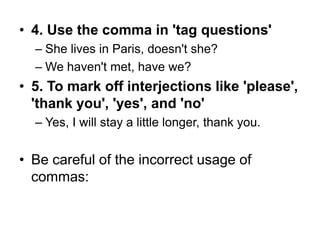
• 4. Use the comma in 'tag questions'
  – She lives in Paris, doesn't she?
  – We haven't met, have we?
• 5. To mark off interjections like 'please',
  'thank you', 'yes', and 'no'
  – Yes, I will stay a little longer, thank you.


• Be careful of the incorrect usage of
  commas:
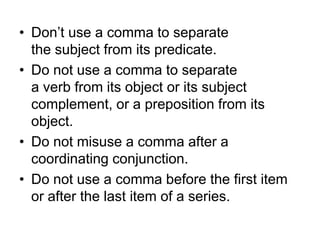
• Don’t use a comma to separate
  the subject from its predicate.
• Do not use a comma to separate
  a verb from its object or its subject
  complement, or a preposition from its
  object.
• Do not misuse a comma after a
  coordinating conjunction.
• Do not use a comma before the first item
  or after the last item of a series.
Semicolon
• The semicolon is somewhere between a
  weak full stop and a strong comma.
• Join phrases and sentences without
  having to use a conjunction (and, but etc.)
  – phrases or sentences are thematically linked
    but independent.
  – Join only those independent clauses that are
    closely related in meaning.
Examples:
• Abdominal exercises help prevent back pain;
  proper posture is also important.
• The auditors made six recommendations;
  however, only one has been adopted so far.
THANK YOU!

Punctuation marks ii bim

  • 1.
    PUNCTUATION MARKS Lic. Cristina Morocho
  • 2.
    • Merriam-Webster Dictionary:“any of various standardized marks or signs used in punctuation” • Symbols that indicate: – structure and organization of written language, – intonation and pauses to be observed when reading aloud. • Capital letters are also used to help us organize meaning and to structure the sense of our writing.
  • 3.
    Period • Usedto mark the end (as of a declarative sentence or an abbreviation). • There is no space between the last letter and the period. • Use one space between the period and the first letter of the next sentence. • 1. to mark the end of a sentence which is not a question or an exclamation (including imperative sentences). Quito is the capital of Ecuador. The boy plays with his balloon. Close the window, please.
  • 4.
    • 2. toindicate an abbreviation I will be in between 6 a.m. and 7 p.m. • 3. special case - three dots Only part of the sentence or text has been quoted or that it is being left up to the reader to complete the rest of the sentence. The Lord's Prayer begins, 'Our Father who are in Heaven...' • 4. full-stop after a single word Sometimes a single word can form the sentence. "Goodbye." "Hello."
  • 5.
    Comma • To addto the meaning of a sentence or to emphasize an item, point or meaning. • To help us add 'breathing spaces' to sentences they are. • To organize blocks of thought or logical groupings.
  • 6.
    • 1. Toseparate phrases, words, or clauses in lists – On my birthday I went to the cinema, ate dinner in a restaurant, and went dancing. – The meal consisted of soup, fish, chicken, dessert and coffee. • 2. To enclose insertions or comments. The comma is placed on either side of the insertion. – China, one of the most powerful nations on Earth, has a huge population. • 3. To mark off a participial phrase – Hearing that her father was in hospital, Jane left work immediately.
  • 7.
    • 4. Usethe comma in 'tag questions' – She lives in Paris, doesn't she? – We haven't met, have we? • 5. To mark off interjections like 'please', 'thank you', 'yes', and 'no' – Yes, I will stay a little longer, thank you. • Be careful of the incorrect usage of commas:
  • 8.
    • Don’t usea comma to separate the subject from its predicate. • Do not use a comma to separate a verb from its object or its subject complement, or a preposition from its object. • Do not misuse a comma after a coordinating conjunction. • Do not use a comma before the first item or after the last item of a series.
  • 9.
    Semicolon • The semicolonis somewhere between a weak full stop and a strong comma. • Join phrases and sentences without having to use a conjunction (and, but etc.) – phrases or sentences are thematically linked but independent. – Join only those independent clauses that are closely related in meaning.
  • 10.
    Examples: • Abdominal exerciseshelp prevent back pain; proper posture is also important. • The auditors made six recommendations; however, only one has been adopted so far.
  • 11.