Sampling Techniques and Sample Size
Determination
By
Khem Raj Subedi
Associate Professor
TMC
Sampling Technique and Sample
Size Determination
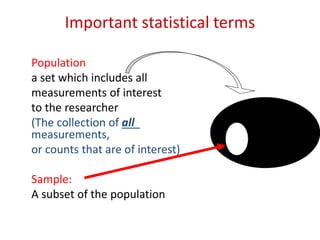
Important statistical terms
Population:
a set which includes all
measurements of interest
to the researcher
(The collection of all responses,
measurements,
or counts that are of interest)
Sample:
A subset of the population
Population -hg;+Vof _
• 'Population refers to all the individuals
or objects on which we have to make
some study.'
cg';Gwfgsf] nflu 5gf]6 ul/Psf ;Dk"0f{ dflg;Pjd
j:t'x¿sf] ;d"xnfO{ ;du|jf hg;+VofelgG5.
• Finite Population l;ldt hg;+Vof
• Infinite Population cl;ldt hg;+Vof
Sample-gd'gf_
The representative proportion of the population is
called a sample. 7"nf] hg;+Vofaf6 5gf]6 ul/Psf] k|ltlglwd"ns
;d"xnfO{ g} gd"gf elgG5 .
Koul (2009: 111) sf cg';f/ æhg;ªVofsf] k|ltlglwd"nsc+znfO{ g}
gd'gf elgG5 .Æ (The respresentative portion of the
population is called sample).
Best & Khan (1998: 13) sf cg';f/ ægd'gfPp6f cjnf]sg /
ljZn]if0fsf nflu hg;ªVofaf6 5gf]6 ul/Psf] ;fgf] cg'kftxf] .Æ (A
sample is a small proportion of a population
selected for observation and analysis.)
Characteristics of a good sample
• A true representative of the population
• Free from error due to bias
• Adequate in size for being reliable
• Units of sample should be complete
precise and up to date
• free from random sampling error
Sampling gd"gf 5gf]6
• Sampling is the process of selecting a
representative part of a population for
the purpose of determining the
characteristics of the whole population.
• Gfd"gf 5gf]6 To:tf] k|lqmof xf] h;4f/f Jolqm, j:t' /
36gfx¿sf] ;fgf] ;+Vof 5gf]6 ul/G5 / ;Dk"0f{ hg;+Vofsf]
af/]dfslx s'/f kQfnufpgljZn]if0ful/G5.
Definitions of Sampling
• Kerlinger (1986:110) sf cg';f/ æhg;ªVof jf ;du|tfsf] k|ltlglwTj x'g] u/L
hg;ªVofsf] s]xL efu 5gf]6 ul/g] k|lj|mofnfO{ gd'gf 5gf]6 (sampling)
elgG5 . (sampling is process of selecting any portion of a
population or universe as representative of the
population or universe).
• Koul (2009: 111) sf cg';f/ ægd'gf 5gf]6 To:tf] k|lj|mof xf] h;åf/f JolQm,
j:t' / 36gfx¿sf] ;fk]lIft ¿kdf ;fgf] ;ªVof 5gf]6 ul/G5 / ;Dk"0f{ hg;ªVofsf af/]df
s]xLs'/fkQfnufO{ljZn]if0ful/G5 .Æ
• Sampling is the process by which a relatively small
number of individuals, objects or events is selected and
analyzed in order to find out something about the
entire population.
Why sampling?
• Get information about large populations
• Less costs
• Less field time
• More accuracy i.e. Can Do A Better Job of Data
Collection
• When it’s impossible to study the whole
population
Steps in sampling Method
• Defining the population
hg;+VofnfO{ kl/efliftug]{
• Listing the population (Sampling Frame)
hg;+Vofsf] ;"lr tof/ ug]{
• Selecting the representative sample
hg;+Vofsf] k|ltlgwLd"ns gd'gf 5g]6 ug]{
• Obtaining an adequate sample cfjZos
gd'gf k|fKtug]{
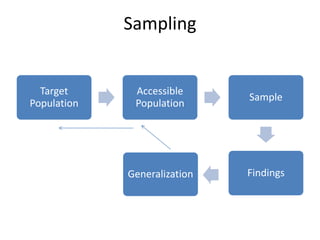
Sampling
Target
Population
Accessible
Population
Sample
FindingsGeneralization
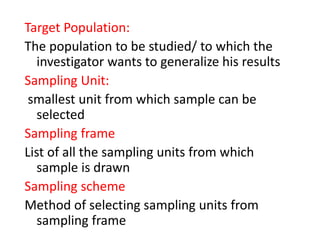
Target Population:
The population to be studied/ to which the
investigator wants to generalize his results
Sampling Unit:
smallest unit from which sample can be
selected
Sampling frame
List of all the sampling units from which
sample is drawn
Sampling scheme
Method of selecting sampling units from
sampling frame
Sampling Techniques
& Samples Types
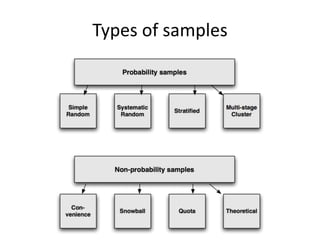
Types of sampling in researches
Probability
samples
;+efjgfo'Qm gd'gf
5gf}]6
Non-
probability
samples
;+efgf/lxt gd'gf
5gf}]6
Types of samples
;+efjgfo"Qmgd'gf 5gf]6
(Probability Sampling)
• ;+efjgfo'Qm gd'gf 5gf]6nfO{ ;+of]u gd'gf 5gf]6 (chance
sampling) jf b}jLgd'gf5gf]6 (random sampling) klgelgG5 .
• o; ljlwdf cWoog hg;ªVofsf] k|To]s PsfOx¿ gd'gfsf ¿kdf 5gf]6 x'g ;Sg]
a/fa/ ;+efjgf x'G5 . To;}n] of] gd'gf 5gf]6 ljlw k"0f{ ¿kdf kIfkft /lxt
dflgG5 .
• cg';GwfgnfO{ a9L k|ltlglwd"ns Pjd kIfkft/lxt agfpgsf nflu ;Defjgfo'Qm
gd'gf5gf]6 k4ltsf]pkof]u ul/G5.
Simple Random Sample
• Every subset of a specified size n from the
population has an equal chance of being
selected
• Gay (1976: 68) sf cg';f/ æ;fdfGo ;+efjgfo'Qm gd'gf 5gf]6 cg';Gwfgsf] nflu
gd'gf 5gf]6 ug{] To:tf] ljlw xf] h;df kl/eflift ul/Psf] hg;ªVofdf /x]sf ;a} JolQmx¿
gd'gfsf] ¿kdf 5gf]6 x'g] ;Defjgf ;dfg / :jtGq
x'G5Æ .
• d'Vou/L lgDg ljlwx¿dWo] s'g} Psljlwsf] k|of]u ug{ ;lsG5 .
• uf]nf k|yf ljlw(Lottery method)
• ufO{ lqz'n (Coin-toss method)
• sf8{ ljlw(Card method)
• b}ljs c+ssf] tflnsfsf] k|of]u (Table of random number)
• Kjfn ljlw(Grid method)
• sDKo'6/ ljlw(Computer method)
• b}ljs c+s 8fon (Random digit dialing-RDD)
Advantages
1.Easy to conduct
2.High probability of achieving a representative
sample
3. Meets assumptions of many statistical
procedures
Disadvantages
1.Identification of all members of the population
can be difficult
2. Contacting all members of the sample can be
difficult
Systematic Sample
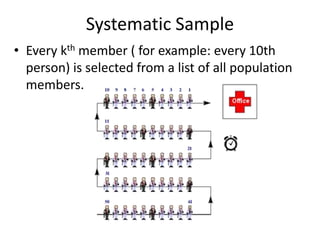
• Every kth member ( for example: every 10th
person) is selected from a list of all population
members.
Jojl:ytgd'gf 5gf]6 ljlw
(Systematic sampling)
• Jojl:yt gd'gf 5gf]6 To:tf] ljlw xf], h;df ;+efJotfsf cfwf/df ;du|
hg;ªVofaf6 Pp6f PsfO -gd'gf_ sf] 5gf]6 u/L lglZrt gd'gf cGt/
(sample interval) sf cfwf/df cGo afFsL gd'gfsf] 5gf]6
ul/G5 . o;nfO{cw{ ;+efjgfo'Qmgd'gf 5gf]6 klgelgG5 .
gd'gf 5gf]6 cGt /fn (Sampling Interval) =
(Sizeof population)
(Sizeof samplerequired)
hg; V+ofsf]cfsf/
r flxg]gd'gfsf]cfsf/
K = N
n
Advantage
•Very easily done
Disadvantages
•Some members of the population don’t
have an equal chance of being included
Stratified Random Sample
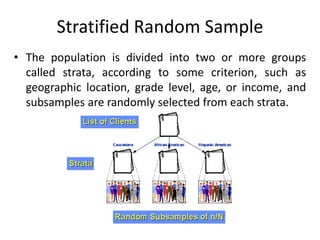
• The population is divided into two or more groups
called strata, according to some criterion, such as
geographic location, grade level, age, or income, and
subsamples are randomly selected from each strata.
:tLl/s[t gd'gf 5gf]6
(stratified sampling):
• ;du|tf jf cWoog hg;+Vof leq /x]sf ljleGg PsfOx?sf] ljz]iftfsf cfwf/df
PsfOx?nfO{ :t/Ls[t u/L ;+efjgfo'Qm gd'gf 5gf]6 (random sampling)
ljwLaf6 gd'gf 5gf]6 ug]{ k|lqmof jf tl/sfnfO{ :t/Ls[t gd'gf 5gf]6 (Stratified
sampling) elgG5.
• obL cWoog hg;+Vofsf] :j?k jf jgfj6 c;dfg (heterogeneous) 5 eg] To;
cj:yfdf:t/Ls[tgd'gf5gf]6ljwLj9Lpko'Qmx'G5 .
• :t/Ls[t gd'gf 5gf]6 ljlw k|of]u ubf{ cg';Gwfgsf] p2]Zo cg';f/ cWoog
hg;ªVofnfO{ ln·, pd]/, z}lIfs cj:yf, k];f, wd{, hftL, a;f]af; If]q -zx/÷ufpF_,
;fdflhs cfly{s cj:yf, ef}uf]lns If]q h:tf ljz]iftfx¿sf cfwf/df ljleGg ju{ (Strata)
df ljefhg ul/G5 / k|To]s ju{af6 ;Defjgfo'Qm gd'gf 5gf]6 ljlwsf] k|of]u u/L
gd'gf5gf]6ul/G5 .
Advantages
•More accurate sample
•Can be used for both proportional and non-
proportional samples
•Representation of subgroups in the sample
Disadvantages
•Identification of all members of the population can
be difficult
•Identifying members of all subgroups can be
difficult
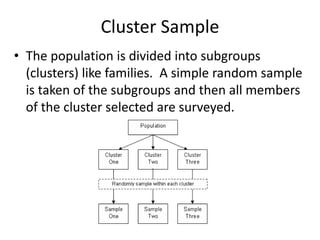
Cluster Sample
• The population is divided into subgroups
(clusters) like families. A simple random sample
is taken of the subgroups and then all members
of the cluster selected are surveyed.
em'08 gd'gf 5gf]6
(Cluster Sampling)
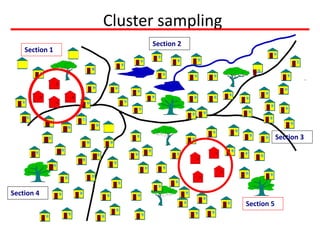
• of] ljlw cl;ldt hg;ªVof (infinite population) ePdf, hg;ªVofsf]
;"rL k|fKt x'g g;Sbf jf hg;ªVof 5l/P/ (scatter) /x]sf] cj:yfdf tyf
hg;ªVofsf] ef}uf]lns ljt/0f 7"nf] ePsf] cj:yfdf a9L pko'Qm x'G5
(Best and Khan, 1999:18) . ;du| hg;ªVof jf If]qnfO{ ljleGg
e'm08df ljefhg u/L gd'gf 5gf]6 ug{] ljlwnfO{ em"08 gd'gf 5gf]6
(Cluster sampling) elgG5 .
Cluster sampling
Section 4
Section 5
Section 3
Section 2
Section 1
Advantages
•Very useful when populations are large and
spread over a large geographic region
•Convenient and expedient
•Do not need the names of everyone in the
population
Disadvantages
•Representation is likely to become an issue
ax'r/0f gd'gf 5gf]6 (Multistage Sampling)
• ;du| hg;ªVofnfO{ ljleGg txdf Pskl5 csf{] ljefhg ub{} tNnf] txdf
k'u]/ gd'gf 5gf]6 ug{] ljlwnfO{ ax'tx gd'gf 5gf]6 (Multistage
sampling) elgG5 . o; gd'gf 5gf]6 ljlw cg';f/ cg';Gwfgsf nflu
gd'gf 5gf]6 ubf{ ljleGg r/0fx¿df ljefhg u/L ax'txaf6 clt z'Id PsfOdf
k'u]/gd'gf 5gf]6 ul/G5 .
Non-Probability Sampling
• s'g} hg;ªVofaf6cWoogsf nflu5gf]6 ul/g]gd'gf;+of]usf]
cfwf/df geO{ k"j{lgwf{l/t;f]r jf ljrf/sf cfwf/df ul/G5, h;df k|To]s
PsfOx¿ gd'gfsf¿kdf 5gf]6 x'g] ;+efjgfx'Fb}geg] To;nfO{;+efjgf
/lxtgd'gf 5gf]6 (Non-Probability Sampling) elgG5 .
• Pant (2012) sf cg';f/ "Non-Probability sampling
is described as those samples, which are not
determined by chances but rather by personal
convenience or judgment of the researcher."
;+efjgf/lxtgd'gf5gf]6 ljlwsf]k|of]ux'g]cj:yfx¿
• ha hg;ªVofsfPsfOx¿sf];ªVofyfxfgePsf]cj:yfdfjfJolQmut¿kdfklxrfg
gePsf]cj:yfdf.
• cg';Gwfgstf{n];+efjgfo'Qmgd'gf5gf]6ubf{hg;ªVofsfaf/]dfk"0f{hfgsf/L
k|fKtgePsf]n]cj:yfdf.
• cg';Gwfgstf{n]cWoogsf36gfx¿sf]7"nf];ªVof;dfj]zug{ c;+ej÷cJojxfl/sdx;';
u/]sfn] cj:yfdf.
• olbcg';Gwfgu'0ffTdsk|s[ltsf]Pj+36gfcWoogePdf.
• ;+efjgfo'Qmgd'gf5gf]6ljlwdfkm{t5gf]6ul/Psfgd'gfnfO{;Dks{ug{sl7gfO
k|dfl0ftePdf.h:t}M3/ljlxg(homeless) jfnfu'cf}ifw;]jgstf{ (Drug
addicts), dlxnfof}gsdL{x? (Female sex workers) cflbJolQmsf]
cWoog.
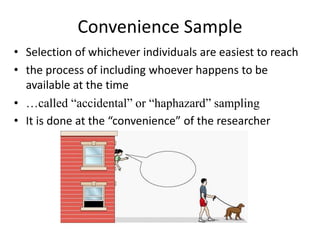
Convenience Sample
• Selection of whichever individuals are easiest to reach
• the process of including whoever happens to be
available at the time
• …called “accidental” or “haphazard” sampling
• It is done at the “convenience” of the researcher
disadvantages…
…difficulty in determining how much
of the effect (dependent variable)
results from the cause (independent
variable)
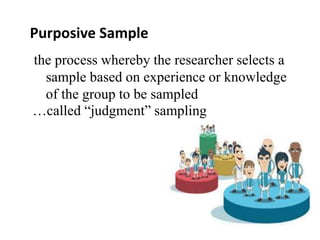
Purposive Sample
the process whereby the researcher selects a
sample based on experience or knowledge
of the group to be sampled
…called “judgment” sampling
p2]Zod"ns gd'gf 5gf]6
(Purposive sampling)
• p2]Zod"ns gd'gf 5gf]6df cg';Gwfgstf{sf] p2]Zo, ?rL / rfxgf cg';f/ gd'gfsf]
5gf]6 ul/G5 . cg';Gwfgstf{n] h'g p2]Zo cGtu{t /x]/ cg';Gwfg sfo{ ug{ nfu]sf]
xf] ;f]xL p2]Zo adf]lhd cfˆgf] JolQmut lg0f{osf cfwf/df gd'gf 5gf]6 u5{ eg]
To:tf] gd'gf 5gf]6 ljlwnfO{ p2]Zod"ns gd'gf 5gf]6 ljlw (purposive
sampling) elgG5.
• o; ljlwdf cg';Gwfgstf{n] gd'gf 5gf]6 ubf{ cfˆgf] ljifout cfwf/ (Subjective
basis), p2]Zo (objective) Pj+ cGtb{[li6 (intuition) k|of]u u/L
cfkm} lg0f{o ug{] ePsf]n] o;nfO{ lg0f{ofTds gd'gf 5gf]6 (Judgemental
sampling) klgelgG5.
disadvantages…
…potential for inaccuracy in the researcher’s
criteria and resulting sample selections
Quota Sample
1. Determine what the population looks like
in terms of specific qualities.
2. Create “quotas” based on those qualities.
3. Select people for each quota.
Quota sampling
• cg';Gwfgstf{n]hg;ªVofnfO{lglZrtljz]iftfsfcfwf/dfljleGg
PsfOx¿nfO{cf/If0fsf¿kdfljleGg;d"x(strata)dfljefhgu/L
cg';Gwfgstf{sf]JolQmut lg0f{osfcfwf/dfk|To]s ;d"xsf];dfg'kflts
k|ltlglwTjx'g]u/Lgd'gf5gf]6ug{]ljlwnfO{cf/If0fgd'gf5gf]6
(Quota sampling) elgG5.
• cWooghg;ªVofnfO{slt;d"xdfljefhgug]{xf], ;f]lg0f{oug{]
• k|To]s ;d"xaf6gd'gfsf]sltk|ltztlng'kg{]xf],;f]s'/flg0f{oug{]
• jf:tljsgd'gfPsfOx¿sf]5gf]6ug{]
disadvantages…
…people who are less accessible (more
difficult to contact, more reluctant to
participate) are under-represented
Snowball Sample
 In this method the first members of the sample
are identified.
 Subsequent members of the sample come by
recommendation or identification by the first
members.
 This does not guarantee a representative sample,
but it can be the best method when the subject of
research is sensitive or relates to a population that is
hard to contact (e.g people engaged in social security
fraud).
Snowball sampling
• :gf]an gd'gf 5gf]6 ljlwaf6 gd'gf 5gf]6 ubf{ ;j{k|yd cWoog
hg;ªVofsf] s'g} Pp6f PsfOnfO{ gd'gfsf] ¿kdf lnO{ To; PsfOsf]
dfWodaf6 cGo PsfOx¿nfO{ kQf nufpFb} gd'gf 5gf]6 ul/G5 . o;
ljlwdf s'g} Ps PsfOsf] klxrfg kl5 5gf]6 ul/Psf] pQm gd'gfn]
lbPsf] ;"rgf jf hfgsf/Lsf cfwf/df csf{] gd'gf 5gf]6 ul/G5 o;/L Ps
kl5 csf{] ub{} k|fKt ;"rgfsf] cfwf/df ;+hfn (network)
k|lj|mofaf6 cfjZos ;ªVofdf gd'gf 5gf]6 ug{] ljlwnfO{ :gf]jn gd'gf
5gf]6 (Snowball sampling) elgG5 .
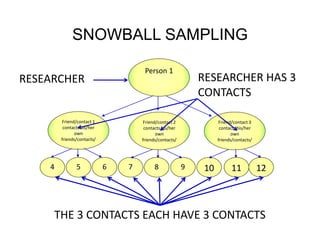
Person 1
Friend/contact 1
contacts his/her
own
friends/contacts/
Friend/contact 2
contacts his/her
own
friends/contacts/
Friend/contact 3
contacts his/her
own
friends/contacts/
4 5 6 7 8 9 10 11 12
RESEARCHER RESEARCHER HAS 3
CONTACTS
THE 3 CONTACTS EACH HAVE 3 CONTACTS
SNOWBALL SAMPLING
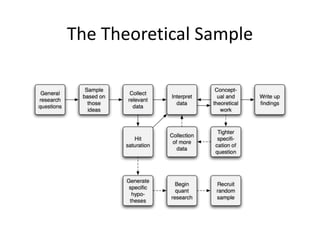
The Theoretical Sample
46
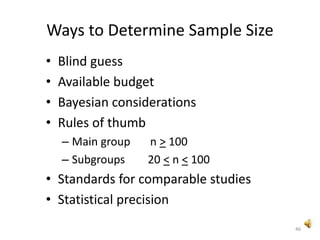
Ways to Determine Sample Size
• Blind guess
• Available budget
• Bayesian considerations
• Rules of thumb
– Main group n > 100
– Subgroups 20 < n < 100
• Standards for comparable studies
• Statistical precision
47
Statistical Precision
Must know:
• Variability of population and individual
stratum
• Acceptable level of sampling error
• Needed level of confidence
• Type of distribution (if non-normal)
48
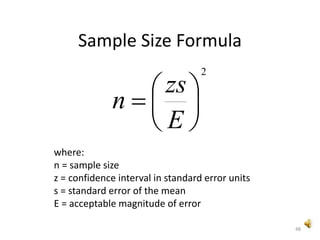
Sample Size Formula
2






E
zs
n
where:
n = sample size
z = confidence interval in standard error units
s = standard error of the mean
E = acceptable magnitude of error
49
Sample Size Formula:
Example #1
Suppose a survey researcher, studying
expenditures on lipstick, wishes to have a 95%
confident level (Z) and a range of error (E) of
less than $2.00. The estimate of the standard
deviation is $29.00.
50
2
E
zs
n 






   2
00.2
00.2996.1





2
00.2
84.56




  2
42.28 808
Calculation: Example #1
51
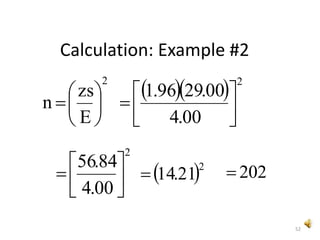
Suppose, in the same example as the one
before, the range of error (E) is acceptable at
$4.00. By how much is sample size is
reduced?
Sample Size Formula:
Example #2
52
2
E
zs
n 






   2
00.4
00.2996.1





2
00.4
84.56






  2
21.14 202
Calculation: Example #2
53
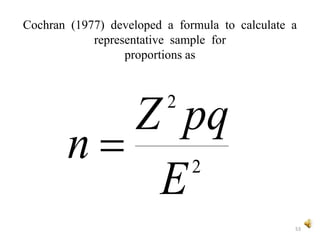
2
2
E
pqZ
n 
Cochran (1977) developed a formula to calculate a
representative sample for
proportions as
54
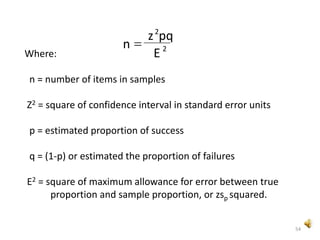
2
2
E
pqz
n 
Where:
n = number of items in samples
Z2 = square of confidence interval in standard error units
p = estimated proportion of success
q = (1-p) or estimated the proportion of failures
E2 = square of maximum allowance for error between true
proportion and sample proportion, or zsp squared.
55
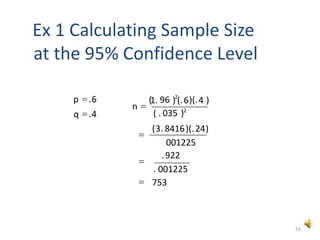
Ex 1 Calculating Sample Size
at the 95% Confidence Level
753
001225.
922.

001225
)24)(.8416.3(

)035( .
)4)(.6(.)961.(
n
4.q
6.p
2
2



Sampling Technique and Sample Size Determination

Sampling Technique and Sample Size Determination

  • 1.
    Sampling Techniques andSample Size Determination By Khem Raj Subedi Associate Professor TMC
  • 2.
    Sampling Technique andSample Size Determination
  • 3.
    Important statistical terms Population: aset which includes all measurements of interest to the researcher (The collection of all responses, measurements, or counts that are of interest) Sample: A subset of the population
  • 4.
    Population -hg;+Vof _ •'Population refers to all the individuals or objects on which we have to make some study.' cg';Gwfgsf] nflu 5gf]6 ul/Psf ;Dk"0f{ dflg;Pjd j:t'x¿sf] ;d"xnfO{ ;du|jf hg;+VofelgG5. • Finite Population l;ldt hg;+Vof • Infinite Population cl;ldt hg;+Vof
  • 5.
    Sample-gd'gf_ The representative proportionof the population is called a sample. 7"nf] hg;+Vofaf6 5gf]6 ul/Psf] k|ltlglwd"ns ;d"xnfO{ g} gd"gf elgG5 . Koul (2009: 111) sf cg';f/ æhg;ªVofsf] k|ltlglwd"nsc+znfO{ g} gd'gf elgG5 .Æ (The respresentative portion of the population is called sample). Best & Khan (1998: 13) sf cg';f/ ægd'gfPp6f cjnf]sg / ljZn]if0fsf nflu hg;ªVofaf6 5gf]6 ul/Psf] ;fgf] cg'kftxf] .Æ (A sample is a small proportion of a population selected for observation and analysis.)
  • 6.
    Characteristics of agood sample • A true representative of the population • Free from error due to bias • Adequate in size for being reliable • Units of sample should be complete precise and up to date • free from random sampling error
  • 7.
    Sampling gd"gf 5gf]6 •Sampling is the process of selecting a representative part of a population for the purpose of determining the characteristics of the whole population. • Gfd"gf 5gf]6 To:tf] k|lqmof xf] h;4f/f Jolqm, j:t' / 36gfx¿sf] ;fgf] ;+Vof 5gf]6 ul/G5 / ;Dk"0f{ hg;+Vofsf] af/]dfslx s'/f kQfnufpgljZn]if0ful/G5.
  • 8.
    Definitions of Sampling •Kerlinger (1986:110) sf cg';f/ æhg;ªVof jf ;du|tfsf] k|ltlglwTj x'g] u/L hg;ªVofsf] s]xL efu 5gf]6 ul/g] k|lj|mofnfO{ gd'gf 5gf]6 (sampling) elgG5 . (sampling is process of selecting any portion of a population or universe as representative of the population or universe). • Koul (2009: 111) sf cg';f/ ægd'gf 5gf]6 To:tf] k|lj|mof xf] h;åf/f JolQm, j:t' / 36gfx¿sf] ;fk]lIft ¿kdf ;fgf] ;ªVof 5gf]6 ul/G5 / ;Dk"0f{ hg;ªVofsf af/]df s]xLs'/fkQfnufO{ljZn]if0ful/G5 .Æ • Sampling is the process by which a relatively small number of individuals, objects or events is selected and analyzed in order to find out something about the entire population.
  • 9.
    Why sampling? • Getinformation about large populations • Less costs • Less field time • More accuracy i.e. Can Do A Better Job of Data Collection • When it’s impossible to study the whole population
  • 10.
    Steps in samplingMethod • Defining the population hg;+VofnfO{ kl/efliftug]{ • Listing the population (Sampling Frame) hg;+Vofsf] ;"lr tof/ ug]{ • Selecting the representative sample hg;+Vofsf] k|ltlgwLd"ns gd'gf 5g]6 ug]{ • Obtaining an adequate sample cfjZos gd'gf k|fKtug]{
  • 11.
  • 12.
    Target Population: The populationto be studied/ to which the investigator wants to generalize his results Sampling Unit: smallest unit from which sample can be selected Sampling frame List of all the sampling units from which sample is drawn Sampling scheme Method of selecting sampling units from sampling frame
  • 13.
  • 14.
    Types of samplingin researches Probability samples ;+efjgfo'Qm gd'gf 5gf}]6 Non- probability samples ;+efgf/lxt gd'gf 5gf}]6
  • 15.
  • 16.
    ;+efjgfo"Qmgd'gf 5gf]6 (Probability Sampling) •;+efjgfo'Qm gd'gf 5gf]6nfO{ ;+of]u gd'gf 5gf]6 (chance sampling) jf b}jLgd'gf5gf]6 (random sampling) klgelgG5 . • o; ljlwdf cWoog hg;ªVofsf] k|To]s PsfOx¿ gd'gfsf ¿kdf 5gf]6 x'g ;Sg] a/fa/ ;+efjgf x'G5 . To;}n] of] gd'gf 5gf]6 ljlw k"0f{ ¿kdf kIfkft /lxt dflgG5 . • cg';GwfgnfO{ a9L k|ltlglwd"ns Pjd kIfkft/lxt agfpgsf nflu ;Defjgfo'Qm gd'gf5gf]6 k4ltsf]pkof]u ul/G5.
  • 17.
    Simple Random Sample •Every subset of a specified size n from the population has an equal chance of being selected
  • 18.
    • Gay (1976:68) sf cg';f/ æ;fdfGo ;+efjgfo'Qm gd'gf 5gf]6 cg';Gwfgsf] nflu gd'gf 5gf]6 ug{] To:tf] ljlw xf] h;df kl/eflift ul/Psf] hg;ªVofdf /x]sf ;a} JolQmx¿ gd'gfsf] ¿kdf 5gf]6 x'g] ;Defjgf ;dfg / :jtGq x'G5Æ . • d'Vou/L lgDg ljlwx¿dWo] s'g} Psljlwsf] k|of]u ug{ ;lsG5 . • uf]nf k|yf ljlw(Lottery method) • ufO{ lqz'n (Coin-toss method) • sf8{ ljlw(Card method) • b}ljs c+ssf] tflnsfsf] k|of]u (Table of random number) • Kjfn ljlw(Grid method) • sDKo'6/ ljlw(Computer method) • b}ljs c+s 8fon (Random digit dialing-RDD)
  • 19.
    Advantages 1.Easy to conduct 2.Highprobability of achieving a representative sample 3. Meets assumptions of many statistical procedures Disadvantages 1.Identification of all members of the population can be difficult 2. Contacting all members of the sample can be difficult
  • 20.
    Systematic Sample • Everykth member ( for example: every 10th person) is selected from a list of all population members.
  • 21.
    Jojl:ytgd'gf 5gf]6 ljlw (Systematicsampling) • Jojl:yt gd'gf 5gf]6 To:tf] ljlw xf], h;df ;+efJotfsf cfwf/df ;du| hg;ªVofaf6 Pp6f PsfO -gd'gf_ sf] 5gf]6 u/L lglZrt gd'gf cGt/ (sample interval) sf cfwf/df cGo afFsL gd'gfsf] 5gf]6 ul/G5 . o;nfO{cw{ ;+efjgfo'Qmgd'gf 5gf]6 klgelgG5 . gd'gf 5gf]6 cGt /fn (Sampling Interval) = (Sizeof population) (Sizeof samplerequired) hg; V+ofsf]cfsf/ r flxg]gd'gfsf]cfsf/ K = N n
  • 22.
    Advantage •Very easily done Disadvantages •Somemembers of the population don’t have an equal chance of being included
  • 23.
    Stratified Random Sample •The population is divided into two or more groups called strata, according to some criterion, such as geographic location, grade level, age, or income, and subsamples are randomly selected from each strata.
  • 24.
    :tLl/s[t gd'gf 5gf]6 (stratifiedsampling): • ;du|tf jf cWoog hg;+Vof leq /x]sf ljleGg PsfOx?sf] ljz]iftfsf cfwf/df PsfOx?nfO{ :t/Ls[t u/L ;+efjgfo'Qm gd'gf 5gf]6 (random sampling) ljwLaf6 gd'gf 5gf]6 ug]{ k|lqmof jf tl/sfnfO{ :t/Ls[t gd'gf 5gf]6 (Stratified sampling) elgG5. • obL cWoog hg;+Vofsf] :j?k jf jgfj6 c;dfg (heterogeneous) 5 eg] To; cj:yfdf:t/Ls[tgd'gf5gf]6ljwLj9Lpko'Qmx'G5 . • :t/Ls[t gd'gf 5gf]6 ljlw k|of]u ubf{ cg';Gwfgsf] p2]Zo cg';f/ cWoog hg;ªVofnfO{ ln·, pd]/, z}lIfs cj:yf, k];f, wd{, hftL, a;f]af; If]q -zx/÷ufpF_, ;fdflhs cfly{s cj:yf, ef}uf]lns If]q h:tf ljz]iftfx¿sf cfwf/df ljleGg ju{ (Strata) df ljefhg ul/G5 / k|To]s ju{af6 ;Defjgfo'Qm gd'gf 5gf]6 ljlwsf] k|of]u u/L gd'gf5gf]6ul/G5 .
  • 25.
    Advantages •More accurate sample •Canbe used for both proportional and non- proportional samples •Representation of subgroups in the sample Disadvantages •Identification of all members of the population can be difficult •Identifying members of all subgroups can be difficult
  • 26.
    Cluster Sample • Thepopulation is divided into subgroups (clusters) like families. A simple random sample is taken of the subgroups and then all members of the cluster selected are surveyed.
  • 27.
    em'08 gd'gf 5gf]6 (ClusterSampling) • of] ljlw cl;ldt hg;ªVof (infinite population) ePdf, hg;ªVofsf] ;"rL k|fKt x'g g;Sbf jf hg;ªVof 5l/P/ (scatter) /x]sf] cj:yfdf tyf hg;ªVofsf] ef}uf]lns ljt/0f 7"nf] ePsf] cj:yfdf a9L pko'Qm x'G5 (Best and Khan, 1999:18) . ;du| hg;ªVof jf If]qnfO{ ljleGg e'm08df ljefhg u/L gd'gf 5gf]6 ug{] ljlwnfO{ em"08 gd'gf 5gf]6 (Cluster sampling) elgG5 .
  • 28.
    Cluster sampling Section 4 Section5 Section 3 Section 2 Section 1
  • 29.
    Advantages •Very useful whenpopulations are large and spread over a large geographic region •Convenient and expedient •Do not need the names of everyone in the population Disadvantages •Representation is likely to become an issue
  • 30.
    ax'r/0f gd'gf 5gf]6(Multistage Sampling) • ;du| hg;ªVofnfO{ ljleGg txdf Pskl5 csf{] ljefhg ub{} tNnf] txdf k'u]/ gd'gf 5gf]6 ug{] ljlwnfO{ ax'tx gd'gf 5gf]6 (Multistage sampling) elgG5 . o; gd'gf 5gf]6 ljlw cg';f/ cg';Gwfgsf nflu gd'gf 5gf]6 ubf{ ljleGg r/0fx¿df ljefhg u/L ax'txaf6 clt z'Id PsfOdf k'u]/gd'gf 5gf]6 ul/G5 .
  • 31.
  • 32.
    Non-Probability Sampling • s'g}hg;ªVofaf6cWoogsf nflu5gf]6 ul/g]gd'gf;+of]usf] cfwf/df geO{ k"j{lgwf{l/t;f]r jf ljrf/sf cfwf/df ul/G5, h;df k|To]s PsfOx¿ gd'gfsf¿kdf 5gf]6 x'g] ;+efjgfx'Fb}geg] To;nfO{;+efjgf /lxtgd'gf 5gf]6 (Non-Probability Sampling) elgG5 . • Pant (2012) sf cg';f/ "Non-Probability sampling is described as those samples, which are not determined by chances but rather by personal convenience or judgment of the researcher."
  • 33.
    ;+efjgf/lxtgd'gf5gf]6 ljlwsf]k|of]ux'g]cj:yfx¿ • hahg;ªVofsfPsfOx¿sf];ªVofyfxfgePsf]cj:yfdfjfJolQmut¿kdfklxrfg gePsf]cj:yfdf. • cg';Gwfgstf{n];+efjgfo'Qmgd'gf5gf]6ubf{hg;ªVofsfaf/]dfk"0f{hfgsf/L k|fKtgePsf]n]cj:yfdf. • cg';Gwfgstf{n]cWoogsf36gfx¿sf]7"nf];ªVof;dfj]zug{ c;+ej÷cJojxfl/sdx;'; u/]sfn] cj:yfdf. • olbcg';Gwfgu'0ffTdsk|s[ltsf]Pj+36gfcWoogePdf. • ;+efjgfo'Qmgd'gf5gf]6ljlwdfkm{t5gf]6ul/Psfgd'gfnfO{;Dks{ug{sl7gfO k|dfl0ftePdf.h:t}M3/ljlxg(homeless) jfnfu'cf}ifw;]jgstf{ (Drug addicts), dlxnfof}gsdL{x? (Female sex workers) cflbJolQmsf] cWoog.
  • 34.
    Convenience Sample • Selectionof whichever individuals are easiest to reach • the process of including whoever happens to be available at the time • …called “accidental” or “haphazard” sampling • It is done at the “convenience” of the researcher
  • 35.
    disadvantages… …difficulty in determininghow much of the effect (dependent variable) results from the cause (independent variable)
  • 36.
    Purposive Sample the processwhereby the researcher selects a sample based on experience or knowledge of the group to be sampled …called “judgment” sampling
  • 37.
    p2]Zod"ns gd'gf 5gf]6 (Purposivesampling) • p2]Zod"ns gd'gf 5gf]6df cg';Gwfgstf{sf] p2]Zo, ?rL / rfxgf cg';f/ gd'gfsf] 5gf]6 ul/G5 . cg';Gwfgstf{n] h'g p2]Zo cGtu{t /x]/ cg';Gwfg sfo{ ug{ nfu]sf] xf] ;f]xL p2]Zo adf]lhd cfˆgf] JolQmut lg0f{osf cfwf/df gd'gf 5gf]6 u5{ eg] To:tf] gd'gf 5gf]6 ljlwnfO{ p2]Zod"ns gd'gf 5gf]6 ljlw (purposive sampling) elgG5. • o; ljlwdf cg';Gwfgstf{n] gd'gf 5gf]6 ubf{ cfˆgf] ljifout cfwf/ (Subjective basis), p2]Zo (objective) Pj+ cGtb{[li6 (intuition) k|of]u u/L cfkm} lg0f{o ug{] ePsf]n] o;nfO{ lg0f{ofTds gd'gf 5gf]6 (Judgemental sampling) klgelgG5.
  • 38.
    disadvantages… …potential for inaccuracyin the researcher’s criteria and resulting sample selections
  • 39.
    Quota Sample 1. Determinewhat the population looks like in terms of specific qualities. 2. Create “quotas” based on those qualities. 3. Select people for each quota.
  • 40.
    Quota sampling • cg';Gwfgstf{n]hg;ªVofnfO{lglZrtljz]iftfsfcfwf/dfljleGg PsfOx¿nfO{cf/If0fsf¿kdfljleGg;d"x(strata)dfljefhgu/L cg';Gwfgstf{sf]JolQmutlg0f{osfcfwf/dfk|To]s ;d"xsf];dfg'kflts k|ltlglwTjx'g]u/Lgd'gf5gf]6ug{]ljlwnfO{cf/If0fgd'gf5gf]6 (Quota sampling) elgG5. • cWooghg;ªVofnfO{slt;d"xdfljefhgug]{xf], ;f]lg0f{oug{] • k|To]s ;d"xaf6gd'gfsf]sltk|ltztlng'kg{]xf],;f]s'/flg0f{oug{] • jf:tljsgd'gfPsfOx¿sf]5gf]6ug{]
  • 41.
    disadvantages… …people who areless accessible (more difficult to contact, more reluctant to participate) are under-represented
  • 42.
    Snowball Sample  Inthis method the first members of the sample are identified.  Subsequent members of the sample come by recommendation or identification by the first members.  This does not guarantee a representative sample, but it can be the best method when the subject of research is sensitive or relates to a population that is hard to contact (e.g people engaged in social security fraud).
  • 43.
    Snowball sampling • :gf]angd'gf 5gf]6 ljlwaf6 gd'gf 5gf]6 ubf{ ;j{k|yd cWoog hg;ªVofsf] s'g} Pp6f PsfOnfO{ gd'gfsf] ¿kdf lnO{ To; PsfOsf] dfWodaf6 cGo PsfOx¿nfO{ kQf nufpFb} gd'gf 5gf]6 ul/G5 . o; ljlwdf s'g} Ps PsfOsf] klxrfg kl5 5gf]6 ul/Psf] pQm gd'gfn] lbPsf] ;"rgf jf hfgsf/Lsf cfwf/df csf{] gd'gf 5gf]6 ul/G5 o;/L Ps kl5 csf{] ub{} k|fKt ;"rgfsf] cfwf/df ;+hfn (network) k|lj|mofaf6 cfjZos ;ªVofdf gd'gf 5gf]6 ug{] ljlwnfO{ :gf]jn gd'gf 5gf]6 (Snowball sampling) elgG5 .
  • 44.
    Person 1 Friend/contact 1 contactshis/her own friends/contacts/ Friend/contact 2 contacts his/her own friends/contacts/ Friend/contact 3 contacts his/her own friends/contacts/ 4 5 6 7 8 9 10 11 12 RESEARCHER RESEARCHER HAS 3 CONTACTS THE 3 CONTACTS EACH HAVE 3 CONTACTS SNOWBALL SAMPLING
  • 45.
  • 46.
    46 Ways to DetermineSample Size • Blind guess • Available budget • Bayesian considerations • Rules of thumb – Main group n > 100 – Subgroups 20 < n < 100 • Standards for comparable studies • Statistical precision
  • 47.
    47 Statistical Precision Must know: •Variability of population and individual stratum • Acceptable level of sampling error • Needed level of confidence • Type of distribution (if non-normal)
  • 48.
    48 Sample Size Formula 2       E zs n where: n= sample size z = confidence interval in standard error units s = standard error of the mean E = acceptable magnitude of error
  • 49.
    49 Sample Size Formula: Example#1 Suppose a survey researcher, studying expenditures on lipstick, wishes to have a 95% confident level (Z) and a range of error (E) of less than $2.00. The estimate of the standard deviation is $29.00.
  • 50.
    50 2 E zs n          2 00.2 00.2996.1      2 00.2 84.56       2 42.28 808 Calculation: Example #1
  • 51.
    51 Suppose, in thesame example as the one before, the range of error (E) is acceptable at $4.00. By how much is sample size is reduced? Sample Size Formula: Example #2
  • 52.
    52 2 E zs n          2 00.4 00.2996.1      2 00.4 84.56         2 21.14 202 Calculation: Example #2
  • 53.
    53 2 2 E pqZ n  Cochran (1977)developed a formula to calculate a representative sample for proportions as
  • 54.
    54 2 2 E pqz n  Where: n =number of items in samples Z2 = square of confidence interval in standard error units p = estimated proportion of success q = (1-p) or estimated the proportion of failures E2 = square of maximum allowance for error between true proportion and sample proportion, or zsp squared.
  • 55.
    55 Ex 1 CalculatingSample Size at the 95% Confidence Level 753 001225. 922.  001225 )24)(.8416.3(  )035( . )4)(.6(.)961.( n 4.q 6.p 2 2   