Digital Differential Analyzer
Line Drawing Algorithm
Kasun Ranga Wijeweera
(krw19870829@gmail.com)
A Straight Line Segment
• A straight line segment in a scene is defined by the coordinate
positions for the end points of the segment.
• The graphics system must first project the end points to integer
screen coordinates and determine the nearest pixel positions
along the line path between the two end points.
• A computed line position of (11.48, 21.51), for example, is
converted to pixel position (11, 22).
• This rounding of coordinate values to integers causes all but
horizontal and vertical lines to be displayed with a stair-step
appearance.
Line Equations
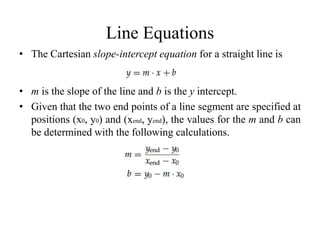
• The Cartesian slope-intercept equation for a straight line is
• m is the slope of the line and b is the y intercept.
• Given that the two end points of a line segment are specified at
positions (x0, y0) and (xend, yend), the values for the m and b can
be determined with the following calculations.
Line Equations…
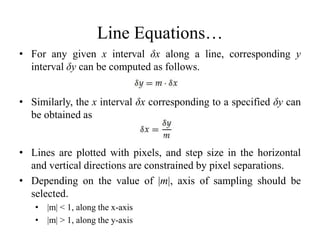
• For any given x interval δx along a line, corresponding y
interval δy can be computed as follows.
• Similarly, the x interval δx corresponding to a specified δy can
be obtained as
• Lines are plotted with pixels, and step size in the horizontal
and vertical directions are constrained by pixel separations.
• Depending on the value of |m|, axis of sampling should be
selected.
• |m| < 1, along the x-axis
• |m| > 1, along the y-axis
DDAAlgorithm
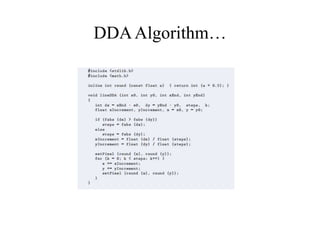
• The digital differential analyzer (DDA) is line drawing
algorithm based on calculating either δy or δx.
• A line is sampled at unit intervals in one coordinate and the
corresponding integer values nearest the line path are
determined for the other coordinate.
DDAAlgorithm…
DDAAlgorithm…
• The DDA algorithm is a faster method for calculating pixel
positions than one directly implements y = m * x + c.
• The accumulation of round-off error in successive additions of
the floating-point increment, however, can cause the calculated
pixel positions to drift away from the true path for long line
segments.
• The rounding operations and floating-point arithmetic in this
procedure are still time consuming.
Reference
Any Questions?
Thank You!

Digital Differential Analyzer Line Drawing Algorithm

  • 1.
    Digital Differential Analyzer LineDrawing Algorithm Kasun Ranga Wijeweera (krw19870829@gmail.com)
  • 2.
    A Straight LineSegment • A straight line segment in a scene is defined by the coordinate positions for the end points of the segment. • The graphics system must first project the end points to integer screen coordinates and determine the nearest pixel positions along the line path between the two end points. • A computed line position of (11.48, 21.51), for example, is converted to pixel position (11, 22). • This rounding of coordinate values to integers causes all but horizontal and vertical lines to be displayed with a stair-step appearance.
  • 3.
    Line Equations • TheCartesian slope-intercept equation for a straight line is • m is the slope of the line and b is the y intercept. • Given that the two end points of a line segment are specified at positions (x0, y0) and (xend, yend), the values for the m and b can be determined with the following calculations.
  • 4.
    Line Equations… • Forany given x interval δx along a line, corresponding y interval δy can be computed as follows. • Similarly, the x interval δx corresponding to a specified δy can be obtained as • Lines are plotted with pixels, and step size in the horizontal and vertical directions are constrained by pixel separations. • Depending on the value of |m|, axis of sampling should be selected. • |m| < 1, along the x-axis • |m| > 1, along the y-axis
  • 5.
    DDAAlgorithm • The digitaldifferential analyzer (DDA) is line drawing algorithm based on calculating either δy or δx. • A line is sampled at unit intervals in one coordinate and the corresponding integer values nearest the line path are determined for the other coordinate.
  • 6.
  • 7.
    DDAAlgorithm… • The DDAalgorithm is a faster method for calculating pixel positions than one directly implements y = m * x + c. • The accumulation of round-off error in successive additions of the floating-point increment, however, can cause the calculated pixel positions to drift away from the true path for long line segments. • The rounding operations and floating-point arithmetic in this procedure are still time consuming.
  • 8.
  • 9.
  • 10.