BY: KARISHMA ASHOK
[IV/I ] ROLL NO: 33
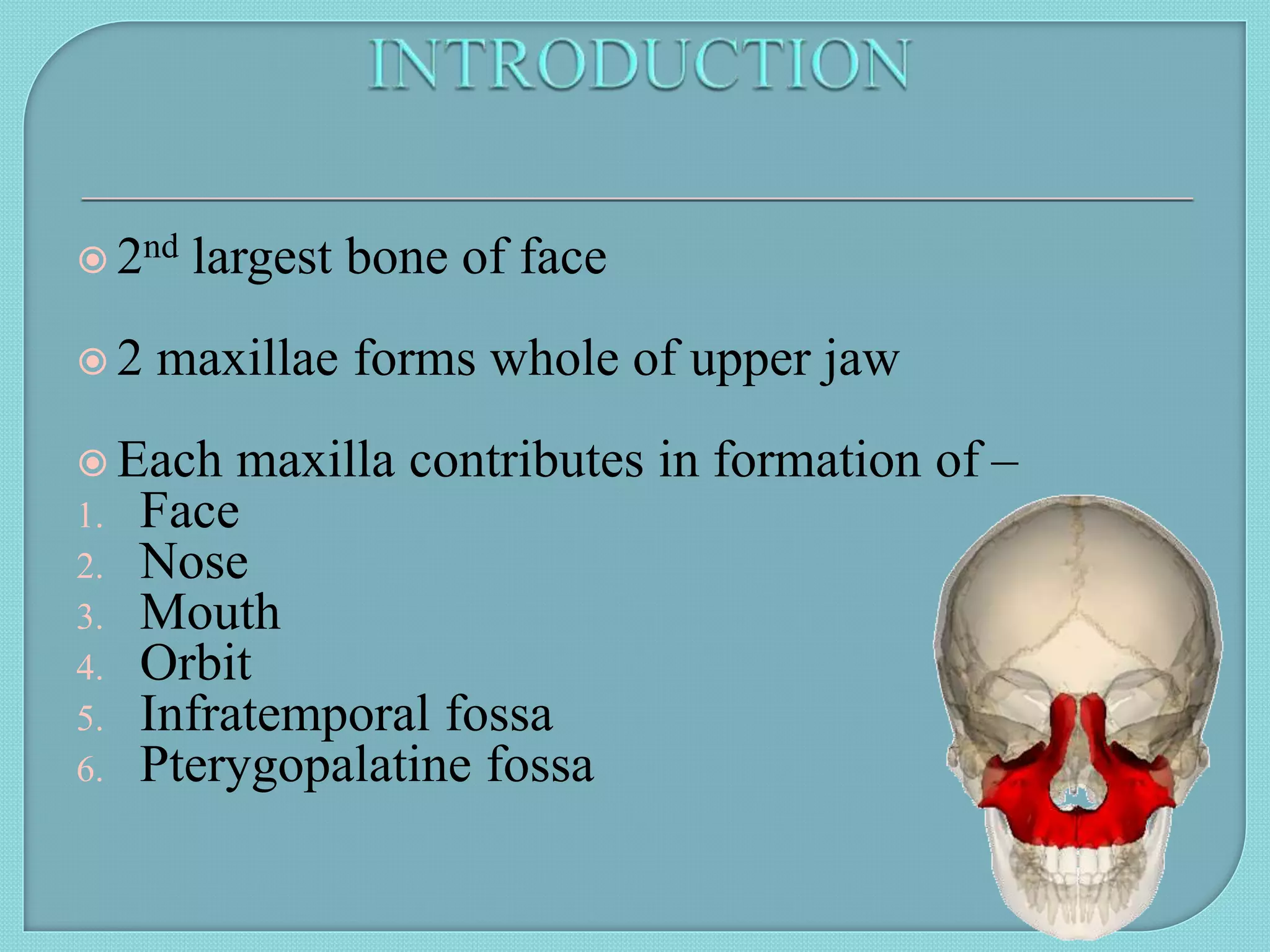
 2nd largest bone of face
 2 maxillae forms whole of upper jaw
 Each maxilla contributes in formation of –
1. Face
2. Nose
3. Mouth
4. Orbit
5. Infratemporal fossa
6. Pterygopalatine fossa
 Shape – pyramidal
 Each maxilla has –
1. A body
2. 4 processes – frontal
zygomatic
alveolar
palatine
 It has –
1. Base – directed medially at nasal surface
2. Apex - directed laterally at zygomatic process
3. 4 surfaces – anterior / facial
posterior / infratemporal
medial / nasal
superior / orbital
Encloses a cavity – maxillary sinus
 Unerupted teeth: tooth in the process of
eruption & is likely to erupt.
 Impacted teeth: that has failed to erupt
completely or partially to its correct position in
the dental arch &its eruption potential is lost.
 More common in females than males, in maxilla
than in mandible and on right side than left.
 mandibular 3rd molars
 maxillary 3rd molars
 maxillary cuspid
 mandibular bicuspids
 Maxillary bicuspids
 Mandibular canine
 maxillary central and lateral incisors
Local causes:
1. Density of overlying bone
2. Lack of space due to undedeveloped jaws
3. Obstruction-
a. Over-retained deciduous tooth
b. Thick fibrous alveolar mucosa
c. Cyst/tumors
4. Dialceration
5. Ectopic tooth eruption
Systemic causes:
1. Pre-natal: heredity
2. Post-natal: factors that interfer with
development-
a. Rickets
b. Malnutrition
c. anaemia
3. Rare conditions:
a. Cleft lip
b. osteoporosis
Infection
Caries
Periodontal diseases
Dentigerous cyst
External resorption
Prophylactic removal
 Pericoronitis was found to
be common in vertical
(23.0%) followed by
mesioangular (15.0%),
distoangular(8.0%) and
horizontal
angulatio(3.0%).
 Common in females than
males
 Streptococcus Viridans is
the most common
facultative isolate.
Markedly red, swollen
suppurating lesion
Marked tenderness
toxic systemic complications -
fever, leukocytosis and
malaise.
Teeth which can be used as abutments of
FPD
Age (Longer recovery periods
Difficult - more densely calcified bone
Bone removal more due to reduced PDL
space
Longer healing time )
Medical history
Deeply impacted teeth; in relation with vital
structures (vessels, sinus)
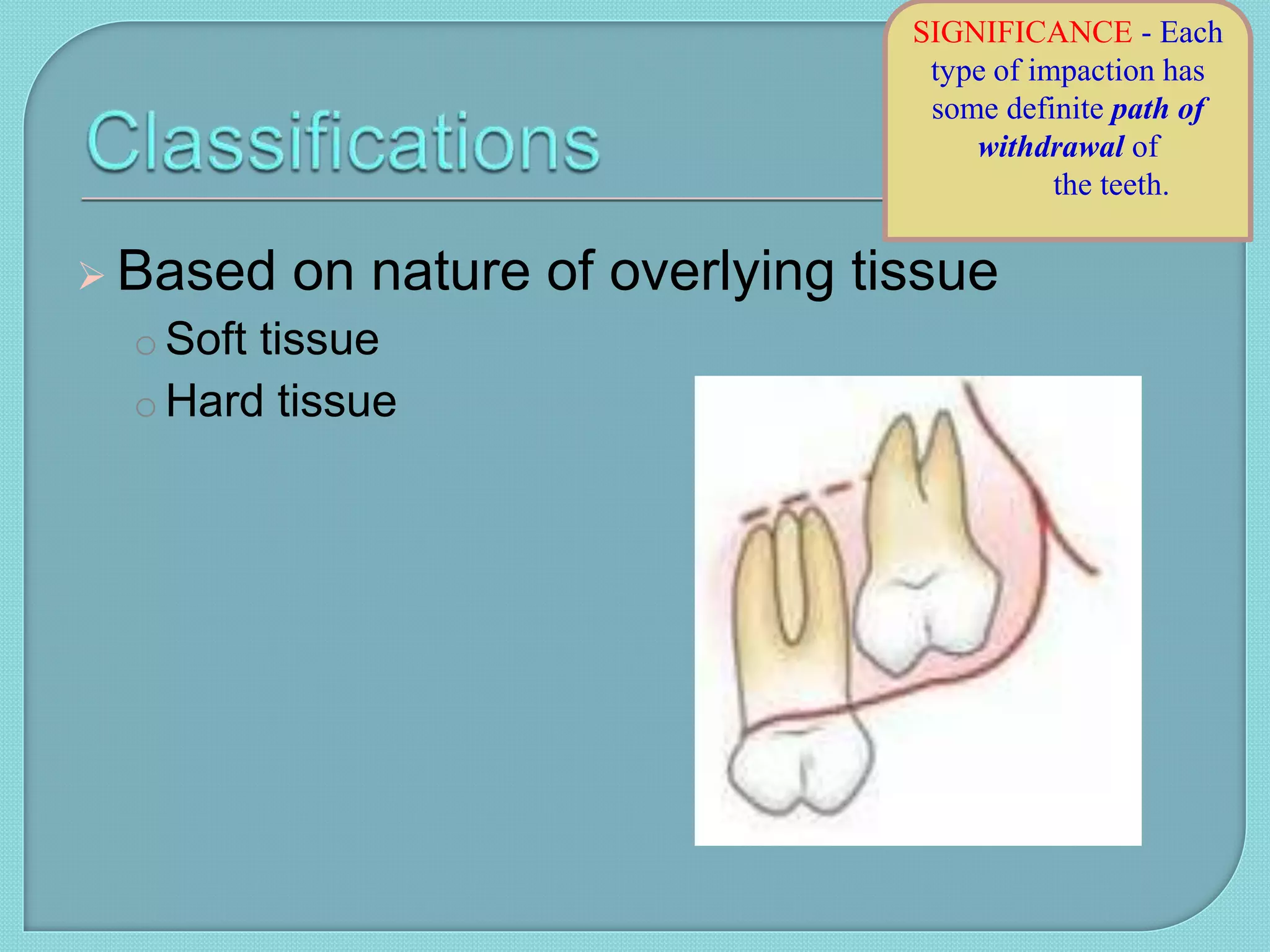
 Based on nature of overlying tissue
o Soft tissue
o Hard tissue
SIGNIFICANCE - Each
type of impaction has
some definite path of
withdrawal of
the teeth.
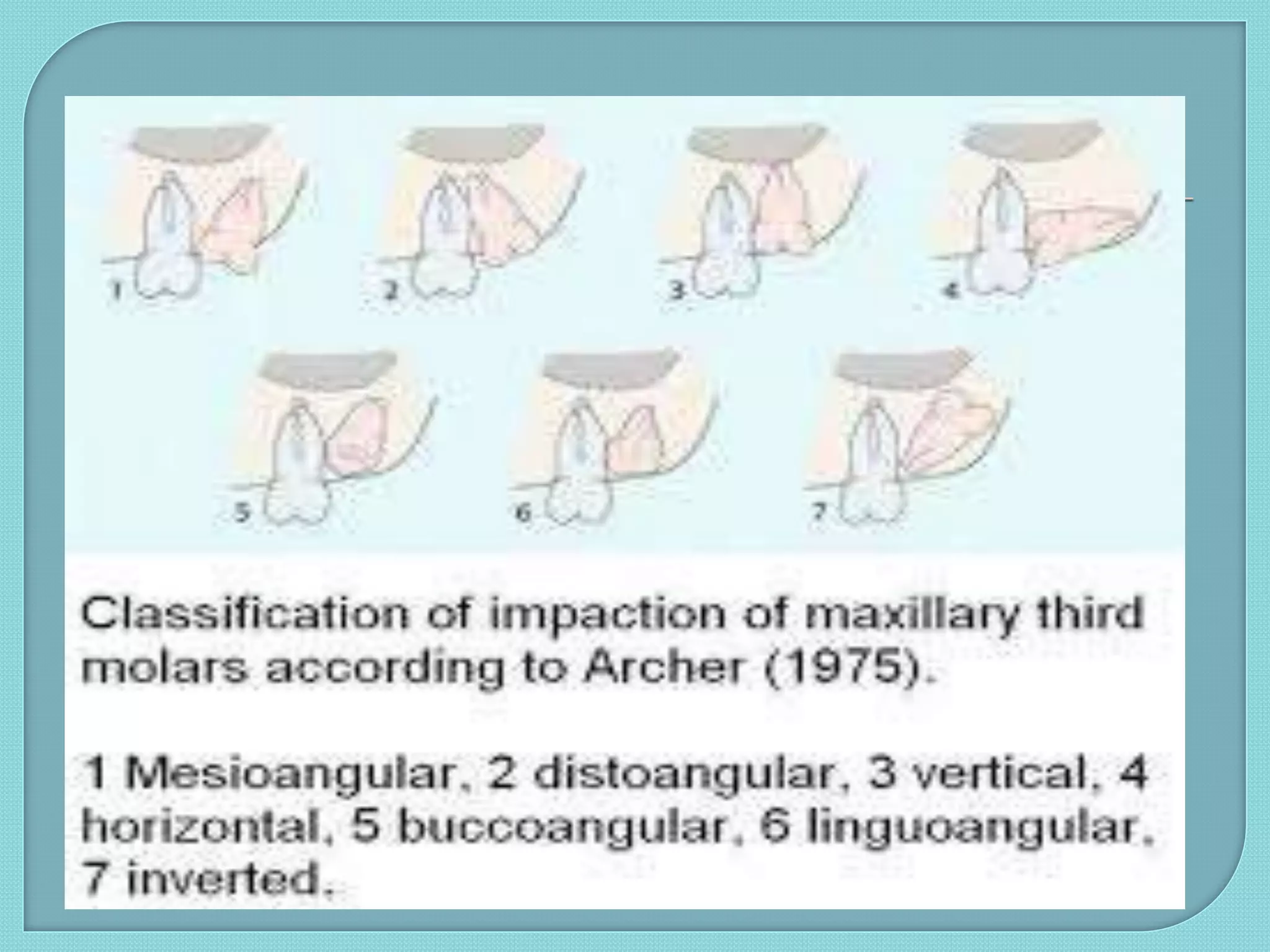
 Winter’s classification:
 Pell & Gregory’s classification
1. Relationship with occlusal plane
Sinus approximation
o General
 Systemic disorders
 Radiation therapy
 Age
 Extra oral:
 Signs of swelling & redness of the cheek.
 Lymph node - enlargment & tenderness.
 Anesthesia or paraesthesia of lower lip.
 Intra oral:
 State of eruption of tooth, signs of pericoronitis
 Condition of 1st & 2nd molars
 Elasticity of oral tissues
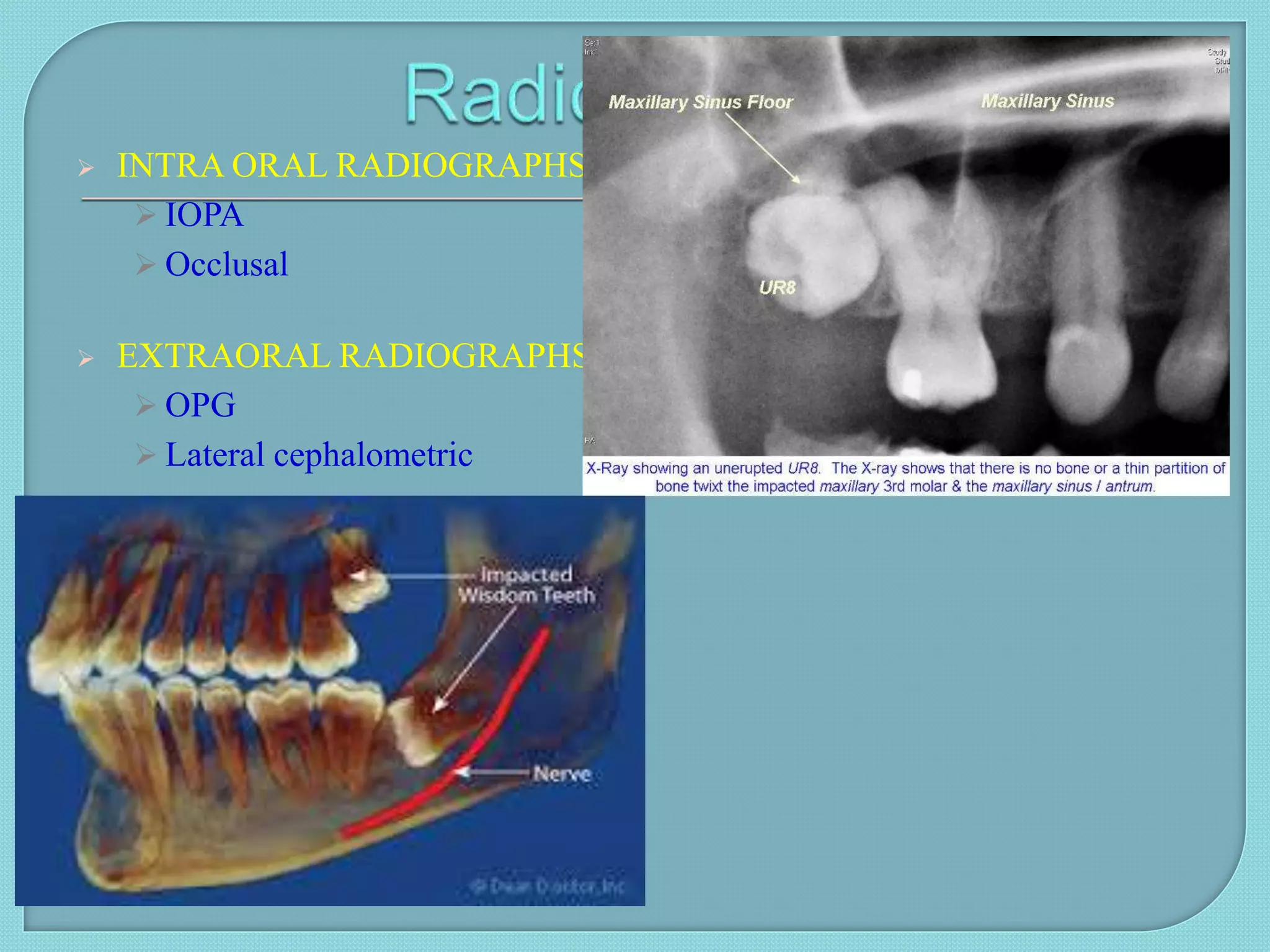
 INTRA ORAL RADIOGRAPHS
 IOPA
 Occlusal
 EXTRAORAL RADIOGRAPHS
 OPG
 Lateral cephalometric
 DIGITAL IMAGING
 CT
 CBCT
 LOCALIZATION TECHNIQUES:
 -Buccal object rule (SLOB)
 -CBCT(3D)
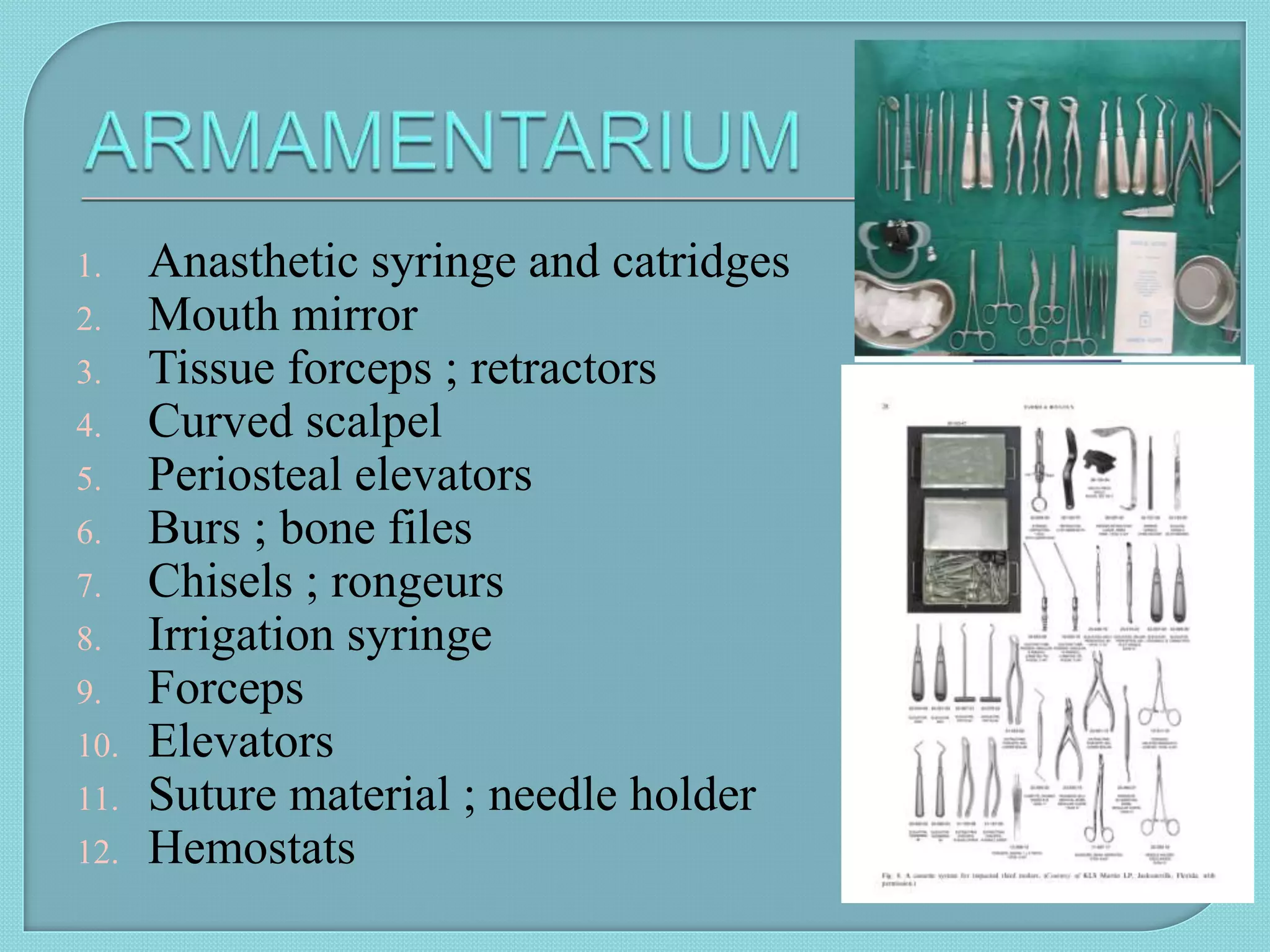
1. Anasthetic syringe and catridges
2. Mouth mirror
3. Tissue forceps ; retractors
4. Curved scalpel
5. Periosteal elevators
6. Burs ; bone files
7. Chisels ; rongeurs
8. Irrigation syringe
9. Forceps
10. Elevators
11. Suture material ; needle holder
12. Hemostats
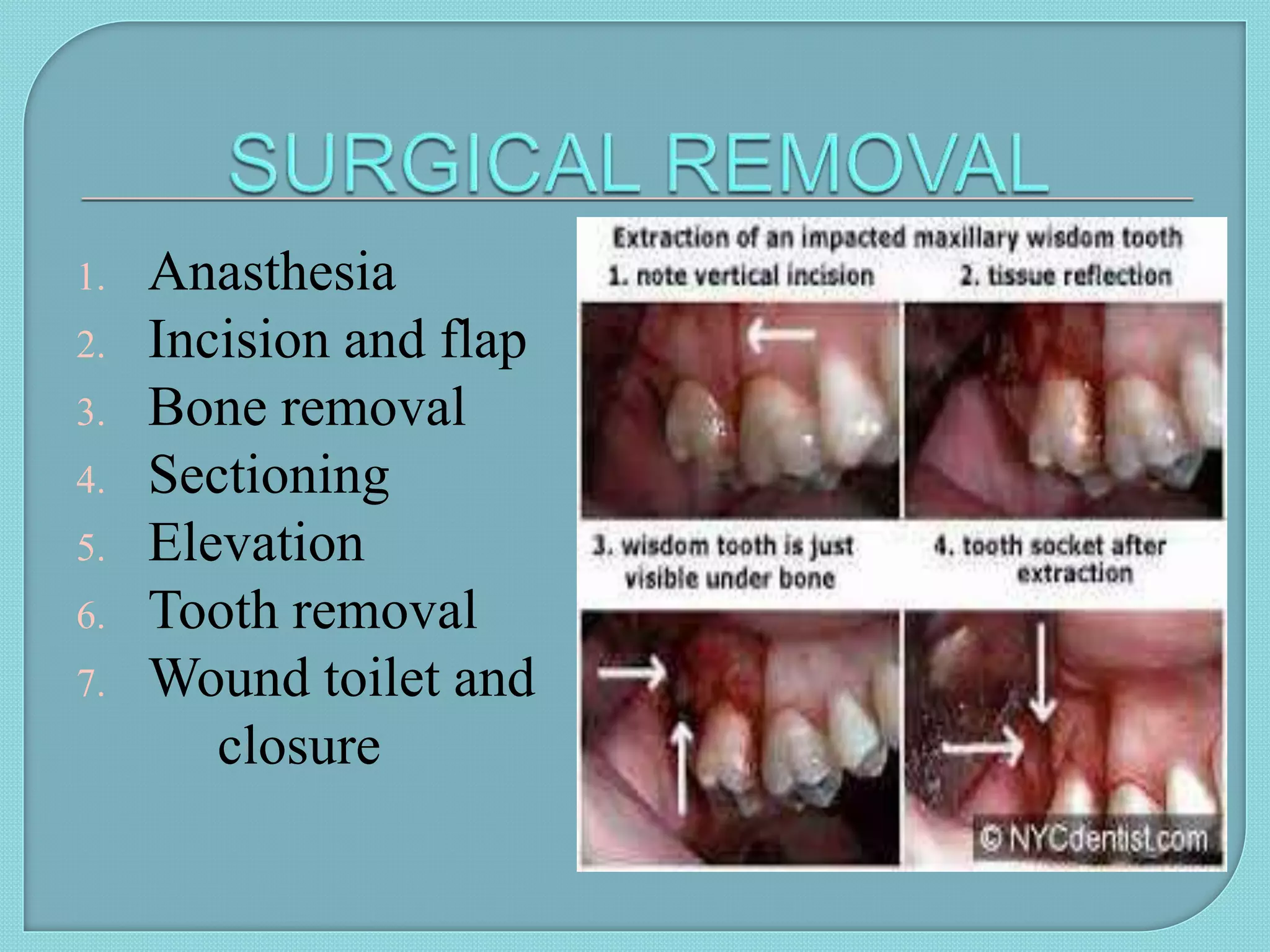
1. Anasthesia
2. Incision and flap
3. Bone removal
4. Sectioning
5. Elevation
6. Tooth removal
7. Wound toilet and
closure
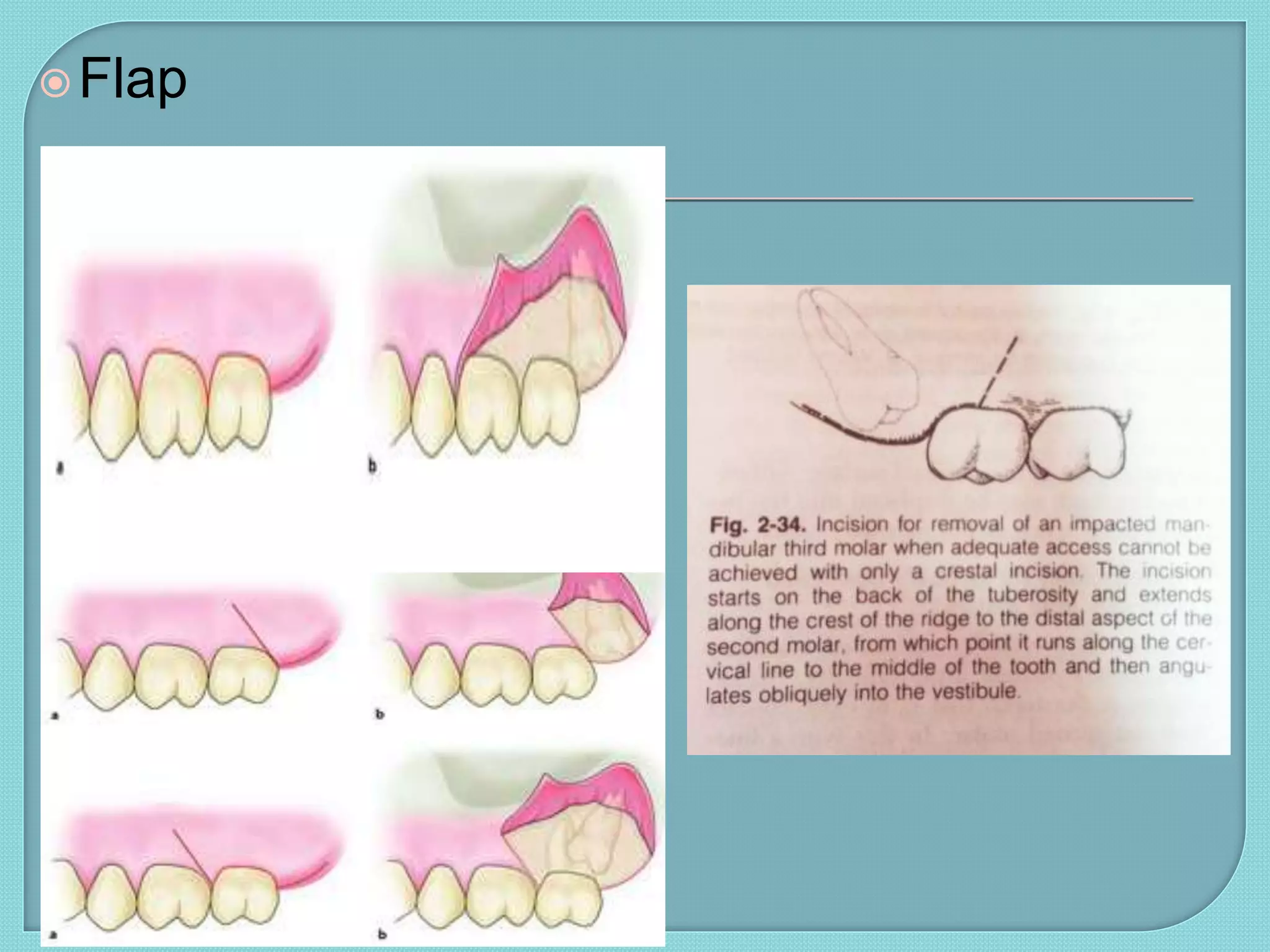
Flap

Bone removal
To remove the bone obstructing the pathway for
removal of the impacted tooth.
Bone should be removed till we reach below the
height of contour, where we can apply the
elevator.
Tooth sectioning
Rationale of tooth sectioning is to create a space
into which impacted tooth can be displaced & then
removed.
Impacted maxillary teeth are rarely sectioned,
because the overlying bone is relatively thin &
elastic.
Also, in no case should a chisel be used, for it may
cause displacement of tooth in the sinus.
Sectioning when done, is done at the cervical
line.
Periapical curettage.
Smoothening of sharp bony margins by Bone file / burs.
Thorough irrigation of the socket with Betadine solution
+ Saline .
Suturing
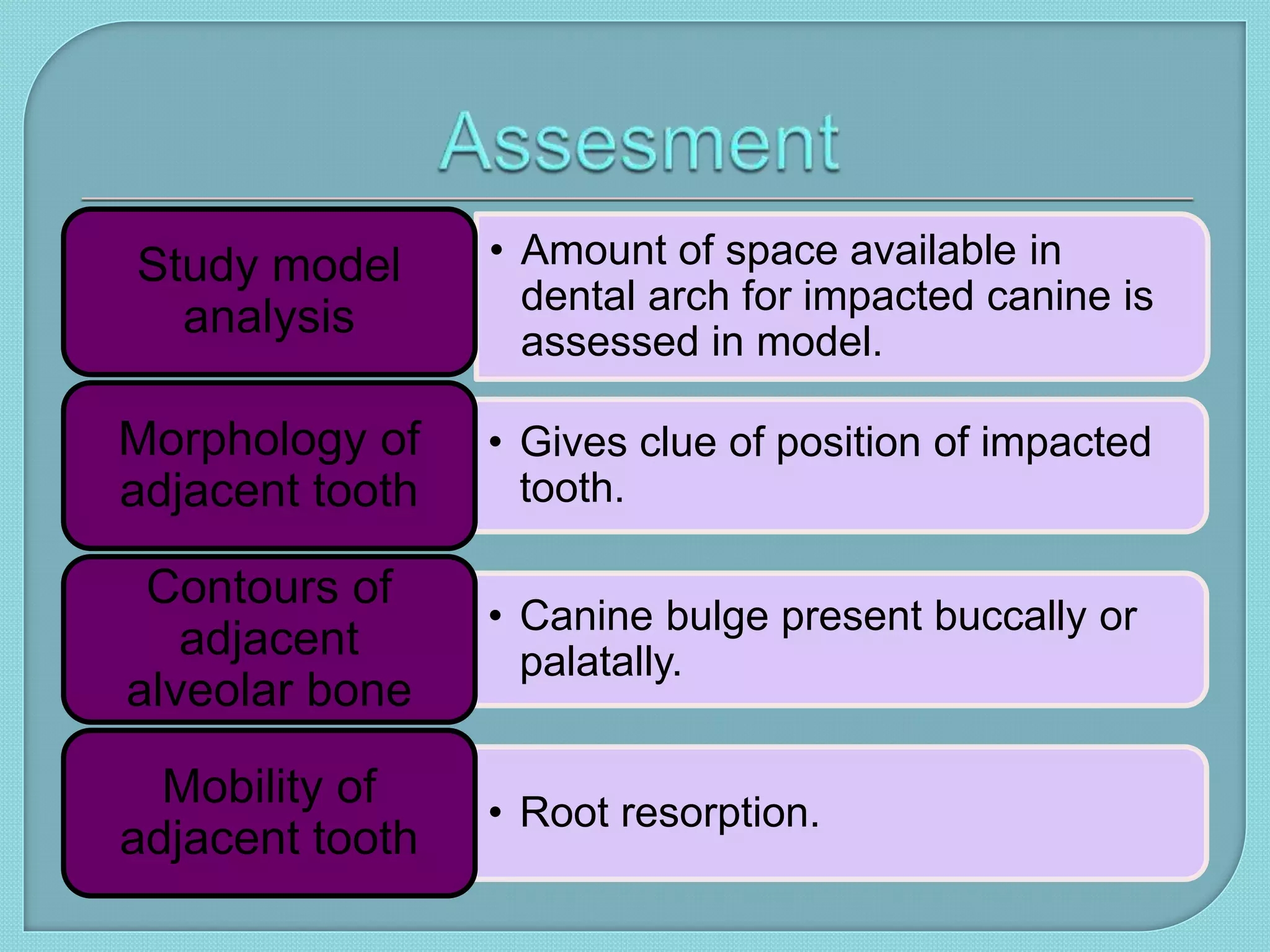
• Amount of space available in
dental arch for impacted canine is
assessed in model.
Study model
analysis
• Gives clue of position of impacted
tooth.
Morphology of
adjacent tooth
• Canine bulge present buccally or
palatally.
Contours of
adjacent
alveolar bone
• Root resorption.
Mobility of
adjacent tooth
Age of patient
Suitability of 1st premolar to replace a permanent canine
Patient motivation for orthodontic applainces
General dental health and oral hygiene
Radiographic position of canine
Availability of space
monitoring
Interceptive
removal
Surgical exposure
with orthodontic
traction
autotransplantation
Surgical
removal
canine is located buccally-Angulated flap
canine is high & buccally –Semilunar flap
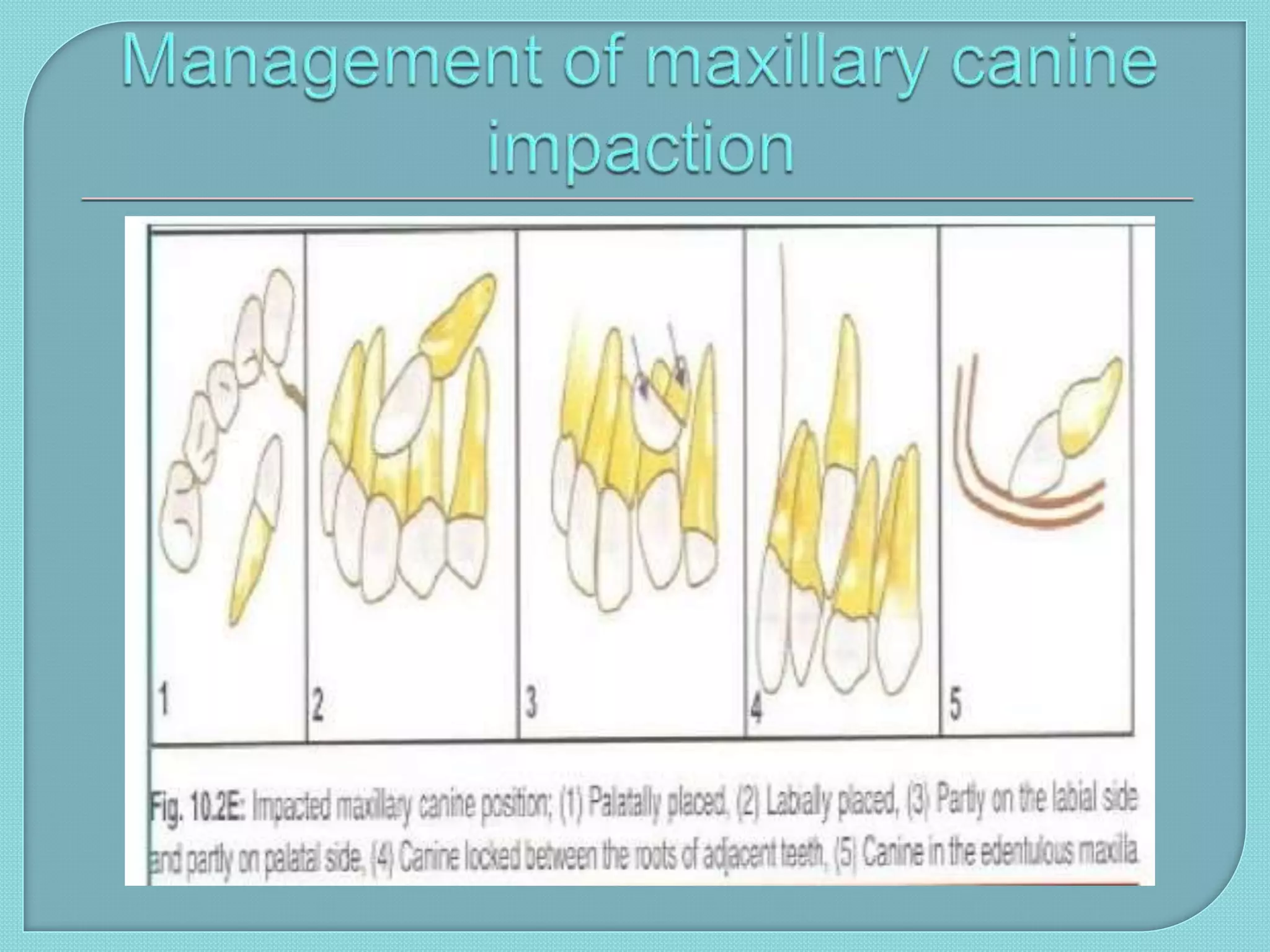
Labial
impaction
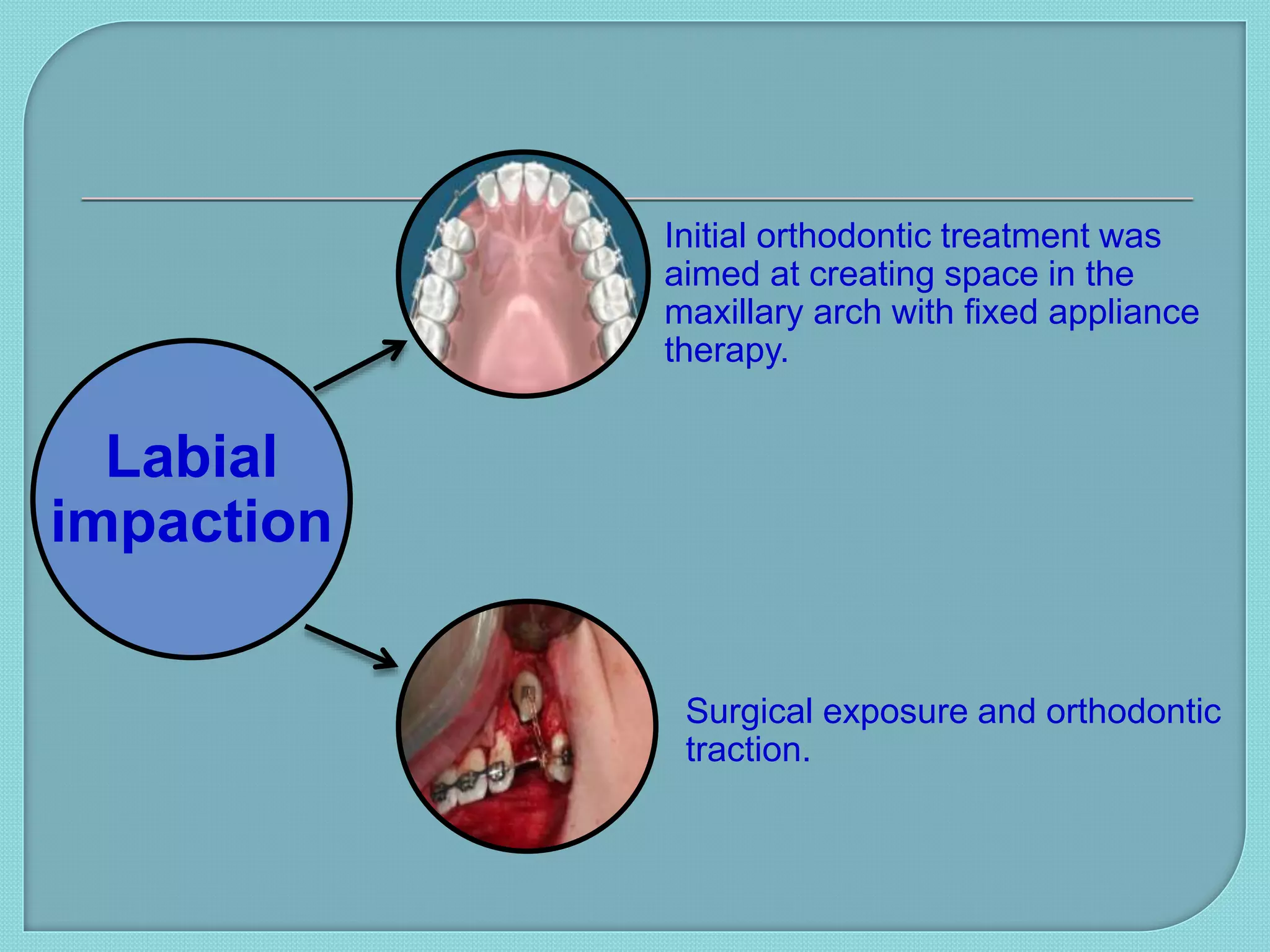
Initial orthodontic treatment was
aimed at creating space in the
maxillary arch with fixed appliance
therapy.
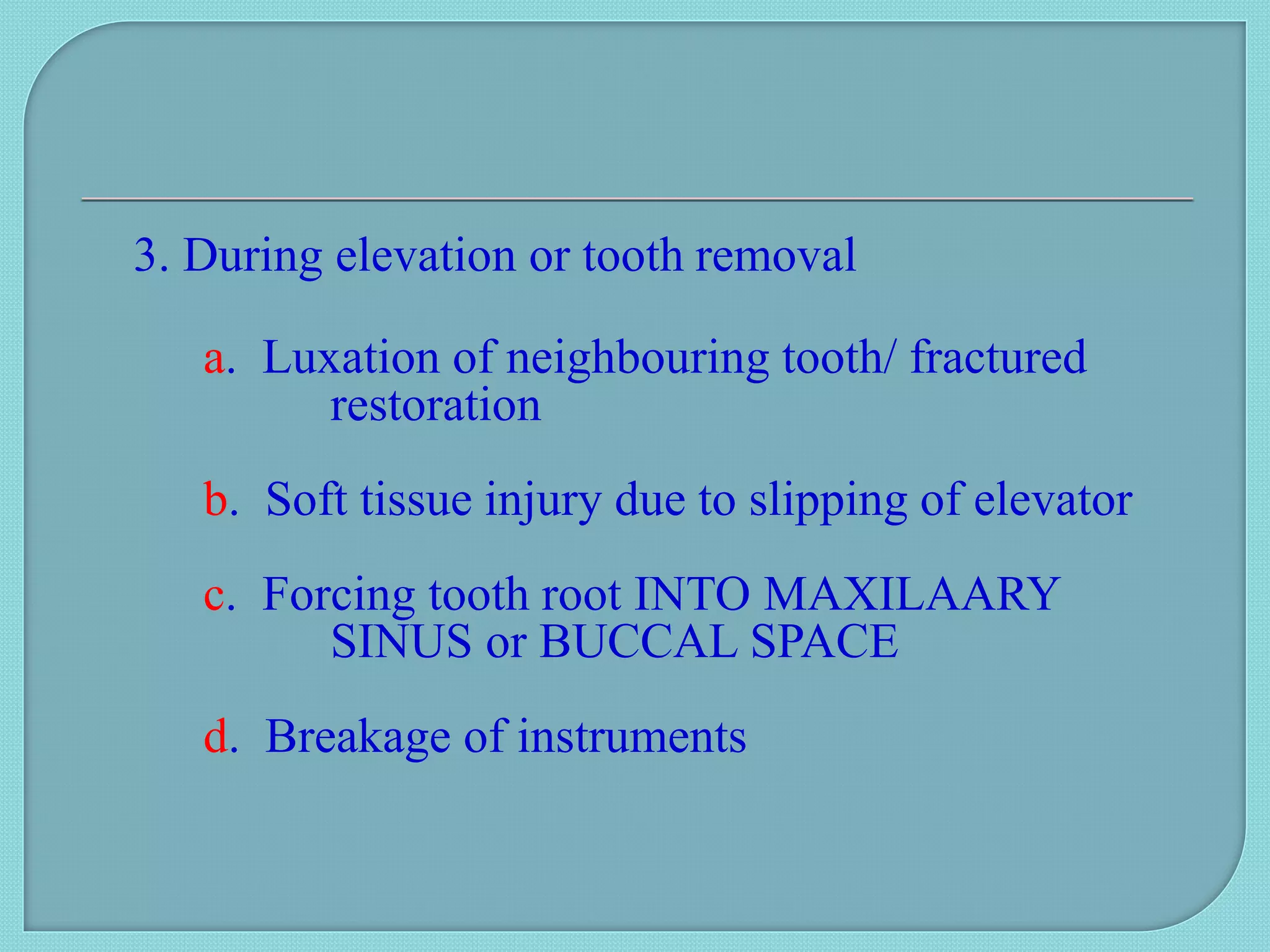
Surgical exposure and orthodontic
traction.
Flap is elevated
Attachment placed on impacted
tooth
Ligature or chain placed over the
attachment to activate after a
week
Raised flap is repositioned in its
original location
Permit eruption of impacted
canine in normal direction
1. During incision
a. Injury to facial artery
b. Injury to lingual nerve
2. During bone removal
a. Damage to second molar
b. Slipping of bur- soft tissue injury
c. Extra oral/ mucosal burns
d. Fracture of the mandible when using chisel &
mallet
e. Subcutaneous emphysema
3. During elevation or tooth removal
a. Luxation of neighbouring tooth/ fractured
restoration
b. Soft tissue injury due to slipping of elevator
c. Forcing tooth root INTO MAXILAARY
SINUS or BUCCAL SPACE
d. Breakage of instruments
 Immediate
- Hemorrhage
- Pain
- Edema
- Drug reaction
 Delayed
- Alveolitis
- Infection
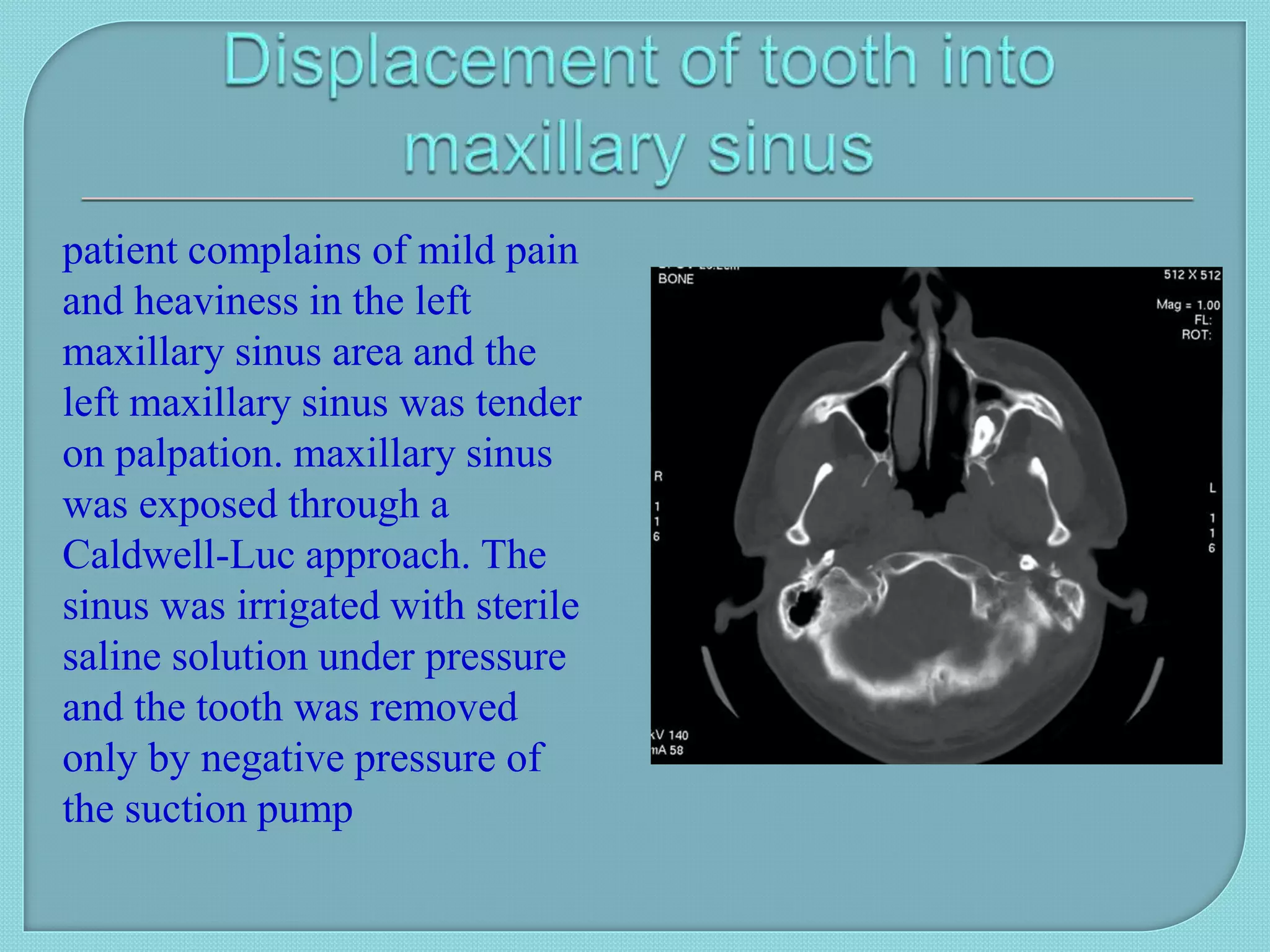
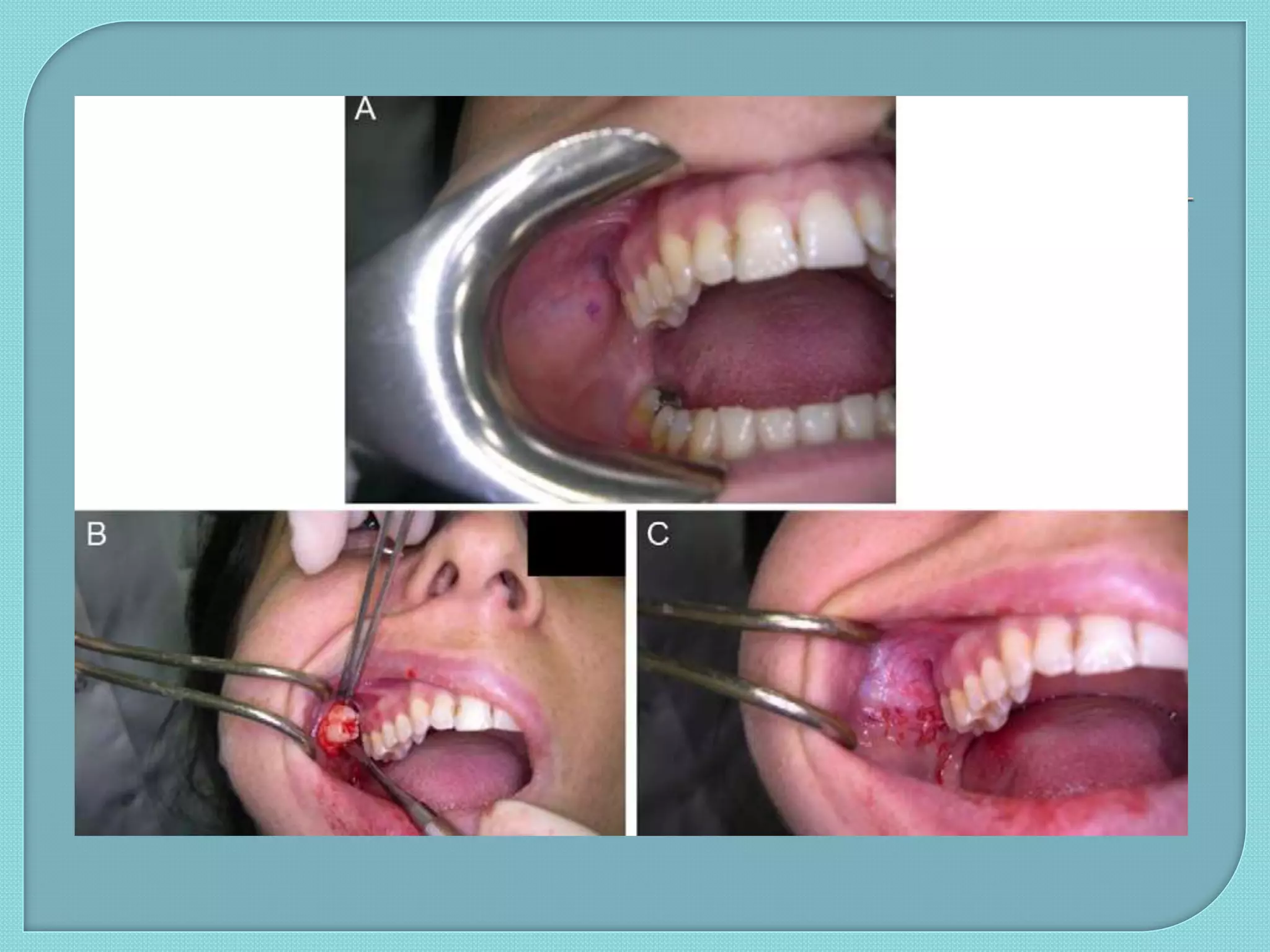
patient complains of mild pain
and heaviness in the left
maxillary sinus area and the
left maxillary sinus was tender
on palpation. maxillary sinus
was exposed through a
Caldwell-Luc approach. The
sinus was irrigated with sterile
saline solution under pressure
and the tooth was removed
only by negative pressure of
the suction pump
CT image of the case
depicting the displaced tooth
between the buccinator and
masseter muscle in the
buccal space..
3D CT image of the displaced
maxillary third molar seen as
localized obliquely in front of the
anterior border of the ramus of the
mandible in the buccopalatine
direction.
impacted maxillary 3rd molar & canine

impacted maxillary 3rd molar & canine

  • 1.
  • 2.
     2nd largestbone of face  2 maxillae forms whole of upper jaw  Each maxilla contributes in formation of – 1. Face 2. Nose 3. Mouth 4. Orbit 5. Infratemporal fossa 6. Pterygopalatine fossa
  • 3.
     Shape –pyramidal  Each maxilla has – 1. A body 2. 4 processes – frontal zygomatic alveolar palatine  It has – 1. Base – directed medially at nasal surface 2. Apex - directed laterally at zygomatic process 3. 4 surfaces – anterior / facial posterior / infratemporal medial / nasal superior / orbital Encloses a cavity – maxillary sinus
  • 4.
     Unerupted teeth:tooth in the process of eruption & is likely to erupt.  Impacted teeth: that has failed to erupt completely or partially to its correct position in the dental arch &its eruption potential is lost.  More common in females than males, in maxilla than in mandible and on right side than left.
  • 5.
     mandibular 3rdmolars  maxillary 3rd molars  maxillary cuspid  mandibular bicuspids  Maxillary bicuspids  Mandibular canine  maxillary central and lateral incisors
  • 6.
    Local causes: 1. Densityof overlying bone 2. Lack of space due to undedeveloped jaws 3. Obstruction- a. Over-retained deciduous tooth b. Thick fibrous alveolar mucosa c. Cyst/tumors 4. Dialceration 5. Ectopic tooth eruption
  • 7.
    Systemic causes: 1. Pre-natal:heredity 2. Post-natal: factors that interfer with development- a. Rickets b. Malnutrition c. anaemia 3. Rare conditions: a. Cleft lip b. osteoporosis
  • 8.
  • 9.
     Pericoronitis wasfound to be common in vertical (23.0%) followed by mesioangular (15.0%), distoangular(8.0%) and horizontal angulatio(3.0%).  Common in females than males  Streptococcus Viridans is the most common facultative isolate.
  • 10.
    Markedly red, swollen suppuratinglesion Marked tenderness toxic systemic complications - fever, leukocytosis and malaise.
  • 11.
    Teeth which canbe used as abutments of FPD Age (Longer recovery periods Difficult - more densely calcified bone Bone removal more due to reduced PDL space Longer healing time ) Medical history Deeply impacted teeth; in relation with vital structures (vessels, sinus)
  • 12.
     Based onnature of overlying tissue o Soft tissue o Hard tissue SIGNIFICANCE - Each type of impaction has some definite path of withdrawal of the teeth.
  • 13.
  • 15.
     Pell &Gregory’s classification 1. Relationship with occlusal plane
  • 16.
  • 17.
    o General  Systemicdisorders  Radiation therapy  Age  Extra oral:  Signs of swelling & redness of the cheek.  Lymph node - enlargment & tenderness.  Anesthesia or paraesthesia of lower lip.  Intra oral:  State of eruption of tooth, signs of pericoronitis  Condition of 1st & 2nd molars  Elasticity of oral tissues
  • 18.
     INTRA ORALRADIOGRAPHS  IOPA  Occlusal  EXTRAORAL RADIOGRAPHS  OPG  Lateral cephalometric  DIGITAL IMAGING  CT  CBCT  LOCALIZATION TECHNIQUES:  -Buccal object rule (SLOB)  -CBCT(3D)
  • 20.
    1. Anasthetic syringeand catridges 2. Mouth mirror 3. Tissue forceps ; retractors 4. Curved scalpel 5. Periosteal elevators 6. Burs ; bone files 7. Chisels ; rongeurs 8. Irrigation syringe 9. Forceps 10. Elevators 11. Suture material ; needle holder 12. Hemostats
  • 22.
    1. Anasthesia 2. Incisionand flap 3. Bone removal 4. Sectioning 5. Elevation 6. Tooth removal 7. Wound toilet and closure
  • 23.
  • 24.
    Bone removal To removethe bone obstructing the pathway for removal of the impacted tooth. Bone should be removed till we reach below the height of contour, where we can apply the elevator.
  • 25.
    Tooth sectioning Rationale oftooth sectioning is to create a space into which impacted tooth can be displaced & then removed. Impacted maxillary teeth are rarely sectioned, because the overlying bone is relatively thin & elastic. Also, in no case should a chisel be used, for it may cause displacement of tooth in the sinus. Sectioning when done, is done at the cervical line.
  • 26.
    Periapical curettage. Smoothening ofsharp bony margins by Bone file / burs. Thorough irrigation of the socket with Betadine solution + Saline . Suturing
  • 29.
    • Amount ofspace available in dental arch for impacted canine is assessed in model. Study model analysis • Gives clue of position of impacted tooth. Morphology of adjacent tooth • Canine bulge present buccally or palatally. Contours of adjacent alveolar bone • Root resorption. Mobility of adjacent tooth
  • 30.
    Age of patient Suitabilityof 1st premolar to replace a permanent canine Patient motivation for orthodontic applainces General dental health and oral hygiene Radiographic position of canine Availability of space
  • 31.
  • 32.
    canine is locatedbuccally-Angulated flap canine is high & buccally –Semilunar flap
  • 33.
    Labial impaction Initial orthodontic treatmentwas aimed at creating space in the maxillary arch with fixed appliance therapy. Surgical exposure and orthodontic traction.
  • 34.
    Flap is elevated Attachmentplaced on impacted tooth Ligature or chain placed over the attachment to activate after a week Raised flap is repositioned in its original location Permit eruption of impacted canine in normal direction
  • 35.
    1. During incision a.Injury to facial artery b. Injury to lingual nerve 2. During bone removal a. Damage to second molar b. Slipping of bur- soft tissue injury c. Extra oral/ mucosal burns d. Fracture of the mandible when using chisel & mallet e. Subcutaneous emphysema
  • 36.
    3. During elevationor tooth removal a. Luxation of neighbouring tooth/ fractured restoration b. Soft tissue injury due to slipping of elevator c. Forcing tooth root INTO MAXILAARY SINUS or BUCCAL SPACE d. Breakage of instruments
  • 37.
     Immediate - Hemorrhage -Pain - Edema - Drug reaction  Delayed - Alveolitis - Infection
  • 38.
    patient complains ofmild pain and heaviness in the left maxillary sinus area and the left maxillary sinus was tender on palpation. maxillary sinus was exposed through a Caldwell-Luc approach. The sinus was irrigated with sterile saline solution under pressure and the tooth was removed only by negative pressure of the suction pump
  • 39.
    CT image ofthe case depicting the displaced tooth between the buccinator and masseter muscle in the buccal space.. 3D CT image of the displaced maxillary third molar seen as localized obliquely in front of the anterior border of the ramus of the mandible in the buccopalatine direction.