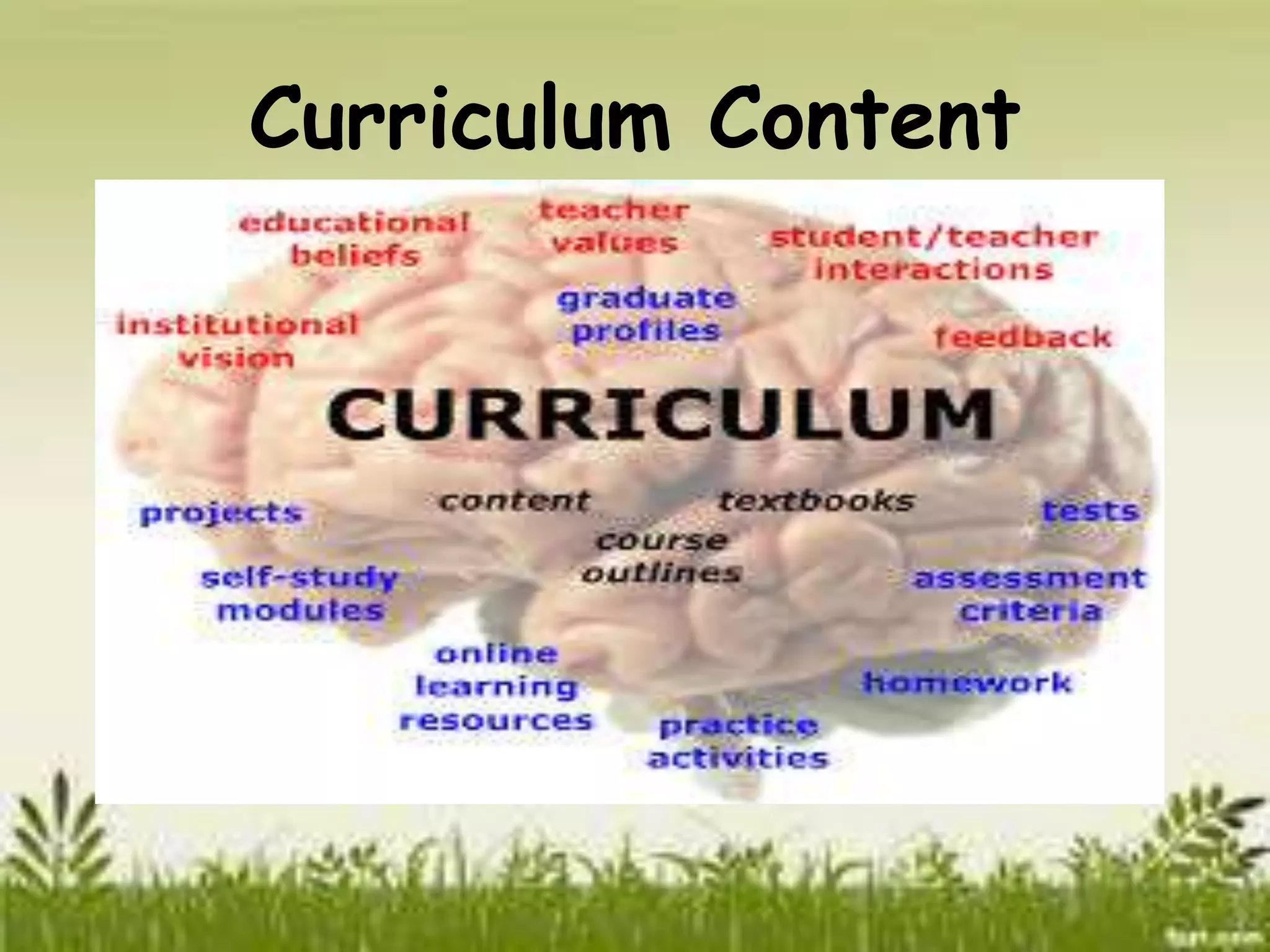
Curriculum Content
Definition Of Curriculum 
• All the learning which is 
planned and guided by the 
school, whether it is carried on 
in groups or individually, inside 
or outside the school.
Elements of Curriculum 
Aims and objectives 
Content 
Evaluation 
Teaching Strategies
Definition of Content 
• Content is defined as 
“Information to be learned 
in school, another term for 
knowledge (a collection of 
facts, concepts, 
generalization, principles, 
theories)”
Definition of Content 
• Content comes in any form 
(audio, text and video) and 
it informs, entertains, 
enlightens or teaches people 
who consume it.
Subject-centered view of 
curriculum 
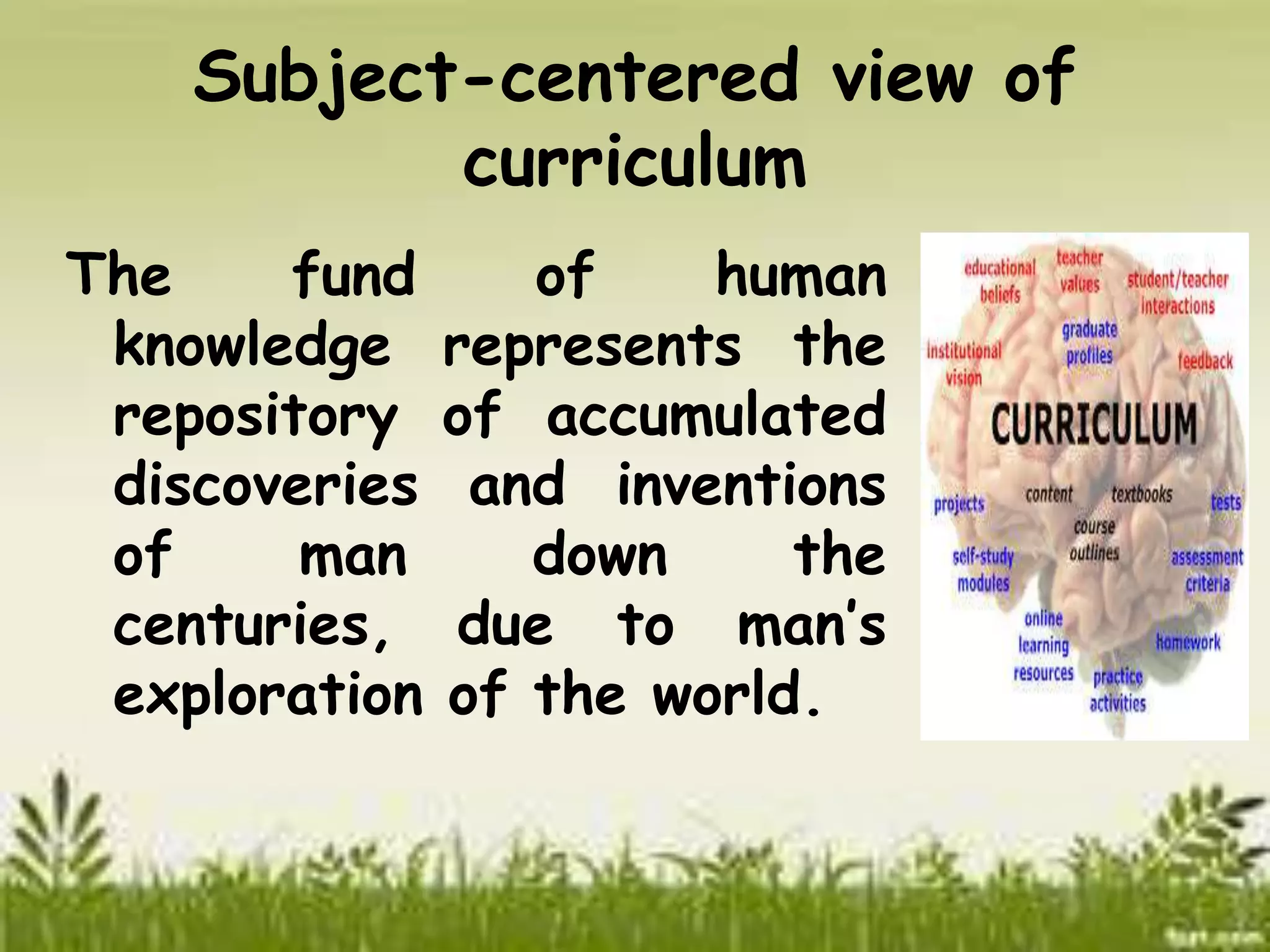
The fund of human 
knowledge represents the 
repository of accumulated 
discoveries and inventions 
of man down the 
centuries, due to man’s 
exploration of the world.
Learner-centered view of 
curriculum 
• Relates knowledge to the 
individual’s personal and social world 
and how he or she defines reality. 
• Jerome Bruner: “Knowledge is a 
model we construct to give meaning 
and structure to
Jerome Bruner
Purposes of Content
Purposes of Content 
To help organize materials 
To help a sequential relationship of 
material 
To present material basic to a 
general understanding of a course.
Purposes of Content 
To furnish a source of valuable 
information. 
To present application
The content is: 
 United with the goals and 
objectives of the basic education 
curriculum. 
 Responds to the needs of the 
learner. 
 Includes cognitive skill and affective 
elements.
The content is: 
 Fully and deeply covers the 
essential to avoid the “mile-wide-and- 
inch-deep” impression. 
 That is of use to the learners. 
 That is practical and achievable.
The content is: 
Facts are basic in the structure of 
cognitive subject matter. But content 
must go beyond facts. 
Working out a process of conceptual 
understanding means teaching and 
learning beyond facts. This can be 
done by the use of the thematic or 
the integrated approach.
The content is: 
Subject matter content integrates the 
cognitive, skill, and affective 
components. 
The cognitive content includes facts, 
concept, principles, hypothesis, 
theories and laws. 
The skill component dwells on thinking 
skill and manipulative skills.
Criteria for Content 
Selection
Criteria for content selection 
Self-sufficiency – According to 
Scheffler (1970) the prime guiding 
principle for the content selection 
is helping the learners to attain 
maximum self sufficiency in 
learning but in the most economical 
manner.
Criteria for content selection 
Economy means less teaching effort 
and educational resources, less 
learner’s effort but more results and 
effective learning outcomes.
Criteria for content selection 
Significance 
– It is significant if 
 When content or subject matter will 
contribute to basic ideas, concepts, 
principles, and geberalization to 
achieve the over all aim of the 
curriculum. 
 It will develop learning abilities, skills, 
processes and attitude
Criteria for content selection 
Significance 
– It is significant if 
 It will develop the cognitive, 
effective and psychomotor skills of 
the learners 
 The cultural aspects will be 
considered
Criteria for content selection 
 Relevance to life: learning experience 
must be related to the learner’s real 
life situations in and out of school; 
 Variety: learning experiences must 
cater to the needs of different types 
of learners by providing different types 
of experiences;
Criteria for content selection 
 Suitability: learning experiences must 
be suitable to the learners present 
state of learning and characteristics:
Criteria for content selection 
 Validity – it relates to the 
authenticity of the content selected. 
 this refers to the relevance of the 
stated learning experience to the 
stated goals of the curriculum; 
 Means two things, is the content 
related to the objectives, and is the 
content true or authentic;
Criteria for content selection 
Interest- the content should suit 
the personality and intellectual 
capabilities of the students. 
Is the content interesting to 
the learner? Or can the content 
be made interesting to learners?
Criteria for content selection 
• Utility – it is concerned with the 
usefulness of the content. 
Here the question is whether the 
content selected is useful i.e. will 
lead to the acquisition of skills and 
knowledge that are considered 
useful by society?
Criteria for content selection 
• Utility 
is the content selected such that 
learners can learn and understand given 
their present level. 
• Learnability- this criteria emphasizes 
on the optimal placement and 
appropriate organization and 
sequencing of the content
Criteria for content selection 
 Feasibility – it compels the planners to 
analyze and examine the content in the 
light of the time and resources available 
to the students, costs involved, socio-political 
climate etc.
Other considerations that may be 
used in the selection of the learning 
content 
As a guide, subject matter or content 
can be selected for use if these are: 
a. Frequently and commonly used in daily 
life. 
b. suited to the maturity levels and 
abilities of students.
As a guide, subject matter or content 
can be selected for use if these are: 
c. Valuable in meeting the needs and the 
competencies of a future career; 
d. related with other subject areas; and 
e. important in the transfer of learning
Organization of the content 
• It demands a through understanding of 
the teaching leaning process. 
• Important aspects for this:- 
a) sequencing 
b) continuity 
c) integration
Organization of the content 
• a) Sequencing- it means putting the 
content and materials into some sort of 
order of succession. 
• b) Continuity- content should provide 
continuity n learning and prevent loss 
through forgetting. The students should 
be provided with experiences step by step. 
.
Organization of the content 
• c) Integration- learning is more 
effective when facts and principles 
from one field can be related to 
another, esp when applying knowledge.
Selecting and Organizing 
Content 
• Planning curriculum similar to 
guided tour 
• Various options of how to reach 
destination (broad program goals) 
• Planning itinerary in advance aids in 
avoidance of confusion—saves time
Selecting and Organizing 
Content 
• Broadest level involves selecting, 
structuring subject matter to be taught to 
reach broad program goals 
• Learning becomes development of a series 
of connections among concepts that hold 
real meaning and relevance for learner
Reported By: 
Julieta D. Cabiles

Curriculum content.ppt

  • 1.
  • 2.
    Definition Of Curriculum • All the learning which is planned and guided by the school, whether it is carried on in groups or individually, inside or outside the school.
  • 3.
    Elements of Curriculum Aims and objectives Content Evaluation Teaching Strategies
  • 4.
    Definition of Content • Content is defined as “Information to be learned in school, another term for knowledge (a collection of facts, concepts, generalization, principles, theories)”
  • 6.
    Definition of Content • Content comes in any form (audio, text and video) and it informs, entertains, enlightens or teaches people who consume it.
  • 7.
    Subject-centered view of curriculum The fund of human knowledge represents the repository of accumulated discoveries and inventions of man down the centuries, due to man’s exploration of the world.
  • 8.
    Learner-centered view of curriculum • Relates knowledge to the individual’s personal and social world and how he or she defines reality. • Jerome Bruner: “Knowledge is a model we construct to give meaning and structure to
  • 9.
  • 10.
  • 11.
    Purposes of Content To help organize materials To help a sequential relationship of material To present material basic to a general understanding of a course.
  • 12.
    Purposes of Content To furnish a source of valuable information. To present application
  • 13.
    The content is:  United with the goals and objectives of the basic education curriculum.  Responds to the needs of the learner.  Includes cognitive skill and affective elements.
  • 14.
    The content is:  Fully and deeply covers the essential to avoid the “mile-wide-and- inch-deep” impression.  That is of use to the learners.  That is practical and achievable.
  • 15.
    The content is: Facts are basic in the structure of cognitive subject matter. But content must go beyond facts. Working out a process of conceptual understanding means teaching and learning beyond facts. This can be done by the use of the thematic or the integrated approach.
  • 16.
    The content is: Subject matter content integrates the cognitive, skill, and affective components. The cognitive content includes facts, concept, principles, hypothesis, theories and laws. The skill component dwells on thinking skill and manipulative skills.
  • 17.
  • 18.
    Criteria for contentselection Self-sufficiency – According to Scheffler (1970) the prime guiding principle for the content selection is helping the learners to attain maximum self sufficiency in learning but in the most economical manner.
  • 19.
    Criteria for contentselection Economy means less teaching effort and educational resources, less learner’s effort but more results and effective learning outcomes.
  • 20.
    Criteria for contentselection Significance – It is significant if  When content or subject matter will contribute to basic ideas, concepts, principles, and geberalization to achieve the over all aim of the curriculum.  It will develop learning abilities, skills, processes and attitude
  • 21.
    Criteria for contentselection Significance – It is significant if  It will develop the cognitive, effective and psychomotor skills of the learners  The cultural aspects will be considered
  • 22.
    Criteria for contentselection  Relevance to life: learning experience must be related to the learner’s real life situations in and out of school;  Variety: learning experiences must cater to the needs of different types of learners by providing different types of experiences;
  • 23.
    Criteria for contentselection  Suitability: learning experiences must be suitable to the learners present state of learning and characteristics:
  • 24.
    Criteria for contentselection  Validity – it relates to the authenticity of the content selected.  this refers to the relevance of the stated learning experience to the stated goals of the curriculum;  Means two things, is the content related to the objectives, and is the content true or authentic;
  • 25.
    Criteria for contentselection Interest- the content should suit the personality and intellectual capabilities of the students. Is the content interesting to the learner? Or can the content be made interesting to learners?
  • 26.
    Criteria for contentselection • Utility – it is concerned with the usefulness of the content. Here the question is whether the content selected is useful i.e. will lead to the acquisition of skills and knowledge that are considered useful by society?
  • 27.
    Criteria for contentselection • Utility is the content selected such that learners can learn and understand given their present level. • Learnability- this criteria emphasizes on the optimal placement and appropriate organization and sequencing of the content
  • 28.
    Criteria for contentselection  Feasibility – it compels the planners to analyze and examine the content in the light of the time and resources available to the students, costs involved, socio-political climate etc.
  • 29.
    Other considerations thatmay be used in the selection of the learning content As a guide, subject matter or content can be selected for use if these are: a. Frequently and commonly used in daily life. b. suited to the maturity levels and abilities of students.
  • 30.
    As a guide,subject matter or content can be selected for use if these are: c. Valuable in meeting the needs and the competencies of a future career; d. related with other subject areas; and e. important in the transfer of learning
  • 31.
    Organization of thecontent • It demands a through understanding of the teaching leaning process. • Important aspects for this:- a) sequencing b) continuity c) integration
  • 32.
    Organization of thecontent • a) Sequencing- it means putting the content and materials into some sort of order of succession. • b) Continuity- content should provide continuity n learning and prevent loss through forgetting. The students should be provided with experiences step by step. .
  • 33.
    Organization of thecontent • c) Integration- learning is more effective when facts and principles from one field can be related to another, esp when applying knowledge.
  • 34.
    Selecting and Organizing Content • Planning curriculum similar to guided tour • Various options of how to reach destination (broad program goals) • Planning itinerary in advance aids in avoidance of confusion—saves time
  • 35.
    Selecting and Organizing Content • Broadest level involves selecting, structuring subject matter to be taught to reach broad program goals • Learning becomes development of a series of connections among concepts that hold real meaning and relevance for learner
  • 36.