Introduction to Generative Adversarial Networks
Oct 16, 2018
Jong Wook Kim
Music and Audio Research Laboratory, New York University
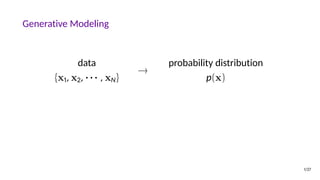
Generative Modeling
data
→
probability distribution
{x1, x2, · · · , xN} p(x)
1/27
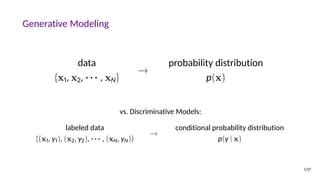
Generative Modeling
data
→
probability distribution
{x1, x2, · · · , xN} p(x)
vs. Discriminative Models:
labeled data
→
conditional probability distribution
{(x1, y1), (x2, y2), · · · , (xN, yN)} p(y | x)
1/27
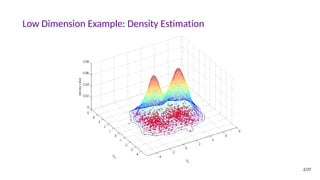
Low Dimension Example: Density Estimation
2/27
High Dimension Example: Sample Generation
→
data samples
[Berthelot et al. 2017, BEGAN]
3/27
Why Study Generative Models?
• Test of our ability to use high-dimensional, complicated probability distributions
• Simulate possible futures for planning or reinforcement learning
• Missing data, semi-supervised learning
• Multi-modal outputs
• Realistic generation tasks
[Goodfellow, NIPS 2016 Tutorial]
4/27
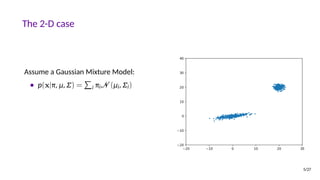
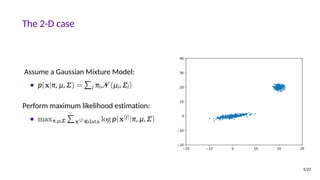
The 2-D case
Assume a Gaussian Mixture Model:
• p(x|π, μ, ) = i πi (μi, i)
5/27
The 2-D case
Assume a Gaussian Mixture Model:
• p(x|π, μ, ) = i πi (μi, i)
Perform maximum likelihood estimation:
• maxπ,μ, x(j)∈data log p(x(j)|π, μ, )
5/27
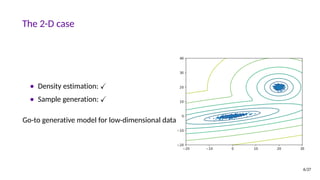
The 2-D case
• Density estimation:
• Sample generation:
Go-to generative model for low-dimensional data
6/27
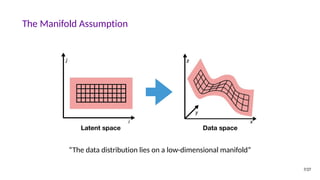
The Manifold Assumption
Latent space Data space
“The data distribution lies on a low-dimensional manifold”
7/27
Latent Space Interpolation
[Berthelot et al. 2017, BEGAN]
8/27
Latent Space Arithmetic
[Radford et al. 2015, DCGAN]
9/27
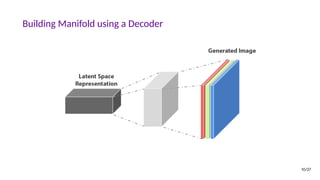
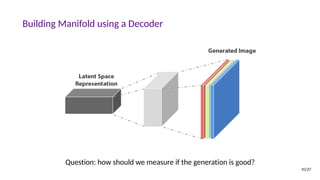
Building Manifold using a Decoder
10/27
Building Manifold using a Decoder
Question: how should we measure if the generation is good?
10/27
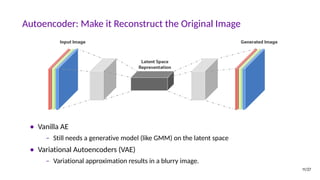
Autoencoder: Make it Reconstruct the Original Image
• Vanilla AE
– Still needs a generative model (like GMM) on the latent space
• Variational Autoencoders (VAE)
– Variational approximation results in a blurry image.
11/27
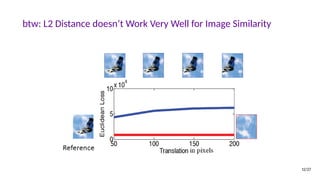
btw: L2 Distance doesn’t Work Very Well for Image Similarity
12/27
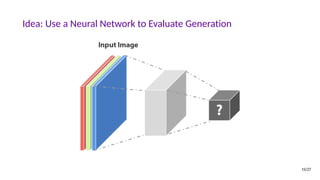
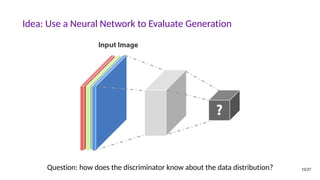
Idea: Use a Neural Network to Evaluate Generation
13/27
Idea: Use a Neural Network to Evaluate Generation
Question: how does the discriminator know about the data distribution? 13/27
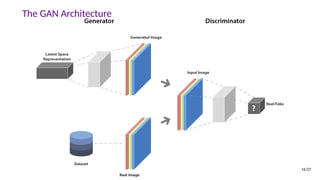
The GAN Architecture
14/27
The GAN Formula
min
G
max
D
[︁
Ex∼pdata log D(x) + Ez∼pz log (1 − D(G(z)))
]︁
(1)
• A minimax game between the generator and the discriminator.
• In practice, a non-saturating variant is often used for updating G:
max
G
Ez∼pz log D(G(z)) (2)
[Goodfellow et al. 2014, Generative Adversarial Nets]
15/27
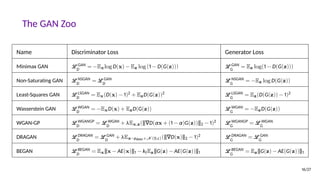
The GAN Zoo
Name Discriminator Loss Generator Loss
Minimax GAN GAN
D
= −Exlog D(x) − Ez log (1 − D(G(z))) GAN
G
= Ez log(1 − D(G(z)))
Non-Saturating GAN NSGAN
D
= GAN
D
NSGAN
G
= −Ez log D(G(z))
Least-Squares GAN LSGAN
D
= Ex(D(x) − 1)2 + EzD(G(z))2 LSGAN
G
= Ez(D(G(z)) − 1)2
Wasserstein GAN WGAN
D
= −ExD(x) + EzD(G(z)) WGAN
G
= −EzD(G(z))
WGAN-GP WGANGP
D
= WGAN
D
+ λEx,z( ∇D(αx + (1 − α)G(z)) 2 − 1)2 WGANGP
G
= WGAN
G
DRAGAN DRAGAN
D
= GAN
D
+ λEx∼pdata+ (0,c)( ∇D(x) 2 − 1)2 DRAGAN
G
= GAN
G
BEGAN BEGAN
D
= Ex x − AE(x) 1 − ktEz G(z) − AE(G(z)) 1
BEGAN
G
= Ez G(z) − AE(G(z)) 1
16/27
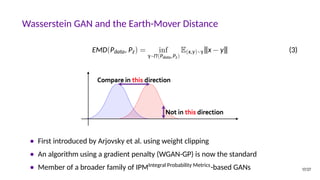
Wasserstein GAN and the Earth-Mover Distance
EMD(Pdata, Pz) = inf
γ∼(Pdata,Pz)
E(x,y)∼γ x − y (3)
• First introduced by Arjovsky et al. using weight clipping
• An algorithm using a gradient penalty (WGAN-GP) is now the standard
• Member of a broader family of IPMIntegral Probability Metrics-based GANs 17/27
Training Tricks
• Improved Techniques for Training GANsTalimans et al. 2016
– Feature matching
– One-sided label smoothing
• GAN Hacks https://github.com/soumith/ganhacks
– Use BatchNorm, but do not mix real and fake batches
– Avoid sparse gradients by using LeakyReLU
• Two Time-scale Update RuleHeusel et al. 2017
– Train the discriminator faster than generator
• Progressive Growing of GANsKarras et al. 2017
– Start with low resolution and linearly interpolate to higher dimensions
18/27
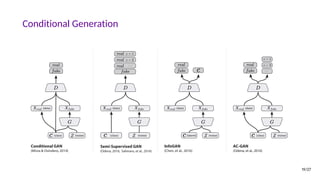
Conditional Generation
(noise)(latent)
(data)
InfoGAN
(Chen, et al., 2016)
. . .
(noise)(class)
(data)
AC-GAN
(Odena, et al., 2016)
(noise)(class)
(data)
Conditional GAN
(Mirza & Osindero, 2014)
(noise)
. . .
(class)
(data)
Semi-Supervised GAN
(Odena, 2016; Salimans, et al., 2016)
19/27
Projection Discriminator
[Miyato & Koyama, 2018] 20/27
GANs with Encoder
features data
z G G(z)
xEE (x)
G(z), z
x, E (x)
D P (y)
[Donahue et al., 2017, Dumoulin et al., 2017]
21/27
Superresolution
bicubic SRResNet SRGAN original
(21.59dB/0.6423) (23.53dB/0.7832) (21.15dB/0.6868)
[Ledig et al., 2016]
22/27
Image-to-Image Translation
[Zhu et al., 2016] 23/27
WaveGAN and Speech Enhancement GAN
Phase shuffle n=1
-1 0 +1
[Donahue et al. 2018, Pascual et al. 2017]
24/27
Reasons to Love GANs
• GANs set up an arms race
• GANs can be used as a “learned loss function”
• GANs are “meta-supervisors”
• GANs are great data memorizers
• GANs are democratizing computer art
[Alexei A. Efros, CVPR 2018 Tutorial]
25/27
MSE and MAE do not Account for Multi-Modality
[Sønderby et al., 2017]
26/27
Programming GANs
• Needs to fix the opponent’s weights during each update
• Framework-dependent:
– Keras: hack with the trainable flag
– TensorFlow: tf.contrib.gan contains off-the-shelf algorithms
– PyTorch: Call appropriate backward() for each update
• There are tons of examples, and the best way to learn is to read them
27/27

A Short Introduction to Generative Adversarial Networks

  • 1.
    Introduction to GenerativeAdversarial Networks Oct 16, 2018 Jong Wook Kim Music and Audio Research Laboratory, New York University
  • 2.
  • 3.
    Generative Modeling data → probability distribution {x1,x2, · · · , xN} p(x) vs. Discriminative Models: labeled data → conditional probability distribution {(x1, y1), (x2, y2), · · · , (xN, yN)} p(y | x) 1/27
  • 4.
    Low Dimension Example:Density Estimation 2/27
  • 5.
    High Dimension Example:Sample Generation → data samples [Berthelot et al. 2017, BEGAN] 3/27
  • 6.
    Why Study GenerativeModels? • Test of our ability to use high-dimensional, complicated probability distributions • Simulate possible futures for planning or reinforcement learning • Missing data, semi-supervised learning • Multi-modal outputs • Realistic generation tasks [Goodfellow, NIPS 2016 Tutorial] 4/27
  • 7.
    The 2-D case Assumea Gaussian Mixture Model: • p(x|π, μ, ) = i πi (μi, i) 5/27
  • 8.
    The 2-D case Assumea Gaussian Mixture Model: • p(x|π, μ, ) = i πi (μi, i) Perform maximum likelihood estimation: • maxπ,μ, x(j)∈data log p(x(j)|π, μ, ) 5/27
  • 9.
    The 2-D case •Density estimation: • Sample generation: Go-to generative model for low-dimensional data 6/27
  • 10.
    The Manifold Assumption Latentspace Data space “The data distribution lies on a low-dimensional manifold” 7/27
  • 11.
    Latent Space Interpolation [Berthelotet al. 2017, BEGAN] 8/27
  • 12.
    Latent Space Arithmetic [Radfordet al. 2015, DCGAN] 9/27
  • 13.
    Building Manifold usinga Decoder 10/27
  • 14.
    Building Manifold usinga Decoder Question: how should we measure if the generation is good? 10/27
  • 15.
    Autoencoder: Make itReconstruct the Original Image • Vanilla AE – Still needs a generative model (like GMM) on the latent space • Variational Autoencoders (VAE) – Variational approximation results in a blurry image. 11/27
  • 16.
    btw: L2 Distancedoesn’t Work Very Well for Image Similarity 12/27
  • 17.
    Idea: Use aNeural Network to Evaluate Generation 13/27
  • 18.
    Idea: Use aNeural Network to Evaluate Generation Question: how does the discriminator know about the data distribution? 13/27
  • 19.
  • 20.
    The GAN Formula min G max D [︁ Ex∼pdatalog D(x) + Ez∼pz log (1 − D(G(z))) ]︁ (1) • A minimax game between the generator and the discriminator. • In practice, a non-saturating variant is often used for updating G: max G Ez∼pz log D(G(z)) (2) [Goodfellow et al. 2014, Generative Adversarial Nets] 15/27
  • 21.
    The GAN Zoo NameDiscriminator Loss Generator Loss Minimax GAN GAN D = −Exlog D(x) − Ez log (1 − D(G(z))) GAN G = Ez log(1 − D(G(z))) Non-Saturating GAN NSGAN D = GAN D NSGAN G = −Ez log D(G(z)) Least-Squares GAN LSGAN D = Ex(D(x) − 1)2 + EzD(G(z))2 LSGAN G = Ez(D(G(z)) − 1)2 Wasserstein GAN WGAN D = −ExD(x) + EzD(G(z)) WGAN G = −EzD(G(z)) WGAN-GP WGANGP D = WGAN D + λEx,z( ∇D(αx + (1 − α)G(z)) 2 − 1)2 WGANGP G = WGAN G DRAGAN DRAGAN D = GAN D + λEx∼pdata+ (0,c)( ∇D(x) 2 − 1)2 DRAGAN G = GAN G BEGAN BEGAN D = Ex x − AE(x) 1 − ktEz G(z) − AE(G(z)) 1 BEGAN G = Ez G(z) − AE(G(z)) 1 16/27
  • 22.
    Wasserstein GAN andthe Earth-Mover Distance EMD(Pdata, Pz) = inf γ∼(Pdata,Pz) E(x,y)∼γ x − y (3) • First introduced by Arjovsky et al. using weight clipping • An algorithm using a gradient penalty (WGAN-GP) is now the standard • Member of a broader family of IPMIntegral Probability Metrics-based GANs 17/27
  • 23.
    Training Tricks • ImprovedTechniques for Training GANsTalimans et al. 2016 – Feature matching – One-sided label smoothing • GAN Hacks https://github.com/soumith/ganhacks – Use BatchNorm, but do not mix real and fake batches – Avoid sparse gradients by using LeakyReLU • Two Time-scale Update RuleHeusel et al. 2017 – Train the discriminator faster than generator • Progressive Growing of GANsKarras et al. 2017 – Start with low resolution and linearly interpolate to higher dimensions 18/27
  • 24.
    Conditional Generation (noise)(latent) (data) InfoGAN (Chen, etal., 2016) . . . (noise)(class) (data) AC-GAN (Odena, et al., 2016) (noise)(class) (data) Conditional GAN (Mirza & Osindero, 2014) (noise) . . . (class) (data) Semi-Supervised GAN (Odena, 2016; Salimans, et al., 2016) 19/27
  • 25.
  • 26.
    GANs with Encoder featuresdata z G G(z) xEE (x) G(z), z x, E (x) D P (y) [Donahue et al., 2017, Dumoulin et al., 2017] 21/27
  • 27.
    Superresolution bicubic SRResNet SRGANoriginal (21.59dB/0.6423) (23.53dB/0.7832) (21.15dB/0.6868) [Ledig et al., 2016] 22/27
  • 28.
  • 29.
    WaveGAN and SpeechEnhancement GAN Phase shuffle n=1 -1 0 +1 [Donahue et al. 2018, Pascual et al. 2017] 24/27
  • 30.
    Reasons to LoveGANs • GANs set up an arms race • GANs can be used as a “learned loss function” • GANs are “meta-supervisors” • GANs are great data memorizers • GANs are democratizing computer art [Alexei A. Efros, CVPR 2018 Tutorial] 25/27
  • 31.
    MSE and MAEdo not Account for Multi-Modality [Sønderby et al., 2017] 26/27
  • 32.
    Programming GANs • Needsto fix the opponent’s weights during each update • Framework-dependent: – Keras: hack with the trainable flag – TensorFlow: tf.contrib.gan contains off-the-shelf algorithms – PyTorch: Call appropriate backward() for each update • There are tons of examples, and the best way to learn is to read them 27/27