Monitoring
 Visits
   Jobin Kunjumon
   Vilapurathu
Definition

Monitoring
      The act of overseeing the progress of a clinical trial, and
  of ensuring that it is conducted, recorded, and reported in
  accordance with the protocol, SOPs, GCP, & the applicable
  regulatory requirements.

Monitoring Report
         A written report from the monitor to the sponsor after
  each site visit and other trial-related communication
  according to the sponsor’s SOPs.
Purpose


   The rights & well being of the human subjects are protected .

   The reported trial data are accurate ,complete and verifiable
    from source documents.

   The conduct of the trial is in compliance with the currently
    approved protocol or amendments, with GCP & with
    applicable regulatory requirements.
Frequency
Frequency of monitoring visits is not defined by ICH or FDA
  regulations

   ICH states that “the sponsor should ensure trials are
    adequately monitored before, during and after the study”.

   The frequency of monitoring depends on
    ◦ The complexity of the study
    ◦ Rate of enrollment
    ◦ GCP compliance issues
Selection & Qualification of monitors
   Should be appointed by the sponsor.

   Should be appropriately trained & should have
    scientific/clinical knowledge.

   Qualification should be documented.

   Should be thoroughly familiar with the IP, protocol, ICF, & any
    other written information to be provided to subjects, the
    SOPs, GCP & applicable regulatory requirements.
Types
The most common types of site visits for industry-sponsored
  studies:
  ◦ Site Evaluation/Qualification Visit

  ◦ Site Initiation Visit

  ◦ Site Monitoring Visit

  ◦ Site Close-Out Visit
Site Evaluation Visit
ICH Guidelines nor FDA regulations specifically require a Site
Evaluation Visit.

ICH does require a pre-trial monitoring report as part of the
“Essential Documents” and states that there is a need for on-site
monitoring “before, during and after” a trial.

FDA “Guidelines for the Monitoring of Clinical Investigations”
does recommend that a monitor visit the site of the clinical
investigation prior to the initiation of the trial.
Site Evaluation Visit
   Investigator’s Qualifications:
    1. Up-to-date CV
    2. Specialty
    3. Previous experience in conducting trial.

   Adequate Resources:
    1.Retrospective data
    2.Sufficient time
    3.Adequate number of qualified staff
Site Evaluation Visit
   Adequate facilities:
    1.Exam rooms

    2.Pharmacy/Study drug storage area

    3.Laboratory or specimen processing area

    4.Special testing areas ( x-rays, CT scans, endoscopy, etc.)

    5.Record keeping facilities
Site Evaluation Visit
   Protocol review/discussion

    ◦ Study objectives

    ◦ Inclusion/exclusion criteria
       Are there barriers to enrollment at your site?
    ◦ Study Procedures/Tests
       Can you perform all the procedures/tests required
        for the study?

    ◦ Schedule of Assessments
       Special considerations such as weekend/24 hour
        coverage, etc.

    ◦ Are there any competing trials?
Site Initiation Visit
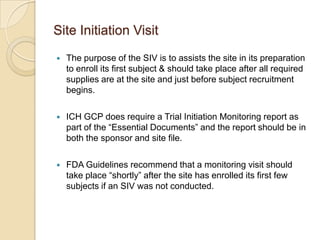
   The purpose of the SIV is to assists the site in its preparation
    to enroll its first subject & should take place after all required
    supplies are at the site and just before subject recruitment
    begins.

   ICH GCP does require a Trial Initiation Monitoring report as
    part of the “Essential Documents” and the report should be in
    both the sponsor and site file.

   FDA Guidelines recommend that a monitoring visit should
    take place “shortly” after the site has enrolled its first few
    subjects if an SIV was not conducted.
Site Monitoring Visit
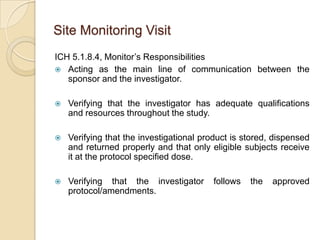
ICH 5.1.8.4, Monitor’s Responsibilities
 Acting as the main line of communication between the
   sponsor and the investigator.

   Verifying that the investigator has adequate qualifications
    and resources throughout the study.

   Verifying that the investigational product is stored, dispensed
    and returned properly and that only eligible subjects receive
    it at the protocol specified dose.

   Verifying that the investigator      follows   the   approved
    protocol/amendments.
Site Monitoring Visit
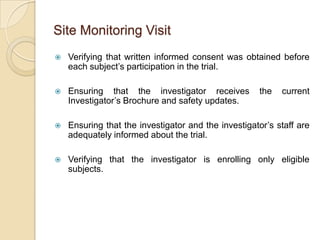
   Verifying that written informed consent was obtained before
    each subject’s participation in the trial.

   Ensuring that the investigator receives          the   current
    Investigator’s Brochure and safety updates.

   Ensuring that the investigator and the investigator’s staff are
    adequately informed about the trial.

   Verifying that the investigator is enrolling only eligible
    subjects.
Site Monitoring Visit
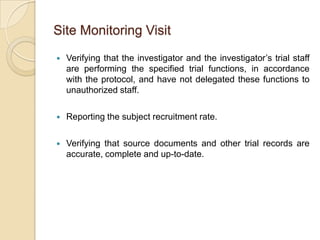
   Verifying that the investigator and the investigator’s trial staff
    are performing the specified trial functions, in accordance
    with the protocol, and have not delegated these functions to
    unauthorized staff.

   Reporting the subject recruitment rate.

   Verifying that source documents and other trial records are
    accurate, complete and up-to-date.
Site Monitoring Visit

   Informing the investigator of any CRF entry error, omission or
    illegibility. The monitor should ensure that appropriate
    corrections, additions or deletions are made, dated, explained
    (if necessary) and initialed by the investigator or a trial staff
    member that has been authorized to make CRF changes for
    the investigator. This authorization should be documented.

   Determining whether the investigator is maintaining the
    essential documents.
Site Monitoring Visit
   Determining whether all adverse events are appropriately
    reported within the time periods required by GCP, the
    protocol, the IRB, the sponsor and the applicable regulatory
    authorities.

   Communicating deviations from the protocol, SOPs and GCP
    to the investigator and taking appropriate action designed to
    prevent recurrence of the deviations.
Monitoring Report
Monitor submits to the sponsor after each trial site visit:
o Written report.


o   Should include date, site, name of the monitor, investigator or
    other individuals contacted.

o   Summary of what the monitor reviewed & the monitor’s
    statements concerning significant findings/facts, deviations &
    deficiencies, conclusions, actions taken or to be taken
    &/actions recommended to secure compliance.

o   Review & follow-up of the report with the sponsor should be
    documented by sponsor’s designated representative.
Site Close-Out Visit
There are no clear ICH or FDA regulations regarding the close-
  out visit.
ICH GCP requires a close-out monitoring report as an Essential
  Document.

In general, three activities are required to “officially” close-out a
   site.
   ◦ The sponsor conducts a close-out visit and signs the
      monitoring log.

   ◦ The investigator submits a final report to the IRB stating
     that the site is closed.

   ◦ The sponsor sends the investigator a letter stating that the
     site is closed.
Site Close-Out Visit
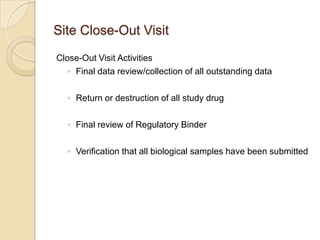
Close-Out Visit Activities
   ◦ Final data review/collection of all outstanding data

  ◦ Return or destruction of all study drug

  ◦ Final review of Regulatory Binder

  ◦ Verification that all biological samples have been submitted
Site Close-Out Visit
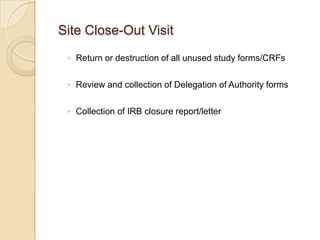
 ◦ Return or destruction of all unused study forms/CRFs

 ◦ Review and collection of Delegation of Authority forms

 ◦ Collection of IRB closure report/letter
Monitoring Visits

Monitoring Visits

  • 1.
    Monitoring Visits Jobin Kunjumon Vilapurathu
  • 2.
    Definition Monitoring The act of overseeing the progress of a clinical trial, and of ensuring that it is conducted, recorded, and reported in accordance with the protocol, SOPs, GCP, & the applicable regulatory requirements. Monitoring Report A written report from the monitor to the sponsor after each site visit and other trial-related communication according to the sponsor’s SOPs.
  • 3.
    Purpose  The rights & well being of the human subjects are protected .  The reported trial data are accurate ,complete and verifiable from source documents.  The conduct of the trial is in compliance with the currently approved protocol or amendments, with GCP & with applicable regulatory requirements.
  • 4.
    Frequency Frequency of monitoringvisits is not defined by ICH or FDA regulations  ICH states that “the sponsor should ensure trials are adequately monitored before, during and after the study”.  The frequency of monitoring depends on ◦ The complexity of the study ◦ Rate of enrollment ◦ GCP compliance issues
  • 5.
    Selection & Qualificationof monitors  Should be appointed by the sponsor.  Should be appropriately trained & should have scientific/clinical knowledge.  Qualification should be documented.  Should be thoroughly familiar with the IP, protocol, ICF, & any other written information to be provided to subjects, the SOPs, GCP & applicable regulatory requirements.
  • 6.
    Types The most commontypes of site visits for industry-sponsored studies: ◦ Site Evaluation/Qualification Visit ◦ Site Initiation Visit ◦ Site Monitoring Visit ◦ Site Close-Out Visit
  • 7.
    Site Evaluation Visit ICHGuidelines nor FDA regulations specifically require a Site Evaluation Visit. ICH does require a pre-trial monitoring report as part of the “Essential Documents” and states that there is a need for on-site monitoring “before, during and after” a trial. FDA “Guidelines for the Monitoring of Clinical Investigations” does recommend that a monitor visit the site of the clinical investigation prior to the initiation of the trial.
  • 8.
    Site Evaluation Visit  Investigator’s Qualifications: 1. Up-to-date CV 2. Specialty 3. Previous experience in conducting trial.  Adequate Resources: 1.Retrospective data 2.Sufficient time 3.Adequate number of qualified staff
  • 9.
    Site Evaluation Visit  Adequate facilities: 1.Exam rooms 2.Pharmacy/Study drug storage area 3.Laboratory or specimen processing area 4.Special testing areas ( x-rays, CT scans, endoscopy, etc.) 5.Record keeping facilities
  • 10.
    Site Evaluation Visit  Protocol review/discussion ◦ Study objectives ◦ Inclusion/exclusion criteria  Are there barriers to enrollment at your site? ◦ Study Procedures/Tests  Can you perform all the procedures/tests required for the study? ◦ Schedule of Assessments  Special considerations such as weekend/24 hour coverage, etc. ◦ Are there any competing trials?
  • 11.
    Site Initiation Visit  The purpose of the SIV is to assists the site in its preparation to enroll its first subject & should take place after all required supplies are at the site and just before subject recruitment begins.  ICH GCP does require a Trial Initiation Monitoring report as part of the “Essential Documents” and the report should be in both the sponsor and site file.  FDA Guidelines recommend that a monitoring visit should take place “shortly” after the site has enrolled its first few subjects if an SIV was not conducted.
  • 12.
    Site Monitoring Visit ICH5.1.8.4, Monitor’s Responsibilities  Acting as the main line of communication between the sponsor and the investigator.  Verifying that the investigator has adequate qualifications and resources throughout the study.  Verifying that the investigational product is stored, dispensed and returned properly and that only eligible subjects receive it at the protocol specified dose.  Verifying that the investigator follows the approved protocol/amendments.
  • 13.
    Site Monitoring Visit  Verifying that written informed consent was obtained before each subject’s participation in the trial.  Ensuring that the investigator receives the current Investigator’s Brochure and safety updates.  Ensuring that the investigator and the investigator’s staff are adequately informed about the trial.  Verifying that the investigator is enrolling only eligible subjects.
  • 14.
    Site Monitoring Visit  Verifying that the investigator and the investigator’s trial staff are performing the specified trial functions, in accordance with the protocol, and have not delegated these functions to unauthorized staff.  Reporting the subject recruitment rate.  Verifying that source documents and other trial records are accurate, complete and up-to-date.
  • 15.
    Site Monitoring Visit  Informing the investigator of any CRF entry error, omission or illegibility. The monitor should ensure that appropriate corrections, additions or deletions are made, dated, explained (if necessary) and initialed by the investigator or a trial staff member that has been authorized to make CRF changes for the investigator. This authorization should be documented.  Determining whether the investigator is maintaining the essential documents.
  • 16.
    Site Monitoring Visit  Determining whether all adverse events are appropriately reported within the time periods required by GCP, the protocol, the IRB, the sponsor and the applicable regulatory authorities.  Communicating deviations from the protocol, SOPs and GCP to the investigator and taking appropriate action designed to prevent recurrence of the deviations.
  • 17.
    Monitoring Report Monitor submitsto the sponsor after each trial site visit: o Written report. o Should include date, site, name of the monitor, investigator or other individuals contacted. o Summary of what the monitor reviewed & the monitor’s statements concerning significant findings/facts, deviations & deficiencies, conclusions, actions taken or to be taken &/actions recommended to secure compliance. o Review & follow-up of the report with the sponsor should be documented by sponsor’s designated representative.
  • 18.
    Site Close-Out Visit Thereare no clear ICH or FDA regulations regarding the close- out visit. ICH GCP requires a close-out monitoring report as an Essential Document. In general, three activities are required to “officially” close-out a site. ◦ The sponsor conducts a close-out visit and signs the monitoring log. ◦ The investigator submits a final report to the IRB stating that the site is closed. ◦ The sponsor sends the investigator a letter stating that the site is closed.
  • 19.
    Site Close-Out Visit Close-OutVisit Activities ◦ Final data review/collection of all outstanding data ◦ Return or destruction of all study drug ◦ Final review of Regulatory Binder ◦ Verification that all biological samples have been submitted
  • 20.
    Site Close-Out Visit ◦ Return or destruction of all unused study forms/CRFs ◦ Review and collection of Delegation of Authority forms ◦ Collection of IRB closure report/letter