• The ClinicalResearch Associate (CRA) is the primary representative
of the sponsor and arguably has the most direct impact on the
proper and accurate reporting of adverse events in clinical trials.
This impact is encompassed within the following
responsibilities
• The CRA is the first line of communication between the sponsor and
investigator throughout the study.
3.
One of themost critical functions of the CRA is to assure that
investigators are fully aware of, and comply with, their
responsibilities for adverse event reporting.
To achieve this, the CRA must often teach the adverse
event reporting requirements to investigators.
• Consequently, the CRA must be knowledgeable about both the
regulatory and sponsor-specific requirements for reporting serious
and non-serious adverse events in clinical trials
RESPONSIBILITIES:
Evaluating &Selecting theinvestigators
• The Monitor is responsible for selecting the
investigator/institution.
• Each investigator should be qualified by training experience
and should have adequate resources to properly conduct the
trial for which the investigator is selected.
6.
Pre Study Visit(site selection visit)
• Conducted at a potential research site Assess the investigator’s
experience, staff, facility and potential patient population Introduce
the study & obligations to the potential investigator & staff
7.
Site Initiation Visit
•Conducted at a confirmed research site Verify the confirmed
investigator’s experience, staff, facility and potential patient
population Detail the study & obligations to the potential
investigator & staff.
• Collect all essential documents before this visit
8.
Routine Monitoring Visit
CRA’smain activity – study monitoring
Purpose of monitoring:
• Rights& well being of subjects are protected reported data are
accurate, complete & verifiable from source documents.
• trial conduct is in compliance with protocol, GCP & applicable
regulatory requirements
9.
Routine Monitoring Visit
•Review IP handling, storage conditions, receipt, use, return and
disposition
• Review all informed consent forms
• Review protocol compliance
• Review CRFs, source documents, site file
• Review AEs/SAEs
• Review facilities, resources, staffing
• Address questions and/or concerns
10.
Site Close outVisit
Site close out visit is conducted when
• Study is complete & finished
• Enrollment has stopped
• All subjects have completed their study related activities
• Data are complete & correct
• Final IP accountability is done
11.
Site close outvisit is conducted to
• Retrieve all appropriate study supplies
• Verify that study documentation is complete & accurate
• Ensure that site is in compliance with regulatory & GCP
guidelines
12.
Brief List ofResponsibilities :
• Identify and recruit investigators.
• Conduct on-site clinical monitoring which includes: document
review, ensuring accurate data recording, verifying patient data,
adherence to the protocol of a clinical trial in accordance with
GCP/ICH guidelines, and Excel’s/sponsor’s SOPs.
• Perform on-site visits, including site qualification, initiation,
monitoring and closeout visits.
• Assist investigator meeting including preparation, liaison,
presentations, problem resolutions, and follow up.
• Ensure timely submission of protocol / consent documents for
EC/IRB approval.
• Maintain all files and documentation pertaining to studies.
13.
• Motivate investigatorsin order to achieve recruitment targets.
• Maintaining regular contact with study sites to ensure
protocol/GCP compliance.
• Communicate progress of study and relevant information to Project
Manager/Sr. CRA and other project team members.
• Complete accurate study status reports in time.
• Ensure the correct storage of drugs and the diligent account of all
drugs in accordance with SOPs.
• Deal with CRF queries in a timely manner.
• Participate, if requested, in the preparation of and review of study
documentation, e.g. draft protocols, draft CRFs, monitoring
guidelines and elements of final report.
• Ensure correct archiving of files on completion of a study.
14.
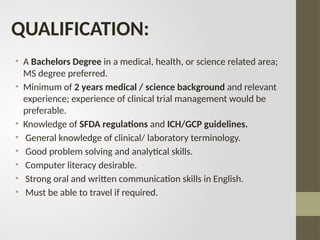
QUALIFICATION:
• A BachelorsDegree in a medical, health, or science related area;
MS degree preferred.
• Minimum of 2 years medical / science background and relevant
experience; experience of clinical trial management would be
preferable.
• Knowledge of SFDA regulations and ICH/GCP guidelines.
• General knowledge of clinical/ laboratory terminology.
• Good problem solving and analytical skills.
• Computer literacy desirable.
• Strong oral and written communication skills in English.
• Must be able to travel if required.





![062016CV_Johnson_Debra [147732]](https://cdn.slidesharecdn.com/ss_thumbnails/19b81a04-95e2-42e9-865f-f4fa76591197-161129173015-thumbnail.jpg?width=640&height=640&fit=bounds)


