QUALITY
    ASSURANCE OF
    CLINICAL TRIALS

    A culture of checks and examinations
    ensuring the quality of clinical trials


1
      Dr. Bhaswat S. Chakraborty
      Sr. VP & Chair, R&D Core Committee
      Cadila Pharmaceuticals Ltd., Ahmedabad
2
CONTENTS
 Quality Framework
 Understanding the critical parameters that need
  to be taken care of while conducting a trial
 Developing practical techniques to ensure the
  incorporation of Quality by Design (QbD) in the
  design trials
 Dealing with practical challenges in data capture
  and documentation design to ensure flawless
  execution of your clinical trials
 Case Studies

 Concluding remarks
                                                      3
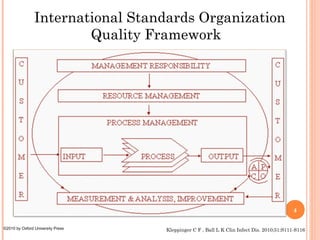
International Standards Organization
                        Quality Framework


                                                                                         4

©2010 by Oxford University Press   Kleppinger C F , Ball L K Clin Infect Dis. 2010;51:S111-S116
GCP
   Good clinical practice (GCP) is a set of internationally
    recognized ethical and scientific standards for the
    following aspects of clinical trials:
      Design
      Conduct
      Performance
      Monitoring
      Auditing
      Recording
      Analysis, and
      Reporting
                                                           5
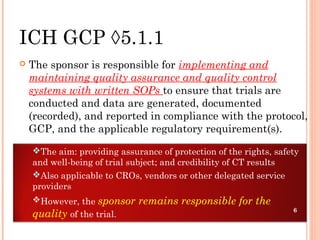
ICH GCP ◊5.1.1
   The sponsor is responsible for implementing and
    maintaining quality assurance and quality control
    systems with written SOPs to ensure that trials are
    conducted and data are generated, documented
    (recorded), and reported in compliance with the protocol,
    GCP, and the applicable regulatory requirement(s).

    The aim: providing assurance of protection of the rights, safety
    and well-being of trial subject; and credibility of CT results
    Also applicable to CROs, vendors or other delegated service
    providers
    However, the sponsor remains responsible for the
                                                                   6
    quality of the trial.
KEY ELEMENTS OF THE
QUALITY SYSTEM
   Documented procedures are developed, implemented
    and kept up-to-date
   Training of sponsor personnel as well as of the
    personnel in affiliates, at CROs and at trial sites
   Validation of computerised systems
   Monitoring of trial sites and technical facilities on-site
    or by using centralised monitoring techniques
   Data management and quality control
   Internal and external audits performed by
    independent auditors                                     7
WHAT QUALITY & AT WHAT
COST?
   The most pragmatic definition of quality is “fitness
    for purpose”
 Simply striving for the “highest level” of quality has
  little practical meaning
 Current practices: either success at an [unnecessarily]
  high cost or failure also very costly
 A practical & cost effective paradigm:

  “Adequate quality of a CT should be such that the
  decisions made would have been no different had the
  quality of data and information generated been perfect”

     EMA reflection paper on risk based quality management in clinical trials   8
CURRENT CLINICAL TRIALS
(CTS)
   Current CT design, implementation and oversight
     Expensive,  outmoded and unsustainable in a global,
      complex trial environment
     Especially existing monitoring models do not optimally
      address the most critical risks to trial integrity
     They rely on frequent, on-site monitoring visits by sponsor
      personnel
     Monitoring is only one component of an overall quality
      framework
     Trial personnel agree that widespread adoption of an
      enlightened “quality-by-design” approach to trial planning,
      conduct, and oversight is needed to ensure trial quality and
      efficiency
     Such an approach would apply risk management principles    9

      to the design and execution of CTs
THE CURRENT QUALITY
CHALLENGE
   The ongoing challenge in managing the quality of clinical data is to
    continually monitor data collection procedures and data management
    practices at every level of the study. This includes:
   Ensuring that data generated during the study reflect what is specified
    in the protocol (case report form[CRF] vs. protocol)
   Comparing data in the CRF and data collected in source documents for
    accuracy (CRF vs. source documents)
   Ensuring that the data analyzed are the data recorded in the CRF
    (database vs. CRF).Quality surveillance continues after the trial has
    ended and plays an important role in ensuring that:
   Data presented in tables, listings, and graphs (TLGs) correctly match
    data in the database (TLGs vs. database)
   Data reported in the clinical study report (CSR) are the data analyzed
    (CSR vs. TLGs)
   All aspects of the data management processes are compliant with SOPs
    and GCPs.                                                           10
QUALTY BY DESIGN
(QBD)
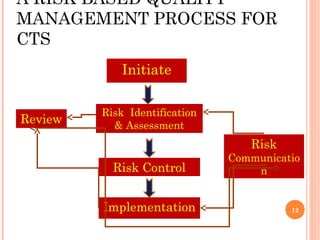
 QbD   is based on 2 basic principles:

1. Clinical insight: link between the product
   and its safety and efficacy in humans
   and
2. Process understanding: link between the
   drug product and process attributes


                                                11
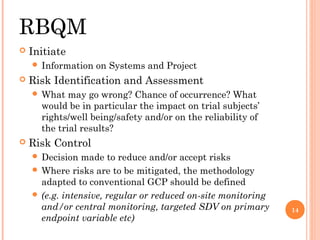
A RISK BASED QUALITY
MANAGEMENT PROCESS FOR
CTS
             Initiate

         Risk Identification
Review     & Assessment
                                  Risk
                               Communicatio
           Risk Control            n


         Implementation                  12
RISK BASED QUALITY
MANAGEMENT
   Key idea & practice:
     Identify,  assess, control & mitigate, communicate,
      and review [both risks & remedies]
     All risks [low, mid & high grade] associated with the
      clinical trial during its lifecycle
 RBQM facilitates better and more informed
  decision making and makes best use of the
  available resources
 Should be appropriately documented and
  integrated within existing quality systems
 Responsibility of all involved parties to
  contribute to the delivery of an effective RBQM
                                                              13
RBQM
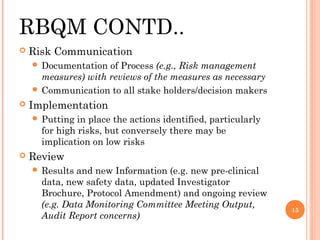
   Initiate
     Information   on Systems and Project
   Risk Identification and Assessment
     What   may go wrong? Chance of occurrence? What
      would be in particular the impact on trial subjects’
      rights/well being/safety and/or on the reliability of
      the trial results?
   Risk Control
     Decision   made to reduce and/or accept risks
     Where risks are to be mitigated, the methodology
      adapted to conventional GCP should be defined
     (e.g. intensive, regular or reduced on-site monitoring
      and/or central monitoring, targeted SDV on primary       14
      endpoint variable etc)
RBQM CONTD..
   Risk Communication
     Documentation  of Process (e.g., Risk management
      measures) with reviews of the measures as necessary
     Communication to all stake holders/decision makers
   Implementation
     Putting  in place the actions identified, particularly
      for high risks, but conversely there may be
      implication on low risks
   Review
     Results  and new Information (e.g. new pre-clinical
      data, new safety data, updated Investigator
      Brochure, Protocol Amendment) and ongoing review
      (e.g. Data Monitoring Committee Meeting Output,
                                                               15
      Audit Report concerns)
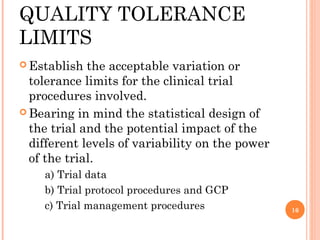
QUALITY TOLERANCE
LIMITS
 Establish  the acceptable variation or
  tolerance limits for the clinical trial
  procedures involved.
 Bearing in mind the statistical design of
  the trial and the potential impact of the
  different levels of variability on the power
  of the trial.
    a) Trial data
    b) Trial protocol procedures and GCP
    c) Trial management procedures               16
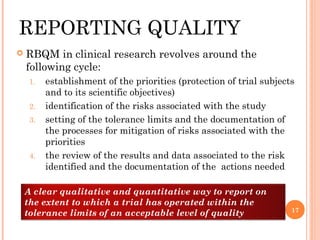
REPORTING QUALITY
   RBQM in clinical research revolves around the
    following cycle:
     1.   establishment of the priorities (protection of trial subjects
          and to its scientific objectives)
     2.   identification of the risks associated with the study
     3.   setting of the tolerance limits and the documentation of
          the processes for mitigation of risks associated with the
          priorities
     4.   the review of the results and data associated to the risk
          identified and the documentation of the actions needed

    A clear qualitative and quantitative way to report on
    the extent to which a trial has operated within the
                                                                      17
    tolerance limits of an acceptable level of quality
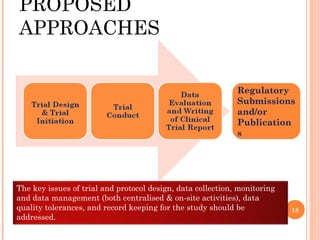
PROPOSED
APPROACHES


                                                             Regulatory
                                                             Submissions
                                                             and/or
                                                             Publication
                                                             s


The key issues of trial and protocol design, data collection, monitoring
and data management (both centralised & on-site activities), data
quality tolerances, and record keeping for the study should be             18
addressed.
   Prioritization and risk mitigation approaches across
    several dimensions:
     Protection of trials subjects - Rights and Integrity, Safety
     Credibility of data and results
 Stratified according to knowledge of product (MA
  status)
 Customized approach depending on:
     Protocolcomplexity
     Therapeutic indication and nature of endpoints, including
      population and co-medications
     Administration of the product, dose, formulation
     Complexity of study procedures and measurement,
      including the nature of the intervention
     Vulnerability of the study population
                                                                     19
OPERATIONAL DELIVERABLES
OF RBQM
   Overall QC plan
   Sampling plan to be used (if applicable)
   Data source to be used for QC at each operational stage
   Metrics to be documented
   Acceptable quality levels
   Management of compliance with the protocol, SOPs, and GCPs
   Resolution of system problems prior to the end of the study
   Reduction of data queries
   Identification of ways to reduce cycle times for various processes
   Ensuring data integrity throughout the study's course and that
    the data collected are the data required by the protocol
   Ensuring the accuracy and consistency of data from entry into the
    CRF to final datasets reported in the final CSR
   Dealing with instances of nonconformity while carrying out
    clinical trials
                                                                      20
   Delivering an accurate and complete report (final CSR)
   …
CASE STUDIES


               21
CS 1: ASCEND-HF, STUDY DESIGN
 RCT, Double Blind, in acute Heart Failure (HF)
  patients
 3500 Nesiritide, 3500 Placebo

 Randomize <48 hours from hospitalization, <24 hours
  from IV RX for HF
 Co-Primary Endpoint Dyspnea index at 6/24hrs

 Co-Primary Endpoint 30-day Death/HF
  rehospitalization and secondary endpoints
 All-cause Mortality at 180 days


                                                    22
CS 1: ASCEND-HF, BUILDING & DEFINING
QUALITY
   Building
       Building Establish principles for quality operations/data before trial
        begins
       Integrate principles throughout trial operations
       Communicate expectations to sites and trial teams
       Implement surveillance plans and provide feedback
       Adhere to pragmatic principles
           Efficient, effective (& hopefully economical)
   Defining
       Enrolled the right participants according to the protocol with adequate
        consent?
       Did participants receive the assigned treatment and did they stay on the
        treatment?
       Was there complete ascertainment of primary and secondary efficacy
        data?
       Was there complete ascertainment of primary and secondary safety data?
                                                                                23
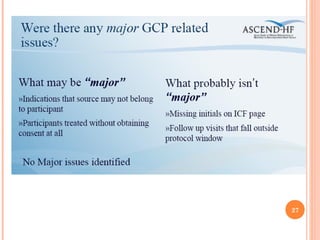
       Were there any major GCP related issues?
                                         Source: Hernandez and Reist (2011), CTTI Workshop Presentation
24
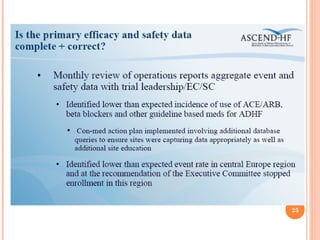
25
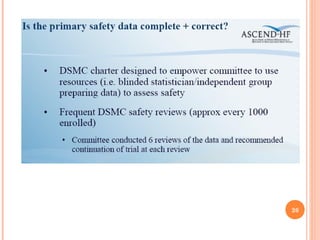
26
27
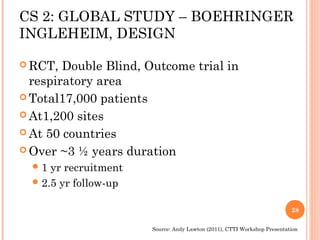
CS 2: GLOBAL STUDY – BOEHRINGER
INGLEHEIM, DESIGN

 RCT,  Double Blind, Outcome trial in
  respiratory area
 Total17,000 patients

 At1,200 sites

 At 50 countries

 Over ~3 ½ years duration
  1  yr recruitment
   2.5 yr follow-up


                                                                          28


                       Source: Andy Lawton (2011), CTTI Workshop Presentation
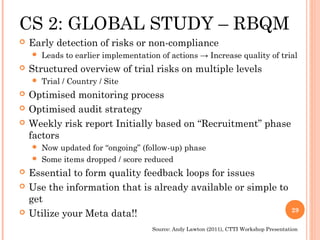
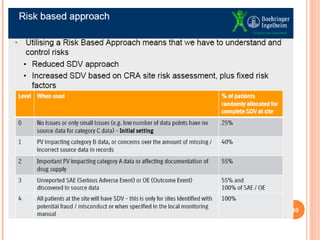
CS 2: GLOBAL STUDY – RBQM
   Early detection of risks or non-compliance
       Leads to earlier implementation of actions → Increase quality of trial
   Structured overview of trial risks on multiple levels
       Trial / Country / Site
   Optimised monitoring process
   Optimised audit strategy
   Weekly risk report Initially based on “Recruitment” phase
    factors
     Now updated for “ongoing” (follow-up) phase
     Some items dropped / score reduced

   Essential to form quality feedback loops for issues
   Use the information that is already available or simple to
    get
                                                                                         29
   Utilize your Meta data!!
                                      Source: Andy Lawton (2011), CTTI Workshop Presentation
30
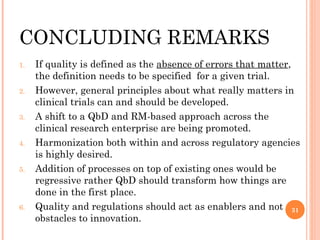
CONCLUDING REMARKS
1.   If quality is defined as the absence of errors that matter,
     the definition needs to be specified for a given trial.
2.   However, general principles about what really matters in
     clinical trials can and should be developed.
3.   A shift to a QbD and RM-based approach across the
     clinical research enterprise are being promoted.
4.   Harmonization both within and across regulatory agencies
     is highly desired.
5.   Addition of processes on top of existing ones would be
     regressive rather QbD should transform how things are
     done in the first place.
6.   Quality and regulations should act as enablers and not 31
     obstacles to innovation.
Acknowledgement:
THANK YOU VERY
    MUCH


                      32

Qc in clinical trials

  • 1.
    QUALITY ASSURANCE OF CLINICAL TRIALS A culture of checks and examinations ensuring the quality of clinical trials 1 Dr. Bhaswat S. Chakraborty Sr. VP & Chair, R&D Core Committee Cadila Pharmaceuticals Ltd., Ahmedabad
  • 2.
  • 3.
    CONTENTS  Quality Framework Understanding the critical parameters that need to be taken care of while conducting a trial  Developing practical techniques to ensure the incorporation of Quality by Design (QbD) in the design trials  Dealing with practical challenges in data capture and documentation design to ensure flawless execution of your clinical trials  Case Studies  Concluding remarks 3
  • 4.
    International Standards Organization Quality Framework 4 ©2010 by Oxford University Press Kleppinger C F , Ball L K Clin Infect Dis. 2010;51:S111-S116
  • 5.
    GCP  Good clinical practice (GCP) is a set of internationally recognized ethical and scientific standards for the following aspects of clinical trials:  Design  Conduct  Performance  Monitoring  Auditing  Recording  Analysis, and  Reporting 5
  • 6.
    ICH GCP ◊5.1.1  The sponsor is responsible for implementing and maintaining quality assurance and quality control systems with written SOPs to ensure that trials are conducted and data are generated, documented (recorded), and reported in compliance with the protocol, GCP, and the applicable regulatory requirement(s). The aim: providing assurance of protection of the rights, safety and well-being of trial subject; and credibility of CT results Also applicable to CROs, vendors or other delegated service providers However, the sponsor remains responsible for the 6 quality of the trial.
  • 7.
    KEY ELEMENTS OFTHE QUALITY SYSTEM  Documented procedures are developed, implemented and kept up-to-date  Training of sponsor personnel as well as of the personnel in affiliates, at CROs and at trial sites  Validation of computerised systems  Monitoring of trial sites and technical facilities on-site or by using centralised monitoring techniques  Data management and quality control  Internal and external audits performed by independent auditors 7
  • 8.
    WHAT QUALITY &AT WHAT COST?  The most pragmatic definition of quality is “fitness for purpose”  Simply striving for the “highest level” of quality has little practical meaning  Current practices: either success at an [unnecessarily] high cost or failure also very costly  A practical & cost effective paradigm: “Adequate quality of a CT should be such that the decisions made would have been no different had the quality of data and information generated been perfect” EMA reflection paper on risk based quality management in clinical trials 8
  • 9.
    CURRENT CLINICAL TRIALS (CTS)  Current CT design, implementation and oversight  Expensive, outmoded and unsustainable in a global, complex trial environment  Especially existing monitoring models do not optimally address the most critical risks to trial integrity  They rely on frequent, on-site monitoring visits by sponsor personnel  Monitoring is only one component of an overall quality framework  Trial personnel agree that widespread adoption of an enlightened “quality-by-design” approach to trial planning, conduct, and oversight is needed to ensure trial quality and efficiency  Such an approach would apply risk management principles 9 to the design and execution of CTs
  • 10.
    THE CURRENT QUALITY CHALLENGE  The ongoing challenge in managing the quality of clinical data is to continually monitor data collection procedures and data management practices at every level of the study. This includes:  Ensuring that data generated during the study reflect what is specified in the protocol (case report form[CRF] vs. protocol)  Comparing data in the CRF and data collected in source documents for accuracy (CRF vs. source documents)  Ensuring that the data analyzed are the data recorded in the CRF (database vs. CRF).Quality surveillance continues after the trial has ended and plays an important role in ensuring that:  Data presented in tables, listings, and graphs (TLGs) correctly match data in the database (TLGs vs. database)  Data reported in the clinical study report (CSR) are the data analyzed (CSR vs. TLGs)  All aspects of the data management processes are compliant with SOPs and GCPs. 10
  • 11.
    QUALTY BY DESIGN (QBD) QbD is based on 2 basic principles: 1. Clinical insight: link between the product and its safety and efficacy in humans and 2. Process understanding: link between the drug product and process attributes 11
  • 12.
    A RISK BASEDQUALITY MANAGEMENT PROCESS FOR CTS Initiate Risk Identification Review & Assessment Risk Communicatio Risk Control n Implementation 12
  • 13.
    RISK BASED QUALITY MANAGEMENT  Key idea & practice:  Identify, assess, control & mitigate, communicate, and review [both risks & remedies]  All risks [low, mid & high grade] associated with the clinical trial during its lifecycle  RBQM facilitates better and more informed decision making and makes best use of the available resources  Should be appropriately documented and integrated within existing quality systems  Responsibility of all involved parties to contribute to the delivery of an effective RBQM 13
  • 14.
    RBQM  Initiate  Information on Systems and Project  Risk Identification and Assessment  What may go wrong? Chance of occurrence? What would be in particular the impact on trial subjects’ rights/well being/safety and/or on the reliability of the trial results?  Risk Control  Decision made to reduce and/or accept risks  Where risks are to be mitigated, the methodology adapted to conventional GCP should be defined  (e.g. intensive, regular or reduced on-site monitoring and/or central monitoring, targeted SDV on primary 14 endpoint variable etc)
  • 15.
    RBQM CONTD..  Risk Communication  Documentation of Process (e.g., Risk management measures) with reviews of the measures as necessary  Communication to all stake holders/decision makers  Implementation  Putting in place the actions identified, particularly for high risks, but conversely there may be implication on low risks  Review  Results and new Information (e.g. new pre-clinical data, new safety data, updated Investigator Brochure, Protocol Amendment) and ongoing review (e.g. Data Monitoring Committee Meeting Output, 15 Audit Report concerns)
  • 16.
    QUALITY TOLERANCE LIMITS  Establish the acceptable variation or tolerance limits for the clinical trial procedures involved.  Bearing in mind the statistical design of the trial and the potential impact of the different levels of variability on the power of the trial. a) Trial data b) Trial protocol procedures and GCP c) Trial management procedures 16
  • 17.
    REPORTING QUALITY  RBQM in clinical research revolves around the following cycle: 1. establishment of the priorities (protection of trial subjects and to its scientific objectives) 2. identification of the risks associated with the study 3. setting of the tolerance limits and the documentation of the processes for mitigation of risks associated with the priorities 4. the review of the results and data associated to the risk identified and the documentation of the actions needed A clear qualitative and quantitative way to report on the extent to which a trial has operated within the 17 tolerance limits of an acceptable level of quality
  • 18.
    PROPOSED APPROACHES Regulatory Submissions and/or Publication s The key issues of trial and protocol design, data collection, monitoring and data management (both centralised & on-site activities), data quality tolerances, and record keeping for the study should be 18 addressed.
  • 19.
    Prioritization and risk mitigation approaches across several dimensions:  Protection of trials subjects - Rights and Integrity, Safety  Credibility of data and results  Stratified according to knowledge of product (MA status)  Customized approach depending on:  Protocolcomplexity  Therapeutic indication and nature of endpoints, including population and co-medications  Administration of the product, dose, formulation  Complexity of study procedures and measurement, including the nature of the intervention  Vulnerability of the study population 19
  • 20.
    OPERATIONAL DELIVERABLES OF RBQM  Overall QC plan  Sampling plan to be used (if applicable)  Data source to be used for QC at each operational stage  Metrics to be documented  Acceptable quality levels  Management of compliance with the protocol, SOPs, and GCPs  Resolution of system problems prior to the end of the study  Reduction of data queries  Identification of ways to reduce cycle times for various processes  Ensuring data integrity throughout the study's course and that the data collected are the data required by the protocol  Ensuring the accuracy and consistency of data from entry into the CRF to final datasets reported in the final CSR  Dealing with instances of nonconformity while carrying out clinical trials 20  Delivering an accurate and complete report (final CSR)  …
  • 21.
  • 22.
    CS 1: ASCEND-HF,STUDY DESIGN  RCT, Double Blind, in acute Heart Failure (HF) patients  3500 Nesiritide, 3500 Placebo  Randomize <48 hours from hospitalization, <24 hours from IV RX for HF  Co-Primary Endpoint Dyspnea index at 6/24hrs  Co-Primary Endpoint 30-day Death/HF rehospitalization and secondary endpoints  All-cause Mortality at 180 days 22
  • 23.
    CS 1: ASCEND-HF,BUILDING & DEFINING QUALITY  Building  Building Establish principles for quality operations/data before trial begins  Integrate principles throughout trial operations  Communicate expectations to sites and trial teams  Implement surveillance plans and provide feedback  Adhere to pragmatic principles  Efficient, effective (& hopefully economical)  Defining  Enrolled the right participants according to the protocol with adequate consent?  Did participants receive the assigned treatment and did they stay on the treatment?  Was there complete ascertainment of primary and secondary efficacy data?  Was there complete ascertainment of primary and secondary safety data? 23  Were there any major GCP related issues? Source: Hernandez and Reist (2011), CTTI Workshop Presentation
  • 24.
  • 25.
  • 26.
  • 27.
  • 28.
    CS 2: GLOBALSTUDY – BOEHRINGER INGLEHEIM, DESIGN  RCT, Double Blind, Outcome trial in respiratory area  Total17,000 patients  At1,200 sites  At 50 countries  Over ~3 ½ years duration 1 yr recruitment  2.5 yr follow-up 28 Source: Andy Lawton (2011), CTTI Workshop Presentation
  • 29.
    CS 2: GLOBALSTUDY – RBQM  Early detection of risks or non-compliance  Leads to earlier implementation of actions → Increase quality of trial  Structured overview of trial risks on multiple levels  Trial / Country / Site  Optimised monitoring process  Optimised audit strategy  Weekly risk report Initially based on “Recruitment” phase factors  Now updated for “ongoing” (follow-up) phase  Some items dropped / score reduced  Essential to form quality feedback loops for issues  Use the information that is already available or simple to get 29  Utilize your Meta data!! Source: Andy Lawton (2011), CTTI Workshop Presentation
  • 30.
  • 31.
    CONCLUDING REMARKS 1. If quality is defined as the absence of errors that matter, the definition needs to be specified for a given trial. 2. However, general principles about what really matters in clinical trials can and should be developed. 3. A shift to a QbD and RM-based approach across the clinical research enterprise are being promoted. 4. Harmonization both within and across regulatory agencies is highly desired. 5. Addition of processes on top of existing ones would be regressive rather QbD should transform how things are done in the first place. 6. Quality and regulations should act as enablers and not 31 obstacles to innovation.
  • 32.

Editor's Notes

  • #5 International Standards Organization quality framework [1]. Four key areas of concern: management responsibility (policy, objectives, planning, quality management system, and management review), resource management (human resources, information, and facilities), process management (customer satisfaction, design, purchasing, and production), and measurement, analysis, and improvement (audit, process control, and continual improvement).