Managing the
Clinical Research
Process
From Startup to Closeout
Clinical Research Essentials
In order to manage a clinical
research process, you will need:
● A research site
● A PI
● A study coordinator
● A study
1. Business Development: Acquiring Studies
● Without studies, you cannot generate
revenue!
● You can hire a service to help with acquiring
studies, or do it yourself.
● Go on clinicaltrials.gov, drugdev.org, or other
databases
● Search for indications and open studies
● Contact and network with project managers
that are looking for research sites
● Play the numbers game
Acquiring CDAs
● CDA: Confidentiality Disclosure Agreement (sometimes called NDA)
● Sponsors will send you CDAs as a formal document to inform you that
they are about to send confidential information about a study which
should not be shared
● Keep in mind: even though you have signed an NDA, you are still allowed
to forward the study contact to a colleague, just not the protocol or study
synopsis.
● Check your email!!! CDAs should be reviewed and returned back to the
sponsor as soon as possible!
Feasibility Survey
● Returning the CDA will likely trigger a
feasibility survey
● A feasibility survey is how the sponsor
gauges your site’s capabilities:
○ Your Investigator’s experience
○ Your coordinator’s experience
○ Your patient database numbers
○ Your previous study experience
● They are primarily looking for: patient
recruitment capabilities and clinical
research experience
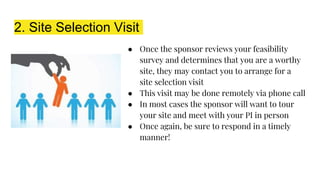
2. Site Selection Visit
● Once the sponsor reviews your feasibility
survey and determines that you are a worthy
site, they may contact you to arrange for a
site selection visit
● This visit may be done remotely via phone call
● In most cases the sponsor will want to tour
your site and meet with your PI in person
● Once again, be sure to respond in a timely
manner!
After the SSV...
● You will receive a site selection letter letting you know whether or not
you were awarded the study
● How soon after the SSV will vary
○ Could be on the day of the SSV or months later
● Typically, new sites will take longer to get a response vs add-on sites
● If it is up to you to follow up if you have not heard a response
Always Take on More Studies!
● Always try to take on more studies
than you think you can manage
● With the prevalence of risk-based
monitoring, studies may end much
sooner than when they were
scheduled to end
● Studies may be ended due to low-
efficacy or safety reasons
● If you end up with too many studies,
you can always lower recruitment
3. Contracts and Budgets
● Always negotiate your contracts and
budgets!
● Never just accept what is offered
because they will give you every
excuse to pay you less
● Always try to turn around your
negotiation of your contracts and
budgets within 1-2 weeks
4. Startup Regulatory
● The sponsor will send you a startup regulatory package which will include:
○ 1572
○ Financial disclosure forms
○ IRB Questionnaire
○ Site Delegation Log
○ Other essential documents
● These documents should be completed before your site initiation visit (SIV)
● Make sure the PI, Sub-I, and all relevant staff sign off on these forms
● Make sure you send in your initial IRB submission so that your site can be
approved
● Again, make sure this is done within 1-2 weeks
Other Essentials
● At this point, the sponsor will likely have sent
you other essentials for the study:
○ Regulatory binder
○ Lab kits
○ Investigational product
● Staff Training
○ ECG training
○ EDC training
○ GCP training
○ IATA training
● Make sure you have these things in place
prior to the SIV
5. Site Initiation Visit
● At this visit, the monitor visits your site to:
○ Conduct protocol training
○ Ensure you are fully equipped with lab kits, source docs, and study supplies
○ Ensure you have all regulatory documents in order
○ Ensure that your staff have EDC and IWRS access
○ Review your SOPs (Standard Operating Procedures)
● Essentially, they come to make sure you have everything you
need to start screening patients
● If anything is lacking, the monitor will let you know in their
follow up letter what action items need to be completed before
your site can start screening patients
6. Source Documents
● You could outsource for the creation of source
documents or make them yourself although
this can be time consuming
● Reference the Schedule of Assessments chart
in the protocol
○ Don’t forget to read all the footnotes!
● Ask the sponsor for eCRF guidelines or
screenshots of the EDC system to fine tune
your source docs
● Follow your own SOPs
7. Hire a Coordinator
● It will be difficult to manage study activities/subject
visits while handling business development as well
● Always actively tend to business development
because studies are prone to closing out early --
have something lined up
● The coordinator is the backbone of any study and
will do 90% of the work
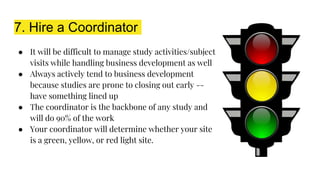
● Your coordinator will determine whether your site
is a green, yellow, or red light site.
8. Interim Monitoring Visits
● Every 6-8 weeks on average, a
monitor will visit your site to:
○ Do source data verification
○ Monitor your EDC and query any
discrepancies
○ Ensure you are following the protocol
○ Review your regulatory binder and make
sure all training and documents are up to
date
● Your relationship with your CRA is
critical!
9. Database Locks
● At certain points in the study, monitors will
require all data up to that point to be entered,
free of queries, and locked
● During database lock weeks, monitors will be
issuing a lot of queries and contacting you
frequently to ensure that all data is entered so
that it can be frozen.
10. Study Closeout Visit
● Will occur after all data has been
source data verified.
A CRA will visit your site to:
● Collect any remaining IP
● Send out a close out report to the IRB
● Conduct a final check of your
regulatory documents
11. Invoicing and Payments
● Depending on the study and on your contract/budget, you may or may not be
able to invoice for screen failures, transportation, and other line items
● Some studies require invoicing and others pay automatically
○ SDVed study visits when entered in EDC may trigger payments
● Every contract is different so make sure you negotiate effectively from the start

Managing the clinical research process

  • 1.
  • 2.
    Clinical Research Essentials Inorder to manage a clinical research process, you will need: ● A research site ● A PI ● A study coordinator ● A study
  • 3.
    1. Business Development:Acquiring Studies ● Without studies, you cannot generate revenue! ● You can hire a service to help with acquiring studies, or do it yourself. ● Go on clinicaltrials.gov, drugdev.org, or other databases ● Search for indications and open studies ● Contact and network with project managers that are looking for research sites ● Play the numbers game
  • 4.
    Acquiring CDAs ● CDA:Confidentiality Disclosure Agreement (sometimes called NDA) ● Sponsors will send you CDAs as a formal document to inform you that they are about to send confidential information about a study which should not be shared ● Keep in mind: even though you have signed an NDA, you are still allowed to forward the study contact to a colleague, just not the protocol or study synopsis. ● Check your email!!! CDAs should be reviewed and returned back to the sponsor as soon as possible!
  • 5.
    Feasibility Survey ● Returningthe CDA will likely trigger a feasibility survey ● A feasibility survey is how the sponsor gauges your site’s capabilities: ○ Your Investigator’s experience ○ Your coordinator’s experience ○ Your patient database numbers ○ Your previous study experience ● They are primarily looking for: patient recruitment capabilities and clinical research experience
  • 6.
    2. Site SelectionVisit ● Once the sponsor reviews your feasibility survey and determines that you are a worthy site, they may contact you to arrange for a site selection visit ● This visit may be done remotely via phone call ● In most cases the sponsor will want to tour your site and meet with your PI in person ● Once again, be sure to respond in a timely manner!
  • 7.
    After the SSV... ●You will receive a site selection letter letting you know whether or not you were awarded the study ● How soon after the SSV will vary ○ Could be on the day of the SSV or months later ● Typically, new sites will take longer to get a response vs add-on sites ● If it is up to you to follow up if you have not heard a response
  • 8.
    Always Take onMore Studies! ● Always try to take on more studies than you think you can manage ● With the prevalence of risk-based monitoring, studies may end much sooner than when they were scheduled to end ● Studies may be ended due to low- efficacy or safety reasons ● If you end up with too many studies, you can always lower recruitment
  • 9.
    3. Contracts andBudgets ● Always negotiate your contracts and budgets! ● Never just accept what is offered because they will give you every excuse to pay you less ● Always try to turn around your negotiation of your contracts and budgets within 1-2 weeks
  • 10.
    4. Startup Regulatory ●The sponsor will send you a startup regulatory package which will include: ○ 1572 ○ Financial disclosure forms ○ IRB Questionnaire ○ Site Delegation Log ○ Other essential documents ● These documents should be completed before your site initiation visit (SIV) ● Make sure the PI, Sub-I, and all relevant staff sign off on these forms ● Make sure you send in your initial IRB submission so that your site can be approved ● Again, make sure this is done within 1-2 weeks
  • 11.
    Other Essentials ● Atthis point, the sponsor will likely have sent you other essentials for the study: ○ Regulatory binder ○ Lab kits ○ Investigational product ● Staff Training ○ ECG training ○ EDC training ○ GCP training ○ IATA training ● Make sure you have these things in place prior to the SIV
  • 12.
    5. Site InitiationVisit ● At this visit, the monitor visits your site to: ○ Conduct protocol training ○ Ensure you are fully equipped with lab kits, source docs, and study supplies ○ Ensure you have all regulatory documents in order ○ Ensure that your staff have EDC and IWRS access ○ Review your SOPs (Standard Operating Procedures) ● Essentially, they come to make sure you have everything you need to start screening patients ● If anything is lacking, the monitor will let you know in their follow up letter what action items need to be completed before your site can start screening patients
  • 13.
    6. Source Documents ●You could outsource for the creation of source documents or make them yourself although this can be time consuming ● Reference the Schedule of Assessments chart in the protocol ○ Don’t forget to read all the footnotes! ● Ask the sponsor for eCRF guidelines or screenshots of the EDC system to fine tune your source docs ● Follow your own SOPs
  • 14.
    7. Hire aCoordinator ● It will be difficult to manage study activities/subject visits while handling business development as well ● Always actively tend to business development because studies are prone to closing out early -- have something lined up ● The coordinator is the backbone of any study and will do 90% of the work ● Your coordinator will determine whether your site is a green, yellow, or red light site.
  • 15.
    8. Interim MonitoringVisits ● Every 6-8 weeks on average, a monitor will visit your site to: ○ Do source data verification ○ Monitor your EDC and query any discrepancies ○ Ensure you are following the protocol ○ Review your regulatory binder and make sure all training and documents are up to date ● Your relationship with your CRA is critical!
  • 16.
    9. Database Locks ●At certain points in the study, monitors will require all data up to that point to be entered, free of queries, and locked ● During database lock weeks, monitors will be issuing a lot of queries and contacting you frequently to ensure that all data is entered so that it can be frozen.
  • 17.
    10. Study CloseoutVisit ● Will occur after all data has been source data verified. A CRA will visit your site to: ● Collect any remaining IP ● Send out a close out report to the IRB ● Conduct a final check of your regulatory documents
  • 18.
    11. Invoicing andPayments ● Depending on the study and on your contract/budget, you may or may not be able to invoice for screen failures, transportation, and other line items ● Some studies require invoicing and others pay automatically ○ SDVed study visits when entered in EDC may trigger payments ● Every contract is different so make sure you negotiate effectively from the start