LIGHTNING IMPULSE TEST
Purpose of test:
 The purpose of the test is to secure that the transformer
   insulations withstand the lightning overvoltages which may
   occur in service.
METHOD OF TESTING:
 The testing is conducted by artificial generation of
lightning impulse using IMPULSe GENERATORS.(FIG 1)

 Capacitor banks are charged in parallel from a d.c source and
  is discharged in series to create impulse voltage of wave front
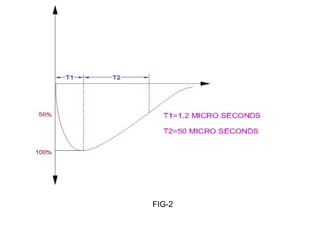
  1.2micro seconds&tail of 50 micro seconds.(FIG 2)

 There are 20 capacitors of 150 kv each &together they
  produce 3 million volts.(shown only 4 capacitors in fig)
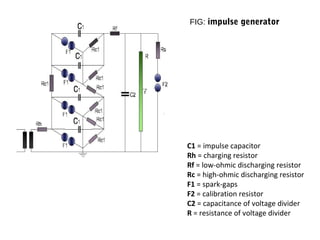
FIG: impulse generator


C1 = impulse capacitor
Rh = charging resistor
Rf = low-ohmic discharging resistor
Rc = high-ohmic discharging resistor
F1 = spark-gaps
F2 = calibration resistor
C2 = capacitance of voltage divider
R = resistance of voltage divider
 The impulse wave applied is negative because positive wave
  can cause distarge from line to earth since all coils are
  earthed.(FIG 2)


 The impulse voltage is applied to the transformer under test,
  if the insulation has failed then response wave will be
  distorted or will be chopped.


 The response is obtained in an impulse analyser taken by
  means of potential divider.
FIG-2
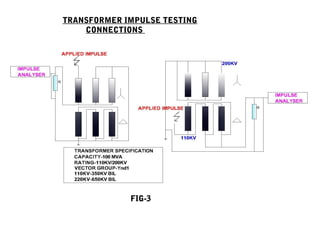
 The lightning impulse test is normally applied to the H.V.
  winding. The impulse test-sequence is applied successively to
  each of the line terminals of the tested winding. The other
  line terminals and the other winding are earthed (FIG 3).
TRANSFORMER IMPULSE TESTING
    CONNECTIONS


             FIG-3
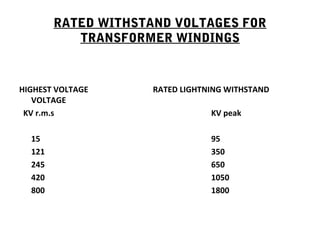
RATED WITHSTAND VOLTAGES FOR
           TRANSFORMER WINDINGS


HIGHEST VOLTAGE      RATED LIGHTNING WITHSTAND
   VOLTAGE
 KV r.m.s                        KV peak

  15                             95
  121                            350
  245                            650
  420                            1050
  800                            1800
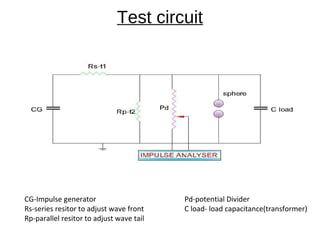
Test circuit


CG-Impulse generator                      Pd-potential Divider
Rs-series resitor to adjust wave front    C load- load capacitance(transformer)
Rp-parallel resitor to adjust wave tail
procedure
 The impulse voltage wave form is obtained at reduced level
  from the potential divider by polishing its front & tail using Rs
  and Rp.

 The sphere is calibrated to know the voltage to be applied or
  can be checked using analyser.

 All winding except the test winding is earthed .

 The calibrated impulse wave is applied to the test windings.

 Its response is recorded using impulse analyser.
Presented by
       JIBIN
 JOY

Impulse test for power transformers

  • 1.
  • 2.
    Purpose of test: The purpose of the test is to secure that the transformer insulations withstand the lightning overvoltages which may occur in service. METHOD OF TESTING:  The testing is conducted by artificial generation of lightning impulse using IMPULSe GENERATORS.(FIG 1)  Capacitor banks are charged in parallel from a d.c source and is discharged in series to create impulse voltage of wave front 1.2micro seconds&tail of 50 micro seconds.(FIG 2)  There are 20 capacitors of 150 kv each &together they produce 3 million volts.(shown only 4 capacitors in fig)
  • 3.
    FIG: impulse generator C1= impulse capacitor Rh = charging resistor Rf = low-ohmic discharging resistor Rc = high-ohmic discharging resistor F1 = spark-gaps F2 = calibration resistor C2 = capacitance of voltage divider R = resistance of voltage divider
  • 4.
     The impulsewave applied is negative because positive wave can cause distarge from line to earth since all coils are earthed.(FIG 2)  The impulse voltage is applied to the transformer under test, if the insulation has failed then response wave will be distorted or will be chopped.  The response is obtained in an impulse analyser taken by means of potential divider.
  • 5.
  • 6.
     The lightningimpulse test is normally applied to the H.V. winding. The impulse test-sequence is applied successively to each of the line terminals of the tested winding. The other line terminals and the other winding are earthed (FIG 3).
  • 7.
  • 8.
    RATED WITHSTAND VOLTAGESFOR TRANSFORMER WINDINGS HIGHEST VOLTAGE RATED LIGHTNING WITHSTAND VOLTAGE KV r.m.s KV peak 15 95 121 350 245 650 420 1050 800 1800
  • 9.
    Test circuit CG-Impulse generator Pd-potential Divider Rs-series resitor to adjust wave front C load- load capacitance(transformer) Rp-parallel resitor to adjust wave tail
  • 10.
    procedure  The impulsevoltage wave form is obtained at reduced level from the potential divider by polishing its front & tail using Rs and Rp.  The sphere is calibrated to know the voltage to be applied or can be checked using analyser.  All winding except the test winding is earthed .  The calibrated impulse wave is applied to the test windings.  Its response is recorded using impulse analyser.
  • 11.
    Presented by JIBIN JOY