1
SCHOOL OF ARCHITECTURE, BUILDING AND DESIGN
Bachelor of Quantity Surveying (Honours)
RESEARCH PROPOSAL
BUILDING COST COMPARISON BETWEEN
CONVENTIONAL METHOD AND INDUSTRIALIZED
BUILDING SYSTEM (IBS) IN MALAYSIA
STUDENT NAME: THAN LEK MEI
STUDENT ID NO.: 0315538
SUPERVISOR: MR. MOHAMMED RIZAL
DATE OF SUBMISSION: 26 OCTOBER 2017
2
BUILDING COST COMPARISON BETWEEN
CONVENTIONAL METHOD AND INDUSTRIALIZED
BUILDING SYSTEM (IBS) IN MALAYSIA
THAN LEK MEI
(0315538)
3
TABLES OF CONTENTS
CHAPTER TITLE PAGE
TABLE OF CONTENTS I
LIST OF TABLES II
1 INTRODUCTION
1.1 Background 1
1.2 Problem Statement 4
1.3 Previous Similar Study 4
1.4 Research Aim 6
1.5 Research Questions and Research Objectives 6
1.6 Scope and Limitations 7
1.7 Importance of Study 7
1.8 Research Design 8
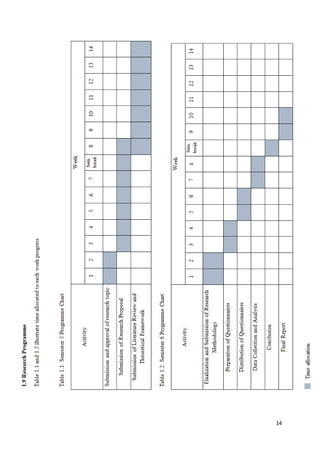
1.9 Research Programme 9
1.10 Structure of The Report 10
REFERENCES 11
4
LIST OF TABLES
PAGE
Table 1.0 Research Design…………………….………………………... 8
Table 1.1 Semester 5 Program Chart…………………………………… 9
Table 1.2 Semester 6 Program Chart…………………………………… 9
5
1.1 Background
The implementation of IBS in Malaysia has started since 1960’s, it is known only in 1998
when Cabinet of Ministers endorsed IBS Strategic Plan as the blueprint for the total
industrialisation of the construction sector. Since then, the Construction Industry
Development Board (CIDB) has been actively promoting the use of IBS in Malaysian
Construction Industry (Mohamad et.al., 2009)
As reflected in MIDF (2014) research report, Malaysian government has mandated for
government projects to comprise of 70% of IBS components. While the government
associated projects have initiated the implementation of IBS, less than half of private sector
projects are using IBS. According to CIDB (2013), about 46% of 400 construction projects
either completed or still progressing are using IBS, whereas the remaining 54% still using
conventional methods.
The data informed by CIDB shows that there is still very low of acceptance for IBS in
Malaysia, particularly in private sector. Malaysian Government, through CIDB, has launched
IBS Roadmap 2003-2010 and 2011-2015 which stated several strategies and aggressive steps
to promote the use of IBS in Malaysia, with the aim to encourage IBS usage that can reduce
construction industry’s reliance on foreigner workforce and to increase productivity (Nawi et
al. 2012; Azman et al. 2011). Based on CIDB (2016), IBS Roadmap 2003-2010 is a
masterplan to facilitate the transformation of Malaysian construction sector which was
formulated with inputs from industry and endorsed by the cabinet back in October 2003.
Known as the "Industrialised Building Systems (IBS) Roadmap 2003-2010", the Masterplan
is based on the 5-M Strategy (Manpower / Materials-Components-Machines / Management-
Processes-Methods / Monetary / Marketing) with the target of having an industrialised
construction industry as well as achieving Open Building by the year 2010.
Haron et al. (2005) and Marsono et al. (2006) defined IBS as one of the construction method
that can upgrade the quality and productivity of the construction by using better machineries,
6
equipment, materials and extensive project planning while Abdullah et al. (2009) stated that
IBS can be classified as modern construction method, prebuilding system, advance
automation and volumetric construction. With the implementation of prefabrication in the
construction, this method help in increasing the sustainability of the project in which lower
the total construction time and shortened the overall construction time including enhanced in
occupational health and safety, material conservation and also less construction site waste
(Chen et al., 2010).
The early attempt to apply IBS in Malaysia was the two pilot projects, the first project was
Jalan Pekeliling Flats in Kuala Lumpur in 1964 and the second project was Rifle Range,
Penang in 1965 had used Danish system and French Estoit System respectively. Both projects
were the first time whereby precast elements were used to construct mass houses; while these
projects have brought bad reputation to IBS due to the problems of leakage as it was based on
the European systems and was not appropriate for Malaysian wet toilets and bathrooms
(Rahman, 2006). Although the failure of these two projects, the government did not despair
and improved its way towards enhancing the experience in prefabricated system field. After
the development of precast concrete and steel technology, Malaysian construction sector
witnessed many successful projects such as Petronas Twin Towers, Bukit Jalil Sports
Complex and Games Village, and the LRT lines and tunnels (E. Harirchan, 2015).
Before the introduction of IBS, conventional construction is one of the earliest approaches
practised in the construction industry which does not involve building materials or finished
components manufactured by factories (Othuman, Sani & Phius, 2014). In addition, Aishah
and Ali (2012) explained in detailed that this method is divided into two components. The
first part is the structural system which is the cast-in-situ of the frame such as column, beam
and slab. The cast in-situ of the frame undertakes four steps which are the erection of timber
formwork and scaffolding, installation of steel reinforcement, pouring of fresh concrete and
disassemble of formwork and scaffolding.
7
According to Ramli et.al. (2016), IBS helps in decrease the expenditure and increase the
future profits for the stakeholders and developer in ways by implementing IBS whereby the
cost of the labour and materials can be reduced. In his research, he also mentioned that the
difference between IBS and conventional does not have much differences in term of material
saving but IBS has benefit in term of quality of project, easy to handle as well as labour
saving as compared to conventional system.
Thus, this research was done to investigate the cost comparison between IBS and
conventional method and it is focusing on residential building, which is on double-storey
houses which are located in Klang Valley. In addition, the most common type of IBS system
used in Malaysia as well as the factors affecting the cost of IBS and conventional
construction method were also determined in this research as this research introduces the
implementation of IBS.
8
1.2 Problem Statement
High dependency and demand for foreign workers has appeared to be a problem in Malaysia.
The presence of them can increase cost and wastage in construction industry (Aziz, 2010). In
regards to this matter, Malaysian construction industry is currently undergoing a transitional
change from an industry, which employing conventional technology to a more systematic and
mechanized type of system. This method of construction system is well known as
Industrialized Building System (IBS) (Rahim et.al., 2007). Regardless of having introduced
in Malaysia since year 1960, IBS is not widely applied in Malaysia even though it is said to
bring a lot of advantages.
One of the reasons is due to the uncertainties about how IBS saves cost in a project as
compared to conventional method (Tan E.P., 1997). Inadequacy of information readily on a
guideline or benchmark for building cost comparison between conventional construction
system and IBS in Malaysia has not been identified. Thus the result of this study should
further clarify the building cost comparison between Conventional System and Industrialized
Building System.
The Edge Property (2015) mentioned, CIDB general manager of the IBS & mechanisation
division, technology development sector Noraini Bahri noted in a press statement, that some
of the crucial issues hindering wider implementation of IBS are the limited enforcement of
IBS requirements as per the IBS Roadmap 2011-2015, a lack of IBS expertise in the market,
the lure of cheap labour for construction in Malaysia, cash flow problems for contractors, and
minimal economies of scale for smaller developers. Moreover as stressed by CIDB senior
general manager of operation sector, Megat Kamil Azmi to PressRadar of The Sun
Newspaper (2016) during the 12th Conference on Status and Outlook of the Malaysian Iron
and Steel Industry, the main reason for low adoption of IBS is cheap labour. Yet, according
to a technical and sales manager of CMS Concrete Products Sdn Bhd, Lim Wee Han reported
to The BorneoPost in 2017 that underlines the affordable labour makes conventional
construction to be more cost effective than using IBS elements due to its lower upfront costs,
but over the last decade, this gap has been getting shorter and shorter. To clarify how labour
9
cost of conventional construction method distinguishes from IBS installer, this study also see
the importance in assessing the conventional labour wages and IBS installer wage rates in
construction industry.
Moreover, As reported in The Edge Financial Daily (2017), Rehda’s past president Datuk Ng
Seing Liong clarified that IBS has to reach economies of scale for it to be economically
viable and that volume is key. According to him, there is no resistance as far as big projects
are concerned. It is only the smaller ones where developers cannot get economies of scale and
unable to introduce IBS. In Nawi et. al. (2015)’s research, it shows that IBS adopted more in
industrial and commercial buildings (30%), followed by housing (9%) and institution and
utility (7%). Hence, another focus of this study is to determine in precise the usage of IBS in
different types of buildings so that the percentage on those buildings that are frequently
adopting IBS can develop in greater scale whereas those which have less percentage of
adoption get more encouragement like incentive to increase the IBS adoption rate.
1.3 Previous Similar Study
A few of previous studies have investigated the effectiveness of IBS implementation in
Malaysia as well as building cost comparison between conventional construction system and
Industrialized Building System (IBS). This subtopic will further explain their research
findings and the gap in between that contributes to this study.
Haron et al. (2005)’s research is regarding Building Cost Comparison between Conventional
and Formwork System : A Case Study of Four-Storey School Buildings in Malaysia. Their
research objective was to address the details building cost between the conventional system
and the formwork system and indicates which of the two is cheaper. The data for the research
were collected through questionnaire survey and case study, which consisting of institutional
10
buildings. Eventually, this study revealed that the conventional construction method is more
cost saving compared to IBS method.
However, Rahim and Haron’s study in 2013 on Construction Cost Comparison between
Conventional and Formwork System for Condominium Project oppose the result of the
previous case study whereby the case study undertaken concluded that Industrialized
Building System is better construction cost saving as compared to the conventional system.
In 2016, Ramli et al’s research result echoes the analysis result from Rahim and Haron’s
research. Their study of Cost Comparison on Industrialized Building System (IBS) and
Conventional Method for School Construction Project was done to determine the cost
comparison based on technical data collection and analysis between IBS which using half
slab with conventional method for slab structure and also to determine the perception from
the industrial players on IBS and conventional method through questionnaire surveys. From
the results obtained, it demonstrates that IBS offers a good reduction in cost as compared to
conventional construction method.
The current construction industry in Malaysia has undergone varieties of innovations is the
recent decades. Hence it is essential that many aspects of the industry need to be studied
(Nazul et.al., 2002). One of which is to study the cost comparison between conventional
system and IBS. There still seems a lack of studies on cost comparison of both systems
conducted for landed residential housing, hence leads to this study which focusing on double-
storey houses in Klang Valley to establish which building construction method leads to
cheaper building cost.
11
1.4 ResearchAim
The aim of this study is to compare the building cost differences between conventional
system and Industrialized Building System (IBS). In regard to this, the objectives of this
research have been identified in sub-topic 1.5.
1.5 ResearchQuestions and ResearchObjectives
Following questions on cost comparison between conventional method and Industrialized
Building System (IBS) are to be raised:
1. What is/are the most common type of IBS system used in Malaysia?
2. What are the factors affecting the cost of IBS and conventional construction method?
3. Which construction method is the most cost effective/saving in residential building?
To achieve this aim, the following objectives have been identified:
1. To determine the most common type of IBS system used in Malaysia.
2. To identify the factors affecting the cost of IBS and conventional construction method.
3. To compare the cost differences between IBS and conventional method in residential
building.
12
1.6 Scope and limitations
This research will focus on cost comparison between conventional method and Industrialized
Building System (IBS) for double storey residential houses. Also to reduce the scope of
research, the research will be restricted to Klang Valley area where the construction scene is
growing rapidly.
In addition, this study also intends to find out the most common type of IBS system used in
Malaysia and factors affecting the cost of IBS and conventional construction method thus the
output of respondents only restricted to view of developers who have involved in IBS project,
contractors and IBS manufacturers in Klang Valley.
1.7 Importance of Study
This research intends to introduce the contemporary method of construction, which is known
as Industrialized Building System (IBS) in this research, to reduce the usage of foreign
worker, hoping to reduce labour cost. The existence of this study will allow the key players in
construction industry to understand the concepts of the various aspects in the IBS system and
promote the IBS system that is said to have benefits of reducing cost, time and workers as
compared to conventional construction method. With this study, the researcher of dissertation
will able to understand more clearly about the cost differences between conventional
construction method and IBS in Klang Valley, Malaysia. Eventually, this research allows the
belief of ‘cost reduction using IBS’ to be confirmed or rejected.
13
1.8 ResearchDesign
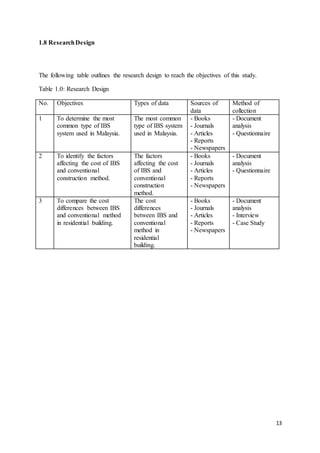
The following table outlines the research design to reach the objectives of this study.
Table 1.0: Research Design
No. Objectives Types of data Sources of
data
Method of
collection
1 To determine the most
common type of IBS
system used in Malaysia.
The most common
type of IBS system
used in Malaysia.
- Books
- Journals
- Articles
- Reports
- Newspapers
- Document
analysis
- Questionnaire
2 To identify the factors
affecting the cost of IBS
and conventional
construction method.
The factors
affecting the cost
of IBS and
conventional
construction
method.
- Books
- Journals
- Articles
- Reports
- Newspapers
- Document
analysis
- Questionnaire
3 To compare the cost
differences between IBS
and conventional method
in residential building.
The cost
differences
between IBS and
conventional
method in
residential
building.
- Books
- Journals
- Articles
- Reports
- Newspapers
- Document
analysis
- Interview
- Case Study
14
15
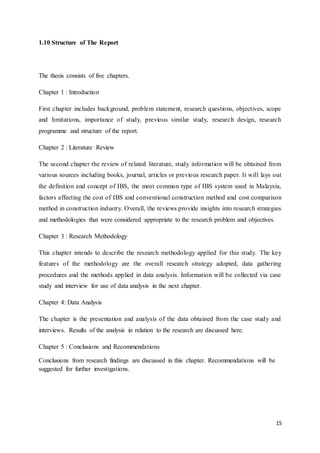
1.10 Structure of The Report
The thesis consists of five chapters.
Chapter 1 : Introduction
First chapter includes background, problem statement, research questions, objectives, scope
and limitations, importance of study, previous similar study, research design, research
programme and structure of the report.
Chapter 2 : Literature Review
The second chapter the review of related literature, study information will be obtained from
various sources including books, journal, articles or previous research paper. It will lays out
the definition and concept of IBS, the most common type of IBS system used in Malaysia,
factors affecting the cost of IBS and conventional construction method and cost comparison
method in construction industry. Overall, the reviews provide insights into research strategies
and methodologies that were considered appropriate to the research problem and objectives.
Chapter 3 : Research Methodology
This chapter intends to describe the research methodology applied for this study. The key
features of the methodology are the overall research strategy adopted, data gathering
procedures and the methods applied in data analysis. Information will be collected via case
study and interview for use of data analysis in the next chapter.
Chapter 4: Data Analysis
The chapter is the presentation and analysis of the data obtained from the case study and
interviews. Results of the analysis in relation to the research are discussed here.
Chapter 5 : Conclusions and Recommendations
Conclusions from research findings are discussed in this chapter. Recommendations will be
suggested for further investigations.
16
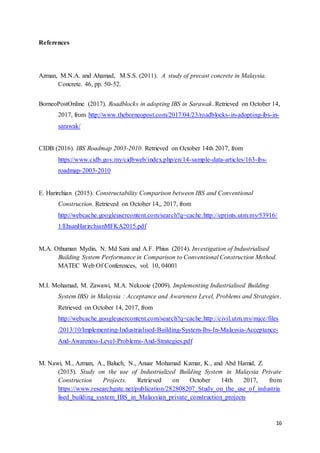
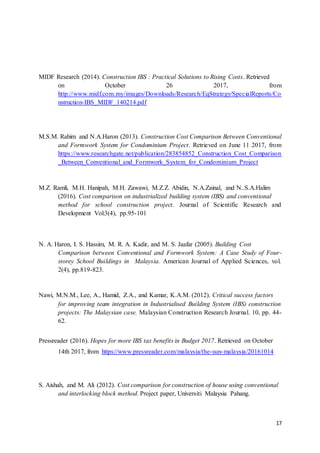
References
Azman, M.N.A. and Ahamad, M.S.S. (2011). A study of precast concrete in Malaysia.
Concrete. 46, pp. 50-52.
BorneoPostOnline (2017). Roadblocks in adopting IBS in Sarawak. Retrieved on October 14,
2017, from http://www.theborneopost.com/2017/04/23/roadblocks-in-adopting-ibs-in-
sarawak/
CIDB (2016). IBS Roadmap 2003-2010. Retrieved on October 14th 2017, from
https://www.cidb.gov.my/cidbweb/index.php/en/14-sample-data-articles/163-ibs-
roadmap-2003-2010
E. Harirchian (2015). Constructability Comparison between IBS and Conventional
Construction. Retrieved on October 14,, 2017, from
http://webcache.googleusercontent.com/search?q=cache:http://eprints.utm.my/53916/
1/EhsanHarirchianMFKA2015.pdf
M.A. Othuman Mydin, N. Md Sani and A.F. Phius (2014). Investigation of Industrialised
Building System Performance in Comparison to Conventional Construction Method.
MATEC Web Of Conferences, vol. 10, 04001
M.I. Mohamad, M. Zawawi, M.A. Nekooie (2009). Implementing Industrialised Building
System IBS) in Malaysia : Acceptance and Awareness Level, Problems and Strategies.
Retrieved on October 14, 2017, from
http://webcache.googleusercontent.com/search?q=cache:http://civil.utm.my/mjce/files
/2013/10/Implementing-Industrialised-Building-System-Ibs-In-Malaysia-Acceptance-
And-Awareness-Level-Problems-And-Strategies.pdf
M. Nawi, M., Azman, A., Baluch, N., Anuar Mohamad Kamar, K., and Abd Hamid, Z.
(2015). Study on the use of Industrialized Building System in Malaysia Private
Construction Projects. Retrieved on October 14th 2017, from
https://www.researchgate.net/publication/282808207_Study_on_the_use_of_industria
lised_building_system_IBS_in_Malaysian_private_construction_projects
17
MIDF Research (2014). Construction IBS : Practical Solutions to Rising Costs. Retrieved
on October 26 2017, from
http://www.midf.com.my/images/Downloads/Research/EqStrategy/SpecialReports/Co
nstruction-IBS_MIDF_140214.pdf
M.S.M. Rahim and N.A.Haron (2013). Construction Cost Comparison Between Conventional
and Formwork System for Condominium Project. Retrieved on June 11 2017, from
https://www.researchgate.net/publication/283854852_Construction_Cost_Comparison
_Between_Conventional_and_Formwork_System_for_Condominium_Project
M.Z. Ramli, M.H. Hanipah, M.H. Zawawi, M.Z.Z. Abidin, N.A.Zainal, and N..S.A.Halim
(2016). Cost comparison on industrialized building system (IBS) and conventional
method for school construction project. Journal of Scientific Research and
Development Vol:3(4), pp.95-101
N. A. Haron, I. S. Hassim, M. R. A. Kadir, and M. S. Jaafar (2005). Building Cost
Comparison between Conventional and Formwork System: A Case Study of Four-
storey School Buildings in Malaysia. American Journal of Applied Sciences, vol.
2(4), pp.819-823.
Nawi, M.N.M., Lee, A., Hamid, Z.A., and Kamar, K.A.M. (2012). Critical success factors
for improving team integration in Industrialised Building System (IBS) construction
projects: The Malaysian case. Malaysian Construction Research Journal. 10, pp. 44-
62.
Pressreader (2016). Hopes for more IBS tax benefits in Budget 2017. Retrieved on October
14th 2017, from https://www.pressreader.com/malaysia/the-sun-malaysia/20161014
S. Aishah, and M. Ali (2012). Cost comparison for construction of house using conventional
and interlocking block method. Project paper, Universiti Malaysia Pahang.
18
S.B.A. Aziz (2010). The Applicatino of Industrialized Building System in Residential Project.
Retrieved on October 14,, 2017, from
http://umpir.ump.edu.my/2411/1/SYAZANA_BINTI_ABDUL_AZIZ.PDF
The Edge Financial Daily (2017). Economies of scale needed for IBS adoption — Rehda.
Retrieved on October 14, 2017, from https://www.msn.com/en
sg/news/other/economies-of-scale-needed-for-ibs-adoption-e2-80-94-rehda/ar-
AArX5JL
The Edge Property (2015). IBS adoption in Malaysia remains low: CIDB. Retrieved on
October 14th 2017, from http://news.theedgeproperty.com.my/content/ibs-adoption-
malaysia-remains-low-cidb

Chapter 1-research proposal

  • 1.
    1 SCHOOL OF ARCHITECTURE,BUILDING AND DESIGN Bachelor of Quantity Surveying (Honours) RESEARCH PROPOSAL BUILDING COST COMPARISON BETWEEN CONVENTIONAL METHOD AND INDUSTRIALIZED BUILDING SYSTEM (IBS) IN MALAYSIA STUDENT NAME: THAN LEK MEI STUDENT ID NO.: 0315538 SUPERVISOR: MR. MOHAMMED RIZAL DATE OF SUBMISSION: 26 OCTOBER 2017
  • 2.
    2 BUILDING COST COMPARISONBETWEEN CONVENTIONAL METHOD AND INDUSTRIALIZED BUILDING SYSTEM (IBS) IN MALAYSIA THAN LEK MEI (0315538)
  • 3.
    3 TABLES OF CONTENTS CHAPTERTITLE PAGE TABLE OF CONTENTS I LIST OF TABLES II 1 INTRODUCTION 1.1 Background 1 1.2 Problem Statement 4 1.3 Previous Similar Study 4 1.4 Research Aim 6 1.5 Research Questions and Research Objectives 6 1.6 Scope and Limitations 7 1.7 Importance of Study 7 1.8 Research Design 8 1.9 Research Programme 9 1.10 Structure of The Report 10 REFERENCES 11
  • 4.
    4 LIST OF TABLES PAGE Table1.0 Research Design…………………….………………………... 8 Table 1.1 Semester 5 Program Chart…………………………………… 9 Table 1.2 Semester 6 Program Chart…………………………………… 9
  • 5.
    5 1.1 Background The implementationof IBS in Malaysia has started since 1960’s, it is known only in 1998 when Cabinet of Ministers endorsed IBS Strategic Plan as the blueprint for the total industrialisation of the construction sector. Since then, the Construction Industry Development Board (CIDB) has been actively promoting the use of IBS in Malaysian Construction Industry (Mohamad et.al., 2009) As reflected in MIDF (2014) research report, Malaysian government has mandated for government projects to comprise of 70% of IBS components. While the government associated projects have initiated the implementation of IBS, less than half of private sector projects are using IBS. According to CIDB (2013), about 46% of 400 construction projects either completed or still progressing are using IBS, whereas the remaining 54% still using conventional methods. The data informed by CIDB shows that there is still very low of acceptance for IBS in Malaysia, particularly in private sector. Malaysian Government, through CIDB, has launched IBS Roadmap 2003-2010 and 2011-2015 which stated several strategies and aggressive steps to promote the use of IBS in Malaysia, with the aim to encourage IBS usage that can reduce construction industry’s reliance on foreigner workforce and to increase productivity (Nawi et al. 2012; Azman et al. 2011). Based on CIDB (2016), IBS Roadmap 2003-2010 is a masterplan to facilitate the transformation of Malaysian construction sector which was formulated with inputs from industry and endorsed by the cabinet back in October 2003. Known as the "Industrialised Building Systems (IBS) Roadmap 2003-2010", the Masterplan is based on the 5-M Strategy (Manpower / Materials-Components-Machines / Management- Processes-Methods / Monetary / Marketing) with the target of having an industrialised construction industry as well as achieving Open Building by the year 2010. Haron et al. (2005) and Marsono et al. (2006) defined IBS as one of the construction method that can upgrade the quality and productivity of the construction by using better machineries,
  • 6.
    6 equipment, materials andextensive project planning while Abdullah et al. (2009) stated that IBS can be classified as modern construction method, prebuilding system, advance automation and volumetric construction. With the implementation of prefabrication in the construction, this method help in increasing the sustainability of the project in which lower the total construction time and shortened the overall construction time including enhanced in occupational health and safety, material conservation and also less construction site waste (Chen et al., 2010). The early attempt to apply IBS in Malaysia was the two pilot projects, the first project was Jalan Pekeliling Flats in Kuala Lumpur in 1964 and the second project was Rifle Range, Penang in 1965 had used Danish system and French Estoit System respectively. Both projects were the first time whereby precast elements were used to construct mass houses; while these projects have brought bad reputation to IBS due to the problems of leakage as it was based on the European systems and was not appropriate for Malaysian wet toilets and bathrooms (Rahman, 2006). Although the failure of these two projects, the government did not despair and improved its way towards enhancing the experience in prefabricated system field. After the development of precast concrete and steel technology, Malaysian construction sector witnessed many successful projects such as Petronas Twin Towers, Bukit Jalil Sports Complex and Games Village, and the LRT lines and tunnels (E. Harirchan, 2015). Before the introduction of IBS, conventional construction is one of the earliest approaches practised in the construction industry which does not involve building materials or finished components manufactured by factories (Othuman, Sani & Phius, 2014). In addition, Aishah and Ali (2012) explained in detailed that this method is divided into two components. The first part is the structural system which is the cast-in-situ of the frame such as column, beam and slab. The cast in-situ of the frame undertakes four steps which are the erection of timber formwork and scaffolding, installation of steel reinforcement, pouring of fresh concrete and disassemble of formwork and scaffolding.
  • 7.
    7 According to Ramliet.al. (2016), IBS helps in decrease the expenditure and increase the future profits for the stakeholders and developer in ways by implementing IBS whereby the cost of the labour and materials can be reduced. In his research, he also mentioned that the difference between IBS and conventional does not have much differences in term of material saving but IBS has benefit in term of quality of project, easy to handle as well as labour saving as compared to conventional system. Thus, this research was done to investigate the cost comparison between IBS and conventional method and it is focusing on residential building, which is on double-storey houses which are located in Klang Valley. In addition, the most common type of IBS system used in Malaysia as well as the factors affecting the cost of IBS and conventional construction method were also determined in this research as this research introduces the implementation of IBS.
  • 8.
    8 1.2 Problem Statement Highdependency and demand for foreign workers has appeared to be a problem in Malaysia. The presence of them can increase cost and wastage in construction industry (Aziz, 2010). In regards to this matter, Malaysian construction industry is currently undergoing a transitional change from an industry, which employing conventional technology to a more systematic and mechanized type of system. This method of construction system is well known as Industrialized Building System (IBS) (Rahim et.al., 2007). Regardless of having introduced in Malaysia since year 1960, IBS is not widely applied in Malaysia even though it is said to bring a lot of advantages. One of the reasons is due to the uncertainties about how IBS saves cost in a project as compared to conventional method (Tan E.P., 1997). Inadequacy of information readily on a guideline or benchmark for building cost comparison between conventional construction system and IBS in Malaysia has not been identified. Thus the result of this study should further clarify the building cost comparison between Conventional System and Industrialized Building System. The Edge Property (2015) mentioned, CIDB general manager of the IBS & mechanisation division, technology development sector Noraini Bahri noted in a press statement, that some of the crucial issues hindering wider implementation of IBS are the limited enforcement of IBS requirements as per the IBS Roadmap 2011-2015, a lack of IBS expertise in the market, the lure of cheap labour for construction in Malaysia, cash flow problems for contractors, and minimal economies of scale for smaller developers. Moreover as stressed by CIDB senior general manager of operation sector, Megat Kamil Azmi to PressRadar of The Sun Newspaper (2016) during the 12th Conference on Status and Outlook of the Malaysian Iron and Steel Industry, the main reason for low adoption of IBS is cheap labour. Yet, according to a technical and sales manager of CMS Concrete Products Sdn Bhd, Lim Wee Han reported to The BorneoPost in 2017 that underlines the affordable labour makes conventional construction to be more cost effective than using IBS elements due to its lower upfront costs, but over the last decade, this gap has been getting shorter and shorter. To clarify how labour
  • 9.
    9 cost of conventionalconstruction method distinguishes from IBS installer, this study also see the importance in assessing the conventional labour wages and IBS installer wage rates in construction industry. Moreover, As reported in The Edge Financial Daily (2017), Rehda’s past president Datuk Ng Seing Liong clarified that IBS has to reach economies of scale for it to be economically viable and that volume is key. According to him, there is no resistance as far as big projects are concerned. It is only the smaller ones where developers cannot get economies of scale and unable to introduce IBS. In Nawi et. al. (2015)’s research, it shows that IBS adopted more in industrial and commercial buildings (30%), followed by housing (9%) and institution and utility (7%). Hence, another focus of this study is to determine in precise the usage of IBS in different types of buildings so that the percentage on those buildings that are frequently adopting IBS can develop in greater scale whereas those which have less percentage of adoption get more encouragement like incentive to increase the IBS adoption rate. 1.3 Previous Similar Study A few of previous studies have investigated the effectiveness of IBS implementation in Malaysia as well as building cost comparison between conventional construction system and Industrialized Building System (IBS). This subtopic will further explain their research findings and the gap in between that contributes to this study. Haron et al. (2005)’s research is regarding Building Cost Comparison between Conventional and Formwork System : A Case Study of Four-Storey School Buildings in Malaysia. Their research objective was to address the details building cost between the conventional system and the formwork system and indicates which of the two is cheaper. The data for the research were collected through questionnaire survey and case study, which consisting of institutional
  • 10.
    10 buildings. Eventually, thisstudy revealed that the conventional construction method is more cost saving compared to IBS method. However, Rahim and Haron’s study in 2013 on Construction Cost Comparison between Conventional and Formwork System for Condominium Project oppose the result of the previous case study whereby the case study undertaken concluded that Industrialized Building System is better construction cost saving as compared to the conventional system. In 2016, Ramli et al’s research result echoes the analysis result from Rahim and Haron’s research. Their study of Cost Comparison on Industrialized Building System (IBS) and Conventional Method for School Construction Project was done to determine the cost comparison based on technical data collection and analysis between IBS which using half slab with conventional method for slab structure and also to determine the perception from the industrial players on IBS and conventional method through questionnaire surveys. From the results obtained, it demonstrates that IBS offers a good reduction in cost as compared to conventional construction method. The current construction industry in Malaysia has undergone varieties of innovations is the recent decades. Hence it is essential that many aspects of the industry need to be studied (Nazul et.al., 2002). One of which is to study the cost comparison between conventional system and IBS. There still seems a lack of studies on cost comparison of both systems conducted for landed residential housing, hence leads to this study which focusing on double- storey houses in Klang Valley to establish which building construction method leads to cheaper building cost.
  • 11.
    11 1.4 ResearchAim The aimof this study is to compare the building cost differences between conventional system and Industrialized Building System (IBS). In regard to this, the objectives of this research have been identified in sub-topic 1.5. 1.5 ResearchQuestions and ResearchObjectives Following questions on cost comparison between conventional method and Industrialized Building System (IBS) are to be raised: 1. What is/are the most common type of IBS system used in Malaysia? 2. What are the factors affecting the cost of IBS and conventional construction method? 3. Which construction method is the most cost effective/saving in residential building? To achieve this aim, the following objectives have been identified: 1. To determine the most common type of IBS system used in Malaysia. 2. To identify the factors affecting the cost of IBS and conventional construction method. 3. To compare the cost differences between IBS and conventional method in residential building.
  • 12.
    12 1.6 Scope andlimitations This research will focus on cost comparison between conventional method and Industrialized Building System (IBS) for double storey residential houses. Also to reduce the scope of research, the research will be restricted to Klang Valley area where the construction scene is growing rapidly. In addition, this study also intends to find out the most common type of IBS system used in Malaysia and factors affecting the cost of IBS and conventional construction method thus the output of respondents only restricted to view of developers who have involved in IBS project, contractors and IBS manufacturers in Klang Valley. 1.7 Importance of Study This research intends to introduce the contemporary method of construction, which is known as Industrialized Building System (IBS) in this research, to reduce the usage of foreign worker, hoping to reduce labour cost. The existence of this study will allow the key players in construction industry to understand the concepts of the various aspects in the IBS system and promote the IBS system that is said to have benefits of reducing cost, time and workers as compared to conventional construction method. With this study, the researcher of dissertation will able to understand more clearly about the cost differences between conventional construction method and IBS in Klang Valley, Malaysia. Eventually, this research allows the belief of ‘cost reduction using IBS’ to be confirmed or rejected.
  • 13.
    13 1.8 ResearchDesign The followingtable outlines the research design to reach the objectives of this study. Table 1.0: Research Design No. Objectives Types of data Sources of data Method of collection 1 To determine the most common type of IBS system used in Malaysia. The most common type of IBS system used in Malaysia. - Books - Journals - Articles - Reports - Newspapers - Document analysis - Questionnaire 2 To identify the factors affecting the cost of IBS and conventional construction method. The factors affecting the cost of IBS and conventional construction method. - Books - Journals - Articles - Reports - Newspapers - Document analysis - Questionnaire 3 To compare the cost differences between IBS and conventional method in residential building. The cost differences between IBS and conventional method in residential building. - Books - Journals - Articles - Reports - Newspapers - Document analysis - Interview - Case Study
  • 14.
  • 15.
    15 1.10 Structure ofThe Report The thesis consists of five chapters. Chapter 1 : Introduction First chapter includes background, problem statement, research questions, objectives, scope and limitations, importance of study, previous similar study, research design, research programme and structure of the report. Chapter 2 : Literature Review The second chapter the review of related literature, study information will be obtained from various sources including books, journal, articles or previous research paper. It will lays out the definition and concept of IBS, the most common type of IBS system used in Malaysia, factors affecting the cost of IBS and conventional construction method and cost comparison method in construction industry. Overall, the reviews provide insights into research strategies and methodologies that were considered appropriate to the research problem and objectives. Chapter 3 : Research Methodology This chapter intends to describe the research methodology applied for this study. The key features of the methodology are the overall research strategy adopted, data gathering procedures and the methods applied in data analysis. Information will be collected via case study and interview for use of data analysis in the next chapter. Chapter 4: Data Analysis The chapter is the presentation and analysis of the data obtained from the case study and interviews. Results of the analysis in relation to the research are discussed here. Chapter 5 : Conclusions and Recommendations Conclusions from research findings are discussed in this chapter. Recommendations will be suggested for further investigations.
  • 16.
    16 References Azman, M.N.A. andAhamad, M.S.S. (2011). A study of precast concrete in Malaysia. Concrete. 46, pp. 50-52. BorneoPostOnline (2017). Roadblocks in adopting IBS in Sarawak. Retrieved on October 14, 2017, from http://www.theborneopost.com/2017/04/23/roadblocks-in-adopting-ibs-in- sarawak/ CIDB (2016). IBS Roadmap 2003-2010. Retrieved on October 14th 2017, from https://www.cidb.gov.my/cidbweb/index.php/en/14-sample-data-articles/163-ibs- roadmap-2003-2010 E. Harirchian (2015). Constructability Comparison between IBS and Conventional Construction. Retrieved on October 14,, 2017, from http://webcache.googleusercontent.com/search?q=cache:http://eprints.utm.my/53916/ 1/EhsanHarirchianMFKA2015.pdf M.A. Othuman Mydin, N. Md Sani and A.F. Phius (2014). Investigation of Industrialised Building System Performance in Comparison to Conventional Construction Method. MATEC Web Of Conferences, vol. 10, 04001 M.I. Mohamad, M. Zawawi, M.A. Nekooie (2009). Implementing Industrialised Building System IBS) in Malaysia : Acceptance and Awareness Level, Problems and Strategies. Retrieved on October 14, 2017, from http://webcache.googleusercontent.com/search?q=cache:http://civil.utm.my/mjce/files /2013/10/Implementing-Industrialised-Building-System-Ibs-In-Malaysia-Acceptance- And-Awareness-Level-Problems-And-Strategies.pdf M. Nawi, M., Azman, A., Baluch, N., Anuar Mohamad Kamar, K., and Abd Hamid, Z. (2015). Study on the use of Industrialized Building System in Malaysia Private Construction Projects. Retrieved on October 14th 2017, from https://www.researchgate.net/publication/282808207_Study_on_the_use_of_industria lised_building_system_IBS_in_Malaysian_private_construction_projects
  • 17.
    17 MIDF Research (2014).Construction IBS : Practical Solutions to Rising Costs. Retrieved on October 26 2017, from http://www.midf.com.my/images/Downloads/Research/EqStrategy/SpecialReports/Co nstruction-IBS_MIDF_140214.pdf M.S.M. Rahim and N.A.Haron (2013). Construction Cost Comparison Between Conventional and Formwork System for Condominium Project. Retrieved on June 11 2017, from https://www.researchgate.net/publication/283854852_Construction_Cost_Comparison _Between_Conventional_and_Formwork_System_for_Condominium_Project M.Z. Ramli, M.H. Hanipah, M.H. Zawawi, M.Z.Z. Abidin, N.A.Zainal, and N..S.A.Halim (2016). Cost comparison on industrialized building system (IBS) and conventional method for school construction project. Journal of Scientific Research and Development Vol:3(4), pp.95-101 N. A. Haron, I. S. Hassim, M. R. A. Kadir, and M. S. Jaafar (2005). Building Cost Comparison between Conventional and Formwork System: A Case Study of Four- storey School Buildings in Malaysia. American Journal of Applied Sciences, vol. 2(4), pp.819-823. Nawi, M.N.M., Lee, A., Hamid, Z.A., and Kamar, K.A.M. (2012). Critical success factors for improving team integration in Industrialised Building System (IBS) construction projects: The Malaysian case. Malaysian Construction Research Journal. 10, pp. 44- 62. Pressreader (2016). Hopes for more IBS tax benefits in Budget 2017. Retrieved on October 14th 2017, from https://www.pressreader.com/malaysia/the-sun-malaysia/20161014 S. Aishah, and M. Ali (2012). Cost comparison for construction of house using conventional and interlocking block method. Project paper, Universiti Malaysia Pahang.
  • 18.
    18 S.B.A. Aziz (2010).The Applicatino of Industrialized Building System in Residential Project. Retrieved on October 14,, 2017, from http://umpir.ump.edu.my/2411/1/SYAZANA_BINTI_ABDUL_AZIZ.PDF The Edge Financial Daily (2017). Economies of scale needed for IBS adoption — Rehda. Retrieved on October 14, 2017, from https://www.msn.com/en sg/news/other/economies-of-scale-needed-for-ibs-adoption-e2-80-94-rehda/ar- AArX5JL The Edge Property (2015). IBS adoption in Malaysia remains low: CIDB. Retrieved on October 14th 2017, from http://news.theedgeproperty.com.my/content/ibs-adoption- malaysia-remains-low-cidb