z
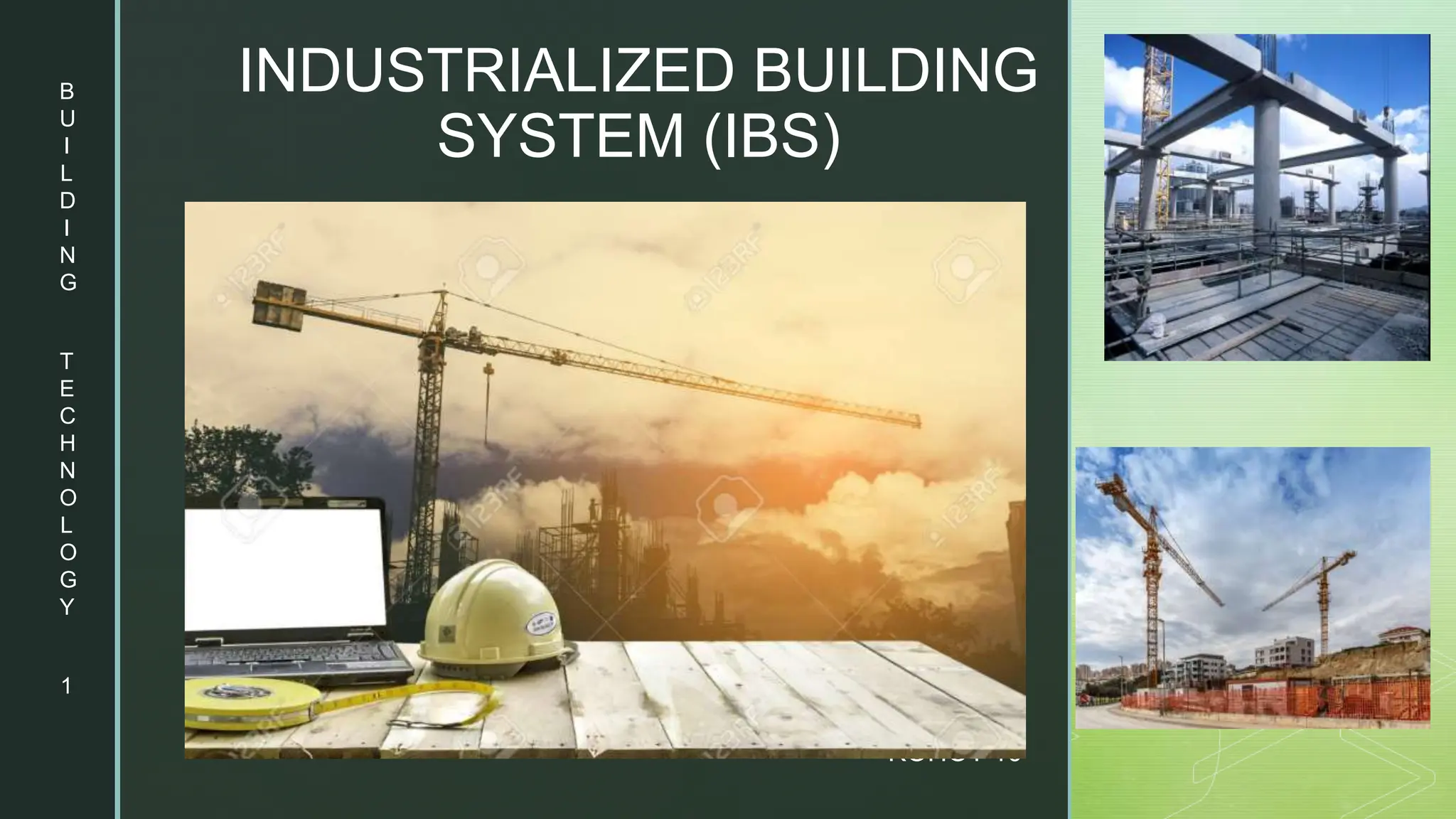
INDUSTRIALIZED BUILDING
SYSTEM (IBS)
B
U
I
L
D
I
N
G
T
E
C
H
N
O
L
O
G
Y
1
KOHOT 10
z
 Conventional construction vs IBS System
 Advantages and disadvantages of IBS System
 What types of IBS?
 What is IBS?
 IBS installation
 Case Studies/example (2 CASE STUDIES)
 How IBS produced?
 How IBS transported?
 Issues in IBS
 Steel framing
 Interlocking System
z
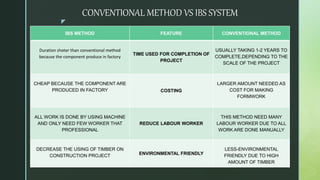
CONVENTIONAL METHOD VS IBS SYSTEM
IBS METHOD FEATURE CONVENTIONAL METHOD
Duration shoter than conventional method
because the component produce in factory
TIME USED FOR COMPLETION OF
PROJECT
USUALLY TAKING 1-2 YEARS TO
COMPLETE,DEPENDING TO THE
SCALE OF THE PROJECT
CHEAP BECAUSE THE COMPONENT ARE
PRODUCED IN FACTORY COSTING
LARGER AMOUNT NEEDED AS
COST FOR MAKING
FORMWORK
ALL WORK IS DONE BY USING MACHINE
AND ONLY NEED FEW WORKER THAT
PROFESSIONAL
REDUCE LABOUR WORKER
THIS METHOD NEED MANY
LABOUR WORKER DUE TO ALL
WORK ARE DONE MANUALLY
DECREASE THE USING OF TIMBER ON
CONSTRUCTION PROJECT ENVIRONMENTAL FRIENDLY
LESS-ENVIRONMENTAL
FRIENDLY DUE TO HIGH
AMOUNT OF TIMBER
z
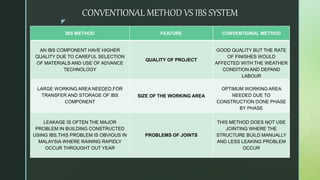
CONVENTIONAL METHOD VS IBS SYSTEM
IBS METHOD FEATURE CONVENTIONAL METHOD
AN IBS COMPONENT HAVE HIGHER
QUALITY DUE TO CAREFUL SELECTION
OF MATERIALS AND USE OF ADVANCE
TECHNOLOGY
QUALITY OF PROJECT
GOOD QUALITY BUT THE RATE
OF FINISHES WOULD
AFFECTED WITH THE WEATHER
CONDITION AND DEPAND
LABOUR
LARGE WORKING AREA NEEDED,FOR
TRANSFER AND STORAGE OF IBS
COMPONENT
SIZE OF THE WORKING AREA
OPTIMUM WORKING AREA
NEEDED DUE TO
CONSTRUCTION DONE PHASE
BY PHASE
LEAKAGE IS OFTEN THE MAJOR
PROBLEM IN BUILDING CONSTRUCTED
USING IBS.THIS PROBLEM IS OBVIOUS IN
MALAYSIA WHERE RAINING RAPIDLY
OCCUR THROUGHT OUT YEAR
PROBLEMS OF JOINTS
THIS METHOD DOES NOT USE
JOINTING WHERE THE
STRUCTURE BUILD MANUALLY
AND LESS LEAKING PROBLEM
OCCUR
z
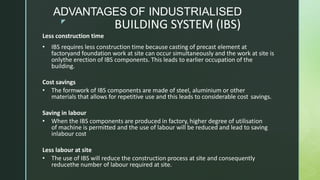
BUILDING SYSTEM (IBS)
Less construction time
• IBS requires less construction time because casting of precast element at
factoryand foundation work at site can occur simultaneously and the work at site is
onlythe erection of IBS components. This leads to earlier occupation of the
building.
Cost savings
• The formwork of IBS components are made of steel, aluminium or other
materials that allows for repetitive use and this leads to considerable cost savings.
Saving in labour
• When the IBS components are produced in factory, higher degree of utilisation
of machine is permitted and the use of labour will be reduced and lead to saving
inlabour cost
Less labour at site
• The use of IBS will reduce the construction process at site and consequently
reducethe number of labour required at site.
ADVANTAGES OF INDUSTRIALISED
z
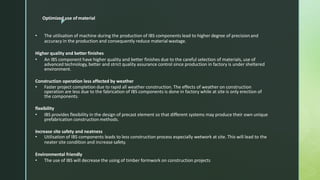
• The utilisation of machine during the production of IBS components lead to higher degree of precisionand
accuracy in the production and consequently reduce material wastage.
Higher quality and better finishes
• An IBS component have higher quality and better finishes due to the careful selection of materials, use of
advanced technology, better and strict quality assurance control since production in factory is under sheltered
environment.
Construction operation less affected by weather
• Faster project completion due to rapid all weather construction. The effects of weather on construction
operation are less due to the fabrication of IBS components is done in factory while at site is only erection of
the components.
flexibility
• IBS provides flexibility in the design of precast element so that different systems may produce their own unique
prefabrication construction methods.
Increase site safety and neatness
• Utilisation of IBS components leads to less construction process especially wetwork at site. This will lead to the
neater site condition and increase safety.
Environmental friendly
• The use of IBS will decrease the using of timber formwork on construction projects
Optimized use of material
z
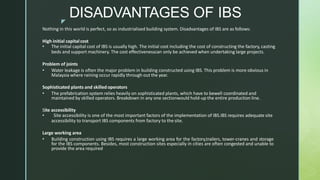
DISADVANTAGES OF IBS
Nothing in this world is perfect, so as industrialised building system. Disadvantages of IBS are as follows:
High initial capitalcost
• The initial capital cost of IBS is usually high. The initial cost including the cost of constructing the factory, casting
beds and support machinery. The cost effectivenesscan only be achieved when undertaking large projects.
Problem of joints
• Water leakage is often the major problem in building constructed using IBS. This problem is more obvious in
Malaysia where raining occur rapidly through out the year.
Sophisticated plants and skilled operators
• The prefabrication system relies heavily on sophisticated plants, which have to bewell coordinated and
maintained by skilled operators. Breakdown in any one sectionwould hold-up the entire production line.
Site accessibility
• Site accessibility is one of the most important factors of the implementation of IBS.IBS requires adequate site
accessibility to transport IBS components from factory to the site.
Large working area
• Building construction using IBS requires a large working area for the factory,trailers, tower-cranes and storage
for the IBS components. Besides, most construction sites especially in cities are often congested and unable to
provide the area required
z
WHAT IS IBS
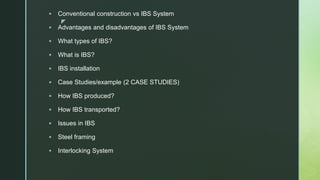
A construction technique in which components are
manufactured in a controlled environment (on or off site),
transported, positioned and assembled into a structure with
minimal additional site works.
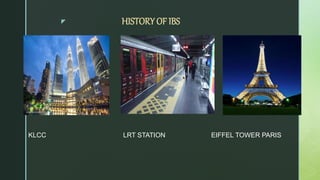
z HISTORY OF IBS
KLCC LRT STATION EIFFEL TOWER PARIS
z
VIDEO
z
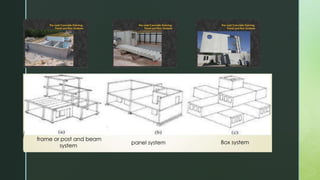
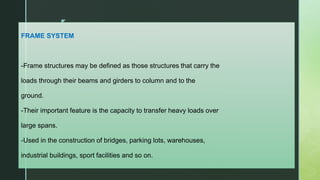
There are various Industrialised Building
Systems (IBS) used throughout the world, and
they can be classified into three major
categories. According to Junid (1986), the
typical classifications are as follows: Typical
classification of IBS Frame or post and beam
system Box systemPanel system
Typical classification of ibs
z
z
z
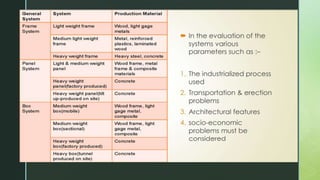
FRAME SYSTEM
-Frame structures may be defined as those structures that carry the
loads through their beams and girders to column and to the
ground.
-Their important feature is the capacity to transfer heavy loads over
large spans.
-Used in the construction of bridges, parking lots, warehouses,
industrial buildings, sport facilities and so on.
z
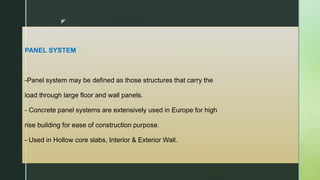
PANEL SYSTEM
-Panel system may be defined as those structures that carry the
load through large floor and wall panels.
- Concrete panel systems are extensively used in Europe for high
rise building for ease of construction purpose.
- Used in Hollow core slabs, Interior & Exterior Wall.
z
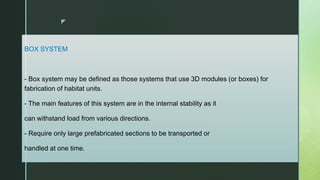
BOX SYSTEM
- Box system may be defined as those systems that use 3D modules (or boxes) for
fabrication of habitat units.
- The main features of this system are in the internal stability as it
can withstand load from various directions.
- Require only large prefabricated sections to be transported or
handled at one time.
z
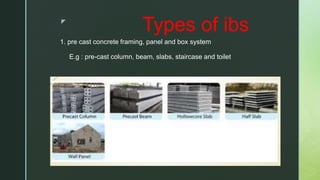
Types of ibs
1. pre cast concrete framing, panel and box system
E.g : pre-cast column, beam, slabs, staircase and toilet
z
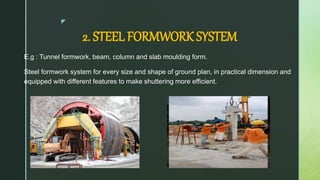
2. STEEL FORMWORK SYSTEM
E.g : Tunnel formwork, beam, column and slab moulding form.
Steel formwork system for every size and shape of ground plan, in practical dimension and
equipped with different features to make shuttering more efficient.
z
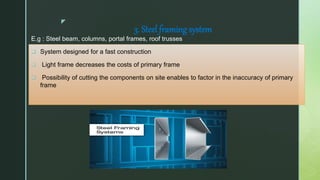
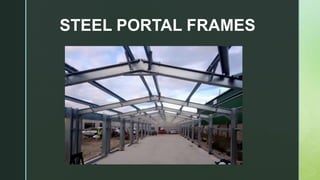
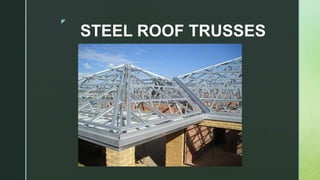
3. Steel framing system
E.g : Steel beam, columns, portal frames, roof trusses
 System designed for a fast construction
 Light frame decreases the costs of primary frame
 Possibility of cutting the components on site enables to factor in the inaccuracy of primary
frame
z
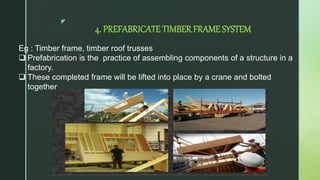
4. PREFABRICATE TIMBER FRAME SYSTEM
Eg : Timber frame, timber roof trusses
 Prefabrication is the practice of assembling components of a structure in a
factory.
 These completed frame will be lifted into place by a crane and bolted
together
z
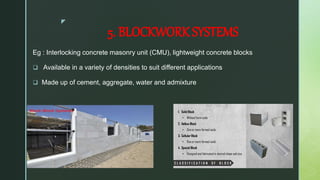
5. BLOCKWORK SYSTEMS
Eg : Interlocking concrete masonry unit (CMU), lightweight concrete blocks
 Available in a variety of densities to suit different applications
 Made up of cement, aggregate, water and admixture
z
Installation of IBS
Or Pre- Fabricated
z
The construction methods are generally
classified into 4 categories.
 Conventional construction method
 Components prefabricated on site through timber/plywood
formwork installation.( more cost)
z
 Cast-in-situ ( non- conventional )
 It is applicable to to all types of building. Etc: steel,fibre glass/aluminium
formwork act as mould and wet concrete to replace traditional timber
framed, formwork( less cost, speedy const.)
 Composite method( non-conventional)
 Components of the building are partially prefabricated. ( quality improve)

 Fully fabricated ( non-conventional)
 All elements are fully made at the factory (high cost) .
z
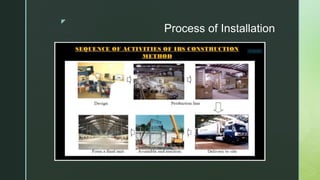
Process of Installation
z
CASE STUDY OF
INDUSTRIALIZED BUILDING
Miza Raimi Binti Mohd Saf’a (DB180169)
Nur Amira Shafiqah Binti Azhar (DB180195)
Nur Amshahiera Binti Mazlan (DB180189)
Dr. Lutfiah Natrah Bt Abbas @ Ahmad
BBB20403 CONSTRUCTION TECHNOLOGI 1
z
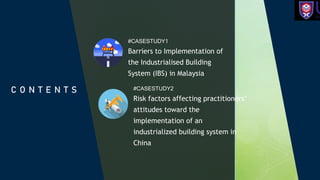
#CASESTUDY1
Barriers to Implementation of
the Industrialised Building
System (IBS) in Malaysia
C O N T E N T S #CASESTUDY2
Risk factors affecting practitioners’
attitudes toward the
implementation of an
industrialized building system in
China
z
CASE STUDY
1
BBB20403 CONSTRUCTION TECHNOLOGI 1
Barriers to Implementation of the Industrialised
BuildingSystem (IBS) in Malaysia
z
ABSTRACT
Malaysia, like any other developing country, considers the construction
industry as one the main contributors to its
Gross Domestic Product (GDP). However, there are unresolved issues arising
from the ongoing and widespread adoption of the traditional method of
construction.
This paper discusses the identified barriers with the aim of examining how far
these barriers may well affect the process of IBS implementation in the
Malaysian construction industry.
z
There is no short of the increasing
demand for construction. This is due
to a greater part, on the increase of
population and improvement in the
quality of life of the populace. This
demand will be made more acute if
the following factors were to take
into consideration
INTRODUCTION
z
Factors That Must Take Into
Consideration
1 3
2 4
the increase in number of
foreign migrants (especially
forming the workforce);
the dilapidated stocks that
need to be replaced
the rebuilding of damaged
buildings due to natural disasters
the demolition of illegal squatter
units and the ensuing construction
of affordable residential units to
resettle the squatters
z
IBS IN MALAYSIA
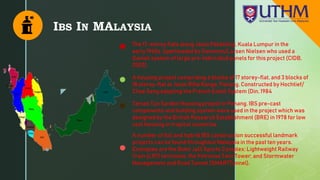
The 17-storey flats along Jalan Pekeliling, Kuala Lumpur in the
early 1960s. Sperheaded by Gammon/Larsen Nielsen who used a
Danish system of large pre-fabricated panels for this project (CIDB,
2003).
A housing project comprising 6 blocks of 17 storey-flat, and 3 blocks of
18 storey-flat at Jalan Rifle Range, Penang. Constructed by Hochtief/
Chee Seng adopting the French Estoit System (Din, 1984
Taman Tun Sardon Housing project in Penang. IBS pre-cast
components and building system were used in the project which was
designed by the British Research Establishment (BRE) in 1978 for low
cost housing in tropical countries.
A number of full and hybrid IBS construction successful landmark
projects can be found throughout Malaysia in the past ten years.
Examples are the Bukit Jalil Sports Complex; Lightweight Railway
Train (LRT) terminals; the Petronas Twin Tower; and Stormwater
Management and Road Tunnel (SMARTTunnel).
z
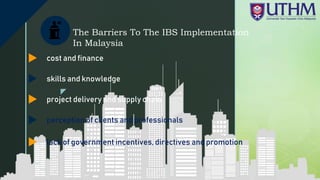
The Barriers To The IBS Implementation
In Malaysia
skills and knowledge
project delivery and supply chain
perception of clients and professionals
cost and finance
lack of government incentives, directives and promotion
z
CASE STUDY
2
BBB20403 CONSTRUCTION TECHNOLOGI 1
Risk factors affecting practitioners’ attitudes toward
the implementation of an industrialized building
system in China
z
INTRODUCTION
An industrialized building system (IBS) is regarded as an effective residential
building system that provides several benefits, including high quality, low cost,
short time, good flexibility, reduced waste, and strong environmental
performance. However, the adoption of IBS in China is extremely limited.
Potential risks exist and affect the attitudes of practitioners toward the use of
this system. The purpose of this case study is to prioritize and analyze these
risks and to develop corresponding strategies for mitigating these risks in
China.
BBB20403 CONSTRUCTION TECHNOLOGI 1
z
RISK ANALYSIS
E O
M T
Economic risk
Market risk
On-site management
risk
Technical risk
The researchers conducted in-depth interviews with the project managers
working on these cases to investigate the risks they encountered in the
process of implementing these projects.
z
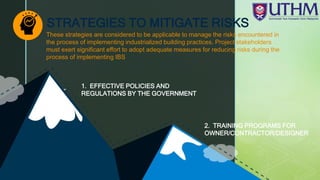
1. EFFECTIVE POLICIES AND
REGULATIONS BY THE GOVERNMENT
2. TRAINING PROGRAMS FOR
OWNER/CONTRACTOR/DESIGNER
STRATEGIES TO MITIGATE RISKS
These strategies are considered to be applicable to manage the risks encountered in
the process of implementing industrialized building practices. Project stakeholders
must exert significant effort to adopt adequate measures for reducing risks during the
process of implementing IBS
z
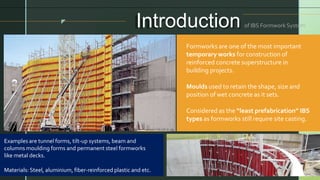
Introduction of IBS Formwork System
Formworks are one of the most important
temporary works for construction of
reinforced concrete superstructure in
building projects.
Moulds used to retain the shape, size and
position of wet concrete as it sets.
Considered as the “least prefabrication” IBS
types as formworks still require site casting.
Examples are tunnel forms, tilt-up systems, beam and
columns moulding forms and permanent steel formworks
like metal decks.
Materials: Steel, aluminium, fiber-reinforced plastic and etc.
z
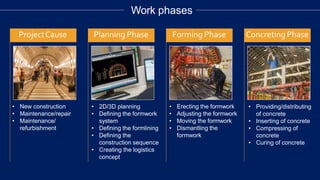
ProjectCause Planning Phase Forming Phase Concreting Phase
• New construction
• Maintenance/repair
• Maintenance/
refurbishment
• 2D/3D planning
• Defining the formwork
system
• Defining the formlining
• Defining the
construction sequence
• Creating the logistics
concept
• Erecting the formwork
• Adjusting the formwork
• Moving the formwork
• Dismantling the
formwork
• Providing/distributing
of concrete
• Inserting of concrete
• Compressing of
concrete
• Curing of concrete
Work phases
Manufacture
Assembly
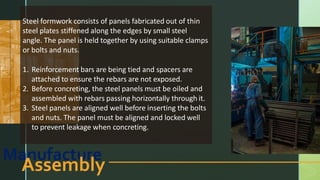
Steel formwork consists of panels fabricated out of thin
steel plates stiffened along the edges by small steel
angle. The panel is held together by using suitable clamps
or bolts and nuts.
1. Reinforcement bars are being tied and spacers are
attached to ensure the rebars are not exposed.
2. Before concreting, the steel panels must be oiled and
assembled with rebars passing horizontally through it.
3. Steel panels are aligned well before inserting the bolts
and nuts. The panel must be aligned and locked well
to prevent leakage when concreting.
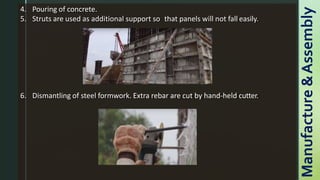
4. Pouring of concrete.
5. Struts are used as additional support so that panels will not fall easily.
6. Dismantling of steel formwork. Extra rebar are cut by hand-held cutter.
Manufacture
&
Assembly
z
https://youtu.be/2sO2G
p_ctco
z
How IBS Transport ??
z
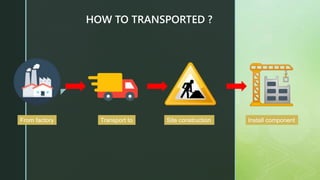
HOW TO TRANSPORTED ?
From factory Transport to Site construction Install component
decide appropriate weight crane to carry and erect the non-volumetric
component and the volumetric structure
safety and proper erection is important to ensure the component is not defect
and require high precision during the installation process
Apart from the effective distance to transport the component to the site, it is
also important to have the component in partial size where it can be ‘plug and
play’ to become large scale structure
Reason of transportation delay
• Shortage In Raw Materials • Supply Delay • Bad Weather
z Issues of IBS
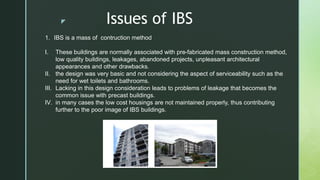
1. IBS is a mass of contruction method
I. These buildings are normally associated with pre-fabricated mass construction method,
low quality buildings, leakages, abandoned projects, unpleasant architectural
appearances and other drawbacks.
II. the design was very basic and not considering the aspect of serviceability such as the
need for wet toilets and bathrooms.
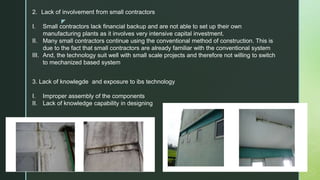
III. Lacking in this design consideration leads to problems of leakage that becomes the
common issue with precast buildings.
IV. in many cases the low cost housings are not maintained properly, thus contributing
further to the poor image of IBS buildings.
z
2. Lack of involvement from small contractors
I. Small contractors lack financial backup and are not able to set up their own
manufacturing plants as it involves very intensive capital investment.
II. Many small contractors continue using the conventional method of construction. This is
due to the fact that small contractors are already familiar with the conventional system
III. And, the technology suit well with small scale projects and therefore not willing to switch
to mechanized based system
3. Lack of knowlegde and exposure to ibs technology
I. Improper assembly of the components
II. Lack of knowledge capability in designing
z
STEEL FRAMING
SYSTEMS
z
STEEL FRAME SYSTEM
 Frame structures may be defined as those
structures that carry the loads through their
beams to column and to the ground
 Their important feature is the capacity to transfer
heavy loads over large spans.
 Used in the construction of bridges, parking lots,
warehouses, industrial buildings, sport facilities
and so on.
z STEEL BEAM &
COLUMNS
z
STEEL PORTAL FRAMES
z
STEEL ROOF TRUSSES
z
VIDEO INSTALLATION STEEL
FRAMING SYSTEMS
z
VIDEO INSTALLATION STEEL
FRAMING SYSTEMS
z
INTERLOCKIN
G
BRICKS
SYSTEM
IBS is a building construction system using ready-made
components in factories such as walls, poles, floors
and trusses before being shipped to the construction
site for installation.
The system has been used about a century ago in the
Americas and Europe with the introduction of pre-
installed installations.
IBS has gained international recognition and the block
of IBS is more time-consuming and costly than ordinary
bricks.
IBS offers cooler, air-conditioned, heat-resistant,
soundproof, 1-2-month complete construction & most
importantly 40% SAVE.
z
z
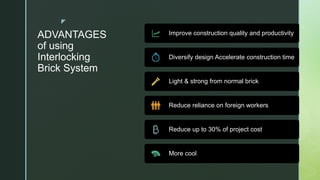
ADVANTAGES
of using
Interlocking
Brick System
Improve construction quality and productivity
Diversify design Accelerate construction time
Light & strong from normal brick
Reduce reliance on foreign workers
Reduce up to 30% of project cost
More cool
z
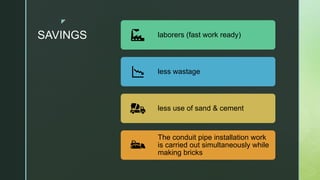
SAVINGS laborers (fast work ready)
less wastage
less use of sand & cement
The conduit pipe installation work
is carried out simultaneously while
making bricks
z
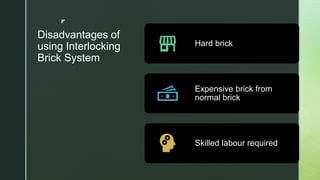
Disadvantages of
using Interlocking
Brick System
Hard brick
Expensive brick from
normal brick
Skilled labour required

434773055-INDUSTRIALIZED-BUILDING-SYSTEM-IBS-pptx.pptx

  • 1.
  • 2.
    z  Conventional constructionvs IBS System  Advantages and disadvantages of IBS System  What types of IBS?  What is IBS?  IBS installation  Case Studies/example (2 CASE STUDIES)  How IBS produced?  How IBS transported?  Issues in IBS  Steel framing  Interlocking System
  • 3.
    z CONVENTIONAL METHOD VSIBS SYSTEM IBS METHOD FEATURE CONVENTIONAL METHOD Duration shoter than conventional method because the component produce in factory TIME USED FOR COMPLETION OF PROJECT USUALLY TAKING 1-2 YEARS TO COMPLETE,DEPENDING TO THE SCALE OF THE PROJECT CHEAP BECAUSE THE COMPONENT ARE PRODUCED IN FACTORY COSTING LARGER AMOUNT NEEDED AS COST FOR MAKING FORMWORK ALL WORK IS DONE BY USING MACHINE AND ONLY NEED FEW WORKER THAT PROFESSIONAL REDUCE LABOUR WORKER THIS METHOD NEED MANY LABOUR WORKER DUE TO ALL WORK ARE DONE MANUALLY DECREASE THE USING OF TIMBER ON CONSTRUCTION PROJECT ENVIRONMENTAL FRIENDLY LESS-ENVIRONMENTAL FRIENDLY DUE TO HIGH AMOUNT OF TIMBER
  • 4.
    z CONVENTIONAL METHOD VSIBS SYSTEM IBS METHOD FEATURE CONVENTIONAL METHOD AN IBS COMPONENT HAVE HIGHER QUALITY DUE TO CAREFUL SELECTION OF MATERIALS AND USE OF ADVANCE TECHNOLOGY QUALITY OF PROJECT GOOD QUALITY BUT THE RATE OF FINISHES WOULD AFFECTED WITH THE WEATHER CONDITION AND DEPAND LABOUR LARGE WORKING AREA NEEDED,FOR TRANSFER AND STORAGE OF IBS COMPONENT SIZE OF THE WORKING AREA OPTIMUM WORKING AREA NEEDED DUE TO CONSTRUCTION DONE PHASE BY PHASE LEAKAGE IS OFTEN THE MAJOR PROBLEM IN BUILDING CONSTRUCTED USING IBS.THIS PROBLEM IS OBVIOUS IN MALAYSIA WHERE RAINING RAPIDLY OCCUR THROUGHT OUT YEAR PROBLEMS OF JOINTS THIS METHOD DOES NOT USE JOINTING WHERE THE STRUCTURE BUILD MANUALLY AND LESS LEAKING PROBLEM OCCUR
  • 5.
    z BUILDING SYSTEM (IBS) Lessconstruction time • IBS requires less construction time because casting of precast element at factoryand foundation work at site can occur simultaneously and the work at site is onlythe erection of IBS components. This leads to earlier occupation of the building. Cost savings • The formwork of IBS components are made of steel, aluminium or other materials that allows for repetitive use and this leads to considerable cost savings. Saving in labour • When the IBS components are produced in factory, higher degree of utilisation of machine is permitted and the use of labour will be reduced and lead to saving inlabour cost Less labour at site • The use of IBS will reduce the construction process at site and consequently reducethe number of labour required at site. ADVANTAGES OF INDUSTRIALISED
  • 6.
    z • The utilisationof machine during the production of IBS components lead to higher degree of precisionand accuracy in the production and consequently reduce material wastage. Higher quality and better finishes • An IBS component have higher quality and better finishes due to the careful selection of materials, use of advanced technology, better and strict quality assurance control since production in factory is under sheltered environment. Construction operation less affected by weather • Faster project completion due to rapid all weather construction. The effects of weather on construction operation are less due to the fabrication of IBS components is done in factory while at site is only erection of the components. flexibility • IBS provides flexibility in the design of precast element so that different systems may produce their own unique prefabrication construction methods. Increase site safety and neatness • Utilisation of IBS components leads to less construction process especially wetwork at site. This will lead to the neater site condition and increase safety. Environmental friendly • The use of IBS will decrease the using of timber formwork on construction projects Optimized use of material
  • 7.
    z DISADVANTAGES OF IBS Nothingin this world is perfect, so as industrialised building system. Disadvantages of IBS are as follows: High initial capitalcost • The initial capital cost of IBS is usually high. The initial cost including the cost of constructing the factory, casting beds and support machinery. The cost effectivenesscan only be achieved when undertaking large projects. Problem of joints • Water leakage is often the major problem in building constructed using IBS. This problem is more obvious in Malaysia where raining occur rapidly through out the year. Sophisticated plants and skilled operators • The prefabrication system relies heavily on sophisticated plants, which have to bewell coordinated and maintained by skilled operators. Breakdown in any one sectionwould hold-up the entire production line. Site accessibility • Site accessibility is one of the most important factors of the implementation of IBS.IBS requires adequate site accessibility to transport IBS components from factory to the site. Large working area • Building construction using IBS requires a large working area for the factory,trailers, tower-cranes and storage for the IBS components. Besides, most construction sites especially in cities are often congested and unable to provide the area required
  • 8.
    z WHAT IS IBS Aconstruction technique in which components are manufactured in a controlled environment (on or off site), transported, positioned and assembled into a structure with minimal additional site works.
  • 9.
    z HISTORY OFIBS KLCC LRT STATION EIFFEL TOWER PARIS
  • 10.
  • 11.
    z There are variousIndustrialised Building Systems (IBS) used throughout the world, and they can be classified into three major categories. According to Junid (1986), the typical classifications are as follows: Typical classification of IBS Frame or post and beam system Box systemPanel system Typical classification of ibs
  • 12.
  • 13.
  • 14.
    z FRAME SYSTEM -Frame structuresmay be defined as those structures that carry the loads through their beams and girders to column and to the ground. -Their important feature is the capacity to transfer heavy loads over large spans. -Used in the construction of bridges, parking lots, warehouses, industrial buildings, sport facilities and so on.
  • 15.
    z PANEL SYSTEM -Panel systemmay be defined as those structures that carry the load through large floor and wall panels. - Concrete panel systems are extensively used in Europe for high rise building for ease of construction purpose. - Used in Hollow core slabs, Interior & Exterior Wall.
  • 16.
    z BOX SYSTEM - Boxsystem may be defined as those systems that use 3D modules (or boxes) for fabrication of habitat units. - The main features of this system are in the internal stability as it can withstand load from various directions. - Require only large prefabricated sections to be transported or handled at one time.
  • 17.
    z Types of ibs 1.pre cast concrete framing, panel and box system E.g : pre-cast column, beam, slabs, staircase and toilet
  • 18.
    z 2. STEEL FORMWORKSYSTEM E.g : Tunnel formwork, beam, column and slab moulding form. Steel formwork system for every size and shape of ground plan, in practical dimension and equipped with different features to make shuttering more efficient.
  • 19.
    z 3. Steel framingsystem E.g : Steel beam, columns, portal frames, roof trusses  System designed for a fast construction  Light frame decreases the costs of primary frame  Possibility of cutting the components on site enables to factor in the inaccuracy of primary frame
  • 20.
    z 4. PREFABRICATE TIMBERFRAME SYSTEM Eg : Timber frame, timber roof trusses  Prefabrication is the practice of assembling components of a structure in a factory.  These completed frame will be lifted into place by a crane and bolted together
  • 21.
    z 5. BLOCKWORK SYSTEMS Eg: Interlocking concrete masonry unit (CMU), lightweight concrete blocks  Available in a variety of densities to suit different applications  Made up of cement, aggregate, water and admixture
  • 22.
    z Installation of IBS OrPre- Fabricated
  • 23.
    z The construction methodsare generally classified into 4 categories.  Conventional construction method  Components prefabricated on site through timber/plywood formwork installation.( more cost)
  • 24.
    z  Cast-in-situ (non- conventional )  It is applicable to to all types of building. Etc: steel,fibre glass/aluminium formwork act as mould and wet concrete to replace traditional timber framed, formwork( less cost, speedy const.)  Composite method( non-conventional)  Components of the building are partially prefabricated. ( quality improve)  Fully fabricated ( non-conventional)  All elements are fully made at the factory (high cost) .
  • 25.
  • 26.
    z CASE STUDY OF INDUSTRIALIZEDBUILDING Miza Raimi Binti Mohd Saf’a (DB180169) Nur Amira Shafiqah Binti Azhar (DB180195) Nur Amshahiera Binti Mazlan (DB180189) Dr. Lutfiah Natrah Bt Abbas @ Ahmad BBB20403 CONSTRUCTION TECHNOLOGI 1
  • 27.
    z #CASESTUDY1 Barriers to Implementationof the Industrialised Building System (IBS) in Malaysia C O N T E N T S #CASESTUDY2 Risk factors affecting practitioners’ attitudes toward the implementation of an industrialized building system in China
  • 28.
    z CASE STUDY 1 BBB20403 CONSTRUCTIONTECHNOLOGI 1 Barriers to Implementation of the Industrialised BuildingSystem (IBS) in Malaysia
  • 29.
    z ABSTRACT Malaysia, like anyother developing country, considers the construction industry as one the main contributors to its Gross Domestic Product (GDP). However, there are unresolved issues arising from the ongoing and widespread adoption of the traditional method of construction. This paper discusses the identified barriers with the aim of examining how far these barriers may well affect the process of IBS implementation in the Malaysian construction industry.
  • 30.
    z There is noshort of the increasing demand for construction. This is due to a greater part, on the increase of population and improvement in the quality of life of the populace. This demand will be made more acute if the following factors were to take into consideration INTRODUCTION
  • 31.
    z Factors That MustTake Into Consideration 1 3 2 4 the increase in number of foreign migrants (especially forming the workforce); the dilapidated stocks that need to be replaced the rebuilding of damaged buildings due to natural disasters the demolition of illegal squatter units and the ensuing construction of affordable residential units to resettle the squatters
  • 32.
    z IBS IN MALAYSIA The17-storey flats along Jalan Pekeliling, Kuala Lumpur in the early 1960s. Sperheaded by Gammon/Larsen Nielsen who used a Danish system of large pre-fabricated panels for this project (CIDB, 2003). A housing project comprising 6 blocks of 17 storey-flat, and 3 blocks of 18 storey-flat at Jalan Rifle Range, Penang. Constructed by Hochtief/ Chee Seng adopting the French Estoit System (Din, 1984 Taman Tun Sardon Housing project in Penang. IBS pre-cast components and building system were used in the project which was designed by the British Research Establishment (BRE) in 1978 for low cost housing in tropical countries. A number of full and hybrid IBS construction successful landmark projects can be found throughout Malaysia in the past ten years. Examples are the Bukit Jalil Sports Complex; Lightweight Railway Train (LRT) terminals; the Petronas Twin Tower; and Stormwater Management and Road Tunnel (SMARTTunnel).
  • 33.
    z The Barriers ToThe IBS Implementation In Malaysia skills and knowledge project delivery and supply chain perception of clients and professionals cost and finance lack of government incentives, directives and promotion
  • 34.
    z CASE STUDY 2 BBB20403 CONSTRUCTIONTECHNOLOGI 1 Risk factors affecting practitioners’ attitudes toward the implementation of an industrialized building system in China
  • 35.
    z INTRODUCTION An industrialized buildingsystem (IBS) is regarded as an effective residential building system that provides several benefits, including high quality, low cost, short time, good flexibility, reduced waste, and strong environmental performance. However, the adoption of IBS in China is extremely limited. Potential risks exist and affect the attitudes of practitioners toward the use of this system. The purpose of this case study is to prioritize and analyze these risks and to develop corresponding strategies for mitigating these risks in China. BBB20403 CONSTRUCTION TECHNOLOGI 1
  • 36.
    z RISK ANALYSIS E O MT Economic risk Market risk On-site management risk Technical risk The researchers conducted in-depth interviews with the project managers working on these cases to investigate the risks they encountered in the process of implementing these projects.
  • 37.
    z 1. EFFECTIVE POLICIESAND REGULATIONS BY THE GOVERNMENT 2. TRAINING PROGRAMS FOR OWNER/CONTRACTOR/DESIGNER STRATEGIES TO MITIGATE RISKS These strategies are considered to be applicable to manage the risks encountered in the process of implementing industrialized building practices. Project stakeholders must exert significant effort to adopt adequate measures for reducing risks during the process of implementing IBS
  • 38.
    z Introduction of IBSFormwork System Formworks are one of the most important temporary works for construction of reinforced concrete superstructure in building projects. Moulds used to retain the shape, size and position of wet concrete as it sets. Considered as the “least prefabrication” IBS types as formworks still require site casting. Examples are tunnel forms, tilt-up systems, beam and columns moulding forms and permanent steel formworks like metal decks. Materials: Steel, aluminium, fiber-reinforced plastic and etc.
  • 39.
    z ProjectCause Planning PhaseForming Phase Concreting Phase • New construction • Maintenance/repair • Maintenance/ refurbishment • 2D/3D planning • Defining the formwork system • Defining the formlining • Defining the construction sequence • Creating the logistics concept • Erecting the formwork • Adjusting the formwork • Moving the formwork • Dismantling the formwork • Providing/distributing of concrete • Inserting of concrete • Compressing of concrete • Curing of concrete Work phases
  • 40.
    Manufacture Assembly Steel formwork consistsof panels fabricated out of thin steel plates stiffened along the edges by small steel angle. The panel is held together by using suitable clamps or bolts and nuts. 1. Reinforcement bars are being tied and spacers are attached to ensure the rebars are not exposed. 2. Before concreting, the steel panels must be oiled and assembled with rebars passing horizontally through it. 3. Steel panels are aligned well before inserting the bolts and nuts. The panel must be aligned and locked well to prevent leakage when concreting.
  • 41.
    4. Pouring ofconcrete. 5. Struts are used as additional support so that panels will not fall easily. 6. Dismantling of steel formwork. Extra rebar are cut by hand-held cutter. Manufacture & Assembly
  • 42.
  • 43.
  • 44.
    z HOW TO TRANSPORTED? From factory Transport to Site construction Install component
  • 45.
    decide appropriate weightcrane to carry and erect the non-volumetric component and the volumetric structure safety and proper erection is important to ensure the component is not defect and require high precision during the installation process Apart from the effective distance to transport the component to the site, it is also important to have the component in partial size where it can be ‘plug and play’ to become large scale structure
  • 46.
    Reason of transportationdelay • Shortage In Raw Materials • Supply Delay • Bad Weather
  • 47.
    z Issues ofIBS 1. IBS is a mass of contruction method I. These buildings are normally associated with pre-fabricated mass construction method, low quality buildings, leakages, abandoned projects, unpleasant architectural appearances and other drawbacks. II. the design was very basic and not considering the aspect of serviceability such as the need for wet toilets and bathrooms. III. Lacking in this design consideration leads to problems of leakage that becomes the common issue with precast buildings. IV. in many cases the low cost housings are not maintained properly, thus contributing further to the poor image of IBS buildings.
  • 48.
    z 2. Lack ofinvolvement from small contractors I. Small contractors lack financial backup and are not able to set up their own manufacturing plants as it involves very intensive capital investment. II. Many small contractors continue using the conventional method of construction. This is due to the fact that small contractors are already familiar with the conventional system III. And, the technology suit well with small scale projects and therefore not willing to switch to mechanized based system 3. Lack of knowlegde and exposure to ibs technology I. Improper assembly of the components II. Lack of knowledge capability in designing
  • 49.
  • 50.
    z STEEL FRAME SYSTEM Frame structures may be defined as those structures that carry the loads through their beams to column and to the ground  Their important feature is the capacity to transfer heavy loads over large spans.  Used in the construction of bridges, parking lots, warehouses, industrial buildings, sport facilities and so on.
  • 51.
    z STEEL BEAM& COLUMNS
  • 52.
  • 53.
  • 54.
  • 55.
  • 56.
    z INTERLOCKIN G BRICKS SYSTEM IBS is abuilding construction system using ready-made components in factories such as walls, poles, floors and trusses before being shipped to the construction site for installation. The system has been used about a century ago in the Americas and Europe with the introduction of pre- installed installations. IBS has gained international recognition and the block of IBS is more time-consuming and costly than ordinary bricks. IBS offers cooler, air-conditioned, heat-resistant, soundproof, 1-2-month complete construction & most importantly 40% SAVE.
  • 57.
  • 58.
    z ADVANTAGES of using Interlocking Brick System Improveconstruction quality and productivity Diversify design Accelerate construction time Light & strong from normal brick Reduce reliance on foreign workers Reduce up to 30% of project cost More cool
  • 59.
    z SAVINGS laborers (fastwork ready) less wastage less use of sand & cement The conduit pipe installation work is carried out simultaneously while making bricks
  • 60.
    z Disadvantages of using Interlocking BrickSystem Hard brick Expensive brick from normal brick Skilled labour required