FORMS OF 
COMMUNICATION
What Is 
Communicatio 
n ??? 
10/27/2014 Forms Of Communication 2
Communication is … 
 According to Newman and Summer , 
“Communication is an exchange of 
facts , ideas , opinions or emotions by 
two or more persons . “ 
 According to Allen , 
“The sum of all the things one person 
does when he wants to create 
understanding in the mind of another . 
“ 10/27/2014 Forms Of Communication 3
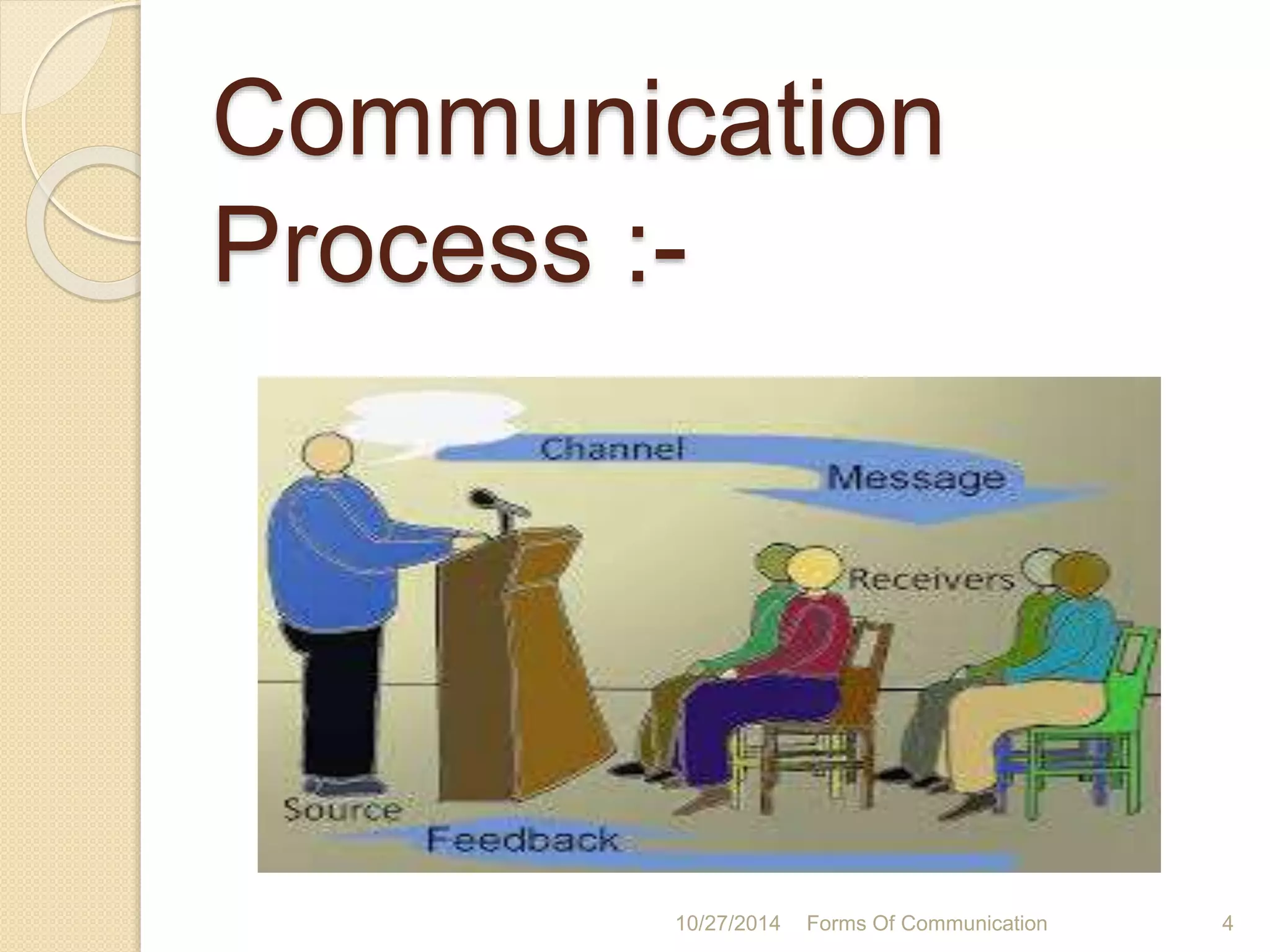
Communication 
Process :- 
10/27/2014 Forms Of Communication 4
Key Elements Of Communication 
 Sender 
 Message 
 Encoding 
 Channel 
 Receiver 
 Decoding 
 Feedback 
10/27/2014 Forms Of Communication 5
Forms Of 
Communicatio 
n 
10/27/2014 Forms Of Communication 6
…conti… 
Forms Of 
Communication 
Verbal 
Communication 
Oral 
Communication 
Written 
Communication 
Non – Verbal 
Communication 
Sign Language Body Language 
10/27/2014 Forms Of Communication 7
VERBAL 
COMMUNICATION 
10/27/2014 Forms Of Communication 8
A :- Verbal Communication 
 Language is the most useful tool of 
communication as it can convey idea 
and message easily if the parties to 
the communication understand the 
language used . 
 So , 
“Communication by the using language is 
simply called as verbal communication . “ 
10/27/2014 Forms Of Communication 9
…conti… 
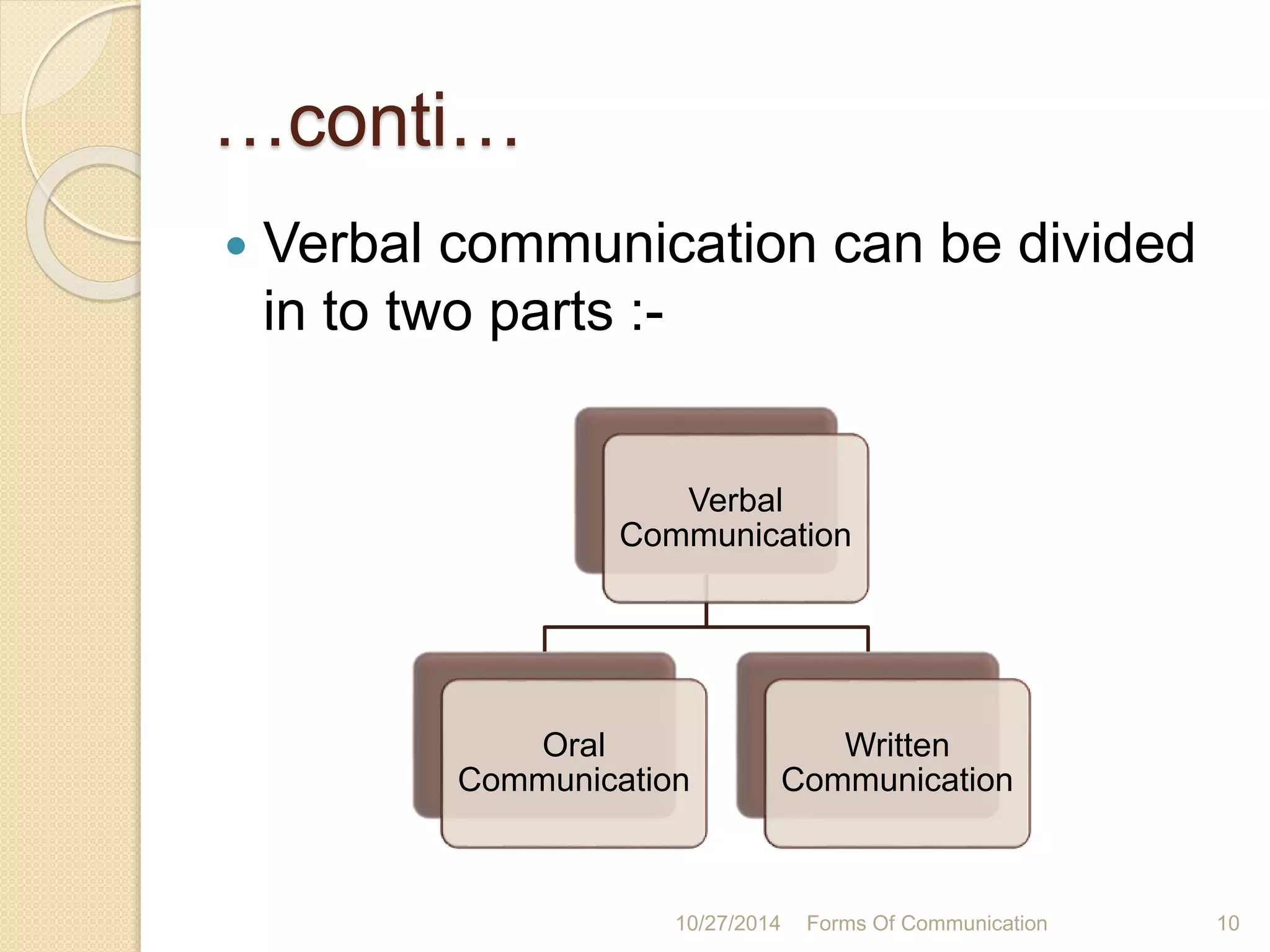
 Verbal communication can be divided 
in to two parts :- 
Verbal 
Communication 
Oral 
Communication 
Written 
Communication 
10/27/2014 Forms Of Communication 10
1. Oral Communication 
 Oral communication is the interchange 
of verbal messages between sender 
and receiver . 
 Oral communication can be terms as , 
“ Spoken communication which can 
be defined as communicating our 
thoughts through words . “ 
10/27/2014 Forms Of Communication 11
Forms of Oral Communication 
Informal face to face talk 
Interviews 
Group communication 
• Debate Of Group Dicussion 
• Meeting 
• Conferences 
• Committees 
Speeches And Presentations 
10/27/2014 Forms Of Communication 12
Advantages of oral communication 
are: 
 It is spontaneous and natural. 
 It is, therefore, easy for others to 
understand . 
 Choice of words generally suits the 
listeners . 
 It is supported by nonverbal 
communication. 
 The communicator or the person who 
communicates, is always physically 
available. 10/27/2014 Forms Of Communication 13
Disadvantages of oral 
communication: 
 Words spoken disappear into thin air. 
The words are temporary. 
 Words are not permanent unlike say 
written communication. 
 What is heard is often forgotten. 
 Nonverbal communication that supports 
oral communication may not be 
understood by people from other 
cultures. 10/27/2014 Forms Of Communication 14
2 . Written Communication 
 Written communication is a creative 
activity that requires a lot of imagination 
and efforts to arrive at the finished 
product . 
 Written communication can be terms as 
, 
“ Transformation of information 
through in any written form like letters , 
notices , circulars , memos , reports etc . 
“ 10/27/2014 Forms Of Communication 15
Forms of Written 
Communication 
Letters 
Circulars 
Orders 
Reports 
Forms and questionnaires 
Manuals 
Newsletters 
Handbills 
Bulletin boards 
Books 
10/27/2014 Forms Of Communication 16
Advantages of written 
communication: 
 Knowledge and information became 
available to people who could read. 
 Written message are more carefully 
formulated than oral communication . 
 Written communication serves as a 
reliable record for future reference and 
can be used in legal proceedings . 
10/27/2014 Forms Of Communication 17
Disadvantages of written 
communication: 
• One has to be literate to use written 
communication. 
• Written communication is generally more 
expensive to convey a short message . 
• Formal in nature so It does not involves 
personal touch between two parties . 
• If the written communication is poorly 
drafted , it mat create misunderstanding 
and confusion in the mind of receiver . 
10/27/2014 Forms Of Communication 18
NON - VERBAL 
COMMUNICATION 
10/27/2014 Forms Of Communication 19
B . Non – Verbal 
Communication 
 Nonverbal communication describes the 
process of conveying meaning in the 
form of non-word messages. 
 It can be define as , 
“ Non verbal communication is the 
transfer of meaningful information from 
one person to another by means other 
than written or spoken words . “ 
10/27/2014 Forms Of Communication 20
…conti… 
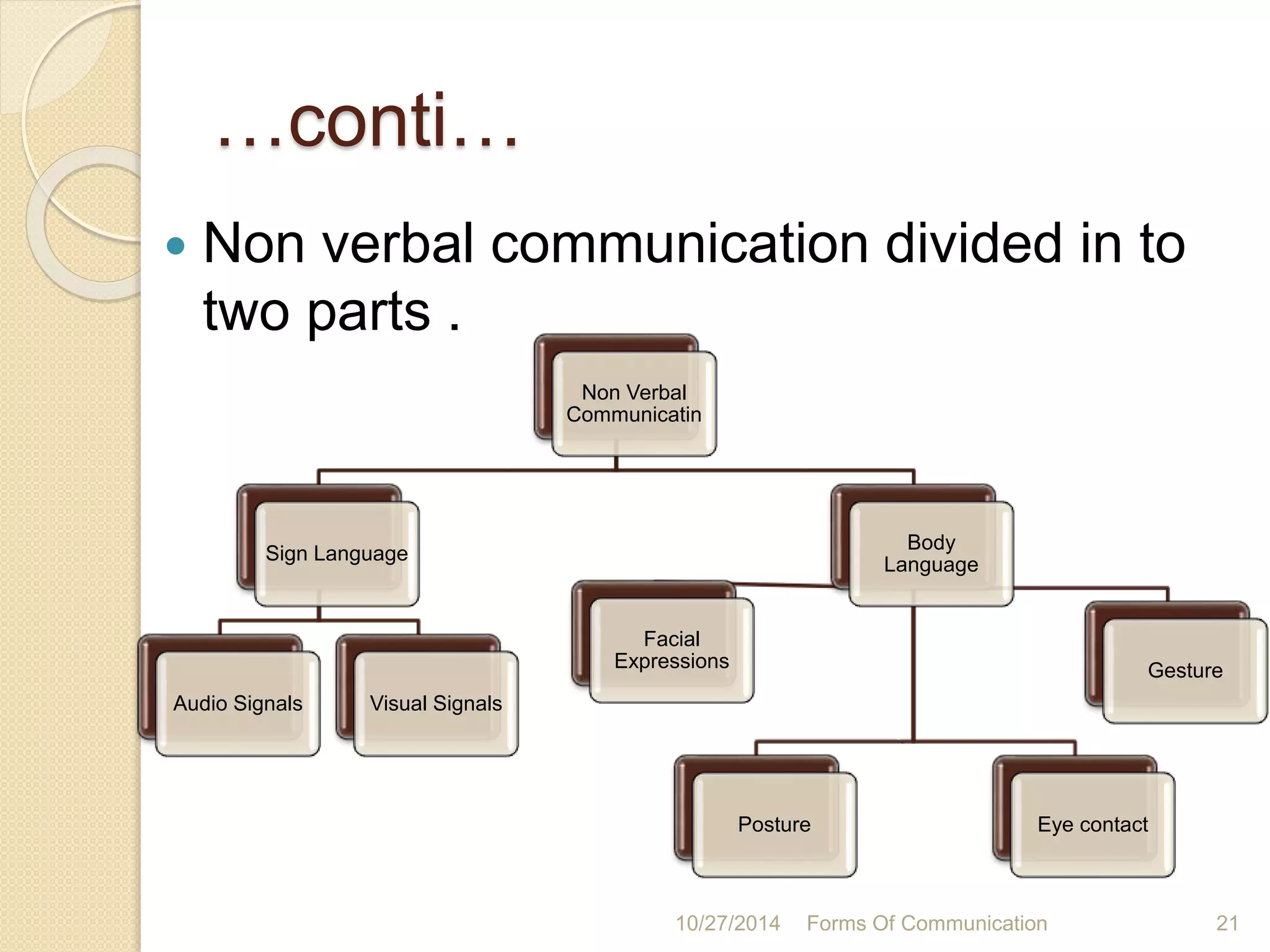
 Non verbal communication divided in to 
two parts . 
Non Verbal 
Communicatin 
Sign Language 
Audio Signals Visual Signals 
Body 
Language 
Facial 
Expressions 
Posture 
Gesture 
Eye contact 
10/27/2014 Forms Of Communication 21
1 . Sign Language 
 People, today , not onlt communicate 
through words only , but also make use 
of sign and symbols in communication 
hence , 
“ Sign language includes all forms of 
symbols which replace words , numbers 
and punctuation signs . “ 
10/27/2014 Forms Of Communication 22
Features of Sign Language :- 
 Sign language is an art of 
communication with the use of pictures 
, drawings , sounds , etc . 
 It is an expression of one’s feelings 
through the use of symbols . 
 It requires just common sense and not 
any formal education for being 
understood . 
10/27/2014 Forms Of Communication 23
Aspects of 
Sign 
Language 
Visual Signs Audio Signs 
10/27/2014 Forms Of Communication 24
Visual 
Signs 
 Visual signs & symbols speak a 
universal language understood by 
people all over the world and are easy to 
grasp and remember . 
 It includes the use of posters , drawings , 
cartoon maps , diagrams , photographs 
etc . 10/27/2014 Forms Of Communication 25
…conti… 
 For example , 
◦ Anybody anywhere can recognize the sign 
for a telephone booth or a no smoking , or a 
factory . 
◦ Traffic lights red , yellow , green on roads 
and the lights at railway station . 
◦ Lights are used to mark celebrations , 
festive occasions , etc . 
◦ Hoardings , lights on top of VIP vehicles or 
an ambulance serve their purpose . 
10/27/2014 Forms Of Communication 26
Audio Signs 
:- 
 Audio signs or signals have been used 
to send message since the early days 
of civilization . 
 It is also universal in nature as they are 
understood by people easily . 
 Audio signals include the use of drum 
beating , alarms , hooters , buzzers, 
whistles , bells , sire10n/27s/201.4 EFortmcs Of .Communication 27
Advantages Of Sign language 
 It conveys message very quickly , 
easily and effectively . 
 Useful for managing time . 
 Makes communication interesting . 
 Useful for informing and educating 
illiterate people . 
10/27/2014 Forms Of Communication 28
Disadvantages Of Sign 
language 
 Sign language , whether using visual or 
sound signals can communicate only 
elementary and simple ideas . 
 It is not easy to draw effective pictures , 
posters , cartoons etc . It require great 
skill on the part of the artist . 
 It is quite likely to be misunderstood . 
 In verbal communication spot correction 
can be made easily . It is not possible in 
sign language . 
10/27/2014 Forms Of Communication 29
2 . Body Language 
 Body language is a form of non-verbal 
communication which consists of body 
posture , gestures , facial expressions 
and eye movements . 
 Humans send and interpret such 
signals almost entirely subconsciously . 
10/27/2014 Forms Of Communication 30
…conti… 
 In other words 
“The bodily gestures, postures, and 
facial expressions by which a person 
communicates nonverbally with others” 
 Movement/kinesics :- 
◦ Posture 
◦ Gesture 
◦ Facial expressions 
◦ Gaze / Eye contact 
10/27/2014 Forms Of Communication 31
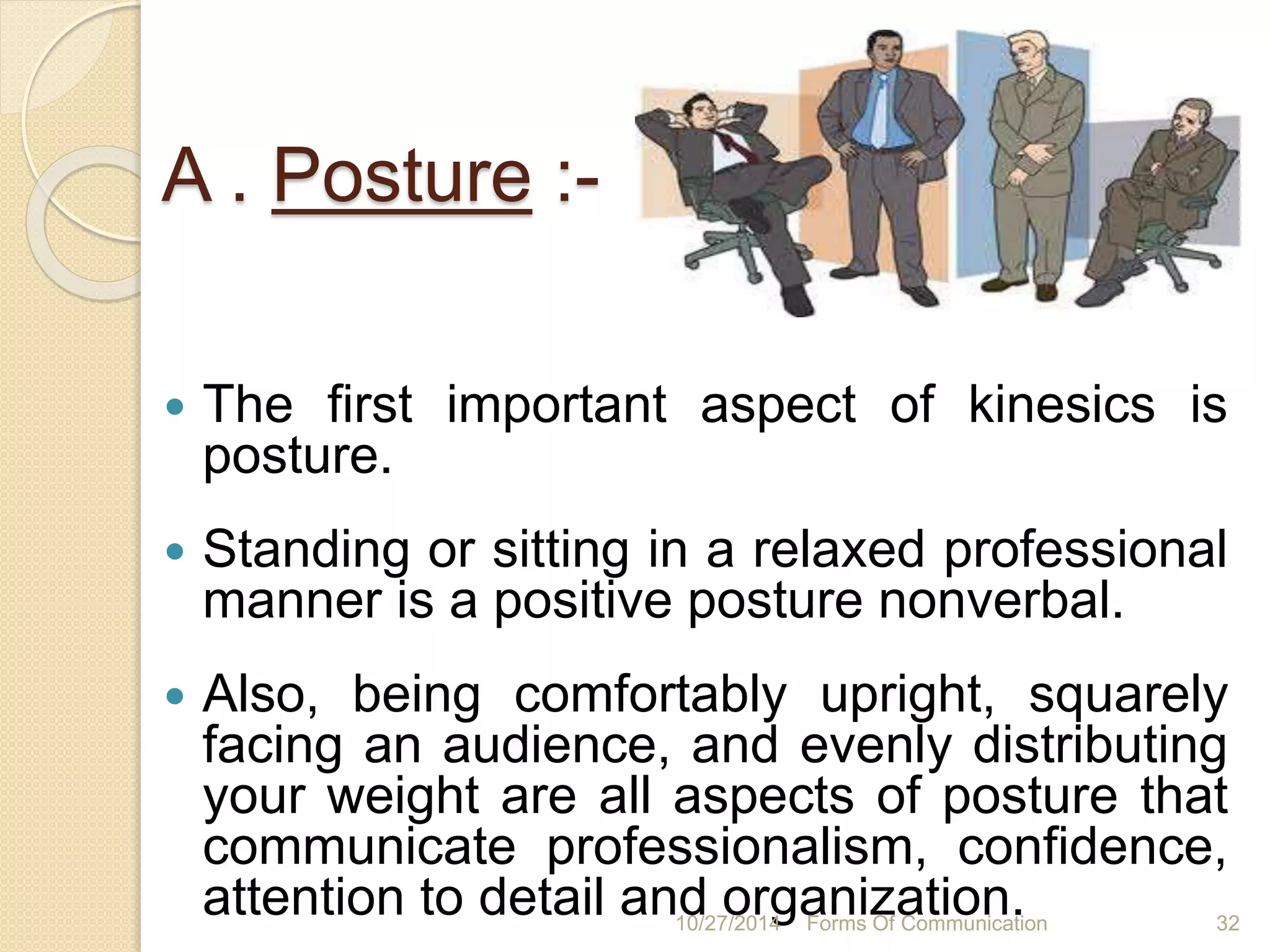
A . Posture :- 
 The first important aspect of kinesics is 
posture. 
 Standing or sitting in a relaxed professional 
manner is a positive posture nonverbal. 
 Also, being comfortably upright, squarely 
facing an audience, and evenly distributing 
your weight are all aspects of posture that 
communicate professionalism, confidence, 
attention to detail an1d0/27o/20r14gaFonrmsi zOf aCotmimounnica.tion 32
B . Gesture 
:- 
Deliberate movements and signals are 
an important way to communicate 
meaning without words. 
 Common gestures include waving, 
pointing, and using fingers to indicate 
numeric amounts. 
 Other gestures are arbitrary and 
related to culture. 10/27/2014 Forms Of Communication 33
C . Facial 
Expressions 
 Facial expressions are responsible for a 
huge proportion of nonverbal 
communication. 
 Consider how much information can be 
conveyed with a smile or a frown. 
 While nonverbal communication and 
behaviour can vary dramatically between 
cultures, the facial expressions for 
happiness, sadness, anger and fear are 
similar throughout th1e0/27w/201o4 rFlodrms Of Communication 34
D . Eye 
Contact/ 
Gaze 
 Looking at someone means showing 
interest in that person, and showing interest 
is a giant step forward in making the right 
impression . 
 Your aim should be to stay with a calm, 
steady, and non-threatening gaze. 
 Eye behavior can reveal confidence , or 
nervousness , warmth and caring , doubt 
and fear , or other em10/2o7/2t0i1o4 nFosrms tOof Coammumnicaetions sage .35
E . Personal 
Appearance 
 Appearance includes such things as a 
person’s body shape , skin color , hair 
color and length and facial features . 
 Some aspects of a person’s appearance 
may provide us with useful information 
that we do not want to ignore . 
 It may be desirable to attended to certain 
aspects such as age or gender . 
10/27/2014 Forms Of Communication 36
F . Vocal 
Features 
 Vocal features every thing about a 
spoken message except the words 
themselves , such as the tone of the 
voice or pace of speech . 
 Voice , quality , volume , pitch , rate of 
delivery , pronunciations and pauses are 
aspects of vocalizes . 
10/27/2014 Forms Of Communication 37
Advantages Of Non – Verbal 
Communication :- 
 Non- verbal communication helps the 
communicator to communicate all that 
thing secretly which they do not want to 
revel to others . 
 Through non – verbal communication we 
can communicate in brief . 
for example , If we want to show that we 
are angry we can easily show it through 
facial expression . 
10/27/2014 Forms Of Communication 38
…conti… 
 As words have limitations , non – verbal 
communication is more effective in 
situations is more effective in situations 
where a person has to explain shapes , 
directions , inner feelings and personalities 
. 
 Non-verbal signals serve to make the 
message more powerful and convincing . 
Try to convince or motivate another person 
into doing a certain task while keeping 
your facial expression , gestures and tone 
of voice unanimated10./27/2014 Forms Of Communication 39
Disadvantages Of Non – Verbal 
Communication :- 
 Long conversation is difficult. 
 It varies culture to culture . 
 Difficult to understand and requires a lot 
of repetitions . 
 Cannot be used as public tool for 
communication . 
 Less influential and cannot be used 
everywhere . 
10/27/2014 Forms Of Communication 40
THANK YOU 
 
10/27/2014 Forms Of Communication 41

Forms of communication

  • 1.
  • 2.
    What Is Communicatio n ??? 10/27/2014 Forms Of Communication 2
  • 3.
    Communication is …  According to Newman and Summer , “Communication is an exchange of facts , ideas , opinions or emotions by two or more persons . “  According to Allen , “The sum of all the things one person does when he wants to create understanding in the mind of another . “ 10/27/2014 Forms Of Communication 3
  • 4.
    Communication Process :- 10/27/2014 Forms Of Communication 4
  • 5.
    Key Elements OfCommunication  Sender  Message  Encoding  Channel  Receiver  Decoding  Feedback 10/27/2014 Forms Of Communication 5
  • 6.
    Forms Of Communicatio n 10/27/2014 Forms Of Communication 6
  • 7.
    …conti… Forms Of Communication Verbal Communication Oral Communication Written Communication Non – Verbal Communication Sign Language Body Language 10/27/2014 Forms Of Communication 7
  • 8.
    VERBAL COMMUNICATION 10/27/2014Forms Of Communication 8
  • 9.
    A :- VerbalCommunication  Language is the most useful tool of communication as it can convey idea and message easily if the parties to the communication understand the language used .  So , “Communication by the using language is simply called as verbal communication . “ 10/27/2014 Forms Of Communication 9
  • 10.
    …conti…  Verbalcommunication can be divided in to two parts :- Verbal Communication Oral Communication Written Communication 10/27/2014 Forms Of Communication 10
  • 11.
    1. Oral Communication  Oral communication is the interchange of verbal messages between sender and receiver .  Oral communication can be terms as , “ Spoken communication which can be defined as communicating our thoughts through words . “ 10/27/2014 Forms Of Communication 11
  • 12.
    Forms of OralCommunication Informal face to face talk Interviews Group communication • Debate Of Group Dicussion • Meeting • Conferences • Committees Speeches And Presentations 10/27/2014 Forms Of Communication 12
  • 13.
    Advantages of oralcommunication are:  It is spontaneous and natural.  It is, therefore, easy for others to understand .  Choice of words generally suits the listeners .  It is supported by nonverbal communication.  The communicator or the person who communicates, is always physically available. 10/27/2014 Forms Of Communication 13
  • 14.
    Disadvantages of oral communication:  Words spoken disappear into thin air. The words are temporary.  Words are not permanent unlike say written communication.  What is heard is often forgotten.  Nonverbal communication that supports oral communication may not be understood by people from other cultures. 10/27/2014 Forms Of Communication 14
  • 15.
    2 . WrittenCommunication  Written communication is a creative activity that requires a lot of imagination and efforts to arrive at the finished product .  Written communication can be terms as , “ Transformation of information through in any written form like letters , notices , circulars , memos , reports etc . “ 10/27/2014 Forms Of Communication 15
  • 16.
    Forms of Written Communication Letters Circulars Orders Reports Forms and questionnaires Manuals Newsletters Handbills Bulletin boards Books 10/27/2014 Forms Of Communication 16
  • 17.
    Advantages of written communication:  Knowledge and information became available to people who could read.  Written message are more carefully formulated than oral communication .  Written communication serves as a reliable record for future reference and can be used in legal proceedings . 10/27/2014 Forms Of Communication 17
  • 18.
    Disadvantages of written communication: • One has to be literate to use written communication. • Written communication is generally more expensive to convey a short message . • Formal in nature so It does not involves personal touch between two parties . • If the written communication is poorly drafted , it mat create misunderstanding and confusion in the mind of receiver . 10/27/2014 Forms Of Communication 18
  • 19.
    NON - VERBAL COMMUNICATION 10/27/2014 Forms Of Communication 19
  • 20.
    B . Non– Verbal Communication  Nonverbal communication describes the process of conveying meaning in the form of non-word messages.  It can be define as , “ Non verbal communication is the transfer of meaningful information from one person to another by means other than written or spoken words . “ 10/27/2014 Forms Of Communication 20
  • 21.
    …conti…  Nonverbal communication divided in to two parts . Non Verbal Communicatin Sign Language Audio Signals Visual Signals Body Language Facial Expressions Posture Gesture Eye contact 10/27/2014 Forms Of Communication 21
  • 22.
    1 . SignLanguage  People, today , not onlt communicate through words only , but also make use of sign and symbols in communication hence , “ Sign language includes all forms of symbols which replace words , numbers and punctuation signs . “ 10/27/2014 Forms Of Communication 22
  • 23.
    Features of SignLanguage :-  Sign language is an art of communication with the use of pictures , drawings , sounds , etc .  It is an expression of one’s feelings through the use of symbols .  It requires just common sense and not any formal education for being understood . 10/27/2014 Forms Of Communication 23
  • 24.
    Aspects of Sign Language Visual Signs Audio Signs 10/27/2014 Forms Of Communication 24
  • 25.
    Visual Signs Visual signs & symbols speak a universal language understood by people all over the world and are easy to grasp and remember .  It includes the use of posters , drawings , cartoon maps , diagrams , photographs etc . 10/27/2014 Forms Of Communication 25
  • 26.
    …conti…  Forexample , ◦ Anybody anywhere can recognize the sign for a telephone booth or a no smoking , or a factory . ◦ Traffic lights red , yellow , green on roads and the lights at railway station . ◦ Lights are used to mark celebrations , festive occasions , etc . ◦ Hoardings , lights on top of VIP vehicles or an ambulance serve their purpose . 10/27/2014 Forms Of Communication 26
  • 27.
    Audio Signs :-  Audio signs or signals have been used to send message since the early days of civilization .  It is also universal in nature as they are understood by people easily .  Audio signals include the use of drum beating , alarms , hooters , buzzers, whistles , bells , sire10n/27s/201.4 EFortmcs Of .Communication 27
  • 28.
    Advantages Of Signlanguage  It conveys message very quickly , easily and effectively .  Useful for managing time .  Makes communication interesting .  Useful for informing and educating illiterate people . 10/27/2014 Forms Of Communication 28
  • 29.
    Disadvantages Of Sign language  Sign language , whether using visual or sound signals can communicate only elementary and simple ideas .  It is not easy to draw effective pictures , posters , cartoons etc . It require great skill on the part of the artist .  It is quite likely to be misunderstood .  In verbal communication spot correction can be made easily . It is not possible in sign language . 10/27/2014 Forms Of Communication 29
  • 30.
    2 . BodyLanguage  Body language is a form of non-verbal communication which consists of body posture , gestures , facial expressions and eye movements .  Humans send and interpret such signals almost entirely subconsciously . 10/27/2014 Forms Of Communication 30
  • 31.
    …conti…  Inother words “The bodily gestures, postures, and facial expressions by which a person communicates nonverbally with others”  Movement/kinesics :- ◦ Posture ◦ Gesture ◦ Facial expressions ◦ Gaze / Eye contact 10/27/2014 Forms Of Communication 31
  • 32.
    A . Posture:-  The first important aspect of kinesics is posture.  Standing or sitting in a relaxed professional manner is a positive posture nonverbal.  Also, being comfortably upright, squarely facing an audience, and evenly distributing your weight are all aspects of posture that communicate professionalism, confidence, attention to detail an1d0/27o/20r14gaFonrmsi zOf aCotmimounnica.tion 32
  • 33.
    B . Gesture :- Deliberate movements and signals are an important way to communicate meaning without words.  Common gestures include waving, pointing, and using fingers to indicate numeric amounts.  Other gestures are arbitrary and related to culture. 10/27/2014 Forms Of Communication 33
  • 34.
    C . Facial Expressions  Facial expressions are responsible for a huge proportion of nonverbal communication.  Consider how much information can be conveyed with a smile or a frown.  While nonverbal communication and behaviour can vary dramatically between cultures, the facial expressions for happiness, sadness, anger and fear are similar throughout th1e0/27w/201o4 rFlodrms Of Communication 34
  • 35.
    D . Eye Contact/ Gaze  Looking at someone means showing interest in that person, and showing interest is a giant step forward in making the right impression .  Your aim should be to stay with a calm, steady, and non-threatening gaze.  Eye behavior can reveal confidence , or nervousness , warmth and caring , doubt and fear , or other em10/2o7/2t0i1o4 nFosrms tOof Coammumnicaetions sage .35
  • 36.
    E . Personal Appearance  Appearance includes such things as a person’s body shape , skin color , hair color and length and facial features .  Some aspects of a person’s appearance may provide us with useful information that we do not want to ignore .  It may be desirable to attended to certain aspects such as age or gender . 10/27/2014 Forms Of Communication 36
  • 37.
    F . Vocal Features  Vocal features every thing about a spoken message except the words themselves , such as the tone of the voice or pace of speech .  Voice , quality , volume , pitch , rate of delivery , pronunciations and pauses are aspects of vocalizes . 10/27/2014 Forms Of Communication 37
  • 38.
    Advantages Of Non– Verbal Communication :-  Non- verbal communication helps the communicator to communicate all that thing secretly which they do not want to revel to others .  Through non – verbal communication we can communicate in brief . for example , If we want to show that we are angry we can easily show it through facial expression . 10/27/2014 Forms Of Communication 38
  • 39.
    …conti…  Aswords have limitations , non – verbal communication is more effective in situations is more effective in situations where a person has to explain shapes , directions , inner feelings and personalities .  Non-verbal signals serve to make the message more powerful and convincing . Try to convince or motivate another person into doing a certain task while keeping your facial expression , gestures and tone of voice unanimated10./27/2014 Forms Of Communication 39
  • 40.
    Disadvantages Of Non– Verbal Communication :-  Long conversation is difficult.  It varies culture to culture .  Difficult to understand and requires a lot of repetitions .  Cannot be used as public tool for communication .  Less influential and cannot be used everywhere . 10/27/2014 Forms Of Communication 40
  • 41.
    THANK YOU  10/27/2014 Forms Of Communication 41