THE OESOPHAGEAL
RUPTURE PUB QUIZ
Thursday Trivia Session
Charlie’s Hotel
Your host: Dr Deanne Chiu
Emergency Education Reg
THE RULES
 Two teams
 10 questions covering the learning outcome:
Discuss oesophageal rupture
 Fighting for the inaugural “Weird and Wonderful Cup”
aka the “Deanne is moving house and has found some
really random stuff to put in a prize hamper”
 No biting, name-calling or falling asleep
On your marks… get set…
Q1: THE WEIRD AND WONDERFUL
What’s in the Prize Hamper? Is it:
 A) Revlon cosmetics & a copy of The Hunger Games
trilogy
 B) Stationery & chocolate biscuits & a cheese board
 C) A single serve pack of Tic Tacs & automotive Wash
and Wax
 D) A and C
 E) All of the above
[1 point]
Q2 : 1ST PART GLORY
Name the anatomical relations of the
oesophagus.
 Posterior – possible 5 points
 Anterior – possible 5 points
 Left – possible 4 points
 Right – possible 2 points
[16 points]
Q3: EPONYM SCHEPONYM
 Spontaneous Oesophageal Rupture, or Boerhaave
Syndrome, was first described in 1724 – True or False?
 Boerhaave Syndrome was named after Dr Herman
Boerhaave, a German physician – T/F?
 Boerhaave Syndrome was described in relation to Baron
Jan von Wassenaer, a Dutch Grand Admiral who sustained
a large transverse tear of his distal oesophagus due to
retching – T/F?
 Baron Jan von Wassenaer had roast duck and 3 litres of
beer and a self administered emetic 3 days prior to his
death – T/F?
 Herman Boerhaave had a degree in philosophy and later
became a professor of botany and medicine – T/F?
[6 points]
Q4: TYPES AND CAUSES
Please complete the following list of types/causes of Oesophageal
Rupture:
 Boerhaave’s Syndrome of “Spontaneous” Oesophageal Rupture n.b.
3 in 4 cases are preceded by vomiting
 T-----
 B----
 P----------
 I---------
 E--------
 P--- O-
 Other
 Includes caustic, peptic ulcers, foreign body, aortic pathology, diseases of
oesophagus
[6 points]
Q5: HIGHLY MORBID
Which type of oesophageal rupture has the
highest mortality rate?
What is the main cause of death?
[2 points]
Q6: CLINICAL PRESENTATION
 Name the Mackler triad:
 1
 2
 3
 Name the Anderson triad (of clinical findings):
 1
 2
 3
[2 points]
Q7: CXR #1
Name the four
features of
oesophageal
rupture that are
visible on this
film.
[4 points]
Q8: CXR #2: Name two features of oesophageal rupture
that are visible on these films. [2 points]
Q9: CORNERSTONES OF MX
Outline the three management priorities for
oesophageal rupture
[3 points]
Q10: TO CHOP OR NOT TO CHOP?
Name three reasons or situations that might
cause you to consider conservative (non-
operative) management of oesophageal
rupture.
[3 points]
OESOPHAGEAL RUPTURE
- THE ANSWERS
Thursday Trivia Session
Charlie’s Hotel
Your host: Dr Deanne Chiu
Emergency Education Reg
A1: THE WEIRD AND WONDERFUL
What’s in the Prize Hamper? Is it:
 A) Revlon cosmetics & a copy of The Hunger Games trilogy
 B) Stationery & chocolate biscuits & a cheese board
 C) A single serve pack of Tic Tacs & automotive Wash and Wax
 D) A and C
 E) All of the above (1 point)
A2 : ANATOMICAL RELATIONS OF THE
OESOPHAGUS
 Name the
anatomical
relations of the
oesophagus.
 Posterior –
possible 5 points
 Anterior –
possible 5 points
 Left – possible 4
points
 Right – possible
2 points
[16 points]The lack of a serosal layer
makes it vulnerable to rupture or perforation
A3: EPONYM SCHNEPONYM
 Spontaneous Oesophageal Rupture, or Boerhaave
Syndrome, was first described in 1724 – TRUE
 Boerhaave Syndrome was named after Dr Herman
Boerhaave, a German physician – FALSE, he was Dutch
 Boerhaave Syndrome was described in relation to Baron
Jan von Wassenaer, a Dutch Grand Admiral who sustained
a large transverse tear of his distal oesophagus due to
retching – TRUE
 Baron Jan von Wassenaer had roast duck and 5 cups of
beer and a self administered emetic 3 days prior to his death
– TRUE
 Herman Boerhaave had a degree in philosophy and later
became a professor of botany and medicine – TRUE
[6 points]
HERMAN BOERHAAVE
Atrocis, nec descripti prius, morbi historia (1724) is the book in which
he describes the case of Baron Jan Gerrit von Wassenaer, the Grand
Admiral of the Dutch Fleet and Prefect of Rhineland.
 51yo, ate roast duck, took a mild emetic and had four cups of beer.
 Unable to vomit but had violent, minimally productive retching
 Excruciating chest and abdominal pain “like something had broken
or ruptured”. Clear voice and no cough despite severe chest pain.
 Autopsy revealed a large transverse tear in the distal oesophagus;
significant subcutaneous emphysema and air in the abdominal
cavity with the smell of roast duck meat. Bilateral pleural effusions –
approx. 3 litres drained.
Legend has it that letters Boerhaave received bore no address and
were simply mailed “To the Greatest Physician in the World”. – Tan SY,
Hu M.
BOERHAAVE’S SYNDROME
 Due to a sudden increase in intraluminal pressures, often due to
violent vomiting or retching, may be related to heavy food and
alcohol intake
 Usually longitudinal (cases reported range from 0.6-8.9cm long)
 >90% occur in the lower 1/3 of the oesophagus
 >90% are in the left posterolateral region
 lack of adjacent supporting structures,
 thinner musculature in the lower oesophagus and
 anterior angulation of the oesophagus at the left diaphragmatic crus
 50% of patients have GORD
 Ease of pressure transfer from abdominal to thoracic may facilitate rupture
A4: TYPES AND CAUSES
Please complete the following list of types/causes of Oesophageal
Rupture:
 Boerhaave’s Syndrome of “Spontaneous” Oesophageal Rupture n.b.
3 in 4 cases are preceded by vomiting
 Trauma
 Blunt (rare – may be related to intraabdominal crush/pressure increase)
 Penetrating (almost all traumas)
 Iatrogenic
 Endoscopy (most common cause overall)
 Post Op
 Other
 Includes caustic, peptic ulcers, foreign body, aortic pathology, diseases of
oesophagus
[6 points]
A5: HIGHLY MORBID
Which type of oesophageal rupture has the
highest mortality rate? – Post-emetic – ~ 30%
overall
 Mortality rates reported ~2% per hour after Sx
 If Rx w/in 24 hours – 25% mortality rate
 If Rx after 24 hours – 65%
 If Rx after 48 hours – 75-89%
 No Rx – essentially 100%
What is the main cause of death? – Polymicrobial
Sepsis/Mediastinitis (+/- pleural effusion/s)
[2 points]
Q6: CLINICAL PRESENTATION - HX
 Mackler triad: (Only present in 50% of cases of Boerhaave’s)
 Vomiting
 Lower chest pain
 Cervical subcutaneous emphysema
 Typical symptoms can include:
 Pain – variable location – lower anterior chest or upper abdomen most common;
may have back or neck pain. May be unable to lie flat due to pain.
 Vomiting
 Subcutaneous emphysema
 Dysphagia or odynophagia; dysphonia
 Dyspnoea
 GI bleed
[1 point for naming all three ]
Q6: CLINICAL PRESENTATION -
SIGNS
 Name the Anderson triad (of clinical findings):
 Subcutaneous emphysema
 Rapid respirations
 Abdominal rigidity
 Physical signs may include:
 Fever
 Crepitus/subcutaneous emphysema
 Tachycardia, shock
 Tachypnoea, cyanosis, altered WOB
 Upper abdominal rigidity/signs of perforation/acute abdomen
 Local tenderness
 Pleural effusions, pneumothorax
[1 point for naming all three ]
CLINICAL PRESENTATION
 May not always be the classical middle-aged gouty man with a
history of dietary or alcohol overconsumption
 1 in 4 cases may not have vomiting
 Other reported preceding hx for Boerhaave’s: Straining,
Childbirth, Heavy lifting, Seizures, Fits of
coughing/laughing/hiccups, Forceful swallowing
 Higher risk of perforation with recent instrumentation, older age
(>65) or pre-existing upper GI pathology
 Mackler’s triad is only present in ~50% of cases
Have a high index of suspicion and move to imaging as necessary
A7: CXR
Name the four
features of
oesophageal
rupture that are
visible on this
film.
[4 points]
1. Subcut
emphysema
2. Pneumo-
mediastinum
4. Prominent renal
outline due to air
3. Air under the
diaphragm
Q8: CXR #2: Name two features of oesophageal rupture
that are visible on these films. [2 points]
1. Pneumo-
mediastinum
2. Subcut
emphysema
OTHER IMAGING
 Water soluble (gastrograffin) contrast
fluoroscopy/oesophagogram
 Sensitivity 60-75%
 Barium swallow
 Sensitivity 90% for small perforations
 BUT barium causes a severe inflammatory response in tissues ie mediastinitis
 CT chest +/- upper abdomen
 Contrast-enhanced
 Useful if oesophagogram negative but high index of suspicion; evaluation of
other diagnoses
 Findings may include: pneumomediastinum, extravasation of contrast,
peroesophageal fluid collection, pleural effusion, sighting of passage (air
communication)
A9: MANAGEMENT
 Aggressive resuscitation
 Airway control, oxygenation, IV etc
 Early surgical intervention (call Cardiothoracics!)
 The time between onset of Sx and surgical intervention is the
greatest predictor of patient survival
 Various thoracic procedures will depend on extent of injury:
Primary repair, stent, resection, drain placement
 May need laparotomy for abdominal involvement
 Broad spectrum antibiotics
 To cover gram pos (incl enterococcus), gram neg and
anaerobes.
 ?Antifungal cover (controversial)
[3 points]
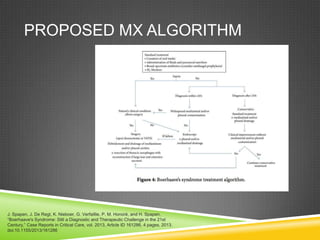
PROPOSED MX ALGORITHM
J. Spapen, J. De Regt, K. Nieboer, G. Verfaillie, P. M. Honoré, and H. Spapen,
“Boerhaave's Syndrome: Still a Diagnostic and Therapeutic Challenge in the 21st
Century,” Case Reports in Critical Care, vol. 2013, Article ID 161286, 4 pages, 2013.
doi:10.1155/2013/161286
ANOTHER PROPOSED MX ALGORITHM
http://lifeinthefastlane.com/pulmonary-puzzle-003/
CONSERVATIVE MANAGEMENT?
 Three situations where non-operative Mx may be
considered:
 Presentation >48h
 Debilitated pre-morbid condition/significant comorbidity
 Contained rupture with minimal symptoms and negligible
clinical evidence of sepsis (SIRS negative)
 Others include
 Tear not involving abdomen/contained to
mediastinum/draining to oesophagus/draining to lumen;
no neoplasm involved; no associated obstruction;
experienced thoracic surgeon available; serial contrast
imaging available
[3 points]
QUESTIONS?
REFERENCES
 http://www.instantanatomy.net/thorax/areas/oesophagus/relations.html
 http://www.whonamedit.com/doctor.cfm/2404.html
 Tan SY, Hu M. Hermann Boerhaave (1668-1738): 18th century teacher
extraordinaire. Singapore Med J. 2004 Jan;45(1):3-5. PMID: 14976574
 Esophageal Rupture http://emedicine.medscape.com/article/425410-
overview#a03
 Esophageal Rupture and Tears in Emergency Medicine Treatment &
Management http://emedicine.medscape.com/article/775165-
treatment#a1126
 Boerhaave Syndrome http://lifeinthefastlane.com/pulmonary-puzzle-003/
 J. Spapen, J. De Regt, K. Nieboer, G. Verfaillie, P. M. Honoré, and H.
Spapen, “Boerhaave's Syndrome: Still a Diagnostic and Therapeutic
Challenge in the 21st Century,” Case Reports in Critical Care, vol. 2013,
Article ID 161286, 4 pages, 2013. doi:10.1155/2013/161286
 Boerhaave Syndrome http://radiopaedia.org/articles/boerhaave-syndrome
OESOPHAGEAL RUPTURE –
TAKE HOME MESSAGES
Very high mortality rate
Have a very high index of suspicion
Call Cardiothoracics sooner rather than later
AND THE WINNER IS…?

Oesophageal rupture

  • 1.
    THE OESOPHAGEAL RUPTURE PUBQUIZ Thursday Trivia Session Charlie’s Hotel Your host: Dr Deanne Chiu Emergency Education Reg
  • 2.
    THE RULES  Twoteams  10 questions covering the learning outcome: Discuss oesophageal rupture  Fighting for the inaugural “Weird and Wonderful Cup” aka the “Deanne is moving house and has found some really random stuff to put in a prize hamper”  No biting, name-calling or falling asleep On your marks… get set…
  • 3.
    Q1: THE WEIRDAND WONDERFUL What’s in the Prize Hamper? Is it:  A) Revlon cosmetics & a copy of The Hunger Games trilogy  B) Stationery & chocolate biscuits & a cheese board  C) A single serve pack of Tic Tacs & automotive Wash and Wax  D) A and C  E) All of the above [1 point]
  • 4.
    Q2 : 1STPART GLORY Name the anatomical relations of the oesophagus.  Posterior – possible 5 points  Anterior – possible 5 points  Left – possible 4 points  Right – possible 2 points [16 points]
  • 5.
    Q3: EPONYM SCHEPONYM Spontaneous Oesophageal Rupture, or Boerhaave Syndrome, was first described in 1724 – True or False?  Boerhaave Syndrome was named after Dr Herman Boerhaave, a German physician – T/F?  Boerhaave Syndrome was described in relation to Baron Jan von Wassenaer, a Dutch Grand Admiral who sustained a large transverse tear of his distal oesophagus due to retching – T/F?  Baron Jan von Wassenaer had roast duck and 3 litres of beer and a self administered emetic 3 days prior to his death – T/F?  Herman Boerhaave had a degree in philosophy and later became a professor of botany and medicine – T/F? [6 points]
  • 6.
    Q4: TYPES ANDCAUSES Please complete the following list of types/causes of Oesophageal Rupture:  Boerhaave’s Syndrome of “Spontaneous” Oesophageal Rupture n.b. 3 in 4 cases are preceded by vomiting  T-----  B----  P----------  I---------  E--------  P--- O-  Other  Includes caustic, peptic ulcers, foreign body, aortic pathology, diseases of oesophagus [6 points]
  • 7.
    Q5: HIGHLY MORBID Whichtype of oesophageal rupture has the highest mortality rate? What is the main cause of death? [2 points]
  • 8.
    Q6: CLINICAL PRESENTATION Name the Mackler triad:  1  2  3  Name the Anderson triad (of clinical findings):  1  2  3 [2 points]
  • 9.
    Q7: CXR #1 Namethe four features of oesophageal rupture that are visible on this film. [4 points]
  • 10.
    Q8: CXR #2:Name two features of oesophageal rupture that are visible on these films. [2 points]
  • 11.
    Q9: CORNERSTONES OFMX Outline the three management priorities for oesophageal rupture [3 points]
  • 12.
    Q10: TO CHOPOR NOT TO CHOP? Name three reasons or situations that might cause you to consider conservative (non- operative) management of oesophageal rupture. [3 points]
  • 13.
    OESOPHAGEAL RUPTURE - THEANSWERS Thursday Trivia Session Charlie’s Hotel Your host: Dr Deanne Chiu Emergency Education Reg
  • 14.
    A1: THE WEIRDAND WONDERFUL What’s in the Prize Hamper? Is it:  A) Revlon cosmetics & a copy of The Hunger Games trilogy  B) Stationery & chocolate biscuits & a cheese board  C) A single serve pack of Tic Tacs & automotive Wash and Wax  D) A and C  E) All of the above (1 point)
  • 15.
    A2 : ANATOMICALRELATIONS OF THE OESOPHAGUS  Name the anatomical relations of the oesophagus.  Posterior – possible 5 points  Anterior – possible 5 points  Left – possible 4 points  Right – possible 2 points [16 points]The lack of a serosal layer makes it vulnerable to rupture or perforation
  • 16.
    A3: EPONYM SCHNEPONYM Spontaneous Oesophageal Rupture, or Boerhaave Syndrome, was first described in 1724 – TRUE  Boerhaave Syndrome was named after Dr Herman Boerhaave, a German physician – FALSE, he was Dutch  Boerhaave Syndrome was described in relation to Baron Jan von Wassenaer, a Dutch Grand Admiral who sustained a large transverse tear of his distal oesophagus due to retching – TRUE  Baron Jan von Wassenaer had roast duck and 5 cups of beer and a self administered emetic 3 days prior to his death – TRUE  Herman Boerhaave had a degree in philosophy and later became a professor of botany and medicine – TRUE [6 points]
  • 17.
    HERMAN BOERHAAVE Atrocis, necdescripti prius, morbi historia (1724) is the book in which he describes the case of Baron Jan Gerrit von Wassenaer, the Grand Admiral of the Dutch Fleet and Prefect of Rhineland.  51yo, ate roast duck, took a mild emetic and had four cups of beer.  Unable to vomit but had violent, minimally productive retching  Excruciating chest and abdominal pain “like something had broken or ruptured”. Clear voice and no cough despite severe chest pain.  Autopsy revealed a large transverse tear in the distal oesophagus; significant subcutaneous emphysema and air in the abdominal cavity with the smell of roast duck meat. Bilateral pleural effusions – approx. 3 litres drained. Legend has it that letters Boerhaave received bore no address and were simply mailed “To the Greatest Physician in the World”. – Tan SY, Hu M.
  • 18.
    BOERHAAVE’S SYNDROME  Dueto a sudden increase in intraluminal pressures, often due to violent vomiting or retching, may be related to heavy food and alcohol intake  Usually longitudinal (cases reported range from 0.6-8.9cm long)  >90% occur in the lower 1/3 of the oesophagus  >90% are in the left posterolateral region  lack of adjacent supporting structures,  thinner musculature in the lower oesophagus and  anterior angulation of the oesophagus at the left diaphragmatic crus  50% of patients have GORD  Ease of pressure transfer from abdominal to thoracic may facilitate rupture
  • 19.
    A4: TYPES ANDCAUSES Please complete the following list of types/causes of Oesophageal Rupture:  Boerhaave’s Syndrome of “Spontaneous” Oesophageal Rupture n.b. 3 in 4 cases are preceded by vomiting  Trauma  Blunt (rare – may be related to intraabdominal crush/pressure increase)  Penetrating (almost all traumas)  Iatrogenic  Endoscopy (most common cause overall)  Post Op  Other  Includes caustic, peptic ulcers, foreign body, aortic pathology, diseases of oesophagus [6 points]
  • 20.
    A5: HIGHLY MORBID Whichtype of oesophageal rupture has the highest mortality rate? – Post-emetic – ~ 30% overall  Mortality rates reported ~2% per hour after Sx  If Rx w/in 24 hours – 25% mortality rate  If Rx after 24 hours – 65%  If Rx after 48 hours – 75-89%  No Rx – essentially 100% What is the main cause of death? – Polymicrobial Sepsis/Mediastinitis (+/- pleural effusion/s) [2 points]
  • 21.
    Q6: CLINICAL PRESENTATION- HX  Mackler triad: (Only present in 50% of cases of Boerhaave’s)  Vomiting  Lower chest pain  Cervical subcutaneous emphysema  Typical symptoms can include:  Pain – variable location – lower anterior chest or upper abdomen most common; may have back or neck pain. May be unable to lie flat due to pain.  Vomiting  Subcutaneous emphysema  Dysphagia or odynophagia; dysphonia  Dyspnoea  GI bleed [1 point for naming all three ]
  • 22.
    Q6: CLINICAL PRESENTATION- SIGNS  Name the Anderson triad (of clinical findings):  Subcutaneous emphysema  Rapid respirations  Abdominal rigidity  Physical signs may include:  Fever  Crepitus/subcutaneous emphysema  Tachycardia, shock  Tachypnoea, cyanosis, altered WOB  Upper abdominal rigidity/signs of perforation/acute abdomen  Local tenderness  Pleural effusions, pneumothorax [1 point for naming all three ]
  • 23.
    CLINICAL PRESENTATION  Maynot always be the classical middle-aged gouty man with a history of dietary or alcohol overconsumption  1 in 4 cases may not have vomiting  Other reported preceding hx for Boerhaave’s: Straining, Childbirth, Heavy lifting, Seizures, Fits of coughing/laughing/hiccups, Forceful swallowing  Higher risk of perforation with recent instrumentation, older age (>65) or pre-existing upper GI pathology  Mackler’s triad is only present in ~50% of cases Have a high index of suspicion and move to imaging as necessary
  • 24.
    A7: CXR Name thefour features of oesophageal rupture that are visible on this film. [4 points] 1. Subcut emphysema 2. Pneumo- mediastinum 4. Prominent renal outline due to air 3. Air under the diaphragm
  • 25.
    Q8: CXR #2:Name two features of oesophageal rupture that are visible on these films. [2 points] 1. Pneumo- mediastinum 2. Subcut emphysema
  • 26.
    OTHER IMAGING  Watersoluble (gastrograffin) contrast fluoroscopy/oesophagogram  Sensitivity 60-75%  Barium swallow  Sensitivity 90% for small perforations  BUT barium causes a severe inflammatory response in tissues ie mediastinitis  CT chest +/- upper abdomen  Contrast-enhanced  Useful if oesophagogram negative but high index of suspicion; evaluation of other diagnoses  Findings may include: pneumomediastinum, extravasation of contrast, peroesophageal fluid collection, pleural effusion, sighting of passage (air communication)
  • 27.
    A9: MANAGEMENT  Aggressiveresuscitation  Airway control, oxygenation, IV etc  Early surgical intervention (call Cardiothoracics!)  The time between onset of Sx and surgical intervention is the greatest predictor of patient survival  Various thoracic procedures will depend on extent of injury: Primary repair, stent, resection, drain placement  May need laparotomy for abdominal involvement  Broad spectrum antibiotics  To cover gram pos (incl enterococcus), gram neg and anaerobes.  ?Antifungal cover (controversial) [3 points]
  • 28.
    PROPOSED MX ALGORITHM J.Spapen, J. De Regt, K. Nieboer, G. Verfaillie, P. M. Honoré, and H. Spapen, “Boerhaave's Syndrome: Still a Diagnostic and Therapeutic Challenge in the 21st Century,” Case Reports in Critical Care, vol. 2013, Article ID 161286, 4 pages, 2013. doi:10.1155/2013/161286
  • 29.
    ANOTHER PROPOSED MXALGORITHM http://lifeinthefastlane.com/pulmonary-puzzle-003/
  • 30.
    CONSERVATIVE MANAGEMENT?  Threesituations where non-operative Mx may be considered:  Presentation >48h  Debilitated pre-morbid condition/significant comorbidity  Contained rupture with minimal symptoms and negligible clinical evidence of sepsis (SIRS negative)  Others include  Tear not involving abdomen/contained to mediastinum/draining to oesophagus/draining to lumen; no neoplasm involved; no associated obstruction; experienced thoracic surgeon available; serial contrast imaging available [3 points]
  • 31.
  • 32.
    REFERENCES  http://www.instantanatomy.net/thorax/areas/oesophagus/relations.html  http://www.whonamedit.com/doctor.cfm/2404.html Tan SY, Hu M. Hermann Boerhaave (1668-1738): 18th century teacher extraordinaire. Singapore Med J. 2004 Jan;45(1):3-5. PMID: 14976574  Esophageal Rupture http://emedicine.medscape.com/article/425410- overview#a03  Esophageal Rupture and Tears in Emergency Medicine Treatment & Management http://emedicine.medscape.com/article/775165- treatment#a1126  Boerhaave Syndrome http://lifeinthefastlane.com/pulmonary-puzzle-003/  J. Spapen, J. De Regt, K. Nieboer, G. Verfaillie, P. M. Honoré, and H. Spapen, “Boerhaave's Syndrome: Still a Diagnostic and Therapeutic Challenge in the 21st Century,” Case Reports in Critical Care, vol. 2013, Article ID 161286, 4 pages, 2013. doi:10.1155/2013/161286  Boerhaave Syndrome http://radiopaedia.org/articles/boerhaave-syndrome
  • 33.
    OESOPHAGEAL RUPTURE – TAKEHOME MESSAGES Very high mortality rate Have a very high index of suspicion Call Cardiothoracics sooner rather than later AND THE WINNER IS…?

Editor's Notes

  • #16 http://www.instantanatomy.net/thorax/areas/oesophagus/relations.html
  • #18 http://www.whonamedit.com/doctor.cfm/2404.htmlTan SY, Hu M. Hermann Boerhaave (1668-1738): 18th century teacher extraordinaire. Singapore Med J. 2004 Jan;45(1):3-5. PMID: 14976574
  • #19 http://emedicine.medscape.com/article/425410-overview#a0104http://emedicine.medscape.com/article/775165-overview#a0104In contrast to traumatic (penetrating), toxic and FB usually cervical oesophagus
  • #22 http://emedicine.medscape.com/article/425410-overview#a0112
  • #28 http://lifeinthefastlane.com/pulmonary-puzzle-003/
  • #29 J. Spapen, J. De Regt, K. Nieboer, G. Verfaillie, P. M. Honoré, and H. Spapen, “Boerhaave's Syndrome: Still a Diagnostic and Therapeutic Challenge in the 21st Century,” Case Reports in Critical Care, vol. 2013, Article ID 161286, 4 pages, 2013. doi:10.1155/2013/161286