NURS 241 Nursing Skills Procedure: Manual                        1

             NURS 241 Nursing Skills Procedure: Manual
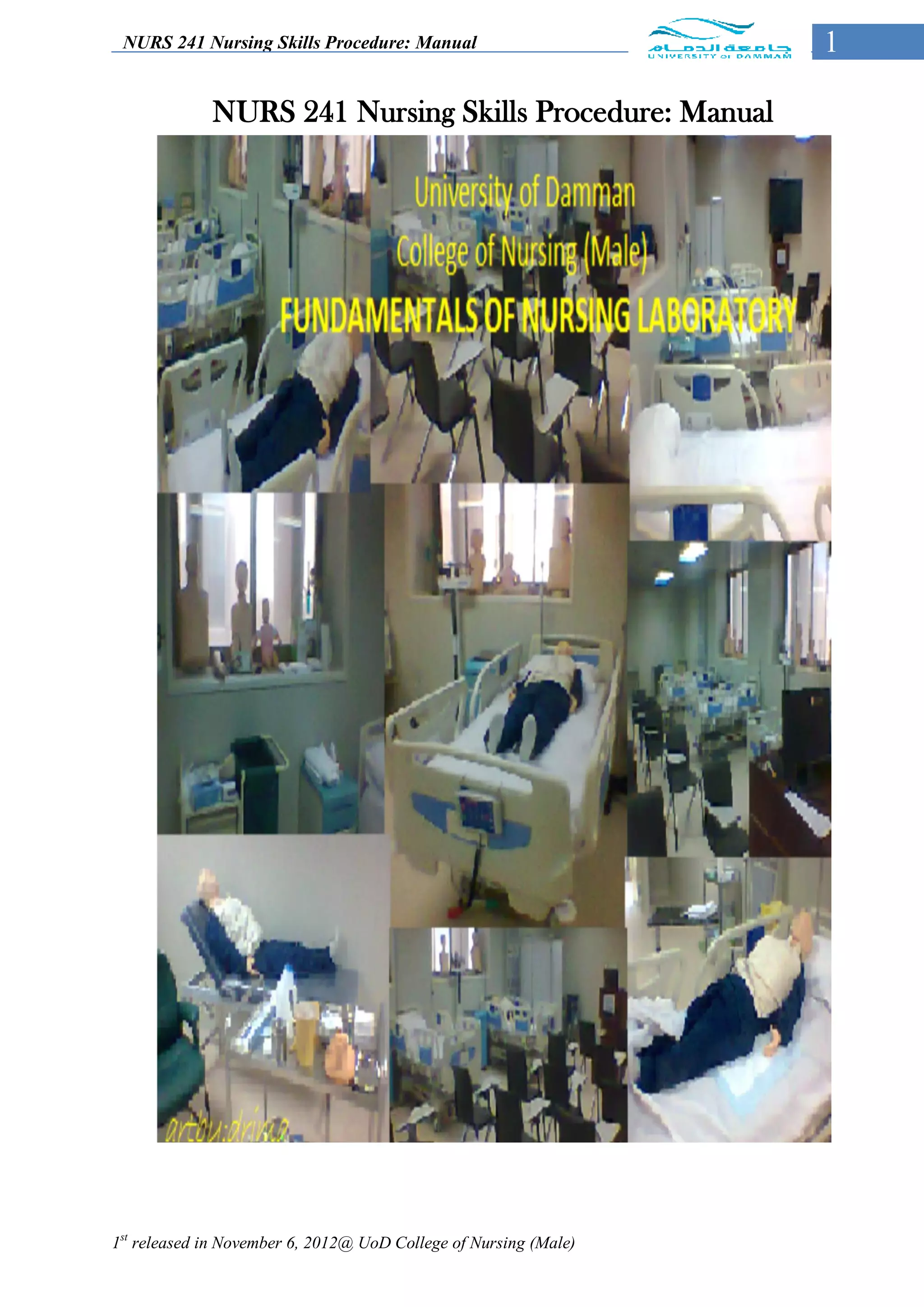
                                      (cover page)


1st released in November 6, 2012@ UoD College of Nursing (Male)
NURS 241 Nursing Skills Procedure: Manual                                 2


    The NURS 241 Nursing Skills Procedure Manual
                                  Is a compilation of

    The University of Dammam, College of Nursing(Male) faculty.


                                 1st edition 2012-2013


       The author and contributor have prepared this work for the
 student nurses. Furthermore, no warranty, express or implied and
   disclaim any obligation, loss as a consequence of the use and
             application of any contents of this activity.


                              THE AUTHORS,

                              Nursing Course Coordinator:
                              Dr. James M. Alo, RN, MAN, MAPsycho., PhD.

                              Clinical Staff:
                              Mr. Robin Easow, RN, MAN
                              Mr. Abdullah Ghanem, RN, MAN
                              Mr. Fhaied Mobarak, RN, MAPPC
                              Mr. Shadi Alshadafan, RN, MAN
                              Mr. Darwin Agman, RN
                              Mr. Fathi Alhurani, RN


1st released in November 6, 2012@ UoD College of Nursing (Male)
NURS 241 Nursing Skills Procedure: Manual                                         3


Preface
       This manual will help the student learn knowledge and

demonstrate nursing skills related to the fundamental management

of patient care especially to patient with medical and surgical

impediments.


       Special attention of the student to this manual will aid them in

developing, enhancing their learned skills from their dedicated

clinical staff.


       The authors and contributors recognize the student as an

active participant who assumes a collaborative role in the learning

process. Content is presented to challenge the student to develop

clinical nursing skills.


                                                            NURS 241 TEAM

                                                            Course Coordinator:
                                                            Dr. James M. Alo
                                                            Clinical Staff:
                                                            Mr. Robin Easow
                                                            Mr. Abdullah Ghanem
                                                            Mr. Fhaied Mobarak
                                                            Mr. Shadi Alshadafan
                                                            Mr. Darwin Agman
                                                            Mr. Fathi Alhurani


1st released in November 6, 2012@ UoD College of Nursing (Male)
NURS 241 Nursing Skills Procedure: Manual                                        4

                NURS 241 Nursing Skills Procedure: Manual

                               TABLE OF CONTENTS

Sec.               CONTENTS                                              Page #
                   Cover Page
                   Acknowledgment
                   Preface
                   Handwashing                                              6
                   Measuring Body Temperature/ Vital Signs                  9
                        -Oral Temperature Measurement                      13
                        -Oral Temperature Measurement w/ E-Thermomemter    15
                        -Rectal Temperature Measurement w/ glass           15
                   thermometer
                        -Rectal Temperature Measurement w/ e-thermometer   17
                        -Axillary Temperature Measurement w/ glass         18
                   thermometer
                        -Axillary Temperature Measurement w/ e-            19
                   thermometer
                        -Tympanic Membrane Measurement w/ e-               20
                   thermometer
                   Advantages & Disadvantages of Selecting Temperature     21
                   Measurement
                   Assessing Radial and apical Pulse                       22
                        -Radial Pulse                                      25
                        -Apical Pulse                                      26
                        -Apical-Radial Pulse                               28
                   Assessing Respiration                                   32
                        -Abnormal breathing patterns                       34
                   Assessing BP                                            37
                   Applying and Removing sterile gloves                    44
                   Changing an occupied bed                                47
                   Changing an unoccupied bed                              50
                   Body mechanics                                          55
                   Lifting an object from the floor                        58
                   Positioning clients                                     59
                   Transferring patient from bed to chair                  66
                   Bathing adult client                                    69
                   Collecting sputum specimen                              76
                   Collecting and testing of urine                         78
                   Collecting a specimen from indwelling catheter          84
                   Collecting and testing of stool                         87
                   Obtaining a capillary blood specimen                    89
                   Collecting samples from nose and throat                 93
                   Collecting samples from nasal mucosa                    96
                   Bandage and binders                                     97
                   Bandaging                                               99
                       -Types of bandage turns                            102
                       -Types and purpose of binders                      104

1st released in November 6, 2012@ UoD College of Nursing (Male)
NURS 241 Nursing Skills Procedure: Manual                              5
                   Shoulder immobilization                        115
 APPENDIX A        /Performance Checklist                         118
                   Handwashing                                    118
                   Applying and removing of gloves                120
                   Axillary temperature (electronic)              122
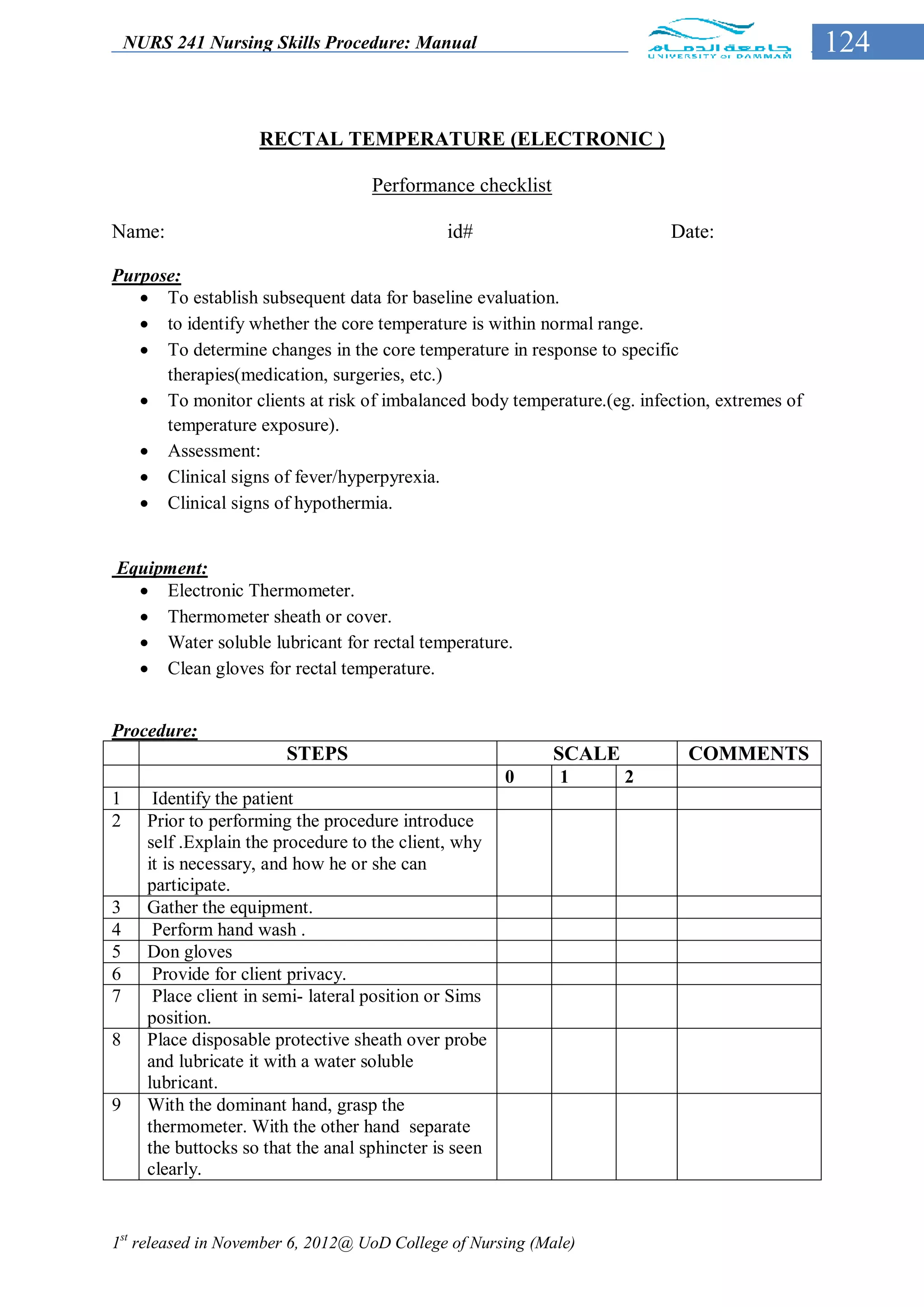
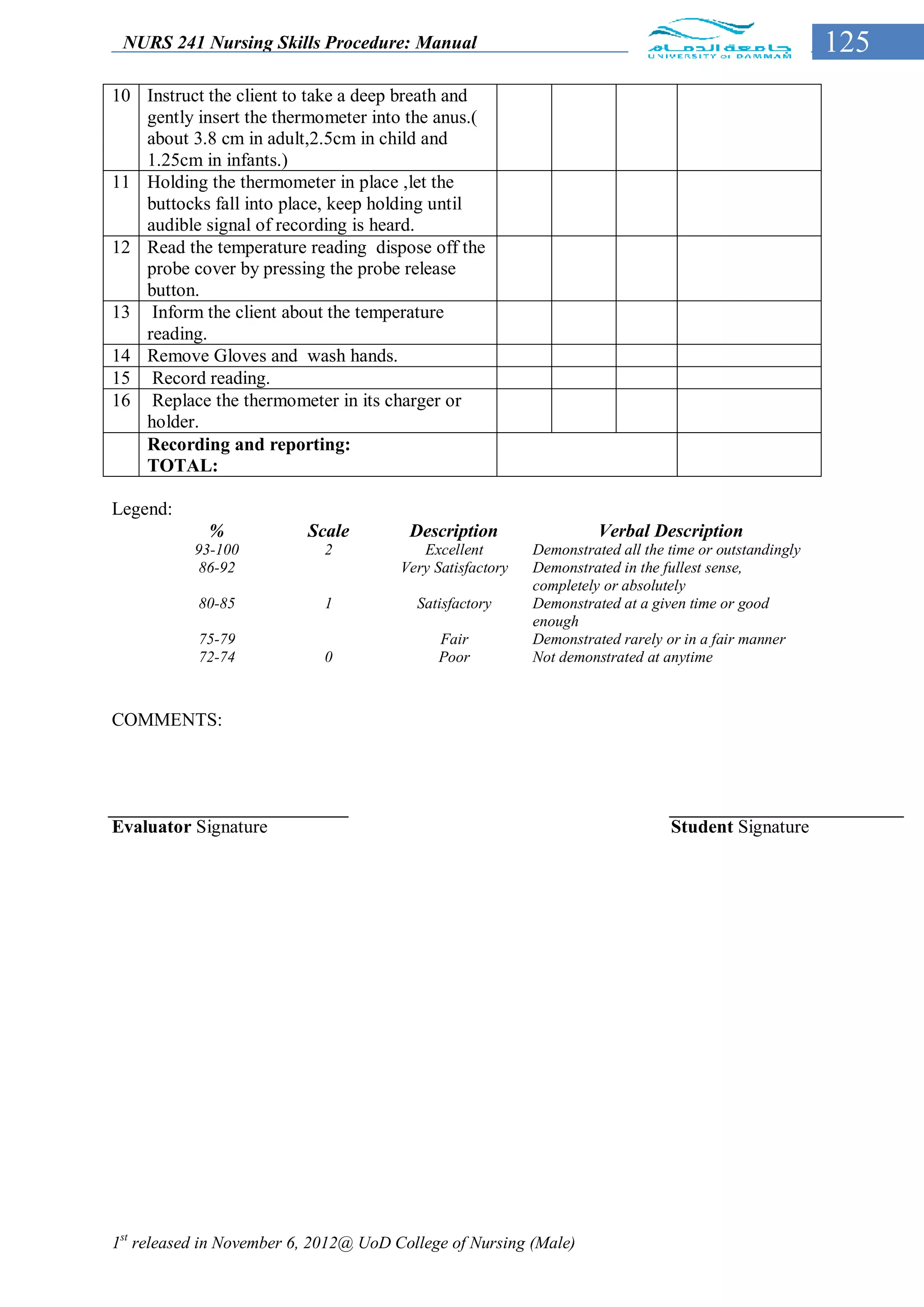
                   Rectal temperature (electronic)                124
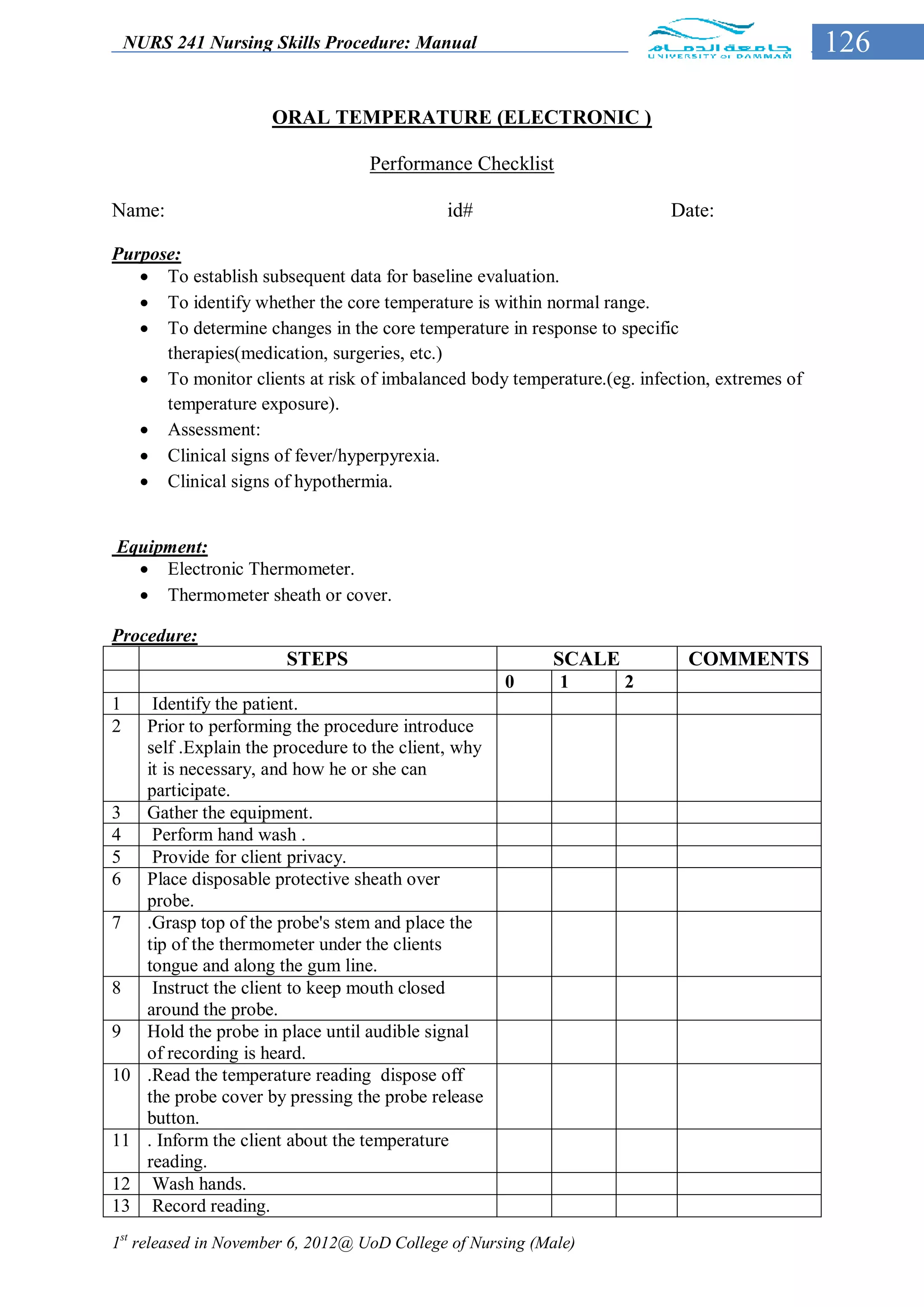
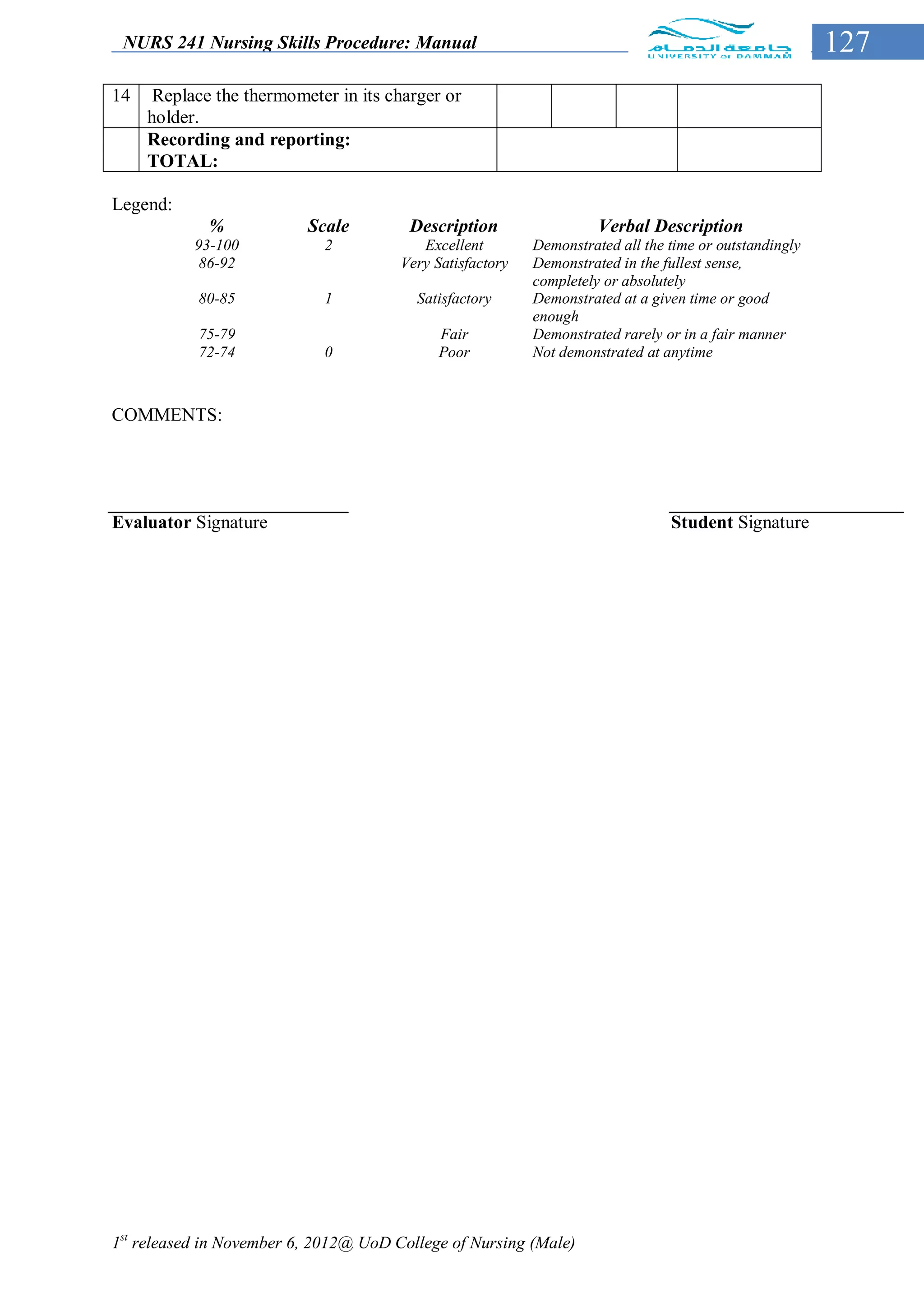
                   Oral temperature (electronic)                  126
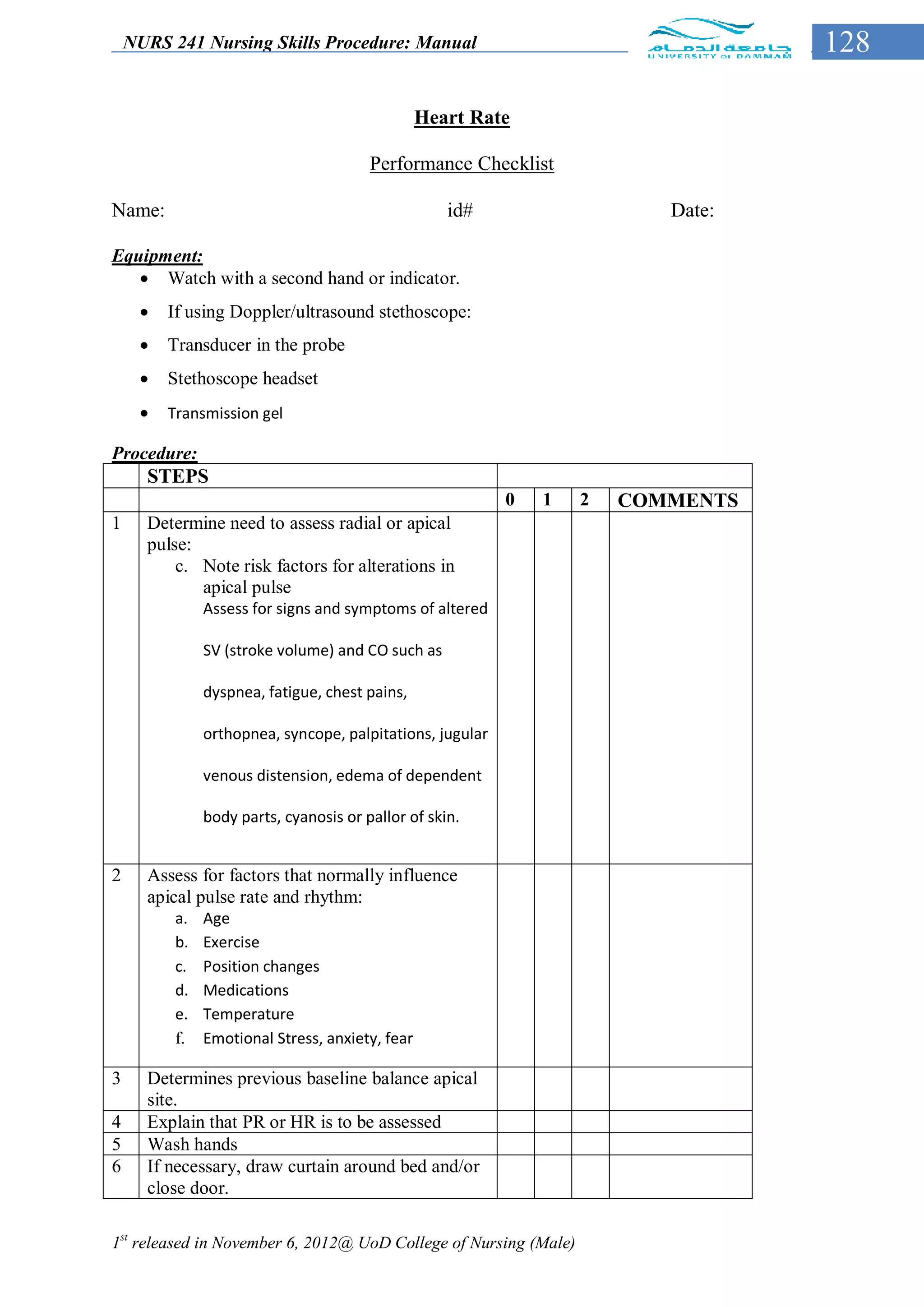
                   Heart rate                                     128
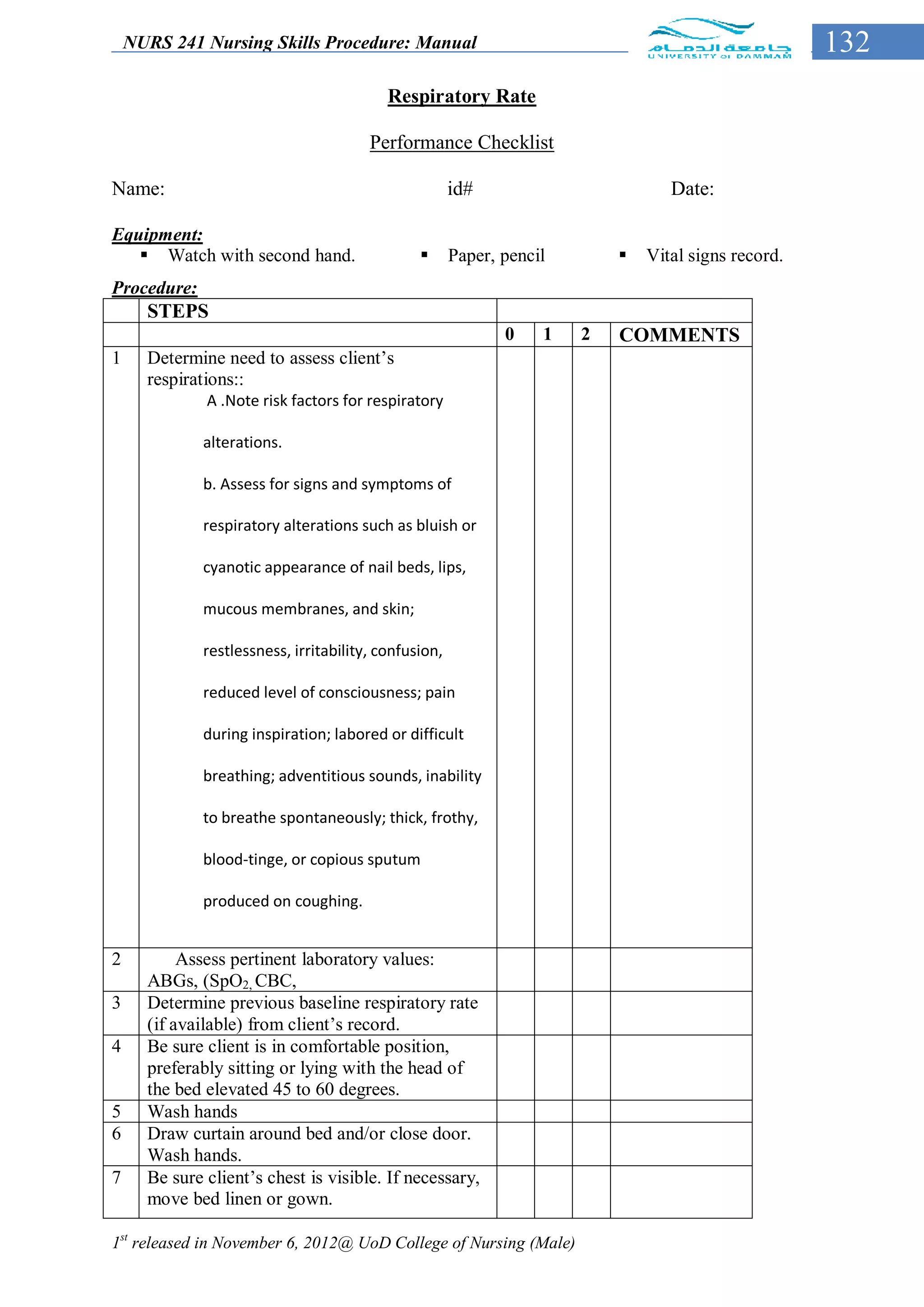
                   Respiratory rate                               132
                   Moving the client up in bed                    134
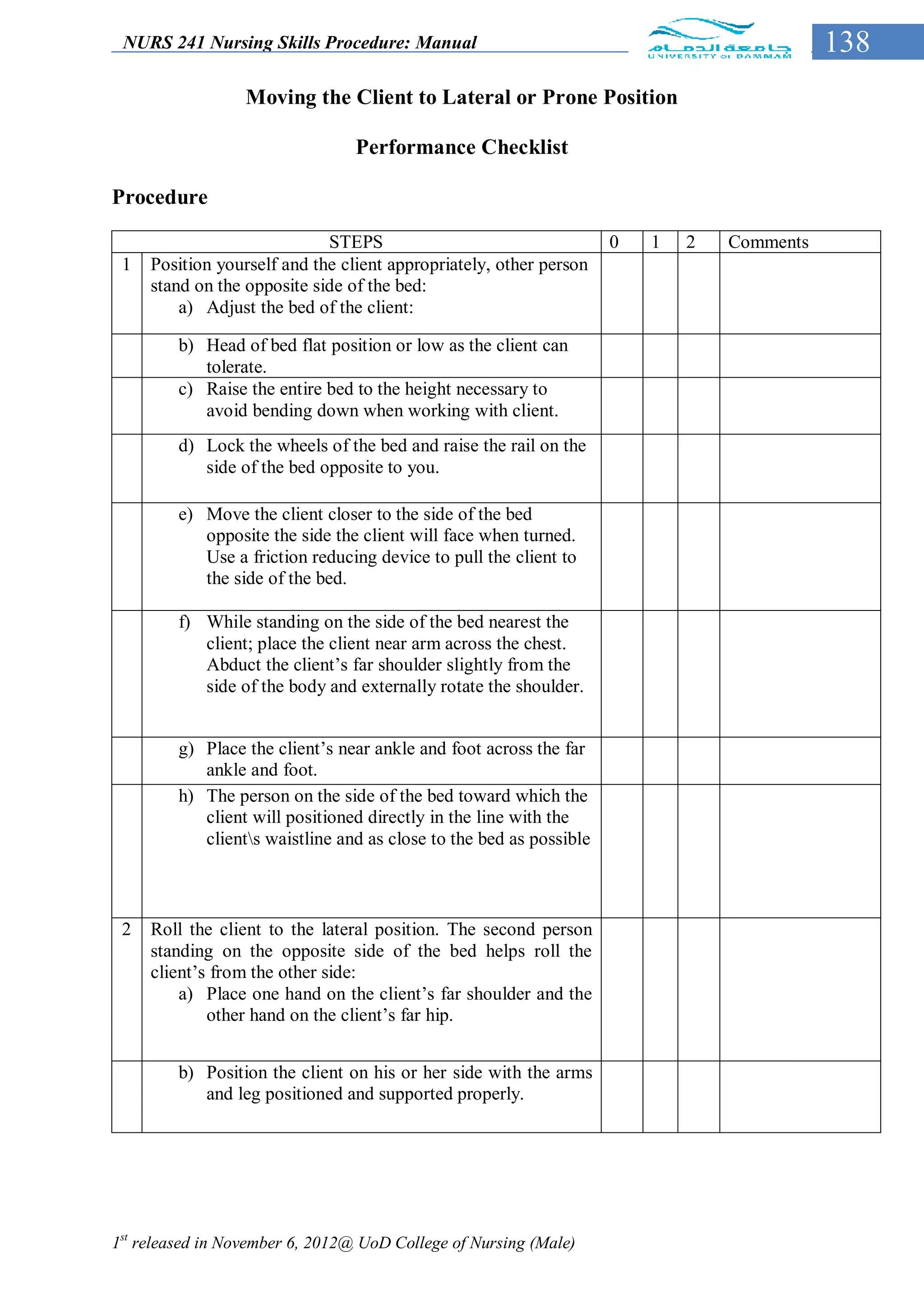
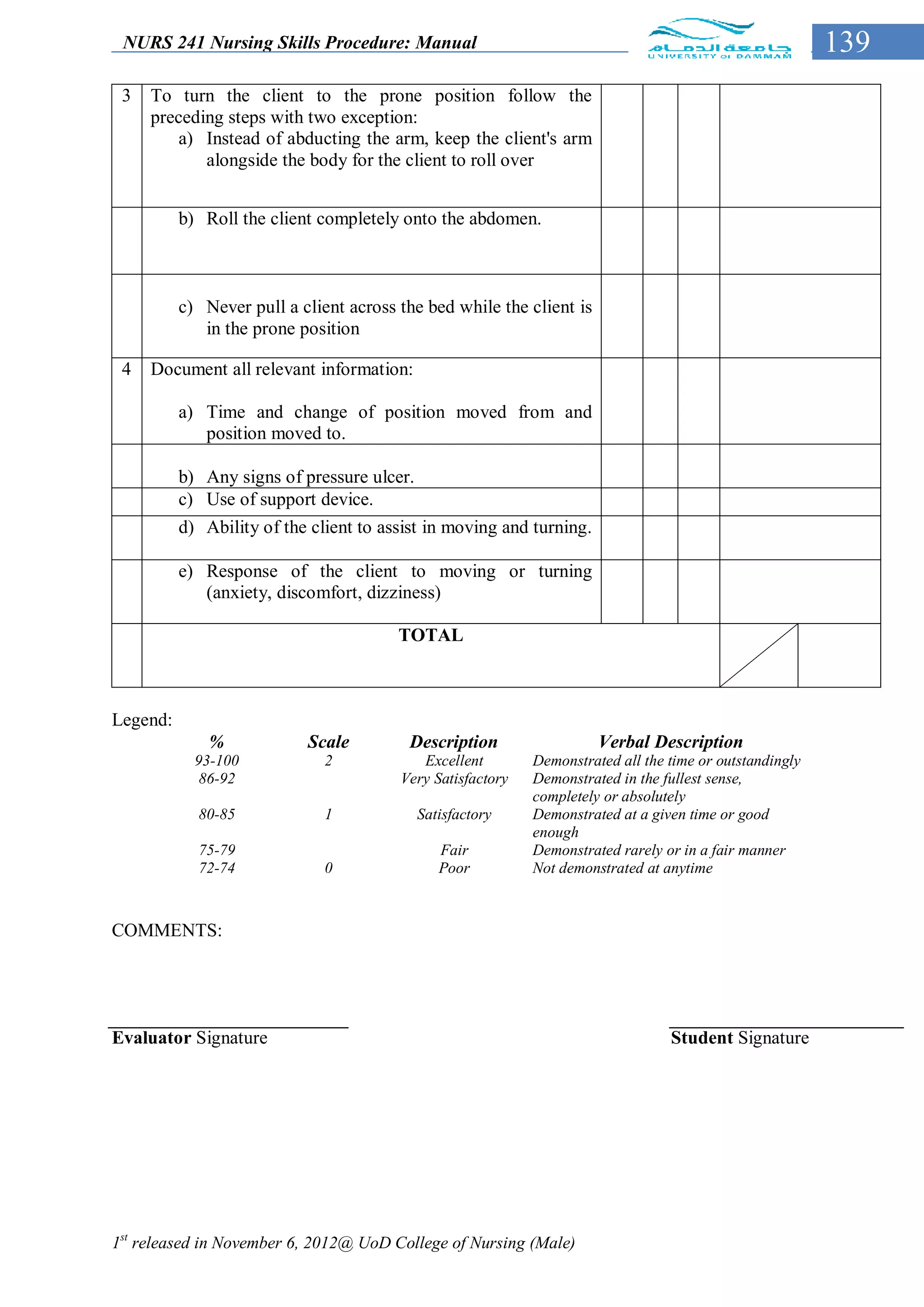
                   Moving the client to lateral position          138
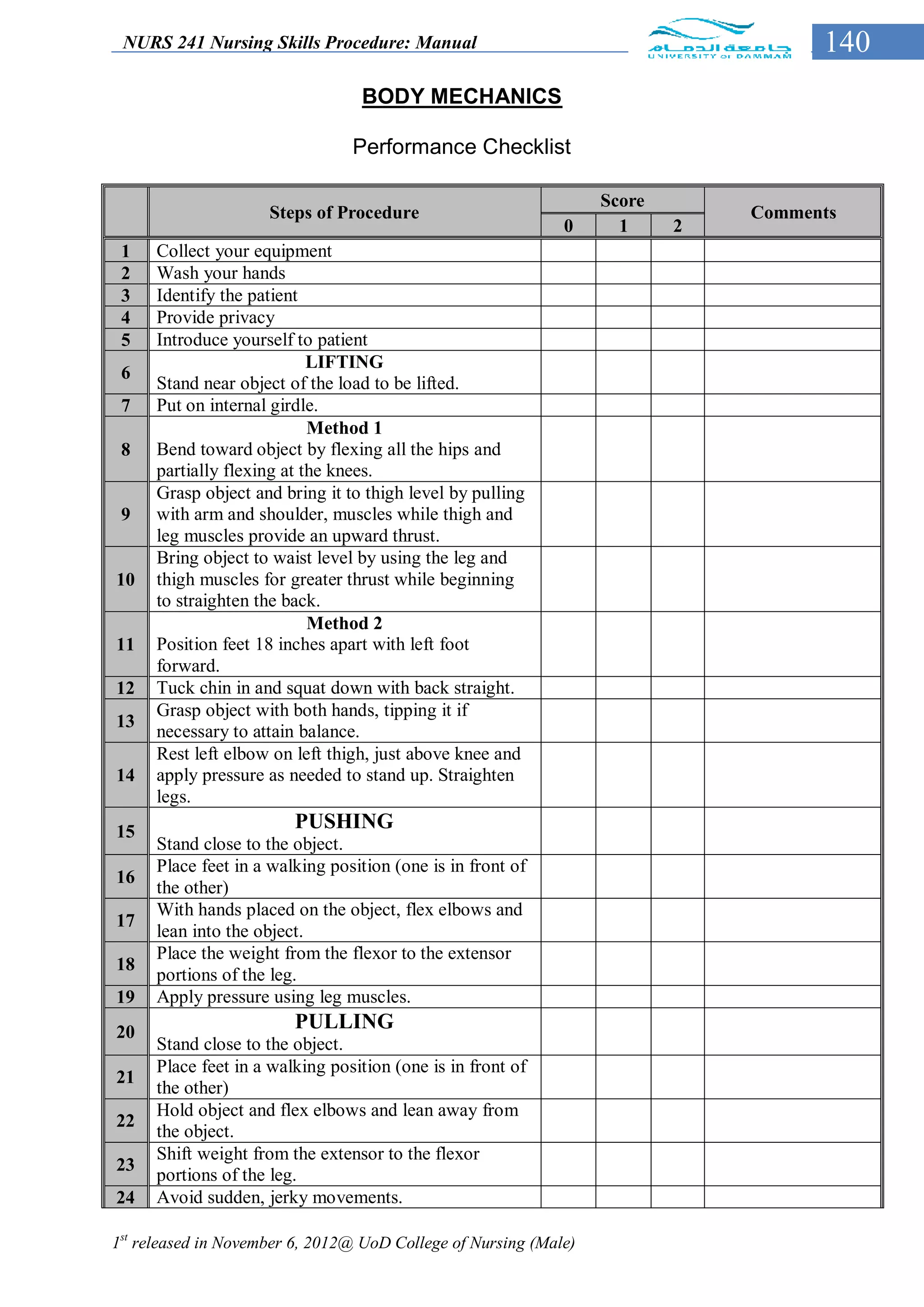
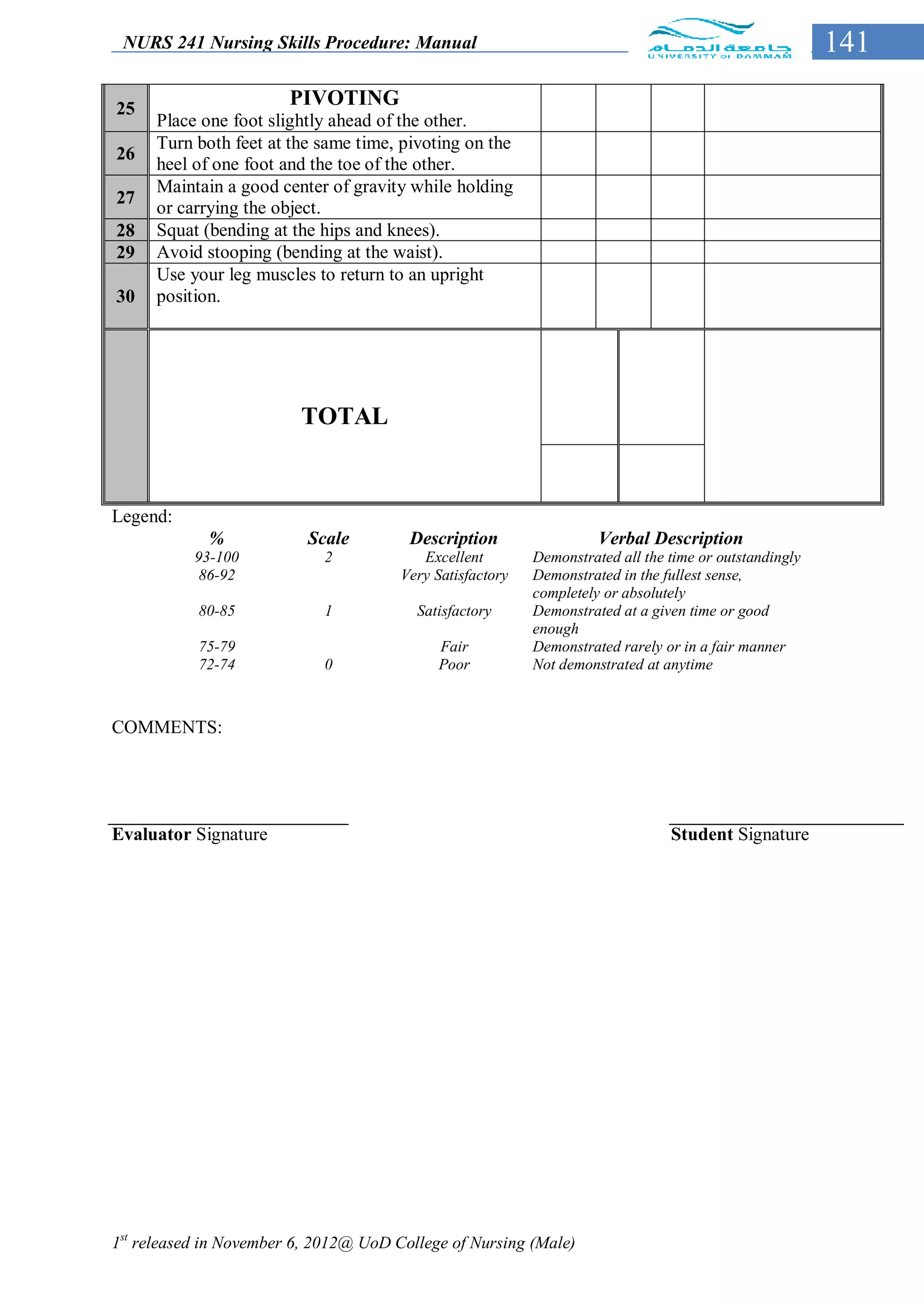
                   Body mechanics                                 140
                   Logrolling a client                            143
                   Dangling a client                              145
                   Applying and removing gloves, gowns and mask   147
                   Assessing Blood Pressure                       148
                   Changing an Unoccupied Bed                     151
                   Changing an occupied Bed                      152

REFERENCES                                                        154


1st released in November 6, 2012@ UoD College of Nursing (Male)
NURS 241 Nursing Skills Procedure: Manual                                             6
                                  HANDWASHING


Introduction:

       Hand washing is important in every setting, including hospitals. It is
considered one of the most effective infection control measures. There are two types
of microorganisms (bacteria) present on the hands: Resident bacteria, which cannot
be removed by hand washing. The second type is transient bacteria, which is easily
removed by hand washing.


It is important that hands be washed at the following time:
      Before and after eating.
      Before and after contact with any patient.
      When handling patient’s food, blood, body fluids, secretions or excretions.
      When there is contact with any object that is likely to be a reservoir of
       organisms such as soiled dressings or bedpan.
      After urinary or bowel elimination.


Purposes: Handwashing is performed to:

   1. Remove the natural body oil and dirt from the skin.
   2. Remove transient microbes, those normally picked up by the hands in the
       usual activities of daily living.
   3. Reduce the number of resident microbes, those normally found in creases of
       the skin.
   4. Prevent the transmission of microorganisms from client to client / from nurse
       to family / from client to nurse.
   5. Prevent the cross-contamination among clients.


Key Points:
Handwashing is a basic aseptic practice involved in all aspects of providing care to
persons who are sick or well. It becomes especially important when the client have
nursing diagnoses such as:
      Potential for infection.
      Altered body temperature.
      Impaired skin integrity.

1st released in November 6, 2012@ UoD College of Nursing (Male)
NURS 241 Nursing Skills Procedure: Manual                                                 7
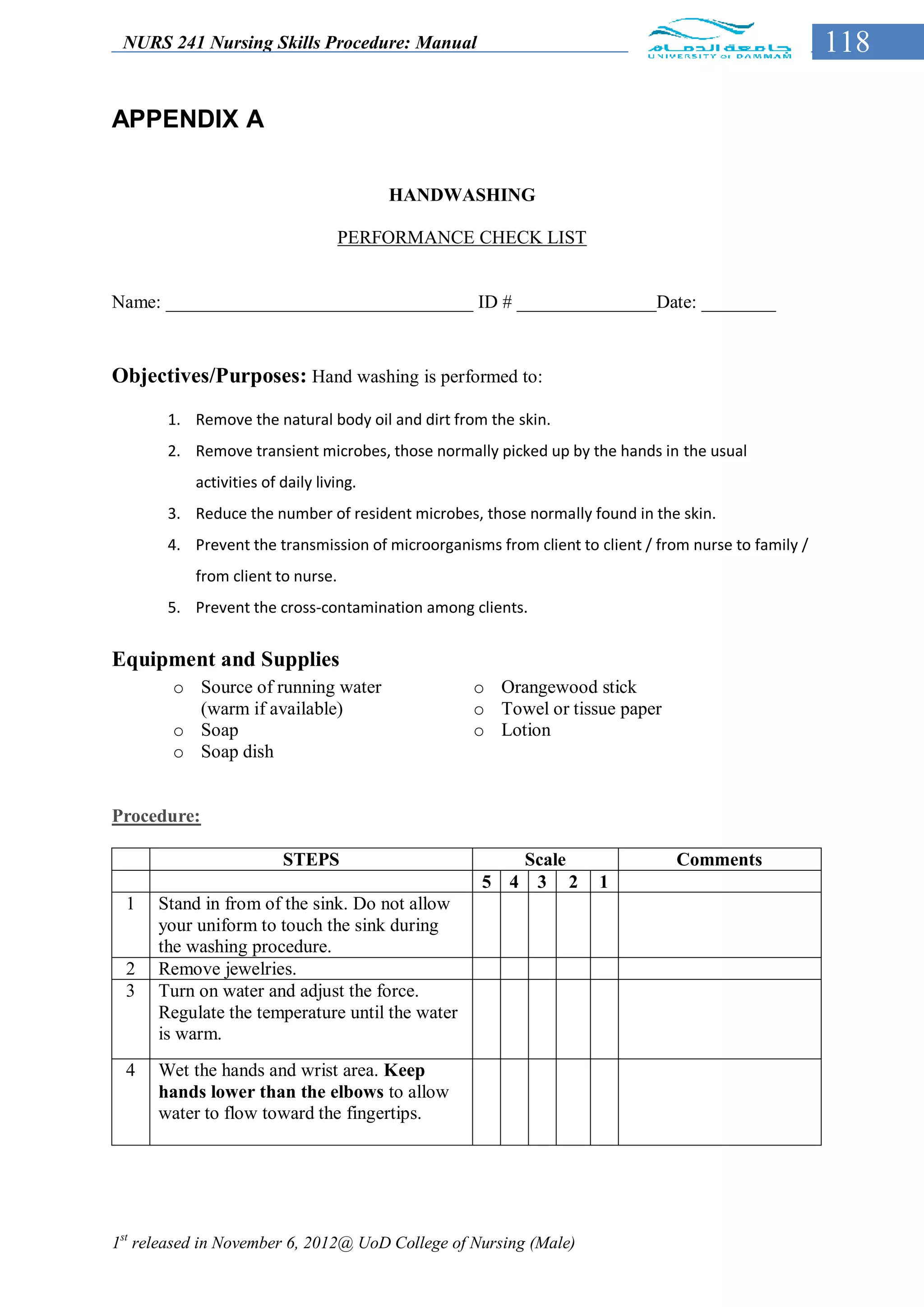
Equipment and Supplies
         o Source of running water               o Orangewood stick
           (warm if available)                   o Towel or tissue paper
         o Soap                                  o Lotion
         o Soap dish

Procedure:
                         STEPS                                    RATIONALE
     1    Stand in from of the sink. Do not           The sink is considered
          allow your uniform to touch the sink        contaminated. Uniforms may carry
          during the washing procedure.               organisms from place to place.
     2    Remove jewelries. Remove watch 3-           Removal of jewelries facilitates
          5 inch above wrist                          proper cleansing. Microorganisms
                                                      may accumulate in settings of
                                                      jewelries.
     3    Turn on water and adjust the force.         Water splashed from the
          Regulate the temperature until the          contaminated sink will contaminate
          water is warm. Do not allow water to        your uniform. Warm water is more
          splash.                                     comfortable and has fewer
                                                      tendencies to open pores and
                                                      remove oils from the skin.
                                                      Organisms can lodge in roughened
                                                      and broken areas of chapped skin.
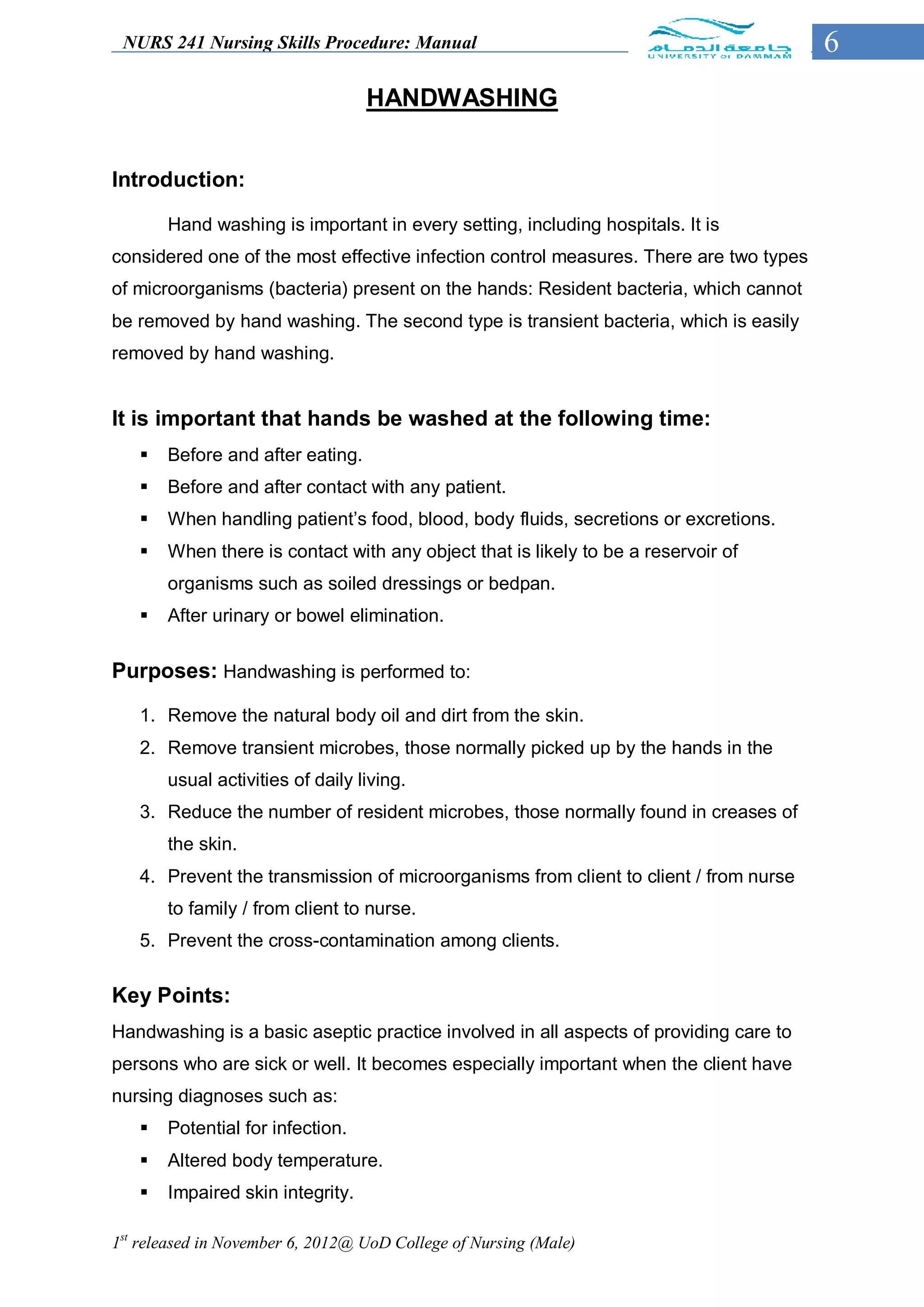
     4    Wet the hands and wrist area. Keep          Water should flow from the cleaner
          hands lower than the elbows to              area toward the more
          allow water to flow toward the              contaminated area. Hands are
          fingertips.                                 more contaminated than the
                                                      forearm.


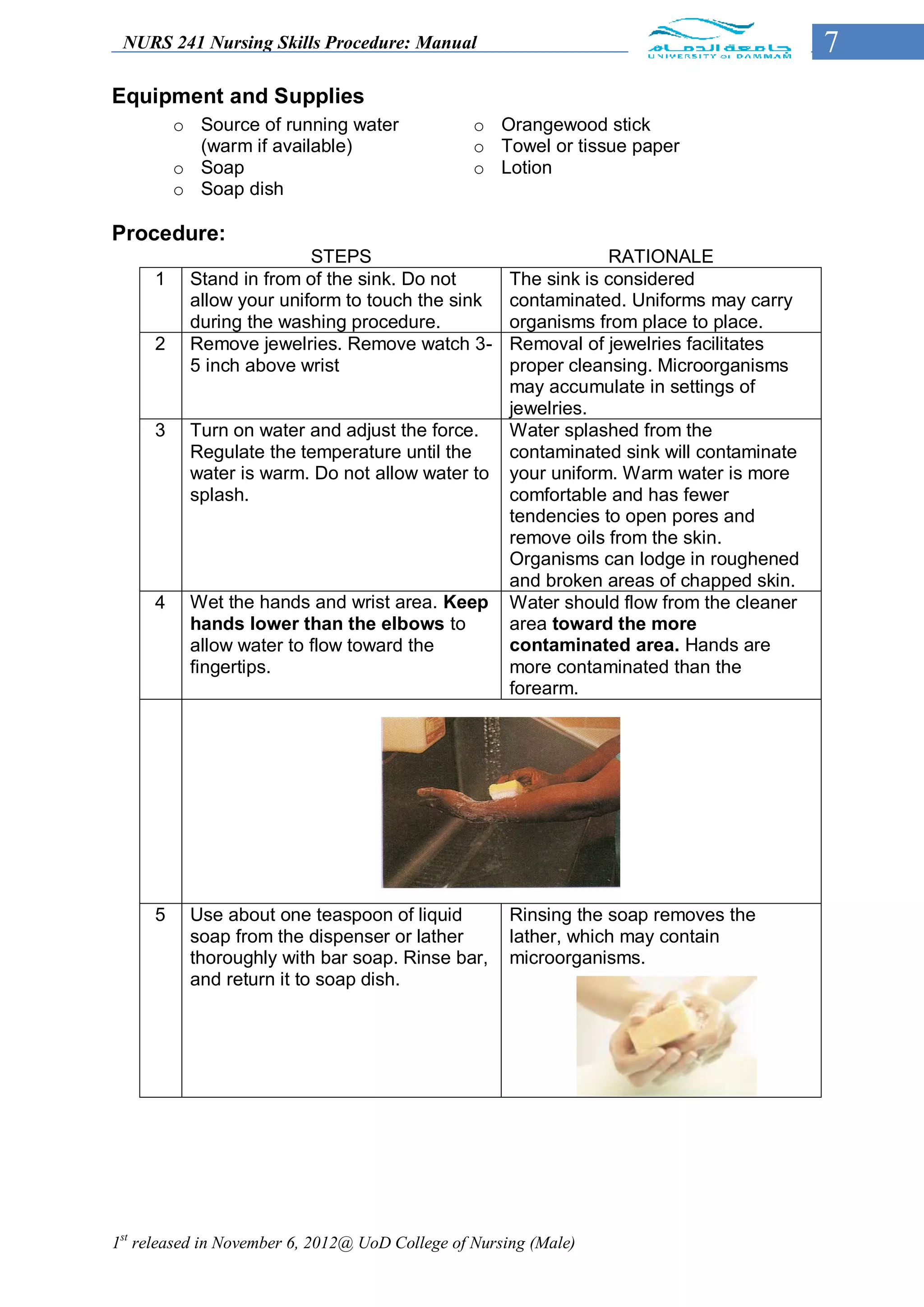
     5    Use about one teaspoon of liquid            Rinsing the soap removes the
          soap from the dispenser or lather           lather, which may contain
          thoroughly with bar soap. Rinse bar,        microorganisms.
          and return it to soap dish.


1st released in November 6, 2012@ UoD College of Nursing (Male)
NURS 241 Nursing Skills Procedure: Manual                                                    8
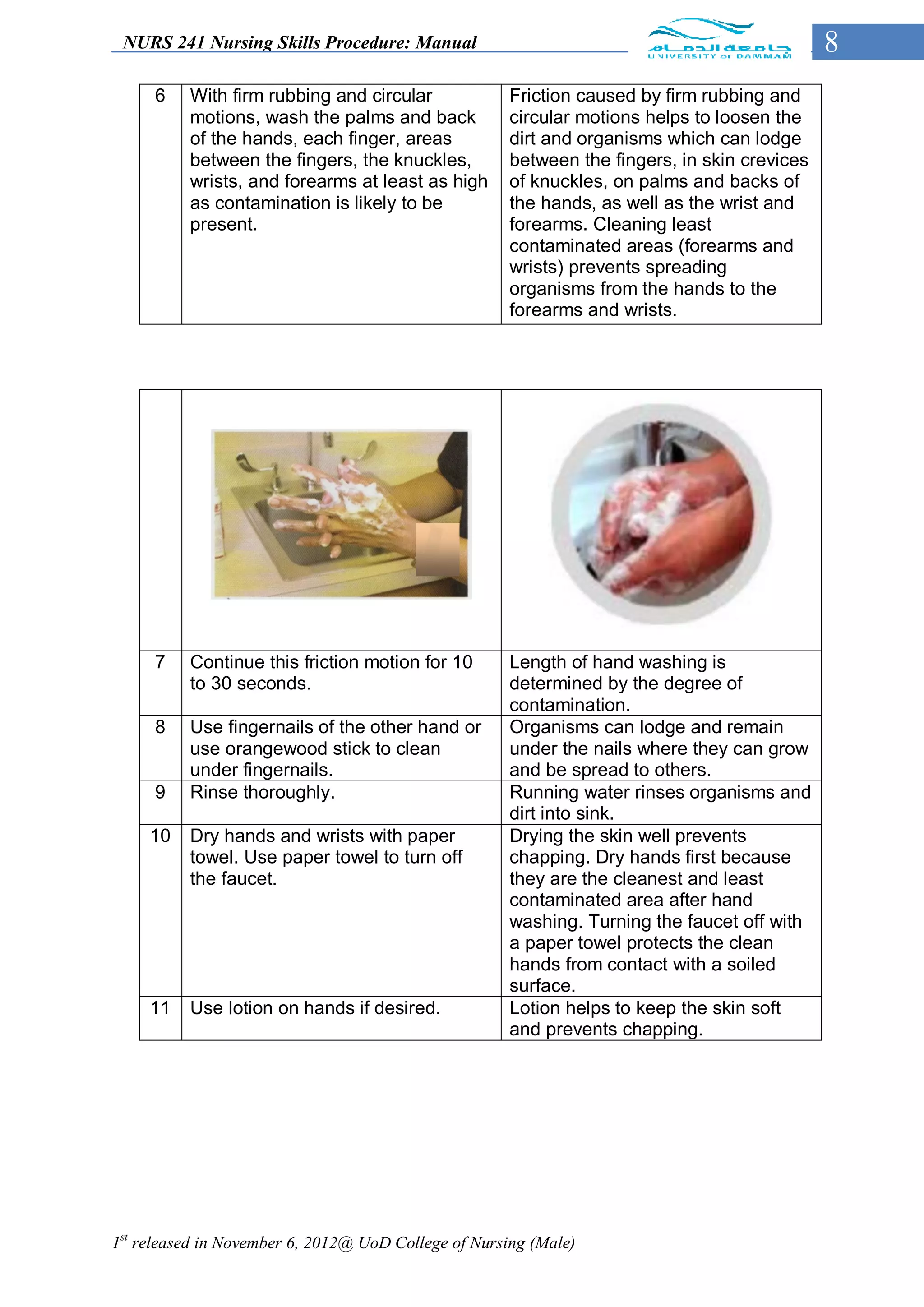
     6    With firm rubbing and circular              Friction caused by firm rubbing and
          motions, wash the palms and back            circular motions helps to loosen the
          of the hands, each finger, areas            dirt and organisms which can lodge
          between the fingers, the knuckles,          between the fingers, in skin crevices
          wrists, and forearms at least as high       of knuckles, on palms and backs of
          as contamination is likely to be            the hands, as well as the wrist and
          present.                                    forearms. Cleaning least
                                                      contaminated areas (forearms and
                                                      wrists) prevents spreading
                                                      organisms from the hands to the
                                                      forearms and wrists.


     7    Continue this friction motion for 10        Length of hand washing is
          to 30 seconds.                              determined by the degree of
                                                      contamination.
     8    Use fingernails of the other hand or        Organisms can lodge and remain
          use orangewood stick to clean               under the nails where they can grow
          under fingernails.                          and be spread to others.
     9    Rinse thoroughly.                           Running water rinses organisms and
                                                      dirt into sink.
     10   Dry hands and wrists with paper             Drying the skin well prevents
          towel. Use paper towel to turn off          chapping. Dry hands first because
          the faucet.                                 they are the cleanest and least
                                                      contaminated area after hand
                                                      washing. Turning the faucet off with
                                                      a paper towel protects the clean
                                                      hands from contact with a soiled
                                                      surface.
     11   Use lotion on hands if desired.             Lotion helps to keep the skin soft
                                                      and prevents chapping.


1st released in November 6, 2012@ UoD College of Nursing (Male)
NURS 241 Nursing Skills Procedure: Manual                                   9
          MEASURING BODY TEMPERATURE or VITAL SIGNS

Objectives:
    1. To measure the body temperature accurately and safely.
    2. Recognize deviations from the normal.


Purposes:
   1. To establish baseline data.
   2. To identify if the body temperature is within normal range.
   3. To determine changes in the body temperature in response to specific
       therapies.
   4. To monitor client’s at risk for alterations in temperature.


                              Types of Thermometers:


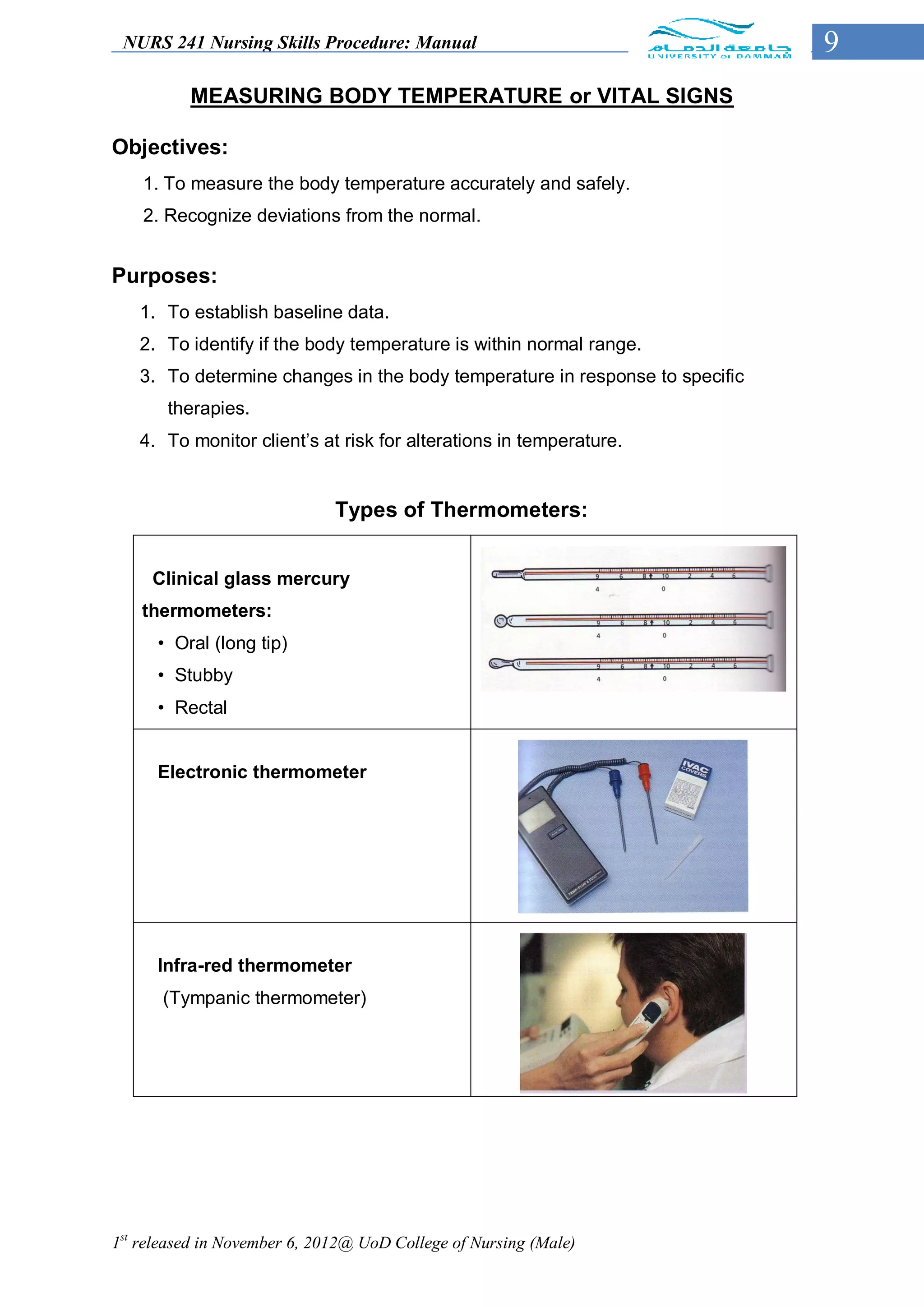
     Clinical glass mercury
    thermometers:
      • Oral (long tip)
      • Stubby
      • Rectal


      Electronic thermometer


      Infra-red thermometer
      (Tympanic thermometer)


1st released in November 6, 2012@ UoD College of Nursing (Male)
NURS 241 Nursing Skills Procedure: Manual                                               10

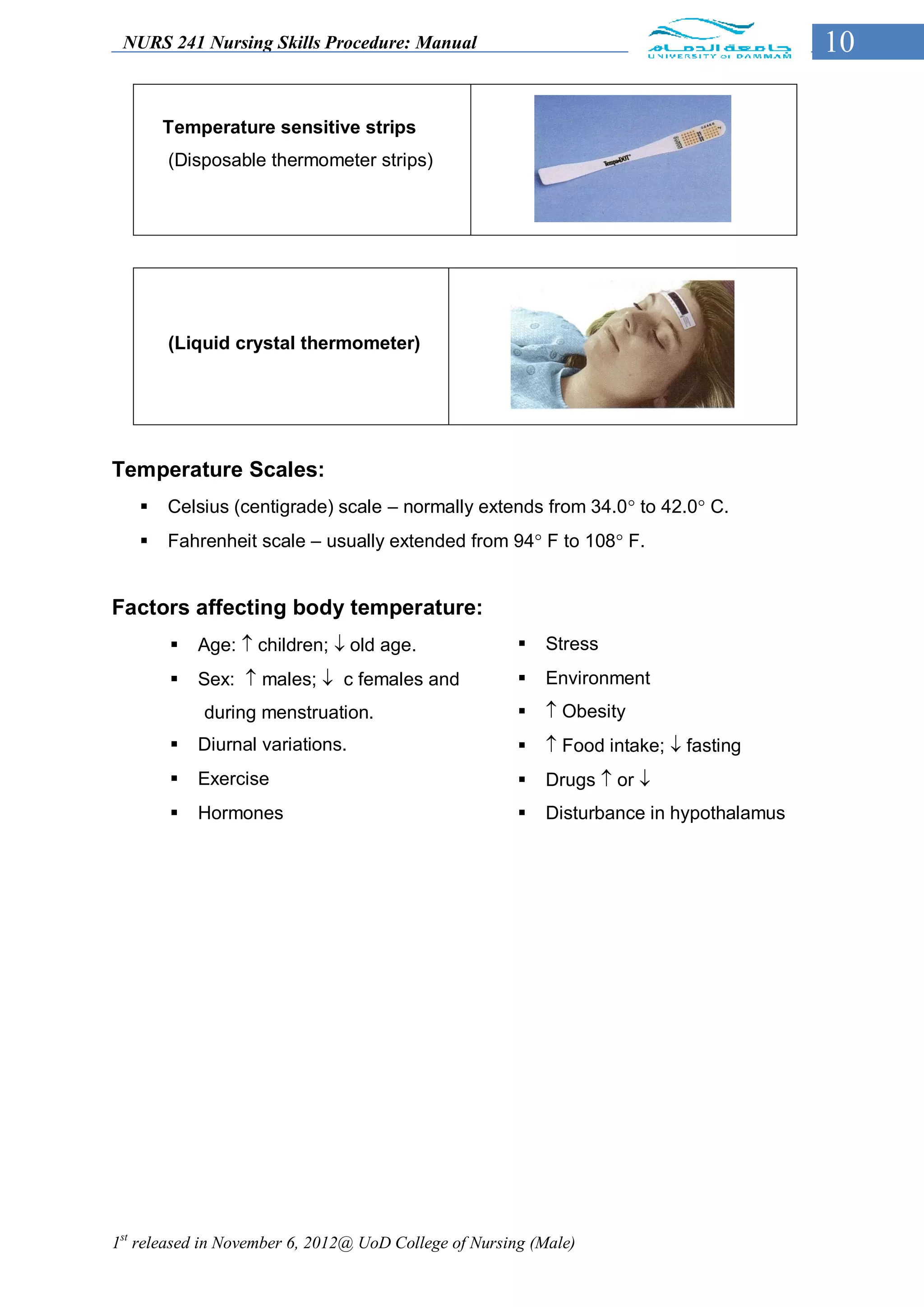
       Temperature sensitive strips
       (Disposable thermometer strips)


       (Liquid crystal thermometer)


Temperature Scales:
      Celsius (centigrade) scale – normally extends from 34.0 to 42.0 C.
      Fahrenheit scale – usually extended from 94 F to 108 F.


Factors affecting body temperature:
          Age:  children;  old age.                    Stress
          Sex:  males;  c females and                  Environment
            during menstruation.                           Obesity
          Diurnal variations.                             Food intake;  fasting
          Exercise                                       Drugs  or 
          Hormones                                       Disturbance in hypothalamus


1st released in November 6, 2012@ UoD College of Nursing (Male)
NURS 241 Nursing Skills Procedure: Manual                                              11


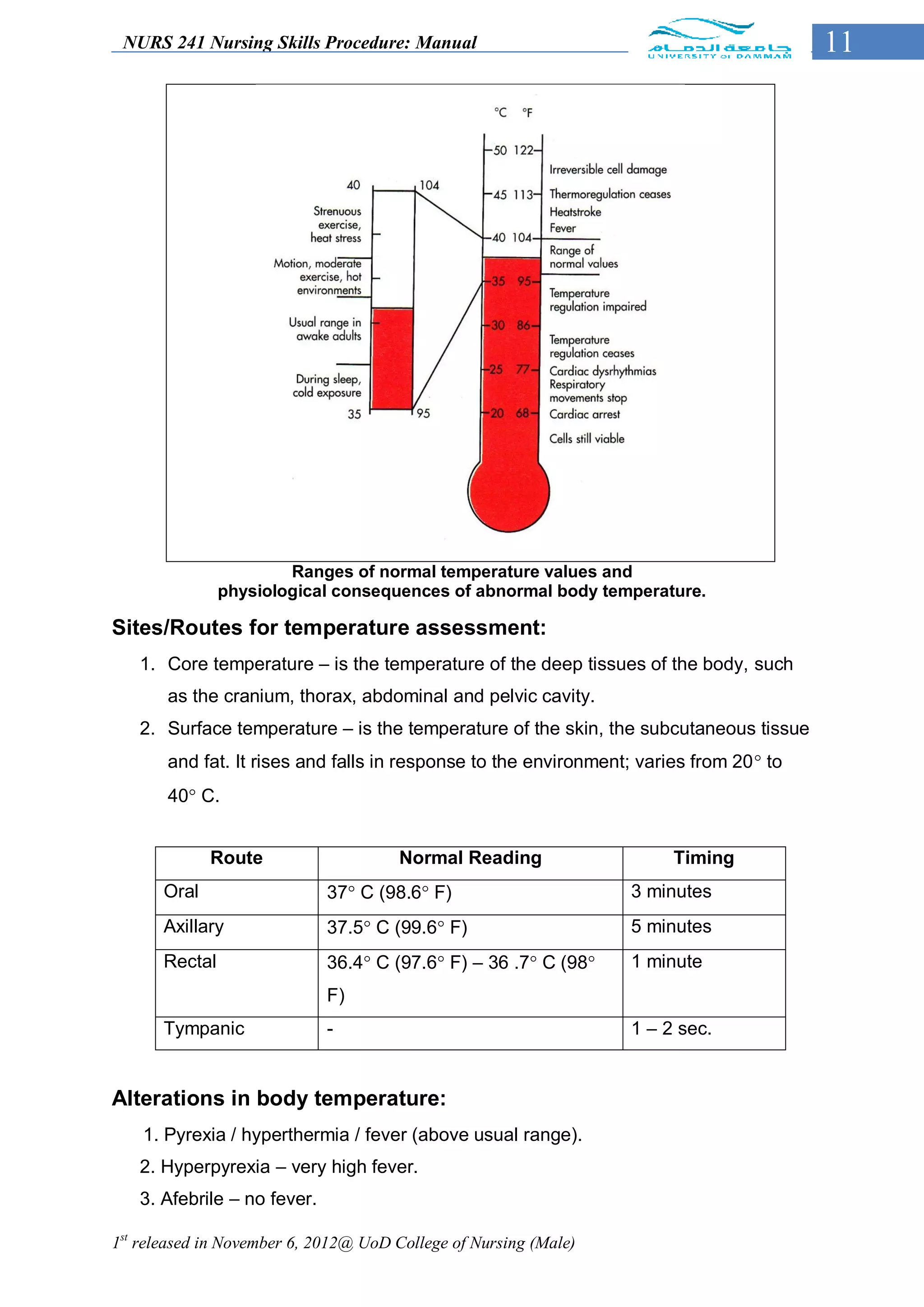
                        Ranges of normal temperature values and
                physiological consequences of abnormal body temperature.

Sites/Routes for temperature assessment:
   1. Core temperature – is the temperature of the deep tissues of the body, such
       as the cranium, thorax, abdominal and pelvic cavity.
   2. Surface temperature – is the temperature of the skin, the subcutaneous tissue
       and fat. It rises and falls in response to the environment; varies from 20 to
       40 C.


              Route                    Normal Reading                  Timing
       Oral                  37 C (98.6 F)                      3 minutes
       Axillary              37.5 C (99.6 F)                    5 minutes
       Rectal                36.4 C (97.6 F) – 36 .7 C (98    1 minute
                             F)
       Tympanic              -                                    1 – 2 sec.


Alterations in body temperature:
    1. Pyrexia / hyperthermia / fever (above usual range).
   2. Hyperpyrexia – very high fever.
   3. Afebrile – no fever.

1st released in November 6, 2012@ UoD College of Nursing (Male)
NURS 241 Nursing Skills Procedure: Manual                                          12


                      CONTRAINDICATIONS / CAUTIONS:

A. Oral:
   1. Children younger than 4 to 5 years.
   2. Confused, combative or comatose individuals.
   3. Irritable clients or with mental diseases.
   4. With history of convulsive disorders.
   5. Mouth breathers.
   6. With oral infections or with injuries or conditions that prevent them from
       closing their mouths fully.
   7. Immediate post-op under anesthesia.
   8. Surgery for nose and mouth.
   9. Patient receiving oxygen therapy.
   10. Wait at least 15 to 30 minutes after person smokes / drinks / eats.

B. Rectal:
   1. With rectal or perineal injuries or surgeries.
   2. With diarrhea, diseases of the rectum.
   3. Patient with heart disease.
   4. Lubricate the thermometer well and insert gently to avoid damage to the
       mucosa or perforation of the rectum.
C. Axillary : NONE.
D. Tympanic: NONE.


Equipment:
      Appropriate thermometer
      Soft tissue papers
      Lubricant (for rectal measurement only)
      Pen, pencil, vital signs flow sheet or record form.
      Disposable gloves, plastic thermometer sleeves or disposable probe covers.


1st released in November 6, 2012@ UoD College of Nursing (Male)
NURS 241 Nursing Skills Procedure: Manual                                                   13
Procedure:
                           STEPS                                  RATIONALE
     1    Assess for signs and symptoms of           Physical signs and symptoms may
          temperature alterations and for            indicate abnormal temperature.
          factors that influence body                Nurse can accurately assess nature
          temperature.                               of variations.
     2    Determine any previous activity that       Smoking and hot or cold substances
          would interfere with accuracy of           can cause false temperature
          temperature measurement. When              readings in oral cavity.
          taking temperature, wait 20 to 30
          minutes before measuring
          temperature if client has smoked or
          ingested hot or cold liquids or foods.
     3    Determine appropriate site and             Chosen on basis of preferred site for
          measurement device to be used.             temperature measurement.
     4    Explain why temperature will be            Clients are often curious about such
          taken and maintaining the proper           measurements and should be
          position until reading is complete.        cautioned against prematurely
                                                     removing thermometer to read
                                                     results.
     5    Wash hands.                                Reduces transmission of
                                                     microorganisms.
     6    Assist client in assuming                  Ensures comfort and accuracy of
          comfortable position that provides         temperature reading.
          easy access to mouth.
     7    Obtain temperature reading.


                   A. Oral temperature measurement with glass thermometer:

     1    Apply disposable gloves.                   Maintains standard precautions
                                                     when exposed to items soiled with
                                                     body fluids. (e.g., saliva)
     2    Hold end of glass thermometer with         Reduces contamination of
          fingertips.                                thermometer bulb.
     3    Read mercury level while gently            Mercury should be below 35 C.
          rotating thermometer at eye level,         Thermometer reading must be
          grasp tip of thermometer securely,         below client’s actual temperature
          stand away from solid objects, and         before use. Brisk shaking lowers
          sharply flick wrist downward.              mercury level of glass tube.
          Continue shaking until reading is
          below 35 C (96 F).
     4    Insert thermometer into plastic            Protects from contact with saliva.
          sleeve or cover.


1st released in November 6, 2012@ UoD College of Nursing (Male)
NURS 241 Nursing Skills Procedure: Manual                                                  14
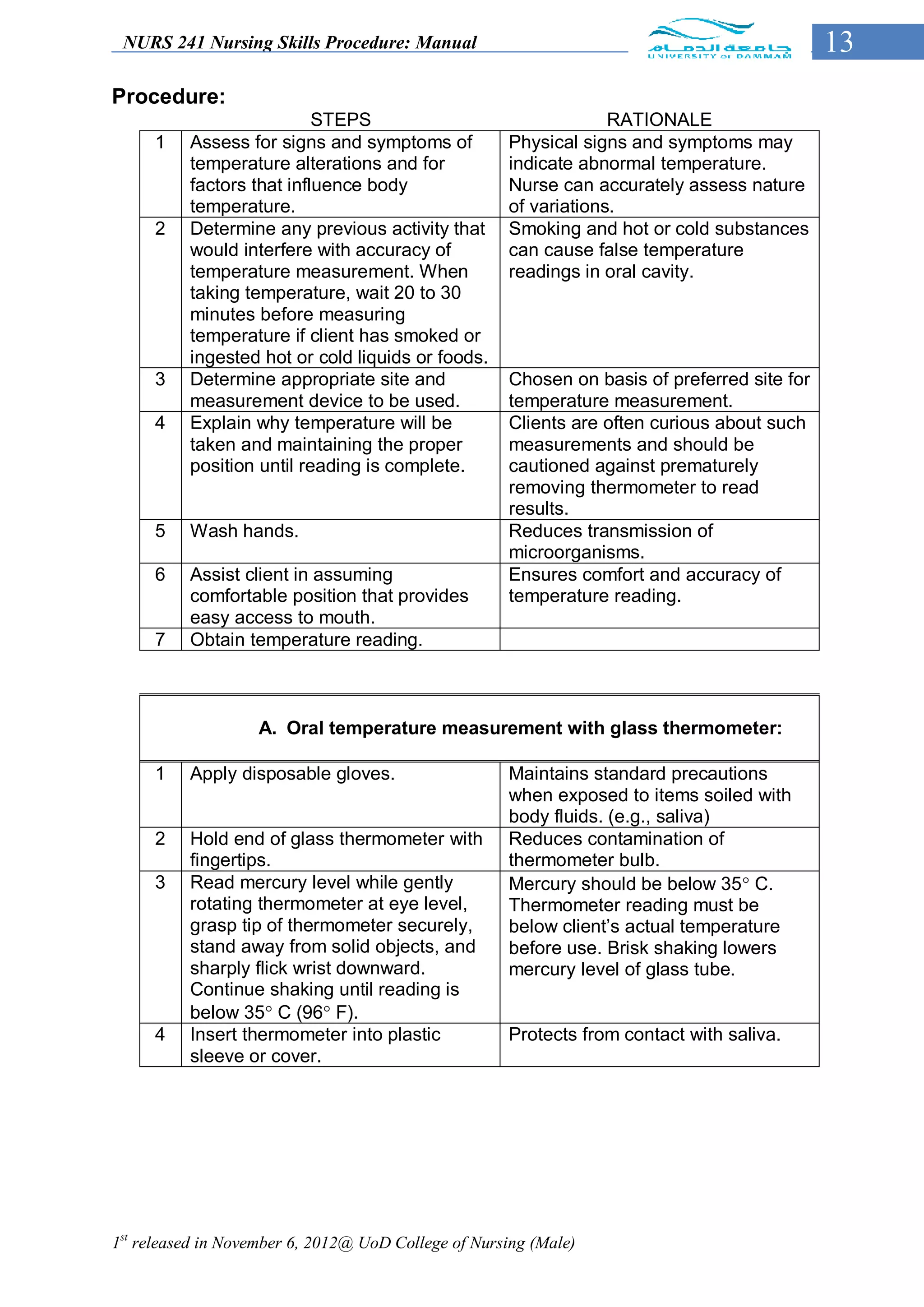
     5    Ask client to open mouth and gently        Heat from superficial blood vessels
          place thermometer under tongue in          in sublingual pockets produces
          posterior sublingual pocket lateral to     temperature reading.
          the center of lower jaw.


     6    Ask client to hold thermometer with        Maintains proper position of
          lips closed. Caution against biting        thermometer during recording.
          down the thermometer                       Breakage of thermometer may
                                                     injure mucosa and cause mercury
                                                     poisoning.
     7    Leave thermometer in place for 3           Studies vary as to proper length of
          minutes or according to agency             time for recording. Holtzclaw (1992)
          policy.                                    recommends 3 minutes.
     8    Carefully remove thermometer,              Prevents cross contamination.
          remove and discard plastic sleeve          Ensures accurate reading.
          cover in appropriate receptacle, and
          read at eye level. Gently rotate until
          scale appears.
     9    Cleanse any additional secretions          Avoids contact of microorganisms
          on thermometer, by wiping with             with nurse’s hands. Wipe from area
          clean, soft tissue. Wipe in rotating       of least contamination to area of
          fashion from fingers toward bulb.          most contamination. Glass
          Dispose of tissue in appropriate           thermometers should not be shared
          receptacle. Store thermometer in           between clients unless terminal
          appropriate storage container.             disinfection is performed between
                                                     each measurement. Protective
                                                     storage container prevents
                                                     breakage and reduces risks of
                                                     mercury spills.
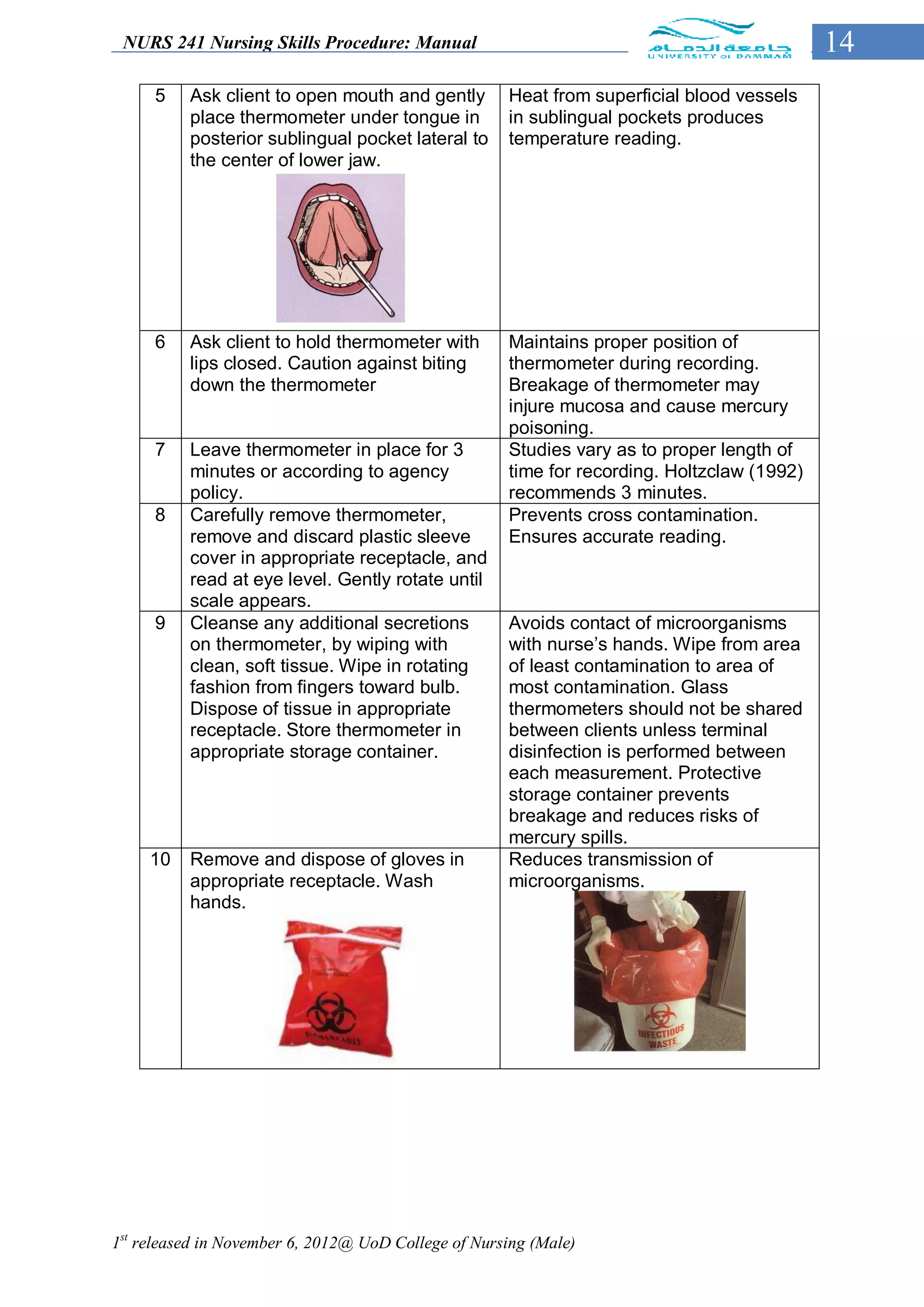
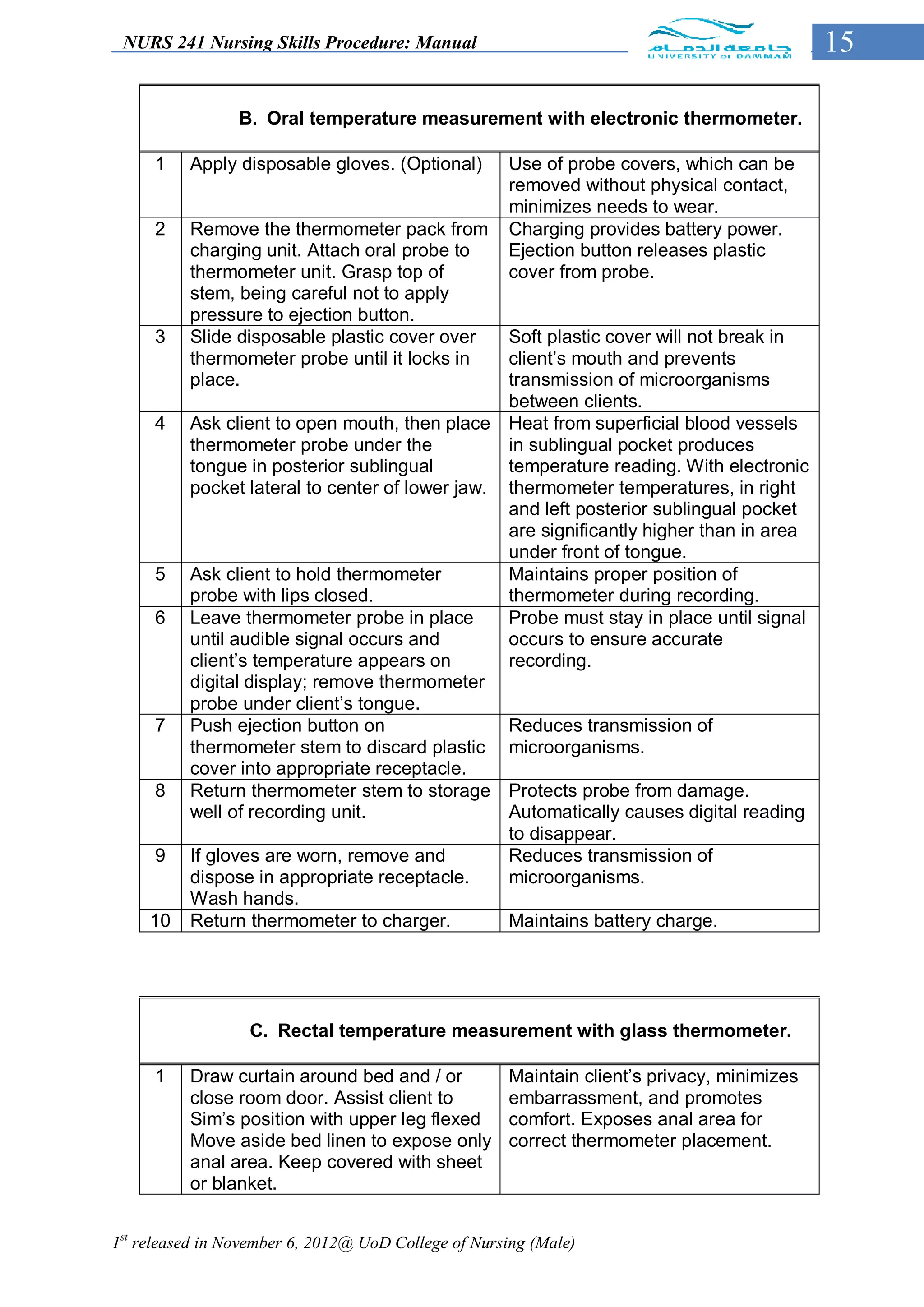
     10   Remove and dispose of gloves in            Reduces transmission of
          appropriate receptacle. Wash               microorganisms.
          hands.


1st released in November 6, 2012@ UoD College of Nursing (Male)
NURS 241 Nursing Skills Procedure: Manual                                                  15

                 B. Oral temperature measurement with electronic thermometer.

     1    Apply disposable gloves. (Optional)        Use of probe covers, which can be
                                                     removed without physical contact,
                                                     minimizes needs to wear.
     2    Remove the thermometer pack from           Charging provides battery power.
          charging unit. Attach oral probe to        Ejection button releases plastic
          thermometer unit. Grasp top of             cover from probe.
          stem, being careful not to apply
          pressure to ejection button.
     3    Slide disposable plastic cover over    Soft plastic cover will not break in
          thermometer probe until it locks in    client’s mouth and prevents
          place.                                 transmission of microorganisms
                                                 between clients.
     4    Ask client to open mouth, then place Heat from superficial blood vessels
          thermometer probe under the            in sublingual pocket produces
          tongue in posterior sublingual         temperature reading. With electronic
          pocket lateral to center of lower jaw. thermometer temperatures, in right
                                                 and left posterior sublingual pocket
                                                 are significantly higher than in area
                                                 under front of tongue.
     5    Ask client to hold thermometer         Maintains proper position of
          probe with lips closed.                thermometer during recording.
     6    Leave thermometer probe in place       Probe must stay in place until signal
          until audible signal occurs and        occurs to ensure accurate
          client’s temperature appears on        recording.
          digital display; remove thermometer
          probe under client’s tongue.
     7    Push ejection button on                Reduces transmission of
          thermometer stem to discard plastic microorganisms.
          cover into appropriate receptacle.
     8    Return thermometer stem to storage Protects probe from damage.
          well of recording unit.                Automatically causes digital reading
                                                 to disappear.
     9    If gloves are worn, remove and         Reduces transmission of
          dispose in appropriate receptacle.     microorganisms.
          Wash hands.
     10   Return thermometer to charger.         Maintains battery charge.


                  C. Rectal temperature measurement with glass thermometer.

     1    Draw curtain around bed and / or           Maintain client’s privacy, minimizes
          close room door. Assist client to          embarrassment, and promotes
          Sim’s position with upper leg flexed       comfort. Exposes anal area for
          Move aside bed linen to expose only        correct thermometer placement.
          anal area. Keep covered with sheet
          or blanket.


1st released in November 6, 2012@ UoD College of Nursing (Male)
NURS 241 Nursing Skills Procedure: Manual                                                   16
     2    Apply disposable gloves.                   Maintains standard precautions
                                                     when exposed to items soiled with
                                                     body fluids (e.g., feces).


     3    Hold end of glass thermometer with         Reduced contamination of
          fingertips.                                thermometer bulb.
     4    Read mercury level while gently            Mercury should be below 35 C.
          rotating thermometer at eye level. If      Thermometer reading must be
          mercury is above desired level,            below client’s actual temperature
          grasp tip of thermometer securely,         before client’s actual temperature
          and stand away from solid objects,         before use. Brisk shaking lowers
          and sharply flick wrist downward.          mercury level in glass tube.
          Continue shaking until reading is
          below 35 C.
     5    Insert thermometer into plastic            Protects from contact with feces.
          sleeve cover.
     6    Squeeze liberal portion of lubricant       Lubrication minimizes trauma to
          on tissue. Dip thermometer’s blunt         rectal mucosa during insertion.
          end into lubricant, covering 2.5 cm        Tissue avoids contamination of
          (1 to 1 ½ inch) for adult.                 remaining of remaining lubricant in
                                                     container.
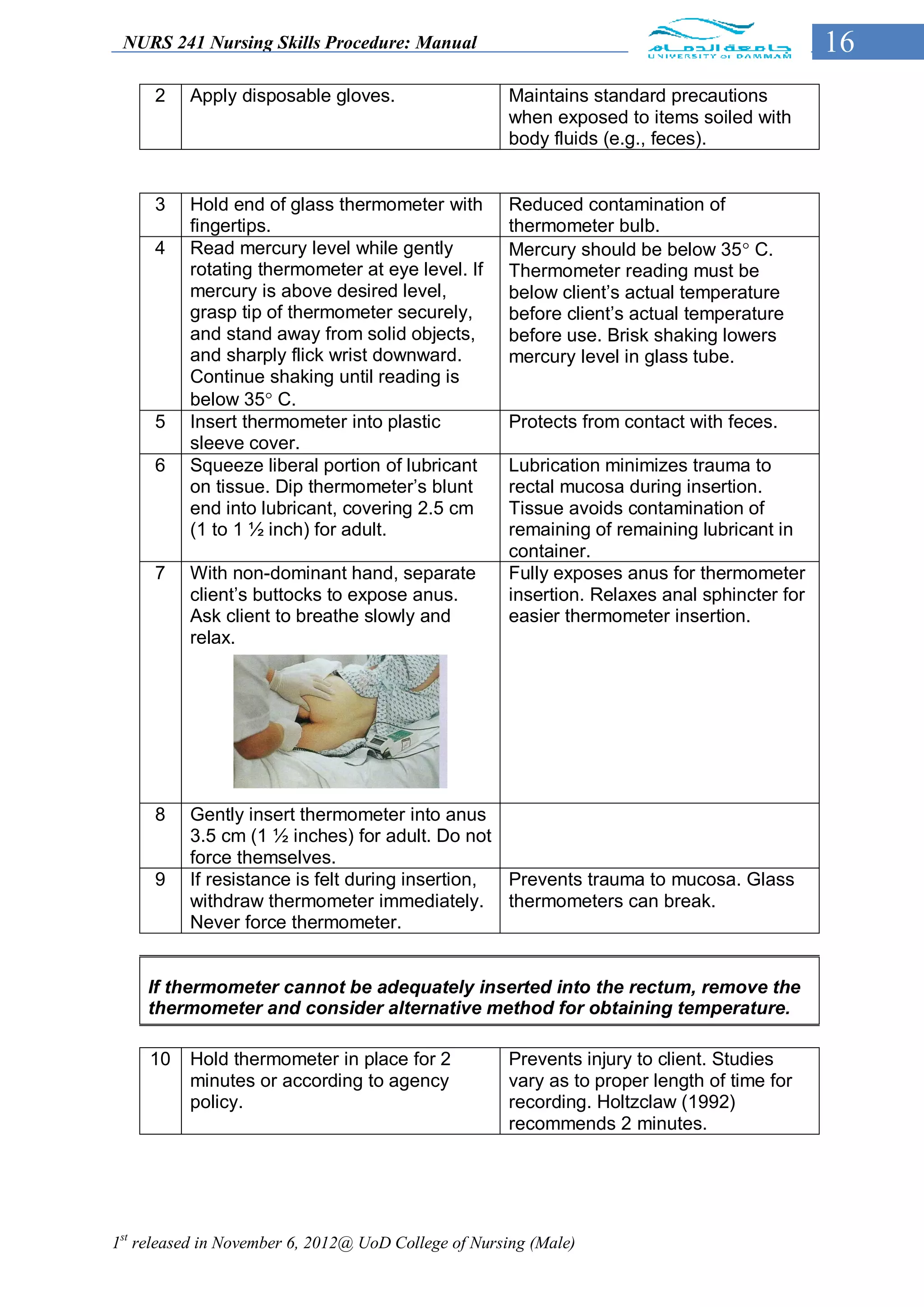
     7    With non-dominant hand, separate           Fully exposes anus for thermometer
          client’s buttocks to expose anus.          insertion. Relaxes anal sphincter for
          Ask client to breathe slowly and           easier thermometer insertion.
          relax.


     8    Gently insert thermometer into anus
          3.5 cm (1 ½ inches) for adult. Do not
          force themselves.
     9    If resistance is felt during insertion, Prevents trauma to mucosa. Glass
          withdraw thermometer immediately. thermometers can break.
          Never force thermometer.


    If thermometer cannot be adequately inserted into the rectum, remove the
    thermometer and consider alternative method for obtaining temperature.

     10   Hold thermometer in place for 2            Prevents injury to client. Studies
          minutes or according to agency             vary as to proper length of time for
          policy.                                    recording. Holtzclaw (1992)
                                                     recommends 2 minutes.


1st released in November 6, 2012@ UoD College of Nursing (Male)
NURS 241 Nursing Skills Procedure: Manual                                                   17
     11   Carefully remove thermometer,              Prevents cross contamination. Wipe
          remove and discard plastic cover in        from area of least contamination to
          appropriate receptacle and wipe off        area of most contamination.
          remaining secretions with clean
          tissue. Wipe in rotating fashion from
          fingers toward the bulb. Dispose of
          tissue in appropriate receptacle.
     12   Read thermometer at eye level.             Ensures accurate reading.
          Gently rotate until scale appears.


     13   Wipe client’s anal area with soft          Provides for comfort and hygiene.
          tissue to remove lubricant or feces
          and discard tissue. Assist client in
          assuming a comfortable position.
     14   Store thermometer in appropriate           Glass thermometers should not be
          storage container.                         shared between clients unless
                                                     terminal disinfection is performed
                                                     between each measurement.
                                                     Protective storage container
                                                     prevents breakage and reduces risk
                                                     of mercury spill.
     15   Remove and dispose of gloves in            Reduces transmission of
          appropriate receptacle. Wash               microorganisms.
          hands.


          D. Rectal temperature measurement with electronic thermometer.

     1    Follow steps C-1 and C-2.
     2    Follow steps C-5, 6, 7, 8, 9
     3    Leave thermometer in place until           Probe must stay in place until signal
          audible signal occurs and client’s         occurs to ensure accurate reading.
          temperature appears on digital
          display; remove thermometer probe
          from anus.
     4    Push ejection button on                    Reduces transmission of
          thermometer stem to discard plastic        microorganisms.
          probe cover into appropriate
          receptacle.
     5    Return thermometer stem to storage         Protects probe from damage.
          well of recording unit.                    Automatically causes digital reading
                                                     to disappear.
     6    Wipe client’s anal area with soft          Provides comfort and hygiene.
          tissue to remove lubricant or feces
          and discard tissue. Assist client in
          assuming a comfortable position.
     7    Remove and dispose of gloves in            Reduces transmission of
          appropriate receptacle.                    microorganisms.
     8    Return thermometer to charger.             Maintains battery charge.

1st released in November 6, 2012@ UoD College of Nursing (Male)
NURS 241 Nursing Skills Procedure: Manual                                                 18


               E. Axillary temperature measurement with glass thermometer.

     1    Wash hands.                                Reduces transmission of
                                                     microorganisms.
     2    Draw curtain around bed and/or             Provides privacy and minimizes
          close door.                                embarrassment.
     3    Assist client to supine or sitting         Provides easy access to axilla.
          position.
     4    Move clothing or gown away from            Exposes axilla.
          shoulder and arm.
     5    Prepares glass thermometer                 Mercury must be below client’s
          following steps A –2, 3.                   temperature level before insertion.
     6    Insert thermometer into the center of      Maintains proper position of
          axilla, lower arm over thermometer,        thermometer against blood vessels
          and place arm across chest.                in axilla.


     7    Hold thermometer in place for 3            Studies as to proper length of time
          minutes or according to agency             for recording vary. They concluded
          policy.                                    that changes after 3 minutes had
                                                     little or no significance.
     8    Remove thermometer, remove                 Avoids nurse’s contact with
          plastic sleeve, and wipe off               microorganisms. Wipe from are of
          remaining secretions with tissue.          least contamination to area of most
          Wipe in rotating fashion from fingers      contamination.
          toward bulb. Dispose of sleeve and
          tissue in appropriate receptacle.
      9   Read thermometer at eye level.             Ensures accurate reading.
     10   Inform client of reading.                  Promotes participation in care and
                                                     understanding of health status.
     11   Store thermometer at bedside in            Glass thermometers should not be
          protective covering container.             shared between clients unless
                                                     terminal disinfection is performed
                                                     between each measurement.
                                                     Storage container prevents
                                                     breakage and reduces risk of
                                                     mercury spill.


1st released in November 6, 2012@ UoD College of Nursing (Male)
NURS 241 Nursing Skills Procedure: Manual                                                19
     12   Assist client in replacing clothing pr     Restore sense of well-being.
          gown.
     13   Wash hands.                                Reduces transmission of
                                                     microorganisms.


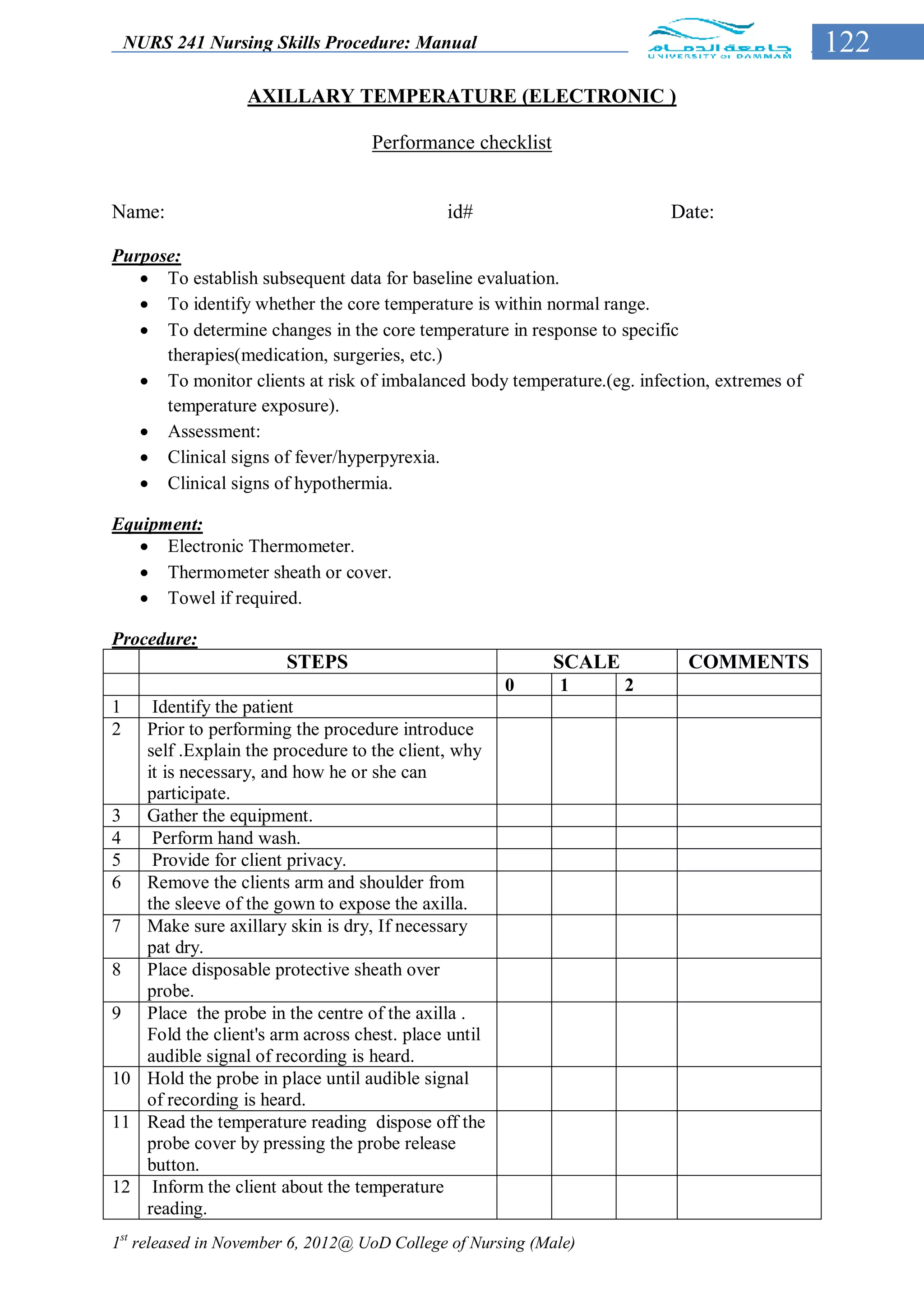
          F. Axillary temperature measurement with electronic thermometer.

     1    Position client lying supine or sitting.   Provides easy access to axilla.
     2    Move clothing or gown away from            Provides optimal access to axilla.
          shoulder and arm.
     3    Remove the thermometer pack from           Ejection button releases plastic
          charging unit. Be sure oral probe          cover from probe.
          (blue tip) is attached to thermometer
          unit. Attach oral probe to
          thermometer unit. Grasp top of
          stem, being careful not to apply
          pressure to ejection button.
     4    Slide disposable plastic cover over   Soft plastic cover will not break in
          thermometer probe until it locks in   client’s mouth and prevents
          place.                                transmission of microorganisms
                                                between clients.
     5    Raise client’s arm away from torso,   Maintains proper position of probe
          inspect for skin lesion and excessive against blood vessels in axilla.
          perspiration. Insert probe into the
          center of axilla, lower arm over
          thermometer, and place arm across
          chest.
     6    Leave probe in place until audible    Probe must stay in place until signal
          signal occurs and client’s            occurs to ensure accurate reading.
          temperature appears on digital
          display.
     7    Remove probe from axilla.
     8    Push ejection button on               Reduces transmission of
          thermometer stem to discard plastic microorganisms.
          probe cover into appropriate
          receptacle.
     9    Return probe to storage well of       Protects probe from damage.
          recording unit.                       Automatically causes digital reading
                                                to disappear.
     10   Assist client in assuming a           Restores comfort and promotes
          comfortable position.                 privacy.
     11   Wash hands.                           Reduces transmission of
                                                microorganisms.


1st released in November 6, 2012@ UoD College of Nursing (Male)
NURS 241 Nursing Skills Procedure: Manual                                                   20


                  G. Tympanic membrane temperature measurement with
                       electronic thermometer.
     1    Assist client in assuming             Ensures comfort and exposes
          comfortable position with head        auditory canal for accurate
          turned toward side, away from the     temperature measurement.
          nurse.
     2    Remove thermometer handheld unit Base provides battery power.
          from charging base, being careful     Removal of handheld unit from base
          not to apply pressure to ejection     prepares it to measure temperature.
          button.
     3    Slide disposable speculum cover       Soft plastic probe cover prevents
          over otoscope like tip until it locks transmission of microorganisms
          into place.                           between clients.
     4    Insert speculum into ear canal        Correct positioning of the probe with
          following manufacturer’s instructions respect to ear canal ensures
          for tympanic probe positioning.       accurate readings. The ear tug
                                                straightens the external auditory
                                                canal, allowing maximum exposure
                                                of the tympanic membrane.
           a. Pull ear pinna upward and back
                for                             Some manufacturers recommend
                adult.                          movement of the speculum tip in a
           b. Move thermometer in a figure– figure – 8 pattern that allows the
                eight pattern.                  sensor to detect maximum tympanic
           c. Fit probe snug into canal and     membrane heat radiation. Gentle
                do not move.                    pressure seals ear canal from
           d. Point toward nose.                ambient air temperature.


     5    Depress scan button on handheld            Depression of scan button causes
          unit. Leave thermometer probe in           infrared energy to be detected.
          place until audible signal occurs and      Probe must stay in place until signal
          client’s temperature appear on             occurs to ensure accurate reading.
          digital display.


     6    Carefully remove speculum from
          auditory meatus.


1st released in November 6, 2012@ UoD College of Nursing (Male)
NURS 241 Nursing Skills Procedure: Manual                                                       21
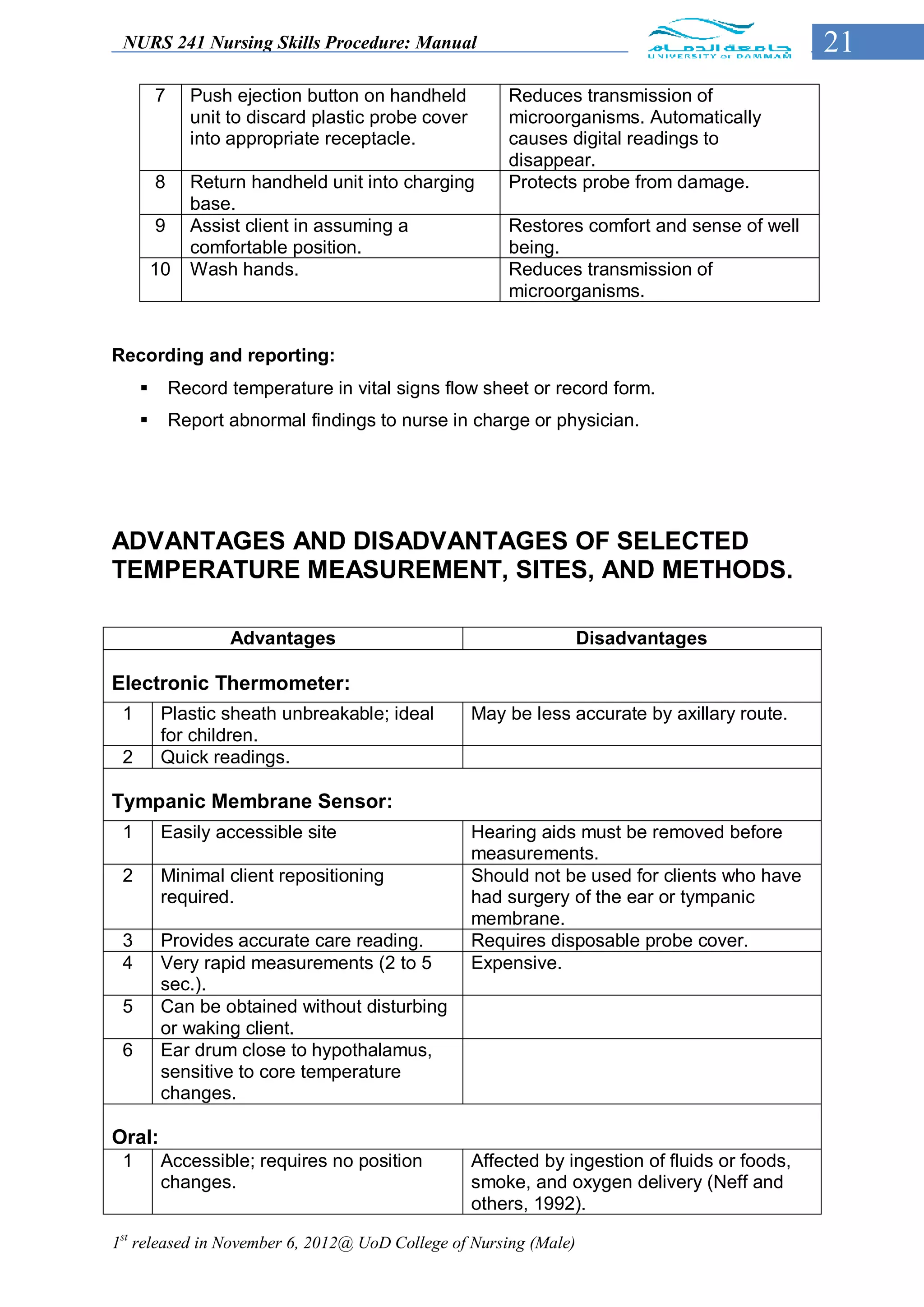
         7     Push ejection button on handheld          Reduces transmission of
               unit to discard plastic probe cover       microorganisms. Automatically
               into appropriate receptacle.              causes digital readings to
                                                         disappear.
         8     Return handheld unit into charging        Protects probe from damage.
               base.
         9     Assist client in assuming a               Restores comfort and sense of well
               comfortable position.                     being.
         10    Wash hands.                               Reduces transmission of
                                                         microorganisms.


Recording and reporting:
            Record temperature in vital signs flow sheet or record form.
            Report abnormal findings to nurse in charge or physician.


ADVANTAGES AND DISADVANTAGES OF SELECTED
TEMPERATURE MEASUREMENT, SITES, AND METHODS.

                    Advantages                                    Disadvantages

Electronic Thermometer:
 1        Plastic sheath unbreakable; ideal          May be less accurate by axillary route.
          for children.
 2        Quick readings.

Tympanic Membrane Sensor:
 1        Easily accessible site                     Hearing aids must be removed before
                                                     measurements.
 2        Minimal client repositioning               Should not be used for clients who have
          required.                                  had surgery of the ear or tympanic
                                                     membrane.
 3        Provides accurate care reading.            Requires disposable probe cover.
 4        Very rapid measurements (2 to 5            Expensive.
          sec.).
 5        Can be obtained without disturbing
          or waking client.
 6        Ear drum close to hypothalamus,
          sensitive to core temperature
          changes.

Oral:
 1        Accessible; requires no position           Affected by ingestion of fluids or foods,
          changes.                                   smoke, and oxygen delivery (Neff and
                                                     others, 1992).

1st released in November 6, 2012@ UoD College of Nursing (Male)
NURS 241 Nursing Skills Procedure: Manual                                                    22
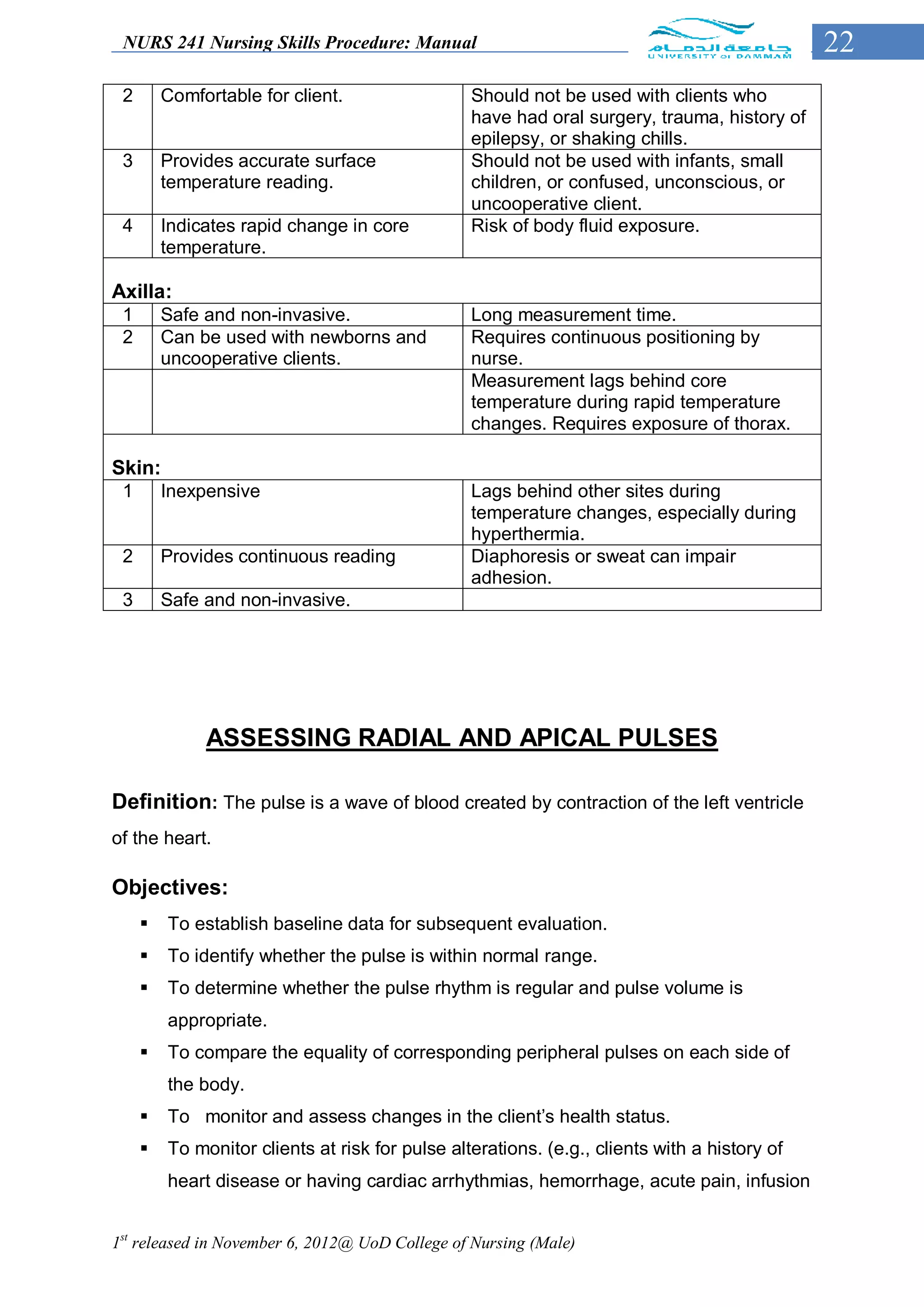
 2       Comfortable for client.                 Should not be used with clients who
                                                 have had oral surgery, trauma, history of
                                                 epilepsy, or shaking chills.
 3       Provides accurate surface               Should not be used with infants, small
         temperature reading.                    children, or confused, unconscious, or
                                                 uncooperative client.
 4       Indicates rapid change in core          Risk of body fluid exposure.
         temperature.

Axilla:
 1       Safe and non-invasive.                  Long measurement time.
 2       Can be used with newborns and           Requires continuous positioning by
         uncooperative clients.                  nurse.
                                                 Measurement lags behind core
                                                 temperature during rapid temperature
                                                 changes. Requires exposure of thorax.

Skin:
 1       Inexpensive                             Lags behind other sites during
                                                 temperature changes, especially during
                                                 hyperthermia.
 2       Provides continuous reading             Diaphoresis or sweat can impair
                                                 adhesion.
 3       Safe and non-invasive.


              ASSESSING RADIAL AND APICAL PULSES

Definition: The pulse is a wave of blood created by contraction of the left ventricle
of the heart.

Objectives:
        To establish baseline data for subsequent evaluation.
        To identify whether the pulse is within normal range.
        To determine whether the pulse rhythm is regular and pulse volume is
         appropriate.
        To compare the equality of corresponding peripheral pulses on each side of
         the body.
        To monitor and assess changes in the client’s health status.
        To monitor clients at risk for pulse alterations. (e.g., clients with a history of
         heart disease or having cardiac arrhythmias, hemorrhage, acute pain, infusion


1st released in November 6, 2012@ UoD College of Nursing (Male)
NURS 241 Nursing Skills Procedure: Manual                                                  23
           of large volumes of fluids, fever).

Key Points:
          Locate the pulse point properly.
          Always count pulse for one full minute if dysrhythmias or other abnormality is
           present.
          Have another nurse locate and count the radial pulse while you auscultate the
           apical pulse. Determine an apical-radial pulse rate by counting simultaneously
           for one full minute.

Equipment:
                Watch with a second hand or indicator.
                If using Doppler/ultrasound stethoscope:
                Transducer in the probe
                Stethoscope headset
                Transmission gel


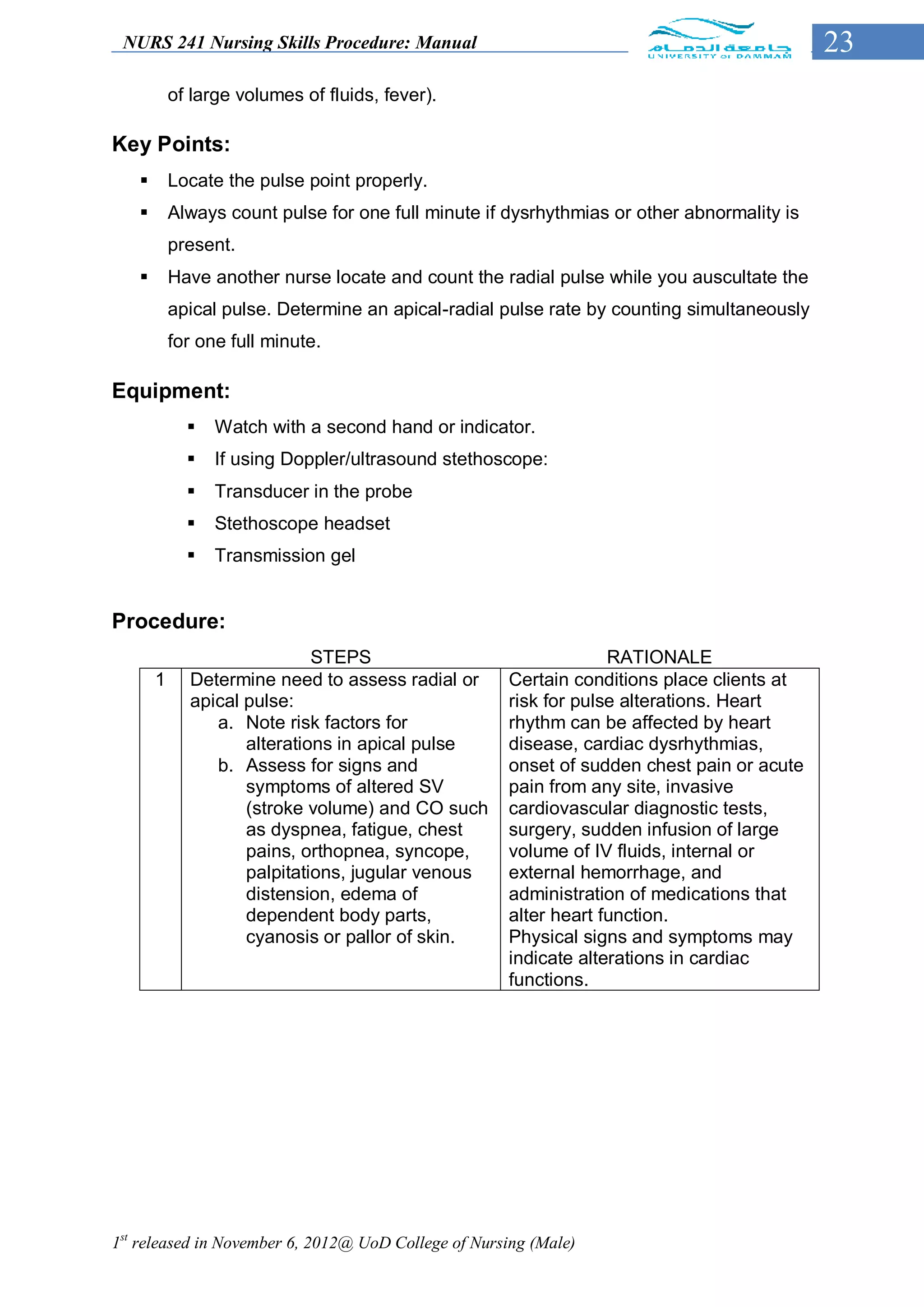
Procedure:
                             STEPS                                RATIONALE
       1     Determine need to assess radial or      Certain conditions place clients at
             apical pulse:                           risk for pulse alterations. Heart
                a. Note risk factors for             rhythm can be affected by heart
                    alterations in apical pulse      disease, cardiac dysrhythmias,
                b. Assess for signs and              onset of sudden chest pain or acute
                    symptoms of altered SV           pain from any site, invasive
                    (stroke volume) and CO such      cardiovascular diagnostic tests,
                    as dyspnea, fatigue, chest       surgery, sudden infusion of large
                    pains, orthopnea, syncope,       volume of IV fluids, internal or
                    palpitations, jugular venous     external hemorrhage, and
                    distension, edema of             administration of medications that
                    dependent body parts,            alter heart function.
                    cyanosis or pallor of skin.      Physical signs and symptoms may
                                                     indicate alterations in cardiac
                                                     functions.


1st released in November 6, 2012@ UoD College of Nursing (Male)
NURS 241 Nursing Skills Procedure: Manual                                                    24
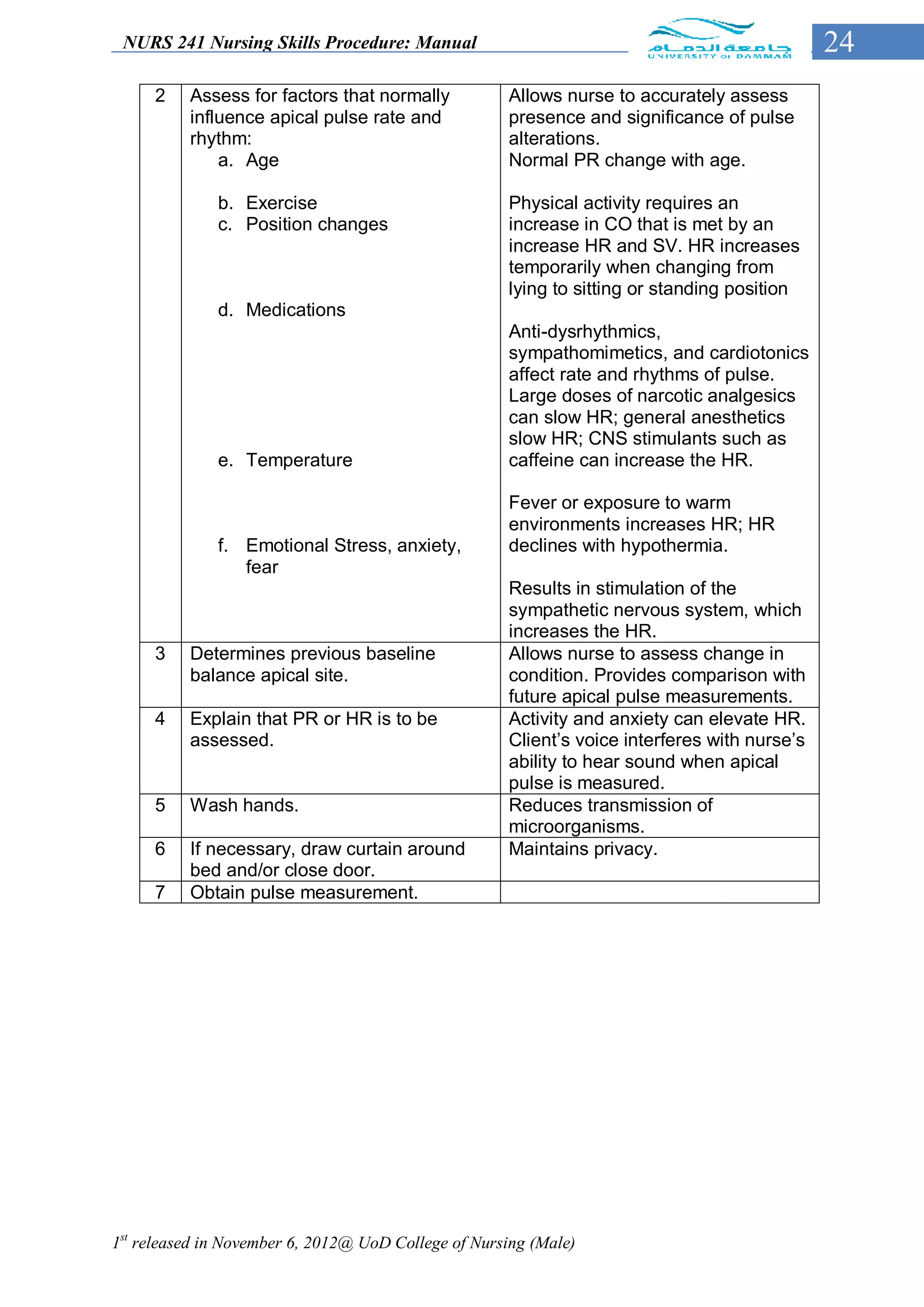
     2    Assess for factors that normally           Allows nurse to accurately assess
          influence apical pulse rate and            presence and significance of pulse
          rhythm:                                    alterations.
              a. Age                                 Normal PR change with age.

              b. Exercise                            Physical activity requires an
              c. Position changes                    increase in CO that is met by an
                                                     increase HR and SV. HR increases
                                                     temporarily when changing from
                                                     lying to sitting or standing position
              d. Medications
                                                     Anti-dysrhythmics,
                                                     sympathomimetics, and cardiotonics
                                                     affect rate and rhythms of pulse.
                                                     Large doses of narcotic analgesics
                                                     can slow HR; general anesthetics
                                                     slow HR; CNS stimulants such as
              e. Temperature                         caffeine can increase the HR.

                                                     Fever or exposure to warm
                                                     environments increases HR; HR
              f. Emotional Stress, anxiety,          declines with hypothermia.
                 fear
                                                     Results in stimulation of the
                                                     sympathetic nervous system, which
                                                     increases the HR.
     3    Determines previous baseline               Allows nurse to assess change in
          balance apical site.                       condition. Provides comparison with
                                                     future apical pulse measurements.
     4    Explain that PR or HR is to be             Activity and anxiety can elevate HR.
          assessed.                                  Client’s voice interferes with nurse’s
                                                     ability to hear sound when apical
                                                     pulse is measured.
     5    Wash hands.                                Reduces transmission of
                                                     microorganisms.
     6    If necessary, draw curtain around          Maintains privacy.
          bed and/or close door.
     7    Obtain pulse measurement.


1st released in November 6, 2012@ UoD College of Nursing (Male)
NURS 241 Nursing Skills Procedure: Manual                                                    25
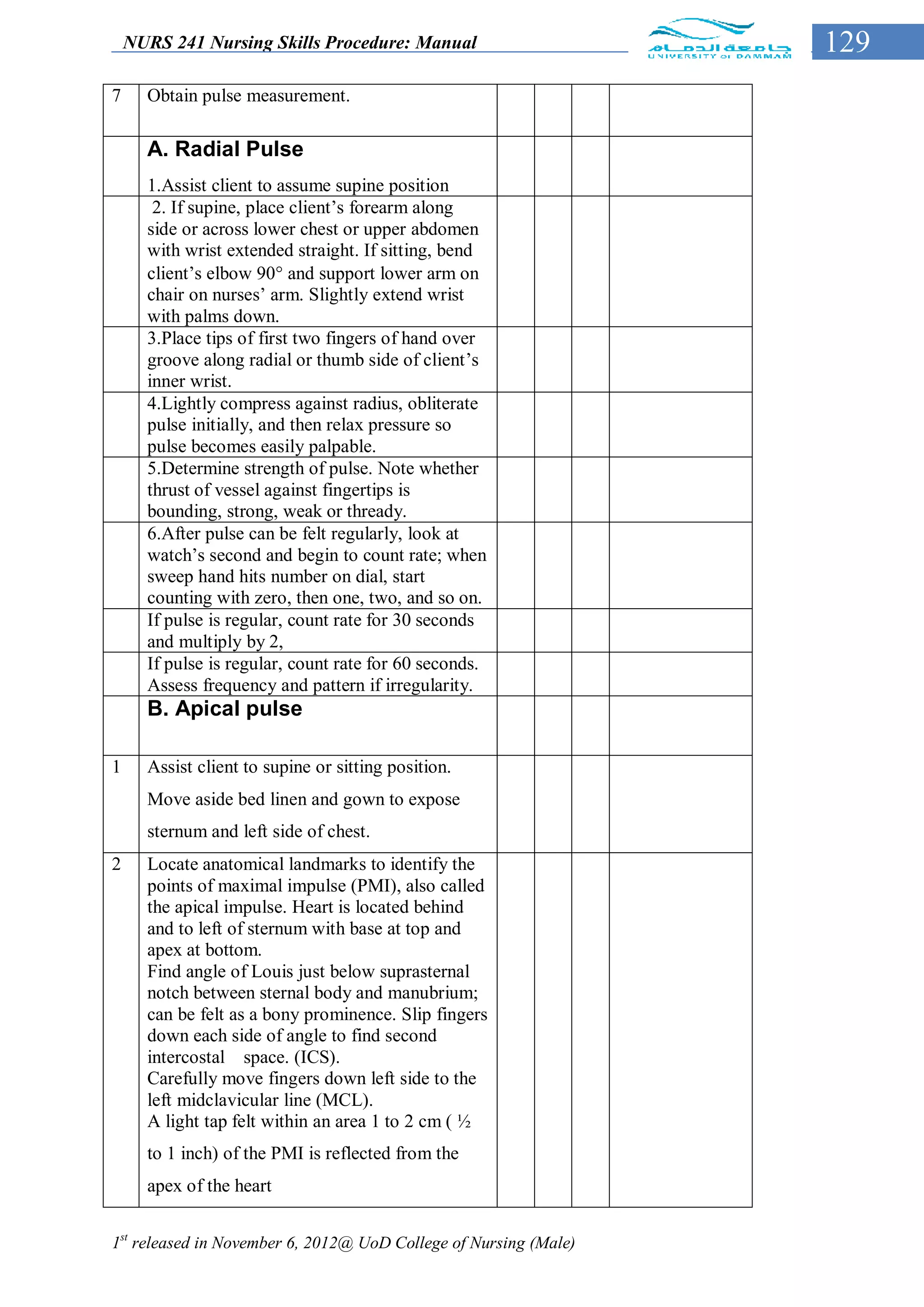
                                    A. Radial Pulse
                             STEPS                              RATIONALE
     1    Assist client to assume supine             Provides easy access to pulse sites.
          position.
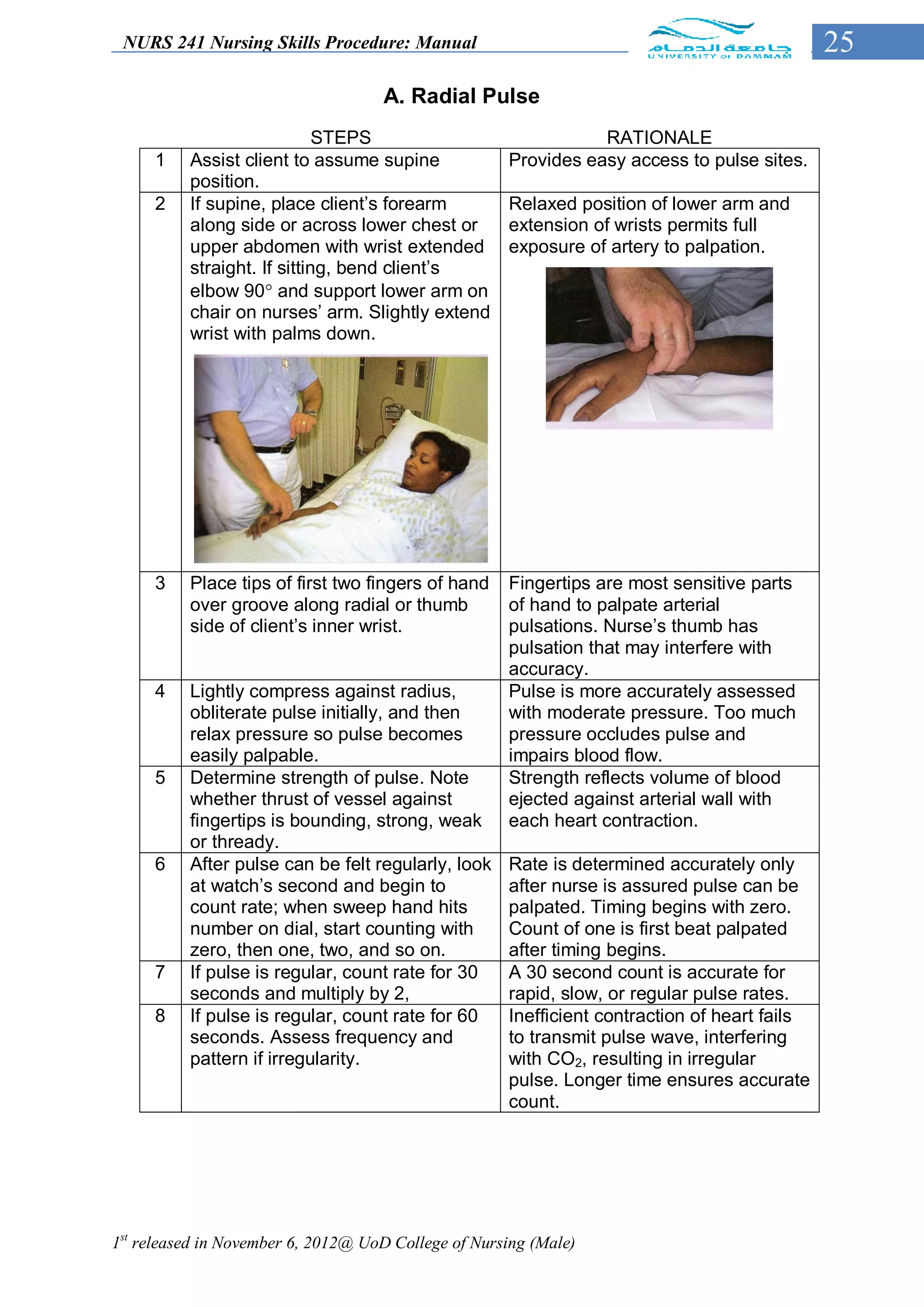
     2    If supine, place client’s forearm          Relaxed position of lower arm and
          along side or across lower chest or        extension of wrists permits full
          upper abdomen with wrist extended          exposure of artery to palpation.
          straight. If sitting, bend client’s
          elbow 90 and support lower arm on
          chair on nurses’ arm. Slightly extend
          wrist with palms down.


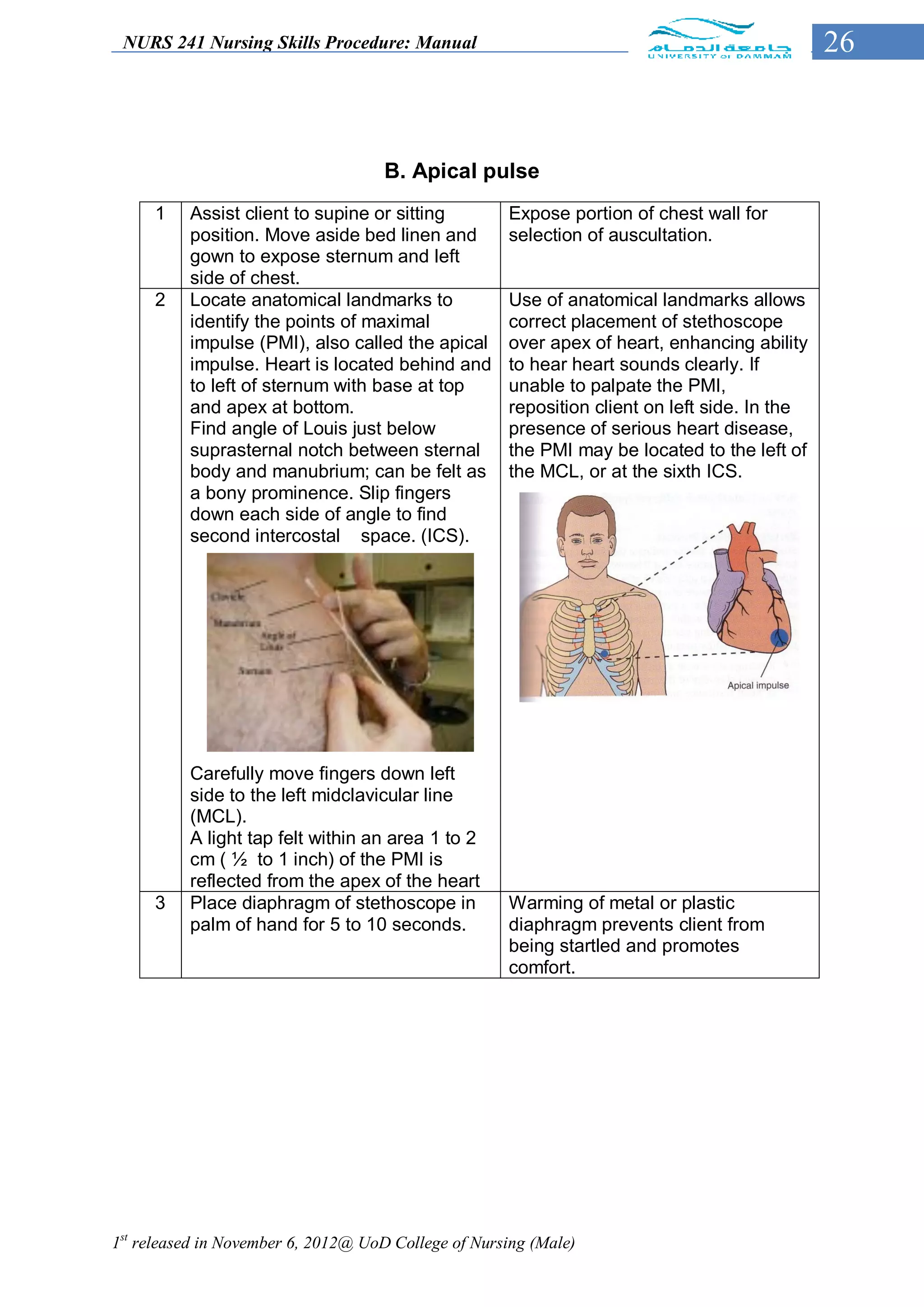
     3    Place tips of first two fingers of hand    Fingertips are most sensitive parts
          over groove along radial or thumb          of hand to palpate arterial
          side of client’s inner wrist.              pulsations. Nurse’s thumb has
                                                     pulsation that may interfere with
                                                     accuracy.
     4    Lightly compress against radius,           Pulse is more accurately assessed
          obliterate pulse initially, and then       with moderate pressure. Too much
          relax pressure so pulse becomes            pressure occludes pulse and
          easily palpable.                           impairs blood flow.
     5    Determine strength of pulse. Note          Strength reflects volume of blood
          whether thrust of vessel against           ejected against arterial wall with
          fingertips is bounding, strong, weak       each heart contraction.
          or thready.
     6    After pulse can be felt regularly, look    Rate is determined accurately only
          at watch’s second and begin to             after nurse is assured pulse can be
          count rate; when sweep hand hits           palpated. Timing begins with zero.
          number on dial, start counting with        Count of one is first beat palpated
          zero, then one, two, and so on.            after timing begins.
     7    If pulse is regular, count rate for 30     A 30 second count is accurate for
          seconds and multiply by 2,                 rapid, slow, or regular pulse rates.
     8    If pulse is regular, count rate for 60     Inefficient contraction of heart fails
          seconds. Assess frequency and              to transmit pulse wave, interfering
          pattern if irregularity.                   with CO2, resulting in irregular
                                                     pulse. Longer time ensures accurate
                                                     count.


1st released in November 6, 2012@ UoD College of Nursing (Male)
NURS 241 Nursing Skills Procedure: Manual                                                    26


                                     B. Apical pulse
     1    Assist client to supine or sitting         Expose portion of chest wall for
          position. Move aside bed linen and         selection of auscultation.
          gown to expose sternum and left
          side of chest.
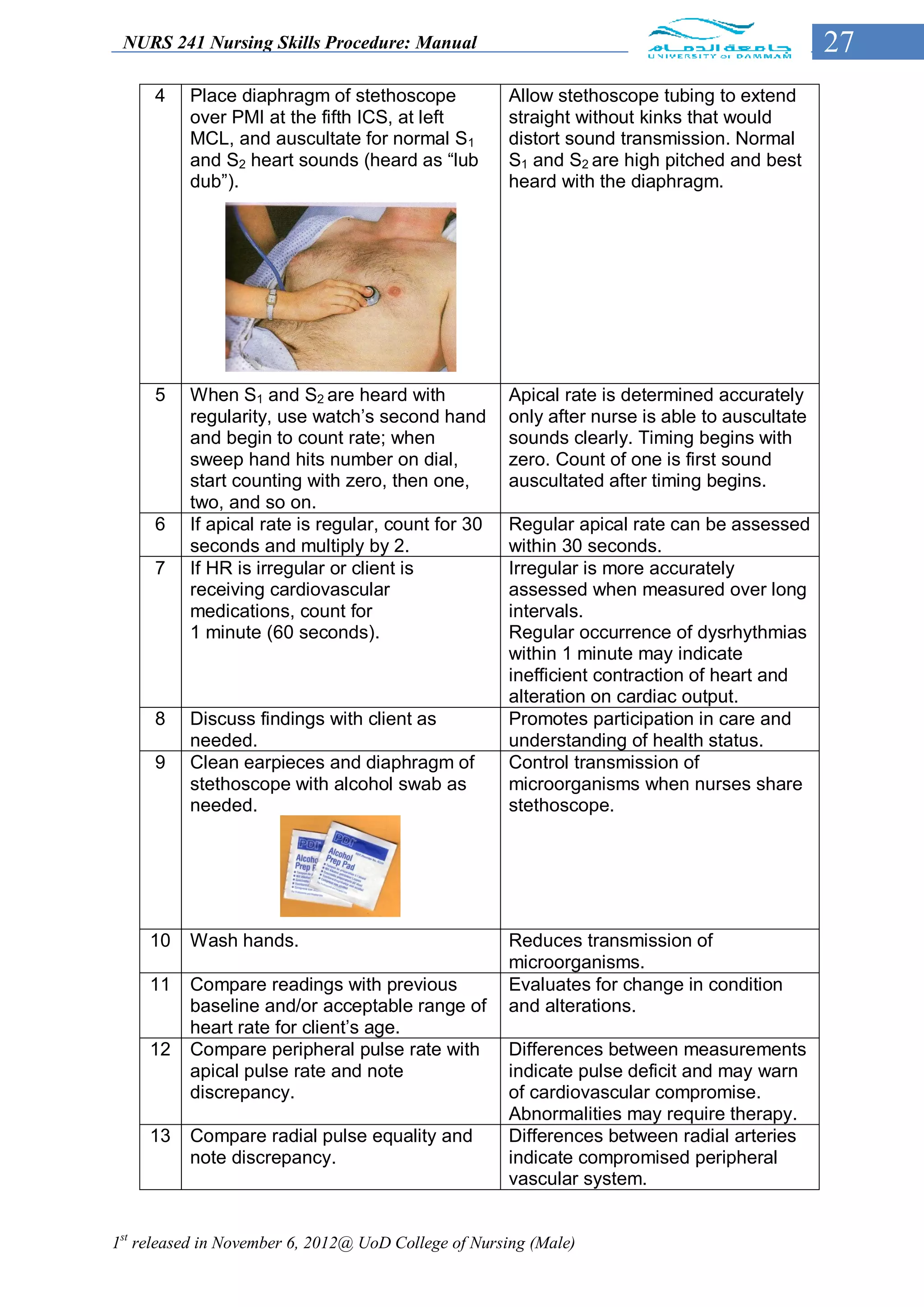
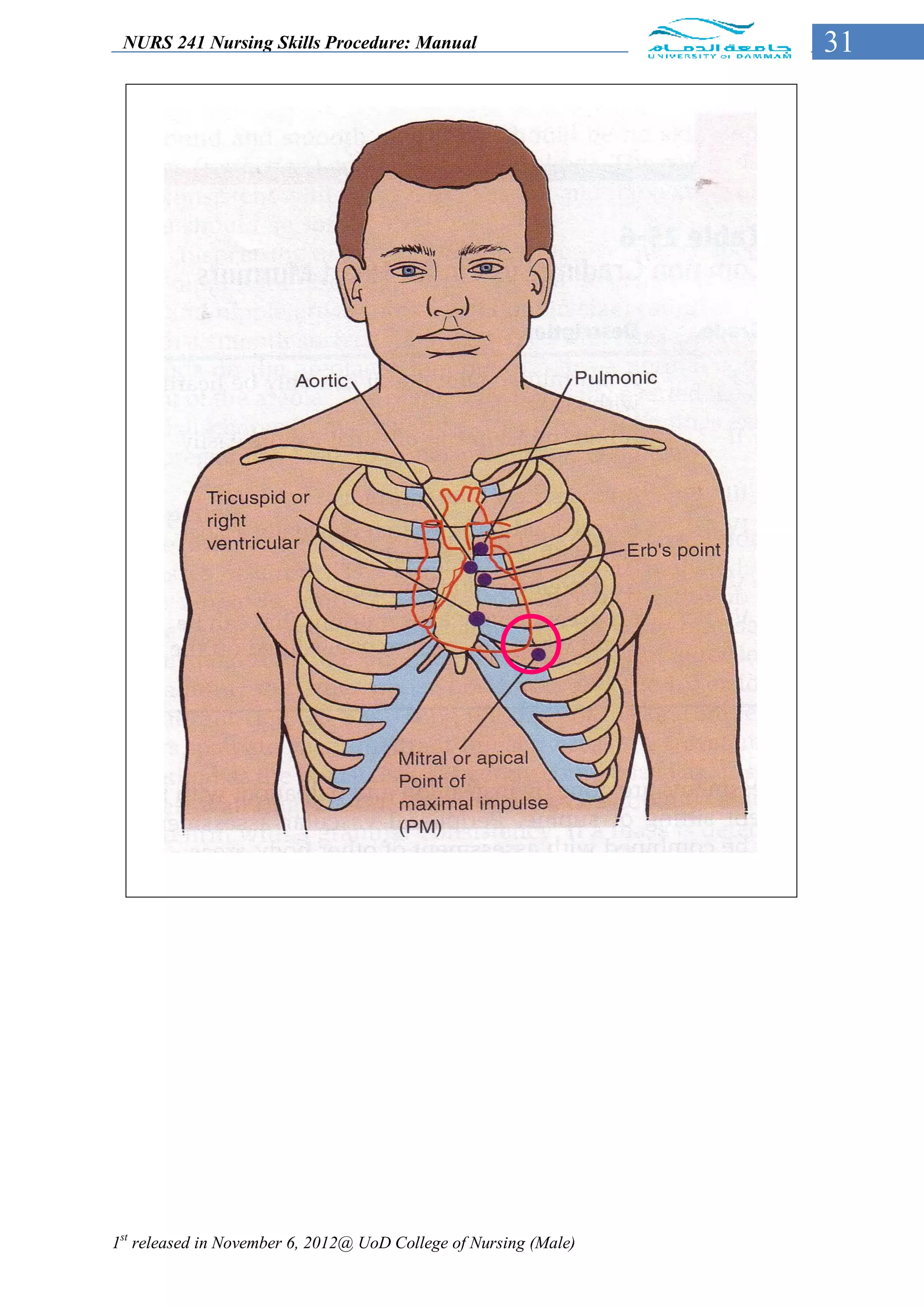
     2    Locate anatomical landmarks to             Use of anatomical landmarks allows
          identify the points of maximal             correct placement of stethoscope
          impulse (PMI), also called the apical      over apex of heart, enhancing ability
          impulse. Heart is located behind and       to hear heart sounds clearly. If
          to left of sternum with base at top        unable to palpate the PMI,
          and apex at bottom.                        reposition client on left side. In the
          Find angle of Louis just below             presence of serious heart disease,
          suprasternal notch between sternal         the PMI may be located to the left of
          body and manubrium; can be felt as         the MCL, or at the sixth ICS.
          a bony prominence. Slip fingers
          down each side of angle to find
          second intercostal space. (ICS).


          Carefully move fingers down left
          side to the left midclavicular line
          (MCL).
          A light tap felt within an area 1 to 2
          cm ( ½ to 1 inch) of the PMI is
          reflected from the apex of the heart
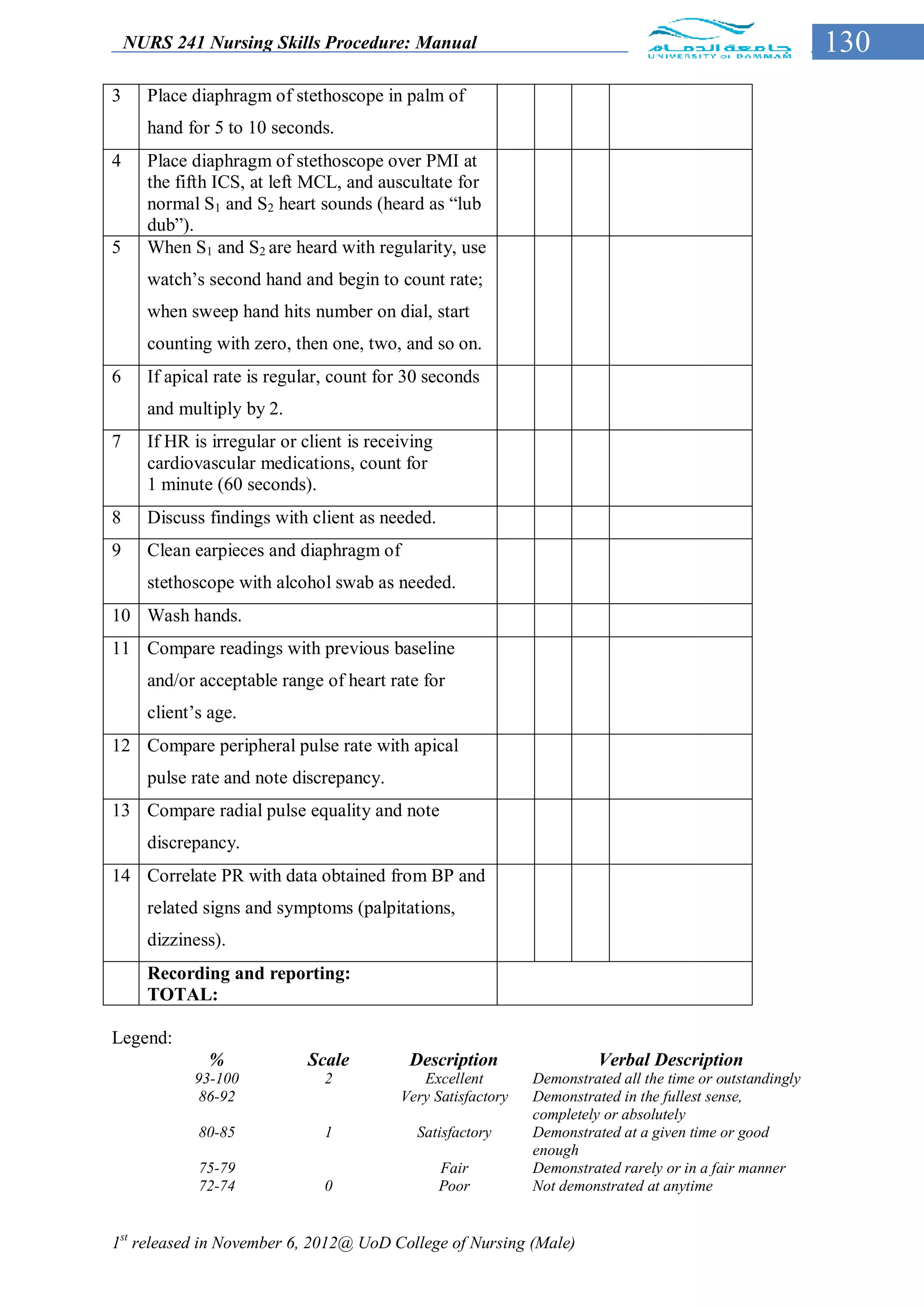
     3    Place diaphragm of stethoscope in          Warming of metal or plastic
          palm of hand for 5 to 10 seconds.          diaphragm prevents client from
                                                     being startled and promotes
                                                     comfort.


1st released in November 6, 2012@ UoD College of Nursing (Male)
NURS 241 Nursing Skills Procedure: Manual                                                    27
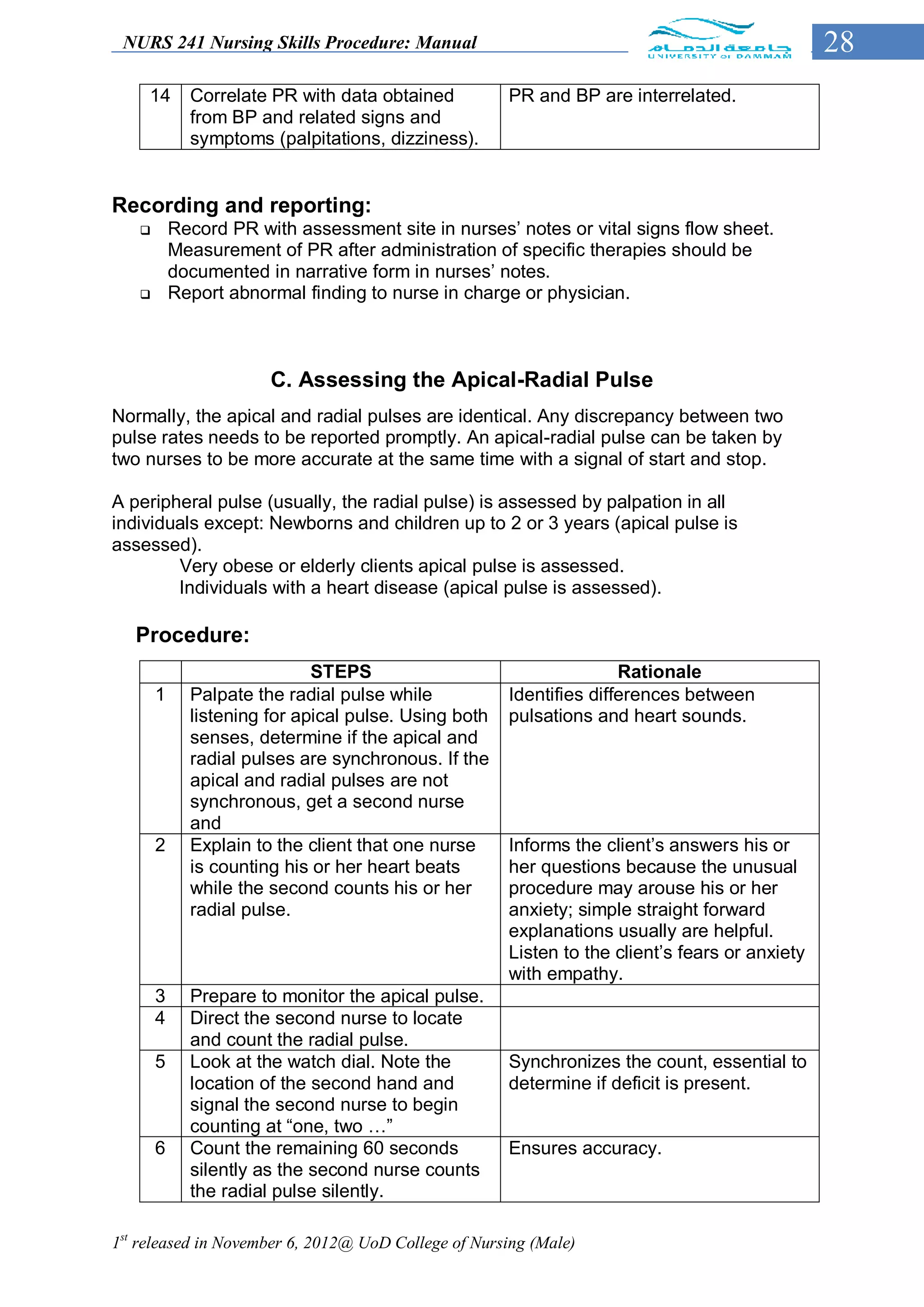
     4    Place diaphragm of stethoscope             Allow stethoscope tubing to extend
          over PMI at the fifth ICS, at left         straight without kinks that would
          MCL, and auscultate for normal S1          distort sound transmission. Normal
          and S2 heart sounds (heard as “lub         S1 and S2 are high pitched and best
          dub”).                                     heard with the diaphragm.


     5    When S1 and S2 are heard with              Apical rate is determined accurately
          regularity, use watch’s second hand        only after nurse is able to auscultate
          and begin to count rate; when              sounds clearly. Timing begins with
          sweep hand hits number on dial,            zero. Count of one is first sound
          start counting with zero, then one,        auscultated after timing begins.
          two, and so on.
     6    If apical rate is regular, count for 30    Regular apical rate can be assessed
          seconds and multiply by 2.                 within 30 seconds.
     7    If HR is irregular or client is            Irregular is more accurately
          receiving cardiovascular                   assessed when measured over long
          medications, count for                     intervals.
          1 minute (60 seconds).                     Regular occurrence of dysrhythmias
                                                     within 1 minute may indicate
                                                     inefficient contraction of heart and
                                                     alteration on cardiac output.
     8    Discuss findings with client as            Promotes participation in care and
          needed.                                    understanding of health status.
     9    Clean earpieces and diaphragm of           Control transmission of
          stethoscope with alcohol swab as           microorganisms when nurses share
          needed.                                    stethoscope.


     10   Wash hands.                                Reduces transmission of
                                                     microorganisms.
     11   Compare readings with previous             Evaluates for change in condition
          baseline and/or acceptable range of        and alterations.
          heart rate for client’s age.
     12   Compare peripheral pulse rate with         Differences between measurements
          apical pulse rate and note                 indicate pulse deficit and may warn
          discrepancy.                               of cardiovascular compromise.
                                                     Abnormalities may require therapy.
     13   Compare radial pulse equality and          Differences between radial arteries
          note discrepancy.                          indicate compromised peripheral
                                                     vascular system.


1st released in November 6, 2012@ UoD College of Nursing (Male)
NURS 241 Nursing Skills Procedure: Manual                                                      28
     14      Correlate PR with data obtained          PR and BP are interrelated.
             from BP and related signs and
             symptoms (palpitations, dizziness).


Recording and reporting:
          Record PR with assessment site in nurses’ notes or vital signs flow sheet.
           Measurement of PR after administration of specific therapies should be
           documented in narrative form in nurses’ notes.
          Report abnormal finding to nurse in charge or physician.


                       C. Assessing the Apical-Radial Pulse
Normally, the apical and radial pulses are identical. Any discrepancy between two
pulse rates needs to be reported promptly. An apical-radial pulse can be taken by
two nurses to be more accurate at the same time with a signal of start and stop.

A peripheral pulse (usually, the radial pulse) is assessed by palpation in all
individuals except: Newborns and children up to 2 or 3 years (apical pulse is
assessed).
        Very obese or elderly clients apical pulse is assessed.
        Individuals with a heart disease (apical pulse is assessed).

   Procedure:
                             STEPS                                   Rationale
       1     Palpate the radial pulse while           Identifies differences between
             listening for apical pulse. Using both   pulsations and heart sounds.
             senses, determine if the apical and
             radial pulses are synchronous. If the
             apical and radial pulses are not
             synchronous, get a second nurse
             and
       2     Explain to the client that one nurse     Informs the client’s answers his or
             is counting his or her heart beats       her questions because the unusual
             while the second counts his or her       procedure may arouse his or her
             radial pulse.                            anxiety; simple straight forward
                                                      explanations usually are helpful.
                                                      Listen to the client’s fears or anxiety
                                                      with empathy.
       3     Prepare to monitor the apical pulse.
       4     Direct the second nurse to locate
             and count the radial pulse.
       5     Look at the watch dial. Note the         Synchronizes the count, essential to
             location of the second hand and          determine if deficit is present.
             signal the second nurse to begin
             counting at “one, two …”
       6     Count the remaining 60 seconds           Ensures accuracy.
             silently as the second nurse counts
             the radial pulse silently.

1st released in November 6, 2012@ UoD College of Nursing (Male)
NURS 241 Nursing Skills Procedure: Manual                                            29
     7    Say “Stop” when exactly 60 seconds Ensures accuracy.
          have passed.
     8    Reposition the client comfortable.
     9    Record the apical and radial rates Ensures prompt and accurate
          immediately. Note any deficits.    documentation.


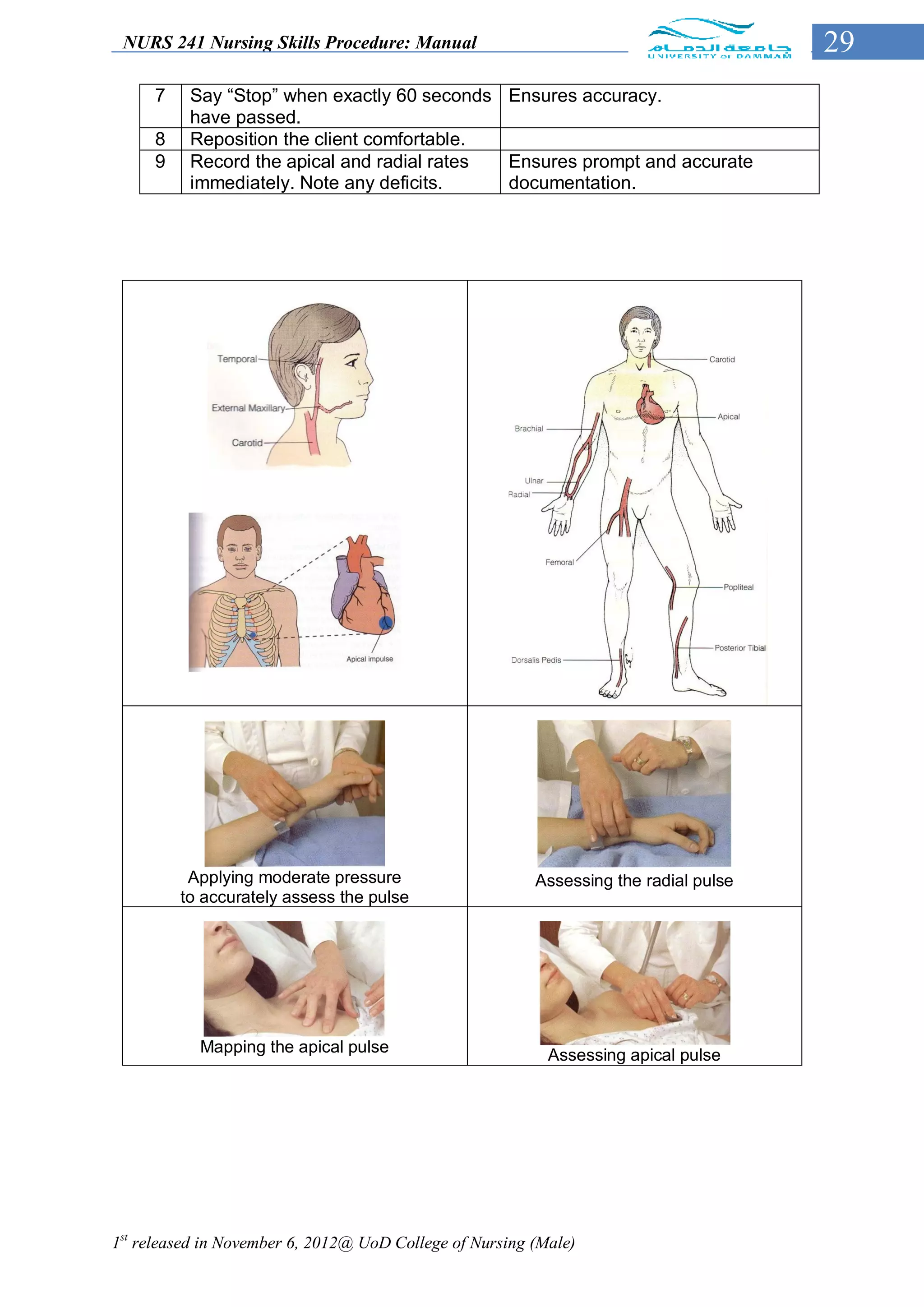
          Applying moderate pressure                     Assessing the radial pulse
         to accurately assess the pulse


            Mapping the apical pulse                       Assessing apical pulse


1st released in November 6, 2012@ UoD College of Nursing (Male)
NURS 241 Nursing Skills Procedure: Manual                                         30


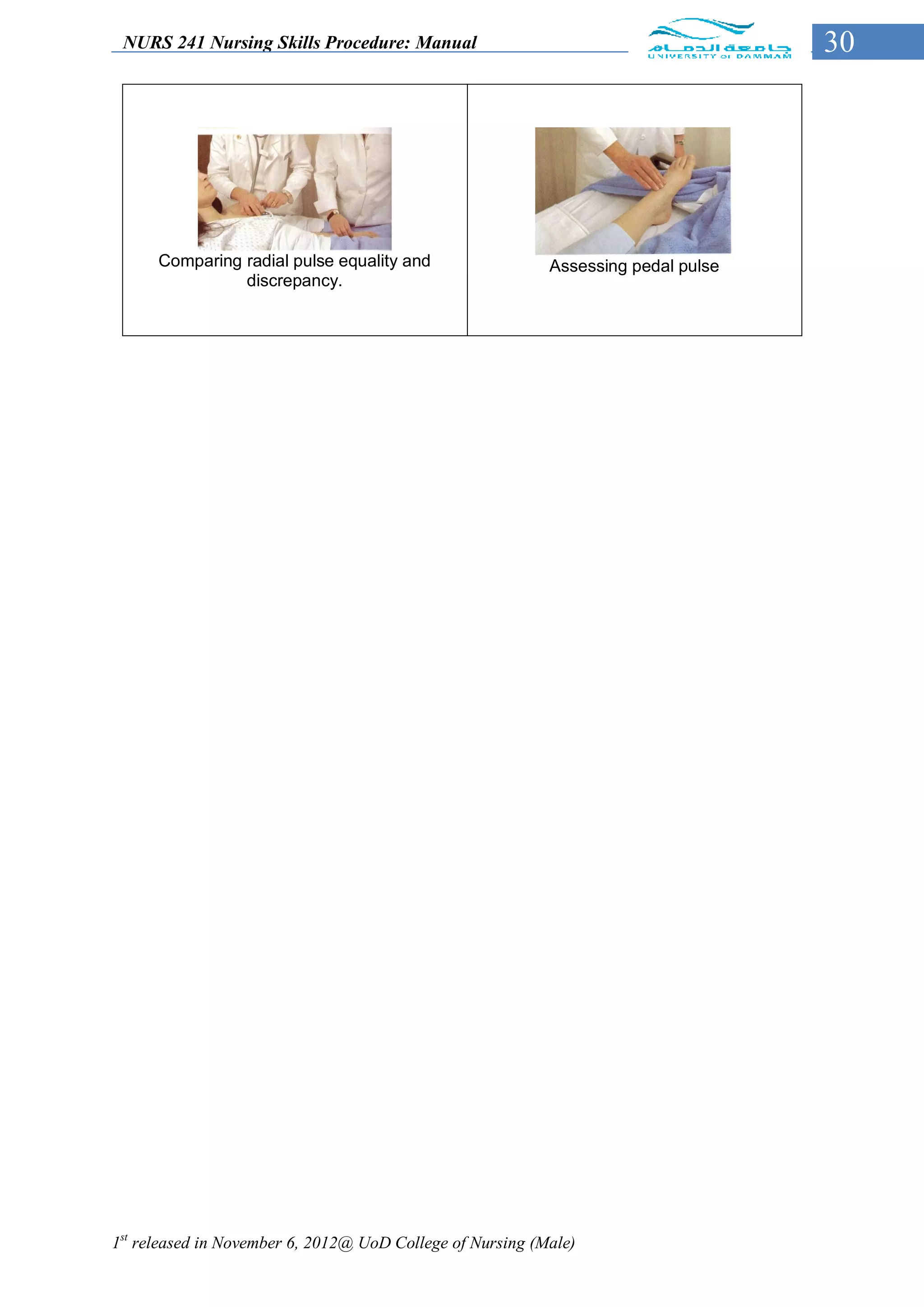
      Comparing radial pulse equality and                  Assessing pedal pulse
                discrepancy.


1st released in November 6, 2012@ UoD College of Nursing (Male)
NURS 241 Nursing Skills Procedure: Manual                        31


1st released in November 6, 2012@ UoD College of Nursing (Male)
NURS 241 Nursing Skills Procedure: Manual                                               32
                         ASSESSING RESPIRATION

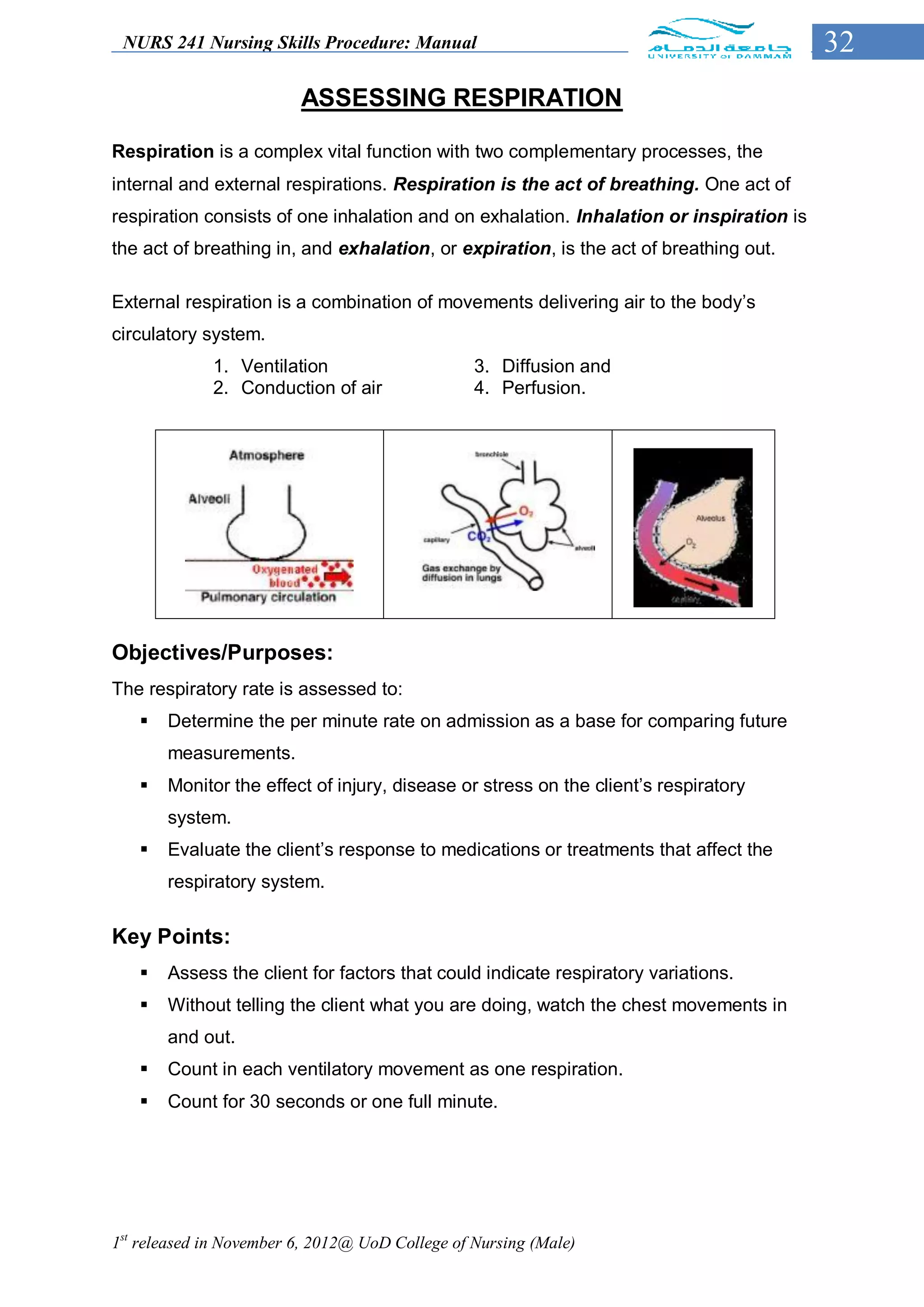
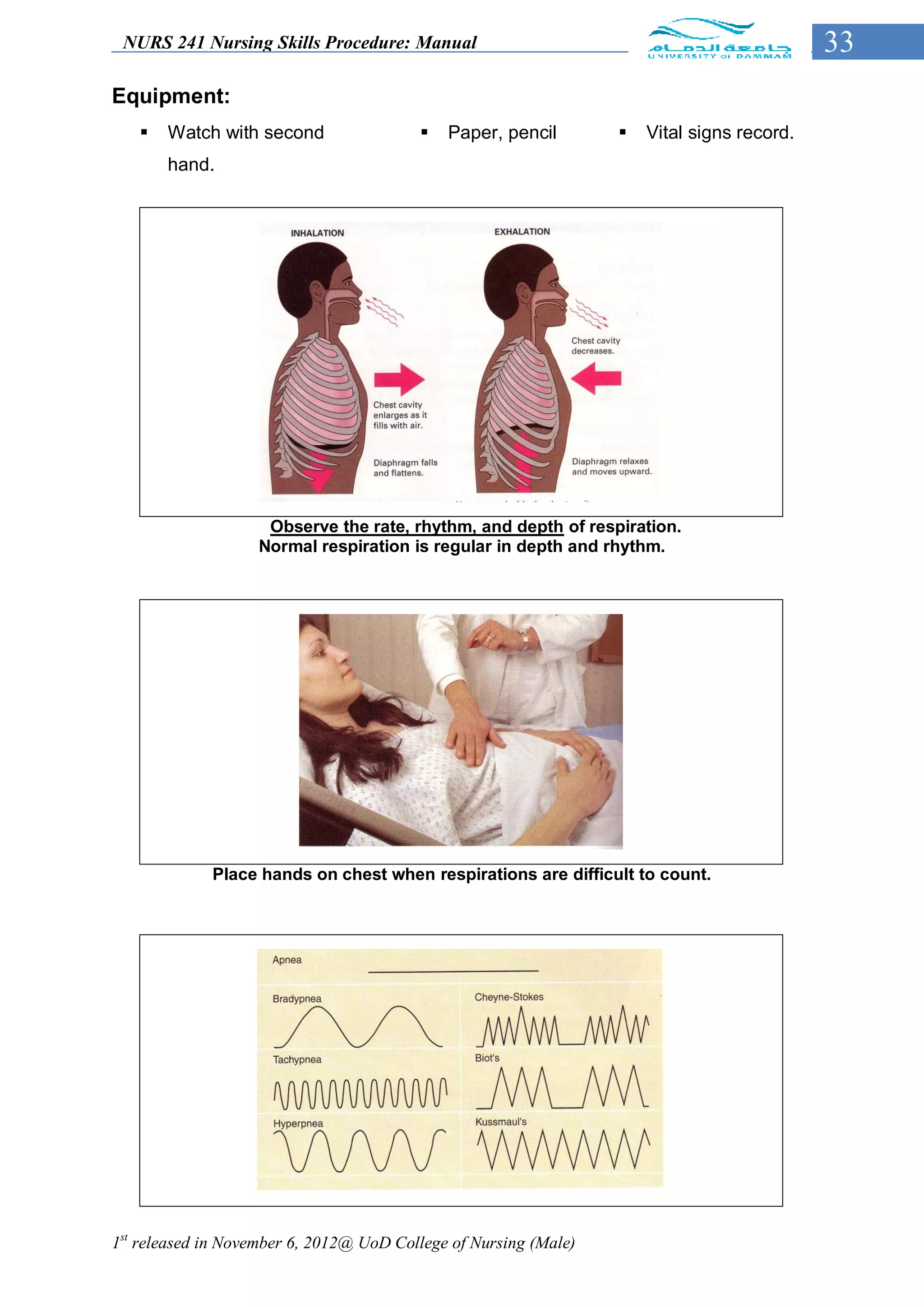
Respiration is a complex vital function with two complementary processes, the
internal and external respirations. Respiration is the act of breathing. One act of
respiration consists of one inhalation and on exhalation. Inhalation or inspiration is
the act of breathing in, and exhalation, or expiration, is the act of breathing out.

External respiration is a combination of movements delivering air to the body’s
circulatory system.
             1. Ventilation                      3. Diffusion and
             2. Conduction of air                4. Perfusion.


Objectives/Purposes:
The respiratory rate is assessed to:
      Determine the per minute rate on admission as a base for comparing future
       measurements.
      Monitor the effect of injury, disease or stress on the client’s respiratory
       system.
      Evaluate the client’s response to medications or treatments that affect the
       respiratory system.


Key Points:
      Assess the client for factors that could indicate respiratory variations.
      Without telling the client what you are doing, watch the chest movements in
       and out.
      Count in each ventilatory movement as one respiration.
      Count for 30 seconds or one full minute.


1st released in November 6, 2012@ UoD College of Nursing (Male)
NURS 241 Nursing Skills Procedure: Manual                                                  33
Equipment:
      Watch with second                    Paper, pencil           Vital signs record.
       hand.


                    Observe the rate, rhythm, and depth of respiration.
                   Normal respiration is regular in depth and rhythm.


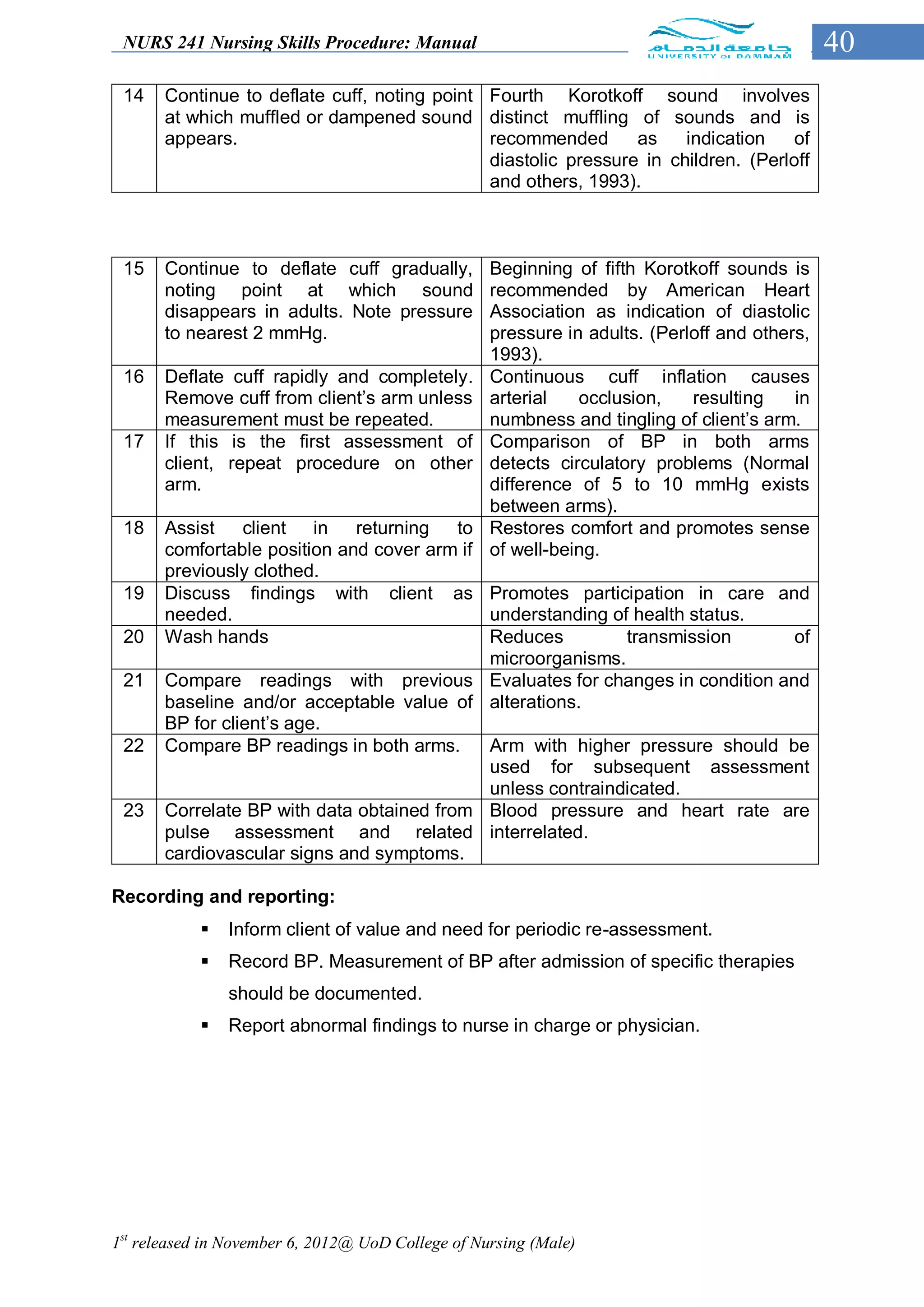
             Place hands on chest when respirations are difficult to count.


1st released in November 6, 2012@ UoD College of Nursing (Male)
NURS 241 Nursing Skills Procedure: Manual                                                     34
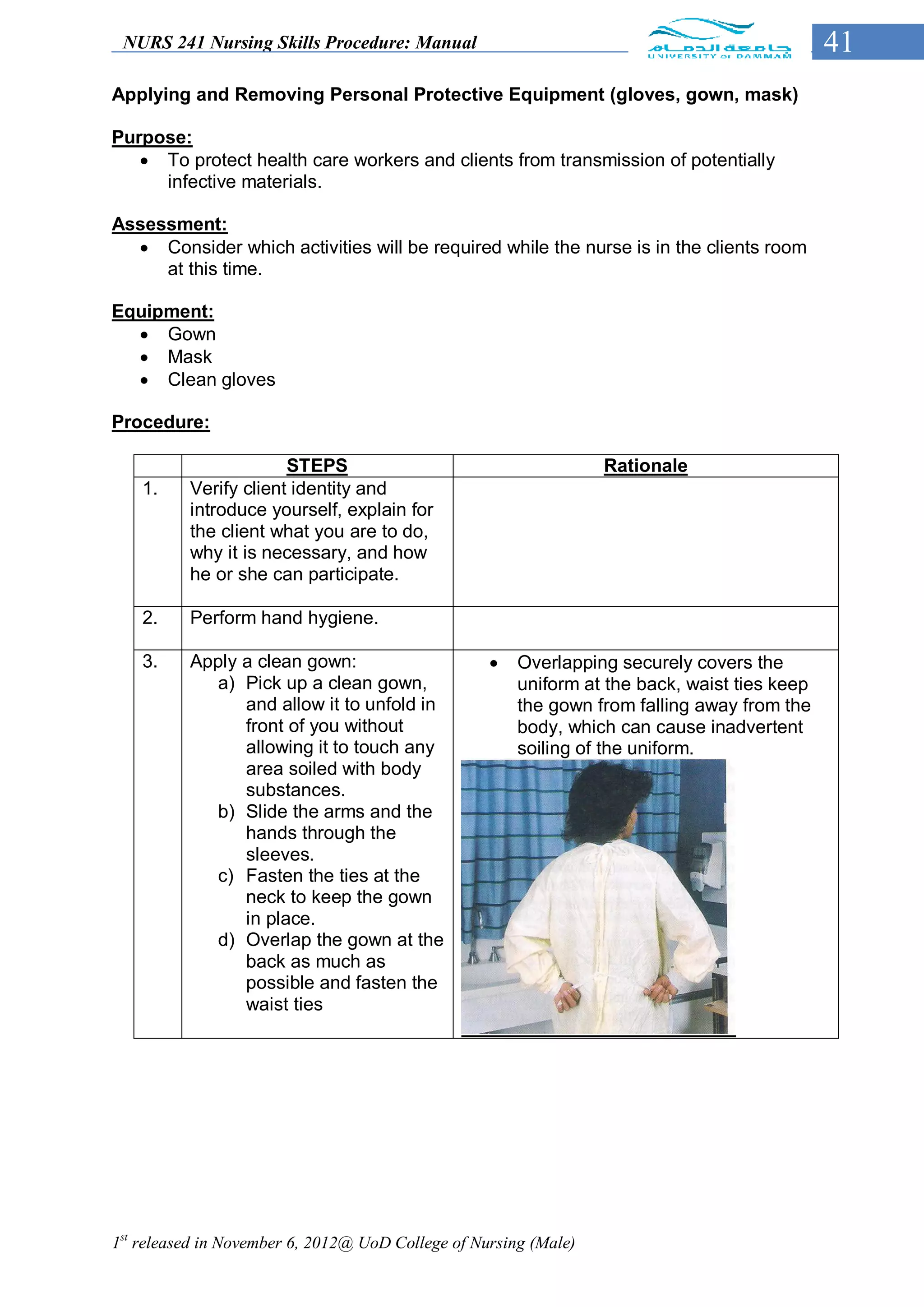
                               Abnormal Breathing Patterns


  Procedure:

                    STEPS                                         RATIONALE
 1 Determine need to assess client’s
   respirations:
  a Note risk factors for respiratory                 Certain conditions place client at
    alterations.                                      risk for alterations in ventilation
                                                      detected by changes in respiratory
                                                      rate, depth, and rhythm. Fever,
                                                      pain, anxiety, diseases of chest wall
                                                      or muscles, constrictive chest or
                                                      abdominal dressings, gastric
                                                      distention, chronic pulmonary
                                                      disease (emphysema, bronchitis,
                                                      asthma), traumatic injury to chest
                                                      wall with or without collapse of
                                                      underlying lung tissue, presence of
                                                      a chest tube, respiratory infection
                                                      (pneumonia, acute bronchitis),
                                                      pulmonary edema, and emboli,
                                                      head injury with damage to brain
                                                      stem, and anemia can result in
                                                      respiratory alteration.
   b Assess for signs and symptoms of                 Physical signs and symptoms may
     respiratory alterations such as bluish or        indicate alterations in respiratory
     cyanotic appearance of nail beds, lips,          status related to ventilation.
     mucous membranes, and skin;
     restlessness, irritability, confusion,
     reduced level of consciousness; pain
     during inspiration; labored or difficult
     breathing; adventitious sounds, inability
     to breathe spontaneously; thick, frothy,
     blood-tinge, or copious sputum
     produced on coughing.

 2 Assess pertinent laboratory values:
  a. Arterial blood gases (ABGs): normal              Arterial blood gases measure
     ABGs (values may vary slightly within            arterial blood pH, partial pressure of
     institutions.                                    O2, and CO2, and arterial O2
                                                      saturation, which reflects client’s
                                                      oxygenation.
  b. Pulse oxymetry (SpO2): normal SpO2 =             SpO2 less than 85% is often
     90% - 100%; 85% – 89% may be                     accompanied by changes in
     acceptable for certain chronic disease           respiratory rate, depth, and rhythm.
     conditions less than 85% is abnormal.


1st released in November 6, 2012@ UoD College of Nursing (Male)
NURS 241 Nursing Skills Procedure: Manual                                                   35
  c. Complete blood count (CBC): normal               Complete blood count measures red
     CBC for adults (values may vary within           blood cell count, volume of red
     institutions)                                    blood cells, and concentration of
                                                      hemoglobin, which reflects client’s
                                                      capacity to carry O2.
     1) Hemoglobin: 14 to 18 g/100 ml, males;
        12 to 16 g/100 ml, females.
     2) Hematocrit: 40% to 54%, males; 38% to
        47%, females.
     3) Red blood cell count: 4.6 to 6.2 million/μl,
        males; 4.2 to 5.4 million/μl, females.

 3 Determine previous baseline respiratory               Allows nurse to assess for
   rate (if available) from client’s record.             change in condition. Provides
                                                         comparison with future
                                                         respiratory measurements.
 4 Be sure client is in comfortable position,            Sitting erect promotes full
   preferably sitting or lying with the head of          ventilatory movement.
   the bed elevated 45 to 60 degrees.


Critical Decision Point:
Clients with difficulty of breathing (dyspnea) such as those with congestive heart
failure or abdominal ascites or in late stages of pregnancy should be assessed in
positions of greatest comfort. Repositioning may increase the work of breathing,
which will increase respiratory rate.


 5     Draw curtain around bed and/or close           Maintains privacy. Prevents
       door. Wash hands.                              transmission of microorganisms.
 6     Be sure client’s chest is visible. If          Ensures clear view of chest wall and
       necessary, move bed linen or gown.             abdominal movements.
 7     Place client’s arm in relaxed position         A similar position used during pulse
       across the abdomen or lower chest, or          assessment allows respiratory rate
       place nurse’s hands directly over client’s     assessment to be inconspicuous.
       upper abdomen.                                 Client’s or nurse’s hand rises and
                                                      falls during respiratory cycle.
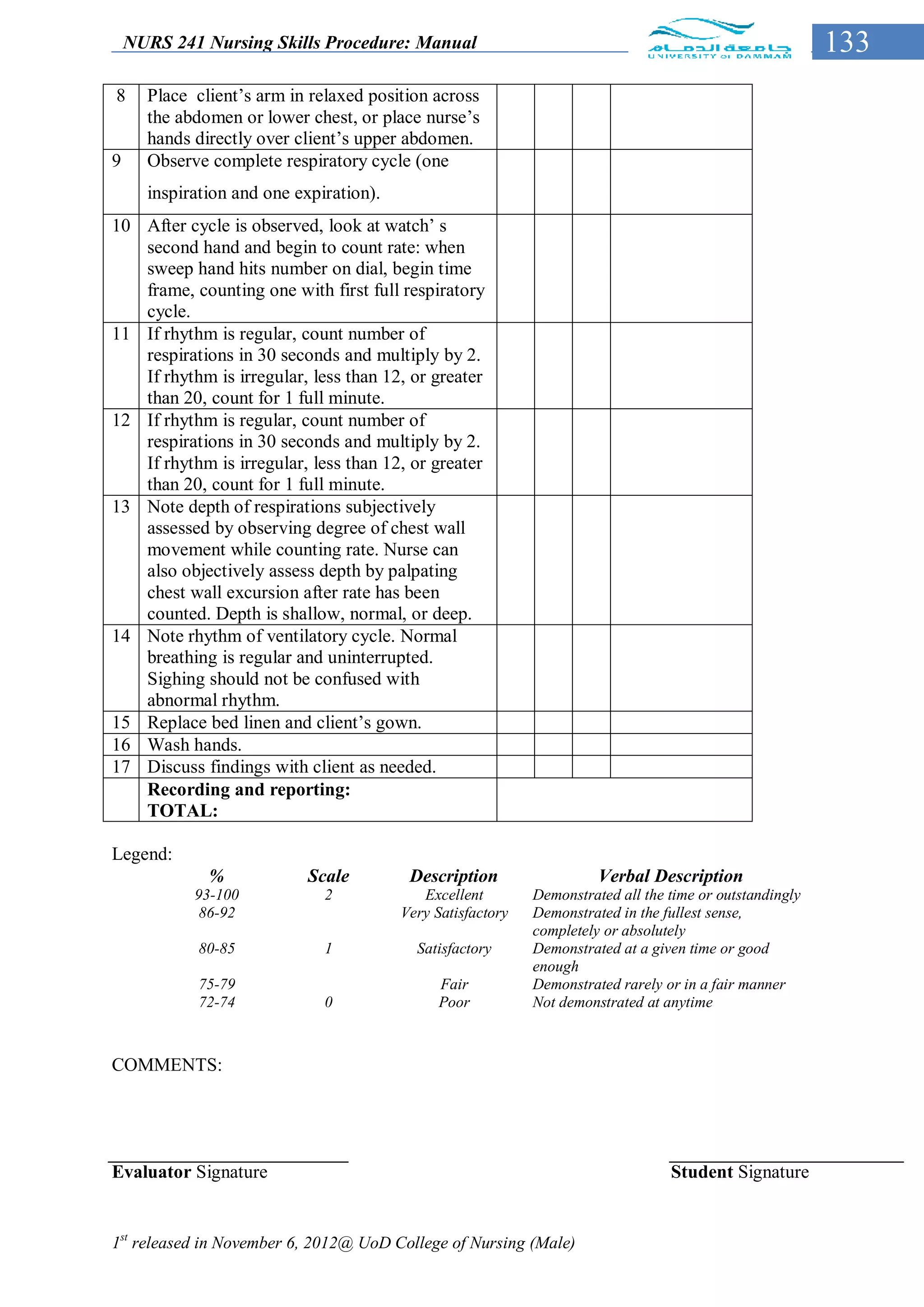
 8     Observe complete respiratory cycle (one        Rate is accurately determined only
       inspiration and one expiration).               after nurse has viewed respiratory
                                                      cycle.
 9  After cycle is observed, look at watch’ s         Timing begins with count of one.
    second hand and begin to count rate:              Respirations occur more slowly than
    when sweep hand hits number on dial,              pulse; thus timing does not begin
    begin time frame, counting one with first         with zero.
    full respiratory cycle.
 10 If rhythm is regular, count number of             Respiratory rate is equivalent to
    respirations in 30 seconds and multiply           number of respirations per minute.
    by 2. If rhythm is irregular, less than 12,       Suspected irregularities require
    or greater than 20, count for 1 full              assessment for at least 1 minute.
    minute.

1st released in November 6, 2012@ UoD College of Nursing (Male)
NURS 241 Nursing Skills Procedure: Manual                                                    36
 11 Note depth of respirations subjectively           Character of ventilatory movement
    assessed by observing degree of chest             may reveal specific disease state
    wall movement while counting rate.                restricting volume of air from moving
    Nurse can also objectively assess depth           into and out of the lungs.
    by palpating chest wall excursion after
    rate has been counted. Depth is shallow,
    normal, or deep.
 12 Note rhythm of ventilatory cycle. Normal          Character of ventilations can reveal
    breathing is regular and uninterrupted.           specific types of alterations.
    Sighing should not be confused with
    abnormal rhythm.
 13 Replace bed linen and client’s gown.              Restores comfort and promotes
                                                      sense of well-being.
 14 Wash hands.                                       Reduces transmission of
                                                      microorganisms.
 15 Discuss findings with client as needed.           Promotes participation in care and
                                                      understanding of health status.
 16 If respirations are assessed for the first        Used to compare future respiratory
    time, establish rate, rhythm, and depth           assessment.
    as baseline if within normal range.
 17 Compare respirations with client’s                Allows nurse to assess for changes
    previous baseline and normal rate,                in client’s condition and for
    rhythm, and depth.                                presence of respiratory alterations.


Recording and Reporting:
      Record respiratory rate and character in nurses’ notes or vital sign flow sheet.
       Indicate type and amount of oxygen therapy if used by client during
       assessment. Measurement of respiratory rate after administration of specific
       therapies should be documented in narrative form in nurses’ notes.
      Report abnormal findings to nurse in charge or physician.

Home care Considerations:
Assess for environmental factors in the home that may influence client’s respiratory
rate such as second-hand smoke, poor ventilation, or gas fumes.


1st released in November 6, 2012@ UoD College of Nursing (Male)
NURS 241 Nursing Skills Procedure: Manual                                              37
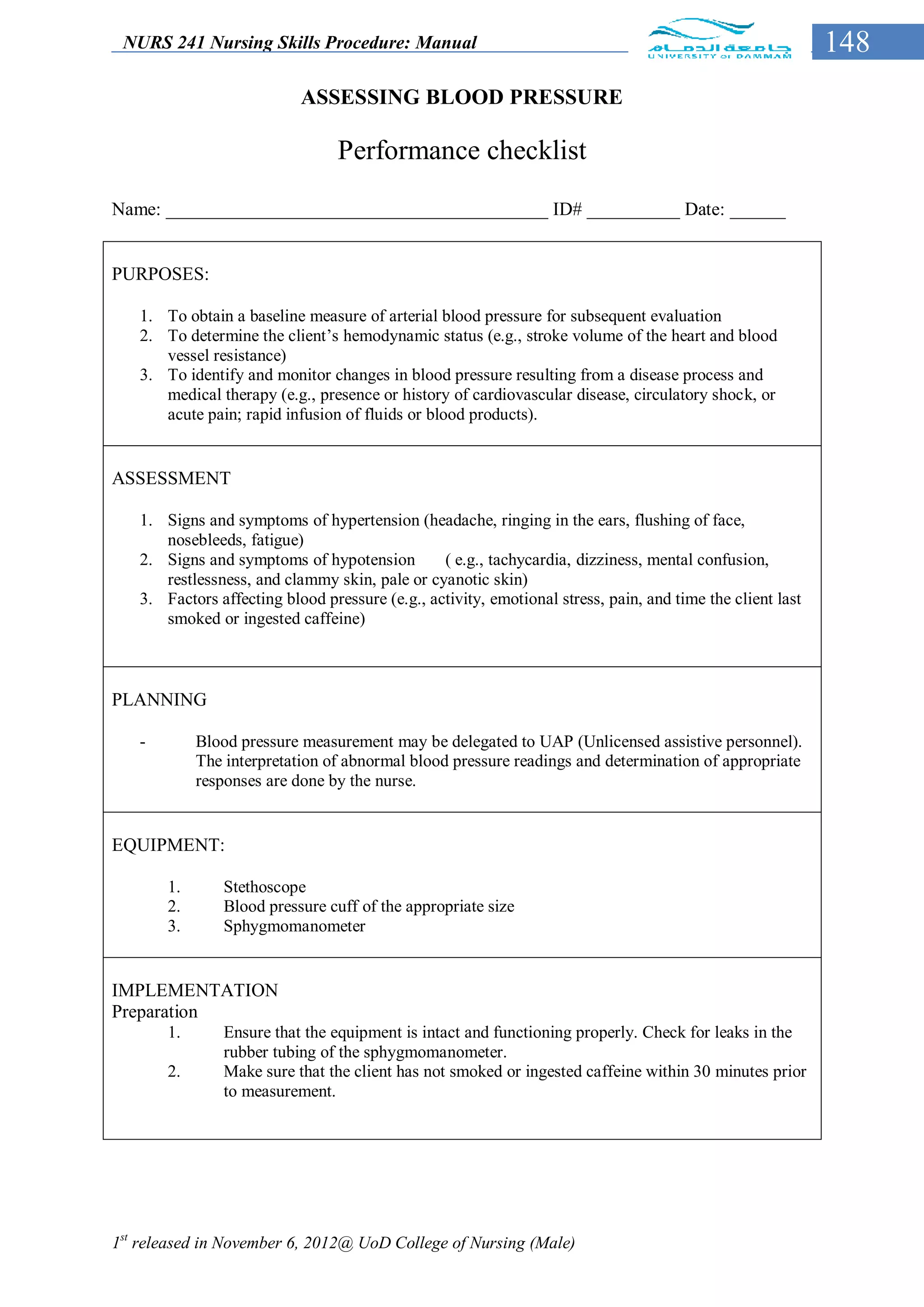
                     ASSESSING BLOOD PRESSURE


Definition:

Blood pressure is the force exerted produced by the volume of blood pressing on
the resisting walls of the arteries Blood pressure is commonly abbreviated BP. Its
measurement is expressed as a fraction.

The numerator or the upper figure is the systolic pressure/ systole (the phase
during which the heart works or contracts) and the denominator or the lower figure is
the diastolic pressure/ diastole (the heart’s resting phase).


The pressure is expressed in millimeters of mercury, abbreviated mmHg. Thus a
recording of
120/80 means systolic blood pressure was measured at 120 mmHg and the diastolic
blood pressure was measured at 80 mmHg. The difference between two readings is
called pulse pressure.


Blood is circulated through a loop involving the heart and blood vessels.


Purposes: The blood pressure is assessed by:

            1. Determine the systolic and diastolic pressure of the client during
               admission in order to compare his current status with normal changes.
            2. Acquire data that may be compared with subsequent changes that
               may occur during the care of the client.
            3. Assist in evaluating the status of the client’s blood volume, cardiac

1st released in November 6, 2012@ UoD College of Nursing (Male)
NURS 241 Nursing Skills Procedure: Manual                                                38
               output and vascular system.
            4. Evaluate the client’s response to changes in his medical condition as a
               result of treatment with fluids or medications.


Key Points:
            1. Blood pressure is the measurements of the pressure exerted by the
               blood on the walls of the arteries. The rate and force of the heartbeat
               determines the reading as the ventricles contract and rest.
            2. Do no take BP reading on person’s arm if:
                      is injured/diseased.
                      Is on the same side of body where a female has had a radical
                       mastectomy.
                      has a shunt or fistula for renal dialysis, or is site for an
                       intravenous infusion.

Equipment and Supplies:

            o Stethoscope                     o Blood pressure cuff of appropriate size
            o Sphygmomanometer – an aneroid or a mercury manometer may be
                available. The gauge should be inspected to validate that the needle
                or mercury is within the zero mark.
            o Alcohol swab                    o Paper, pencil, pen, V/S flow sheet or
                                                  record form


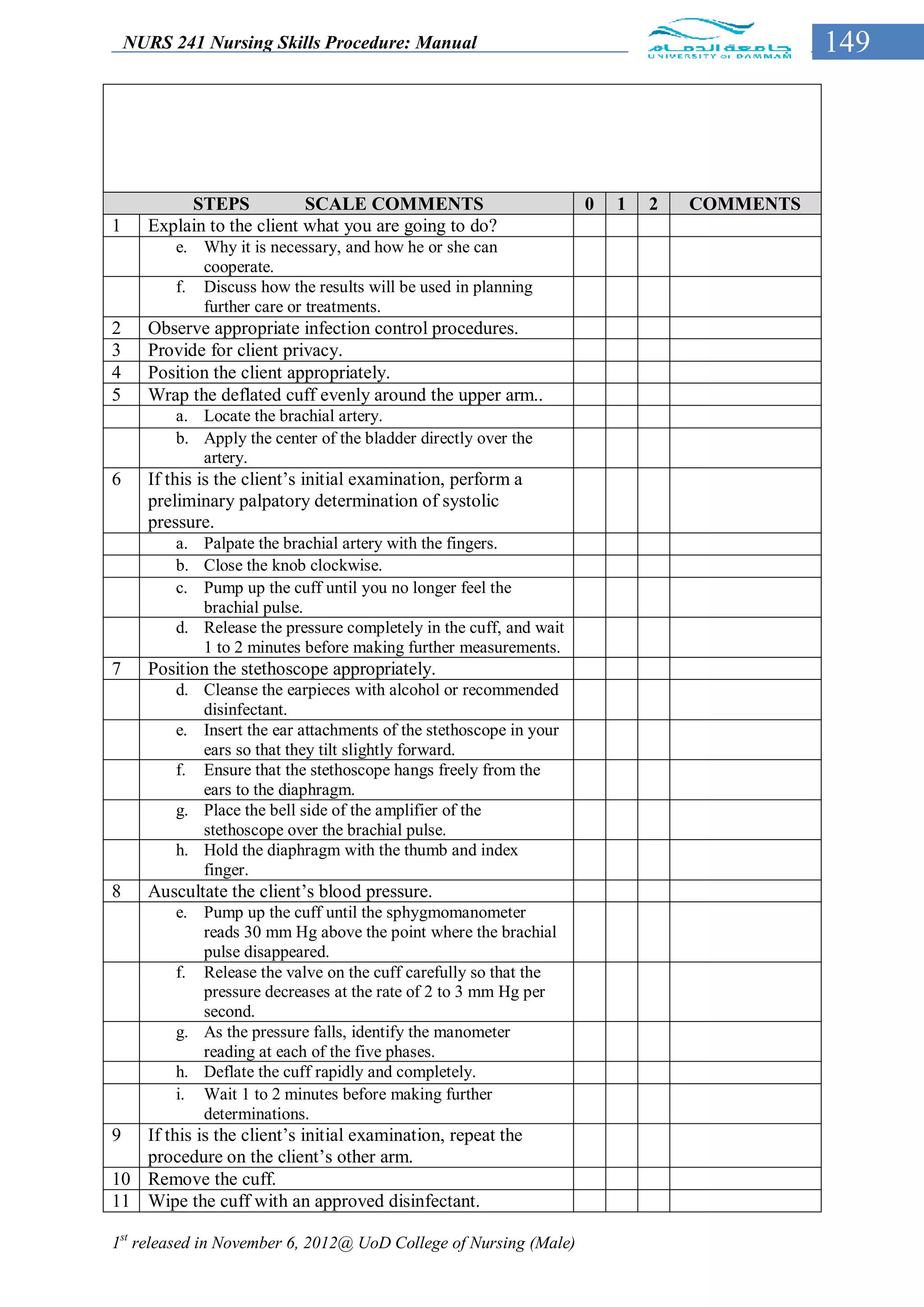
Procedure: AUSCULTATION METHOD


1st released in November 6, 2012@ UoD College of Nursing (Male)
NURS 241 Nursing Skills Procedure: Manual                                               39
                       STEPS                                 RATIONALE
  1    Wash hands.                            Reduces transmission of
                                              microorganisms.
  2    With client sitting or lying, position If arm is unsupported, client may
       client’s forearm, supported if needed, perform isometric exercise that can
       with palms turned up.                  increase diastolic pressure 10%.
                                              Placement of arm above the level of
                                              the heart causes false low reading.
  3    Expose upper arm fully by removing Ensures proper cuff application.
       constricting clothing.
  4    Palpate brachial artery. Position cuff Inflating bladder directly over brachial
       2.5 cm (1inch) above site of brachial artery ensures proper pressure is
       pulsation (antecubital space). Center applied during inflation. Loose-fitting
       bladder of cuff above artery. With     cuff causes false high readings.
       cuff fully deflated, wrap evenly and
       snugly around upper arm.
  5    Position manometer vertically at eye Accurate readings are obtained by
       level. Observer should be no farther looking at the meniscus of the mercury
       than 1 meter (approximately 1 yard) at eye level. The meniscus is the point
       away.                                  where the crescent-shaped top of the
                                              mercury column aligns with the
                                              manometer scale. Looking up or down
                                              at the mercury results in distorted
                                              readings.
  6    Palpate brachial or radial artery with Identifies      approximate     systolic
       fingertips of one hand while inflating pressure and determines maximal
       cuff rapidly to pressure 30 mmHg inflation point for accurate reading.
       above point at which pulse Prevents auscultatory gap. If unable to
       disappears.                            palpate artery because of weakened
                                              pulse, an ultrasonic stethoscope can
                                              be used.
  7    Deflate cuff fully and wait 30 Prevents venous congestion and false
       seconds.                               high readings.
  8    Place stethoscope earpieces in ears Each earpiece should follow angle of
       and be sure sounds are clear, not ear canal to facilitate hearing.
       muffled,
  9    Relocate brachial artery and place Proper           stethoscope     placement
       bell or diaphragm (chest piece) of the ensures optimal sound reception.
       stethoscope over it. Do not allow Stethoscope improperly positioned
       chest piece to touch cuff or clothing. causes muffled sounds that often
                                              result in false low systolic and false
                                              high readings.
 10    Close valve of pressure bulb Tightening of valve prevents air leak
       clockwise until tight.                 during inflation.
 11    Inflate cuff to 30 mmHg above Ensures accurate measurement of
       palpated systolic pressure.            systolic pressure.
 12    Slowly release valve and allow Too rapid or slow a decline in mercury
       mercury to fall at rate of 2 to 3 level can cause inaccurate readings.
       mmHg/sec.
 13    Note point on manometer when first First Korotkoff sound indicates systolic
       clear sound is heard.                  pressure.


1st released in November 6, 2012@ UoD College of Nursing (Male)
NURS 241 Nursing Skills Procedure: Manual                                                    40
 14    Continue to deflate cuff, noting point Fourth Korotkoff sound involves
       at which muffled or dampened sound distinct muffling of sounds and is
       appears.                               recommended       as    indication    of
                                              diastolic pressure in children. (Perloff
                                              and others, 1993).


 15    Continue to deflate cuff gradually,         Beginning of fifth Korotkoff sounds is
       noting point at which sound                 recommended by American Heart
       disappears in adults. Note pressure         Association as indication of diastolic
       to nearest 2 mmHg.                          pressure in adults. (Perloff and others,
                                                   1993).
 16    Deflate cuff rapidly and completely.        Continuous cuff inflation causes
       Remove cuff from client’s arm unless        arterial   occlusion,    resulting    in
       measurement must be repeated.               numbness and tingling of client’s arm.
 17    If this is the first assessment of          Comparison of BP in both arms
       client, repeat procedure on other           detects circulatory problems (Normal
       arm.                                        difference of 5 to 10 mmHg exists
                                                   between arms).
 18    Assist    client in    returning   to       Restores comfort and promotes sense
       comfortable position and cover arm if       of well-being.
       previously clothed.
 19    Discuss findings with client as Promotes participation in care and
       needed.                               understanding of health status.
 20    Wash hands                            Reduces         transmission     of
                                             microorganisms.
 21    Compare readings with previous Evaluates for changes in condition and
       baseline and/or acceptable value of alterations.
       BP for client’s age.
 22    Compare BP readings in both arms.     Arm with higher pressure should be
                                             used for subsequent assessment
                                             unless contraindicated.
 23    Correlate BP with data obtained from Blood pressure and heart rate are
       pulse assessment and related interrelated.
       cardiovascular signs and symptoms.

Recording and reporting:
               Inform client of value and need for periodic re-assessment.
               Record BP. Measurement of BP after admission of specific therapies
                should be documented.
               Report abnormal findings to nurse in charge or physician.


1st released in November 6, 2012@ UoD College of Nursing (Male)
NURS 241 Nursing Skills Procedure: Manual                                                    41
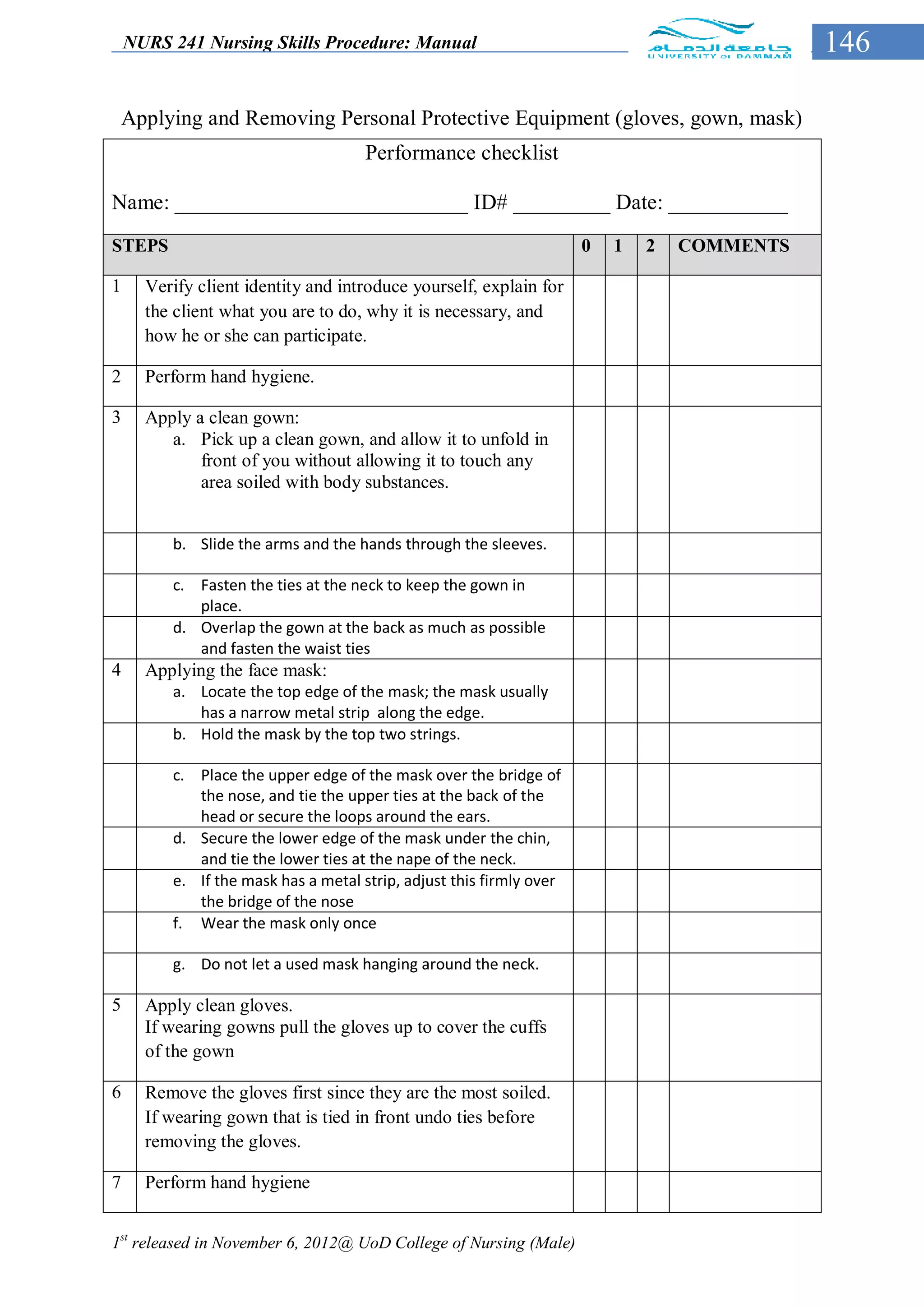
Applying and Removing Personal Protective Equipment (gloves, gown, mask)

Purpose:
    To protect health care workers and clients from transmission of potentially
     infective materials.

Assessment:
   Consider which activities will be required while the nurse is in the clients room
     at this time.

Equipment:
   Gown
   Mask
   Clean gloves

Procedure:

                       STEPS                                      Rationale
    1.    Verify client identity and
          introduce yourself, explain for
          the client what you are to do,
          why it is necessary, and how
          he or she can participate.

    2.    Perform hand hygiene.

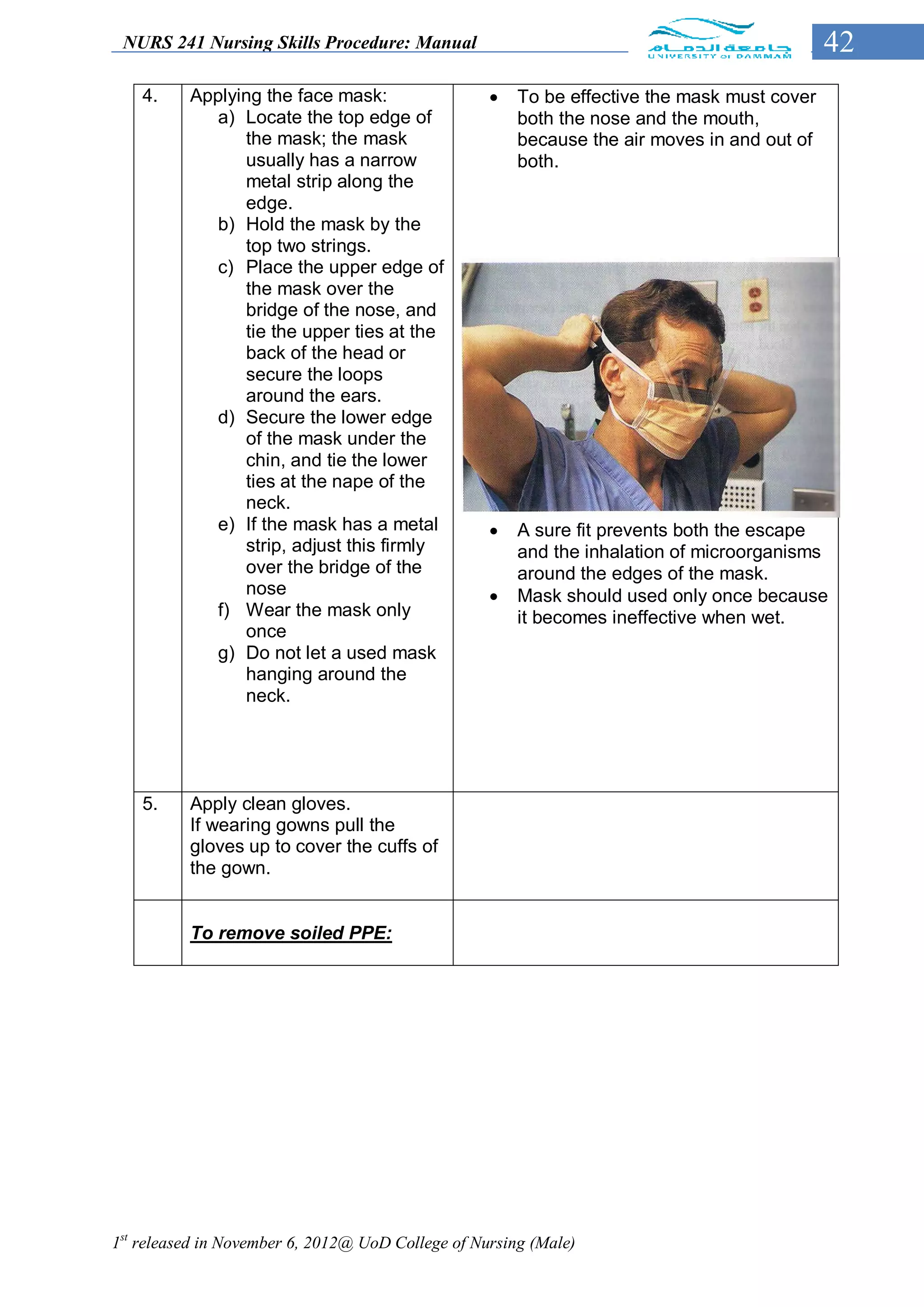
    3.    Apply a clean gown:                         Overlapping securely covers the
             a) Pick up a clean gown,                  uniform at the back, waist ties keep
                and allow it to unfold in              the gown from falling away from the
                front of you without                   body, which can cause inadvertent
                allowing it to touch any               soiling of the uniform.
                area soiled with body
                substances.
             b) Slide the arms and the
                hands through the
                sleeves.
             c) Fasten the ties at the
                neck to keep the gown
                in place.
             d) Overlap the gown at the
                back as much as
                possible and fasten the
                waist ties


1st released in November 6, 2012@ UoD College of Nursing (Male)
NURS 241 Nursing Skills Procedure: Manual                                                   42
    4.    Applying the face mask:                     To be effective the mask must cover
             a) Locate the top edge of                 both the nose and the mouth,
                the mask; the mask                     because the air moves in and out of
                usually has a narrow                   both.
                metal strip along the
                edge.
             b) Hold the mask by the
                top two strings.
             c) Place the upper edge of
                the mask over the
                bridge of the nose, and
                tie the upper ties at the
                back of the head or
                secure the loops
                around the ears.
             d) Secure the lower edge
                of the mask under the
                chin, and tie the lower
                ties at the nape of the
                neck.
             e) If the mask has a metal               A sure fit prevents both the escape
                strip, adjust this firmly              and the inhalation of microorganisms
                over the bridge of the                 around the edges of the mask.
                nose                                  Mask should used only once because
             f) Wear the mask only                     it becomes ineffective when wet.
                once
             g) Do not let a used mask
                hanging around the
                neck.


    5.    Apply clean gloves.
          If wearing gowns pull the
          gloves up to cover the cuffs of
          the gown.


          To remove soiled PPE:


1st released in November 6, 2012@ UoD College of Nursing (Male)
NURS 241 Nursing Skills Procedure: Manual                                               43
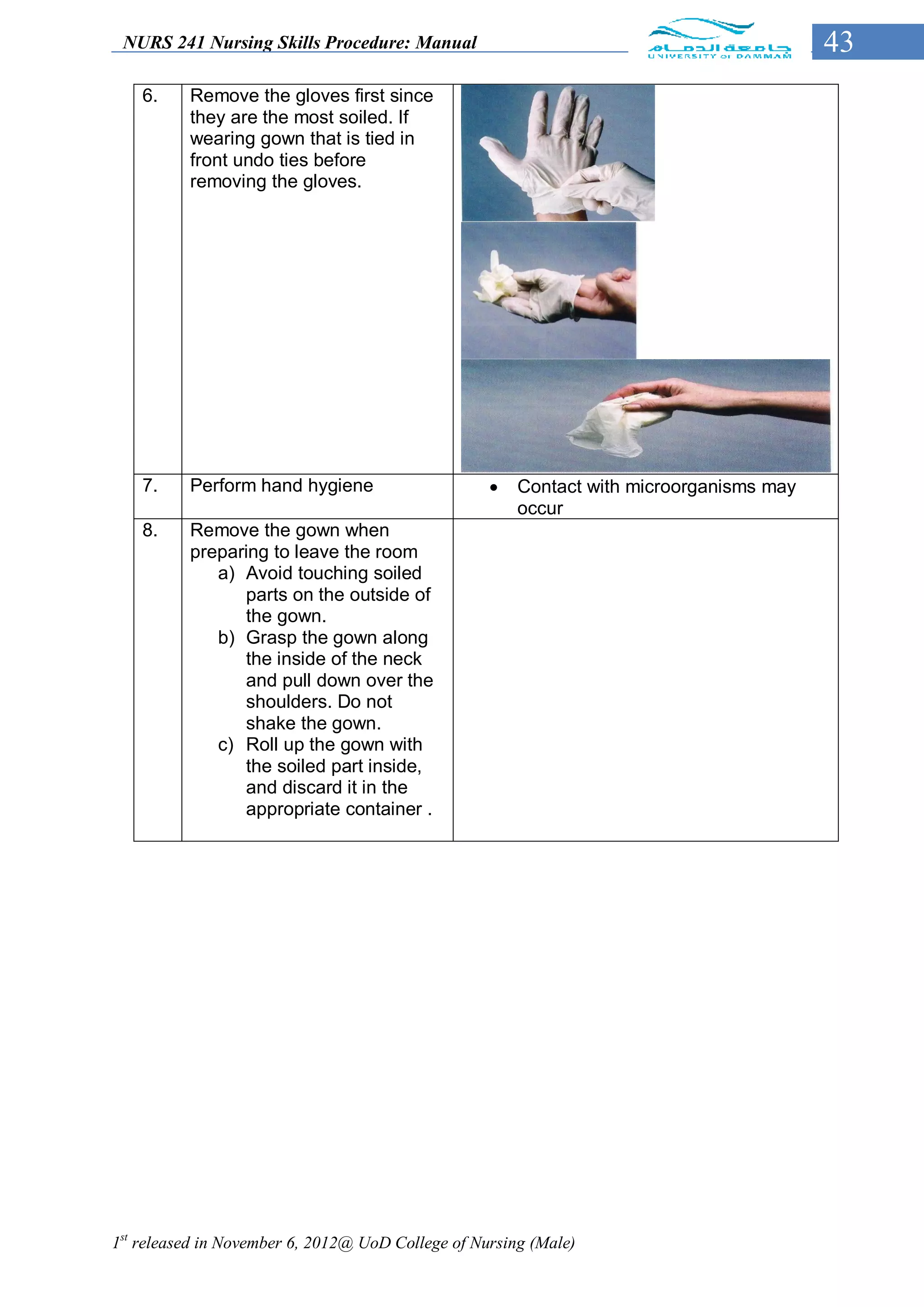
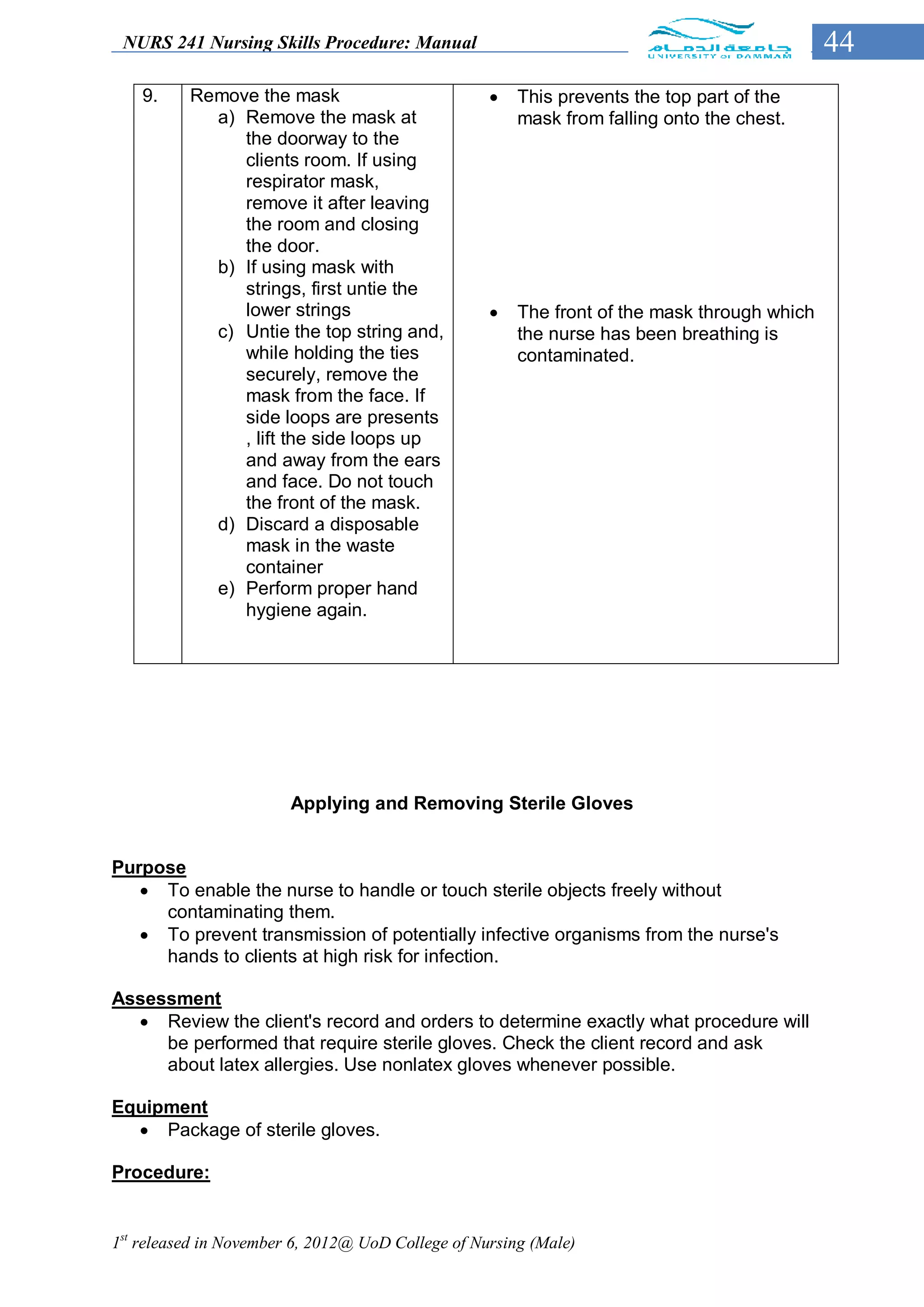
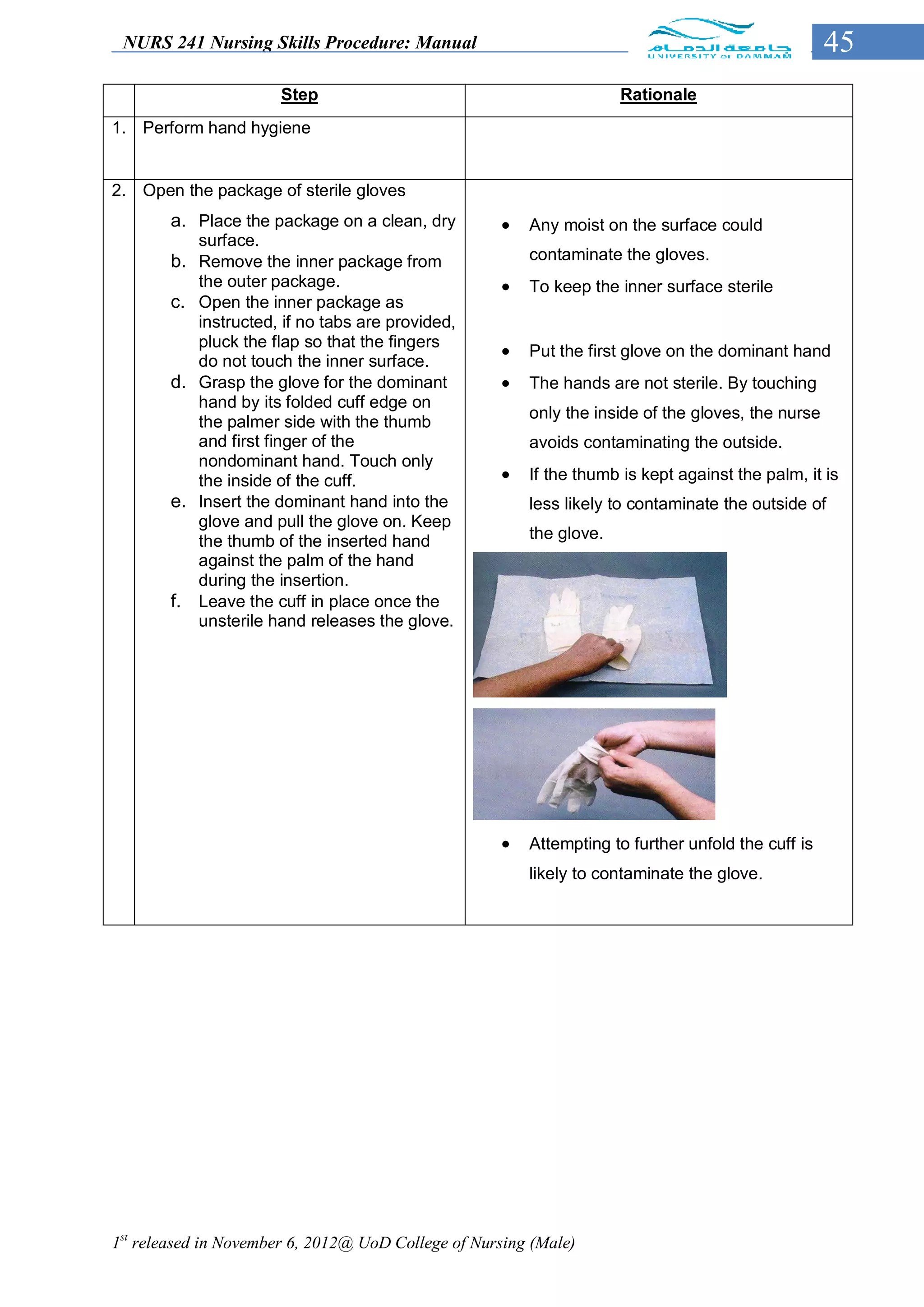
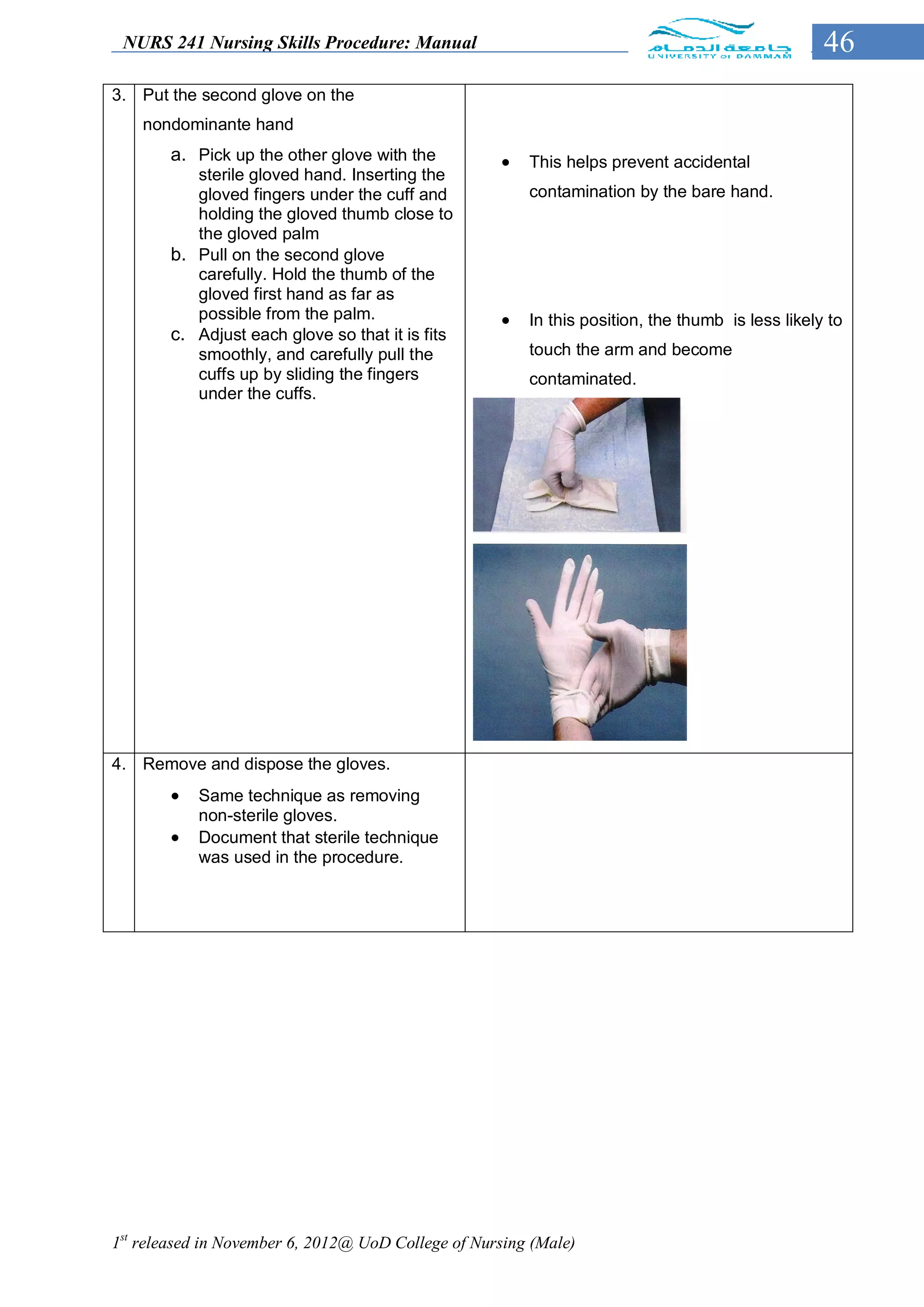
    6.    Remove the gloves first since
          they are the most soiled. If
          wearing gown that is tied in
          front undo ties before
          removing the gloves.


    7.    Perform hand hygiene                        Contact with microorganisms may
                                                       occur
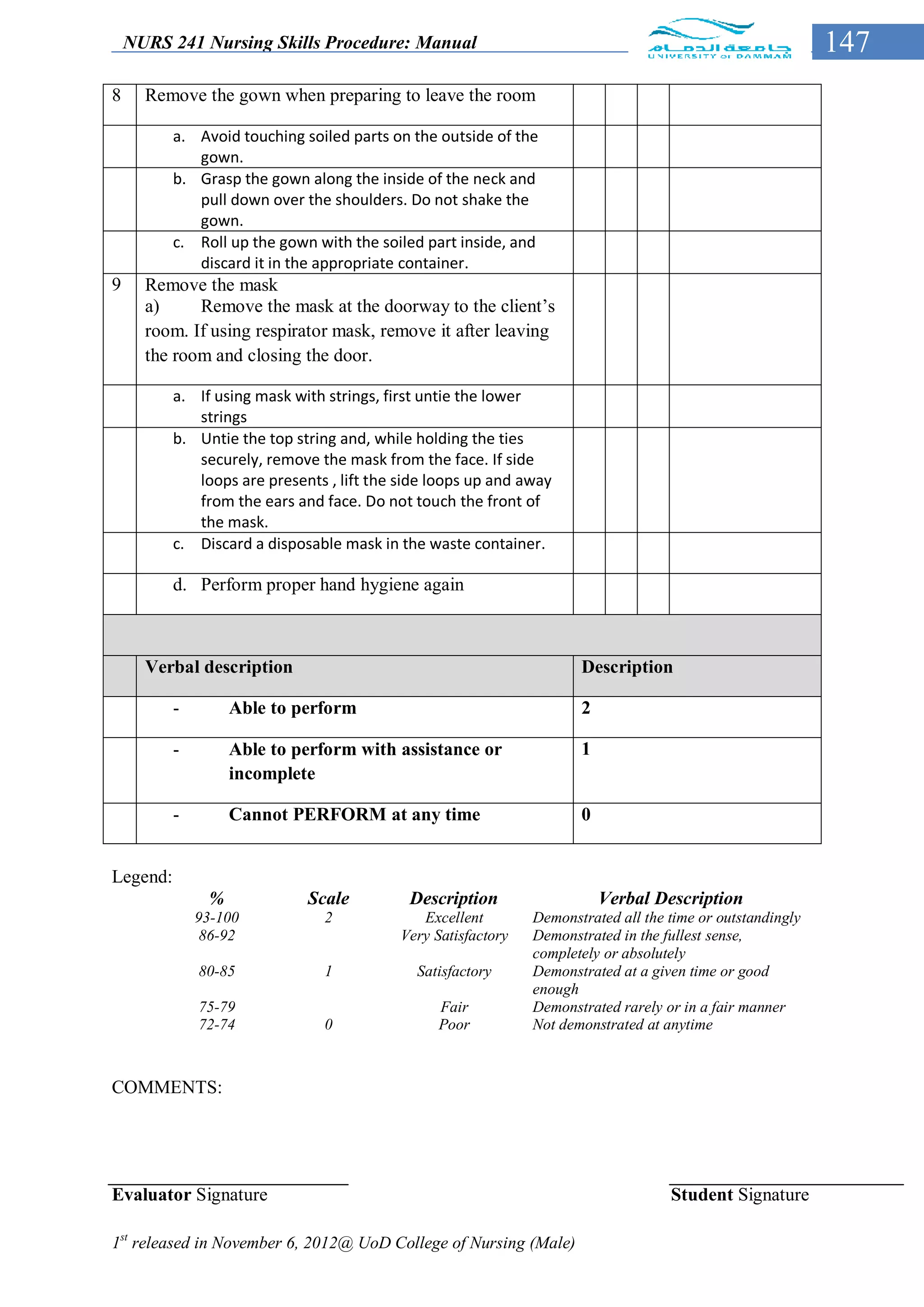
    8.    Remove the gown when
          preparing to leave the room
             a) Avoid touching soiled
                parts on the outside of
                the gown.
             b) Grasp the gown along
                the inside of the neck
                and pull down over the
                shoulders. Do not
                shake the gown.
             c) Roll up the gown with
                the soiled part inside,
                and discard it in the
                appropriate container .


1st released in November 6, 2012@ UoD College of Nursing (Male)
NURS 241 Nursing Skills Procedure: Manual                                                   44
    9.    Remove the mask                             This prevents the top part of the
            a) Remove the mask at                      mask from falling onto the chest.
               the doorway to the
               clients room. If using
               respirator mask,
               remove it after leaving
               the room and closing
               the door.
            b) If using mask with
               strings, first untie the
               lower strings                          The front of the mask through which
            c) Untie the top string and,               the nurse has been breathing is
               while holding the ties                  contaminated.
               securely, remove the
               mask from the face. If
               side loops are presents
               , lift the side loops up
               and away from the ears
               and face. Do not touch
               the front of the mask.
            d) Discard a disposable
               mask in the waste
               container
            e) Perform proper hand
               hygiene again.


                        Applying and Removing Sterile Gloves


Purpose
    To enable the nurse to handle or touch sterile objects freely without
     contaminating them.
    To prevent transmission of potentially infective organisms from the nurse's
     hands to clients at high risk for infection.

Assessment
   Review the client's record and orders to determine exactly what procedure will
     be performed that require sterile gloves. Check the client record and ask
     about latex allergies. Use nonlatex gloves whenever possible.

Equipment
   Package of sterile gloves.

Procedure:


1st released in November 6, 2012@ UoD College of Nursing (Male)
NURS 241 Nursing Skills Procedure: Manual                                                         45
                        Step                                         Rationale
1. Perform hand hygiene


2. Open the package of sterile gloves
        a. Place the package on a clean, dry           Any moist on the surface could
             surface.
        b.   Remove the inner package from              contaminate the gloves.
             the outer package.                        To keep the inner surface sterile
        c.   Open the inner package as
             instructed, if no tabs are provided,
             pluck the flap so that the fingers
                                                       Put the first glove on the dominant hand
             do not touch the inner surface.
        d.   Grasp the glove for the dominant          The hands are not sterile. By touching
             hand by its folded cuff edge on
                                                        only the inside of the gloves, the nurse
             the palmer side with the thumb
             and first finger of the                    avoids contaminating the outside.
             nondominant hand. Touch only
             the inside of the cuff.                   If the thumb is kept against the palm, it is
        e.   Insert the dominant hand into the          less likely to contaminate the outside of
             glove and pull the glove on. Keep
             the thumb of the inserted hand             the glove.
             against the palm of the hand
             during the insertion.
        f.   Leave the cuff in place once the
             unsterile hand releases the glove.


                                                       Attempting to further unfold the cuff is
                                                        likely to contaminate the glove.


1st released in November 6, 2012@ UoD College of Nursing (Male)
NURS 241 Nursing Skills Procedure: Manual                                                        46
3. Put the second glove on the
    nondominante hand
        a. Pick up the other glove with the            This helps prevent accidental
           sterile gloved hand. Inserting the
           gloved fingers under the cuff and            contamination by the bare hand.
           holding the gloved thumb close to
           the gloved palm
        b. Pull on the second glove
           carefully. Hold the thumb of the
           gloved first hand as far as
           possible from the palm.                     In this position, the thumb is less likely to
        c. Adjust each glove so that it is fits
           smoothly, and carefully pull the             touch the arm and become
           cuffs up by sliding the fingers              contaminated.
           under the cuffs.


4. Remove and dispose the gloves.
           Same technique as removing
            non-sterile gloves.
           Document that sterile technique
            was used in the procedure.


1st released in November 6, 2012@ UoD College of Nursing (Male)
NURS 241 Nursing Skills Procedure: Manual                                                     47

                      CHANGING AN OCCUPIED BED
PURPOSES

1.  To conserve the client’s energy
2.  To promote client comfort.
3.  To provide a clean, neat environment for the client
4.  To provide a smooth, wrinkle-free bed foundation, thus minimizing sources of
    skin irritation
                     ASSESSMENT                                               Rationale
     Assess
1 Skin condition and need for a special mattress
     (e.g., an egg-crate mattress), footboard, bed
     cradle, or heel protectors)
2 Client’s ability to reposition self.                        This will determine if additional
                                                              assistance is needed.
3 Determine presence of incontinence or excessive
     drainage from other sources indicating the need
     for protective waterproof pads.
4 Note specific orders or precautions for moving and
     positioning the client.
PLANNING
Delegation
Bed-making is usually delegated to UAP (Unlicensed Assistive Personnel). Inform. Inform the UAP to
what extent the client can assist or if another person will be needed to assist the UAP.
Instruct the UAP about the handling of any dressing and/or tubes of the client and also the
need for special equipment (e.g., footboard, heel protectors), if appropriate.
EQUIPMENT
    1. Two flat or one fitted and one flat sheet
    2. Cloth draw sheet (optional)
    3. One blanket
    4. One bedspread
    5. Pillowcase(s) for the head pillow(s)
    6. Waterproof drawsheet or waterproof pads (optional)
    7. Plastic laundry bag or portable lines hamper, if available

IMPLEMENTATION
Preparation

Determine what lines the client may already have                  This avoids stockpiling of
in the room to avoid stockpiling of the                           unnecessary extra linens.
unnecessary extra linens
                       Performance                                           Rationale
1 Prior to performing the procedure, introduce self
     and verify the client’s identity using agency
     protocol. Explain to the client what you are going
     to do, why it is necessary, and how he or she can
     cooperate.
2 Perform hand hygiene and observe other
     appropriate infection control procedures. Apply
     clean gloves if linens is soiled with body fluids.
1st released in November 6, 2012@ UoD College of Nursing (Male)
NURS 241 Nursing Skills Procedure: Manual                                                                48
3     Provide for client privacy.
4     Remove the top bedding.
      a Remove any equipment attached to the linen,
         such as signal light.
      b Loosen all top linen at the foot of the bed, and
         remove the spread and the blanket.
      c Leave the top sheet over the client (the top
         sheet can remain over the client if it is being
         changed and if it will provide sufficient
         warmth), or replace it with a bath blanket as
         follows:
         a Spread the bath blanket over the top sheet.
         b Ask the client to hold the top edge of the
             blanket.
         c Reaching under the blanket from the side,                 (1)       Removing top linens under a bath
                                                                           blanket.
             grasp the top edge of the sheet and draw it
             down to the foot of the bed. Leaving the
             blanket in place. ( 1 )
         d Remove the sheet from the bed and place
             it in the soiled linen hamper.
5     Change the bottom sheet and draw sheet.
      a Raise the side rail that the client will turn             This protects clients from falling
         toward. If there is no side rail, have another           and allows them to support
         nurse support the client at the edge of the bed.         themselves in the side-lying
                                                                  position.
      b   Assist the client to turn on the side away from
          the nurse and toward the raised side rail.
      c   Loosen the bottom linens on the side of the
          bed near the nurse.
      d   Fanfold the dirty linen (e.g., draw sheet and
          the bottom sheet toward the center of the bed.
          (2) As close to and under the client as
          possible.

                                                                     (2)   Moving soiled linen as close to the
                                                                           client as possible.
                                                                  Doing this leaves the near half of
                                                                  the bed free to be changed.
      e   Place the new bottom sheet on the bed, and
          vertically fanfold the half to be used on the far
          side of the bed as close to the client as
          possible. (3) Tuck the sheet under the near
          half of the bed and miter the corner if a contour
          sheet is not being used.


                                                                     (3)   Placing new bottom sheet on half of the
                                                                           bed.


1st released in November 6, 2012@ UoD College of Nursing (Male)
NURS 241 Nursing Skills Procedure: Manual                                                                    49
      f   Place the clean drawsheet on the bed with the
          center fold at the center of the bed. Fanfold the
          uppermost half vertically at the center of the
          bed and tuck the near side edge under the
          side of the mattress. (4)


                                                                       (4)   Placing clean drawsheet on the bed.
      g  Assist the client to roll over toward you, over
         the fanfold bed linens at the center of the bed,
         onto the clean side of the bed.
      h Move the pillows to the clean side for the
         client’s use. Raise the side rail before leaving
         the side of the bed.
      i Move to the other side of the bed and lower
         the side rail.
      j Remove the used linen and place it in the
         portable hamper.
      k Unfold the fanfold bottom sheet from the
         center of the bed.
      l Facing the side of the bed, use both hands to
         pull the bottom sheet so that it is smooth and
         tuck the excess under the side of the mattress.
      m Unfold the drawsheet fanfold at the center of
         the bed and full it tightly with both hands. Pull
         the sheet in three divisions: (a) face the side of
         the bed to pull the middle division, (b) face the
         far top corner to pull the bottom division, and
         (c) face the far bottom corner to pull top
         division.
      n Tuck the excess drawsheet under the side of
         the mattress.
6     Reposition the client in the center of the bed.
      a Reposition the pillows at the center of the bed.
      b Assist the client to the center of the bed.
         Determine what position the client requires or
         prefers and assist the client to that position.
7     Apply or complete the top bedding.
      a Spread the top sheet over the client and either
         ask the client to hold the top edge of the sheet
         or tuck it under the shoulders. The sheet
         should remain over the client when the bath
         blanket or used sheet is removed. (5)


                                                                  (5)Client hold top edge of sheet while nurse
                                                                  removes bath blanket.
      b Complete the top of the bed.
8     Ensure continued safety of the client.
      a Raise the de rails. Place the bed in the low
         position before leaving the bedside.

1st released in November 6, 2012@ UoD College of Nursing (Male)
NURS 241 Nursing Skills Procedure: Manual                                                        50
     Attach the call light bed linen within the client’s
      b
     reach
   c Put items used by the client within easy reach.
9 Bed-making is not normally recorded.
EVALUATION
      Conduct appropriate follow up, such as determining
       client’s comfort and safety. Patency of all dranage
       tubes, and client’s access to call light to summon
       help when needed.
      Reassess all tubing, oxygen apparatus, IV pumps,           This prevents errors in
       and so forth.
                                                                  supportive devices resulting from
                                                                  procedure.


                    CHANGING AN UNOCCUPIED BED
PURPOSES

     1. To promote the client comfort
     2. To provide a clean neat environment for the client
     3. To provide a smooth, wrinkle-free bed foundation, thus minimizing sources of skin
        irritation

                          STEPS                                                 Rationale
      Assess
                                                                  In some hospital it is necessary
1     Client’s health status to determine that the person         to have a written order to get out
      can safely get out of bed.                                  of bed if the client has been in
                                                                  bed continuously.
                                                                  Client may experience postural
2     Client’s BP, pulse and respirations if indicated.           hypotension when moved from a
                                                                  lying position to standing to
                                                                  sitting, particularly if it is the first
                                                                  time out of bed for awhile.
3     Client’s mobility status.                                   This may influence the need for
                                                                  additional assistance with
                                                                  transferring the client from the
                                                                  bed to a chair.
4     Tubes and equipment connected to the client.                This may influence the need for
                                                                  additional linens or waterproof
                                                                  pads.
PLANNING

Delegation
Bed-making is usually delegated to UAP (Unlicensed Assistive Personnel). If appropriate, inform the
UAP of the proper disposal method of linens that contain drainage. Ask the UAP to inform
you immediately if any tubes or dressings become dislodged or removed. Stress the
importance of the call light being readily available while the client is out of bed.


1st released in November 6, 2012@ UoD College of Nursing (Male)
NURS 241 Nursing Skills Procedure: Manual                                                   51
EQUIPMENT
     8. Clean gloves, if needed
     9. Two flat or one fitted and one flat sheet
     10. Cloth draw sheet (optional)
     11. One blanket
     12. One bedspread
     13. Pillowcase(s) for the head pillow(s)
     14. Waterproof drawsheet or waterproof pads (optional)
     15. Plastic laundry bag or portable lines hamper, if available

IMPLEMENTATION

Preparation
Determine what lines the client may already have in the room to avoid stockpiling of the
unnecessary extra linens.

                             STEPS                                         RATIONALE
1     If the client is in bed, prior to performing the
      procedure, introduce self and verify the client’s
      identity using agency protocol. Explain to the
      client what you are going to do, why it is
      necessary, and how he or she can cooperate.
2     Perform hand hygiene and observe other
      appropriate infection control procedures.
3     Provide for client privacy.
4     Place the fresh linen on the client’s chair or over         This prevents cross-
      bed table; do not use another client’s bed.                 contamination (the movement of
                                                                  microorganisms from one client
                                                                  to another) via soiled linen.
5     Assess and assist the client out of bed.                    This ensures client safety.
      a Make sure that this is an appropriate and
          convenient time for the client to be out of bed.
      b Assist the client to a comfortable chair.
6     Raise the bed to a comfortable working height.
7     Apply clean gloves if linens and equipment have
      been soiled with secretions and/or excretions.
8     Strip the bed.
      a Check bed lines for any items belonging to the
          client, and detach the call bell or any drainage
          tubes from the linen.
      b Loosen all bedding systematically, starting at            . Moving around the bed
          the head of the bed on the far side and moving          systematically prevents
          around the bed up to the head of the bed on             stretching and reaching and
          the near side.                                          possible muscle strain.
      c Remove the pillowcases, if soiled, and place
          the pillows on the bed-side near the foot of the
          bed.


1st released in November 6, 2012@ UoD College of Nursing (Male)
NURS 241 Nursing Skills Procedure: Manual                                                                  52
      d Fold reusable lines, such as the bedspread                Folding linens saves time and
        and top sheet on the bed, into fourths, First,            energy when reapplying the
        fold the linen in half by bringing he top edge            linens on the bed and keeps
        even with the bottom edge, and then grasp it at           them clean.
        the center of the middle fold and bottom edges
        (1).


                                                                  (1) Fold reusable linens into fourths when
                                                                  removing them from the bed.
      e Remove the waterproof pad and discard it if
        soiled.
      f Roll all soiled linen inside the bottom sheet,            These actions are essential to
        hold it away from your uniform, and place it              prevent the transmission of
        directly in the linen hamper (2).                         microorganism to the nurse and
                                                                  others.


                                                                  (2) Roll soiled linen inside bottom sheet and hold
                                                                  away from body.
      g Grasp the mattress securely. Using the lugs if
         present, and move the mattress up to the head
         of the bed.
      h Remove and discard gloves if used. Perform
         hand hygiene.
9     Apply the bottom sheet and draw sheet.
      a Place the folded bottom sheet with its center             The top of the sheet needs to be well tucked
                                                                  under to remain securely in place, especially
         fold on the center of the bed. Make sure the             when the head of the bed is elevated.
         sheet is hem side down for a smooth
         foundation. Spread the sheet out over the
         mattress, and allow a sufficient amount of
         sheet at the top to tuck under the mattress.
         Place the sheet along the edge of the mattress
         at the foot of the bed and do not tuck it in
         (unless it is a contour or fitted sheet (3).             (3) Placing bottom sheet on bed.
      b Miler the sheet at the top corner on the near
         side (see figure 33-20) and tuck the sheet under the
         mattress, working from the head of the bed to
         the foot.


1st released in November 6, 2012@ UoD College of Nursing (Male)
NURS 241 Nursing Skills Procedure: Manual                                                            53
      c   If a waterproof drawsheet is used, place it over
          the bottom sheet so that the centerfold is at the
          centerline of the bed and the top and bottom
          edges extend from the middle of the client’s
          back to the area of the midthigh or knee.
          Fanfold the uppermost half of the folded draw
          sheet at the center or far edges of the bed and
          tuck in the edge (4).
                                                                  (4) Placing clean drawsheet on bed.
      d OPTIONAL: before moving to the other side of              Completing one entire side of the
          the bed, place the top linens on the hemside            bed at a time saves time and
          up, unfold them, tuck them in, and miter the            energy.
          bottom corners.
1     Move to the other side and secure the bottom
0     linens.
      a Tuck in the bottom sheet under the head of the
          mattress, pull the sheet firmly, and miter the
          corner of the sheet.
      b Pull the remainder of the sheet firmly so that            Wrinkles can cause discomfort
          there are no wrinkles. Tuck the sheet in at the         for the client and breakdown of
          side.                                                   skin. Tuck the sheet in at the
                                                                  side.
      c Tuck in the drawsheets, if appropriate.
1     Apply or complete the top sheet, blanket, and
1     spread.
      a Place the top sheet, hem side up; on the bed
         so that its centerfold is at the center of the bed
         and the top edge is even with the top edge of
         the mattress.
      b Unfold the sheet over the bed.

      c Follow the same procedure for the blanket and
        the spread, but place the top edges about 15
        cm (6 in.) from the head of the bed to allow a
        cuff of sheet to be folded over them.
      d Tuck in the sheet, blanket, and spread at the
        foot of the bed, and miter the corner, using all
        three layers of linen. Leave the sides of the top
        sheet, blanket, and spread hanging freely
        unless toe pleats were provided.
      e Fold the top of the top sheet down over the               The cuff of a sheet makes it
        spread, providing a cuff (7).                             easier for the client to pull the
                                                                  covers up.


                                                                  (7) Making a cuff of the top linens.


1st released in November 6, 2012@ UoD College of Nursing (Male)
NURS 241 Nursing Skills Procedure: Manual                                                                 54
      f  Move to the other side of the bed and secure
         the bedding in the same manner.
1     Put clean pillowcases on the pillows as required.
2
      a Grasp the closed end of the pillowcase at the
        center with one hand.
      b Gather up the sides of the pillowcase and
        place them over the hand grasping the case.
        Then grasp the center of one short side of the
        pillow through the pillowcase.(8)


                                                                  (8) Method for putting a clean pillowcase on a
                                                                  pillow.
      c  With the free hand, pull the pillowcase over the
         pillow.
      d Adjust the pillowcase so that the pillow fits into        A smoothly fitting pillowcase is
         the corners of the case and the seams are                more comfortable than a wrinkled
         straight.                                                one.
      e Place the pillows appropriately at the head of
         the bed.
1     Provide for client comfort and safety.
3
      a Attach the signal cord so that the client can
        conveniently reach it. Some cords have clamps
        that attach to the sheet or pillowcase. Others
        are attached by safety pin. Most bed now have
        call light bottom on the side rail.
      b If the bed is currently being used by a client,  This makes it easier for the client
        either fold back the top covers at one side or   to get into the bed.
        fanfold them down to the center of the bed.
      c Place the bedside table and the overbed table
        so that they are available to the client.
      d Leave the bed in the high position if the client
        is returning by stretcher, or place in the low
        position if the client is returning to bed after
        being up.
1     Document and report pertinent data.
4
      a Bed-making is not normally recorded.
      b Recording any nursing assessments, such as
        the client’s physical status and pulse and
        respiratory rates before and after being out of
        bed, as indicated.


1st released in November 6, 2012@ UoD College of Nursing (Male)
NURS 241 Nursing Skills Procedure: Manual                                                     55


                                  BODY MECHANICS
I. Definition:

Is the term used to describe the efficient, coordinated and safe use of the body to
move objects and carry out the ADL's. correct body mechanics would facilitate the
safe and efficient use of appropriate muscle group to maintain balance, reduce the
energy required, reduce fatigue, and decrease the risk of injury for both nurses and
clients, especially during transferring, lifting and reposition.

II. Effects of gravity on body balance.
     A. Definition: Gravity means mutual attraction that the earth has for an object
       and the object for the earth.
   B. Principles of Body Balance:
           1. Center of gravity is low.
           2. Base support is wide.
           3. Line of gravity pass through center of gravity and base of support.
   C. Principles of body mechanics:
           1. Center of gravity: is "the point at which all its mass is centered". An
                 area located in the pelvis about the level of the second sacral vertebra.
           2. Base of support: "It is the area located at the base of an object". It
                 provides balance of equilibrium or stability especially the line of gravity
                 passes through the base of support and center of gravity.
           3. Line of gravity: "It is an imaginary vertical line that passes through the

1st released in November 6, 2012@ UoD College of Nursing (Male)
NURS 241 Nursing Skills Procedure: Manual                                                 56
               center of gravity and the base of support of an object". It passes behind
               the ear, downward just behind the center of jip joint and then downward
               slightly in front of the knee and ankle joint (it differs according to
               skeletal build and curvatures in spine).
   D. Example to maintain balance:
         1. A box of 4 x 3 x 12 of lengths.
                 a. If placed on the side, measured 4 x 12
                    wide base → it is balanced.


                    b. If placed on the side, measured 3 x 12
                       narrow base → it is imbalanced.

           2. A number of blocks:
                  a. Placed on each other, the balance is maintained if column is
                     vertical.
                  b. If placed in a zigzag, the weight distributed is unequal above
                     the lowest block; they will fall.

     Remember: Balance of the human body is much more complex than that of a
solid object, but in both instances governed by the laws of gravity.


III. Principles of Body Mechanics:
      1. "Maintain body balance and alignment".
         The stability of an object greater when there is:
             a. Wide base of support.
             b. Low center of gravity passes through base of support and center of
                gravity.
             Example: in helping the patient to move; praying, standing, sitting, and
             stooping.
      2. "Work at a comfortable height".
         A comfortable working height for most people is between the waist level and
         the hip joint (pelvis). Working at a comfortable height helps to do the
         following:
             a. Minimizes muscle strain when reaching an object at high or low level.
             b. Allows the body to remain aligned and balanced.
             c. Allows us easily to flex the hip and knee joints.
             d. Applies leverage to our work.
             Example: to place or remove object from a shelf that is higher than the
             head or
                         near the floor – hand cranks.
      3. "Keep the object close to your body".
         The force required to maintain body balance is greater when the line of
         gravity is farthest from the center of base of support.
              Example: a person holds a weight close to his body using less effort.
      4. "Use of smooth coordinated movement".
         Muscles tend to act in groups rather than singly.
              Example: during breathing; during stooping (not bending); praying.
      5. "Large muscles fatigue less quickly than small muscles".
              Example: large muscles as the muscle of the buttocks and thigh; small
1st released in November 6, 2012@ UoD College of Nursing (Male)
NURS 241 Nursing Skills Procedure: Manual                                                     57
        muscle as sacrospinal muscle of the back.

        Remember: Less strain results when a heavy object is raised by flexing the
        knees rather than by bending from the waist.

    6. "Set or prepare the muscles for action".
        The muscle is always in slight contraction. This condition is called muscle
        tone.
        If the nurse prepares her muscles for action prior to activity, she will protect
        her ligaments and muscles from strain and injury.
             a. Not to lift more than what is safe, or get help.
             b. To take a deep breath.
             c. Tense or contract muscles (abdomen, pelvis, buttocks, and thigh).
             d. Let your breath out slowly as you lift the object.
             e. Put load down occasionally.
             f. Use proper body mechanics.
             g. Hold object close to the body.
    7. "The use of good judgment in deciding which object you can lift or carry
        alone".
        If in doubt, do not attempt to lift alone, and get others to help you.
              Example: in moving a patient out of bed, either helpless or dependent to
        some extent on a wheelchair or trolley.
    8. "The use of mechanical devices and other devices can lessen the amount of
        work required in movement".
              Example: in using mechanical device, the nurse uses her arm as a lever.
    In using other devices as draw sheet, in moving helpless patient, the drawsheet
    should extend from superior aspect of patient's arm level to the inferior
    aspect of the buttocks. At least 2 nurses are needed.
    9. "The amount of effort (force) required to move a body or an object depends
        upon the resistance of the body or object as well as the pull of gravity".
        i.e., by utilizing the pull gravity rather than working against it.
              Example: It is easier for the nurse to lift a patient up in the bed when he is
        lying flat than in sitting position in which the resistance of the body is much
        greater.
    10. " The friction between an object and the surface upon which the object is
        moved affects the amount of work needed to move the object".
        Friction: is a force that opposes, so that less energy is needed to move
        objects on smooth surfaces.
              Example: when lifting a patient up in bed, it is better to provide a smooth
                          foundation upon which the patient can move.

    11. "Pulling or sliding an object requires less than effort than lifting it".
        Because lifting necessitates moving against force of gravity.
            Example: if the nurse lowers the head of the bed before she helps the
        patient to move up in bed; less effort is required than when the head of the
        bed is raised.
    12. "Using one's own weight to counteract a heavy object's weight (as patient)
        requires less energy in movement.
            Example: if the nurse uses her own weight to pull or push a patient, her
    weight Increases the force applied to the movement".


1st released in November 6, 2012@ UoD College of Nursing (Male)
NURS 241 Nursing Skills Procedure: Manual                                                     58

IV. Benefits of applying principles of body mechanics:
    A. Specific benefits:
           1. Avoids muscle strain.
           2. Uses energy efficiently.
    B. General benefits.
           1. The lungs and circulatory system work better.
           2. The body is less easily tired by minimal muscle strain.
           3. Work is less tiring and more efficient.
           4. The mind is clearer, concentration is easier.
           5. The physiological state is improved.
           6. It gives a good impression on others.


                   LIFTING AN OBJECT FROM THE FLOOR

Purposes: Enables nurses to pick up an object from floor level without self injury.
Two methods are presented.

Contraindications: Assessment of the weight of the load is especially important.
Persons with back problems should not use either of the following methods without
first consulting with a physician.

Learning/Teaching Guidelines: To teach correct body mechanics to clients or to
auxiliary personnel:
   1. Serve as a role model by always using good body mechanics.
   2. Carefully demonstrate the specific method to be sued.
   3. Provide information about the correct use of muscles and ways to use
       leverage, and
   4. Supervise use of the method by those whom you have taught.

Preliminary Activities:
Assessment/Planning:
► Assess weight of the load to be lifted.
► Decide the lifting technique to be used.


Procedure:
                     STEPS                                Rationale/Discussion
1     Stand near object of the load to be       This stance places object nearer your
      lifted.                                   center of gravity and provides
2     Put on internal girdle.                   Internal girdle helps protect intervertebral
                                                disks.

                                         Method 1
    a. Bend toward object by flexing all the    This position lowers center of gravity.
       hips and partially flexing at the knees.
    b. Grasp object and bring it to thigh level Muscles share the workload. Back
       by pulling with arm and shoulder,        muscles remain contracted to protect
       muscles while thigh and leg muscles      the intervertebral disks.
       provide an upward thrust.


1st released in November 6, 2012@ UoD College of Nursing (Male)
NURS 241 Nursing Skills Procedure: Manual                                                  59
  c. Bring object to waist level by using the       This brings load as close as possible
     leg and thigh muscles for greater              to center of gravity.
     thrust while beginning to straighten
     the back.

                                         Method 2
  a.   Position feet 18 inches apart with left  Position maintains wide base of
       foot forward.                            support while allowing use of the left
                                                knee as a fulcrum.
  b.   Tuck chin in and squat down with         This protects intervertebral disks.
       back straight.
  c.   Grasp object with both hands, tipping    This allows firm control of object.
       it if necessary to attain balance.
  d.   Rest left elbow on left thigh, just      Position allows use of leverage.
       above knee and apply pressure as
       needed to stand up. Straighten legs.


                            POSITIONING CLIENTS

Definition:

Positioning are achieved by placing the body of their treatment or examination.
Different position are achieved by placing the body parts in correct alignment or
using the hospital bed the client’s body in desired position


Purposes:
  1. Physical Examination.
  2. Nursing treatment and tests.
  3. Obtain specimens.
  4. Operations


1st released in November 6, 2012@ UoD College of Nursing (Male)
NURS 241 Nursing Skills Procedure: Manual                                                 60
                           COMMON POSITIONS

         Positions           Description                 Areas                  Cautions
                                                   Examined/Indications
1

                          Arms are held         Body contour, posture        Elderly and
                          relaxed at sides      balance, muscles and         weak; patients
                          of the body; feet     extremities.                 may need
                          6 to 8 inches                                      support.
                          apart, face
                          should look
                          straight ahead.
          Standing

2

                         Buttocks firmly on         1. Assessing vital    Elderly and weak;
                         the edge of the bed,       signs.                may require
                         thighs well                2. Examination of     support.
                         supported, knees           the head and
                         bent, feet positioned         neck, posterior
                         flat against the floor.    and anterior
                                                       thorax.
                                                    3. Inspection and
           Sitting                                  palpation of
                                                       thyroid, breasts
                                                    and axilla.
                                                    4. Auscultation of
                                                    the lungs.

3

                       The client sits on       Same as the         Same as above.
                       the side of the bed,     sitting position.   Lightheadedness or
                       with the feet                                vertigo may result
                       dangling over its                            when client sits up for
                       edge. The client                             the first time.
                       dangles after
                       remaining
        Dangling       horizontal in bed for
        position       more than a day or
                       two.


1st released in November 6, 2012@ UoD College of Nursing (Male)
NURS 241 Nursing Skills Procedure: Manual                                                    61
4
                                       Back lying          Abdomen and May be difficult
                                       position with       external    for clients who
                                       knees flexed        genitalia.  have cardio-
                                       and hips                        pulmonary
                                       externally                      problems. The
                                       rotated; small                  client should
           Dorsal recumbent            pillow under                    not raise arms
                                       the head.                       over the head
                                       Flexed knees                    or clasp the
                                       reduce tension                  hands behind
                                       on lower back                   the head
                                       and abdominal                   because this
                                       muscles and                     increases
                                       increase client                 contraction of
                                       comfort.                        the abdominal
                                                                       muscles.

5
                                       Back lying         1.Head, neck,      Not used for
                                       position with      axillae,           abdominal
                                       legs               anterior           assessment
                                       extended;            thorax,          because of the
         Horizontal recumbent          small pillow       lungs, breasts,    increased
                                       under the          heart,             tension of
                                       head.                extremities.     abdominal
                                                          2. Peripheral      muscles.
                                                          pulses.

6
                                         Back lying      As for             Tolerated poorly
                                         without a       horizontal         by clients with
                                         pillow.         recumbent.         cardiovascular
                                                                            and respiratory
                                                                            problems. An
                                                                            alternate position
             Dorsal (Supine)                                                is to raise the
                                                                            head of the bed.
                                                                            Clients with low
                                                                            back pains may
                                                                            unable to lie flat
                                                                            without flexing
                                                                            the knees. Risk
                                                                            for aspiration is
                                                                            greater with this
                                                                            position.


1st released in November 6, 2012@ UoD College of Nursing (Male)
NURS 241 Nursing Skills Procedure: Manual                                            62
7
                        Head of bed 60º angle.            Thoracic surgery,    Need
                                                          severe respiratory   to
                                                          conditions.          suppor
                                                                               t the
                                                                               poplite
                                                                               al
                                                                               vessel
                                                                               s.
      High Fowler’s


8
      Fowler’s    Head of        Post operative,
                  bed 45º        gastrointestinal
                  angle, hips    conditions,
                  may or         promotes lung
                  may not be     expansion; As
                  flexed.        client rests, eats,
                                 or drink; has
                                 visitors, or wishes
                                 to read or watch
                                 TV.

9
       Semi-      Head of bed      Relieving
      Fowler’s    30º angle.       cardiac,
                                   respiratory
                                   distress, and
                                   neurological
                                   conditions.


10
         Low       Head of bed Necessary
       Fowler’s    15º angle.  degree
                               elevation for
                               ease of
                               breathing,
                               promotes skin
                               integrity,
                               client comfort.


1st released in November 6, 2012@ UoD College of Nursing (Male)
NURS 241 Nursing Skills Procedure: Manual                                                         63
11
                                               Back lying    Female           May be difficult
                                               position      genitalia,       and tiring to
                                               with feet     rectum, and      elderly people
                                               supported     female           and those with
                                               in            reproductive     arthritis or joint
                                               stirrups;     tract.           deformities.
                                               the hips
                   Lithotomy                   should be                      This position is
                                               in line                        assumed
                                               with the                       immediately
                                               edge of                        before it is
                                               the table.                     needed
                                                                              because it is
                                                                              embarrassing
                                                                              and
                                                                              uncomfortable.
                                                                              The client is
                                                                              kept draped.

12
                                        Kneeling      Rectal or             Uncomfortable
                                        position      vaginal               position,
                                        with torso at examinations.         tolerated poorly
                                        90º angle to                        by clients who
                                        hips.                               have
                                                                            cardiovascular or
            Genu-pectoral                                                   respiratory
             (knee-chest)                                                   problems.

13
     Standing,         This is more comfortable             Palpation       This position is
     bent-over         position then knee-chest.            of the          assumed
     the                                                    prostate        immediately
     examining                                              gland.          before it is
     table or                                                               needed because
     Jack-knife                                                             it is
     position                                                               embarrassing.
                                                                            Client with back
                                                                            problems may
                                                                            need assistance.

14
     Lateral      The client is       Clients who are
     (side        supported on        obese or older
     lying)       the right or left   may not be able
                  side with the       to tolerate this
                  opposite arm,       position for any
                  thigh, and          length of time.
                  knee flexed
                  and resting on      Left: Rectum,
                  the bed. A          vagina.


1st released in November 6, 2012@ UoD College of Nursing (Male)
NURS 241 Nursing Skills Procedure: Manual                     64
                   pillow is
                   placed under        Right: Rectal
                   the head to         examination,
                   keep the head,      administering
                   neck, and           enema or
                   spine in            inserting a rectal
                   alignment. The      tube.
                   upper arm is
                   flexed at the
                   hips and knee
                   positioned on
                   a small pillow.

15                                     Improper
        Sim’s     The client is in     positioning can
                  semi-prone           cause
                  position on the      unnecessary
                  right or left side   harm to clients,
                  with the             especially if they
                  opposite arm,        have pre-existing
                  thigh, and knee      conditions such
                  flexed and           as peripheral
                  resting on the       vascular disease
                  bed. The             or diabetes.
                  client’s weight      Positions that
                  is placed on the     compromise
                  anterior ileum,      peripheral blood
                  humerus, and         flow may
                  clavicle.            damage nerves
                                       as well.


1
6      Knee     Lower For client’s comfort;
         -      sectio contraindicated for
       Gatc     n of    vascular disorders.
        h       bed
                (under
                knees)
                slightl
                y bent.


1st released in November 6, 2012@ UoD College of Nursing (Male)
NURS 241 Nursing Skills Procedure: Manual                        65
17
      Prone       The client      Contraindicated
     Position     lying on        in possible
                  abdomen,        complications
                  with the        such as
                  head turned     increasing
                  to the side.    intracranial
                  This            pressure or
                  facilitates     cardiopulmonary
                  respiration     disease.
                  and
                  drainage of
                  oral
                  secretions.
                  A pillow is
                  placed
                  under the
                  head for
                  comfort and
                  relief from
                  pressure.


18
     Trendelenburg’s Head of              Percussion,
                     bed                  vibration, and
                     lowered              drainage,
                     and foot             (PVD)
                     part raised.         procedure.


19
         Reverse     Bed frame           Gastric
     Trendelenburg’s is tilted up        condition
                     with foot of        prevents
                     bed down.           esophageal
                                         reflux.


1st released in November 6, 2012@ UoD College of Nursing (Male)
NURS 241 Nursing Skills Procedure: Manual                                                   66
           TRANSFERRING A PATIENT FROM BED TO CHAIR
Purpose:
     To transfer a client from bed to chair, wheelchair or commode.

Assessment:

Before transferring patient assess the client the following:
      1. The clients body size.
      2. Ability to follow instructions.
      3. Ability to bear weight.
      4. Ability to position/reposition feet on floor.
      5. Ability to push down with arms and lean forward.
      6. Ability to achieve independent sitting balance.
      7. Muscle strength.
      8. Activity tolerance.
      9. Joint mobility.
      10. Presence of paralysis.
      11. Presence of orthostatic hypotension.
      12. No. assistants required.

Equipment:
      1.   Appropriate clothing.
      2.   Slippers or shoes with non skid soles.
      3.   Gait/transfer belt.
      4.   Chair, commode, wheelchair as appropriate to client need.
      5.   Slide/lift if needed.

Procedure:
                           STEPS                                  RATIONALE
  1         Identify the patient                     Provides patient safety.
  2        Prior to performing the procedure ,       Will help to reduce the anxiety of
           introduce self .Explain the procedure     the client, and help build a trusting
           to the client, why it is necessary, and   relationship with the client.
           how he or she can participate.
  3        Gather the equipment.                     Provides organized approach to
                                                     task
  4        Perform hand hygiene .Apply gloves        To prevent risk of infection.
           if performing rectal temperature.
  5         Provide for client privacy.              To avoid insecurity and
                                                     embarrassment.
  6        Position        the        equipment
           appropriately.
 a.        Lower the bed to its lowest position. So that the clients feet will rest flat
                                                 on the floor.
 b.        Lock the wheels of the bed.           to keep the bed stationary.
 c.        Place the wheelchair parallel to the For easy movement.
           bed and as close to the bed as
           possible.
 d.        Put the wheelchair on the side of the For easy transfer from bed to chair.
           bed that allows the client to move
           toward his stronger side.


1st released in November 6, 2012@ UoD College of Nursing (Male)
NURS 241 Nursing Skills Procedure: Manual                                                 67
 e.   Lock the wheels of the wheelchair           So that the chair remains stationary
      and raise the footplate.                    while the client is being transferred.
 5.   Prepare and asses the client.
 a.   Assist the client to a sitting position     To transfer the patient to the wheel
      at the side of the bed.                     chair.
 b.   Asses the client for orthostatic            If not assessed condition may
      hypotension before moving from              worsen while transferring .
      bed.
 c.   Assist the client in putting on a bath      To prevent the client from fall and
      robe/appropriate       clothing      and    injury.
      nonskid slippers or shoes.
 d.   Place a gait/transfer belt snugly           The belt helps in easy transfer of
      around the client's waist. Check that       the client without discomfort.
      the belt is securely fastened.
 6.   Give explicit instructions to the client.
      Ask the client to:
 a.   Move forward and sit on the edge of         This brings the client's center of
      the bed with feet placed flat on the        gravity closer to the nurses.
      floor.
 b.   Lean forward slightly from hips .           This brings the clients center of
                                                  gravity more directly over the base
                                                  of support and position the head
                                                  and trunk in the direction of
                                                  movement.
 c.   Place the foot of the stronger leg          In this way the client can use the
      beneath the edge of the bed and put         stronger leg muscles to stand and
      the other foot forward.                     power the movement.
 d.   Place the client's hand on the bed's        This provides additional force for
      surface so that the client can push         the movement and reduces the
      while standing.                             potential for strain on the nurses'
                                                  back.
 7.   Position yourself correctly.
 a.   Stand directly in front of the client       Helps prevents loss of balance
      and to the side requiring the most          during transfer.
      support. Hold the gait/transfer belt
      with the nearest hand ;the other
      hand supporting the back of the
      clients shoulder.
 b.   Lean your trunk forward from hips.          Helps prevents loss of balance
      Flex Your hips ,knees and ankles.           during transfer.

 c.   Assume a broad stance, placing one To prevent the client from sliding
      foot forward and one back. Brace the forward or laterally.
      client's feet with your feet .
 8.   Assist the client to stand and then Coordination allows easy transfer.
      move       together      towards the
      wheelchair.


1st released in November 6, 2012@ UoD College of Nursing (Male)
NURS 241 Nursing Skills Procedure: Manual                                                    68
 a.   On the count of three or verbal             If there is in coordination in lifting it
      instructions ask the client to push         will be discomfortable for both the
      down against the mattress /side of          patient and the nurse.
      the bed while you transfer your
      weight from one foot to the
      other(keeping your back straight)
      and stand upright moving the client
      forward into a standing position.
 b.   Support the client in an upright     This allows the nurse and client to
      position for a few moments.          extend the joints and provides the
                                           nurse with an opportunity to ensure
                                           the client is stable before moving
                                           from bed.
  c. Together pivot your foot farthest Pivoting the farthest foot will assist
     from the chair or take a few steps in balancing body and maintaining
     towards the chair.                    the centre of gravity.
  9. Assist the client to sit.
  a. Have the client back upto the Minimizes the risk of client falling
     wheelchair and place the client's while sitting down.
     legs against the seat
  b. Make sure the wheelchair brakes are To securely allow the client to sit on
     on.                                   the chair and prevent fall.
  c. Have the client reach back and To prevent falling.
     feel/hold the arms of the wheelchair.
  d. Stand directly in front of the client To equally distribute the centre of
     .place one foot front and one back.   gravity.
  e. Tighten your grasp on the transfer To securely hold the client while
     belt, and tighten your gluteal, sitting and prevent fall.
     abdominal, leg and arm muscles.
  f. Have the client sit down while you Bending knees and hips prevents
     bend your knees/hips and lower the strain on the back of the nurse.
     client onto the wheelchair seat.
 10. Ensure client safety.
  a. Ask the client to push back into the Provides a broader base of support
     wheelchair seat.                      and greater stability, minimizes the
                                           risk of falling from the wheelchair.
  b. Remove the gait/transfer belt.        To replace the equipment after use.
  c. Lower the footplates and place the To give support to the feet.
     clients feet on them.
     Variation:     For     clients having This allows the client to pivot into
     difficulty in walking place the the chair easily without much
     wheelchair at 45°angle to the bed.    movement.


1st released in November 6, 2012@ UoD College of Nursing (Male)
NURS 241 Nursing Skills Procedure: Manual                                                          69
     Variation : For transferring with a           This can be used to move heavy
     belt and two nurses., position                patients easily.
     yourselves on both sides of the
     client, facing the same direction as
     the client.
     Flex your hips, knees, and ankles
     .Grasp the clients' transfer belt with
     the hand closest to the client, with
     the other hand supporting the client's
     elbows. coordinating , all three
     should pivot towards the wheelchair.
     Variation: For clients who cannot             This method promotes client's
     stand but are able to co-operate and          sense of independence but also
     possess sufficient upper body                 preserves your energy.
     strength, use a sliding board to help
     them      move     without    nursing
     assistance.
 11. Wash hands                                    To prevent cross infection.
 12. Replace equipment.                            For further use.
 13. Document information.                         For further follow up.


                           BATHING ADULT CLIENT
PURPOSES
   1. To remove transient microorganisms, body secretions and excretion and dead skin
      cells.
   2. To stimulate circulation to the skin.
   3. To promote sense of well-being.
   4. To produce relaxation and comfort.
   5. To prevent and eliminate unpleasant body odors.


ASSESSMENT

   1. Physical or emotional factors (e.g. fatigue, sensitivity to cold, need for control, anxiety
      or fear).
   2. Condition of the skin (color, texture and turgor, presence of pigmented spots,
      temperature, lesions, excoriation, abrasion, and bruises).areas of erythema (redness)
      on the sacrum, bony prominences, and heels should be assessed for possible
      pressure sores.
   3. Presence of pain and need for adjunctive measures (e.g., an analgesic) before the
      bath.
   4. Range of motion of the joints.
   5. Any other aspect of health that may affect the client’s bathing process (e.g., mobility,
      strength, cognition).
   6. Need for use of clean gloves during the bath.


1st released in November 6, 2012@ UoD College of Nursing (Male)
NURS 241 Nursing Skills Procedure: Manual                                                    70
Equipment
        Basin or sink with warm water (43 C˚ -46 C˚).
        Soap and soap dish.
        Linens: bath blanket, two bath towels, washcloth, clean gown or pajamas or clothes
         as needed, additional bed linen and towels, if required.
        Clean gloves, if appropriate (e.g., presence of body fluids or open lesions).
        Personal hygiene articles (e.g., deodorants, powder, lotions).
        Shaving equipment.
        Laundry bag.


IMPLEMENTATION

Before start bathing your client you must be aware for the following
    a. Purpose and type of bathing.
    b. Self-care ability of the client.
    c. Any position or movement precautions for the client.
    d. Coordinate all aspects of health care and prevent unnecessary fatigue. Such as x-
       ray or physical therapy…etc.
    e. Client comfort level with being bathed by someone else.
    f. Presence of all equipment and linens before starting bathing.

                   STEPS                                           Rational
    Prepare the bed and position the
     client appropriately
    Position the bed at a comfortable            This avoids undue reaching and straining
     working height. Lower the side rails on      and promotes good body mechanics. And
     the side close to you. Keep the other        ensure patient safety
     side rail up. Assist the client to move
     near to you.
    Place bath blanket over top sheet.           The bath blanket provides comfort, warmth
     Remove the top sheet from under the          and privacy.
     bath blanket by starting at client’s
     shoulder and moving linen down
     toward client’s feet.[ask the client to
     grasp and hold the top of bath blanket
     while pulling linen to the foot of the
     bed].

    NOTE: if the bed linen is to be reused,
     place it over the bed side chair. If it is
     to be changed, place it in the linen
     hamper, not on the floor.


    Remove client’s gown while keeping
     the client covered with bath blanket.
     Place gown in linen hamper.
    Make a bath mitt with washcloth.             A bath mitt retains water and heat better
                                                  than cloth loosely held and prevents ends
                                                  of washcloth from dragging across the skin


1st released in November 6, 2012@ UoD College of Nursing (Male)
NURS 241 Nursing Skills Procedure: Manual                                                  71

Making a bath mitt, triangular method. (A) Lay your hand on the washcloth; (B) fold
the top corner over
Your hand; (C) fold the side corners over your hand; (D) tuck the second corner under
the cloth on the palm side to secure the mitt.


        A                          B                      C                      D

Making a bath mitt, rectangular method. (A) Lay your hand on the washcloth and fold
one side over your hand; (B) fold the second side over your hand; (C) fold the top of the
cloth down and tuck it under the folded side against your palm to secure the mitt.


A                        B                       D
       Wash the face.                            Begin the bath at the cleanest area and
                                                  work downward toward the feet.
     Place towel under patient’s head.

     Wash the patient’s eyes with water only Using separate corners prevents
      and dry them well. Use a separate       transmitting micro-organisms from one eye
      corner of the washcloth for each eye.   to the other.

     Wipe from the inner to the outer            This prevents secretions from entering the
      canthus.                                    nasolacrimal ducts.


     Ask whether the patient wants soap          Soap has a drying effect, and the face,
      used on the face.                           which is exposed to the air more than
                                                  other body parts, tends to be drier.
     Wash, rinse, and dry the patient’s face,
       ears and neck.
     Remove the towel from under the
       patient’s head.
     Wash the arms and hands. (Omit the
       arms for a partial bath.)
     Place a towel lengthwise under the arm       It protects the bed from becoming wet
      away from you.

1st released in November 6, 2012@ UoD College of Nursing (Male)
NURS 241 Nursing Skills Procedure: Manual                                                  72
   Wash, rinse and dry the arm by                 Firm strokes from distal to proximal areas
    elevating the patient’s arm and               promote circulation by increasing venous
    supporting the patient’s wrist and elbow.     blood return.
    Use long, firm strokes from wrist to
    shoulder, including the axillary area.


   Apply deodorant or powder if desired.
   (Optional) Place a towel on the bed and       Many patients enjoy immersing their hands
    put a washbasin on it. Place the              in the basin and washing themselves.
    patient’s hands in the basin.                 Soaking loosens dirt under the nails.
                                                  Assist the patient as needed to wash, rinse
                                                  and dry the hands, paying particular
                                                  attention to the spaces between the
                                                  fingers.
    Repeat for hand and arm nearest you.         A clear transparent dressing will keep
     Exercise caution if an intravenous           water from an IV site; however, a gauze
     infusion is present, and check its flow      dressing becomes contaminated when it
     after moving the arm.                        became wet with the water.
    Avoid submersing the IV site is not
     clear, transparent dressing.


    Wash the chest and abdomen. (Omit
     the chest and abdomen for a partial
     bath. However, the areas under a
     woman’s breast may require bathing
     if this area is irritated or if the
     patient has significant perspiration
     under the breast.)
    Place bath towel lengthwise over             Keeps the patient warm while preventing
     chest. Fold bath blanket down to the         unnecessary exposure of the chest.
     patient’s pubic area.
    Lift the bath towel off the chest, and
     bathe the chest and abdomen with
     your mitted hand using long, firm
     strokes (Figure 13-9). Give special
     attention to the skin under the breasts
     and any other skin folds particularly if
     the patient is overweight. Rinse and
     dry well.
    Replace the towel when the areas
     have been dried.
    Wash the legs and feet. (Omit legs
     and feet for a partial bath.)


1st released in November 6, 2012@ UoD College of Nursing (Male)
NURS 241 Nursing Skills Procedure: Manual                                                   73
    Expose the leg farthest from you by          Covering the perineum promotes privacy
     folding the towel toward the other leg       and maintains the patient’s dignity.
     being careful to keep the perineum
     covered.
    Lift leg and place the bath towel            Washing from the distal to proximal areas
     lengthwise under the leg. Wash, rinse        promotes circulation by stimulating venous
     and dry the leg using long, smooth,          blood flow.
     firm strokes from the ankle to the knee
     to the thigh.


    Reverse the coverings and repeat for
     the other leg.
    Wash the feet by placing them in the
     basin of water.


    Dry each foot. Pay particular attention
     to the spaces between the toes. If you
     prefer, wash one foot after that leg
     before washing the other leg.
    Obtain fresh, warm bathwater now or          Because surface skin cells are removed
     when necessary. Water may become             with washing, the bathwater from dark-
     dirty or cold.                               skinned patients may be dark, however,
                                                  this does not mean the patient is dirty.
    Lower the bed and raise side rails           This ensures the safety of the patient.
     when refilling basin.
    Wash the back and then the
     perineum.
    Assist the patient into a prone or side-     This provides warmth and undue
     lying position facing away from you.         exposure.
     Place the bath towel lengthwise
     alongside the back and buttocks while
     keeping the patient covered with the
     towel as much as possible.


1st released in November 6, 2012@ UoD College of Nursing (Male)
NURS 241 Nursing Skills Procedure: Manual                                                        74
    Wash and dry the patient’s back,
     moving from the shoulders to the
     buttocks, and upper thighs, paying
     attention to the gluteal folds


    Remove and discard gloves if used.
    Perform a back massage now or after
     completion of bath.
    Assist the patient to the supine position
     and determine whether the patient can
     wash the perineal area independently.
     If the patient cannot do so, cover the
     patient as shown in picture and wash
     the area.


    Assist the patient with grooming aids
     such as powder, lotion, or deodorant.
    Use powder sparingly. Release as little      This will avoid irritation of the respiratory
     as possible into the atmosphere.             tract by powder inhalation. Excessive
                                                  powder can cause caking, which leads to
                                                  skin irritation.
    Help the patient put on fresh clothing.
   
    Assist the patient to care for hair,
     mouth, and nails. Some people prefer
     or need mouth care prior to their bath.


Tub Bath/ Shower
    Prepare the client and the tub.
    Fill the tub about one-third to one-half    Sufficient water is needed to cover the
     full of water, put cold water in before     perineal area.
     hot.
     ( temperature 43-46C˚ )

    Cover all intravenous catheters or
     wound dressings with plastic
     coverings, and instruct the patient to
     prevent wetting these areas if
     possible.
    Put a rubber bath mat or towel on the       These prevent slippage of the patient
     floor of the tub if safety strips are not   during the bath or shower.
     on the tub floor.
    Assist the patient into the shower
     or tub.

1st released in November 6, 2012@ UoD College of Nursing (Male)
NURS 241 Nursing Skills Procedure: Manual                                                  75
    Assist the patient taking a standing
     shower with the initial adjustment of
     the water temperature and water flow
     pressure, as needed. Some patients
     need a chair to sit on in the shower
     because of weakness. Hot water can
     cause elderly people to feel faint due
     to vasodilation and decreased blood
     pressure from positional changes.
    If the patient requires considerable
     assistance with a tub bath, a
     hydraulic chair may be required (see
     Variation below).
    Explain how the patient can signal for
     help; leave the patient for 2–5
     minutes, and place an “occupied” sign
     on the door. For safety reasons, do
     not leave a patient with decreased
     cognition or patients who may be at
     risk (e.g. history of seizures,
     syncope).
    Assist the patient with washing
     and getting out of the tub or bath.
    Wash the patient’s back, lower legs,
     and feet, if necessary.
    Assist the patient out of the bath. If      Draining the water first lessens the
     the patient is unsteady, place a bath       likelihood of a fall. The towel prevents
     towel over the patient’s shoulders and      chilling.
     drain the water before the patient
     attempts to get out of it.

      Dry the patient, and assist with
       follow-up care.
      Assist the patient with grooming aids
       such as powder, lotion, or deodorant.
      Assist the patient back to his or her
       room.
      Discard the used linen in the laundry
       skip.
      Place the “unoccupied” sign on the
       door.

Documentation:
    Type of bath given (i.e. complete, partial, or self-help).
    Skin assessment, such as excoriation, erythema, exudates, rashes, drainage or skin
     breakdown.
    Nursing interventions related to skin integrity.
    Ability of the patient to assist or cooperate with bathing.
    Patient response to bathing.
    Educational needs regarding hygiene.
    Information or teaching shared with the client or their family.


1st released in November 6, 2012@ UoD College of Nursing (Male)
NURS 241 Nursing Skills Procedure: Manual                                                     76

                    COLLECTING SPUTUM SPECIMEN

   I.       Definition:

               Sputum – is the mucous secretion from the lungs, bronchi, and
               trachea. It is important to differentiate it from saliva, a watery
               substance located in the mouths of organisms, secreted by the Salivary
               Glands sometimes referred to as |”spit.” Healthy individuals do not
               produce sputum. Clients need to cough to bring sputum up from the
               lungs, bronchi, and trachea into the mouth in order to expectorate it
               into a collecting container.

   II.      Purposes:

            1. For culture and sensitivity to identify a specific microorganism and its
               drug sensitivities.
            2. For cytology to identify the origin, structure, function, and pathology of
               cells. Specimens for cytology often require serial collection of three
               early-morning specimens and are tested to identify cancer in the lung
               and its specific cell type.
            3. For acid-fast bacillus (AFB), this also requires serial collection, often for
               3 consecutive days, to identify the presence of tuberculosis (TB).
            4. To assess the effectiveness of therapy.

   III.     Supplies and Equipment:

                                                                   Rationale
    1. Sputum container with a tight cover        For collecting the sputum; tight cover
                                                  ensures that the outside of the
                                                  container is free of sputum.
    2. Facial tissues.                            Available for the client if there is
                                                  excessive tearing or coughing following
                                                  culture.
    3. Identification labels.                     Prevents errors by correctly labeling the
                                                  culture tube.
    4. Laboratory requisition form.               Informs the laboratory of the client’s
                                                  identification or other required
                                                  information.
    5. Emesis basin                               Available in case the client gags and
                                                  vomits following the throat culture.
    OPTIONAL: Clean Gloves & Mask.

   IV.      Procedure:

                         STEPS                                   Rationale
        1   Wash hands then wear gloves &         To prevent spread of microorganisms
            personal protective equipment.        and to avoid contact with the sputum.
        2   Gather supplies and equipment.        To save time, effort and energy.


1st released in November 6, 2012@ UoD College of Nursing (Male)
NURS 241 Nursing Skills Procedure: Manual                                                     77
     3    Follow special precautions if           If these options are not available, wear
          tuberculosis is suspected,              a mask capable of filtering droplet
          obtaining the specimen in a room        nuclei.
          equipped with a special airflow
          system or ultraviolet light.
     4    Explain to the client what will be      Informs client; encourages participation
          done; instruct in whatever way is       and cooperation; lessens anxiety.
          necessary.
     5    Draw the curtain or close the           Provides privacy.
          door to the room if the client
          desires privacy.
     6    Position the client so that he or       Place the client in an optimal position to
          she is upright.                         fully expand thee lungs and forcefully
                                                  expel air and secretions.
     7    Give the specimen container             Prevents contamination with
          properly labeled to the client with     microorganisms.
          the cover removed. Warn not to
          touch the inside of the container.
     8    Encourage the client to take            Promotes full lung expansion to loosen
          several deep breaths with full          and expel secretions.
          expiration.
     9    Instruct the client to cough            Forces secretions into larger airways,
          deeply, raising secretions from         facilitating their expulsion.
          the deep airways.
     10   Instruct the client to expectorate
          directly into the container.
     11   Instruct the client to repeat the       Provides and adequate amount of
          deep breathing and coughing             sputum for diagnostic testing.
          sequence until approximately 5
          ml of sputum in the container.
          (Note: Clarify the amount with the
          agency laboratory).
     12   Provide comfort measures for the
          client as necessary.
     13   Wash hands                              Limits transfer of microorganisms.
     14   Send the specimen container to          Ensures prompt analysis and accurate
          the laboratory according to the         test results.
          agency guidelines.


1st released in November 6, 2012@ UoD College of Nursing (Male)
NURS 241 Nursing Skills Procedure: Manual                                             78


                 COLLECTION and TESTING of URINE

Definition:

Urinalysis – the analysis of urine samples. It is a part of the examination of every
patient at the beginning and during illness.

           a. Amount of urine:
                i. 1200 – 1500 ml / 24 ° = normal.
                          1. Less than 500 cc / 24 ° = oliguria.
                          2. More than 1500 cc / 24 ° = polyuria.

                   ii. Day volume is 2 – 3 times more than night volume.
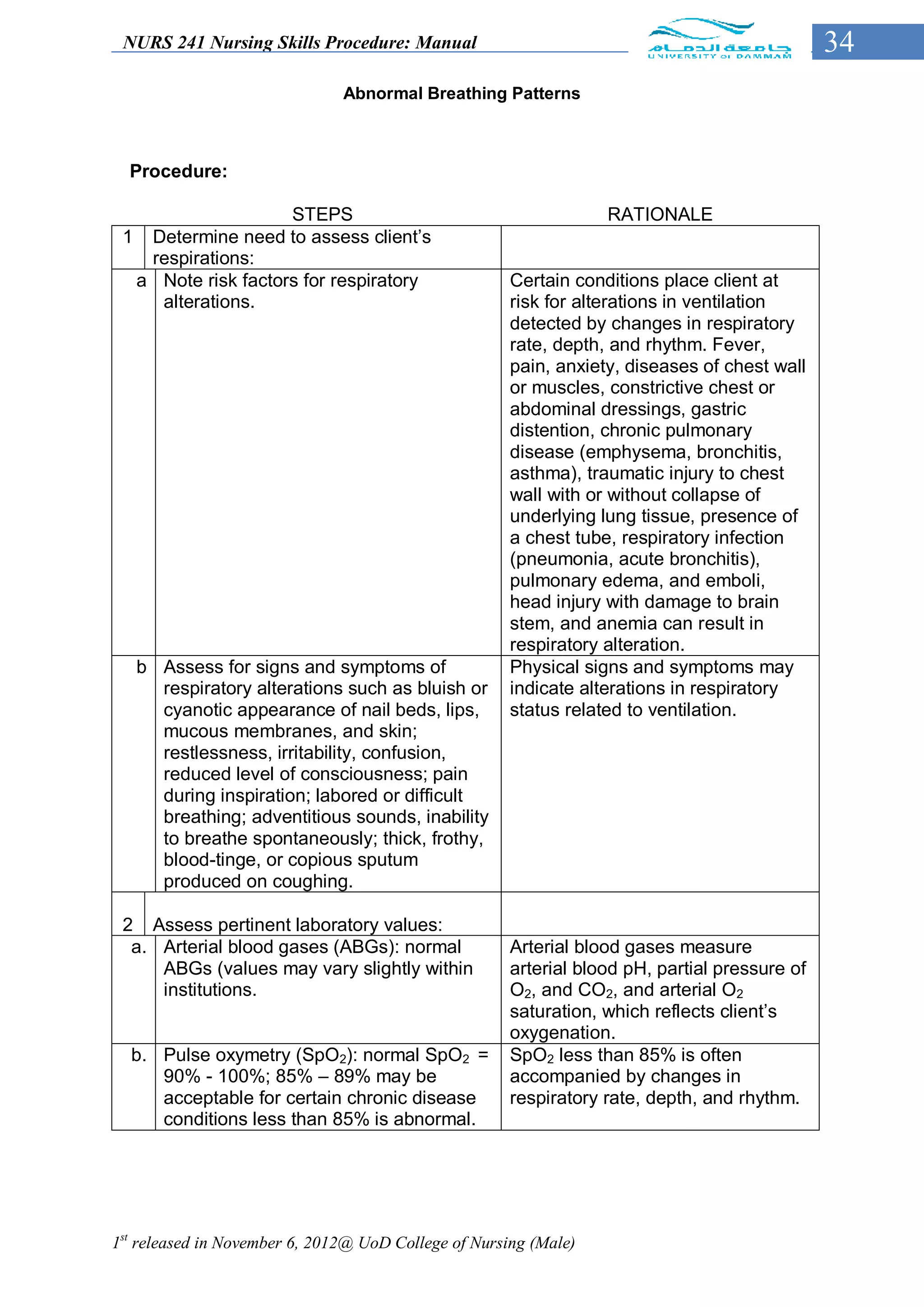
           b. Appearance / Clarity:
                  i. Normal urine is clear.
                 ii. Turbid (cloudy) urine is not always pathologic. Normal urine
                     may develop turbidity on refrigeration or from standing at room
                     temperature; bacteria ferment urine quickly at room
                     temperature.
                iii. Abnormally cloudy urine – due to pus, blood, epithelial cells,
                     bacteria, fat, colloidal particles, phosphate, urates.
           c. Odor:
                  i. Normal – faint aromatic odor.
                 ii. Characteristic odors produced by ingestion of asparagus,
                     thymol.
                iii. Cloudy urine with ammonia odor – urea-splitting bacteria such
                     as Proteus, causing urinary tract infection.
                iv. Abnormally colored urine:

1st released in November 6, 2012@ UoD College of Nursing (Male)
NURS 241 Nursing Skills Procedure: Manual                                                    79
                      a) Turbid or smoky             - may be from hematuria,
                         urine.                      spermatozoa, prostatic fluid, fat
                                                     droplets, chyle.
                      b) Red or red brown.           - may be due to blood pigments,
                                                     porphyria, transfusion reaction,
                                                     bleeding lesions on urogenital tract,
                                                     some drugs.
                      c) Yellow-brown or             - may reveal obstructive lesions of
                         green-brown.                bile duct.

           d. Reaction:
                  i. Reflects the ability of kidney to maintain normal hydrogen ion
                     concentration in plasma and intracellular fluid; indicates acidity
                     or alkalinity or urine.
                 ii. The pH should be measured in fresh urine, since the
                     breakdown of urine to ammonia causes urine to become
                     alkaline.
                iii. Normal pH is around 6 (acidic); may vary from 4.6 – 7.5.
                iv. Urine acidity or alkalinity has relatively little clinical significance
                     unless the patient is on special diet or therapeutic program or
                     is being treated for renal calculous disease.
                 v.  Alkaline urine is often cloudy because of phosphate crystals.


           e. Specific gravity:
                  i. Reflects thee kidney’s ability to concentrate or dilute urine;
                      may reflect degree of hydration or dehydration.
                 ii.  Normal specific gravity ranges from 1.005 – 1.025.
                iii.  Specific gravity is fixed at 1.010 in chronic renal failure.
                iv. In a person eating a normal diet, inability to concentrate or
                      dilute urine indicates disease.

           f. Osmolality:
                 i. Osmolality is an indication of the amount of osmotically active
                    particles in urine (specifically, it is the number of particles per
                    unit volume of water). It is similar to specific gravity, but is
                    considered a more precise test. It is also easy to do – only 1 –
                    2 ml of urine is required.
                ii. The unit osmotic measure is the osmole.
                    Average values: Female: 300 – 1090 mosm / kg.
                                         Male: 390 – 1090 mosm / kg.

     Normal Findings in Routine Urinalysis:

                       Element                                    Findings
                                           MACROSCOPIC
          Color                                  Pale straw or amber.
                                                 More concentrated in the morning.
          Odor                                   Slightly aromatic.
          Appearance                             Clear
          Specific Gravity                       1.010 – 1.025


1st released in November 6, 2012@ UoD College of Nursing (Male)
NURS 241 Nursing Skills Procedure: Manual                                                                                    80
          pH                                     4.5 – 8.0    (average pH 6, 7- neutral, less than 7 acidic, greater than 7
                                                 alkaline).

          Protein                                None
          Glucose                                None
          Ketones                                None
          Sugar                                  None
                                           MICROSCOPIC
          RBCs                                   0 – 3 / high-power field
          WBCs                                   0 – 4 / high-power field
          Epithelial Cells                       Few
          Casts                                  None, except occasional hyaline casts
          Crystals                               Present
          Yeast Cells                            None
          Parasites                              None

Types of Urine Specimen:
   1. Clean urine specimen or random routine urine specimen, or routine urinalysis
      can be collected with a client voiding naturally through a Foley catheter or
      urinary diversion collecting bag. The specimen should be clean but need not
      be sterile. It is commonly used to screen urinary and systemic pathologies.
      The elements of routine urinalysis are the macroscopic and microscopic.
   2. Midstream specimen of clean voided or clean catch – to obtain a specimen
      relatively free of microorganisms growing in the lower urethra but the sterile
      procedure of catheterization is undesirable. Used for urine culture and
      sensitivity.
   3. 24-Hour Urine – done when a large quantity of urine is necessary to analyze
      for protein and creatinine clearance.
   4. Catheterized specimen – used for culture.
   5. Indwelling catheter urine – urine is obtained from an indwelling catheter for
      culture.
   6. Double-voided specimen – used to accurate measurement of glucose and
      ketones.
   7. Use of Keto-Diastix, Multistix, Tes-Tape reagent strips – used to detect
      glucose and ketones.


Purposes:
          1. The client understands the need for the urine specimen and will be able
   to provide a specimen unassisted in the future.
          2. The client provides a clean or sterile urine specimen in the manner
   described by the nurses within a reasonable time.

Key Points:
         1. Assess the client’s ability to collect specimen independently.
         2. Determine the last time the client voided.


1st released in November 6, 2012@ UoD College of Nursing (Male)
NURS 241 Nursing Skills Procedure: Manual                                                 81
Obtaining a clean urine specimen or random urine specimen:

                     STEPS                                        Rationale

    Collection by the patient:
    1 Give client the urine container
        properly labeled with client’s
        identification (name, medical
        record number, sex, age) [date
        and time of urine collection will
        be written after collection].
    2 Instruct the patient on how to            Provides the client with the information
        properly collect.                       needed to collect specimen.
    3 Send the urine to the laboratory          Ensures accurate testing and
        immediately or within 2 hours           documentation.
        with the properly filled up
        laboratory requisition form.

    Collection done by the nurse:
    1 Wash hands.                               To prevent spread of microorganisms.
    2 Collect needed supplies and               To save time, effort and energy.
        equipment:
        a. Urine container properly
        labeled with
           Client’s identification.
        b. Urinal (male) or bedpan
        (female).
        c. Toilet tissues.
        d. Laboratory requisition form.
    3    Explain the purposes(s) and            To gain client’s cooperation.
        procedure of the test.
    4 Put on disposable gloves, place
        urinal or bedpan in position.
        Instruct client to void.
    5 Dry client’s urethral opening             Microorganisms thrive in wet areas.
        with tissue and after voiding.
    6 Remove urinal and bedpan,                 Ensures client’s comfort.
        cover, and take it into the
        bathroom or the utility room.
    7 Put a designed amount of urine
        into the urine container and
        cover it tightly. Discard the
        remainder.
    8 Clear the urinal and bedpan, put          Limits transfer of microorganisms.
        back to proper place. Discard
        gloves and wash hands.
    9 Send to the laboratory                    Ensures accurate testing and
        immediately or within 2 hours           documentation.
        with properly filled up laboratory
        form.


1st released in November 6, 2012@ UoD College of Nursing (Male)
NURS 241 Nursing Skills Procedure: Manual                                                               82
Obtaining a midstream urine specimen:


    A. Collection done by the patient:
    1 Instruct the client on the purposes of
         urine collection and to prepare the
         needed supplies and equipment:
     a. Sterile urine container properly labeled
         with client’s identification.
     b. Soap and water
     c. Disposable washcloth.
     d. Antiseptic solution
     e. Sterile cotton balls
      f. Laboratory requisition form
    2 Instruct the client of the procedure.


                                                                                               Retract the foreskin if
                                                            Cleansing the female urinary       needed. Using a towelette,
                                                            meatus, spread the labia minora    cleanse the urinary meatus
                                                            with one hand and with the other   by moving in a circular
                                                            hand, cleanse the perineal area    motion from the center of the
                                                            from front to back.                uretral openining around the
                                                                                               glans and down the distal
                                                                                               portion of the shaft of the
                                                                                               penis.
     a. Wash hands                                         To prevent transfer of microorganisms.
     b. Clean the perineal area around the                 Removes most pathogenic organisms from the area
         urinary meatus using the disposable               around urethra, thus decreasing potential contamination of
                                                           the urine specimen.
         washcloth.
     c. Wash hands again.                                  Limits transfer of microorganisms.
     d. Soak the cotton ball after one use.
     e. Using a cotton ball, clean around                  Removes microorganisms from peri-urethral
         external meatus with a single stroke.             area.
      f. Discard cotton ball after on use.                 Avoids contamination.
     g. Continue the cleansing action                      Removes microorganisms from the peri-urethral
         discarding all used balls.                        area.
     h. Void a small amount; hold the urinary              Flushes away microorganisms from urethra.
         stream.
      i. Void urine into the sterile specimen              Collects specimen with minimal contamination.
         container, holding the container only
         on the outside.
      j. Stop voiding when container is about three-       Prevents overflow in specimen container.
          quarters full; void remaining urine in toilet,
          bedpan, or urinal. Cover the container tightly
          without touching the inside of the container.
      k. Wash hands.                                       Final hand wash is to remove any contamination
                                                           of hands from possible contact with urine.


    B. Collection done by the Nurse:
    1 Wash hands and put on clean gloves.                  Limits transfer of microorganisms.

1st released in November 6, 2012@ UoD College of Nursing (Male)
NURS 241 Nursing Skills Procedure: Manual                                                   83
     2     Gather needed supplies and                   To save time, effort and energy.
           equipment:
     a.     Sterile urine container.
     b.     Bedpan or urinal.
     c.     Sterile cotton balls.
     d.     Antiseptic soap.
     e.     Disposable washcloth.
      f.    Disposable gloves.
     3     Explain purposes and procedure to the        To gain client’s cooperation.
           client.
     4     Pull on the curtain or close the door.       To provide privacy.
     5     Put on disposable gloves.
     6     Soak the cotton balls with antiseptic        Prepares equipment; client will not have to wait
           soap and set them aside.                     for this part of the procedure.
     7     Place the female client on a bedpan.
           Place urinal under the male client’s
           penis.
     8     Clean the area around the urinary            Removes microorganisms, a decreasing
           meatus using disposable washcloth.           possible contamination of specimen.
     9     Discard gloves, wash hands, and put          Removes microorganisms that may be present
           on clean gloves.                             after cleaning the perineal area.
    10     Clean around the meatus (if client is        Prevents fecal contamination of meatus.
           male); clean from pubis to rectum (if
           client is female) with the cotton balls
           using single strokes.
    11     Discard balls after single use. Repeat       Prevents recontamination with used cotton balls.
           cleansing.
    12     Instruct the client to void a small          Washes away microorganisms in and around
           amount of urine into the bedpan or           meatus.
           urinal, then to hold the urine stream.
    13     Place a sterile specimen near urethra;       Collects the specimen with few if any
           instruct the client to void again.           microorganisms.
    14     When container is nearly full, instruct      Prevents overflow from specimen container.
           the client to hold the urine into the
           bedpan or urinal.
    15     Instruct the client to void the remainder
           of the urine into the bedpan of urinal.
    16     Lift the client from bedpan or remove
           urinal. Leave the client comfortable.
    17     Close specimen container with a sterile      Prevents further contamination by
           top and without touching the inside of       microorganisms.
           the container.
    18     Discard gloves and wash hands.               Limits transfer of microorganisms.
    19     Send to laboratory immediately with
           properly filled up laboratory requisition
           form.


1st released in November 6, 2012@ UoD College of Nursing (Male)
NURS 241 Nursing Skills Procedure: Manual                                                                     84
Collecting urine specimen from Indwelling Catheter:

     1    Wash hands.                                              To prevent the spread of
                                                                   microorganisms.
     2  Prepare needed supplies and                                To save time, effort and energy.
        equipment:
      a. Sterile urine container properly
          labeled with client’s identification.
      b. Disposable 10 ml syringe with
          needle.
      c. Antiseptic swab or alcohol swab.
      d. Clamp.
      e. Disposable clean gloves.
     3 Explain the purposes and procedure to                       To gain client’s cooperation.
        the client.
     4 Pull the curtain or close the door.                         To provide privacy.
     5 Put on disposable gloves.
     6 Inspect the urinary drainage tubing for                     Determines if sufficient amount is
        amount of urine in the tubing.                             present to withdraw for specimen.
     7 Clamp the drainage tubing at least 3                        Blocks urine from draining into the
        in. below the sampling port (if it                         collecting bag; thus rubber
        contains little urine) by using a U                        accumulates a sufficient amount
        clamp or folding the tubing and                            of specimen.
        securing a band around the fold.
     8 Leave the clamp in place for 30                             Allows enough time for urine to
        minutes.                                                   drain.
     9 Locate the specimen port with an                            Identifies the area designated for
        antiseptic swab.                                           withdrawing urine from a drainage
                                                                   system.
     10 Clean the port with an antiseptic swab.                    Removes microorganisms from
                                                                   the port.
     11 Insert the needle of the 10 ml syringe
        through the port.

           Obtaining a urine specimen from a retention catheter:
                A.   From a specific area near the end of the
                     catheter.
                B.   From an access port in the tubing.
                                                                   A                         B


     12 Unclamp the tubing and withdraw the                        For example, 3 mL for a urine culture or
        required amount of urine.                                  30 mL for a routine urinalysis.
                                                                   (Depending on the system).
     13 Transfer the urine to the specimen                         If a sterile culture tube is used, make
        container.                                                 sure the needle or syringe does not touch
                                                                   the outside of the container to prevent
                                                                   recontamination.
     14 Discard the syringe and needle in an
        appropriate sharps container.
1st released in November 6, 2012@ UoD College of Nursing (Male)
NURS 241 Nursing Skills Procedure: Manual                                                         85
     15 Cap the container.
     16 Remove gloves and discard. Perform
        hand hygiene.
     17 Label the container, and send the
        urine to the laboratory immediately for
        analysis or refrigerator.
     18 Record collection of the specimen and
        any pertinent observations of the urine
        on the appropriate records.


Collecting 24-hour urine specimen:

     1        Collect the needed supplies and            To save time, effort and energy.
              equipment.
         a.    Large size urine collector properly
               labeled with client’s identification.
         b.    Bedpan or urinal
         c.    Bucket with container or
               refrigerator.
         d.    Laboratory requisition form.
     2        Explain the procedure to the client.       Informs the client and gives
                                                         instructions on what he or she is to
                                                         do to help. Often the client is the key
                                                         person in the success of a 24-hour
                                                         collection because he or she
                                                         reminds all people to save the urine.
     3        Place the container in a large             Prevents the urine from
              container filled with ice; place this on   deteriorating.
              the client’s bathroom or nearby
              storage area.
     4        Instruct the client to void and discard
              the specimen.
     5        Record the time and date of                Ensures that all urine from this point
              discarded specimen on the                  on is collected.
              collection container. This is the
              starting time of the collection.
     6        Place all voided urine in the              Ensures that urine is saved; this is
              container during the next 24 hours.        critical for the accuracy of the test.
     7        Let client void (in toilet, bedpan, or
              urinal). Collect urine or pour urine
              from the bedpan or urinal into the
              urine container.
     8        Send to the laboratory immediately
              with properly filled up laboratory
              requisition form.


1st released in November 6, 2012@ UoD College of Nursing (Male)
NURS 241 Nursing Skills Procedure: Manual                                                                     86
Testing urine for contents (sugar and ketones):


    A. Double-voided urine.
     1 Prepare needed supplies and                        To save time, effort and energy.
         equipment.
       a. Urine container properly labeled
           with client’s identification.
       b. Tissue
       c. Urinal or bedpan.
       d. Water to drink.
     2 Explain purpose and procedure to                   To gain client’s cooperation.
         client.
     3 Pull on the curtain or close the door. To provide privacy.
     4 Ask client to void and discard urine.
     5 Let client drink water, around 8 oz.
     6 Wait for 30 – 45 minutes.
     7 Let client to void (in toilet, bedpan, or urinal).
           Collect urine or pour urine from the bedpan
           or urinal.
     8     Send to the laboratory immediately            To ensure accuracy.
           with properly filled up laboratory
           requisition form.
                         Using reagent strip.


                                                                  After dipping the reagent strip (dipstick)
                                                                  into fresh urine, wait the stated time
                                                                  period and compare the results to the
                                                                  color chart.
     1     Wash hands.                                   To prevent the spread of
                                                         microorganisms.
     2     Prepare needed supplies and                   To save time, effort and energy.
           equipment
         a. Sterile urine container properly
            labeled with client’s identification.
         b. Reagent strip.
         c. Disposable gloves (optional)
     3     Explain to the client what will be            Informs the client.
           done.
     4     Read instructions on the testing kit to       Instructs on how to use the test
           determine how much urine is                   materials. Techniques vary with
           needed.                                       many different brands.
     5     Wash hands and put on gloves.                 Limits transfer of microorganisms.
     6     Collect the urine specimen.
     7     Take the specimen to a work area.
     8     Dip reagent strip in the urine                Strip contains chemicals that
           specimen and pull it out immediately.         change colors when exposed to
                                                         glucose and ketones.


1st released in November 6, 2012@ UoD College of Nursing (Male)
NURS 241 Nursing Skills Procedure: Manual                                                 87
        9    Remove excess urine from the
             reagent strip.
        10   Wait for 15 to 30 seconds depending
             on the manufacturer’s instructions.
        11   Compare the strip’s color with that of   The color scale measures the
             the chart on the bottle.                 quality of glucose and ketones The
                                                      range of the color scales extends
                                                      from negative, trace, 1+, 2+, 3+.
        12   Discard urine and reagent strip.
        13   Remove gloves and wash hands.
        14   Inform the client of the results and
             record.


                   COLLECTION and TESTING of STOOL

   I.        Introduction:

             Stool specimen yields information related to functioning of the
             gastrointestinal system and its accessory organs.
             a. Test for ova and parasites (O & P) – indicates the presence of
                gastrointestinal parasites and / or their eggs ova.
             b. Guaiac or Hemoccult or occult blood test – used to test presence of
                blood in stool.

Fecal Characteristics:
 Character           Normal                      Abnormal                Cause
Color        Infant: Yellow                 White or Clay          Absence of bile.
             Adult: Brown – due to
             metabolism of bile             Black or tarry         Iron ingestion or
             pigments to                                           upper GI bleeding.
             stercobilin.
                                            Red (melena)           Lower GI bleeding,
                                                                   hemorrhoids.

                                            Pale with fat          Malabsorption of fat.
Odor              Pungent: affected by      Noxious change.        Blood in feces or
                  food type – results                              infection.
                  from the presence of
                  indole and skatole,
                  end products of
                  protein catabolism by
                  bacterial action in the
                  large intestines.
Consistency       Soft, formed              Liquid                 Diarrhea, reduced
                                                                   absorption.

                                            Hard                   Constipation.


1st released in November 6, 2012@ UoD College of Nursing (Male)
NURS 241 Nursing Skills Procedure: Manual                                                 88
Frequency       Infant:                    Infant: more than 6 x    Hypomotility or
                Breastfed – 4 to 6 x       / day or less than       hypermotility.
                daily                      once every 1 – 2
                Bottle-fed – 1 – 3 x       days.
                daily
                                           Adult: More than 3 x
             Adult: daily or 3 x per       a day or less than
             week.                         once a week.
Amount       150 Gm/day                    Narrow, pencil           Obstruction, rapid
shape        resembles diameter            shaped.                  peristalsis.
             of rectum.
Constituents Undigested food,              Blood, pus, foreign      Internal bleeding,
             dead bacteria, fat,           bodies, mucus,           infection, swallowed
             bile pigment, cells           worms.                   objects, irritation,
             lining intestinal                                      inflammation.
             mucosa, water.


   II.    Objectives:
            1. The client understands the purpose of the diagnostic test, as evidenced
   by ability to explain it.
            2. The client eliminates sufficient stool to provide a specimen for the
   diagnostic test.

   III.     Key Points:
           1. Assess the client’s understanding of the test and ability to collect the
           specimen independently.
           2. Determine the time of the client’s last bowel movement.
           3. Wearing disposable gloves use a tongue depressor to transfer stool
           from bedpan to specimen container.
           4. Label specimen correctly.
           5. Test specimen by following instructions on test packet.
           6. Record results of specimen test in the health record.

   IV.     Supplies and Equipment:

                        Action                                  Rationale
          1. Bedpan, commode, ordinary           Provides receptacle for stool
          collecting hat.
          2. Toilet tissue.                      Cleans perineal area after defecation.
          3. Disposable gloves.                  Protects the nurse’s hands.
          4. Tongue blades.                      Transfers stool from one container to
                                                 another.
          5. Specimen container.                 Collects stool for testing.

   V.      Procedure:
                           Action                                  Rationale

    Collecting s Stool Specimen:
     1 Explain the purpose of the test to            Informs the client and encourages
         the client.                                 participation.

1st released in November 6, 2012@ UoD College of Nursing (Male)
NURS 241 Nursing Skills Procedure: Manual                                                    89
     2    Describe how the specimen is to be         Instructs the client who is to collect
          collected.                                 own stool.
     3    Instruct the client to save his or her     Collects specimen that is free of
          stool in a bedpan and to discard           urine, water, and toilet paper.
          toilet paper elsewhere.

    If the client is unable to collect specimen:
     1 Wash hands.                               To prevent spread of
                                                 microorganisms.
     2 Gather the needed equipment and           To save time, effort and energy.
          supplies; label the specimen
          container with appropriate
          identification and fill up the lab.
          request form.
     3     Explain the purposes(s) and           Informs the client and encourages
          procedure of the test.                 participation.
     4 Pull on the curtain or close the door. To provide privacy.
     5 Remove bedpan (or commode pan)
          with stool after the client evacuates.
     6 Cover the bedpan and take it to the       Removes stools from the client’s
          bathroom or dirty work area.           bed unit to minimize embarrassment
                                                 or discomfort.
     7 Use tongue blades to transfer stool
          from bedpan to a specimen
          container. Transfer as much as is
          required for the test. Place lid
          securely on the container.
     8 Discard tongue blades and excess
          stool, wash bedpan.
     9 Discard gloves and wash hands.            Limits transfer of microorganisms.
    10 Send specimen to the laboratory           Ensures accurate testing.
          immediately.
    11 Record date and time of stool
          collection and results.


    OBTAINING A CAPILLARY BLOOD SPECIMEN TO MEASURE
                     BLOOD GLUCOSE

PURPOSES

1. To determine or monitor blood glucose levels of clients at risk for hyperglycemia or
   hypoglycemia

2. To promote blood glucose regulation by the client

3. To evaluate the effectiveness of insulin administration


1st released in November 6, 2012@ UoD College of Nursing (Male)
NURS 241 Nursing Skills Procedure: Manual                                                        90
ASSESSMENT

Before obtaining a capillary blood specimen, determine:

     1. The policies and procedures for the facility
     2. The frequency and type of testing
     3. The client’s understanding of the procedure
     4. The client’s response to previous testing
     5. Assess the client’s skin at the puncture site to determine if it is intact and the circulation
        is not compromised. Color, warmth, and capillary refill.
     6. Reviewed the client’s record for medications that may prolong bleeding such as
        anticoagulants, or medical problems that may increase the bleeding response.
     7. Assess the client’s self-care abilities that may affect accuracy of test results, such as
        visual impairment and finger dexterity.
PLANNING

Delegation

Check the policy and procedure manual to determine who can perform this skill. It is
usually considered an invasive technique and one that requires problem solving and
application of knowledge. It is the responsibility of the nurse to know the results of the
test, and supervises unlicensed assistive personnel responsible for assisting the nurse.

EQUIPMENT

     1. Blood glucose meter (glucometer)
     2. Blood glucose reagent strip compatible with the
        meter
     3. 2 x 2 gauze
     4. Antiseptic swab
     5. Clean gloves
     6. Sterile lancet ( a sharp device to puncture the skin)
     7. Lancet injector (a string-loaded mechanism that
        holds the lancet)


IMPLEMENTATION

Preparation

         Review the type of meter and the manufacturer’s instructions.
         Assemble the equipment at the bedside.

                            STEPS                                              Rationale

1     Prior to performing the procedure, introduce self
      and verify the client’s identity using agency
      protocol.
      Explain to the client what you are going to do, why
      it is necessary, and how he or she can participate.
      Discuss how the results will be used in planning
      further care or treatments.
2     Perform hand hygiene and observe other
      appropriate infection control procedures (e. g.,
      gloves).

1st released in November 6, 2012@ UoD College of Nursing (Male)
NURS 241 Nursing Skills Procedure: Manual                                                         91
3     Provide privacy.                                               (1) Insert the test strip into
                                                                         the meter.
4     Prepare the equipment.

      a  Some meter turn on when a test strip is
         inserted into the meter ( 1 )
      b Confirm the code number.
5     Select and prepare the vascular puncture site.
      a Choose a vascular puncture site (e.g., the side           These actions increase the
         of an adult’s finger). Avoid sites beside bone.          blood flow to the area, ensure
         Hold a finger in a dependent (below heart                an adequate specimen, and
         level) position. If the earlobe is used, rub it          reduce the need for a repeat
         gently with a small piece of gauze.                      puncture.
      b Clean the site with the antiseptic swab or soap           Alcohol can affect accuracy
         and water and allow it to dry completely.                and the site stings when
                                                                  punctured when wet with
                                                                  alcohol.
6     Obtain the blood specimen.
      a Apply gloves.
      b Place the injector, if used, against the site, and        The lancet is designed to
         release the needle, thus permitting it to pierce         pierce the skin at a specific
         the skin. Make sure the lancet is perpendicular          depth when it is a
         to the site.                                             perpendicular position relative
                                                                  to the skin. (2).
      c   Prick the site with a lancet or needle, using a
          darting motion.
      d   Gently squeeze (but do not touch) the
          puncture site until a drop of blood forms. The
          size of the drop of blood can vary depending
          on the meter. Some meters require as little as
          0.3 mL of blood to accurately test blood sugar.


                                                                      (2) Place the injector against
                                                                                  the site.
      e   Hold the reagent strip under the puncture site
          until adequate blood covers the indicator
          square. The pad will absorb the blood and a
          chemical reaction will occur. Do not smear the
          blood. This will cause an inaccurate reading.
             -   Some meters wick the blood by just
                 touching the puncture site with the strip. (3)
      f  Ask the client to apply pressure to the skin
         puncture site with 2x2 gauze. Pressure will
         assist hemostasis.
7     Expose the blood to the test strip for the period
      and the manner specified by the manufacturer. As
      soon as the blood is placed on the test strip:

                                                                     (3) Apply the blood to the test
                                                                         strip.


1st released in November 6, 2012@ UoD College of Nursing (Male)
NURS 241 Nursing Skills Procedure: Manual                                                     92
      a   Follow the manufacturer’s recommendations               The blood must remain in
          on the glucose meter and monitor for the                contact with the test strip for a
          amount of time indicated by the manufacturer.           prescribe time to obtain
                                                                  accurate results.
        Some glucometers have the test strip placed
        in the machine before the specimen is
        obtained.
8     Measure the blood glucose.
      a Place the strip into the meter according to the           Refer to the specific
        manufacturer’s instructions.                              manufacturer’s
                                                                  recommendations for the
                                                                  specific procedure.
      b   After the designed time, most glucose meters
          will display the glucose reading automatically.
          Correct timing ensures accurate results. (4).
      c Turn off the meter and discard the test strip
          and 2x2 gauze in a biohazard container.
          Discard the lancet into a sharps container.
      d Remove and discard gloves. Perform hand
          hygiene.
9     Document the method of testing and results on the
      client’s record. If appropriate, record the client’s
      understanding and ability to demonstrate the
      technique.                                                     (4) Read the results
      The client’s record may also include a flow sheet
      on which capillary blood glucose results and the
      amount, type, route, and time of insulin
      administration are recorded. Always check if a
      diabetic flow sheet is being used for the client.
1     Check for orders for sliding scale insulin based on
0     capillary blood glucose results. Administer insulin
      as prescribed.

EVALUATION

     1. Compare glucose meter reading normal blood glucose level, status of puncture site, and
        motivation of the client to perform the test independently.
     2. Relate blood glucose reading to previous reading and the client’s current health status.
     3. Report abnormal results to the primary care provider. Some agency may have a
        standing policy to obtain a venipuncture blood glucose if the capillary blood glucose
        exceeds a certain value.
     4. Conduct appropriate follow-up such as asking the client to explain the meaning of the
        results and/or demonstrating the procedure at the next scheduled test.
     5. Prepare the client for home glucose monitoring and review frequency, record keeping,
        and insulin administration if appropriate.


1st released in November 6, 2012@ UoD College of Nursing (Male)
NURS 241 Nursing Skills Procedure: Manual                                                   93


          Collecting Samples from the Nose or Throat
   I.        Introduction
   The oronasopharyngeal cavity is lined with mucous membrane that secretes
   mucus, moistening the membrane and the air that is inhaled. Lachrymal fluid and
   saliva also drain into the cavity. Viral infections are common problems in the
   upper airways, but bacterial infections occur as well. Because bacterial infections
   can be treated pharmacologically, samples for cultures are taken of the upper
   airway secretions to distinguish between viral and bacterial infections. When
   bacteria are cultured, sensitivity tests determine the proper treatment.

   II.       Purposes:
   1. The client can accurately report the reason for the culture and explain when
          and how its result will be learned.
   2. The client’s nose and throat are without discomfort or bleeding from taking the
          culture as evidenced by his or her report and an inspection of the area.


   III.      Key Points:

   1. Assess the client for evidence of respiratory infection.
   2. Observe the client’s ability to cough deeply.
   3. Place the client in high Fowler’s position.


   IV.       Supplies and Equipment:
                                                               Rationale
   1. Sterile cotton-tipped or polyester-        Removes exudate from pharyngeal
      tipped swab or applicator in a             mucosa without contamination.
      culture tube.
   2. Tongue depressor.                          Depresses tongue for better visualization
                                                 of pharynx.
   3. Penlight.                                  Illuminates area to be cultured.
   4. Facial tissues.                            Available for the client if there is
                                                 excessive tearing or coughing following
                                                 culture.
   5. Identification labels.                     Prevents errors by correctly labeling the
                                                 culture tube.


1st released in November 6, 2012@ UoD College of Nursing (Male)
NURS 241 Nursing Skills Procedure: Manual                                                    94
    6. Laboratory requisition form.              Informs the laboratory of the client’s
                                                 identification or other required
                                                 information.
    7. Emesis basin.                             Available in case the client gags and
                                                 vomits following the throat culture.

    V.     Procedure:

                         STEPS                                      Rationale

                      Collecting Culture Samples from the Pharynx

1   Wash hands.                                     Limits transfer of microorganisms.
2   Gather needed supplies and equipment.           To save time, effort and energy.
3   Explain the exact procedure to the client.      Informs the client and encourages
    Tell him or her that a ticking sensation in     discussions of anxiety or discomfort.
    the throat may be felt and that the client      Prepares for the discomfort of the
    may even gag as the throat is swabbed.          culture.
4   Pull on the curtain or close the door.          To provide privacy.
5   Instruct the client to sit upright or help      Allows easier view visualization of the
    into that position.                             access to the pharynx.
6   Place tissues and emesis basin within           Prepares the client if need arises.
    the client’s reach.
7   Ready the swab by loosening it from the         Prepares the swab.
    culture tube; place it within reach.
8   Depress the tongue with the tongue              Permits visualization of the pharynx so
    depressor while illuminating the pharynx        that it can be inspected.
    with the penlight.
9   Inspect the pharynx for reddened or
    inflamed areas or patches of exudates.
1   Set the penlight aside and grasp the
0   swab.
1   Insert the swab through the mouth,              Prevents contamination of the swab tip
1   carefully avoiding the tongue, teeth, or
    cheeks.


1st released in November 6, 2012@ UoD College of Nursing (Male)
NURS 241 Nursing Skills Procedure: Manual                                                   95


1   Rub the swab quickly but firmly over the        Ensures collection of secretions from
2   area of inflammation or patchy exudate.         suspicious areas.


If no exudate is seen:
 1 Rub the swab quickly but firmly over the         Ensures collection of secretions in an
 3 nasopharyngeal area behind the uvula.            area representative of the entire
                                                    pharynx.
1   Withdraw the swab quickly without               Prevents contamination of the swab.
4   touching the oral tissues.
1   Replace the swab in the culture tube.
5
1   Insert the swab tip into the medium.            Inserting the collected secretions directly
6                                                   into the medium ensures that the
                                                    bacteria will survive until cultured by the
                                                    laboratory.
1   Secure the top of the culture tube.             Prevents contamination.
7
1   Discard the tongue blade.
8
1   Provide comfort measures for the client
9   as necessary; facial tissues, a drink of
    water.
2   Wash hands.                                     Limits transfer of microorganisms.
0
2   Secure labels to the culture tube.              Prevents identification errors by the
1                                                   laboratory.
2   Send the culture to the laboratory              Ensures accurate results.
2   according to agency guidelines.


B. Collecting Culture Samples from the nasal Mucosa
1st released in November 6, 2012@ UoD College of Nursing (Male)
NURS 241 Nursing Skills Procedure: Manual                                                     96

1   Wash hands.                                     Limits transfer of microorganisms.
2   Gather needed supplies and equipment.           To save time, effort and energy.
3   Explain the exact procedure to the client.      Informs the client of the procedure;
    Tell him or her that she will feel itching      encourages participation; prepares for
    and discomfort or a desire to sneeze as         the discomfort.
    the swab passes through the nose.
4   Pull on the curtain or close door.              To provide privacy.
5   Instruct the client to sit upright or help      Allows easier visualization of the access
    into that position.                             to the nares.
6   Place tissues within the client’s reach.        Prepares the client if need arises.
7   Ready the swab by loosening it from the         Prepare the swab.
    culture tube; place it within reach.
8   Instruct the client to blow his or her          Prepare the swab.
    nose.
9   Instruct the client to tilt head back.          Allows easier access to the turbinates.
1   Inspect the nostrils to determine               Determines which nostril to use; select
0   patency; using the penlight for                 the nostril without visible obstruction.
    illumination.
1   Insert the wire swab gently through the         Prevents contamination of the swab tip.
1   most patent nostril; avoid touching the         A wire swab is preferable for this
    nasal tissue.                                   procedure because it is less likely to
                                                    injure tissues. Bend the swab into a
                                                    curve that permits easier entry before
                                                    the package is opened.


1   Force the swab through the resistance           Ensures that the swab tip rests against
2   met when it enters the turbinates.              the tissues of the turbinates rather than
                                                    the anterior nares.
1   Place the tip of the swab against the           Collects the secretions.
3   turbinate tissue and rotate.
1   Withdraw the swab quickly without               Prevents contamination of the swab.
4   touching the sides of the nares.
1   Replace the swab in the culture tube.
5


1st released in November 6, 2012@ UoD College of Nursing (Male)
NURS 241 Nursing Skills Procedure: Manual                                                           97
1   Insert the swab tip into the medium.                 Inserting the collected secretions directly
6                                                        into the medium ensures that the
                                                         bacteria will survive until cultured by the
                                                         laboratory.
1   Secure the top of the culture tube.                  Prevents contamination.
7
1   Provide comfort measures for the client
8   as necessary; facial tissues, a drink of
    water.
1   Wash hands.                                          Limits transfer of microorganisms.
9
2   Secure labels to the culture tube.                   Prevents identification errors by the
0                                                        laboratory.
2   Send the culture to the laboratory                   Ensures accurate results.
1   according to agency guidelines.


     Insert the wire swab gently through the most patent nostril; avoid touching the nasal tissue.


                           BANDAGES AND BINDERS

Introduction / Definition:
A simple gauze dressing is often not enough to immobilize or provide support to a wound.
Bandages and binders are devices that secure large dressings, wrap body parts, provide
support to body areas and facilitate immobilization of the limits.
Bandage – is a strip or roll of material that is wrapped around a body part to support or
immobilize a body part, or to secure a dressing that cannot be taped to the skin.
Bandages are available in rolls of various widths and material including gauze, elasticized
knits, elastic webbing, flannel, and muslin.
Gauze – is used for bandages because it is light and porous and conforms to body parts;
permit air circulation to underlying skin to prevent maceration, inexpensive, and can be
discarded after one use.
Elastic bandage – adhere to the skin providing support and pressure and conform to body
parts.
A binder – is a broad bandage made of a shape and size to fit and supports the underlying
muscles or incisions or dressings on a body part; is made of cotton or muslin fabric that may
or may not be elasticized. Some binders have metal or plastic ribbing (stays) to prevent

1st released in November 6, 2012@ UoD College of Nursing (Male)
NURS 241 Nursing Skills Procedure: Manual                                                         98
bending and add additional support. Other binders are made of netting that stretches to
accommodate shape as they encircle the entire body to secure dressings.

Bandages and binders applied over or around dressings can provide extra protection
and therapeutic benefits by:
      1. Creating pressure over a body part.
      2. Immobilizing a body part.
      3. Supporting a wound.
      4. Reducing or preventing edema.
      5. Securing a splint, or
      6. Securing dressings.

   Principles for Applying Bandages and Binders:
   • Correctly applied bandages and binders do not cause injury to underlying or nearby
     body parts or create discomfort for the client.
      1.   Inspect the skin for abrasions, edema, discoloration, or exposed wound edges.
      2.   Cover exposed wounds or open abrasions with sterile dressing.
      3.   Assess the condition of underlying dressings and change them if they are soiled.
      4.   Assess the skin of underlying body parts and parts that will be distal to the bandage
           for signs of circulatory impairment; (coolness, pallor, or cyanosis, diminished or
           absent pulses, swelling, numbness, and tingling) to provide a means for comparing
           changes in circulation after bandage application.


                                     BANDAGING
Techniques of Applying Bandages:
   1. Circular turn – is used to anchor the bandage at its beginning and end. It may also be
       used to bandage small areas such as finger and wrist.
   2. Spiral turn – to cover part that is uniform in shape like upper arm or leg.
   3. Spiral reverse – to bandage areas of the body that are not uniform in shape such as
       lower leg.
   4. Recurrent turn – used to cover distal ends such as the skull, distal end of the finger,
       or the stump of an amputation.
   5. Figure-of-eight turn – is used to support joint areas such as knees and elbows while
       slowing some movement of the body part covered.
   6. Spica turn – (modification of figure-of-eight turn) – used to cover larger areas such
       as upper thigh of lower hip area / upper arm with shoulder.


Supplies and Equipment:
For Bandages:


1st released in November 6, 2012@ UoD College of Nursing (Male)
NURS 241 Nursing Skills Procedure: Manual                                                       99
 1    Bandage of approximate materials, width,     Various conditions and purpose determine
      and length.                                  the type of use of different bandage.
 2    Dressing change supplies.                    Available to change dressing if required.
 3    Safety pins, clips, or tape.                 Secure the bandage.


Key Points for Bandage Application:
                        Action                                      Rationale
  1    Position body parts to be bandaged in       Bandages can cause restriction in
       comfortable position of normal              movement. Immobilization in normal
       anatomical alignment.                       functioning position reduces risks of
                                                   deformity or injury.
  2    Prevent friction between and against        Skin surfaces in contact with each other
       surfaces by applying gauze or cotton        (e.g., between toes or under breasts) can
       padding.                                    rub against each other to cause abrasion or
                                                   chafting. Bandages over bony prominences
                                                   may rub against each other to cause
                                                   breakdown.


  3    Apply bandages securely to prevent          Friction between bandages and skin can
       slipping during movement.                   cause skin breakdown.


  4    When bandaging extremities, apply           Gradual application of pressure from distal
       bandage first at distal end and progress    toward proximal portion of extremity
       toward trunk.                               promotes venous return and minimizes risk
                                                   of edema or circulatory impairment.


  5    Apply bandages firmly, with equal           Equal tension prevents unequal pressure
       tension exerted over each turn on layer.    distribution over bandaged body part.
       Avoid excess overlapping of bandage         Localized pressure causes circulatory
       layers.                                     impairment.
  6    Position pins, knots, or ties away from     Pins and ties used to secure bandages and
       wound or sensitive skin areas.              binders can exert localized pressure and
                                                   irritation.

1st released in November 6, 2012@ UoD College of Nursing (Male)
NURS 241 Nursing Skills Procedure: Manual                                                        100


Procedure for BANDAGING:

 1   Explain the procedure and its purposes to     For the client to cooperate and participate.
     the client.
 2   Prepare all the materials needed.             Organizes the procedure saving time,
                                                   effort and energy.
 3   Wash hands.                                   Limits transfer of microorganisms.
 4   Close door or draw the curtains.              Provide privacy.
 5   Inspect the skin for abrasions, edema,
     discoloration, or exposed wound edges.

     • Assess the condition of underlying
       dressings and change them if they are
       soiled.

     • Cover exposed wounds or open
       abrasions with a sterile dressing.
 6   Assess skin of underlying body parts that     Provide a means for comparing changes
     will be distal to the bandage for signs of    in circulation after bandage application.
     circulatory impairment (coolness, pallor
     or cyanosis, diminished or absent pulses,
     swelling, numbness, and tingling.
 7   Assist the client to assume a comfortable     Prevents deformity and increase
     position, maintaining a position of normal    circulation to the affected area.
     function for the body.

     • Bandages on the lower extremities are
       applied before the client sits or stands.

     • An extremity may be elevated for 15 to      To encourage adequate venous return.
        30 minutes before wrapping.
 8   Hold the bandage in the dominant hand         Facilitates control when stretching and
     with the roll up.                             unrolling the bandage.
 9   Unroll 3 to 4 inches of the bandage.
10   Hold the end of the bandage in place on       Maintains uniform tension.
     top of the distal part using the fingers of
     the non-dominant hand.
11   Leave a portion of the distal part exposed,   Allows later inspection and palpation of
     such as the toes or fingers.                  distal parts for neuro-vascular assessment.
12   Bring the bandage down and around the
     body part unrolling and stretching slightly
     if elastic.


1st released in November 6, 2012@ UoD College of Nursing (Male)
NURS 241 Nursing Skills Procedure: Manual                                                       101
13   Wrap the bandage directly over the held         Anchors the bandage at the end.
     end and fasten it with safety pin, clip, or
     tape.

     Note:
     • Use circular turns to begin and end a         Provides security and support to the
       bandage. This is called anchoring.            bandage.

     • In bandaging the foot, start at the side of
     the foot so that the end will not cause
     pressure over the bony area on the upper
     foot or create discomfort on the bottom of
     the foot when the patient walks.

To wrap a Spica Bandage:
14   Anchor with two circular turns.
15   Bring the bandage up and around the body        Varies the figure-8 turn used to cover
     part.                                           large areas.
16   Wrap bandage down and around the other          Covers body areas such as thumb, groin,
     body part forming a figure-8.                   breast, shoulder, and hip.
17   Continue in this pattern until the area is      Provides a means of checking circulation
     covered. Leave tips of finger and toes          in the bandaged extremity.
     exposed.
18   End with two circular turns.
19   Fasten with tape, safety pins, or clips.        Prevents unwrapping.

For all bandage types:
20   Inspect bandage at frequent intervals for       Ensures the bandage is in place and is of
     intactness and constant tension; assess the     benefit to the client.
     neurovascular status of the extremity.


1st released in November 6, 2012@ UoD College of Nursing (Male)
NURS 241 Nursing Skills Procedure: Manual                                         102


                           Types of Bandage Turns

     Type                        Description                      Purpose or Use


   Cecil/Feb./08


1st released in November 6, 2012@ UoD College of Nursing (Male)
NURS 241 Nursing Skills Procedure: Manual                        103


                                        Spiral Reverse


                                        Figure of Eight


                                             Spica


1st released in November 6, 2012@ UoD College of Nursing (Male)
NURS 241 Nursing Skills Procedure: Manual                                                         104
                                        BINDERS

                     Types and Purposes of binders:

   1. The abdominal binder (straight) is used to
      provide support and protection to the
      abdomen. It is made of a rectangular fabric
      (a bath blanket or draw sheet) and long
      enough to encircle the body and extend from
      the lower ribs to the symphysis pubis.
      Commercially made binders are rectangular
      and made from heavy fabric or elastic
      with a Velcro closure.

   2. The scultetus or many-tailed binder is also to provide support to the abdomen or to
      secure dressings. This binder is made of flannel and has three to six tails on either side
      of solid back. The tails are secured starting above the groin and alternated across the
      abdomen to an area just below the ribs.


   3. The breast binder is a vest with adjustable
      straps and a front closure of safety pins.
      Adjustments are made to provide a smooth
      fit that does not interfere with respiration.
      This binder is used to provide support the
      breasts and thorax.


   4. The double T-binder (A) is of the same
      design as the single T-binder with the
      addition of a second trip to aid in securing
      rectal and perineal dressings for men. The
      straps attached to the waist on either sides of
      the penis and scrotum.

   5. The single T-binder (B) is made of muslin.
      Two narrow strips are sewn together at right
      angles, one strip encircles the waist and the
      other secures rectal or perineal dressings.
      These are most often used for women.


1st released in November 6, 2012@ UoD College of Nursing (Male)
NURS 241 Nursing Skills Procedure: Manual                                                        105

   6. The sling or triangular binder is made
      commercially of muslin. Its purpose is to
      provide support to the arm, shoulder, or
      hand. Additionally, it limits movement while
      not impairing circulation, and reduces edema
      to the lower arm and hand.


Objectives:

   1. The client’s abdominal or scultetus binder is properly applied as evidenced by the
      ability to breathe normally; the presence of pulses distal to the binder, and intact skin
      integrity.
   2. The client’s T-binder is properly applied as evidenced by secured perineal or rectal
      dressings, adequate scrotal support, and the client’s ability to remove and reapply the
      binder when needed for elimination.
   3. The client’s triangular binder (sling) is applied as evidenced by immobilization of the
      arm, shoulder, and elbow as therapeutically prescribed without compromised
      circulation.
   4. The client’s binder provides adequate support to the body tissues without discomfort
      to the client as evidenced by verbal and nonverbal responses.


Supplies and Equipment:

For Binders:

      Gloves, if wound drainage is present.     ▪ T and double T Binders:
      Abdominal binder:                               o Correct size
          o Correct size cloth/elastic                 o Safety pins
              straight binder                    ▪ Breast binder:
          o Safety Pins (unless Velcro                 o Correct size
              closure or metal fasteners are           o Safety pins (unless Velcro closure
              attached)                                    or metal fasteners are attached)


1st released in November 6, 2012@ UoD College of Nursing (Male)
NURS 241 Nursing Skills Procedure: Manual                                                           106
                     Preparing for the application of a binder

                                                                       RATIONALE
                           STEPS
    1. Wash hands.                                             Limits transfer of
                                                               microorganism.
    2. Take supplies to the bedside.
    3. Explain the procedure to the client.                    Promotes client cooperation and
                                                               understanding and reduces
                                                               anxiety.
    4. Close door or draw bedside curtains.                    Provides privacy.


Procedure:

                             STEPS                                        RATIONALE
     1    Observe client with need for support of thorax       Baseline assessment determines
          or abdomen. Observe ability to breath deeply         client’s ability to breathe and
          and cough effectively.                               cough. Impaired ventilation of
                                                               lung can lead to alveolar
                                                               atelectasis and inadequate arterial
                                                               oxygenation.
     2    Review medical record if medical prescription        Application of supportive binders
          for particular binder is required and reasons        may be used on nursing judgment.
          for application.                                     In some situations, physician
                                                               input is required.
     3    Inspect the skin for actual or potential             Actual impairments in skin
          alterations in integrity. Observe for irritations,   integrity can be worsened with
          abrasions, skin surfaces that rub against each       application of binder. Binder can
          other, or allergic response to adhesive tape         cause pressure and excoriation.
          used to secure dressing.
     4    Inspect any surgical dressing.                       Dressing replacement or
                                                               reinforcement precedes
                                                               application of any binder.


1st released in November 6, 2012@ UoD College of Nursing (Male)
NURS 241 Nursing Skills Procedure: Manual                                                         107
  Critical decision point:
  Dressing should be clean, dry, and incision/wound should be entirely covered
  by dressing.

     5    Assess client’s comfort level, using analog        Data will determine effectiveness
          scale 0 to 10, and noting any objective signs      of binder placement.
          and symptoms.


           Numerical
     A       0      1        2          3     4         5    6       7       8       9      10
              No pain                                                                 Severe
                                                                                       pain


           Descriptive
     B     No                    Mild         Moderate            Severe            Unbearable
           pain                  pain           pain               pain                pain


           Visual analog
     C        No pain                                                      Unbearable pain

           Client designates a point on the scale corresponding to his perception of the
           pain’s severity at the time of assessment.

     6    Gather necessary data regarding size of client     Ensures proper fit of binder.
          and appropriate binder.
     7    Explain procedure to patient.                      Promote client’s understanding
                                                             and cooperation.
     8    Teach skill to client or significant other.        Reduces anxiety and ensures
                                                             continuity of care after discharge.
     9    Wash hands and apply gloves. (if likely to         Reduces transmission of
          contact wound drainage).                           microorganisms.
    10    Close curtains or room door.                       Maintains client’s comfort and
                                                             dignity.
    11    Apply binder.
    12    Remove gloves and wash hands.                      Prevents cross infection.
    13    Observe site for skin integrity. Circulation and   Determines that binder has not
          characteristics of wound. (Periodically remove     resulted in complication to the
          binder and surgical dressing to assess wound       skin, wound or underlying organs.
          characteristics).
    14    Assess comfort level of client, using analog       Binders should not increase
          scale of 0 to 10 and noting any objective signs    discomfort.
          and symptoms.
    15    Assess client’s ability to ventilate properly,     Identifies any impaired ventilation
          including deep, breathing and coughing.            and potential pulmonary
                                                             complications.
    16    Identify client’s need for assistance with         Mobility of upper extremities may
          activities such as: hair combing, dressing, and    be limited depending on severity
          ambulating.                                        and location of incision.


1st released in November 6, 2012@ UoD College of Nursing (Male)
NURS 241 Nursing Skills Procedure: Manual                                                           108

    Recording and reporting:
        Report any skin irritation to nurse at between shift reports.
        Record application of binder, condition of skin, circulation, integrity of dressing,
          and client’s comfort level.
        Report ineffective lung expansion to physician immediately.

    Home care considerations:
       Abdominal, T, and breast binders are washable and are placed over a line to dry.
       Instruct care giver to avoid excessive pressure with binder application.
   Cecil/Feb./08


Applying a Breast Binder

      1     Assist client in placing arms through        Eases binder placement process.
            binder’s armholes.
      2     Assist client to supine position in bed.     Supine position facilitates normal
                                                         anatomical position of breasts;
                                                         facilitates healing and comfort.
      3     Pad area under breasts if necessary.         Prevents skin contact with undersurface.
      4     Using Velcro closure tabs, or                Horizontal placements of pins may
            horizontally placed safety pins, Secure      reduce risk of uneven pressure or
            binder at nipple level first. Continue       localized irritation.
            closure process above and then below
            nipple line until entire binder is closed.
      5     Make appropriate adjustments,                Maintains support to client’s breasts.
            including individualizing fit if shoulder
            straps and pinning waistline darts to
            reduce binder size.
      6     Instruct and observe skill development       Self care is integral aspect of discharge
            in self care related to reapplying breast    planning. Skin integrity and comfort
            binder.                                      level goals are insured.

Applying an Abdominal Binder

      1     Position client in supine position with      Minimizes muscular tension on
            head elevated and knees slightly             abdominal muscles.
            flexed.                                      Supports the muscles and viscera,
                                                         reduces tension on an incision, if
                                                         present.
      2     Fanfold binder to its midline.               Reduces time client remains
                                                         uncomfortable position.
      3     Instruct and assist client to roll away      Aids in placement of the binder.
            from nurse toward raised side rail
            while firmly supporting abdominal            Reduces pain and discomfort.
            incision and dressing with hands.


1st released in November 6, 2012@ UoD College of Nursing (Male)
NURS 241 Nursing Skills Procedure: Manual                                                        109
     4    Place fanfold ends of binder under          Permits placements and centering of
          client.                                     binder with minimal discomfort.

          Place fanfold binder under the client,      Ensures proper placement that does not
          with its upper border at the waist and      interfere with breathing, ambulation, or
          lower border at the gluteal folds.          defecation.
     5    Instruct client to roll over folded ends.
     6    Unfold and stretch ends out smoothly        Maintains skin integrity and comfort.
          on far side of bed.
     7    Reach over the client and straighten the    Assures placement of binder and is
          fanfolded binder until it is smooth and     comfortable for the client. A smoothly
          wrinkle free. Adjust binder so that the     applied binder is less likely to impair
          supine client is centered over binder       skin integrity. Centers support from
          using symphysis pubis and costal            binder over abdominal structures, which
          margins as lower and upper landmarks.       reduces incidence of decreased lung
                                                      expansion.
     8    Instruct client to roll toward the nurse    Facilitates chest expansion and adequate
          back into supine position and over the      wound support when the binder is
          fanfold binder.                             closed.

   Critical decision point:
   Cover any exposed areas of incision or wound with sterile dressing.

     9    Pad the bony prominences.                   Prevents skin breakdown from
                                                      prolonged pressure.
     10   Check the dressing, if present, to          Limits potential for infection.
          ensure that it covers wound edges.
          Reinforce dressing if needed.
     11   Bring the farthest portion of the binder
          firmly over abdomen.
     12   Place the nearest binder end over the       Applies firm support against the
          center of the abdomen, while holding        abdominal structures.
          tension on the other binder.
     13   Close binder. Secure by placing safety      Provide continuous support and comfort.
          pins horizontally or secure the Velcro      Enhances venous blood flow.
          closure from the distal to proximal
          edges. Rub the Velcro surfaces firmly
          together to ensure full contact.
     14   Place darts or tucks as needed to           Provides tailored fit that is comfortable
          provide a snug fit. Allow room for          and provides uniform support.
          breathing.
     15   Assess client’s comfort level.              Helps determine effectiveness of binder
                                                      application.
     16   Adjust binder as necessary.                 Promotes comfort and chest expansion.


1st released in November 6, 2012@ UoD College of Nursing (Male)
NURS 241 Nursing Skills Procedure: Manual                                                         110
Applying Scultetus Binder

     1    Complete steps 1 through 10 as before.
     2    Bring the distal tail on the side           Provides maximum upward support.
          opposite you across the client’s
          abdomen and hold it firmly against the
          abdomen; if longer than the abdomen,
          fold it back on itself.
     3    Bring the opposite tail across the          Provides smooth, even surfaces of
          abdomen while maintaining tension on        tension against the abdomen.
          the first tail.
     4    Fasten the tail with safety pin or Velcro   Reduces pressure areas from wrinkles.
          or Repeat steps 11 through 12,
          smoothing Away wrinkles, until all
          tails are in place.
     5    Sculpture tail to accommodate body          Provides adequate support while
          shape.                                      maintaining comfort.
     6    Fasten visible tail ends with safety pins   Secures binder in position with sufficient
          or Velcro straps.                           pressure against the muscles to provide
                                                      support.


Applying a Single or Double T Binder

     1    Prepare for the application.
     2    Assist the client to a dorsal recumbent
          position.
     3    Have client raise hips.
     4    Check or change the perineal rectal
          dressing
     5    Help the client to turn away from you.      Positions client for proper placement of
                                                      the binder.
     6    Place the horizontal band (waistband)
          around the waist above the iliac crest.
     7    Bring the remaining strap (perineal     Secures dressing in place.
          strap) down the mid-back and through
          the perineal area to the lower abdomen.
     8    Attach the perineal strap to the waist  Secures the strap in place.
          band by overlapping them and securing
          with a horizontal safety pin.


1st released in November 6, 2012@ UoD College of Nursing (Male)
NURS 241 Nursing Skills Procedure: Manual                                                       111
                                 If a double T-binder

     1    Apply in the same manner but place
          the perineal straps on either side of the
          genitalia.
     2    Observe the client for comfort as he        Ensures adequate fit without discomfort
          lies, sits, or stands.                      from rubbing or chafing of the binder.
     3    Adjust dressings and binder as needed       Prevents skin breakdown by pressure
          for comfort and to reduce pressure and      ischemia.
          rubbing.
     4    Instruct client to remove and reapply       Encourages independence.
          binders as necessary.


Applying Single T and Double T Binders

     1   Assist client to dorsal recumbent position,     Minimizes tension on perineal
         with lower extremities slightly flexed and      organs.
         hips rotated slightly outward.
     2   Have client raise hips and place horizontal     Permits placement of binder. Secures
         band around client’s waist (or above iliac      binder around client.
         crest) with vertical tails extending past
         buttocks. Overlap waistband in front and
         secure with safety pins.
     3   Complete binder application:
       a. Bring remaining vertical strip over            T binders provide support to perineal
          perineal dressing and continue up and          muscles and organs and help
          under center front of horizontal band.         maintain placement of perineal or
          Bring ends over waist band and secure all      suprapubic dressing.
          thickness with safety pin.
     4   Assess client’s comfort level with client in    Determines efficacy of binder to
         lying, sitting, and standing positions.         maintain dressings and support
         Readjust front pins and tails as necessary,     perineal structures.
         ensuring that tails are not too tight.
         Increase padding if any area rubs against
         surrounding tissues.
     5   Instruct client regarding removal of binder     Cleanliness of binders reduces
         before defecating or urinating and need to      infection risk.
         replace binder after performing these
         bodily functions.


1st released in November 6, 2012@ UoD College of Nursing (Male)
NURS 241 Nursing Skills Procedure: Manual                                                          112
Applying a Triangular Bandage (Sling)

      1     Prepare for application.
      2     Close the door or draw bedside curtains.      Provides privacy.
      3     Place the client in a sitting position with   Allows easier application of the sling.
            fingers higher than hand, hand higher         Elevation of the extremity increases
            than the arm, and elbow flexed 90˚, in        venous return.
            correct alignment.
      4     Place the open end of the bandage on the
            uninjured shoulder.
      5     Place the open bandage under the              Positions the bandage so that it can
            affected arm with the longest edge of the     be secured to immobilize the arm.
            hand.
      6     Bring bandage’s other point up over the
            arm, across the affected shoulder, and
            around the neck.


     7    Adjust the arm for the correct angle        Assures adequate venous return and
          and alignment.                              reduces potential for edema.
     8    Tie a square knot with the points at the    Avoids exerting pressure on the neck by
          shoulder level.                             the knot.
     9    Support the wrist and hand of the           Lessens pressure of the bandage against
          affected arm by manipulating the edge       the hand and wrist, thus reducing the
          of the bandage.                             potential for edema.


1st released in November 6, 2012@ UoD College of Nursing (Male)
NURS 241 Nursing Skills Procedure: Manual                                                       113
     10   Fold the apex smoothly around the            Provides adequate elbow support and
          elbow and fasten with a safety pin.          alignment.
     11   Apply padding to areas where the             Prevents development of pressure points
          bandage presses against the soft             of sores.
          tissues. (This may happen around the
          neck, the axilla, and between the wrist
          and a cast.
     12   Inspect the bandage for proper support       Detects improper alignment,
          of the arm, alignment of the arm, and        compromised circulation, or nerve
          pressure of the knot against the             compression.
          shoulders, assess the neurovascular
          condition of the skin and arms.
     13   Instruct the client or caregiver to apply
          the sling using these same steps.


Applying Collar and Cuff:

     1     Secure the cuff to the client's wrist.
     2     Place the collar around the client's neck
           making sure it is secure but not restrictive.
     3     Loop a strap through the cuff and collar to
           suspend the wrist. The final position of the
           elbow should be at slightly less than
           degrees flexion.


Applying Commercial Sling:

     1     Place the injured arm in the fabric holder with the elbow in the seamed corner.
     2     Loop the attached strap across the chest toward the uninjured side, and loop it
           behind the neck, and then down the chest to the D-rings at the wrist end of the
           holder.
     3     Pass the strap upward through the rings, and secure the Velcro edges together with
           the elbow flexed as slightly less than 90 degrees.


1st released in November 6, 2012@ UoD College of Nursing (Male)
NURS 241 Nursing Skills Procedure: Manual                                                      114


  Age-specific Considerations:
   1. Slings are generally not suitable for children with fractures of the humerus or elbow.
      The preferred treatment is a sling and swathe, plaster casting, or surgical
      interventions. Subluxation of the radial heads
   2. Additional padding behind the neck may be needed for an elderly patient to avoid
      excessive pressure over the spine from the weight of the arm in the sling.


  Complications of the Sling:
   1. Compression of soft tissues in the back.
   2. Increased edema of the distal limb as a result of greater than 90 degrees elbow flexion
      in the sling.


  Patient Education of the Sling:
   1. Keep the knot positioned at the side of the neck and not directly over the spine to
      avoid excessive pressure on blood vessels, nerves, and spinous processes.

1st released in November 6, 2012@ UoD College of Nursing (Male)
NURS 241 Nursing Skills Procedure: Manual                                                     115
   2. Keep the hand above elbow level and open and close hand and wiggle fingers
      frequently to prevent or decrease swelling.


                        SHOULDER IMMOBILIZATION
                   (also known as sling and swathe and Velpeau's bandage)

Indications:
   1. To immobilize the clavicle, acromioclavicular joint, shoulder, or proximal humerus. A
      sling and swathe is also useful for anterior dislocations of the shoulder.
   2. To immobilize unstable fractures of the proximal humerus to prevent recurrent
      dislocation as a result of contraction of the pectoralis major muscles (Velpau's
      bandage.
   3. Too provide greater immobilization than a sling alone because the chest wall acts as a
      splint.

Equipment:
   1. Commercial sling and swathe or
   2. 2 to 3 triangular bandages to create a sling and swathe or
   3. 3 to 4 of 6-inch wide elastic bandage or 3 to 4 M length of stockinette to create a
      Velpau's bandage.
   4. Safety pins.
   5. Axillary padding (i.e., gauze dressing, bandage, cast padding).

Patient Preparation:
   1. Pad the axilla on the affected side, across the chest where the arm will lie, and over
      the opposite shoulder where the bandaging material will lie.
   2. Flex the elbow on the injured side and place the forearm across the chest.


Procedure:
A. Shoulder Immobilizer.
    Follow steps of "sling Application".
      Apply the elastic band around the chest, and secure with the Velcro fastener.
      Fasten the arm strap around the humerus, and then fasten the wrist strap around the
       lower forearm.
B. Valpeau's Bandage.
    Follow steps of "sling Application".
   1. Position the affected arm across the chest so that the hand rests on the opposite
       shoulder.
   2. Roll the bandage away from the injury beginning underneath the crossed arm in the
       center of the chest, and pass the roll under the uninjured axilla.
   3. Continue the roll diagonally behind the client's back and over the top of the affected


1st released in November 6, 2012@ UoD College of Nursing (Male)
NURS 241 Nursing Skills Procedure: Manual                                                        116
        shoulder.
   4. Roll downward diagonally over the folded arm and then loop the bandage behind the
        elbow, across the middle of the humerus, and through the axilla.
   5. Repeat the diagonal roll over the shoulder on the affected side, covering the upper
        arm and supporting the elbow. Continue into the axilla.
   6. Encircle the entire thorax and affected arm.
   7. Continue the pattern of alternating the roll of the bandage over the shoulder and arm
        with a pass around the torso.


Gilchrist Stockinette-Velpeau Sleeve:
    Follow steps of "sling Application".
   1. Cut a piece of 4-inch wide stockinette into a 3 to 4 M (approximately 10 to 12 ft)
        length. Make a horizontal alit halfway across the width of the stockinette
        approximately on third from one end.
   2. Insert the client's affected arm into longer end of stockinette until the axilla rests in
        the slot.
   3. Place the injured arm across the chest. Pass the long end of the stockinette around the
        client's back, through the space between the injured arm and chest, and loosely drape
        it over the client's forearm.
   4.   Pass the shorter end of the stockinette around the client's neck, loop it around the
        wrist, and secure with a safety pin.
   5. Pull the loose end of the stockinette tightly, wrap it around the affected arm, and
        secure


1st released in November 6, 2012@ UoD College of Nursing (Male)
NURS 241 Nursing Skills Procedure: Manual                        117


1st released in November 6, 2012@ UoD College of Nursing (Male)
NURS 241 Nursing Skills Procedure: Manual                                                            118

APPENDIX A

                                         HANDWASHING

                                   PERFORMANCE CHECK LIST


Name: _________________________________ ID # _______________Date: ________


Objectives/Purposes: Hand washing is performed to:
       1. Remove the natural body oil and dirt from the skin.
       2. Remove transient microbes, those normally picked up by the hands in the usual
           activities of daily living.
       3. Reduce the number of resident microbes, those normally found in the skin.
       4. Prevent the transmission of microorganisms from client to client / from nurse to family /
           from client to nurse.
       5. Prevent the cross-contamination among clients.


Equipment and Supplies
        o Source of running water                 o Orangewood stick
          (warm if available)                     o Towel or tissue paper
        o Soap                                    o Lotion
        o Soap dish


Procedure:

                         STEPS                            Scale                 Comments
                                                    5 4    3 2      1
 1    Stand in from of the sink. Do not allow
      your uniform to touch the sink during
      the washing procedure.
 2    Remove jewelries.
 3    Turn on water and adjust the force.
      Regulate the temperature until the water
      is warm.
 4    Wet the hands and wrist area. Keep
      hands lower than the elbows to allow
      water to flow toward the fingertips.


1st released in November 6, 2012@ UoD College of Nursing (Male)
NURS 241 Nursing Skills Procedure: Manual                                                              119
 5    Use about one teaspoon of liquid soap
      from the dispenser or lather thoroughly
      with bar soap. Rinse bar, and return it to
      soap dish.
 6    With firm rubbing and circular motions,
      wash the palms and back of the hands,
      each finger, areas between the fingers,
      the knuckles, wrists, and forearms at
      least as high as contamination is likely
      to be present.

 7   Continue this friction motion for 10 to
     30 seconds.
  8 Use fingernails of the other hand or use
     orangewood stick to clean under
     fingernails.
  9 Rinse thoroughly.
 10 Dry hands and wrists with paper towel.
     Use paper towel to turn off the faucet.
 11 Use lotion on hands if desired.
 Recording and reporting:
                                      TOTAL

Legend:
             %            Scale          Description                 Verbal Description
           93-100            5            Excellent        Demonstrated all the time or outstandingly
            86-92            4         Very Satisfactory   Demonstrated in the fullest sense,
                                                           completely or absolutely
           80-85             3            Satisfactory     Demonstrated at a given time or good
                                                           enough
           75-79             2               Fair          Demonstrated rarely or in a fair manner
           72-74             1               Poor          Not demonstrated at anytime


COMMENTS:


Evaluator Signature                                                             Student Signature


1st released in November 6, 2012@ UoD College of Nursing (Male)
NURS 241 Nursing Skills Procedure: Manual                                                               120

                                    DONING OF GLOVES

                                     Performance Checklist

Name:                                              id#                              Date:

Equipment:
    Clean gloves

        Trash receptacle


Procedure:
                         STEPS                                      SCALE              COMMENTS
                                                           1    2     3     4   5
1             Wash your hands.


2     Remove the gloves from the dispenser
3     Hold glove at wrist edge and slip fingers into
      openings .Pull glove up to wrist
4     Place gloved hand under wrist of second
      glove and slip fingers into opening
5     Remove glove by pulling off. touch only
      outside of the glove at cuff,so that gole turns
      inside out
6     Place rolled-up glove in palm of second hand
7        Remove second glove by slipping one

         finger under glove edge and pulling down

         and off so that glove turns inside out.


8     Dispose off gloves in proper container , not
      at bedside.
      Recording and reporting:
      TOTAL:


Legend:
               %            Scale          Description                    Verbal Description
             93-100            5            Excellent          Demonstrated all the time or outstandingly
              86-92            4         Very Satisfactory     Demonstrated in the fullest sense,
                                                               completely or absolutely
             80-85             3            Satisfactory       Demonstrated at a given time or good
                                                               enough

1st released in November 6, 2012@ UoD College of Nursing (Male)
NURS 241 Nursing Skills Procedure: Manual                                                         121
           75-79            2               Fair         Demonstrated rarely or in a fair manner
           72-74            1               Poor         Not demonstrated at anytime


COMMENTS:


Evaluator Signature                                                           Student Signature


1st released in November 6, 2012@ UoD College of Nursing (Male)
NURS 241 Nursing Skills Procedure: Manual                                                122
                  AXILLARY TEMPERATURE (ELECTRONIC )

                                   Performance checklist


Name:                                        id#                        Date:

Purpose:
    To establish subsequent data for baseline evaluation.
    To identify whether the core temperature is within normal range.
    To determine changes in the core temperature in response to specific
      therapies(medication, surgeries, etc.)
    To monitor clients at risk of imbalanced body temperature.(eg. infection, extremes of
      temperature exposure).
    Assessment:
    Clinical signs of fever/hyperpyrexia.
    Clinical signs of hypothermia.

Equipment:
    Electronic Thermometer.
    Thermometer sheath or cover.
    Towel if required.

Procedure:
                       STEPS                               SCALE           COMMENTS
                                                     0      1      2
1   Identify the patient
2  Prior to performing the procedure introduce
   self .Explain the procedure to the client, why
   it is necessary, and how he or she can
   participate.
3 Gather the equipment.
4   Perform hand wash.
5   Provide for client privacy.
6 Remove the clients arm and shoulder from
   the sleeve of the gown to expose the axilla.
7 Make sure axillary skin is dry, If necessary
   pat dry.
8 Place disposable protective sheath over
   probe.
9 Place the probe in the centre of the axilla .
   Fold the client's arm across chest. place until
   audible signal of recording is heard.
10 Hold the probe in place until audible signal
   of recording is heard.
11 Read the temperature reading dispose off the
   probe cover by pressing the probe release
   button.
12 Inform the client about the temperature
   reading.
1st released in November 6, 2012@ UoD College of Nursing (Male)
NURS 241 Nursing Skills Procedure: Manual                                                              123
13    Wash hands.
14    Record reading.
15    Replace the thermometer in its charger or
     holder.
     Recording and reporting:
     TOTAL:

Legend:
             %            Scale         Description                  Verbal Description
           93-100           2             Excellent        Demonstrated all the time or outstandingly
            86-92                      Very Satisfactory   Demonstrated in the fullest sense,
                                                           completely or absolutely
           80-85            1            Satisfactory      Demonstrated at a given time or good
                                                           enough
           75-79                             Fair          Demonstrated rarely or in a fair manner
           72-74            0                Poor          Not demonstrated at anytime


COMMENTS:


Evaluator Signature                                                             Student Signature


1st released in November 6, 2012@ UoD College of Nursing (Male)
NURS 241 Nursing Skills Procedure: Manual                                                124


                     RECTAL TEMPERATURE (ELECTRONIC )

                                     Performance checklist

Name:                                          id#                       Date:

Purpose:
    To establish subsequent data for baseline evaluation.
    to identify whether the core temperature is within normal range.
    To determine changes in the core temperature in response to specific
      therapies(medication, surgeries, etc.)
    To monitor clients at risk of imbalanced body temperature.(eg. infection, extremes of
      temperature exposure).
    Assessment:
    Clinical signs of fever/hyperpyrexia.
    Clinical signs of hypothermia.


Equipment:
   Electronic Thermometer.
   Thermometer sheath or cover.
   Water soluble lubricant for rectal temperature.
   Clean gloves for rectal temperature.


Procedure:
                         STEPS                               SCALE         COMMENTS
                                                        0    1       2
1      Identify the patient
2     Prior to performing the procedure introduce
      self .Explain the procedure to the client, why
      it is necessary, and how he or she can
      participate.
3     Gather the equipment.
4      Perform hand wash .
5     Don gloves
6      Provide for client privacy.
7      Place client in semi- lateral position or Sims
      position.
8     Place disposable protective sheath over probe
      and lubricate it with a water soluble
      lubricant.
9     With the dominant hand, grasp the
      thermometer. With the other hand separate
      the buttocks so that the anal sphincter is seen
      clearly.


1st released in November 6, 2012@ UoD College of Nursing (Male)
NURS 241 Nursing Skills Procedure: Manual                                                              125
10 Instruct the client to take a deep breath and
   gently insert the thermometer into the anus.(
   about 3.8 cm in adult,2.5cm in child and
   1.25cm in infants.)
11 Holding the thermometer in place ,let the
   buttocks fall into place, keep holding until
   audible signal of recording is heard.
12 Read the temperature reading dispose off the
   probe cover by pressing the probe release
   button.
13 Inform the client about the temperature
   reading.
14 Remove Gloves and wash hands.
15 Record reading.
16 Replace the thermometer in its charger or
   holder.
   Recording and reporting:
   TOTAL:

Legend:
             %            Scale         Description                  Verbal Description
           93-100           2             Excellent        Demonstrated all the time or outstandingly
            86-92                      Very Satisfactory   Demonstrated in the fullest sense,
                                                           completely or absolutely
           80-85            1            Satisfactory      Demonstrated at a given time or good
                                                           enough
           75-79                             Fair          Demonstrated rarely or in a fair manner
           72-74            0                Poor          Not demonstrated at anytime


COMMENTS:


Evaluator Signature                                                             Student Signature


1st released in November 6, 2012@ UoD College of Nursing (Male)
NURS 241 Nursing Skills Procedure: Manual                                                126

                       ORAL TEMPERATURE (ELECTRONIC )

                                    Performance Checklist

Name:                                          id#                      Date:

Purpose:
    To establish subsequent data for baseline evaluation.
    To identify whether the core temperature is within normal range.
    To determine changes in the core temperature in response to specific
      therapies(medication, surgeries, etc.)
    To monitor clients at risk of imbalanced body temperature.(eg. infection, extremes of
      temperature exposure).
    Assessment:
    Clinical signs of fever/hyperpyrexia.
    Clinical signs of hypothermia.


Equipment:
   Electronic Thermometer.
   Thermometer sheath or cover.

Procedure:
                         STEPS                             SCALE           COMMENTS
                                                       0    1      2
1      Identify the patient.
2     Prior to performing the procedure introduce
      self .Explain the procedure to the client, why
      it is necessary, and how he or she can
      participate.
3     Gather the equipment.
4      Perform hand wash .
5      Provide for client privacy.
6     Place disposable protective sheath over
      probe.
7     .Grasp top of the probe's stem and place the
      tip of the thermometer under the clients
      tongue and along the gum line.
8      Instruct the client to keep mouth closed
      around the probe.
9     Hold the probe in place until audible signal
      of recording is heard.
10    .Read the temperature reading dispose off
      the probe cover by pressing the probe release
      button.
11    . Inform the client about the temperature
      reading.
12     Wash hands.
13     Record reading.
1st released in November 6, 2012@ UoD College of Nursing (Male)
NURS 241 Nursing Skills Procedure: Manual                                                              127
14    Replace the thermometer in its charger or
     holder.
     Recording and reporting:
     TOTAL:

Legend:
             %            Scale         Description                  Verbal Description
           93-100           2             Excellent        Demonstrated all the time or outstandingly
            86-92                      Very Satisfactory   Demonstrated in the fullest sense,
                                                           completely or absolutely
           80-85            1            Satisfactory      Demonstrated at a given time or good
                                                           enough
           75-79                             Fair          Demonstrated rarely or in a fair manner
           72-74            0                Poor          Not demonstrated at anytime


COMMENTS:


Evaluator Signature                                                             Student Signature


1st released in November 6, 2012@ UoD College of Nursing (Male)
NURS 241 Nursing Skills Procedure: Manual                                     128

                                                 Heart Rate

                                        Performance Checklist

Name:                                               id#                   Date:

Equipment:
    Watch with a second hand or indicator.
        If using Doppler/ultrasound stethoscope:
        Transducer in the probe
        Stethoscope headset
        Transmission gel

Procedure:
      STEPS
                                                           0   1   2   COMMENTS
1     Determine need to assess radial or apical
      pulse:
          c. Note risk factors for alterations in
             apical pulse
               Assess for signs and symptoms of altered

               SV (stroke volume) and CO such as

               dyspnea, fatigue, chest pains,

               orthopnea, syncope, palpitations, jugular

               venous distension, edema of dependent

               body parts, cyanosis or pallor of skin.


2     Assess for factors that normally influence
      apical pulse rate and rhythm:
          a.   Age
          b.   Exercise
          c.   Position changes
          d.   Medications
          e.   Temperature
          f.   Emotional Stress, anxiety, fear

3     Determines previous baseline balance apical
      site.
4     Explain that PR or HR is to be assessed
5     Wash hands
6     If necessary, draw curtain around bed and/or
      close door.

1st released in November 6, 2012@ UoD College of Nursing (Male)
NURS 241 Nursing Skills Procedure: Manual                     129
7     Obtain pulse measurement.

      A. Radial Pulse
      1.Assist client to assume supine position
       2. If supine, place client’s forearm along
      side or across lower chest or upper abdomen
      with wrist extended straight. If sitting, bend
      client’s elbow 90 and support lower arm on
      chair on nurses’ arm. Slightly extend wrist
      with palms down.
      3.Place tips of first two fingers of hand over
      groove along radial or thumb side of client’s
      inner wrist.
      4.Lightly compress against radius, obliterate
      pulse initially, and then relax pressure so
      pulse becomes easily palpable.
      5.Determine strength of pulse. Note whether
      thrust of vessel against fingertips is
      bounding, strong, weak or thready.
      6.After pulse can be felt regularly, look at
      watch’s second and begin to count rate; when
      sweep hand hits number on dial, start
      counting with zero, then one, two, and so on.
      If pulse is regular, count rate for 30 seconds
      and multiply by 2,
      If pulse is regular, count rate for 60 seconds.
      Assess frequency and pattern if irregularity.
      B. Apical pulse

1     Assist client to supine or sitting position.
      Move aside bed linen and gown to expose
      sternum and left side of chest.
2     Locate anatomical landmarks to identify the
      points of maximal impulse (PMI), also called
      the apical impulse. Heart is located behind
      and to left of sternum with base at top and
      apex at bottom.
      Find angle of Louis just below suprasternal
      notch between sternal body and manubrium;
      can be felt as a bony prominence. Slip fingers
      down each side of angle to find second
      intercostal space. (ICS).
      Carefully move fingers down left side to the
      left midclavicular line (MCL).
      A light tap felt within an area 1 to 2 cm ( ½
      to 1 inch) of the PMI is reflected from the
      apex of the heart


1st released in November 6, 2012@ UoD College of Nursing (Male)
NURS 241 Nursing Skills Procedure: Manual                                                              130
3     Place diaphragm of stethoscope in palm of
      hand for 5 to 10 seconds.
4     Place diaphragm of stethoscope over PMI at
      the fifth ICS, at left MCL, and auscultate for
      normal S1 and S2 heart sounds (heard as “lub
      dub”).
5     When S1 and S2 are heard with regularity, use
      watch’s second hand and begin to count rate;
      when sweep hand hits number on dial, start
      counting with zero, then one, two, and so on.
6     If apical rate is regular, count for 30 seconds
      and multiply by 2.
7     If HR is irregular or client is receiving
      cardiovascular medications, count for
      1 minute (60 seconds).
8     Discuss findings with client as needed.
9     Clean earpieces and diaphragm of
      stethoscope with alcohol swab as needed.
10 Wash hands.
11 Compare readings with previous baseline
      and/or acceptable range of heart rate for
      client’s age.
12 Compare peripheral pulse rate with apical
      pulse rate and note discrepancy.
13 Compare radial pulse equality and note
      discrepancy.
14 Correlate PR with data obtained from BP and
      related signs and symptoms (palpitations,
      dizziness).
      Recording and reporting:
      TOTAL:

Legend:
              %              Scale         Description                  Verbal Description
            93-100             2             Excellent        Demonstrated all the time or outstandingly
             86-92                        Very Satisfactory   Demonstrated in the fullest sense,
                                                              completely or absolutely
             80-85             1            Satisfactory      Demonstrated at a given time or good
                                                              enough
             75-79                                Fair        Demonstrated rarely or in a fair manner
             72-74             0                  Poor        Not demonstrated at anytime


1st released in November 6, 2012@ UoD College of Nursing (Male)
NURS 241 Nursing Skills Procedure: Manual                                            131

COMMENTS:


Evaluator Signature                                               Student Signature


1st released in November 6, 2012@ UoD College of Nursing (Male)
NURS 241 Nursing Skills Procedure: Manual                                                        132
                                           Respiratory Rate

                                        Performance Checklist

Name:                                                  id#                        Date:

Equipment:
    Watch with second hand.                          Paper, pencil          Vital signs record.
Procedure:
      STEPS
                                                              0    1   2   COMMENTS
1     Determine need to assess client’s
      respirations::
              A .Note risk factors for respiratory

              alterations.

              b. Assess for signs and symptoms of

              respiratory alterations such as bluish or

              cyanotic appearance of nail beds, lips,

              mucous membranes, and skin;

              restlessness, irritability, confusion,

              reduced level of consciousness; pain

              during inspiration; labored or difficult

              breathing; adventitious sounds, inability

              to breathe spontaneously; thick, frothy,

              blood-tinge, or copious sputum

              produced on coughing.


2          Assess pertinent laboratory values:
      ABGs, (SpO2, CBC,
3     Determine previous baseline respiratory rate
      (if available) from client’s record.
4     Be sure client is in comfortable position,
      preferably sitting or lying with the head of
      the bed elevated 45 to 60 degrees.
5     Wash hands
6     Draw curtain around bed and/or close door.
      Wash hands.
7     Be sure client’s chest is visible. If necessary,
      move bed linen or gown.

1st released in November 6, 2012@ UoD College of Nursing (Male)
NURS 241 Nursing Skills Procedure: Manual                                                             133
8     Place client’s arm in relaxed position across
      the abdomen or lower chest, or place nurse’s
      hands directly over client’s upper abdomen.
9     Observe complete respiratory cycle (one
      inspiration and one expiration).
10 After cycle is observed, look at watch’ s
   second hand and begin to count rate: when
   sweep hand hits number on dial, begin time
   frame, counting one with first full respiratory
   cycle.
11 If rhythm is regular, count number of
   respirations in 30 seconds and multiply by 2.
   If rhythm is irregular, less than 12, or greater
   than 20, count for 1 full minute.
12 If rhythm is regular, count number of
   respirations in 30 seconds and multiply by 2.
   If rhythm is irregular, less than 12, or greater
   than 20, count for 1 full minute.
13 Note depth of respirations subjectively
   assessed by observing degree of chest wall
   movement while counting rate. Nurse can
   also objectively assess depth by palpating
   chest wall excursion after rate has been
   counted. Depth is shallow, normal, or deep.
14 Note rhythm of ventilatory cycle. Normal
   breathing is regular and uninterrupted.
   Sighing should not be confused with
   abnormal rhythm.
15 Replace bed linen and client’s gown.
16 Wash hands.
17 Discuss findings with client as needed.
   Recording and reporting:
   TOTAL:

Legend:
              %             Scale         Description                  Verbal Description
            93-100            2             Excellent        Demonstrated all the time or outstandingly
             86-92                       Very Satisfactory   Demonstrated in the fullest sense,
                                                             completely or absolutely
             80-85            1            Satisfactory      Demonstrated at a given time or good
                                                             enough
             75-79                             Fair          Demonstrated rarely or in a fair manner
             72-74            0                Poor          Not demonstrated at anytime


COMMENTS:


Evaluator Signature                                                               Student Signature


1st released in November 6, 2012@ UoD College of Nursing (Male)
NURS 241 Nursing Skills Procedure: Manual                                                       134


                           Moving the Client up in the Bed

                                 Performance Checklist

Supplies and Equipment:
      Turning sheet            This is a bath blanket or sheet folded in half or
                                quarters and positioned under the client and over the
                                bottom bed liners. It is used for moving the client.

      Trapeze                  Provides the client with a means to move in bed.
      Siderails


Procedure:
   1. Introduce yourself, verify the client identity, explain to the client what you are going
      to do, why, how he-she can participate.
   2. Perform hand hygiene.
   3. Provide privacy

                        STEPS                             0       1     2       Comments
   1    Adjust the bed of the client:
           a) Head of bed flat position or low as
               the client can tolerate.
           b) Raise the entire bed to the height
               necessary to avoid bending down
               when working with client.
           c) Lock the wheels of the bed and raise
               the rail on the side of the bed
               opposite to you.
           d) Remove the pillow from under the
               client’s head and place it upright
               against the headboard

  2.    For the client who is able to reposition
        without assistance:
           a) Stand by and instruct him to move
                his self. Assess if the client can move
                without friction of the skin.
           b) Ask if positioning device required
                (pillow)
  3.    For the client who is partially able to assist:
           a) For the client who weigh less than
                90kg, use a friction reducing device
                and two to three assistants.
           b) For the client who weigh more than
                90 kg use a friction reducing device
                and three assistants.


1st released in November 6, 2012@ UoD College of Nursing (Male)
NURS 241 Nursing Skills Procedure: Manual                        135
            c) Ask the client to flex the hips and
               knees and position the feet so that
               they can be used effectively for
               pushing.


            d) Position the client’s arms on chest,
               one arm folded on the other. Ask the
               client to flex the neck during the
               move and to keep the head off the
               bed surface.
            d. Use a friction reducing device and
               assistants to move the client up in the
               bed. Ask the client to push on the count
               of three.


1st released in November 6, 2012@ UoD College of Nursing (Male)
NURS 241 Nursing Skills Procedure: Manual                                                              136
4   Position yourself appropriately:
       a) Stand at an angle to the side of the
           bed with your feet about 2 ft. apart,
           one foot on front of the other. Flex
           the hip knees and ankles.
       b) Tighten your gluteal, abdominal, leg
           and arm muscles and rock from the
           back leg to the front leg and back
           again. Then shift your weight on the
           front leg as the client pushes with
           heels so that the client moves toward
           the head of the bed.


5   For the client who is unable to assist:
    ( using turn sheet)
        a) Place a drawsheet or a full sheet
            folded in half under the shoulders to
            the thighs. Each person rolls up or
            fanfolds the turn sheet close to the
            clients body on either side.
        b) Both individuals grasp the sheet
            close to the shoulders and buttocks
            of the client.
        c) Assist the client to flex the knees.
            Place the arms across the chest.
        d) Position yourself as described
            previously.


6   Ensure client comfort
        Elevate the head of the bed and
           provide appropriate support devices
           for the clients new position.
7   Document all relevant information, record:
       a) Time and change of position moved
           from and position moved to.
       b) Any signs of pressure ulcer.
       c) Use of support device.
       d) Ability of the client to assist in
           moving and turning.
       e) Response of the client to moving or
           turning      (anxiety,     discomfort,
           dizziness)
                               TOTAL

Legend:
             %            Scale         Description                  Verbal Description
           93-100           2             Excellent        Demonstrated all the time or outstandingly
            86-92                      Very Satisfactory   Demonstrated in the fullest sense,
                                                           completely or absolutely


1st released in November 6, 2012@ UoD College of Nursing (Male)
NURS 241 Nursing Skills Procedure: Manual                                                         137
           80-85            1            Satisfactory    Demonstrated at a given time or good
                                                         enough
           75-79                            Fair         Demonstrated rarely or in a fair manner
           72-74            0               Poor         Not demonstrated at anytime


COMMENTS:


Evaluator Signature                                                           Student Signature


1st released in November 6, 2012@ UoD College of Nursing (Male)
NURS 241 Nursing Skills Procedure: Manual                                                  138
                  Moving the Client to Lateral or Prone Position

                                 Performance Checklist

Procedure

                             STEPS                                   0   1   2   Comments
 1   Position yourself and the client appropriately, other person
     stand on the opposite side of the bed:
         a) Adjust the bed of the client:

         b) Head of bed flat position or low as the client can
            tolerate.
         c) Raise the entire bed to the height necessary to
            avoid bending down when working with client.
         d) Lock the wheels of the bed and raise the rail on the
            side of the bed opposite to you.

         e) Move the client closer to the side of the bed
            opposite the side the client will face when turned.
            Use a friction reducing device to pull the client to
            the side of the bed.

         f) While standing on the side of the bed nearest the
            client; place the client near arm across the chest.
            Abduct the client’s far shoulder slightly from the
            side of the body and externally rotate the shoulder.


         g) Place the client’s near ankle and foot across the far
            ankle and foot.
         h) The person on the side of the bed toward which the
            client will positioned directly in the line with the
            clients waistline and as close to the bed as possible


 2   Roll the client to the lateral position. The second person
     standing on the opposite side of the bed helps roll the
     client’s from the other side:
         a) Place one hand on the client’s far shoulder and the
             other hand on the client’s far hip.


         b) Position the client on his or her side with the arms
            and leg positioned and supported properly.


1st released in November 6, 2012@ UoD College of Nursing (Male)
NURS 241 Nursing Skills Procedure: Manual                                                               139
 3   To turn the client to the prone position follow the
     preceding steps with two exception:
         a) Instead of abducting the arm, keep the client's arm
            alongside the body for the client to roll over


          b) Roll the client completely onto the abdomen.


          c) Never pull a client across the bed while the client is
             in the prone position

 4   Document all relevant information:

          a) Time and change of position moved from and
             position moved to.

          b) Any signs of pressure ulcer.
          c) Use of support device.
          d) Ability of the client to assist in moving and turning.

          e) Response of the client to moving or turning
             (anxiety, discomfort, dizziness)

                                        TOTAL


Legend:
              %            Scale         Description                  Verbal Description
            93-100            2            Excellent        Demonstrated all the time or outstandingly
             86-92                      Very Satisfactory   Demonstrated in the fullest sense,
                                                            completely or absolutely
            80-85             1           Satisfactory      Demonstrated at a given time or good
                                                            enough
            75-79                             Fair          Demonstrated rarely or in a fair manner
            72-74             0               Poor          Not demonstrated at anytime


COMMENTS:


Evaluator Signature                                                              Student Signature


1st released in November 6, 2012@ UoD College of Nursing (Male)
NURS 241 Nursing Skills Procedure: Manual                                          140
                                  BODY MECHANICS

                                 Performance Checklist

                                                                  Score
                     Steps of Procedure                                       Comments
                                                             0      1     2
 1    Collect your equipment
 2    Wash your hands
 3    Identify the patient
 4    Provide privacy
 5    Introduce yourself to patient
                            LIFTING
 6
      Stand near object of the load to be lifted.
 7    Put on internal girdle.
                            Method 1
 8    Bend toward object by flexing all the hips and
      partially flexing at the knees.
      Grasp object and bring it to thigh level by pulling
 9    with arm and shoulder, muscles while thigh and
      leg muscles provide an upward thrust.
      Bring object to waist level by using the leg and
10    thigh muscles for greater thrust while beginning
      to straighten the back.
                            Method 2
11    Position feet 18 inches apart with left foot
      forward.
12    Tuck chin in and squat down with back straight.
      Grasp object with both hands, tipping it if
13
      necessary to attain balance.
      Rest left elbow on left thigh, just above knee and
14    apply pressure as needed to stand up. Straighten
      legs.
15
                         PUSHING
      Stand close to the object.
      Place feet in a walking position (one is in front of
16
      the other)
      With hands placed on the object, flex elbows and
17
      lean into the object.
      Place the weight from the flexor to the extensor
18
      portions of the leg.
19    Apply pressure using leg muscles.
20
                         PULLING
      Stand close to the object.
      Place feet in a walking position (one is in front of
21
      the other)
      Hold object and flex elbows and lean away from
22
      the object.
      Shift weight from the extensor to the flexor
23
      portions of the leg.
24    Avoid sudden, jerky movements.

1st released in November 6, 2012@ UoD College of Nursing (Male)
NURS 241 Nursing Skills Procedure: Manual                                                              141

25
                        PIVOTING
      Place one foot slightly ahead of the other.
      Turn both feet at the same time, pivoting on the
26
      heel of one foot and the toe of the other.
      Maintain a good center of gravity while holding
27
      or carrying the object.
28    Squat (bending at the hips and knees).
29    Avoid stooping (bending at the waist).
      Use your leg muscles to return to an upright
30    position.


                         TOTAL


Legend:
             %            Scale         Description                  Verbal Description
           93-100           2             Excellent        Demonstrated all the time or outstandingly
            86-92                      Very Satisfactory   Demonstrated in the fullest sense,
                                                           completely or absolutely
           80-85            1            Satisfactory      Demonstrated at a given time or good
                                                           enough
           75-79                             Fair          Demonstrated rarely or in a fair manner
           72-74            0                Poor          Not demonstrated at anytime


COMMENTS:


Evaluator Signature                                                             Student Signature


1st released in November 6, 2012@ UoD College of Nursing (Male)
NURS 241 Nursing Skills Procedure: Manual                                      142
                                       Logrolling a Client

                                    Performance Checklist


     Student Name:                                           University ID Number:

     Procedure                                               Date:


STEPS                                                        0    1    2   Feedback

   1. Prior to performing the procedure, introduce
      self and verify the client’s identity using agency
      protocol. Explain to the client what you are
      going to do, why it is necessary, and how he or
      she can participate.
   2. Perform hand hygiene and observe other
      appropriate infection control procedures.
   3. Provide for client privacy.


   4. Position yourselves and the client
      appropriately before the move.

1) Place the client’s arms across the chest

   5. Pull the client to the side of the bed.

   1) Use a turn sheet or friction-reducing device to
      facilitate logrolling. First, stand with another
      nurse on the same side of the bed. Assume a
      broad stance with one foot forward, and grasp
      half of the fanfolded or rolled edge of the turn
      sheet or friction-reducing device. On a signal,
      pull the client toward both of you. (A)

   2) One nurse counts: “One, two, three, go.” Then,
      at the same time, all staff members pull the
      client to the side of the bed by shifting their
      weight to the back foot.


     1st released in November 6, 2012@ UoD College of Nursing (Male)
NURS 241 Nursing Skills Procedure: Manual                                                              143
6. Move to the other side of the bed, and place
   supportive devices for the client when turned.
               1) Place a pillow where it will
                   support the client’s head after
                   the turn.
               2) Place one or two pillows
                   between the client’s legs to
                   support the upper leg when the
                   client is turned.
7. Roll and position the client in proper alignment.

1) Go to the other side of the bed (farthest from
   the client), and assume a stable stance.
2) Reaching over the client, grasp the far edges
   of the turn sheet or friction-reducing device,
   and roll the client toward you. (B)
3) One nurse counts: “One, two, three, go. “
   Then, at the same time, all nurses roll the
   client to a lateral position.
4) The second nurse (behind the client) helps
   turn the client and provides pillow supports to
   ensure good alignment in the lateral position.
5) Support the client’s head, back, and upper and
   lower extremities with pillows.
6) Raise the side rails and place the call bell
   within the client’s reach.

7. Document all relevant information.
Record:

   1) Time and change of position moved from
      and position moved to
   2) Any signs of pressure areas
   3) Use of support devices
   4) Ability of client to assist in moving and
      turning
   5) Response of client to moving and turning
      (e.g., anxiety, discomfort, dizziness).

  Legend:
               %            Scale         Description                  Verbal Description
             93-100           2             Excellent        Demonstrated all the time or outstandingly
              86-92                      Very Satisfactory   Demonstrated in the fullest sense,
                                                             completely or absolutely
             80-85            1            Satisfactory      Demonstrated at a given time or good
                                                             enough
             75-79                             Fair          Demonstrated rarely or in a fair manner
             72-74            0                Poor          Not demonstrated at anytime


  COMMENTS:


  Evaluator Signature                                                             Student Signature
  1st released in November 6, 2012@ UoD College of Nursing (Male)
NURS 241 Nursing Skills Procedure: Manual                                         144
                                           Dangling A Client

                                       Performance Checklist


        Student Name:                                           University ID Number:

        Procedure                                               Date:


STEPS                                                       0      1      2     COMMENTS


 1. Prior to performing the procedure, introduce
    self and verify the client’s identity using agency
    protocol. Explain to the client what you are
    going to do, why it is necessary, and how he or
    she can participate.
 2. Perform hand hygiene and observe other
    appropriate infection control procedures.
 3. Provide for client privacy.


 4. Position yourself and the client appropriately
    before performing the move.

                  1) Assist the client to a lateral
                     position facing you.
                  2) Raise the head of the bed
                     slowly to its highest position.
                  3) Position the client’s feet and
                     lower legs at the edge of the
                     bed.
                  4) Stand beside the client’s hips
                     and face the far corner of the
                     bottom of the bed (the angle in
                     which movement will occur).
                     Assume a broad stance,
                     placing the foot nearest the
                     client and head of the bed
                     forward. Lean your trunk
                     forward from the hips. Flex your
                     hips, knees, and ankles.

 5. Move the client to a sitting position.


        1st released in November 6, 2012@ UoD College of Nursing (Male)
NURS 241 Nursing Skills Procedure: Manual                                                              145
               1) Place the arm nearest to the
                    head of the bed under the
                    client’s shoulders and the other
                    arm over both of the client’s
                    thighs near knees.
               2) Tighten your gluteal,
                    abdominal, leg, and arm
                    muscles.
               3) Pivot on the balls of your feet in
                    the desired direction facing the
                    foot of the bed.
               4) Keep supporting the client until
                    the client is well balanced and
                    comfortable.
                5) Assess vital signs (e.g., pulse,
                         respirations, and blood
                      pressure) as indicated by the
                          client’s health status.
  6. Document all relevant information.

Record:

                    1) Ability of client to assist in
                       moving and turning
                    2) Response of client to moving
                       and turning (e.g., anxiety,
                       discomfort, dizziness).

          Legend:
                       %            Scale         Description                  Verbal Description
                     93-100           2             Excellent        Demonstrated all the time or outstandingly
                      86-92                      Very Satisfactory   Demonstrated in the fullest sense,
                                                                     completely or absolutely
                     80-85            1            Satisfactory      Demonstrated at a given time or good
                                                                     enough
                     75-79                             Fair          Demonstrated rarely or in a fair manner
                     72-74            0                Poor          Not demonstrated at anytime


          COMMENTS:


          Evaluator Signature                                                             Student Signature


          1st released in November 6, 2012@ UoD College of Nursing (Male)
NURS 241 Nursing Skills Procedure: Manual                                               146

 Applying and Removing Personal Protective Equipment (gloves, gown, mask)
                                     Performance checklist

Name: ___________________________ ID# _________ Date: ___________
STEPS                                                                0   1   2   COMMENTS

1     Verify client identity and introduce yourself, explain for
      the client what you are to do, why it is necessary, and
      how he or she can participate.

2     Perform hand hygiene.

3     Apply a clean gown:
         a. Pick up a clean gown, and allow it to unfold in
             front of you without allowing it to touch any
             area soiled with body substances.


         b. Slide the arms and the hands through the sleeves.

         c. Fasten the ties at the neck to keep the gown in
            place.
         d. Overlap the gown at the back as much as possible
            and fasten the waist ties
4     Applying the face mask:
         a. Locate the top edge of the mask; the mask usually
            has a narrow metal strip along the edge.
         b. Hold the mask by the top two strings.

         c. Place the upper edge of the mask over the bridge of
            the nose, and tie the upper ties at the back of the
            head or secure the loops around the ears.
         d. Secure the lower edge of the mask under the chin,
            and tie the lower ties at the nape of the neck.
         e. If the mask has a metal strip, adjust this firmly over
            the bridge of the nose
         f. Wear the mask only once

         g. Do not let a used mask hanging around the neck.

5     Apply clean gloves.
      If wearing gowns pull the gloves up to cover the cuffs
      of the gown

6     Remove the gloves first since they are the most soiled.
      If wearing gown that is tied in front undo ties before
      removing the gloves.

7     Perform hand hygiene


1st released in November 6, 2012@ UoD College of Nursing (Male)
NURS 241 Nursing Skills Procedure: Manual                                                               147
8     Remove the gown when preparing to leave the room

          a. Avoid touching soiled parts on the outside of the
             gown.
          b. Grasp the gown along the inside of the neck and
             pull down over the shoulders. Do not shake the
             gown.
          c. Roll up the gown with the soiled part inside, and
             discard it in the appropriate container.
9     Remove the mask
      a)     Remove the mask at the doorway to the client’s
      room. If using respirator mask, remove it after leaving
      the room and closing the door.

          a. If using mask with strings, first untie the lower
             strings
          b. Untie the top string and, while holding the ties
             securely, remove the mask from the face. If side
             loops are presents , lift the side loops up and away
             from the ears and face. Do not touch the front of
             the mask.
          c. Discard a disposable mask in the waste container.

          d. Perform proper hand hygiene again


      Verbal description                                              Description

          -        Able to perform                                    2

          -        Able to perform with assistance or                 1
                   incomplete

          -        Cannot PERFORM at any time                         0


Legend:
               %             Scale          Description                   Verbal Description
              93-100            2             Excellent        Demonstrated all the time or outstandingly
               86-92                       Very Satisfactory   Demonstrated in the fullest sense,
                                                               completely or absolutely
              80-85             1            Satisfactory      Demonstrated at a given time or good
                                                               enough
              75-79                              Fair          Demonstrated rarely or in a fair manner
              72-74             0                Poor          Not demonstrated at anytime


COMMENTS:


Evaluator Signature                                                                 Student Signature

1st released in November 6, 2012@ UoD College of Nursing (Male)
NURS 241 Nursing Skills Procedure: Manual                                                                 148
                           ASSESSING BLOOD PRESSURE

                                 Performance checklist

Name: _________________________________________ ID# __________ Date: ______


PURPOSES:

   1. To obtain a baseline measure of arterial blood pressure for subsequent evaluation
   2. To determine the client’s hemodynamic status (e.g., stroke volume of the heart and blood
      vessel resistance)
   3. To identify and monitor changes in blood pressure resulting from a disease process and
      medical therapy (e.g., presence or history of cardiovascular disease, circulatory shock, or
      acute pain; rapid infusion of fluids or blood products).


ASSESSMENT

   1. Signs and symptoms of hypertension (headache, ringing in the ears, flushing of face,
      nosebleeds, fatigue)
   2. Signs and symptoms of hypotension         ( e.g., tachycardia, dizziness, mental confusion,
      restlessness, and clammy skin, pale or cyanotic skin)
   3. Factors affecting blood pressure (e.g., activity, emotional stress, pain, and time the client last
      smoked or ingested caffeine)


PLANNING

   -        Blood pressure measurement may be delegated to UAP (Unlicensed assistive personnel).
            The interpretation of abnormal blood pressure readings and determination of appropriate
            responses are done by the nurse.


EQUIPMENT:

       1.       Stethoscope
       2.       Blood pressure cuff of the appropriate size
       3.       Sphygmomanometer


IMPLEMENTATION
Preparation
       1.       Ensure that the equipment is intact and functioning properly. Check for leaks in the
                rubber tubing of the sphygmomanometer.
       2.       Make sure that the client has not smoked or ingested caffeine within 30 minutes prior
                to measurement.


1st released in November 6, 2012@ UoD College of Nursing (Male)
NURS 241 Nursing Skills Procedure: Manual                                               149


           STEPS            SCALE COMMENTS                           0   1   2   COMMENTS
1     Explain to the client what you are going to do?
          e. Why it is necessary, and how he or she can
             cooperate.
          f. Discuss how the results will be used in planning
             further care or treatments.
2     Observe appropriate infection control procedures.
3     Provide for client privacy.
4     Position the client appropriately.
5     Wrap the deflated cuff evenly around the upper arm..
          a. Locate the brachial artery.
          b. Apply the center of the bladder directly over the
             artery.
6     If this is the client’s initial examination, perform a
      preliminary palpatory determination of systolic
      pressure.
          a. Palpate the brachial artery with the fingers.
          b. Close the knob clockwise.
          c. Pump up the cuff until you no longer feel the
             brachial pulse.
          d. Release the pressure completely in the cuff, and wait
             1 to 2 minutes before making further measurements.
7     Position the stethoscope appropriately.
          d. Cleanse the earpieces with alcohol or recommended
             disinfectant.
          e. Insert the ear attachments of the stethoscope in your
             ears so that they tilt slightly forward.
          f. Ensure that the stethoscope hangs freely from the
             ears to the diaphragm.
          g. Place the bell side of the amplifier of the
             stethoscope over the brachial pulse.
          h. Hold the diaphragm with the thumb and index
             finger.
8     Auscultate the client’s blood pressure.
          e. Pump up the cuff until the sphygmomanometer
             reads 30 mm Hg above the point where the brachial
             pulse disappeared.
          f. Release the valve on the cuff carefully so that the
             pressure decreases at the rate of 2 to 3 mm Hg per
             second.
          g. As the pressure falls, identify the manometer
             reading at each of the five phases.
          h. Deflate the cuff rapidly and completely.
          i. Wait 1 to 2 minutes before making further
             determinations.
9  If this is the client’s initial examination, repeat the
   procedure on the client’s other arm.
10 Remove the cuff.
11 Wipe the cuff with an approved disinfectant.

1st released in November 6, 2012@ UoD College of Nursing (Male)
NURS 241 Nursing Skills Procedure: Manual                                                                150
12 Document and report pertinent assessment data
   according to agency policy.

    Verbal description                                                         Description
          -        Able to perform                                                  2
          -        Able to perform with assistance or                               1
                   incomplete
          -        Cannot PERFORM at any time                                         0
Legend:
               %             Scale         Description                 Verbal Description
              93-100           2            Excellent        Demonstrated all the time or outstandingly
               86-92                     Very Satisfactory   Demonstrated in the fullest sense,
                                                             completely or absolutely
              80-85            1            Satisfactory     Demonstrated at a given time or good
                                                             enough
              75-79                            Fair          Demonstrated rarely or in a fair manner
              72-74            0               Poor          Not demonstrated at anytime


COMMENTS:


Evaluator Signature                                                               Student Signature


1st released in November 6, 2012@ UoD College of Nursing (Male)
NURS 241 Nursing Skills Procedure: Manual                                                     151
                           Performance checklist
                    CHANGING AN UNOCCUPIED BED
Name:_________________________________________ID#____________Date:________

STEPS                                                                                                0   1
1 If the client is in bed, prior to performing the procedure, introduce self and verify the client’s
   identity using agency protocol. Explain to the client what you are going to do, why it is
   necessary, and how he or she can cooperate.
2 Perform hand hygiene and observe other appropriate infection control procedures.
3 Provide for client privacy.
4 Place the fresh linen on the client’s chair or over bed table; do not use another client’s bed.
5 Assess and assist the client out of bed.
   a Make sure that this is an appropriate and convenient time for the client to be out of bed.
   b Assist the client to a comfortable chair.
6 Raise the bed to a comfortable working height.
7 Apply clean gloves if linens and equipment have been soiled with secretions and/or
   excretions.
8 Strip the bed.
   a Check bed linens for any items belonging to the client, and detach the call bell or any
       drainage tubes from the linen.
   b Loosen all bedding systematically, starting at the head of the bed on the far side and
       moving around the bed up to the head of the bed on the near side.
   c Remove the pillowcases, if soiled, and place the pillows on the bed-side near the foot of
       the bed.
   d Fold reusable lines, such as the bedspread and top sheet on the bed, into fourths, First,
       fold the linen in half by bringing the top edge even with the bottom edge, and then grasp
       it at the center of the middle fold and bottom edges.
   e Remove the waterproof pad and discard it if soiled.
   f Roll all soiled linen inside the bottom sheet, hold it away from your uniform, and place it
       directly in the linen hamper.
   g Grasp the mattress securely. Using the lugs if present, and move the mattress up to the
       head of the bed.
   h Remove and discard gloves if used. Perform hand hygiene.
9 Apply the bottom sheet and draw sheet.
   a Place the folded bottom sheet with its center fold on the center of the bed. Make sure the
       sheet is hem side down for a smooth foundation. Spread the sheet out over the mattress,
       and allow a sufficient amount of sheet at the top to tuck under the mattress. Place the
       sheet along the edge of the mattress at the foot of the bed and do not tuck it in (unless it
       is a contour or fitted sheet.
   b Miler the sheet at the top corner on the near side and tuck the sheet under the mattress,
       working from the head of the bed to the foot.
   c If a waterproof drawsheet is used, place it over the bottom sheet so that the centerfold is
       at the centerline of the bed and the top and bottom edges extend from the middle of the
       client’s back to the area of the midthigh or knee. Fanfold the uppermost half of the folded
       draw sheet at the center or far edges of the bed and tuck in the edge.
   d OPTIONAL: before moving to the other side of the bed, place the top linens on the
       hemside up, unfold them, tuck them in, and miter the bottom corners.
10 Move to the other side and secure the bottom linens.
   a Tuck in the bottom sheet under the head of the mattress, pull the sheet firmly, and miter
       the corner of the sheet.
   b Pull the remainder of the sheet firmly so that there are no wrinkles. Tuck the sheet in at
       the side.
1st released in November 6, 2012@ UoD College of Nursing (Male)
NURS 241 Nursing Skills Procedure: Manual                                                              152
    c Tuck in the drawsheets, if appropriate.
11 Apply or complete the top sheet, blanket, and spread.
    a Place the top sheet, hem side up; on the bed so that its centerfold is at the center of the
        bed and the top edge is even with the top edge of the mattress.
    b Unfold the sheet over the bed.
    c Follow the same procedure for the blanket and the spread, but place the top edges about
        15 cm (6 in.) from the head of the bed to allow a cuff of sheet to be folded over them.
    d Tuck in the sheet, blanket, and spread at the foot of the bed, and miter the corner, using
        all three layers of linen. Leave the sides of the top sheet, blanket, and spread hanging
        freely unless toe pleats were provided.
    e Fold the top of the top sheet down over the spread, providing a cuff.
    f Move to the other side of the bed and secure the bedding in the same manner.
12 Put clean pillowcases on the pillows as required.
    a Grasp the closed end of the pillowcase at the center with one hand.
    b Gather up the sides of the pillowcase and place them over the hand grasping the case.
        Then grasp the center of one short side of the pillow through the pillowcase.
    c With the free hand, pull the pillowcase over the pillow.
    d Adjust the pillowcase so that the pillow fits into the corners of the case and the seams are
        straight.
    e Place the pillows appropriately at the head of the bed.
13 Provide for client comfort and safety.
    a Attach the signal cord so that the client can conveniently reach it. Some cords have
        clamps that attach to the sheet or pillowcase. Others are attached by safety pin. Most bed
        now have call light bottom on the side rail.
    b If the bed is currently being used by a client, either fold back the top covers at one side or
        fanfold them down to the center of the bed.
    c Place the bedside table and the overbed table so that they are available to the client.
    d Leave the bed in the high position if the client is returning by stretcher, or place in the
        low position if the client is returning to bed after being up.
14 Document and report pertinent data.
    a Bed-making is not normally recorded.
    b Recording any nursing assessments, such as the client’s physical status and pulse and
        respiratory rates before and after being out of bed, as indicated.
Legend:
              %             Scale         Description                Verbal Description
           93-100            2            Excellent        Demonstrated all the time or outstandingly
            86-92                      Very Satisfactory   Demonstrated in the fullest sense,
                                                           completely or absolutely
           80-85             1           Satisfactory      Demonstrated at a given time or good
                                                           enough
           75-79                             Fair          Demonstrated rarely or in a fair manner
           72-74             0               Poor          Not demonstrated at anytime


COMMENTS:


Evaluator Signature                                                             Student Signature


1st released in November 6, 2012@ UoD College of Nursing (Male)
NURS 241 Nursing Skills Procedure: Manual                                                                             153
                                       Performance checklist
                                   CHANGING AN OCCUPIED BED

                                            Performance checklist
Name:_______________________________________ID#_______________________Date:_______________
_
STEPS                                                                                                                               0 1
1   Prior to performing the procedure, introduce self and verify the client’s identity using agency protocol. Explain to the
    client what you are going to do, why it is necessary, and how he or she can cooperate.
2   Perform hand hygiene and observe other appropriate infection control procedures. Apply clean gloves if linens are
    soiled with body fluids.
3   Provide for client privacy.
4   Remove the top bedding.
    a Remove any equipment attached to the linen, such as signal light.
    b Loosen all top linen at the foot of the bed, and remove the spread and the blanket.
    c    Leave the top sheet over the client (the top sheet can remain over the client if it is being changed and if it will
         provide sufficient warmth), or replace it with a bath blanket as follows:
         a Spread the bath blanket over the top sheet.
         b Ask the client to hold the top edge of the blanket.
         c    Reaching under the blanket from the side, grasp the top edge of the sheet and draw it down to the foot of
              the bed. Leaving the blanket in place.
         d Remove the sheet from the bed and place it in the soiled linen hamper.
5   Change the bottom sheet and draw sheet.
    a    Raise the side rail that the client will turn toward. If there is no side rail, have another nurse support the client at
         the edge of the bed.
    b    Assist the client to turn on the side away from the nurse and toward the raised side rail.
    c    Loosen the bottom linens on the side of the bed near the nurse.
    d    Fanfold the dirty linen (e.g., draw sheet and the bottom sheet toward the center of the bed. As close to and
         under the client as possible.
    e    Place the new bottom sheet on the bed, and vertically fanfold the half to be used on the far side of the bed as
         close to the client as possible. Tuck the sheet under the near half of the bed and miter the corner if a contour
         sheet is not being used.
    f    Place the clean drawsheet on the bed with the center fold at the center of the bed. Fanfold the uppermost half
         vertically at the center of the bed and tuck the near side edge under the side of the mattress.
    g    Assist the client to roll over toward you, over the fanfold bed linens at the center of the bed, onto the clean side
         of the bed.
    h    Move the pillows to the clean side for the client’s use. Raise the side rail before leaving the side of the bed.
    i    Move to the other side of the bed and lower the side rail.
    j    Remove the used linen and place it in the portable hamper.
    k    Unfold the fanfold bottom sheet from the center of the bed.
    l    Facing the side of the bed, use both hands to pull the bottom sheet so that it is smooth and tuck the excess
         under the side of the mattress.
    m Unfold the drawsheet fanfold at the center of the bed and full it tightly with both hands. Pull the sheet in three
         divisions: (a) face the side of the bed to pull the middle division, (b) face the far top corner to pull the bottom
         division, and (c) face the far bottom corner to pull top division.

      n   Tuck the excess drawsheet under the side of the mattress.
6     Reposition the client in the center of the bed.
      a   Reposition the pillows at the center of the bed.
      b   Assist the client to the center of the bed. Determine what position the client requires or prefers and assist the
          client to that position.
7     Apply or complete the top bedding.
      a   Spread the top sheet over the client and either ask the client to hold the top edge of the sheet or tuck it under
          the shoulders. The sheet should remain over the client when the bath blanket or used sheet is removed.
      b   Complete the top of the bed.
8     Ensure continued safety of the client.
      a   Raise the side rails. Place the bed in the low position before leaving the bedside.
      b   Attach the call light bed linen within the client’s reach
      c   Put items used by the client within easy reach.
9     EVALUATION

COMMENTS: ………………………………………………………………………………………………………………………………

Evaluator Signature: ____________________                    Students' signature: _________________________


1st released in November 6, 2012@ UoD College of Nursing (Male)
NURS 241 Nursing Skills Procedure: Manual                                             154

REFERENCES:
           1. Kozier & Erbs, (2011). Fundamentals of Nursing. 9th Edition.
           2. Potter & Perry, (2009). Fundamentals of Nursing, 7th Edition, by
               Elsevier Faculty Development and Training.
           3. Delaune S.C., & Ladner P.K. (2002). Fundamentals of Nursing/
               Standards & Practice. 2nd Edition. Published by Delmar & Thomson
               Learning.
           4. Gaylene Bouska Altman.(2005). Delmars Fundamental & Advanced
               Nursing Skills. 2nd Ed. Thomson and Delmar Learning.
           5. Carol R. Taylor, (2009). Fundamentals of Nursing: The Art and Science
               of Nursing Care (Fundamentals of Nursing: The Art & Science of
               Nursing Care)
           6. Kozier & Erb's, (2011). Fundamentals of Nursing with My Nursing Lab
               and Pearson e-Text (Access Card) (9th Edition)
           7. Potter &Perry, (2009). Clinical Nursing Skills and Techniques, 7th
               Edition
               By Anne Griffin Perry, Patricia A. Potter.
           8. Springhouse, (2006). Fundamentals of Nursing Made Incredibly Easy!
               (Incredibly Easy! Series).
           9. Burton & Ludwig, (2010). Fundamentals of Nursing Care: Concepts,
               Connections & Skills.
           10. Mosby's Medical Dictionary, 9th Edition., ISBN: 978-0-323-08541-0.
           11. Lippincott & Williams, (2006). Lippincott Manual of Nursing Practice:
               Handbook, 3rd edition.
           12. Kaplan Nursing, (2002). Th Basics; Essential Conten for International
               Nurses. 2nd Edition.


1st released in November 6, 2012@ UoD College of Nursing (Male)

Nursing skills procedure manual.drjma

  • 1.
    NURS 241 NursingSkills Procedure: Manual 1 NURS 241 Nursing Skills Procedure: Manual (cover page) 1st released in November 6, 2012@ UoD College of Nursing (Male)
  • 2.
    NURS 241 NursingSkills Procedure: Manual 2 The NURS 241 Nursing Skills Procedure Manual Is a compilation of The University of Dammam, College of Nursing(Male) faculty. 1st edition 2012-2013 The author and contributor have prepared this work for the student nurses. Furthermore, no warranty, express or implied and disclaim any obligation, loss as a consequence of the use and application of any contents of this activity. THE AUTHORS, Nursing Course Coordinator: Dr. James M. Alo, RN, MAN, MAPsycho., PhD. Clinical Staff: Mr. Robin Easow, RN, MAN Mr. Abdullah Ghanem, RN, MAN Mr. Fhaied Mobarak, RN, MAPPC Mr. Shadi Alshadafan, RN, MAN Mr. Darwin Agman, RN Mr. Fathi Alhurani, RN 1st released in November 6, 2012@ UoD College of Nursing (Male)
  • 3.
    NURS 241 NursingSkills Procedure: Manual 3 Preface This manual will help the student learn knowledge and demonstrate nursing skills related to the fundamental management of patient care especially to patient with medical and surgical impediments. Special attention of the student to this manual will aid them in developing, enhancing their learned skills from their dedicated clinical staff. The authors and contributors recognize the student as an active participant who assumes a collaborative role in the learning process. Content is presented to challenge the student to develop clinical nursing skills. NURS 241 TEAM Course Coordinator: Dr. James M. Alo Clinical Staff: Mr. Robin Easow Mr. Abdullah Ghanem Mr. Fhaied Mobarak Mr. Shadi Alshadafan Mr. Darwin Agman Mr. Fathi Alhurani 1st released in November 6, 2012@ UoD College of Nursing (Male)
  • 4.
    NURS 241 NursingSkills Procedure: Manual 4 NURS 241 Nursing Skills Procedure: Manual TABLE OF CONTENTS Sec. CONTENTS Page # Cover Page Acknowledgment Preface Handwashing 6 Measuring Body Temperature/ Vital Signs 9 -Oral Temperature Measurement 13 -Oral Temperature Measurement w/ E-Thermomemter 15 -Rectal Temperature Measurement w/ glass 15 thermometer -Rectal Temperature Measurement w/ e-thermometer 17 -Axillary Temperature Measurement w/ glass 18 thermometer -Axillary Temperature Measurement w/ e- 19 thermometer -Tympanic Membrane Measurement w/ e- 20 thermometer Advantages & Disadvantages of Selecting Temperature 21 Measurement Assessing Radial and apical Pulse 22 -Radial Pulse 25 -Apical Pulse 26 -Apical-Radial Pulse 28 Assessing Respiration 32 -Abnormal breathing patterns 34 Assessing BP 37 Applying and Removing sterile gloves 44 Changing an occupied bed 47 Changing an unoccupied bed 50 Body mechanics 55 Lifting an object from the floor 58 Positioning clients 59 Transferring patient from bed to chair 66 Bathing adult client 69 Collecting sputum specimen 76 Collecting and testing of urine 78 Collecting a specimen from indwelling catheter 84 Collecting and testing of stool 87 Obtaining a capillary blood specimen 89 Collecting samples from nose and throat 93 Collecting samples from nasal mucosa 96 Bandage and binders 97 Bandaging 99 -Types of bandage turns 102 -Types and purpose of binders 104 1st released in November 6, 2012@ UoD College of Nursing (Male)
  • 5.
    NURS 241 NursingSkills Procedure: Manual 5 Shoulder immobilization 115 APPENDIX A /Performance Checklist 118 Handwashing 118 Applying and removing of gloves 120 Axillary temperature (electronic) 122 Rectal temperature (electronic) 124 Oral temperature (electronic) 126 Heart rate 128 Respiratory rate 132 Moving the client up in bed 134 Moving the client to lateral position 138 Body mechanics 140 Logrolling a client 143 Dangling a client 145 Applying and removing gloves, gowns and mask 147 Assessing Blood Pressure 148 Changing an Unoccupied Bed 151 Changing an occupied Bed 152 REFERENCES 154 1st released in November 6, 2012@ UoD College of Nursing (Male)
  • 6.
    NURS 241 NursingSkills Procedure: Manual 6 HANDWASHING Introduction: Hand washing is important in every setting, including hospitals. It is considered one of the most effective infection control measures. There are two types of microorganisms (bacteria) present on the hands: Resident bacteria, which cannot be removed by hand washing. The second type is transient bacteria, which is easily removed by hand washing. It is important that hands be washed at the following time:  Before and after eating.  Before and after contact with any patient.  When handling patient’s food, blood, body fluids, secretions or excretions.  When there is contact with any object that is likely to be a reservoir of organisms such as soiled dressings or bedpan.  After urinary or bowel elimination. Purposes: Handwashing is performed to: 1. Remove the natural body oil and dirt from the skin. 2. Remove transient microbes, those normally picked up by the hands in the usual activities of daily living. 3. Reduce the number of resident microbes, those normally found in creases of the skin. 4. Prevent the transmission of microorganisms from client to client / from nurse to family / from client to nurse. 5. Prevent the cross-contamination among clients. Key Points: Handwashing is a basic aseptic practice involved in all aspects of providing care to persons who are sick or well. It becomes especially important when the client have nursing diagnoses such as:  Potential for infection.  Altered body temperature.  Impaired skin integrity. 1st released in November 6, 2012@ UoD College of Nursing (Male)
  • 7.
    NURS 241 NursingSkills Procedure: Manual 7 Equipment and Supplies o Source of running water o Orangewood stick (warm if available) o Towel or tissue paper o Soap o Lotion o Soap dish Procedure: STEPS RATIONALE 1 Stand in from of the sink. Do not The sink is considered allow your uniform to touch the sink contaminated. Uniforms may carry during the washing procedure. organisms from place to place. 2 Remove jewelries. Remove watch 3- Removal of jewelries facilitates 5 inch above wrist proper cleansing. Microorganisms may accumulate in settings of jewelries. 3 Turn on water and adjust the force. Water splashed from the Regulate the temperature until the contaminated sink will contaminate water is warm. Do not allow water to your uniform. Warm water is more splash. comfortable and has fewer tendencies to open pores and remove oils from the skin. Organisms can lodge in roughened and broken areas of chapped skin. 4 Wet the hands and wrist area. Keep Water should flow from the cleaner hands lower than the elbows to area toward the more allow water to flow toward the contaminated area. Hands are fingertips. more contaminated than the forearm. 5 Use about one teaspoon of liquid Rinsing the soap removes the soap from the dispenser or lather lather, which may contain thoroughly with bar soap. Rinse bar, microorganisms. and return it to soap dish. 1st released in November 6, 2012@ UoD College of Nursing (Male)
  • 8.
    NURS 241 NursingSkills Procedure: Manual 8 6 With firm rubbing and circular Friction caused by firm rubbing and motions, wash the palms and back circular motions helps to loosen the of the hands, each finger, areas dirt and organisms which can lodge between the fingers, the knuckles, between the fingers, in skin crevices wrists, and forearms at least as high of knuckles, on palms and backs of as contamination is likely to be the hands, as well as the wrist and present. forearms. Cleaning least contaminated areas (forearms and wrists) prevents spreading organisms from the hands to the forearms and wrists. 7 Continue this friction motion for 10 Length of hand washing is to 30 seconds. determined by the degree of contamination. 8 Use fingernails of the other hand or Organisms can lodge and remain use orangewood stick to clean under the nails where they can grow under fingernails. and be spread to others. 9 Rinse thoroughly. Running water rinses organisms and dirt into sink. 10 Dry hands and wrists with paper Drying the skin well prevents towel. Use paper towel to turn off chapping. Dry hands first because the faucet. they are the cleanest and least contaminated area after hand washing. Turning the faucet off with a paper towel protects the clean hands from contact with a soiled surface. 11 Use lotion on hands if desired. Lotion helps to keep the skin soft and prevents chapping. 1st released in November 6, 2012@ UoD College of Nursing (Male)
  • 9.
    NURS 241 NursingSkills Procedure: Manual 9 MEASURING BODY TEMPERATURE or VITAL SIGNS Objectives: 1. To measure the body temperature accurately and safely. 2. Recognize deviations from the normal. Purposes: 1. To establish baseline data. 2. To identify if the body temperature is within normal range. 3. To determine changes in the body temperature in response to specific therapies. 4. To monitor client’s at risk for alterations in temperature. Types of Thermometers: Clinical glass mercury thermometers: • Oral (long tip) • Stubby • Rectal Electronic thermometer Infra-red thermometer (Tympanic thermometer) 1st released in November 6, 2012@ UoD College of Nursing (Male)
  • 10.
    NURS 241 NursingSkills Procedure: Manual 10 Temperature sensitive strips (Disposable thermometer strips) (Liquid crystal thermometer) Temperature Scales:  Celsius (centigrade) scale – normally extends from 34.0 to 42.0 C.  Fahrenheit scale – usually extended from 94 F to 108 F. Factors affecting body temperature:  Age:  children;  old age.  Stress  Sex:  males;  c females and  Environment during menstruation.   Obesity  Diurnal variations.   Food intake;  fasting  Exercise  Drugs  or   Hormones  Disturbance in hypothalamus 1st released in November 6, 2012@ UoD College of Nursing (Male)
  • 11.
    NURS 241 NursingSkills Procedure: Manual 11 Ranges of normal temperature values and physiological consequences of abnormal body temperature. Sites/Routes for temperature assessment: 1. Core temperature – is the temperature of the deep tissues of the body, such as the cranium, thorax, abdominal and pelvic cavity. 2. Surface temperature – is the temperature of the skin, the subcutaneous tissue and fat. It rises and falls in response to the environment; varies from 20 to 40 C. Route Normal Reading Timing Oral 37 C (98.6 F) 3 minutes Axillary 37.5 C (99.6 F) 5 minutes Rectal 36.4 C (97.6 F) – 36 .7 C (98 1 minute F) Tympanic - 1 – 2 sec. Alterations in body temperature: 1. Pyrexia / hyperthermia / fever (above usual range). 2. Hyperpyrexia – very high fever. 3. Afebrile – no fever. 1st released in November 6, 2012@ UoD College of Nursing (Male)
  • 12.
    NURS 241 NursingSkills Procedure: Manual 12 CONTRAINDICATIONS / CAUTIONS: A. Oral: 1. Children younger than 4 to 5 years. 2. Confused, combative or comatose individuals. 3. Irritable clients or with mental diseases. 4. With history of convulsive disorders. 5. Mouth breathers. 6. With oral infections or with injuries or conditions that prevent them from closing their mouths fully. 7. Immediate post-op under anesthesia. 8. Surgery for nose and mouth. 9. Patient receiving oxygen therapy. 10. Wait at least 15 to 30 minutes after person smokes / drinks / eats. B. Rectal: 1. With rectal or perineal injuries or surgeries. 2. With diarrhea, diseases of the rectum. 3. Patient with heart disease. 4. Lubricate the thermometer well and insert gently to avoid damage to the mucosa or perforation of the rectum. C. Axillary : NONE. D. Tympanic: NONE. Equipment:  Appropriate thermometer  Soft tissue papers  Lubricant (for rectal measurement only)  Pen, pencil, vital signs flow sheet or record form.  Disposable gloves, plastic thermometer sleeves or disposable probe covers. 1st released in November 6, 2012@ UoD College of Nursing (Male)
  • 13.
    NURS 241 NursingSkills Procedure: Manual 13 Procedure: STEPS RATIONALE 1 Assess for signs and symptoms of Physical signs and symptoms may temperature alterations and for indicate abnormal temperature. factors that influence body Nurse can accurately assess nature temperature. of variations. 2 Determine any previous activity that Smoking and hot or cold substances would interfere with accuracy of can cause false temperature temperature measurement. When readings in oral cavity. taking temperature, wait 20 to 30 minutes before measuring temperature if client has smoked or ingested hot or cold liquids or foods. 3 Determine appropriate site and Chosen on basis of preferred site for measurement device to be used. temperature measurement. 4 Explain why temperature will be Clients are often curious about such taken and maintaining the proper measurements and should be position until reading is complete. cautioned against prematurely removing thermometer to read results. 5 Wash hands. Reduces transmission of microorganisms. 6 Assist client in assuming Ensures comfort and accuracy of comfortable position that provides temperature reading. easy access to mouth. 7 Obtain temperature reading. A. Oral temperature measurement with glass thermometer: 1 Apply disposable gloves. Maintains standard precautions when exposed to items soiled with body fluids. (e.g., saliva) 2 Hold end of glass thermometer with Reduces contamination of fingertips. thermometer bulb. 3 Read mercury level while gently Mercury should be below 35 C. rotating thermometer at eye level, Thermometer reading must be grasp tip of thermometer securely, below client’s actual temperature stand away from solid objects, and before use. Brisk shaking lowers sharply flick wrist downward. mercury level of glass tube. Continue shaking until reading is below 35 C (96 F). 4 Insert thermometer into plastic Protects from contact with saliva. sleeve or cover. 1st released in November 6, 2012@ UoD College of Nursing (Male)
  • 14.
    NURS 241 NursingSkills Procedure: Manual 14 5 Ask client to open mouth and gently Heat from superficial blood vessels place thermometer under tongue in in sublingual pockets produces posterior sublingual pocket lateral to temperature reading. the center of lower jaw. 6 Ask client to hold thermometer with Maintains proper position of lips closed. Caution against biting thermometer during recording. down the thermometer Breakage of thermometer may injure mucosa and cause mercury poisoning. 7 Leave thermometer in place for 3 Studies vary as to proper length of minutes or according to agency time for recording. Holtzclaw (1992) policy. recommends 3 minutes. 8 Carefully remove thermometer, Prevents cross contamination. remove and discard plastic sleeve Ensures accurate reading. cover in appropriate receptacle, and read at eye level. Gently rotate until scale appears. 9 Cleanse any additional secretions Avoids contact of microorganisms on thermometer, by wiping with with nurse’s hands. Wipe from area clean, soft tissue. Wipe in rotating of least contamination to area of fashion from fingers toward bulb. most contamination. Glass Dispose of tissue in appropriate thermometers should not be shared receptacle. Store thermometer in between clients unless terminal appropriate storage container. disinfection is performed between each measurement. Protective storage container prevents breakage and reduces risks of mercury spills. 10 Remove and dispose of gloves in Reduces transmission of appropriate receptacle. Wash microorganisms. hands. 1st released in November 6, 2012@ UoD College of Nursing (Male)
  • 15.
    NURS 241 NursingSkills Procedure: Manual 15 B. Oral temperature measurement with electronic thermometer. 1 Apply disposable gloves. (Optional) Use of probe covers, which can be removed without physical contact, minimizes needs to wear. 2 Remove the thermometer pack from Charging provides battery power. charging unit. Attach oral probe to Ejection button releases plastic thermometer unit. Grasp top of cover from probe. stem, being careful not to apply pressure to ejection button. 3 Slide disposable plastic cover over Soft plastic cover will not break in thermometer probe until it locks in client’s mouth and prevents place. transmission of microorganisms between clients. 4 Ask client to open mouth, then place Heat from superficial blood vessels thermometer probe under the in sublingual pocket produces tongue in posterior sublingual temperature reading. With electronic pocket lateral to center of lower jaw. thermometer temperatures, in right and left posterior sublingual pocket are significantly higher than in area under front of tongue. 5 Ask client to hold thermometer Maintains proper position of probe with lips closed. thermometer during recording. 6 Leave thermometer probe in place Probe must stay in place until signal until audible signal occurs and occurs to ensure accurate client’s temperature appears on recording. digital display; remove thermometer probe under client’s tongue. 7 Push ejection button on Reduces transmission of thermometer stem to discard plastic microorganisms. cover into appropriate receptacle. 8 Return thermometer stem to storage Protects probe from damage. well of recording unit. Automatically causes digital reading to disappear. 9 If gloves are worn, remove and Reduces transmission of dispose in appropriate receptacle. microorganisms. Wash hands. 10 Return thermometer to charger. Maintains battery charge. C. Rectal temperature measurement with glass thermometer. 1 Draw curtain around bed and / or Maintain client’s privacy, minimizes close room door. Assist client to embarrassment, and promotes Sim’s position with upper leg flexed comfort. Exposes anal area for Move aside bed linen to expose only correct thermometer placement. anal area. Keep covered with sheet or blanket. 1st released in November 6, 2012@ UoD College of Nursing (Male)
  • 16.
    NURS 241 NursingSkills Procedure: Manual 16 2 Apply disposable gloves. Maintains standard precautions when exposed to items soiled with body fluids (e.g., feces). 3 Hold end of glass thermometer with Reduced contamination of fingertips. thermometer bulb. 4 Read mercury level while gently Mercury should be below 35 C. rotating thermometer at eye level. If Thermometer reading must be mercury is above desired level, below client’s actual temperature grasp tip of thermometer securely, before client’s actual temperature and stand away from solid objects, before use. Brisk shaking lowers and sharply flick wrist downward. mercury level in glass tube. Continue shaking until reading is below 35 C. 5 Insert thermometer into plastic Protects from contact with feces. sleeve cover. 6 Squeeze liberal portion of lubricant Lubrication minimizes trauma to on tissue. Dip thermometer’s blunt rectal mucosa during insertion. end into lubricant, covering 2.5 cm Tissue avoids contamination of (1 to 1 ½ inch) for adult. remaining of remaining lubricant in container. 7 With non-dominant hand, separate Fully exposes anus for thermometer client’s buttocks to expose anus. insertion. Relaxes anal sphincter for Ask client to breathe slowly and easier thermometer insertion. relax. 8 Gently insert thermometer into anus 3.5 cm (1 ½ inches) for adult. Do not force themselves. 9 If resistance is felt during insertion, Prevents trauma to mucosa. Glass withdraw thermometer immediately. thermometers can break. Never force thermometer. If thermometer cannot be adequately inserted into the rectum, remove the thermometer and consider alternative method for obtaining temperature. 10 Hold thermometer in place for 2 Prevents injury to client. Studies minutes or according to agency vary as to proper length of time for policy. recording. Holtzclaw (1992) recommends 2 minutes. 1st released in November 6, 2012@ UoD College of Nursing (Male)
  • 17.
    NURS 241 NursingSkills Procedure: Manual 17 11 Carefully remove thermometer, Prevents cross contamination. Wipe remove and discard plastic cover in from area of least contamination to appropriate receptacle and wipe off area of most contamination. remaining secretions with clean tissue. Wipe in rotating fashion from fingers toward the bulb. Dispose of tissue in appropriate receptacle. 12 Read thermometer at eye level. Ensures accurate reading. Gently rotate until scale appears. 13 Wipe client’s anal area with soft Provides for comfort and hygiene. tissue to remove lubricant or feces and discard tissue. Assist client in assuming a comfortable position. 14 Store thermometer in appropriate Glass thermometers should not be storage container. shared between clients unless terminal disinfection is performed between each measurement. Protective storage container prevents breakage and reduces risk of mercury spill. 15 Remove and dispose of gloves in Reduces transmission of appropriate receptacle. Wash microorganisms. hands. D. Rectal temperature measurement with electronic thermometer. 1 Follow steps C-1 and C-2. 2 Follow steps C-5, 6, 7, 8, 9 3 Leave thermometer in place until Probe must stay in place until signal audible signal occurs and client’s occurs to ensure accurate reading. temperature appears on digital display; remove thermometer probe from anus. 4 Push ejection button on Reduces transmission of thermometer stem to discard plastic microorganisms. probe cover into appropriate receptacle. 5 Return thermometer stem to storage Protects probe from damage. well of recording unit. Automatically causes digital reading to disappear. 6 Wipe client’s anal area with soft Provides comfort and hygiene. tissue to remove lubricant or feces and discard tissue. Assist client in assuming a comfortable position. 7 Remove and dispose of gloves in Reduces transmission of appropriate receptacle. microorganisms. 8 Return thermometer to charger. Maintains battery charge. 1st released in November 6, 2012@ UoD College of Nursing (Male)
  • 18.
    NURS 241 NursingSkills Procedure: Manual 18 E. Axillary temperature measurement with glass thermometer. 1 Wash hands. Reduces transmission of microorganisms. 2 Draw curtain around bed and/or Provides privacy and minimizes close door. embarrassment. 3 Assist client to supine or sitting Provides easy access to axilla. position. 4 Move clothing or gown away from Exposes axilla. shoulder and arm. 5 Prepares glass thermometer Mercury must be below client’s following steps A –2, 3. temperature level before insertion. 6 Insert thermometer into the center of Maintains proper position of axilla, lower arm over thermometer, thermometer against blood vessels and place arm across chest. in axilla. 7 Hold thermometer in place for 3 Studies as to proper length of time minutes or according to agency for recording vary. They concluded policy. that changes after 3 minutes had little or no significance. 8 Remove thermometer, remove Avoids nurse’s contact with plastic sleeve, and wipe off microorganisms. Wipe from are of remaining secretions with tissue. least contamination to area of most Wipe in rotating fashion from fingers contamination. toward bulb. Dispose of sleeve and tissue in appropriate receptacle. 9 Read thermometer at eye level. Ensures accurate reading. 10 Inform client of reading. Promotes participation in care and understanding of health status. 11 Store thermometer at bedside in Glass thermometers should not be protective covering container. shared between clients unless terminal disinfection is performed between each measurement. Storage container prevents breakage and reduces risk of mercury spill. 1st released in November 6, 2012@ UoD College of Nursing (Male)
  • 19.
    NURS 241 NursingSkills Procedure: Manual 19 12 Assist client in replacing clothing pr Restore sense of well-being. gown. 13 Wash hands. Reduces transmission of microorganisms. F. Axillary temperature measurement with electronic thermometer. 1 Position client lying supine or sitting. Provides easy access to axilla. 2 Move clothing or gown away from Provides optimal access to axilla. shoulder and arm. 3 Remove the thermometer pack from Ejection button releases plastic charging unit. Be sure oral probe cover from probe. (blue tip) is attached to thermometer unit. Attach oral probe to thermometer unit. Grasp top of stem, being careful not to apply pressure to ejection button. 4 Slide disposable plastic cover over Soft plastic cover will not break in thermometer probe until it locks in client’s mouth and prevents place. transmission of microorganisms between clients. 5 Raise client’s arm away from torso, Maintains proper position of probe inspect for skin lesion and excessive against blood vessels in axilla. perspiration. Insert probe into the center of axilla, lower arm over thermometer, and place arm across chest. 6 Leave probe in place until audible Probe must stay in place until signal signal occurs and client’s occurs to ensure accurate reading. temperature appears on digital display. 7 Remove probe from axilla. 8 Push ejection button on Reduces transmission of thermometer stem to discard plastic microorganisms. probe cover into appropriate receptacle. 9 Return probe to storage well of Protects probe from damage. recording unit. Automatically causes digital reading to disappear. 10 Assist client in assuming a Restores comfort and promotes comfortable position. privacy. 11 Wash hands. Reduces transmission of microorganisms. 1st released in November 6, 2012@ UoD College of Nursing (Male)
  • 20.
    NURS 241 NursingSkills Procedure: Manual 20 G. Tympanic membrane temperature measurement with electronic thermometer. 1 Assist client in assuming Ensures comfort and exposes comfortable position with head auditory canal for accurate turned toward side, away from the temperature measurement. nurse. 2 Remove thermometer handheld unit Base provides battery power. from charging base, being careful Removal of handheld unit from base not to apply pressure to ejection prepares it to measure temperature. button. 3 Slide disposable speculum cover Soft plastic probe cover prevents over otoscope like tip until it locks transmission of microorganisms into place. between clients. 4 Insert speculum into ear canal Correct positioning of the probe with following manufacturer’s instructions respect to ear canal ensures for tympanic probe positioning. accurate readings. The ear tug straightens the external auditory canal, allowing maximum exposure of the tympanic membrane. a. Pull ear pinna upward and back for Some manufacturers recommend adult. movement of the speculum tip in a b. Move thermometer in a figure– figure – 8 pattern that allows the eight pattern. sensor to detect maximum tympanic c. Fit probe snug into canal and membrane heat radiation. Gentle do not move. pressure seals ear canal from d. Point toward nose. ambient air temperature. 5 Depress scan button on handheld Depression of scan button causes unit. Leave thermometer probe in infrared energy to be detected. place until audible signal occurs and Probe must stay in place until signal client’s temperature appear on occurs to ensure accurate reading. digital display. 6 Carefully remove speculum from auditory meatus. 1st released in November 6, 2012@ UoD College of Nursing (Male)
  • 21.
    NURS 241 NursingSkills Procedure: Manual 21 7 Push ejection button on handheld Reduces transmission of unit to discard plastic probe cover microorganisms. Automatically into appropriate receptacle. causes digital readings to disappear. 8 Return handheld unit into charging Protects probe from damage. base. 9 Assist client in assuming a Restores comfort and sense of well comfortable position. being. 10 Wash hands. Reduces transmission of microorganisms. Recording and reporting:  Record temperature in vital signs flow sheet or record form.  Report abnormal findings to nurse in charge or physician. ADVANTAGES AND DISADVANTAGES OF SELECTED TEMPERATURE MEASUREMENT, SITES, AND METHODS. Advantages Disadvantages Electronic Thermometer: 1 Plastic sheath unbreakable; ideal May be less accurate by axillary route. for children. 2 Quick readings. Tympanic Membrane Sensor: 1 Easily accessible site Hearing aids must be removed before measurements. 2 Minimal client repositioning Should not be used for clients who have required. had surgery of the ear or tympanic membrane. 3 Provides accurate care reading. Requires disposable probe cover. 4 Very rapid measurements (2 to 5 Expensive. sec.). 5 Can be obtained without disturbing or waking client. 6 Ear drum close to hypothalamus, sensitive to core temperature changes. Oral: 1 Accessible; requires no position Affected by ingestion of fluids or foods, changes. smoke, and oxygen delivery (Neff and others, 1992). 1st released in November 6, 2012@ UoD College of Nursing (Male)
  • 22.
    NURS 241 NursingSkills Procedure: Manual 22 2 Comfortable for client. Should not be used with clients who have had oral surgery, trauma, history of epilepsy, or shaking chills. 3 Provides accurate surface Should not be used with infants, small temperature reading. children, or confused, unconscious, or uncooperative client. 4 Indicates rapid change in core Risk of body fluid exposure. temperature. Axilla: 1 Safe and non-invasive. Long measurement time. 2 Can be used with newborns and Requires continuous positioning by uncooperative clients. nurse. Measurement lags behind core temperature during rapid temperature changes. Requires exposure of thorax. Skin: 1 Inexpensive Lags behind other sites during temperature changes, especially during hyperthermia. 2 Provides continuous reading Diaphoresis or sweat can impair adhesion. 3 Safe and non-invasive. ASSESSING RADIAL AND APICAL PULSES Definition: The pulse is a wave of blood created by contraction of the left ventricle of the heart. Objectives:  To establish baseline data for subsequent evaluation.  To identify whether the pulse is within normal range.  To determine whether the pulse rhythm is regular and pulse volume is appropriate.  To compare the equality of corresponding peripheral pulses on each side of the body.  To monitor and assess changes in the client’s health status.  To monitor clients at risk for pulse alterations. (e.g., clients with a history of heart disease or having cardiac arrhythmias, hemorrhage, acute pain, infusion 1st released in November 6, 2012@ UoD College of Nursing (Male)
  • 23.
    NURS 241 NursingSkills Procedure: Manual 23 of large volumes of fluids, fever). Key Points:  Locate the pulse point properly.  Always count pulse for one full minute if dysrhythmias or other abnormality is present.  Have another nurse locate and count the radial pulse while you auscultate the apical pulse. Determine an apical-radial pulse rate by counting simultaneously for one full minute. Equipment:  Watch with a second hand or indicator.  If using Doppler/ultrasound stethoscope:  Transducer in the probe  Stethoscope headset  Transmission gel Procedure: STEPS RATIONALE 1 Determine need to assess radial or Certain conditions place clients at apical pulse: risk for pulse alterations. Heart a. Note risk factors for rhythm can be affected by heart alterations in apical pulse disease, cardiac dysrhythmias, b. Assess for signs and onset of sudden chest pain or acute symptoms of altered SV pain from any site, invasive (stroke volume) and CO such cardiovascular diagnostic tests, as dyspnea, fatigue, chest surgery, sudden infusion of large pains, orthopnea, syncope, volume of IV fluids, internal or palpitations, jugular venous external hemorrhage, and distension, edema of administration of medications that dependent body parts, alter heart function. cyanosis or pallor of skin. Physical signs and symptoms may indicate alterations in cardiac functions. 1st released in November 6, 2012@ UoD College of Nursing (Male)
  • 24.
    NURS 241 NursingSkills Procedure: Manual 24 2 Assess for factors that normally Allows nurse to accurately assess influence apical pulse rate and presence and significance of pulse rhythm: alterations. a. Age Normal PR change with age. b. Exercise Physical activity requires an c. Position changes increase in CO that is met by an increase HR and SV. HR increases temporarily when changing from lying to sitting or standing position d. Medications Anti-dysrhythmics, sympathomimetics, and cardiotonics affect rate and rhythms of pulse. Large doses of narcotic analgesics can slow HR; general anesthetics slow HR; CNS stimulants such as e. Temperature caffeine can increase the HR. Fever or exposure to warm environments increases HR; HR f. Emotional Stress, anxiety, declines with hypothermia. fear Results in stimulation of the sympathetic nervous system, which increases the HR. 3 Determines previous baseline Allows nurse to assess change in balance apical site. condition. Provides comparison with future apical pulse measurements. 4 Explain that PR or HR is to be Activity and anxiety can elevate HR. assessed. Client’s voice interferes with nurse’s ability to hear sound when apical pulse is measured. 5 Wash hands. Reduces transmission of microorganisms. 6 If necessary, draw curtain around Maintains privacy. bed and/or close door. 7 Obtain pulse measurement. 1st released in November 6, 2012@ UoD College of Nursing (Male)
  • 25.
    NURS 241 NursingSkills Procedure: Manual 25 A. Radial Pulse STEPS RATIONALE 1 Assist client to assume supine Provides easy access to pulse sites. position. 2 If supine, place client’s forearm Relaxed position of lower arm and along side or across lower chest or extension of wrists permits full upper abdomen with wrist extended exposure of artery to palpation. straight. If sitting, bend client’s elbow 90 and support lower arm on chair on nurses’ arm. Slightly extend wrist with palms down. 3 Place tips of first two fingers of hand Fingertips are most sensitive parts over groove along radial or thumb of hand to palpate arterial side of client’s inner wrist. pulsations. Nurse’s thumb has pulsation that may interfere with accuracy. 4 Lightly compress against radius, Pulse is more accurately assessed obliterate pulse initially, and then with moderate pressure. Too much relax pressure so pulse becomes pressure occludes pulse and easily palpable. impairs blood flow. 5 Determine strength of pulse. Note Strength reflects volume of blood whether thrust of vessel against ejected against arterial wall with fingertips is bounding, strong, weak each heart contraction. or thready. 6 After pulse can be felt regularly, look Rate is determined accurately only at watch’s second and begin to after nurse is assured pulse can be count rate; when sweep hand hits palpated. Timing begins with zero. number on dial, start counting with Count of one is first beat palpated zero, then one, two, and so on. after timing begins. 7 If pulse is regular, count rate for 30 A 30 second count is accurate for seconds and multiply by 2, rapid, slow, or regular pulse rates. 8 If pulse is regular, count rate for 60 Inefficient contraction of heart fails seconds. Assess frequency and to transmit pulse wave, interfering pattern if irregularity. with CO2, resulting in irregular pulse. Longer time ensures accurate count. 1st released in November 6, 2012@ UoD College of Nursing (Male)
  • 26.
    NURS 241 NursingSkills Procedure: Manual 26 B. Apical pulse 1 Assist client to supine or sitting Expose portion of chest wall for position. Move aside bed linen and selection of auscultation. gown to expose sternum and left side of chest. 2 Locate anatomical landmarks to Use of anatomical landmarks allows identify the points of maximal correct placement of stethoscope impulse (PMI), also called the apical over apex of heart, enhancing ability impulse. Heart is located behind and to hear heart sounds clearly. If to left of sternum with base at top unable to palpate the PMI, and apex at bottom. reposition client on left side. In the Find angle of Louis just below presence of serious heart disease, suprasternal notch between sternal the PMI may be located to the left of body and manubrium; can be felt as the MCL, or at the sixth ICS. a bony prominence. Slip fingers down each side of angle to find second intercostal space. (ICS). Carefully move fingers down left side to the left midclavicular line (MCL). A light tap felt within an area 1 to 2 cm ( ½ to 1 inch) of the PMI is reflected from the apex of the heart 3 Place diaphragm of stethoscope in Warming of metal or plastic palm of hand for 5 to 10 seconds. diaphragm prevents client from being startled and promotes comfort. 1st released in November 6, 2012@ UoD College of Nursing (Male)
  • 27.
    NURS 241 NursingSkills Procedure: Manual 27 4 Place diaphragm of stethoscope Allow stethoscope tubing to extend over PMI at the fifth ICS, at left straight without kinks that would MCL, and auscultate for normal S1 distort sound transmission. Normal and S2 heart sounds (heard as “lub S1 and S2 are high pitched and best dub”). heard with the diaphragm. 5 When S1 and S2 are heard with Apical rate is determined accurately regularity, use watch’s second hand only after nurse is able to auscultate and begin to count rate; when sounds clearly. Timing begins with sweep hand hits number on dial, zero. Count of one is first sound start counting with zero, then one, auscultated after timing begins. two, and so on. 6 If apical rate is regular, count for 30 Regular apical rate can be assessed seconds and multiply by 2. within 30 seconds. 7 If HR is irregular or client is Irregular is more accurately receiving cardiovascular assessed when measured over long medications, count for intervals. 1 minute (60 seconds). Regular occurrence of dysrhythmias within 1 minute may indicate inefficient contraction of heart and alteration on cardiac output. 8 Discuss findings with client as Promotes participation in care and needed. understanding of health status. 9 Clean earpieces and diaphragm of Control transmission of stethoscope with alcohol swab as microorganisms when nurses share needed. stethoscope. 10 Wash hands. Reduces transmission of microorganisms. 11 Compare readings with previous Evaluates for change in condition baseline and/or acceptable range of and alterations. heart rate for client’s age. 12 Compare peripheral pulse rate with Differences between measurements apical pulse rate and note indicate pulse deficit and may warn discrepancy. of cardiovascular compromise. Abnormalities may require therapy. 13 Compare radial pulse equality and Differences between radial arteries note discrepancy. indicate compromised peripheral vascular system. 1st released in November 6, 2012@ UoD College of Nursing (Male)
  • 28.
    NURS 241 NursingSkills Procedure: Manual 28 14 Correlate PR with data obtained PR and BP are interrelated. from BP and related signs and symptoms (palpitations, dizziness). Recording and reporting:  Record PR with assessment site in nurses’ notes or vital signs flow sheet. Measurement of PR after administration of specific therapies should be documented in narrative form in nurses’ notes.  Report abnormal finding to nurse in charge or physician. C. Assessing the Apical-Radial Pulse Normally, the apical and radial pulses are identical. Any discrepancy between two pulse rates needs to be reported promptly. An apical-radial pulse can be taken by two nurses to be more accurate at the same time with a signal of start and stop. A peripheral pulse (usually, the radial pulse) is assessed by palpation in all individuals except: Newborns and children up to 2 or 3 years (apical pulse is assessed). Very obese or elderly clients apical pulse is assessed. Individuals with a heart disease (apical pulse is assessed). Procedure: STEPS Rationale 1 Palpate the radial pulse while Identifies differences between listening for apical pulse. Using both pulsations and heart sounds. senses, determine if the apical and radial pulses are synchronous. If the apical and radial pulses are not synchronous, get a second nurse and 2 Explain to the client that one nurse Informs the client’s answers his or is counting his or her heart beats her questions because the unusual while the second counts his or her procedure may arouse his or her radial pulse. anxiety; simple straight forward explanations usually are helpful. Listen to the client’s fears or anxiety with empathy. 3 Prepare to monitor the apical pulse. 4 Direct the second nurse to locate and count the radial pulse. 5 Look at the watch dial. Note the Synchronizes the count, essential to location of the second hand and determine if deficit is present. signal the second nurse to begin counting at “one, two …” 6 Count the remaining 60 seconds Ensures accuracy. silently as the second nurse counts the radial pulse silently. 1st released in November 6, 2012@ UoD College of Nursing (Male)
  • 29.
    NURS 241 NursingSkills Procedure: Manual 29 7 Say “Stop” when exactly 60 seconds Ensures accuracy. have passed. 8 Reposition the client comfortable. 9 Record the apical and radial rates Ensures prompt and accurate immediately. Note any deficits. documentation. Applying moderate pressure Assessing the radial pulse to accurately assess the pulse Mapping the apical pulse Assessing apical pulse 1st released in November 6, 2012@ UoD College of Nursing (Male)
  • 30.
    NURS 241 NursingSkills Procedure: Manual 30 Comparing radial pulse equality and Assessing pedal pulse discrepancy. 1st released in November 6, 2012@ UoD College of Nursing (Male)
  • 31.
    NURS 241 NursingSkills Procedure: Manual 31 1st released in November 6, 2012@ UoD College of Nursing (Male)
  • 32.
    NURS 241 NursingSkills Procedure: Manual 32 ASSESSING RESPIRATION Respiration is a complex vital function with two complementary processes, the internal and external respirations. Respiration is the act of breathing. One act of respiration consists of one inhalation and on exhalation. Inhalation or inspiration is the act of breathing in, and exhalation, or expiration, is the act of breathing out. External respiration is a combination of movements delivering air to the body’s circulatory system. 1. Ventilation 3. Diffusion and 2. Conduction of air 4. Perfusion. Objectives/Purposes: The respiratory rate is assessed to:  Determine the per minute rate on admission as a base for comparing future measurements.  Monitor the effect of injury, disease or stress on the client’s respiratory system.  Evaluate the client’s response to medications or treatments that affect the respiratory system. Key Points:  Assess the client for factors that could indicate respiratory variations.  Without telling the client what you are doing, watch the chest movements in and out.  Count in each ventilatory movement as one respiration.  Count for 30 seconds or one full minute. 1st released in November 6, 2012@ UoD College of Nursing (Male)
  • 33.
    NURS 241 NursingSkills Procedure: Manual 33 Equipment:  Watch with second  Paper, pencil  Vital signs record. hand. Observe the rate, rhythm, and depth of respiration. Normal respiration is regular in depth and rhythm. Place hands on chest when respirations are difficult to count. 1st released in November 6, 2012@ UoD College of Nursing (Male)
  • 34.
    NURS 241 NursingSkills Procedure: Manual 34 Abnormal Breathing Patterns Procedure: STEPS RATIONALE 1 Determine need to assess client’s respirations: a Note risk factors for respiratory Certain conditions place client at alterations. risk for alterations in ventilation detected by changes in respiratory rate, depth, and rhythm. Fever, pain, anxiety, diseases of chest wall or muscles, constrictive chest or abdominal dressings, gastric distention, chronic pulmonary disease (emphysema, bronchitis, asthma), traumatic injury to chest wall with or without collapse of underlying lung tissue, presence of a chest tube, respiratory infection (pneumonia, acute bronchitis), pulmonary edema, and emboli, head injury with damage to brain stem, and anemia can result in respiratory alteration. b Assess for signs and symptoms of Physical signs and symptoms may respiratory alterations such as bluish or indicate alterations in respiratory cyanotic appearance of nail beds, lips, status related to ventilation. mucous membranes, and skin; restlessness, irritability, confusion, reduced level of consciousness; pain during inspiration; labored or difficult breathing; adventitious sounds, inability to breathe spontaneously; thick, frothy, blood-tinge, or copious sputum produced on coughing. 2 Assess pertinent laboratory values: a. Arterial blood gases (ABGs): normal Arterial blood gases measure ABGs (values may vary slightly within arterial blood pH, partial pressure of institutions. O2, and CO2, and arterial O2 saturation, which reflects client’s oxygenation. b. Pulse oxymetry (SpO2): normal SpO2 = SpO2 less than 85% is often 90% - 100%; 85% – 89% may be accompanied by changes in acceptable for certain chronic disease respiratory rate, depth, and rhythm. conditions less than 85% is abnormal. 1st released in November 6, 2012@ UoD College of Nursing (Male)
  • 35.
    NURS 241 NursingSkills Procedure: Manual 35 c. Complete blood count (CBC): normal Complete blood count measures red CBC for adults (values may vary within blood cell count, volume of red institutions) blood cells, and concentration of hemoglobin, which reflects client’s capacity to carry O2. 1) Hemoglobin: 14 to 18 g/100 ml, males; 12 to 16 g/100 ml, females. 2) Hematocrit: 40% to 54%, males; 38% to 47%, females. 3) Red blood cell count: 4.6 to 6.2 million/μl, males; 4.2 to 5.4 million/μl, females. 3 Determine previous baseline respiratory Allows nurse to assess for rate (if available) from client’s record. change in condition. Provides comparison with future respiratory measurements. 4 Be sure client is in comfortable position, Sitting erect promotes full preferably sitting or lying with the head of ventilatory movement. the bed elevated 45 to 60 degrees. Critical Decision Point: Clients with difficulty of breathing (dyspnea) such as those with congestive heart failure or abdominal ascites or in late stages of pregnancy should be assessed in positions of greatest comfort. Repositioning may increase the work of breathing, which will increase respiratory rate. 5 Draw curtain around bed and/or close Maintains privacy. Prevents door. Wash hands. transmission of microorganisms. 6 Be sure client’s chest is visible. If Ensures clear view of chest wall and necessary, move bed linen or gown. abdominal movements. 7 Place client’s arm in relaxed position A similar position used during pulse across the abdomen or lower chest, or assessment allows respiratory rate place nurse’s hands directly over client’s assessment to be inconspicuous. upper abdomen. Client’s or nurse’s hand rises and falls during respiratory cycle. 8 Observe complete respiratory cycle (one Rate is accurately determined only inspiration and one expiration). after nurse has viewed respiratory cycle. 9 After cycle is observed, look at watch’ s Timing begins with count of one. second hand and begin to count rate: Respirations occur more slowly than when sweep hand hits number on dial, pulse; thus timing does not begin begin time frame, counting one with first with zero. full respiratory cycle. 10 If rhythm is regular, count number of Respiratory rate is equivalent to respirations in 30 seconds and multiply number of respirations per minute. by 2. If rhythm is irregular, less than 12, Suspected irregularities require or greater than 20, count for 1 full assessment for at least 1 minute. minute. 1st released in November 6, 2012@ UoD College of Nursing (Male)
  • 36.
    NURS 241 NursingSkills Procedure: Manual 36 11 Note depth of respirations subjectively Character of ventilatory movement assessed by observing degree of chest may reveal specific disease state wall movement while counting rate. restricting volume of air from moving Nurse can also objectively assess depth into and out of the lungs. by palpating chest wall excursion after rate has been counted. Depth is shallow, normal, or deep. 12 Note rhythm of ventilatory cycle. Normal Character of ventilations can reveal breathing is regular and uninterrupted. specific types of alterations. Sighing should not be confused with abnormal rhythm. 13 Replace bed linen and client’s gown. Restores comfort and promotes sense of well-being. 14 Wash hands. Reduces transmission of microorganisms. 15 Discuss findings with client as needed. Promotes participation in care and understanding of health status. 16 If respirations are assessed for the first Used to compare future respiratory time, establish rate, rhythm, and depth assessment. as baseline if within normal range. 17 Compare respirations with client’s Allows nurse to assess for changes previous baseline and normal rate, in client’s condition and for rhythm, and depth. presence of respiratory alterations. Recording and Reporting:  Record respiratory rate and character in nurses’ notes or vital sign flow sheet. Indicate type and amount of oxygen therapy if used by client during assessment. Measurement of respiratory rate after administration of specific therapies should be documented in narrative form in nurses’ notes.  Report abnormal findings to nurse in charge or physician. Home care Considerations: Assess for environmental factors in the home that may influence client’s respiratory rate such as second-hand smoke, poor ventilation, or gas fumes. 1st released in November 6, 2012@ UoD College of Nursing (Male)
  • 37.
    NURS 241 NursingSkills Procedure: Manual 37 ASSESSING BLOOD PRESSURE Definition: Blood pressure is the force exerted produced by the volume of blood pressing on the resisting walls of the arteries Blood pressure is commonly abbreviated BP. Its measurement is expressed as a fraction. The numerator or the upper figure is the systolic pressure/ systole (the phase during which the heart works or contracts) and the denominator or the lower figure is the diastolic pressure/ diastole (the heart’s resting phase). The pressure is expressed in millimeters of mercury, abbreviated mmHg. Thus a recording of 120/80 means systolic blood pressure was measured at 120 mmHg and the diastolic blood pressure was measured at 80 mmHg. The difference between two readings is called pulse pressure. Blood is circulated through a loop involving the heart and blood vessels. Purposes: The blood pressure is assessed by: 1. Determine the systolic and diastolic pressure of the client during admission in order to compare his current status with normal changes. 2. Acquire data that may be compared with subsequent changes that may occur during the care of the client. 3. Assist in evaluating the status of the client’s blood volume, cardiac 1st released in November 6, 2012@ UoD College of Nursing (Male)
  • 38.
    NURS 241 NursingSkills Procedure: Manual 38 output and vascular system. 4. Evaluate the client’s response to changes in his medical condition as a result of treatment with fluids or medications. Key Points: 1. Blood pressure is the measurements of the pressure exerted by the blood on the walls of the arteries. The rate and force of the heartbeat determines the reading as the ventricles contract and rest. 2. Do no take BP reading on person’s arm if:  is injured/diseased.  Is on the same side of body where a female has had a radical mastectomy.  has a shunt or fistula for renal dialysis, or is site for an intravenous infusion. Equipment and Supplies: o Stethoscope o Blood pressure cuff of appropriate size o Sphygmomanometer – an aneroid or a mercury manometer may be available. The gauge should be inspected to validate that the needle or mercury is within the zero mark. o Alcohol swab o Paper, pencil, pen, V/S flow sheet or record form Procedure: AUSCULTATION METHOD 1st released in November 6, 2012@ UoD College of Nursing (Male)
  • 39.
    NURS 241 NursingSkills Procedure: Manual 39 STEPS RATIONALE 1 Wash hands. Reduces transmission of microorganisms. 2 With client sitting or lying, position If arm is unsupported, client may client’s forearm, supported if needed, perform isometric exercise that can with palms turned up. increase diastolic pressure 10%. Placement of arm above the level of the heart causes false low reading. 3 Expose upper arm fully by removing Ensures proper cuff application. constricting clothing. 4 Palpate brachial artery. Position cuff Inflating bladder directly over brachial 2.5 cm (1inch) above site of brachial artery ensures proper pressure is pulsation (antecubital space). Center applied during inflation. Loose-fitting bladder of cuff above artery. With cuff causes false high readings. cuff fully deflated, wrap evenly and snugly around upper arm. 5 Position manometer vertically at eye Accurate readings are obtained by level. Observer should be no farther looking at the meniscus of the mercury than 1 meter (approximately 1 yard) at eye level. The meniscus is the point away. where the crescent-shaped top of the mercury column aligns with the manometer scale. Looking up or down at the mercury results in distorted readings. 6 Palpate brachial or radial artery with Identifies approximate systolic fingertips of one hand while inflating pressure and determines maximal cuff rapidly to pressure 30 mmHg inflation point for accurate reading. above point at which pulse Prevents auscultatory gap. If unable to disappears. palpate artery because of weakened pulse, an ultrasonic stethoscope can be used. 7 Deflate cuff fully and wait 30 Prevents venous congestion and false seconds. high readings. 8 Place stethoscope earpieces in ears Each earpiece should follow angle of and be sure sounds are clear, not ear canal to facilitate hearing. muffled, 9 Relocate brachial artery and place Proper stethoscope placement bell or diaphragm (chest piece) of the ensures optimal sound reception. stethoscope over it. Do not allow Stethoscope improperly positioned chest piece to touch cuff or clothing. causes muffled sounds that often result in false low systolic and false high readings. 10 Close valve of pressure bulb Tightening of valve prevents air leak clockwise until tight. during inflation. 11 Inflate cuff to 30 mmHg above Ensures accurate measurement of palpated systolic pressure. systolic pressure. 12 Slowly release valve and allow Too rapid or slow a decline in mercury mercury to fall at rate of 2 to 3 level can cause inaccurate readings. mmHg/sec. 13 Note point on manometer when first First Korotkoff sound indicates systolic clear sound is heard. pressure. 1st released in November 6, 2012@ UoD College of Nursing (Male)
  • 40.
    NURS 241 NursingSkills Procedure: Manual 40 14 Continue to deflate cuff, noting point Fourth Korotkoff sound involves at which muffled or dampened sound distinct muffling of sounds and is appears. recommended as indication of diastolic pressure in children. (Perloff and others, 1993). 15 Continue to deflate cuff gradually, Beginning of fifth Korotkoff sounds is noting point at which sound recommended by American Heart disappears in adults. Note pressure Association as indication of diastolic to nearest 2 mmHg. pressure in adults. (Perloff and others, 1993). 16 Deflate cuff rapidly and completely. Continuous cuff inflation causes Remove cuff from client’s arm unless arterial occlusion, resulting in measurement must be repeated. numbness and tingling of client’s arm. 17 If this is the first assessment of Comparison of BP in both arms client, repeat procedure on other detects circulatory problems (Normal arm. difference of 5 to 10 mmHg exists between arms). 18 Assist client in returning to Restores comfort and promotes sense comfortable position and cover arm if of well-being. previously clothed. 19 Discuss findings with client as Promotes participation in care and needed. understanding of health status. 20 Wash hands Reduces transmission of microorganisms. 21 Compare readings with previous Evaluates for changes in condition and baseline and/or acceptable value of alterations. BP for client’s age. 22 Compare BP readings in both arms. Arm with higher pressure should be used for subsequent assessment unless contraindicated. 23 Correlate BP with data obtained from Blood pressure and heart rate are pulse assessment and related interrelated. cardiovascular signs and symptoms. Recording and reporting:  Inform client of value and need for periodic re-assessment.  Record BP. Measurement of BP after admission of specific therapies should be documented.  Report abnormal findings to nurse in charge or physician. 1st released in November 6, 2012@ UoD College of Nursing (Male)
  • 41.
    NURS 241 NursingSkills Procedure: Manual 41 Applying and Removing Personal Protective Equipment (gloves, gown, mask) Purpose:  To protect health care workers and clients from transmission of potentially infective materials. Assessment:  Consider which activities will be required while the nurse is in the clients room at this time. Equipment:  Gown  Mask  Clean gloves Procedure: STEPS Rationale 1. Verify client identity and introduce yourself, explain for the client what you are to do, why it is necessary, and how he or she can participate. 2. Perform hand hygiene. 3. Apply a clean gown:  Overlapping securely covers the a) Pick up a clean gown, uniform at the back, waist ties keep and allow it to unfold in the gown from falling away from the front of you without body, which can cause inadvertent allowing it to touch any soiling of the uniform. area soiled with body substances. b) Slide the arms and the hands through the sleeves. c) Fasten the ties at the neck to keep the gown in place. d) Overlap the gown at the back as much as possible and fasten the waist ties 1st released in November 6, 2012@ UoD College of Nursing (Male)
  • 42.
    NURS 241 NursingSkills Procedure: Manual 42 4. Applying the face mask:  To be effective the mask must cover a) Locate the top edge of both the nose and the mouth, the mask; the mask because the air moves in and out of usually has a narrow both. metal strip along the edge. b) Hold the mask by the top two strings. c) Place the upper edge of the mask over the bridge of the nose, and tie the upper ties at the back of the head or secure the loops around the ears. d) Secure the lower edge of the mask under the chin, and tie the lower ties at the nape of the neck. e) If the mask has a metal  A sure fit prevents both the escape strip, adjust this firmly and the inhalation of microorganisms over the bridge of the around the edges of the mask. nose  Mask should used only once because f) Wear the mask only it becomes ineffective when wet. once g) Do not let a used mask hanging around the neck. 5. Apply clean gloves. If wearing gowns pull the gloves up to cover the cuffs of the gown. To remove soiled PPE: 1st released in November 6, 2012@ UoD College of Nursing (Male)
  • 43.
    NURS 241 NursingSkills Procedure: Manual 43 6. Remove the gloves first since they are the most soiled. If wearing gown that is tied in front undo ties before removing the gloves. 7. Perform hand hygiene  Contact with microorganisms may occur 8. Remove the gown when preparing to leave the room a) Avoid touching soiled parts on the outside of the gown. b) Grasp the gown along the inside of the neck and pull down over the shoulders. Do not shake the gown. c) Roll up the gown with the soiled part inside, and discard it in the appropriate container . 1st released in November 6, 2012@ UoD College of Nursing (Male)
  • 44.
    NURS 241 NursingSkills Procedure: Manual 44 9. Remove the mask  This prevents the top part of the a) Remove the mask at mask from falling onto the chest. the doorway to the clients room. If using respirator mask, remove it after leaving the room and closing the door. b) If using mask with strings, first untie the lower strings  The front of the mask through which c) Untie the top string and, the nurse has been breathing is while holding the ties contaminated. securely, remove the mask from the face. If side loops are presents , lift the side loops up and away from the ears and face. Do not touch the front of the mask. d) Discard a disposable mask in the waste container e) Perform proper hand hygiene again. Applying and Removing Sterile Gloves Purpose  To enable the nurse to handle or touch sterile objects freely without contaminating them.  To prevent transmission of potentially infective organisms from the nurse's hands to clients at high risk for infection. Assessment  Review the client's record and orders to determine exactly what procedure will be performed that require sterile gloves. Check the client record and ask about latex allergies. Use nonlatex gloves whenever possible. Equipment  Package of sterile gloves. Procedure: 1st released in November 6, 2012@ UoD College of Nursing (Male)
  • 45.
    NURS 241 NursingSkills Procedure: Manual 45 Step Rationale 1. Perform hand hygiene 2. Open the package of sterile gloves a. Place the package on a clean, dry  Any moist on the surface could surface. b. Remove the inner package from contaminate the gloves. the outer package.  To keep the inner surface sterile c. Open the inner package as instructed, if no tabs are provided, pluck the flap so that the fingers  Put the first glove on the dominant hand do not touch the inner surface. d. Grasp the glove for the dominant  The hands are not sterile. By touching hand by its folded cuff edge on only the inside of the gloves, the nurse the palmer side with the thumb and first finger of the avoids contaminating the outside. nondominant hand. Touch only the inside of the cuff.  If the thumb is kept against the palm, it is e. Insert the dominant hand into the less likely to contaminate the outside of glove and pull the glove on. Keep the thumb of the inserted hand the glove. against the palm of the hand during the insertion. f. Leave the cuff in place once the unsterile hand releases the glove.  Attempting to further unfold the cuff is likely to contaminate the glove. 1st released in November 6, 2012@ UoD College of Nursing (Male)
  • 46.
    NURS 241 NursingSkills Procedure: Manual 46 3. Put the second glove on the nondominante hand a. Pick up the other glove with the  This helps prevent accidental sterile gloved hand. Inserting the gloved fingers under the cuff and contamination by the bare hand. holding the gloved thumb close to the gloved palm b. Pull on the second glove carefully. Hold the thumb of the gloved first hand as far as possible from the palm.  In this position, the thumb is less likely to c. Adjust each glove so that it is fits smoothly, and carefully pull the touch the arm and become cuffs up by sliding the fingers contaminated. under the cuffs. 4. Remove and dispose the gloves.  Same technique as removing non-sterile gloves.  Document that sterile technique was used in the procedure. 1st released in November 6, 2012@ UoD College of Nursing (Male)
  • 47.
    NURS 241 NursingSkills Procedure: Manual 47 CHANGING AN OCCUPIED BED PURPOSES 1. To conserve the client’s energy 2. To promote client comfort. 3. To provide a clean, neat environment for the client 4. To provide a smooth, wrinkle-free bed foundation, thus minimizing sources of skin irritation ASSESSMENT Rationale Assess 1 Skin condition and need for a special mattress (e.g., an egg-crate mattress), footboard, bed cradle, or heel protectors) 2 Client’s ability to reposition self. This will determine if additional assistance is needed. 3 Determine presence of incontinence or excessive drainage from other sources indicating the need for protective waterproof pads. 4 Note specific orders or precautions for moving and positioning the client. PLANNING Delegation Bed-making is usually delegated to UAP (Unlicensed Assistive Personnel). Inform. Inform the UAP to what extent the client can assist or if another person will be needed to assist the UAP. Instruct the UAP about the handling of any dressing and/or tubes of the client and also the need for special equipment (e.g., footboard, heel protectors), if appropriate. EQUIPMENT 1. Two flat or one fitted and one flat sheet 2. Cloth draw sheet (optional) 3. One blanket 4. One bedspread 5. Pillowcase(s) for the head pillow(s) 6. Waterproof drawsheet or waterproof pads (optional) 7. Plastic laundry bag or portable lines hamper, if available IMPLEMENTATION Preparation Determine what lines the client may already have This avoids stockpiling of in the room to avoid stockpiling of the unnecessary extra linens. unnecessary extra linens Performance Rationale 1 Prior to performing the procedure, introduce self and verify the client’s identity using agency protocol. Explain to the client what you are going to do, why it is necessary, and how he or she can cooperate. 2 Perform hand hygiene and observe other appropriate infection control procedures. Apply clean gloves if linens is soiled with body fluids. 1st released in November 6, 2012@ UoD College of Nursing (Male)
  • 48.
    NURS 241 NursingSkills Procedure: Manual 48 3 Provide for client privacy. 4 Remove the top bedding. a Remove any equipment attached to the linen, such as signal light. b Loosen all top linen at the foot of the bed, and remove the spread and the blanket. c Leave the top sheet over the client (the top sheet can remain over the client if it is being changed and if it will provide sufficient warmth), or replace it with a bath blanket as follows: a Spread the bath blanket over the top sheet. b Ask the client to hold the top edge of the blanket. c Reaching under the blanket from the side, (1) Removing top linens under a bath blanket. grasp the top edge of the sheet and draw it down to the foot of the bed. Leaving the blanket in place. ( 1 ) d Remove the sheet from the bed and place it in the soiled linen hamper. 5 Change the bottom sheet and draw sheet. a Raise the side rail that the client will turn This protects clients from falling toward. If there is no side rail, have another and allows them to support nurse support the client at the edge of the bed. themselves in the side-lying position. b Assist the client to turn on the side away from the nurse and toward the raised side rail. c Loosen the bottom linens on the side of the bed near the nurse. d Fanfold the dirty linen (e.g., draw sheet and the bottom sheet toward the center of the bed. (2) As close to and under the client as possible. (2) Moving soiled linen as close to the client as possible. Doing this leaves the near half of the bed free to be changed. e Place the new bottom sheet on the bed, and vertically fanfold the half to be used on the far side of the bed as close to the client as possible. (3) Tuck the sheet under the near half of the bed and miter the corner if a contour sheet is not being used. (3) Placing new bottom sheet on half of the bed. 1st released in November 6, 2012@ UoD College of Nursing (Male)
  • 49.
    NURS 241 NursingSkills Procedure: Manual 49 f Place the clean drawsheet on the bed with the center fold at the center of the bed. Fanfold the uppermost half vertically at the center of the bed and tuck the near side edge under the side of the mattress. (4) (4) Placing clean drawsheet on the bed. g Assist the client to roll over toward you, over the fanfold bed linens at the center of the bed, onto the clean side of the bed. h Move the pillows to the clean side for the client’s use. Raise the side rail before leaving the side of the bed. i Move to the other side of the bed and lower the side rail. j Remove the used linen and place it in the portable hamper. k Unfold the fanfold bottom sheet from the center of the bed. l Facing the side of the bed, use both hands to pull the bottom sheet so that it is smooth and tuck the excess under the side of the mattress. m Unfold the drawsheet fanfold at the center of the bed and full it tightly with both hands. Pull the sheet in three divisions: (a) face the side of the bed to pull the middle division, (b) face the far top corner to pull the bottom division, and (c) face the far bottom corner to pull top division. n Tuck the excess drawsheet under the side of the mattress. 6 Reposition the client in the center of the bed. a Reposition the pillows at the center of the bed. b Assist the client to the center of the bed. Determine what position the client requires or prefers and assist the client to that position. 7 Apply or complete the top bedding. a Spread the top sheet over the client and either ask the client to hold the top edge of the sheet or tuck it under the shoulders. The sheet should remain over the client when the bath blanket or used sheet is removed. (5) (5)Client hold top edge of sheet while nurse removes bath blanket. b Complete the top of the bed. 8 Ensure continued safety of the client. a Raise the de rails. Place the bed in the low position before leaving the bedside. 1st released in November 6, 2012@ UoD College of Nursing (Male)
  • 50.
    NURS 241 NursingSkills Procedure: Manual 50 Attach the call light bed linen within the client’s b reach c Put items used by the client within easy reach. 9 Bed-making is not normally recorded. EVALUATION  Conduct appropriate follow up, such as determining client’s comfort and safety. Patency of all dranage tubes, and client’s access to call light to summon help when needed.  Reassess all tubing, oxygen apparatus, IV pumps, This prevents errors in and so forth. supportive devices resulting from procedure. CHANGING AN UNOCCUPIED BED PURPOSES 1. To promote the client comfort 2. To provide a clean neat environment for the client 3. To provide a smooth, wrinkle-free bed foundation, thus minimizing sources of skin irritation STEPS Rationale Assess In some hospital it is necessary 1 Client’s health status to determine that the person to have a written order to get out can safely get out of bed. of bed if the client has been in bed continuously. Client may experience postural 2 Client’s BP, pulse and respirations if indicated. hypotension when moved from a lying position to standing to sitting, particularly if it is the first time out of bed for awhile. 3 Client’s mobility status. This may influence the need for additional assistance with transferring the client from the bed to a chair. 4 Tubes and equipment connected to the client. This may influence the need for additional linens or waterproof pads. PLANNING Delegation Bed-making is usually delegated to UAP (Unlicensed Assistive Personnel). If appropriate, inform the UAP of the proper disposal method of linens that contain drainage. Ask the UAP to inform you immediately if any tubes or dressings become dislodged or removed. Stress the importance of the call light being readily available while the client is out of bed. 1st released in November 6, 2012@ UoD College of Nursing (Male)
  • 51.
    NURS 241 NursingSkills Procedure: Manual 51 EQUIPMENT 8. Clean gloves, if needed 9. Two flat or one fitted and one flat sheet 10. Cloth draw sheet (optional) 11. One blanket 12. One bedspread 13. Pillowcase(s) for the head pillow(s) 14. Waterproof drawsheet or waterproof pads (optional) 15. Plastic laundry bag or portable lines hamper, if available IMPLEMENTATION Preparation Determine what lines the client may already have in the room to avoid stockpiling of the unnecessary extra linens. STEPS RATIONALE 1 If the client is in bed, prior to performing the procedure, introduce self and verify the client’s identity using agency protocol. Explain to the client what you are going to do, why it is necessary, and how he or she can cooperate. 2 Perform hand hygiene and observe other appropriate infection control procedures. 3 Provide for client privacy. 4 Place the fresh linen on the client’s chair or over This prevents cross- bed table; do not use another client’s bed. contamination (the movement of microorganisms from one client to another) via soiled linen. 5 Assess and assist the client out of bed. This ensures client safety. a Make sure that this is an appropriate and convenient time for the client to be out of bed. b Assist the client to a comfortable chair. 6 Raise the bed to a comfortable working height. 7 Apply clean gloves if linens and equipment have been soiled with secretions and/or excretions. 8 Strip the bed. a Check bed lines for any items belonging to the client, and detach the call bell or any drainage tubes from the linen. b Loosen all bedding systematically, starting at . Moving around the bed the head of the bed on the far side and moving systematically prevents around the bed up to the head of the bed on stretching and reaching and the near side. possible muscle strain. c Remove the pillowcases, if soiled, and place the pillows on the bed-side near the foot of the bed. 1st released in November 6, 2012@ UoD College of Nursing (Male)
  • 52.
    NURS 241 NursingSkills Procedure: Manual 52 d Fold reusable lines, such as the bedspread Folding linens saves time and and top sheet on the bed, into fourths, First, energy when reapplying the fold the linen in half by bringing he top edge linens on the bed and keeps even with the bottom edge, and then grasp it at them clean. the center of the middle fold and bottom edges (1). (1) Fold reusable linens into fourths when removing them from the bed. e Remove the waterproof pad and discard it if soiled. f Roll all soiled linen inside the bottom sheet, These actions are essential to hold it away from your uniform, and place it prevent the transmission of directly in the linen hamper (2). microorganism to the nurse and others. (2) Roll soiled linen inside bottom sheet and hold away from body. g Grasp the mattress securely. Using the lugs if present, and move the mattress up to the head of the bed. h Remove and discard gloves if used. Perform hand hygiene. 9 Apply the bottom sheet and draw sheet. a Place the folded bottom sheet with its center The top of the sheet needs to be well tucked under to remain securely in place, especially fold on the center of the bed. Make sure the when the head of the bed is elevated. sheet is hem side down for a smooth foundation. Spread the sheet out over the mattress, and allow a sufficient amount of sheet at the top to tuck under the mattress. Place the sheet along the edge of the mattress at the foot of the bed and do not tuck it in (unless it is a contour or fitted sheet (3). (3) Placing bottom sheet on bed. b Miler the sheet at the top corner on the near side (see figure 33-20) and tuck the sheet under the mattress, working from the head of the bed to the foot. 1st released in November 6, 2012@ UoD College of Nursing (Male)
  • 53.
    NURS 241 NursingSkills Procedure: Manual 53 c If a waterproof drawsheet is used, place it over the bottom sheet so that the centerfold is at the centerline of the bed and the top and bottom edges extend from the middle of the client’s back to the area of the midthigh or knee. Fanfold the uppermost half of the folded draw sheet at the center or far edges of the bed and tuck in the edge (4). (4) Placing clean drawsheet on bed. d OPTIONAL: before moving to the other side of Completing one entire side of the the bed, place the top linens on the hemside bed at a time saves time and up, unfold them, tuck them in, and miter the energy. bottom corners. 1 Move to the other side and secure the bottom 0 linens. a Tuck in the bottom sheet under the head of the mattress, pull the sheet firmly, and miter the corner of the sheet. b Pull the remainder of the sheet firmly so that Wrinkles can cause discomfort there are no wrinkles. Tuck the sheet in at the for the client and breakdown of side. skin. Tuck the sheet in at the side. c Tuck in the drawsheets, if appropriate. 1 Apply or complete the top sheet, blanket, and 1 spread. a Place the top sheet, hem side up; on the bed so that its centerfold is at the center of the bed and the top edge is even with the top edge of the mattress. b Unfold the sheet over the bed. c Follow the same procedure for the blanket and the spread, but place the top edges about 15 cm (6 in.) from the head of the bed to allow a cuff of sheet to be folded over them. d Tuck in the sheet, blanket, and spread at the foot of the bed, and miter the corner, using all three layers of linen. Leave the sides of the top sheet, blanket, and spread hanging freely unless toe pleats were provided. e Fold the top of the top sheet down over the The cuff of a sheet makes it spread, providing a cuff (7). easier for the client to pull the covers up. (7) Making a cuff of the top linens. 1st released in November 6, 2012@ UoD College of Nursing (Male)
  • 54.
    NURS 241 NursingSkills Procedure: Manual 54 f Move to the other side of the bed and secure the bedding in the same manner. 1 Put clean pillowcases on the pillows as required. 2 a Grasp the closed end of the pillowcase at the center with one hand. b Gather up the sides of the pillowcase and place them over the hand grasping the case. Then grasp the center of one short side of the pillow through the pillowcase.(8) (8) Method for putting a clean pillowcase on a pillow. c With the free hand, pull the pillowcase over the pillow. d Adjust the pillowcase so that the pillow fits into A smoothly fitting pillowcase is the corners of the case and the seams are more comfortable than a wrinkled straight. one. e Place the pillows appropriately at the head of the bed. 1 Provide for client comfort and safety. 3 a Attach the signal cord so that the client can conveniently reach it. Some cords have clamps that attach to the sheet or pillowcase. Others are attached by safety pin. Most bed now have call light bottom on the side rail. b If the bed is currently being used by a client, This makes it easier for the client either fold back the top covers at one side or to get into the bed. fanfold them down to the center of the bed. c Place the bedside table and the overbed table so that they are available to the client. d Leave the bed in the high position if the client is returning by stretcher, or place in the low position if the client is returning to bed after being up. 1 Document and report pertinent data. 4 a Bed-making is not normally recorded. b Recording any nursing assessments, such as the client’s physical status and pulse and respiratory rates before and after being out of bed, as indicated. 1st released in November 6, 2012@ UoD College of Nursing (Male)
  • 55.
    NURS 241 NursingSkills Procedure: Manual 55 BODY MECHANICS I. Definition: Is the term used to describe the efficient, coordinated and safe use of the body to move objects and carry out the ADL's. correct body mechanics would facilitate the safe and efficient use of appropriate muscle group to maintain balance, reduce the energy required, reduce fatigue, and decrease the risk of injury for both nurses and clients, especially during transferring, lifting and reposition. II. Effects of gravity on body balance. A. Definition: Gravity means mutual attraction that the earth has for an object and the object for the earth. B. Principles of Body Balance: 1. Center of gravity is low. 2. Base support is wide. 3. Line of gravity pass through center of gravity and base of support. C. Principles of body mechanics: 1. Center of gravity: is "the point at which all its mass is centered". An area located in the pelvis about the level of the second sacral vertebra. 2. Base of support: "It is the area located at the base of an object". It provides balance of equilibrium or stability especially the line of gravity passes through the base of support and center of gravity. 3. Line of gravity: "It is an imaginary vertical line that passes through the 1st released in November 6, 2012@ UoD College of Nursing (Male)
  • 56.
    NURS 241 NursingSkills Procedure: Manual 56 center of gravity and the base of support of an object". It passes behind the ear, downward just behind the center of jip joint and then downward slightly in front of the knee and ankle joint (it differs according to skeletal build and curvatures in spine). D. Example to maintain balance: 1. A box of 4 x 3 x 12 of lengths. a. If placed on the side, measured 4 x 12 wide base → it is balanced. b. If placed on the side, measured 3 x 12 narrow base → it is imbalanced. 2. A number of blocks: a. Placed on each other, the balance is maintained if column is vertical. b. If placed in a zigzag, the weight distributed is unequal above the lowest block; they will fall. Remember: Balance of the human body is much more complex than that of a solid object, but in both instances governed by the laws of gravity. III. Principles of Body Mechanics: 1. "Maintain body balance and alignment". The stability of an object greater when there is: a. Wide base of support. b. Low center of gravity passes through base of support and center of gravity. Example: in helping the patient to move; praying, standing, sitting, and stooping. 2. "Work at a comfortable height". A comfortable working height for most people is between the waist level and the hip joint (pelvis). Working at a comfortable height helps to do the following: a. Minimizes muscle strain when reaching an object at high or low level. b. Allows the body to remain aligned and balanced. c. Allows us easily to flex the hip and knee joints. d. Applies leverage to our work. Example: to place or remove object from a shelf that is higher than the head or near the floor – hand cranks. 3. "Keep the object close to your body". The force required to maintain body balance is greater when the line of gravity is farthest from the center of base of support. Example: a person holds a weight close to his body using less effort. 4. "Use of smooth coordinated movement". Muscles tend to act in groups rather than singly. Example: during breathing; during stooping (not bending); praying. 5. "Large muscles fatigue less quickly than small muscles". Example: large muscles as the muscle of the buttocks and thigh; small 1st released in November 6, 2012@ UoD College of Nursing (Male)
  • 57.
    NURS 241 NursingSkills Procedure: Manual 57 muscle as sacrospinal muscle of the back. Remember: Less strain results when a heavy object is raised by flexing the knees rather than by bending from the waist. 6. "Set or prepare the muscles for action". The muscle is always in slight contraction. This condition is called muscle tone. If the nurse prepares her muscles for action prior to activity, she will protect her ligaments and muscles from strain and injury. a. Not to lift more than what is safe, or get help. b. To take a deep breath. c. Tense or contract muscles (abdomen, pelvis, buttocks, and thigh). d. Let your breath out slowly as you lift the object. e. Put load down occasionally. f. Use proper body mechanics. g. Hold object close to the body. 7. "The use of good judgment in deciding which object you can lift or carry alone". If in doubt, do not attempt to lift alone, and get others to help you. Example: in moving a patient out of bed, either helpless or dependent to some extent on a wheelchair or trolley. 8. "The use of mechanical devices and other devices can lessen the amount of work required in movement". Example: in using mechanical device, the nurse uses her arm as a lever. In using other devices as draw sheet, in moving helpless patient, the drawsheet should extend from superior aspect of patient's arm level to the inferior aspect of the buttocks. At least 2 nurses are needed. 9. "The amount of effort (force) required to move a body or an object depends upon the resistance of the body or object as well as the pull of gravity". i.e., by utilizing the pull gravity rather than working against it. Example: It is easier for the nurse to lift a patient up in the bed when he is lying flat than in sitting position in which the resistance of the body is much greater. 10. " The friction between an object and the surface upon which the object is moved affects the amount of work needed to move the object". Friction: is a force that opposes, so that less energy is needed to move objects on smooth surfaces. Example: when lifting a patient up in bed, it is better to provide a smooth foundation upon which the patient can move. 11. "Pulling or sliding an object requires less than effort than lifting it". Because lifting necessitates moving against force of gravity. Example: if the nurse lowers the head of the bed before she helps the patient to move up in bed; less effort is required than when the head of the bed is raised. 12. "Using one's own weight to counteract a heavy object's weight (as patient) requires less energy in movement. Example: if the nurse uses her own weight to pull or push a patient, her weight Increases the force applied to the movement". 1st released in November 6, 2012@ UoD College of Nursing (Male)
  • 58.
    NURS 241 NursingSkills Procedure: Manual 58 IV. Benefits of applying principles of body mechanics: A. Specific benefits: 1. Avoids muscle strain. 2. Uses energy efficiently. B. General benefits. 1. The lungs and circulatory system work better. 2. The body is less easily tired by minimal muscle strain. 3. Work is less tiring and more efficient. 4. The mind is clearer, concentration is easier. 5. The physiological state is improved. 6. It gives a good impression on others. LIFTING AN OBJECT FROM THE FLOOR Purposes: Enables nurses to pick up an object from floor level without self injury. Two methods are presented. Contraindications: Assessment of the weight of the load is especially important. Persons with back problems should not use either of the following methods without first consulting with a physician. Learning/Teaching Guidelines: To teach correct body mechanics to clients or to auxiliary personnel: 1. Serve as a role model by always using good body mechanics. 2. Carefully demonstrate the specific method to be sued. 3. Provide information about the correct use of muscles and ways to use leverage, and 4. Supervise use of the method by those whom you have taught. Preliminary Activities: Assessment/Planning: ► Assess weight of the load to be lifted. ► Decide the lifting technique to be used. Procedure: STEPS Rationale/Discussion 1 Stand near object of the load to be This stance places object nearer your lifted. center of gravity and provides 2 Put on internal girdle. Internal girdle helps protect intervertebral disks. Method 1 a. Bend toward object by flexing all the This position lowers center of gravity. hips and partially flexing at the knees. b. Grasp object and bring it to thigh level Muscles share the workload. Back by pulling with arm and shoulder, muscles remain contracted to protect muscles while thigh and leg muscles the intervertebral disks. provide an upward thrust. 1st released in November 6, 2012@ UoD College of Nursing (Male)
  • 59.
    NURS 241 NursingSkills Procedure: Manual 59 c. Bring object to waist level by using the This brings load as close as possible leg and thigh muscles for greater to center of gravity. thrust while beginning to straighten the back. Method 2 a. Position feet 18 inches apart with left Position maintains wide base of foot forward. support while allowing use of the left knee as a fulcrum. b. Tuck chin in and squat down with This protects intervertebral disks. back straight. c. Grasp object with both hands, tipping This allows firm control of object. it if necessary to attain balance. d. Rest left elbow on left thigh, just Position allows use of leverage. above knee and apply pressure as needed to stand up. Straighten legs. POSITIONING CLIENTS Definition: Positioning are achieved by placing the body of their treatment or examination. Different position are achieved by placing the body parts in correct alignment or using the hospital bed the client’s body in desired position Purposes: 1. Physical Examination. 2. Nursing treatment and tests. 3. Obtain specimens. 4. Operations 1st released in November 6, 2012@ UoD College of Nursing (Male)
  • 60.
    NURS 241 NursingSkills Procedure: Manual 60 COMMON POSITIONS Positions Description Areas Cautions Examined/Indications 1 Arms are held Body contour, posture Elderly and relaxed at sides balance, muscles and weak; patients of the body; feet extremities. may need 6 to 8 inches support. apart, face should look straight ahead. Standing 2 Buttocks firmly on 1. Assessing vital Elderly and weak; the edge of the bed, signs. may require thighs well 2. Examination of support. supported, knees the head and bent, feet positioned neck, posterior flat against the floor. and anterior thorax. 3. Inspection and Sitting palpation of thyroid, breasts and axilla. 4. Auscultation of the lungs. 3 The client sits on Same as the Same as above. the side of the bed, sitting position. Lightheadedness or with the feet vertigo may result dangling over its when client sits up for edge. The client the first time. dangles after remaining Dangling horizontal in bed for position more than a day or two. 1st released in November 6, 2012@ UoD College of Nursing (Male)
  • 61.
    NURS 241 NursingSkills Procedure: Manual 61 4 Back lying Abdomen and May be difficult position with external for clients who knees flexed genitalia. have cardio- and hips pulmonary externally problems. The rotated; small client should Dorsal recumbent pillow under not raise arms the head. over the head Flexed knees or clasp the reduce tension hands behind on lower back the head and abdominal because this muscles and increases increase client contraction of comfort. the abdominal muscles. 5 Back lying 1.Head, neck, Not used for position with axillae, abdominal legs anterior assessment extended; thorax, because of the Horizontal recumbent small pillow lungs, breasts, increased under the heart, tension of head. extremities. abdominal 2. Peripheral muscles. pulses. 6 Back lying As for Tolerated poorly without a horizontal by clients with pillow. recumbent. cardiovascular and respiratory problems. An alternate position Dorsal (Supine) is to raise the head of the bed. Clients with low back pains may unable to lie flat without flexing the knees. Risk for aspiration is greater with this position. 1st released in November 6, 2012@ UoD College of Nursing (Male)
  • 62.
    NURS 241 NursingSkills Procedure: Manual 62 7 Head of bed 60º angle. Thoracic surgery, Need severe respiratory to conditions. suppor t the poplite al vessel s. High Fowler’s 8 Fowler’s Head of Post operative, bed 45º gastrointestinal angle, hips conditions, may or promotes lung may not be expansion; As flexed. client rests, eats, or drink; has visitors, or wishes to read or watch TV. 9 Semi- Head of bed Relieving Fowler’s 30º angle. cardiac, respiratory distress, and neurological conditions. 10 Low Head of bed Necessary Fowler’s 15º angle. degree elevation for ease of breathing, promotes skin integrity, client comfort. 1st released in November 6, 2012@ UoD College of Nursing (Male)
  • 63.
    NURS 241 NursingSkills Procedure: Manual 63 11 Back lying Female May be difficult position genitalia, and tiring to with feet rectum, and elderly people supported female and those with in reproductive arthritis or joint stirrups; tract. deformities. the hips Lithotomy should be This position is in line assumed with the immediately edge of before it is the table. needed because it is embarrassing and uncomfortable. The client is kept draped. 12 Kneeling Rectal or Uncomfortable position vaginal position, with torso at examinations. tolerated poorly 90º angle to by clients who hips. have cardiovascular or Genu-pectoral respiratory (knee-chest) problems. 13 Standing, This is more comfortable Palpation This position is bent-over position then knee-chest. of the assumed the prostate immediately examining gland. before it is table or needed because Jack-knife it is position embarrassing. Client with back problems may need assistance. 14 Lateral The client is Clients who are (side supported on obese or older lying) the right or left may not be able side with the to tolerate this opposite arm, position for any thigh, and length of time. knee flexed and resting on Left: Rectum, the bed. A vagina. 1st released in November 6, 2012@ UoD College of Nursing (Male)
  • 64.
    NURS 241 NursingSkills Procedure: Manual 64 pillow is placed under Right: Rectal the head to examination, keep the head, administering neck, and enema or spine in inserting a rectal alignment. The tube. upper arm is flexed at the hips and knee positioned on a small pillow. 15 Improper Sim’s The client is in positioning can semi-prone cause position on the unnecessary right or left side harm to clients, with the especially if they opposite arm, have pre-existing thigh, and knee conditions such flexed and as peripheral resting on the vascular disease bed. The or diabetes. client’s weight Positions that is placed on the compromise anterior ileum, peripheral blood humerus, and flow may clavicle. damage nerves as well. 1 6 Knee Lower For client’s comfort; - sectio contraindicated for Gatc n of vascular disorders. h bed (under knees) slightl y bent. 1st released in November 6, 2012@ UoD College of Nursing (Male)
  • 65.
    NURS 241 NursingSkills Procedure: Manual 65 17 Prone The client Contraindicated Position lying on in possible abdomen, complications with the such as head turned increasing to the side. intracranial This pressure or facilitates cardiopulmonary respiration disease. and drainage of oral secretions. A pillow is placed under the head for comfort and relief from pressure. 18 Trendelenburg’s Head of Percussion, bed vibration, and lowered drainage, and foot (PVD) part raised. procedure. 19 Reverse Bed frame Gastric Trendelenburg’s is tilted up condition with foot of prevents bed down. esophageal reflux. 1st released in November 6, 2012@ UoD College of Nursing (Male)
  • 66.
    NURS 241 NursingSkills Procedure: Manual 66 TRANSFERRING A PATIENT FROM BED TO CHAIR Purpose: To transfer a client from bed to chair, wheelchair or commode. Assessment: Before transferring patient assess the client the following: 1. The clients body size. 2. Ability to follow instructions. 3. Ability to bear weight. 4. Ability to position/reposition feet on floor. 5. Ability to push down with arms and lean forward. 6. Ability to achieve independent sitting balance. 7. Muscle strength. 8. Activity tolerance. 9. Joint mobility. 10. Presence of paralysis. 11. Presence of orthostatic hypotension. 12. No. assistants required. Equipment: 1. Appropriate clothing. 2. Slippers or shoes with non skid soles. 3. Gait/transfer belt. 4. Chair, commode, wheelchair as appropriate to client need. 5. Slide/lift if needed. Procedure: STEPS RATIONALE 1 Identify the patient Provides patient safety. 2 Prior to performing the procedure , Will help to reduce the anxiety of introduce self .Explain the procedure the client, and help build a trusting to the client, why it is necessary, and relationship with the client. how he or she can participate. 3 Gather the equipment. Provides organized approach to task 4 Perform hand hygiene .Apply gloves To prevent risk of infection. if performing rectal temperature. 5 Provide for client privacy. To avoid insecurity and embarrassment. 6 Position the equipment appropriately. a. Lower the bed to its lowest position. So that the clients feet will rest flat on the floor. b. Lock the wheels of the bed. to keep the bed stationary. c. Place the wheelchair parallel to the For easy movement. bed and as close to the bed as possible. d. Put the wheelchair on the side of the For easy transfer from bed to chair. bed that allows the client to move toward his stronger side. 1st released in November 6, 2012@ UoD College of Nursing (Male)
  • 67.
    NURS 241 NursingSkills Procedure: Manual 67 e. Lock the wheels of the wheelchair So that the chair remains stationary and raise the footplate. while the client is being transferred. 5. Prepare and asses the client. a. Assist the client to a sitting position To transfer the patient to the wheel at the side of the bed. chair. b. Asses the client for orthostatic If not assessed condition may hypotension before moving from worsen while transferring . bed. c. Assist the client in putting on a bath To prevent the client from fall and robe/appropriate clothing and injury. nonskid slippers or shoes. d. Place a gait/transfer belt snugly The belt helps in easy transfer of around the client's waist. Check that the client without discomfort. the belt is securely fastened. 6. Give explicit instructions to the client. Ask the client to: a. Move forward and sit on the edge of This brings the client's center of the bed with feet placed flat on the gravity closer to the nurses. floor. b. Lean forward slightly from hips . This brings the clients center of gravity more directly over the base of support and position the head and trunk in the direction of movement. c. Place the foot of the stronger leg In this way the client can use the beneath the edge of the bed and put stronger leg muscles to stand and the other foot forward. power the movement. d. Place the client's hand on the bed's This provides additional force for surface so that the client can push the movement and reduces the while standing. potential for strain on the nurses' back. 7. Position yourself correctly. a. Stand directly in front of the client Helps prevents loss of balance and to the side requiring the most during transfer. support. Hold the gait/transfer belt with the nearest hand ;the other hand supporting the back of the clients shoulder. b. Lean your trunk forward from hips. Helps prevents loss of balance Flex Your hips ,knees and ankles. during transfer. c. Assume a broad stance, placing one To prevent the client from sliding foot forward and one back. Brace the forward or laterally. client's feet with your feet . 8. Assist the client to stand and then Coordination allows easy transfer. move together towards the wheelchair. 1st released in November 6, 2012@ UoD College of Nursing (Male)
  • 68.
    NURS 241 NursingSkills Procedure: Manual 68 a. On the count of three or verbal If there is in coordination in lifting it instructions ask the client to push will be discomfortable for both the down against the mattress /side of patient and the nurse. the bed while you transfer your weight from one foot to the other(keeping your back straight) and stand upright moving the client forward into a standing position. b. Support the client in an upright This allows the nurse and client to position for a few moments. extend the joints and provides the nurse with an opportunity to ensure the client is stable before moving from bed. c. Together pivot your foot farthest Pivoting the farthest foot will assist from the chair or take a few steps in balancing body and maintaining towards the chair. the centre of gravity. 9. Assist the client to sit. a. Have the client back upto the Minimizes the risk of client falling wheelchair and place the client's while sitting down. legs against the seat b. Make sure the wheelchair brakes are To securely allow the client to sit on on. the chair and prevent fall. c. Have the client reach back and To prevent falling. feel/hold the arms of the wheelchair. d. Stand directly in front of the client To equally distribute the centre of .place one foot front and one back. gravity. e. Tighten your grasp on the transfer To securely hold the client while belt, and tighten your gluteal, sitting and prevent fall. abdominal, leg and arm muscles. f. Have the client sit down while you Bending knees and hips prevents bend your knees/hips and lower the strain on the back of the nurse. client onto the wheelchair seat. 10. Ensure client safety. a. Ask the client to push back into the Provides a broader base of support wheelchair seat. and greater stability, minimizes the risk of falling from the wheelchair. b. Remove the gait/transfer belt. To replace the equipment after use. c. Lower the footplates and place the To give support to the feet. clients feet on them. Variation: For clients having This allows the client to pivot into difficulty in walking place the the chair easily without much wheelchair at 45°angle to the bed. movement. 1st released in November 6, 2012@ UoD College of Nursing (Male)
  • 69.
    NURS 241 NursingSkills Procedure: Manual 69 Variation : For transferring with a This can be used to move heavy belt and two nurses., position patients easily. yourselves on both sides of the client, facing the same direction as the client. Flex your hips, knees, and ankles .Grasp the clients' transfer belt with the hand closest to the client, with the other hand supporting the client's elbows. coordinating , all three should pivot towards the wheelchair. Variation: For clients who cannot This method promotes client's stand but are able to co-operate and sense of independence but also possess sufficient upper body preserves your energy. strength, use a sliding board to help them move without nursing assistance. 11. Wash hands To prevent cross infection. 12. Replace equipment. For further use. 13. Document information. For further follow up. BATHING ADULT CLIENT PURPOSES 1. To remove transient microorganisms, body secretions and excretion and dead skin cells. 2. To stimulate circulation to the skin. 3. To promote sense of well-being. 4. To produce relaxation and comfort. 5. To prevent and eliminate unpleasant body odors. ASSESSMENT 1. Physical or emotional factors (e.g. fatigue, sensitivity to cold, need for control, anxiety or fear). 2. Condition of the skin (color, texture and turgor, presence of pigmented spots, temperature, lesions, excoriation, abrasion, and bruises).areas of erythema (redness) on the sacrum, bony prominences, and heels should be assessed for possible pressure sores. 3. Presence of pain and need for adjunctive measures (e.g., an analgesic) before the bath. 4. Range of motion of the joints. 5. Any other aspect of health that may affect the client’s bathing process (e.g., mobility, strength, cognition). 6. Need for use of clean gloves during the bath. 1st released in November 6, 2012@ UoD College of Nursing (Male)
  • 70.
    NURS 241 NursingSkills Procedure: Manual 70 Equipment  Basin or sink with warm water (43 C˚ -46 C˚).  Soap and soap dish.  Linens: bath blanket, two bath towels, washcloth, clean gown or pajamas or clothes as needed, additional bed linen and towels, if required.  Clean gloves, if appropriate (e.g., presence of body fluids or open lesions).  Personal hygiene articles (e.g., deodorants, powder, lotions).  Shaving equipment.  Laundry bag. IMPLEMENTATION Before start bathing your client you must be aware for the following a. Purpose and type of bathing. b. Self-care ability of the client. c. Any position or movement precautions for the client. d. Coordinate all aspects of health care and prevent unnecessary fatigue. Such as x- ray or physical therapy…etc. e. Client comfort level with being bathed by someone else. f. Presence of all equipment and linens before starting bathing. STEPS Rational  Prepare the bed and position the client appropriately  Position the bed at a comfortable This avoids undue reaching and straining working height. Lower the side rails on and promotes good body mechanics. And the side close to you. Keep the other ensure patient safety side rail up. Assist the client to move near to you.  Place bath blanket over top sheet. The bath blanket provides comfort, warmth Remove the top sheet from under the and privacy. bath blanket by starting at client’s shoulder and moving linen down toward client’s feet.[ask the client to grasp and hold the top of bath blanket while pulling linen to the foot of the bed].  NOTE: if the bed linen is to be reused, place it over the bed side chair. If it is to be changed, place it in the linen hamper, not on the floor.  Remove client’s gown while keeping the client covered with bath blanket. Place gown in linen hamper.  Make a bath mitt with washcloth. A bath mitt retains water and heat better than cloth loosely held and prevents ends of washcloth from dragging across the skin 1st released in November 6, 2012@ UoD College of Nursing (Male)
  • 71.
    NURS 241 NursingSkills Procedure: Manual 71 Making a bath mitt, triangular method. (A) Lay your hand on the washcloth; (B) fold the top corner over Your hand; (C) fold the side corners over your hand; (D) tuck the second corner under the cloth on the palm side to secure the mitt. A B C D Making a bath mitt, rectangular method. (A) Lay your hand on the washcloth and fold one side over your hand; (B) fold the second side over your hand; (C) fold the top of the cloth down and tuck it under the folded side against your palm to secure the mitt. A B D  Wash the face. Begin the bath at the cleanest area and work downward toward the feet.  Place towel under patient’s head.  Wash the patient’s eyes with water only Using separate corners prevents and dry them well. Use a separate transmitting micro-organisms from one eye corner of the washcloth for each eye. to the other.  Wipe from the inner to the outer This prevents secretions from entering the canthus. nasolacrimal ducts.  Ask whether the patient wants soap Soap has a drying effect, and the face, used on the face. which is exposed to the air more than other body parts, tends to be drier.  Wash, rinse, and dry the patient’s face, ears and neck.  Remove the towel from under the patient’s head.  Wash the arms and hands. (Omit the arms for a partial bath.)  Place a towel lengthwise under the arm It protects the bed from becoming wet away from you. 1st released in November 6, 2012@ UoD College of Nursing (Male)
  • 72.
    NURS 241 NursingSkills Procedure: Manual 72  Wash, rinse and dry the arm by Firm strokes from distal to proximal areas elevating the patient’s arm and promote circulation by increasing venous supporting the patient’s wrist and elbow. blood return. Use long, firm strokes from wrist to shoulder, including the axillary area.  Apply deodorant or powder if desired.  (Optional) Place a towel on the bed and Many patients enjoy immersing their hands put a washbasin on it. Place the in the basin and washing themselves. patient’s hands in the basin. Soaking loosens dirt under the nails. Assist the patient as needed to wash, rinse and dry the hands, paying particular attention to the spaces between the fingers.  Repeat for hand and arm nearest you. A clear transparent dressing will keep Exercise caution if an intravenous water from an IV site; however, a gauze infusion is present, and check its flow dressing becomes contaminated when it after moving the arm. became wet with the water.  Avoid submersing the IV site is not clear, transparent dressing.  Wash the chest and abdomen. (Omit the chest and abdomen for a partial bath. However, the areas under a woman’s breast may require bathing if this area is irritated or if the patient has significant perspiration under the breast.)  Place bath towel lengthwise over Keeps the patient warm while preventing chest. Fold bath blanket down to the unnecessary exposure of the chest. patient’s pubic area.  Lift the bath towel off the chest, and bathe the chest and abdomen with your mitted hand using long, firm strokes (Figure 13-9). Give special attention to the skin under the breasts and any other skin folds particularly if the patient is overweight. Rinse and dry well.  Replace the towel when the areas have been dried.  Wash the legs and feet. (Omit legs and feet for a partial bath.) 1st released in November 6, 2012@ UoD College of Nursing (Male)
  • 73.
    NURS 241 NursingSkills Procedure: Manual 73  Expose the leg farthest from you by Covering the perineum promotes privacy folding the towel toward the other leg and maintains the patient’s dignity. being careful to keep the perineum covered.  Lift leg and place the bath towel Washing from the distal to proximal areas lengthwise under the leg. Wash, rinse promotes circulation by stimulating venous and dry the leg using long, smooth, blood flow. firm strokes from the ankle to the knee to the thigh.  Reverse the coverings and repeat for the other leg.  Wash the feet by placing them in the basin of water.  Dry each foot. Pay particular attention to the spaces between the toes. If you prefer, wash one foot after that leg before washing the other leg.  Obtain fresh, warm bathwater now or Because surface skin cells are removed when necessary. Water may become with washing, the bathwater from dark- dirty or cold. skinned patients may be dark, however, this does not mean the patient is dirty.  Lower the bed and raise side rails This ensures the safety of the patient. when refilling basin.  Wash the back and then the perineum.  Assist the patient into a prone or side- This provides warmth and undue lying position facing away from you. exposure. Place the bath towel lengthwise alongside the back and buttocks while keeping the patient covered with the towel as much as possible. 1st released in November 6, 2012@ UoD College of Nursing (Male)
  • 74.
    NURS 241 NursingSkills Procedure: Manual 74  Wash and dry the patient’s back, moving from the shoulders to the buttocks, and upper thighs, paying attention to the gluteal folds  Remove and discard gloves if used.  Perform a back massage now or after completion of bath.  Assist the patient to the supine position and determine whether the patient can wash the perineal area independently. If the patient cannot do so, cover the patient as shown in picture and wash the area.  Assist the patient with grooming aids such as powder, lotion, or deodorant.  Use powder sparingly. Release as little This will avoid irritation of the respiratory as possible into the atmosphere. tract by powder inhalation. Excessive powder can cause caking, which leads to skin irritation.  Help the patient put on fresh clothing.   Assist the patient to care for hair, mouth, and nails. Some people prefer or need mouth care prior to their bath. Tub Bath/ Shower  Prepare the client and the tub.  Fill the tub about one-third to one-half Sufficient water is needed to cover the full of water, put cold water in before perineal area. hot. ( temperature 43-46C˚ )  Cover all intravenous catheters or wound dressings with plastic coverings, and instruct the patient to prevent wetting these areas if possible.  Put a rubber bath mat or towel on the These prevent slippage of the patient floor of the tub if safety strips are not during the bath or shower. on the tub floor.  Assist the patient into the shower or tub. 1st released in November 6, 2012@ UoD College of Nursing (Male)
  • 75.
    NURS 241 NursingSkills Procedure: Manual 75  Assist the patient taking a standing shower with the initial adjustment of the water temperature and water flow pressure, as needed. Some patients need a chair to sit on in the shower because of weakness. Hot water can cause elderly people to feel faint due to vasodilation and decreased blood pressure from positional changes.  If the patient requires considerable assistance with a tub bath, a hydraulic chair may be required (see Variation below).  Explain how the patient can signal for help; leave the patient for 2–5 minutes, and place an “occupied” sign on the door. For safety reasons, do not leave a patient with decreased cognition or patients who may be at risk (e.g. history of seizures, syncope).  Assist the patient with washing and getting out of the tub or bath.  Wash the patient’s back, lower legs, and feet, if necessary.  Assist the patient out of the bath. If Draining the water first lessens the the patient is unsteady, place a bath likelihood of a fall. The towel prevents towel over the patient’s shoulders and chilling. drain the water before the patient attempts to get out of it.  Dry the patient, and assist with follow-up care.  Assist the patient with grooming aids such as powder, lotion, or deodorant.  Assist the patient back to his or her room.  Discard the used linen in the laundry skip.  Place the “unoccupied” sign on the door. Documentation:  Type of bath given (i.e. complete, partial, or self-help).  Skin assessment, such as excoriation, erythema, exudates, rashes, drainage or skin breakdown.  Nursing interventions related to skin integrity.  Ability of the patient to assist or cooperate with bathing.  Patient response to bathing.  Educational needs regarding hygiene.  Information or teaching shared with the client or their family. 1st released in November 6, 2012@ UoD College of Nursing (Male)
  • 76.
    NURS 241 NursingSkills Procedure: Manual 76 COLLECTING SPUTUM SPECIMEN I. Definition: Sputum – is the mucous secretion from the lungs, bronchi, and trachea. It is important to differentiate it from saliva, a watery substance located in the mouths of organisms, secreted by the Salivary Glands sometimes referred to as |”spit.” Healthy individuals do not produce sputum. Clients need to cough to bring sputum up from the lungs, bronchi, and trachea into the mouth in order to expectorate it into a collecting container. II. Purposes: 1. For culture and sensitivity to identify a specific microorganism and its drug sensitivities. 2. For cytology to identify the origin, structure, function, and pathology of cells. Specimens for cytology often require serial collection of three early-morning specimens and are tested to identify cancer in the lung and its specific cell type. 3. For acid-fast bacillus (AFB), this also requires serial collection, often for 3 consecutive days, to identify the presence of tuberculosis (TB). 4. To assess the effectiveness of therapy. III. Supplies and Equipment: Rationale 1. Sputum container with a tight cover For collecting the sputum; tight cover ensures that the outside of the container is free of sputum. 2. Facial tissues. Available for the client if there is excessive tearing or coughing following culture. 3. Identification labels. Prevents errors by correctly labeling the culture tube. 4. Laboratory requisition form. Informs the laboratory of the client’s identification or other required information. 5. Emesis basin Available in case the client gags and vomits following the throat culture. OPTIONAL: Clean Gloves & Mask. IV. Procedure: STEPS Rationale 1 Wash hands then wear gloves & To prevent spread of microorganisms personal protective equipment. and to avoid contact with the sputum. 2 Gather supplies and equipment. To save time, effort and energy. 1st released in November 6, 2012@ UoD College of Nursing (Male)
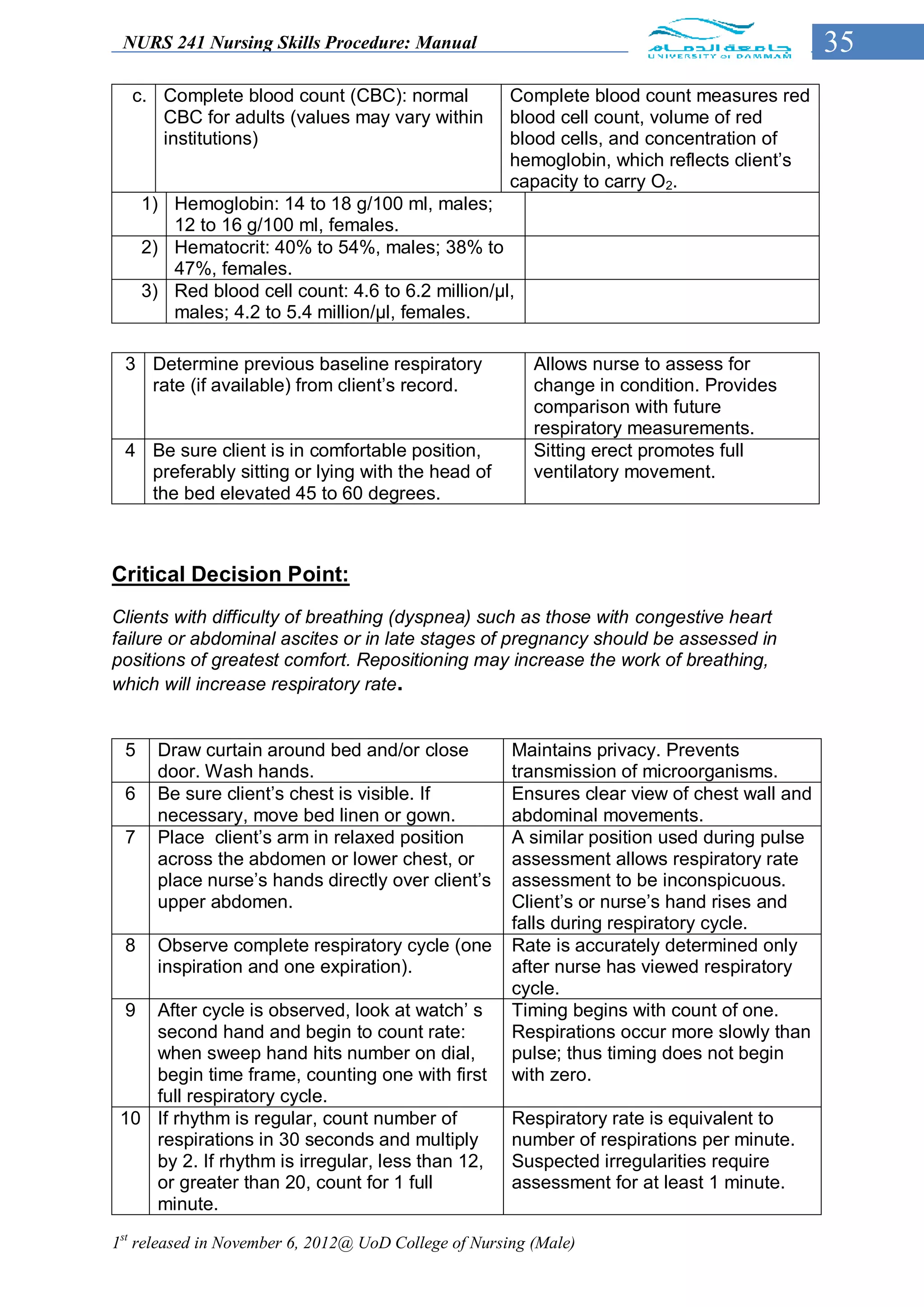
  • 77.
    NURS 241 NursingSkills Procedure: Manual 77 3 Follow special precautions if If these options are not available, wear tuberculosis is suspected, a mask capable of filtering droplet obtaining the specimen in a room nuclei. equipped with a special airflow system or ultraviolet light. 4 Explain to the client what will be Informs client; encourages participation done; instruct in whatever way is and cooperation; lessens anxiety. necessary. 5 Draw the curtain or close the Provides privacy. door to the room if the client desires privacy. 6 Position the client so that he or Place the client in an optimal position to she is upright. fully expand thee lungs and forcefully expel air and secretions. 7 Give the specimen container Prevents contamination with properly labeled to the client with microorganisms. the cover removed. Warn not to touch the inside of the container. 8 Encourage the client to take Promotes full lung expansion to loosen several deep breaths with full and expel secretions. expiration. 9 Instruct the client to cough Forces secretions into larger airways, deeply, raising secretions from facilitating their expulsion. the deep airways. 10 Instruct the client to expectorate directly into the container. 11 Instruct the client to repeat the Provides and adequate amount of deep breathing and coughing sputum for diagnostic testing. sequence until approximately 5 ml of sputum in the container. (Note: Clarify the amount with the agency laboratory). 12 Provide comfort measures for the client as necessary. 13 Wash hands Limits transfer of microorganisms. 14 Send the specimen container to Ensures prompt analysis and accurate the laboratory according to the test results. agency guidelines. 1st released in November 6, 2012@ UoD College of Nursing (Male)
  • 78.
    NURS 241 NursingSkills Procedure: Manual 78 COLLECTION and TESTING of URINE Definition: Urinalysis – the analysis of urine samples. It is a part of the examination of every patient at the beginning and during illness. a. Amount of urine: i. 1200 – 1500 ml / 24 ° = normal. 1. Less than 500 cc / 24 ° = oliguria. 2. More than 1500 cc / 24 ° = polyuria. ii. Day volume is 2 – 3 times more than night volume. b. Appearance / Clarity: i. Normal urine is clear. ii. Turbid (cloudy) urine is not always pathologic. Normal urine may develop turbidity on refrigeration or from standing at room temperature; bacteria ferment urine quickly at room temperature. iii. Abnormally cloudy urine – due to pus, blood, epithelial cells, bacteria, fat, colloidal particles, phosphate, urates. c. Odor: i. Normal – faint aromatic odor. ii. Characteristic odors produced by ingestion of asparagus, thymol. iii. Cloudy urine with ammonia odor – urea-splitting bacteria such as Proteus, causing urinary tract infection. iv. Abnormally colored urine: 1st released in November 6, 2012@ UoD College of Nursing (Male)
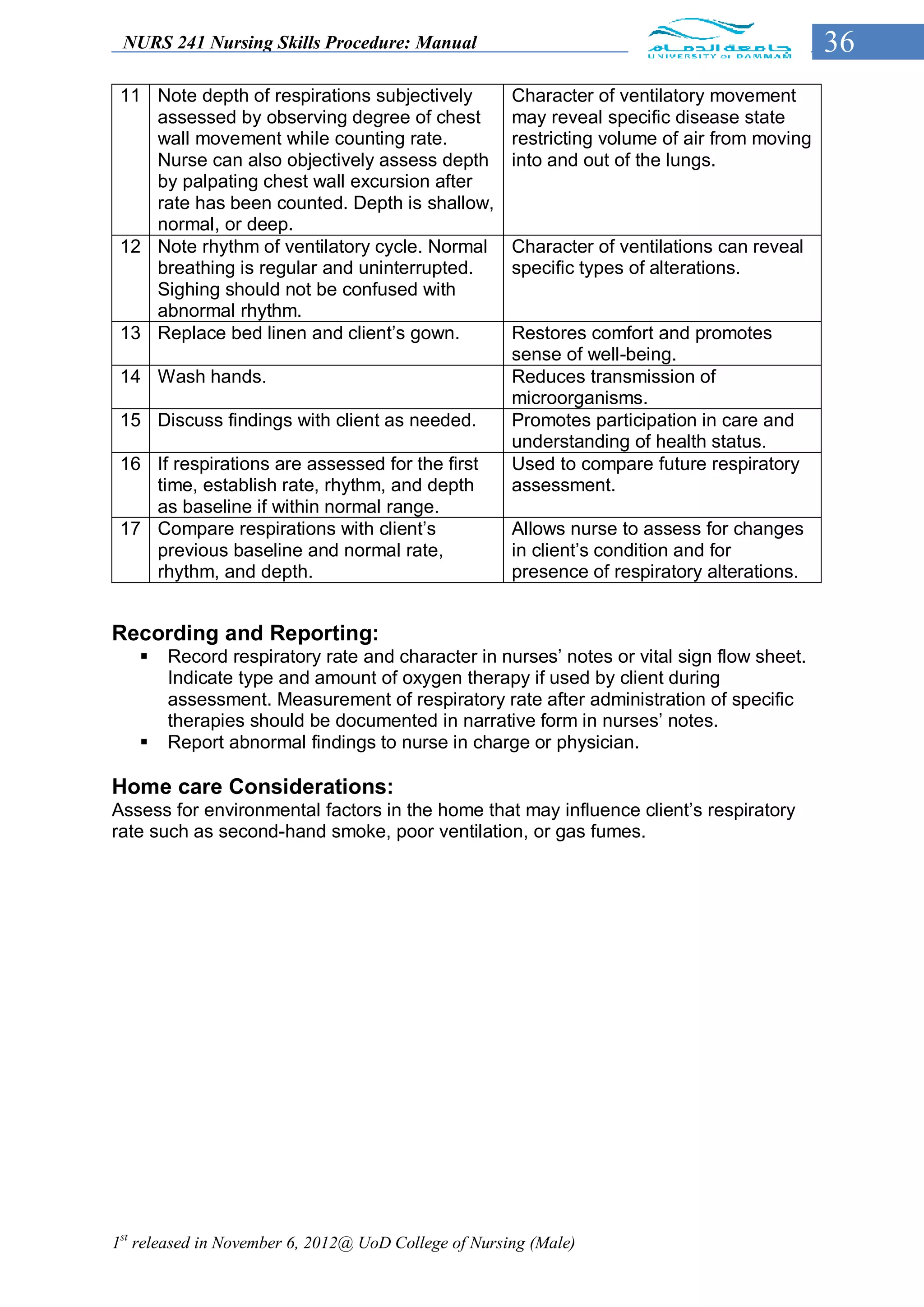
  • 79.
    NURS 241 NursingSkills Procedure: Manual 79 a) Turbid or smoky - may be from hematuria, urine. spermatozoa, prostatic fluid, fat droplets, chyle. b) Red or red brown. - may be due to blood pigments, porphyria, transfusion reaction, bleeding lesions on urogenital tract, some drugs. c) Yellow-brown or - may reveal obstructive lesions of green-brown. bile duct. d. Reaction: i. Reflects the ability of kidney to maintain normal hydrogen ion concentration in plasma and intracellular fluid; indicates acidity or alkalinity or urine. ii. The pH should be measured in fresh urine, since the breakdown of urine to ammonia causes urine to become alkaline. iii. Normal pH is around 6 (acidic); may vary from 4.6 – 7.5. iv. Urine acidity or alkalinity has relatively little clinical significance unless the patient is on special diet or therapeutic program or is being treated for renal calculous disease. v. Alkaline urine is often cloudy because of phosphate crystals. e. Specific gravity: i. Reflects thee kidney’s ability to concentrate or dilute urine; may reflect degree of hydration or dehydration. ii. Normal specific gravity ranges from 1.005 – 1.025. iii. Specific gravity is fixed at 1.010 in chronic renal failure. iv. In a person eating a normal diet, inability to concentrate or dilute urine indicates disease. f. Osmolality: i. Osmolality is an indication of the amount of osmotically active particles in urine (specifically, it is the number of particles per unit volume of water). It is similar to specific gravity, but is considered a more precise test. It is also easy to do – only 1 – 2 ml of urine is required. ii. The unit osmotic measure is the osmole. Average values: Female: 300 – 1090 mosm / kg. Male: 390 – 1090 mosm / kg. Normal Findings in Routine Urinalysis: Element Findings MACROSCOPIC Color Pale straw or amber. More concentrated in the morning. Odor Slightly aromatic. Appearance Clear Specific Gravity 1.010 – 1.025 1st released in November 6, 2012@ UoD College of Nursing (Male)
  • 80.
    NURS 241 NursingSkills Procedure: Manual 80 pH 4.5 – 8.0 (average pH 6, 7- neutral, less than 7 acidic, greater than 7 alkaline). Protein None Glucose None Ketones None Sugar None MICROSCOPIC RBCs 0 – 3 / high-power field WBCs 0 – 4 / high-power field Epithelial Cells Few Casts None, except occasional hyaline casts Crystals Present Yeast Cells None Parasites None Types of Urine Specimen: 1. Clean urine specimen or random routine urine specimen, or routine urinalysis can be collected with a client voiding naturally through a Foley catheter or urinary diversion collecting bag. The specimen should be clean but need not be sterile. It is commonly used to screen urinary and systemic pathologies. The elements of routine urinalysis are the macroscopic and microscopic. 2. Midstream specimen of clean voided or clean catch – to obtain a specimen relatively free of microorganisms growing in the lower urethra but the sterile procedure of catheterization is undesirable. Used for urine culture and sensitivity. 3. 24-Hour Urine – done when a large quantity of urine is necessary to analyze for protein and creatinine clearance. 4. Catheterized specimen – used for culture. 5. Indwelling catheter urine – urine is obtained from an indwelling catheter for culture. 6. Double-voided specimen – used to accurate measurement of glucose and ketones. 7. Use of Keto-Diastix, Multistix, Tes-Tape reagent strips – used to detect glucose and ketones. Purposes: 1. The client understands the need for the urine specimen and will be able to provide a specimen unassisted in the future. 2. The client provides a clean or sterile urine specimen in the manner described by the nurses within a reasonable time. Key Points: 1. Assess the client’s ability to collect specimen independently. 2. Determine the last time the client voided. 1st released in November 6, 2012@ UoD College of Nursing (Male)
  • 81.
    NURS 241 NursingSkills Procedure: Manual 81 Obtaining a clean urine specimen or random urine specimen: STEPS Rationale Collection by the patient: 1 Give client the urine container properly labeled with client’s identification (name, medical record number, sex, age) [date and time of urine collection will be written after collection]. 2 Instruct the patient on how to Provides the client with the information properly collect. needed to collect specimen. 3 Send the urine to the laboratory Ensures accurate testing and immediately or within 2 hours documentation. with the properly filled up laboratory requisition form. Collection done by the nurse: 1 Wash hands. To prevent spread of microorganisms. 2 Collect needed supplies and To save time, effort and energy. equipment: a. Urine container properly labeled with Client’s identification. b. Urinal (male) or bedpan (female). c. Toilet tissues. d. Laboratory requisition form. 3 Explain the purposes(s) and To gain client’s cooperation. procedure of the test. 4 Put on disposable gloves, place urinal or bedpan in position. Instruct client to void. 5 Dry client’s urethral opening Microorganisms thrive in wet areas. with tissue and after voiding. 6 Remove urinal and bedpan, Ensures client’s comfort. cover, and take it into the bathroom or the utility room. 7 Put a designed amount of urine into the urine container and cover it tightly. Discard the remainder. 8 Clear the urinal and bedpan, put Limits transfer of microorganisms. back to proper place. Discard gloves and wash hands. 9 Send to the laboratory Ensures accurate testing and immediately or within 2 hours documentation. with properly filled up laboratory form. 1st released in November 6, 2012@ UoD College of Nursing (Male)
  • 82.
    NURS 241 NursingSkills Procedure: Manual 82 Obtaining a midstream urine specimen: A. Collection done by the patient: 1 Instruct the client on the purposes of urine collection and to prepare the needed supplies and equipment: a. Sterile urine container properly labeled with client’s identification. b. Soap and water c. Disposable washcloth. d. Antiseptic solution e. Sterile cotton balls f. Laboratory requisition form 2 Instruct the client of the procedure. Retract the foreskin if Cleansing the female urinary needed. Using a towelette, meatus, spread the labia minora cleanse the urinary meatus with one hand and with the other by moving in a circular hand, cleanse the perineal area motion from the center of the from front to back. uretral openining around the glans and down the distal portion of the shaft of the penis. a. Wash hands To prevent transfer of microorganisms. b. Clean the perineal area around the Removes most pathogenic organisms from the area urinary meatus using the disposable around urethra, thus decreasing potential contamination of the urine specimen. washcloth. c. Wash hands again. Limits transfer of microorganisms. d. Soak the cotton ball after one use. e. Using a cotton ball, clean around Removes microorganisms from peri-urethral external meatus with a single stroke. area. f. Discard cotton ball after on use. Avoids contamination. g. Continue the cleansing action Removes microorganisms from the peri-urethral discarding all used balls. area. h. Void a small amount; hold the urinary Flushes away microorganisms from urethra. stream. i. Void urine into the sterile specimen Collects specimen with minimal contamination. container, holding the container only on the outside. j. Stop voiding when container is about three- Prevents overflow in specimen container. quarters full; void remaining urine in toilet, bedpan, or urinal. Cover the container tightly without touching the inside of the container. k. Wash hands. Final hand wash is to remove any contamination of hands from possible contact with urine. B. Collection done by the Nurse: 1 Wash hands and put on clean gloves. Limits transfer of microorganisms. 1st released in November 6, 2012@ UoD College of Nursing (Male)
  • 83.
    NURS 241 NursingSkills Procedure: Manual 83 2 Gather needed supplies and To save time, effort and energy. equipment: a. Sterile urine container. b. Bedpan or urinal. c. Sterile cotton balls. d. Antiseptic soap. e. Disposable washcloth. f. Disposable gloves. 3 Explain purposes and procedure to the To gain client’s cooperation. client. 4 Pull on the curtain or close the door. To provide privacy. 5 Put on disposable gloves. 6 Soak the cotton balls with antiseptic Prepares equipment; client will not have to wait soap and set them aside. for this part of the procedure. 7 Place the female client on a bedpan. Place urinal under the male client’s penis. 8 Clean the area around the urinary Removes microorganisms, a decreasing meatus using disposable washcloth. possible contamination of specimen. 9 Discard gloves, wash hands, and put Removes microorganisms that may be present on clean gloves. after cleaning the perineal area. 10 Clean around the meatus (if client is Prevents fecal contamination of meatus. male); clean from pubis to rectum (if client is female) with the cotton balls using single strokes. 11 Discard balls after single use. Repeat Prevents recontamination with used cotton balls. cleansing. 12 Instruct the client to void a small Washes away microorganisms in and around amount of urine into the bedpan or meatus. urinal, then to hold the urine stream. 13 Place a sterile specimen near urethra; Collects the specimen with few if any instruct the client to void again. microorganisms. 14 When container is nearly full, instruct Prevents overflow from specimen container. the client to hold the urine into the bedpan or urinal. 15 Instruct the client to void the remainder of the urine into the bedpan of urinal. 16 Lift the client from bedpan or remove urinal. Leave the client comfortable. 17 Close specimen container with a sterile Prevents further contamination by top and without touching the inside of microorganisms. the container. 18 Discard gloves and wash hands. Limits transfer of microorganisms. 19 Send to laboratory immediately with properly filled up laboratory requisition form. 1st released in November 6, 2012@ UoD College of Nursing (Male)
  • 84.
    NURS 241 NursingSkills Procedure: Manual 84 Collecting urine specimen from Indwelling Catheter: 1 Wash hands. To prevent the spread of microorganisms. 2 Prepare needed supplies and To save time, effort and energy. equipment: a. Sterile urine container properly labeled with client’s identification. b. Disposable 10 ml syringe with needle. c. Antiseptic swab or alcohol swab. d. Clamp. e. Disposable clean gloves. 3 Explain the purposes and procedure to To gain client’s cooperation. the client. 4 Pull the curtain or close the door. To provide privacy. 5 Put on disposable gloves. 6 Inspect the urinary drainage tubing for Determines if sufficient amount is amount of urine in the tubing. present to withdraw for specimen. 7 Clamp the drainage tubing at least 3 Blocks urine from draining into the in. below the sampling port (if it collecting bag; thus rubber contains little urine) by using a U accumulates a sufficient amount clamp or folding the tubing and of specimen. securing a band around the fold. 8 Leave the clamp in place for 30 Allows enough time for urine to minutes. drain. 9 Locate the specimen port with an Identifies the area designated for antiseptic swab. withdrawing urine from a drainage system. 10 Clean the port with an antiseptic swab. Removes microorganisms from the port. 11 Insert the needle of the 10 ml syringe through the port. Obtaining a urine specimen from a retention catheter: A. From a specific area near the end of the catheter. B. From an access port in the tubing. A B 12 Unclamp the tubing and withdraw the For example, 3 mL for a urine culture or required amount of urine. 30 mL for a routine urinalysis. (Depending on the system). 13 Transfer the urine to the specimen If a sterile culture tube is used, make container. sure the needle or syringe does not touch the outside of the container to prevent recontamination. 14 Discard the syringe and needle in an appropriate sharps container. 1st released in November 6, 2012@ UoD College of Nursing (Male)
  • 85.
    NURS 241 NursingSkills Procedure: Manual 85 15 Cap the container. 16 Remove gloves and discard. Perform hand hygiene. 17 Label the container, and send the urine to the laboratory immediately for analysis or refrigerator. 18 Record collection of the specimen and any pertinent observations of the urine on the appropriate records. Collecting 24-hour urine specimen: 1 Collect the needed supplies and To save time, effort and energy. equipment. a. Large size urine collector properly labeled with client’s identification. b. Bedpan or urinal c. Bucket with container or refrigerator. d. Laboratory requisition form. 2 Explain the procedure to the client. Informs the client and gives instructions on what he or she is to do to help. Often the client is the key person in the success of a 24-hour collection because he or she reminds all people to save the urine. 3 Place the container in a large Prevents the urine from container filled with ice; place this on deteriorating. the client’s bathroom or nearby storage area. 4 Instruct the client to void and discard the specimen. 5 Record the time and date of Ensures that all urine from this point discarded specimen on the on is collected. collection container. This is the starting time of the collection. 6 Place all voided urine in the Ensures that urine is saved; this is container during the next 24 hours. critical for the accuracy of the test. 7 Let client void (in toilet, bedpan, or urinal). Collect urine or pour urine from the bedpan or urinal into the urine container. 8 Send to the laboratory immediately with properly filled up laboratory requisition form. 1st released in November 6, 2012@ UoD College of Nursing (Male)
  • 86.
    NURS 241 NursingSkills Procedure: Manual 86 Testing urine for contents (sugar and ketones): A. Double-voided urine. 1 Prepare needed supplies and To save time, effort and energy. equipment. a. Urine container properly labeled with client’s identification. b. Tissue c. Urinal or bedpan. d. Water to drink. 2 Explain purpose and procedure to To gain client’s cooperation. client. 3 Pull on the curtain or close the door. To provide privacy. 4 Ask client to void and discard urine. 5 Let client drink water, around 8 oz. 6 Wait for 30 – 45 minutes. 7 Let client to void (in toilet, bedpan, or urinal). Collect urine or pour urine from the bedpan or urinal. 8 Send to the laboratory immediately To ensure accuracy. with properly filled up laboratory requisition form. Using reagent strip. After dipping the reagent strip (dipstick) into fresh urine, wait the stated time period and compare the results to the color chart. 1 Wash hands. To prevent the spread of microorganisms. 2 Prepare needed supplies and To save time, effort and energy. equipment a. Sterile urine container properly labeled with client’s identification. b. Reagent strip. c. Disposable gloves (optional) 3 Explain to the client what will be Informs the client. done. 4 Read instructions on the testing kit to Instructs on how to use the test determine how much urine is materials. Techniques vary with needed. many different brands. 5 Wash hands and put on gloves. Limits transfer of microorganisms. 6 Collect the urine specimen. 7 Take the specimen to a work area. 8 Dip reagent strip in the urine Strip contains chemicals that specimen and pull it out immediately. change colors when exposed to glucose and ketones. 1st released in November 6, 2012@ UoD College of Nursing (Male)
  • 87.
    NURS 241 NursingSkills Procedure: Manual 87 9 Remove excess urine from the reagent strip. 10 Wait for 15 to 30 seconds depending on the manufacturer’s instructions. 11 Compare the strip’s color with that of The color scale measures the the chart on the bottle. quality of glucose and ketones The range of the color scales extends from negative, trace, 1+, 2+, 3+. 12 Discard urine and reagent strip. 13 Remove gloves and wash hands. 14 Inform the client of the results and record. COLLECTION and TESTING of STOOL I. Introduction: Stool specimen yields information related to functioning of the gastrointestinal system and its accessory organs. a. Test for ova and parasites (O & P) – indicates the presence of gastrointestinal parasites and / or their eggs ova. b. Guaiac or Hemoccult or occult blood test – used to test presence of blood in stool. Fecal Characteristics: Character Normal Abnormal Cause Color Infant: Yellow White or Clay Absence of bile. Adult: Brown – due to metabolism of bile Black or tarry Iron ingestion or pigments to upper GI bleeding. stercobilin. Red (melena) Lower GI bleeding, hemorrhoids. Pale with fat Malabsorption of fat. Odor Pungent: affected by Noxious change. Blood in feces or food type – results infection. from the presence of indole and skatole, end products of protein catabolism by bacterial action in the large intestines. Consistency Soft, formed Liquid Diarrhea, reduced absorption. Hard Constipation. 1st released in November 6, 2012@ UoD College of Nursing (Male)
  • 88.
    NURS 241 NursingSkills Procedure: Manual 88 Frequency Infant: Infant: more than 6 x Hypomotility or Breastfed – 4 to 6 x / day or less than hypermotility. daily once every 1 – 2 Bottle-fed – 1 – 3 x days. daily Adult: More than 3 x Adult: daily or 3 x per a day or less than week. once a week. Amount 150 Gm/day Narrow, pencil Obstruction, rapid shape resembles diameter shaped. peristalsis. of rectum. Constituents Undigested food, Blood, pus, foreign Internal bleeding, dead bacteria, fat, bodies, mucus, infection, swallowed bile pigment, cells worms. objects, irritation, lining intestinal inflammation. mucosa, water. II. Objectives: 1. The client understands the purpose of the diagnostic test, as evidenced by ability to explain it. 2. The client eliminates sufficient stool to provide a specimen for the diagnostic test. III. Key Points: 1. Assess the client’s understanding of the test and ability to collect the specimen independently. 2. Determine the time of the client’s last bowel movement. 3. Wearing disposable gloves use a tongue depressor to transfer stool from bedpan to specimen container. 4. Label specimen correctly. 5. Test specimen by following instructions on test packet. 6. Record results of specimen test in the health record. IV. Supplies and Equipment: Action Rationale 1. Bedpan, commode, ordinary Provides receptacle for stool collecting hat. 2. Toilet tissue. Cleans perineal area after defecation. 3. Disposable gloves. Protects the nurse’s hands. 4. Tongue blades. Transfers stool from one container to another. 5. Specimen container. Collects stool for testing. V. Procedure: Action Rationale Collecting s Stool Specimen: 1 Explain the purpose of the test to Informs the client and encourages the client. participation. 1st released in November 6, 2012@ UoD College of Nursing (Male)
  • 89.
    NURS 241 NursingSkills Procedure: Manual 89 2 Describe how the specimen is to be Instructs the client who is to collect collected. own stool. 3 Instruct the client to save his or her Collects specimen that is free of stool in a bedpan and to discard urine, water, and toilet paper. toilet paper elsewhere. If the client is unable to collect specimen: 1 Wash hands. To prevent spread of microorganisms. 2 Gather the needed equipment and To save time, effort and energy. supplies; label the specimen container with appropriate identification and fill up the lab. request form. 3 Explain the purposes(s) and Informs the client and encourages procedure of the test. participation. 4 Pull on the curtain or close the door. To provide privacy. 5 Remove bedpan (or commode pan) with stool after the client evacuates. 6 Cover the bedpan and take it to the Removes stools from the client’s bathroom or dirty work area. bed unit to minimize embarrassment or discomfort. 7 Use tongue blades to transfer stool from bedpan to a specimen container. Transfer as much as is required for the test. Place lid securely on the container. 8 Discard tongue blades and excess stool, wash bedpan. 9 Discard gloves and wash hands. Limits transfer of microorganisms. 10 Send specimen to the laboratory Ensures accurate testing. immediately. 11 Record date and time of stool collection and results. OBTAINING A CAPILLARY BLOOD SPECIMEN TO MEASURE BLOOD GLUCOSE PURPOSES 1. To determine or monitor blood glucose levels of clients at risk for hyperglycemia or hypoglycemia 2. To promote blood glucose regulation by the client 3. To evaluate the effectiveness of insulin administration 1st released in November 6, 2012@ UoD College of Nursing (Male)
  • 90.
    NURS 241 NursingSkills Procedure: Manual 90 ASSESSMENT Before obtaining a capillary blood specimen, determine: 1. The policies and procedures for the facility 2. The frequency and type of testing 3. The client’s understanding of the procedure 4. The client’s response to previous testing 5. Assess the client’s skin at the puncture site to determine if it is intact and the circulation is not compromised. Color, warmth, and capillary refill. 6. Reviewed the client’s record for medications that may prolong bleeding such as anticoagulants, or medical problems that may increase the bleeding response. 7. Assess the client’s self-care abilities that may affect accuracy of test results, such as visual impairment and finger dexterity. PLANNING Delegation Check the policy and procedure manual to determine who can perform this skill. It is usually considered an invasive technique and one that requires problem solving and application of knowledge. It is the responsibility of the nurse to know the results of the test, and supervises unlicensed assistive personnel responsible for assisting the nurse. EQUIPMENT 1. Blood glucose meter (glucometer) 2. Blood glucose reagent strip compatible with the meter 3. 2 x 2 gauze 4. Antiseptic swab 5. Clean gloves 6. Sterile lancet ( a sharp device to puncture the skin) 7. Lancet injector (a string-loaded mechanism that holds the lancet) IMPLEMENTATION Preparation  Review the type of meter and the manufacturer’s instructions.  Assemble the equipment at the bedside. STEPS Rationale 1 Prior to performing the procedure, introduce self and verify the client’s identity using agency protocol. Explain to the client what you are going to do, why it is necessary, and how he or she can participate. Discuss how the results will be used in planning further care or treatments. 2 Perform hand hygiene and observe other appropriate infection control procedures (e. g., gloves). 1st released in November 6, 2012@ UoD College of Nursing (Male)
  • 91.
    NURS 241 NursingSkills Procedure: Manual 91 3 Provide privacy. (1) Insert the test strip into the meter. 4 Prepare the equipment. a Some meter turn on when a test strip is inserted into the meter ( 1 ) b Confirm the code number. 5 Select and prepare the vascular puncture site. a Choose a vascular puncture site (e.g., the side These actions increase the of an adult’s finger). Avoid sites beside bone. blood flow to the area, ensure Hold a finger in a dependent (below heart an adequate specimen, and level) position. If the earlobe is used, rub it reduce the need for a repeat gently with a small piece of gauze. puncture. b Clean the site with the antiseptic swab or soap Alcohol can affect accuracy and water and allow it to dry completely. and the site stings when punctured when wet with alcohol. 6 Obtain the blood specimen. a Apply gloves. b Place the injector, if used, against the site, and The lancet is designed to release the needle, thus permitting it to pierce pierce the skin at a specific the skin. Make sure the lancet is perpendicular depth when it is a to the site. perpendicular position relative to the skin. (2). c Prick the site with a lancet or needle, using a darting motion. d Gently squeeze (but do not touch) the puncture site until a drop of blood forms. The size of the drop of blood can vary depending on the meter. Some meters require as little as 0.3 mL of blood to accurately test blood sugar. (2) Place the injector against the site. e Hold the reagent strip under the puncture site until adequate blood covers the indicator square. The pad will absorb the blood and a chemical reaction will occur. Do not smear the blood. This will cause an inaccurate reading. - Some meters wick the blood by just touching the puncture site with the strip. (3) f Ask the client to apply pressure to the skin puncture site with 2x2 gauze. Pressure will assist hemostasis. 7 Expose the blood to the test strip for the period and the manner specified by the manufacturer. As soon as the blood is placed on the test strip: (3) Apply the blood to the test strip. 1st released in November 6, 2012@ UoD College of Nursing (Male)
  • 92.
    NURS 241 NursingSkills Procedure: Manual 92 a Follow the manufacturer’s recommendations The blood must remain in on the glucose meter and monitor for the contact with the test strip for a amount of time indicated by the manufacturer. prescribe time to obtain accurate results. Some glucometers have the test strip placed in the machine before the specimen is obtained. 8 Measure the blood glucose. a Place the strip into the meter according to the Refer to the specific manufacturer’s instructions. manufacturer’s recommendations for the specific procedure. b After the designed time, most glucose meters will display the glucose reading automatically. Correct timing ensures accurate results. (4). c Turn off the meter and discard the test strip and 2x2 gauze in a biohazard container. Discard the lancet into a sharps container. d Remove and discard gloves. Perform hand hygiene. 9 Document the method of testing and results on the client’s record. If appropriate, record the client’s understanding and ability to demonstrate the technique. (4) Read the results The client’s record may also include a flow sheet on which capillary blood glucose results and the amount, type, route, and time of insulin administration are recorded. Always check if a diabetic flow sheet is being used for the client. 1 Check for orders for sliding scale insulin based on 0 capillary blood glucose results. Administer insulin as prescribed. EVALUATION 1. Compare glucose meter reading normal blood glucose level, status of puncture site, and motivation of the client to perform the test independently. 2. Relate blood glucose reading to previous reading and the client’s current health status. 3. Report abnormal results to the primary care provider. Some agency may have a standing policy to obtain a venipuncture blood glucose if the capillary blood glucose exceeds a certain value. 4. Conduct appropriate follow-up such as asking the client to explain the meaning of the results and/or demonstrating the procedure at the next scheduled test. 5. Prepare the client for home glucose monitoring and review frequency, record keeping, and insulin administration if appropriate. 1st released in November 6, 2012@ UoD College of Nursing (Male)
  • 93.
    NURS 241 NursingSkills Procedure: Manual 93 Collecting Samples from the Nose or Throat I. Introduction The oronasopharyngeal cavity is lined with mucous membrane that secretes mucus, moistening the membrane and the air that is inhaled. Lachrymal fluid and saliva also drain into the cavity. Viral infections are common problems in the upper airways, but bacterial infections occur as well. Because bacterial infections can be treated pharmacologically, samples for cultures are taken of the upper airway secretions to distinguish between viral and bacterial infections. When bacteria are cultured, sensitivity tests determine the proper treatment. II. Purposes: 1. The client can accurately report the reason for the culture and explain when and how its result will be learned. 2. The client’s nose and throat are without discomfort or bleeding from taking the culture as evidenced by his or her report and an inspection of the area. III. Key Points: 1. Assess the client for evidence of respiratory infection. 2. Observe the client’s ability to cough deeply. 3. Place the client in high Fowler’s position. IV. Supplies and Equipment: Rationale 1. Sterile cotton-tipped or polyester- Removes exudate from pharyngeal tipped swab or applicator in a mucosa without contamination. culture tube. 2. Tongue depressor. Depresses tongue for better visualization of pharynx. 3. Penlight. Illuminates area to be cultured. 4. Facial tissues. Available for the client if there is excessive tearing or coughing following culture. 5. Identification labels. Prevents errors by correctly labeling the culture tube. 1st released in November 6, 2012@ UoD College of Nursing (Male)
  • 94.
    NURS 241 NursingSkills Procedure: Manual 94 6. Laboratory requisition form. Informs the laboratory of the client’s identification or other required information. 7. Emesis basin. Available in case the client gags and vomits following the throat culture. V. Procedure: STEPS Rationale Collecting Culture Samples from the Pharynx 1 Wash hands. Limits transfer of microorganisms. 2 Gather needed supplies and equipment. To save time, effort and energy. 3 Explain the exact procedure to the client. Informs the client and encourages Tell him or her that a ticking sensation in discussions of anxiety or discomfort. the throat may be felt and that the client Prepares for the discomfort of the may even gag as the throat is swabbed. culture. 4 Pull on the curtain or close the door. To provide privacy. 5 Instruct the client to sit upright or help Allows easier view visualization of the into that position. access to the pharynx. 6 Place tissues and emesis basin within Prepares the client if need arises. the client’s reach. 7 Ready the swab by loosening it from the Prepares the swab. culture tube; place it within reach. 8 Depress the tongue with the tongue Permits visualization of the pharynx so depressor while illuminating the pharynx that it can be inspected. with the penlight. 9 Inspect the pharynx for reddened or inflamed areas or patches of exudates. 1 Set the penlight aside and grasp the 0 swab. 1 Insert the swab through the mouth, Prevents contamination of the swab tip 1 carefully avoiding the tongue, teeth, or cheeks. 1st released in November 6, 2012@ UoD College of Nursing (Male)
  • 95.
    NURS 241 NursingSkills Procedure: Manual 95 1 Rub the swab quickly but firmly over the Ensures collection of secretions from 2 area of inflammation or patchy exudate. suspicious areas. If no exudate is seen: 1 Rub the swab quickly but firmly over the Ensures collection of secretions in an 3 nasopharyngeal area behind the uvula. area representative of the entire pharynx. 1 Withdraw the swab quickly without Prevents contamination of the swab. 4 touching the oral tissues. 1 Replace the swab in the culture tube. 5 1 Insert the swab tip into the medium. Inserting the collected secretions directly 6 into the medium ensures that the bacteria will survive until cultured by the laboratory. 1 Secure the top of the culture tube. Prevents contamination. 7 1 Discard the tongue blade. 8 1 Provide comfort measures for the client 9 as necessary; facial tissues, a drink of water. 2 Wash hands. Limits transfer of microorganisms. 0 2 Secure labels to the culture tube. Prevents identification errors by the 1 laboratory. 2 Send the culture to the laboratory Ensures accurate results. 2 according to agency guidelines. B. Collecting Culture Samples from the nasal Mucosa 1st released in November 6, 2012@ UoD College of Nursing (Male)
  • 96.
    NURS 241 NursingSkills Procedure: Manual 96 1 Wash hands. Limits transfer of microorganisms. 2 Gather needed supplies and equipment. To save time, effort and energy. 3 Explain the exact procedure to the client. Informs the client of the procedure; Tell him or her that she will feel itching encourages participation; prepares for and discomfort or a desire to sneeze as the discomfort. the swab passes through the nose. 4 Pull on the curtain or close door. To provide privacy. 5 Instruct the client to sit upright or help Allows easier visualization of the access into that position. to the nares. 6 Place tissues within the client’s reach. Prepares the client if need arises. 7 Ready the swab by loosening it from the Prepare the swab. culture tube; place it within reach. 8 Instruct the client to blow his or her Prepare the swab. nose. 9 Instruct the client to tilt head back. Allows easier access to the turbinates. 1 Inspect the nostrils to determine Determines which nostril to use; select 0 patency; using the penlight for the nostril without visible obstruction. illumination. 1 Insert the wire swab gently through the Prevents contamination of the swab tip. 1 most patent nostril; avoid touching the A wire swab is preferable for this nasal tissue. procedure because it is less likely to injure tissues. Bend the swab into a curve that permits easier entry before the package is opened. 1 Force the swab through the resistance Ensures that the swab tip rests against 2 met when it enters the turbinates. the tissues of the turbinates rather than the anterior nares. 1 Place the tip of the swab against the Collects the secretions. 3 turbinate tissue and rotate. 1 Withdraw the swab quickly without Prevents contamination of the swab. 4 touching the sides of the nares. 1 Replace the swab in the culture tube. 5 1st released in November 6, 2012@ UoD College of Nursing (Male)
  • 97.
    NURS 241 NursingSkills Procedure: Manual 97 1 Insert the swab tip into the medium. Inserting the collected secretions directly 6 into the medium ensures that the bacteria will survive until cultured by the laboratory. 1 Secure the top of the culture tube. Prevents contamination. 7 1 Provide comfort measures for the client 8 as necessary; facial tissues, a drink of water. 1 Wash hands. Limits transfer of microorganisms. 9 2 Secure labels to the culture tube. Prevents identification errors by the 0 laboratory. 2 Send the culture to the laboratory Ensures accurate results. 1 according to agency guidelines. Insert the wire swab gently through the most patent nostril; avoid touching the nasal tissue. BANDAGES AND BINDERS Introduction / Definition: A simple gauze dressing is often not enough to immobilize or provide support to a wound. Bandages and binders are devices that secure large dressings, wrap body parts, provide support to body areas and facilitate immobilization of the limits. Bandage – is a strip or roll of material that is wrapped around a body part to support or immobilize a body part, or to secure a dressing that cannot be taped to the skin. Bandages are available in rolls of various widths and material including gauze, elasticized knits, elastic webbing, flannel, and muslin. Gauze – is used for bandages because it is light and porous and conforms to body parts; permit air circulation to underlying skin to prevent maceration, inexpensive, and can be discarded after one use. Elastic bandage – adhere to the skin providing support and pressure and conform to body parts. A binder – is a broad bandage made of a shape and size to fit and supports the underlying muscles or incisions or dressings on a body part; is made of cotton or muslin fabric that may or may not be elasticized. Some binders have metal or plastic ribbing (stays) to prevent 1st released in November 6, 2012@ UoD College of Nursing (Male)
  • 98.
    NURS 241 NursingSkills Procedure: Manual 98 bending and add additional support. Other binders are made of netting that stretches to accommodate shape as they encircle the entire body to secure dressings. Bandages and binders applied over or around dressings can provide extra protection and therapeutic benefits by: 1. Creating pressure over a body part. 2. Immobilizing a body part. 3. Supporting a wound. 4. Reducing or preventing edema. 5. Securing a splint, or 6. Securing dressings. Principles for Applying Bandages and Binders: • Correctly applied bandages and binders do not cause injury to underlying or nearby body parts or create discomfort for the client. 1. Inspect the skin for abrasions, edema, discoloration, or exposed wound edges. 2. Cover exposed wounds or open abrasions with sterile dressing. 3. Assess the condition of underlying dressings and change them if they are soiled. 4. Assess the skin of underlying body parts and parts that will be distal to the bandage for signs of circulatory impairment; (coolness, pallor, or cyanosis, diminished or absent pulses, swelling, numbness, and tingling) to provide a means for comparing changes in circulation after bandage application. BANDAGING Techniques of Applying Bandages: 1. Circular turn – is used to anchor the bandage at its beginning and end. It may also be used to bandage small areas such as finger and wrist. 2. Spiral turn – to cover part that is uniform in shape like upper arm or leg. 3. Spiral reverse – to bandage areas of the body that are not uniform in shape such as lower leg. 4. Recurrent turn – used to cover distal ends such as the skull, distal end of the finger, or the stump of an amputation. 5. Figure-of-eight turn – is used to support joint areas such as knees and elbows while slowing some movement of the body part covered. 6. Spica turn – (modification of figure-of-eight turn) – used to cover larger areas such as upper thigh of lower hip area / upper arm with shoulder. Supplies and Equipment: For Bandages: 1st released in November 6, 2012@ UoD College of Nursing (Male)
  • 99.
    NURS 241 NursingSkills Procedure: Manual 99 1 Bandage of approximate materials, width, Various conditions and purpose determine and length. the type of use of different bandage. 2 Dressing change supplies. Available to change dressing if required. 3 Safety pins, clips, or tape. Secure the bandage. Key Points for Bandage Application: Action Rationale 1 Position body parts to be bandaged in Bandages can cause restriction in comfortable position of normal movement. Immobilization in normal anatomical alignment. functioning position reduces risks of deformity or injury. 2 Prevent friction between and against Skin surfaces in contact with each other surfaces by applying gauze or cotton (e.g., between toes or under breasts) can padding. rub against each other to cause abrasion or chafting. Bandages over bony prominences may rub against each other to cause breakdown. 3 Apply bandages securely to prevent Friction between bandages and skin can slipping during movement. cause skin breakdown. 4 When bandaging extremities, apply Gradual application of pressure from distal bandage first at distal end and progress toward proximal portion of extremity toward trunk. promotes venous return and minimizes risk of edema or circulatory impairment. 5 Apply bandages firmly, with equal Equal tension prevents unequal pressure tension exerted over each turn on layer. distribution over bandaged body part. Avoid excess overlapping of bandage Localized pressure causes circulatory layers. impairment. 6 Position pins, knots, or ties away from Pins and ties used to secure bandages and wound or sensitive skin areas. binders can exert localized pressure and irritation. 1st released in November 6, 2012@ UoD College of Nursing (Male)
  • 100.
    NURS 241 NursingSkills Procedure: Manual 100 Procedure for BANDAGING: 1 Explain the procedure and its purposes to For the client to cooperate and participate. the client. 2 Prepare all the materials needed. Organizes the procedure saving time, effort and energy. 3 Wash hands. Limits transfer of microorganisms. 4 Close door or draw the curtains. Provide privacy. 5 Inspect the skin for abrasions, edema, discoloration, or exposed wound edges. • Assess the condition of underlying dressings and change them if they are soiled. • Cover exposed wounds or open abrasions with a sterile dressing. 6 Assess skin of underlying body parts that Provide a means for comparing changes will be distal to the bandage for signs of in circulation after bandage application. circulatory impairment (coolness, pallor or cyanosis, diminished or absent pulses, swelling, numbness, and tingling. 7 Assist the client to assume a comfortable Prevents deformity and increase position, maintaining a position of normal circulation to the affected area. function for the body. • Bandages on the lower extremities are applied before the client sits or stands. • An extremity may be elevated for 15 to To encourage adequate venous return. 30 minutes before wrapping. 8 Hold the bandage in the dominant hand Facilitates control when stretching and with the roll up. unrolling the bandage. 9 Unroll 3 to 4 inches of the bandage. 10 Hold the end of the bandage in place on Maintains uniform tension. top of the distal part using the fingers of the non-dominant hand. 11 Leave a portion of the distal part exposed, Allows later inspection and palpation of such as the toes or fingers. distal parts for neuro-vascular assessment. 12 Bring the bandage down and around the body part unrolling and stretching slightly if elastic. 1st released in November 6, 2012@ UoD College of Nursing (Male)
  • 101.
    NURS 241 NursingSkills Procedure: Manual 101 13 Wrap the bandage directly over the held Anchors the bandage at the end. end and fasten it with safety pin, clip, or tape. Note: • Use circular turns to begin and end a Provides security and support to the bandage. This is called anchoring. bandage. • In bandaging the foot, start at the side of the foot so that the end will not cause pressure over the bony area on the upper foot or create discomfort on the bottom of the foot when the patient walks. To wrap a Spica Bandage: 14 Anchor with two circular turns. 15 Bring the bandage up and around the body Varies the figure-8 turn used to cover part. large areas. 16 Wrap bandage down and around the other Covers body areas such as thumb, groin, body part forming a figure-8. breast, shoulder, and hip. 17 Continue in this pattern until the area is Provides a means of checking circulation covered. Leave tips of finger and toes in the bandaged extremity. exposed. 18 End with two circular turns. 19 Fasten with tape, safety pins, or clips. Prevents unwrapping. For all bandage types: 20 Inspect bandage at frequent intervals for Ensures the bandage is in place and is of intactness and constant tension; assess the benefit to the client. neurovascular status of the extremity. 1st released in November 6, 2012@ UoD College of Nursing (Male)
  • 102.
    NURS 241 NursingSkills Procedure: Manual 102 Types of Bandage Turns Type Description Purpose or Use Cecil/Feb./08 1st released in November 6, 2012@ UoD College of Nursing (Male)
  • 103.
    NURS 241 NursingSkills Procedure: Manual 103 Spiral Reverse Figure of Eight Spica 1st released in November 6, 2012@ UoD College of Nursing (Male)
  • 104.
    NURS 241 NursingSkills Procedure: Manual 104 BINDERS Types and Purposes of binders: 1. The abdominal binder (straight) is used to provide support and protection to the abdomen. It is made of a rectangular fabric (a bath blanket or draw sheet) and long enough to encircle the body and extend from the lower ribs to the symphysis pubis. Commercially made binders are rectangular and made from heavy fabric or elastic with a Velcro closure. 2. The scultetus or many-tailed binder is also to provide support to the abdomen or to secure dressings. This binder is made of flannel and has three to six tails on either side of solid back. The tails are secured starting above the groin and alternated across the abdomen to an area just below the ribs. 3. The breast binder is a vest with adjustable straps and a front closure of safety pins. Adjustments are made to provide a smooth fit that does not interfere with respiration. This binder is used to provide support the breasts and thorax. 4. The double T-binder (A) is of the same design as the single T-binder with the addition of a second trip to aid in securing rectal and perineal dressings for men. The straps attached to the waist on either sides of the penis and scrotum. 5. The single T-binder (B) is made of muslin. Two narrow strips are sewn together at right angles, one strip encircles the waist and the other secures rectal or perineal dressings. These are most often used for women. 1st released in November 6, 2012@ UoD College of Nursing (Male)
  • 105.
    NURS 241 NursingSkills Procedure: Manual 105 6. The sling or triangular binder is made commercially of muslin. Its purpose is to provide support to the arm, shoulder, or hand. Additionally, it limits movement while not impairing circulation, and reduces edema to the lower arm and hand. Objectives: 1. The client’s abdominal or scultetus binder is properly applied as evidenced by the ability to breathe normally; the presence of pulses distal to the binder, and intact skin integrity. 2. The client’s T-binder is properly applied as evidenced by secured perineal or rectal dressings, adequate scrotal support, and the client’s ability to remove and reapply the binder when needed for elimination. 3. The client’s triangular binder (sling) is applied as evidenced by immobilization of the arm, shoulder, and elbow as therapeutically prescribed without compromised circulation. 4. The client’s binder provides adequate support to the body tissues without discomfort to the client as evidenced by verbal and nonverbal responses. Supplies and Equipment: For Binders:  Gloves, if wound drainage is present. ▪ T and double T Binders:  Abdominal binder: o Correct size o Correct size cloth/elastic o Safety pins straight binder ▪ Breast binder: o Safety Pins (unless Velcro o Correct size closure or metal fasteners are o Safety pins (unless Velcro closure attached) or metal fasteners are attached) 1st released in November 6, 2012@ UoD College of Nursing (Male)
  • 106.
    NURS 241 NursingSkills Procedure: Manual 106 Preparing for the application of a binder RATIONALE STEPS 1. Wash hands. Limits transfer of microorganism. 2. Take supplies to the bedside. 3. Explain the procedure to the client. Promotes client cooperation and understanding and reduces anxiety. 4. Close door or draw bedside curtains. Provides privacy. Procedure: STEPS RATIONALE 1 Observe client with need for support of thorax Baseline assessment determines or abdomen. Observe ability to breath deeply client’s ability to breathe and and cough effectively. cough. Impaired ventilation of lung can lead to alveolar atelectasis and inadequate arterial oxygenation. 2 Review medical record if medical prescription Application of supportive binders for particular binder is required and reasons may be used on nursing judgment. for application. In some situations, physician input is required. 3 Inspect the skin for actual or potential Actual impairments in skin alterations in integrity. Observe for irritations, integrity can be worsened with abrasions, skin surfaces that rub against each application of binder. Binder can other, or allergic response to adhesive tape cause pressure and excoriation. used to secure dressing. 4 Inspect any surgical dressing. Dressing replacement or reinforcement precedes application of any binder. 1st released in November 6, 2012@ UoD College of Nursing (Male)
  • 107.
    NURS 241 NursingSkills Procedure: Manual 107 Critical decision point: Dressing should be clean, dry, and incision/wound should be entirely covered by dressing. 5 Assess client’s comfort level, using analog Data will determine effectiveness scale 0 to 10, and noting any objective signs of binder placement. and symptoms. Numerical A 0 1 2 3 4 5 6 7 8 9 10 No pain Severe pain Descriptive B No Mild Moderate Severe Unbearable pain pain pain pain pain Visual analog C No pain Unbearable pain Client designates a point on the scale corresponding to his perception of the pain’s severity at the time of assessment. 6 Gather necessary data regarding size of client Ensures proper fit of binder. and appropriate binder. 7 Explain procedure to patient. Promote client’s understanding and cooperation. 8 Teach skill to client or significant other. Reduces anxiety and ensures continuity of care after discharge. 9 Wash hands and apply gloves. (if likely to Reduces transmission of contact wound drainage). microorganisms. 10 Close curtains or room door. Maintains client’s comfort and dignity. 11 Apply binder. 12 Remove gloves and wash hands. Prevents cross infection. 13 Observe site for skin integrity. Circulation and Determines that binder has not characteristics of wound. (Periodically remove resulted in complication to the binder and surgical dressing to assess wound skin, wound or underlying organs. characteristics). 14 Assess comfort level of client, using analog Binders should not increase scale of 0 to 10 and noting any objective signs discomfort. and symptoms. 15 Assess client’s ability to ventilate properly, Identifies any impaired ventilation including deep, breathing and coughing. and potential pulmonary complications. 16 Identify client’s need for assistance with Mobility of upper extremities may activities such as: hair combing, dressing, and be limited depending on severity ambulating. and location of incision. 1st released in November 6, 2012@ UoD College of Nursing (Male)
  • 108.
    NURS 241 NursingSkills Procedure: Manual 108 Recording and reporting:  Report any skin irritation to nurse at between shift reports.  Record application of binder, condition of skin, circulation, integrity of dressing, and client’s comfort level.  Report ineffective lung expansion to physician immediately. Home care considerations:  Abdominal, T, and breast binders are washable and are placed over a line to dry.  Instruct care giver to avoid excessive pressure with binder application. Cecil/Feb./08 Applying a Breast Binder 1 Assist client in placing arms through Eases binder placement process. binder’s armholes. 2 Assist client to supine position in bed. Supine position facilitates normal anatomical position of breasts; facilitates healing and comfort. 3 Pad area under breasts if necessary. Prevents skin contact with undersurface. 4 Using Velcro closure tabs, or Horizontal placements of pins may horizontally placed safety pins, Secure reduce risk of uneven pressure or binder at nipple level first. Continue localized irritation. closure process above and then below nipple line until entire binder is closed. 5 Make appropriate adjustments, Maintains support to client’s breasts. including individualizing fit if shoulder straps and pinning waistline darts to reduce binder size. 6 Instruct and observe skill development Self care is integral aspect of discharge in self care related to reapplying breast planning. Skin integrity and comfort binder. level goals are insured. Applying an Abdominal Binder 1 Position client in supine position with Minimizes muscular tension on head elevated and knees slightly abdominal muscles. flexed. Supports the muscles and viscera, reduces tension on an incision, if present. 2 Fanfold binder to its midline. Reduces time client remains uncomfortable position. 3 Instruct and assist client to roll away Aids in placement of the binder. from nurse toward raised side rail while firmly supporting abdominal Reduces pain and discomfort. incision and dressing with hands. 1st released in November 6, 2012@ UoD College of Nursing (Male)
  • 109.
    NURS 241 NursingSkills Procedure: Manual 109 4 Place fanfold ends of binder under Permits placements and centering of client. binder with minimal discomfort. Place fanfold binder under the client, Ensures proper placement that does not with its upper border at the waist and interfere with breathing, ambulation, or lower border at the gluteal folds. defecation. 5 Instruct client to roll over folded ends. 6 Unfold and stretch ends out smoothly Maintains skin integrity and comfort. on far side of bed. 7 Reach over the client and straighten the Assures placement of binder and is fanfolded binder until it is smooth and comfortable for the client. A smoothly wrinkle free. Adjust binder so that the applied binder is less likely to impair supine client is centered over binder skin integrity. Centers support from using symphysis pubis and costal binder over abdominal structures, which margins as lower and upper landmarks. reduces incidence of decreased lung expansion. 8 Instruct client to roll toward the nurse Facilitates chest expansion and adequate back into supine position and over the wound support when the binder is fanfold binder. closed. Critical decision point: Cover any exposed areas of incision or wound with sterile dressing. 9 Pad the bony prominences. Prevents skin breakdown from prolonged pressure. 10 Check the dressing, if present, to Limits potential for infection. ensure that it covers wound edges. Reinforce dressing if needed. 11 Bring the farthest portion of the binder firmly over abdomen. 12 Place the nearest binder end over the Applies firm support against the center of the abdomen, while holding abdominal structures. tension on the other binder. 13 Close binder. Secure by placing safety Provide continuous support and comfort. pins horizontally or secure the Velcro Enhances venous blood flow. closure from the distal to proximal edges. Rub the Velcro surfaces firmly together to ensure full contact. 14 Place darts or tucks as needed to Provides tailored fit that is comfortable provide a snug fit. Allow room for and provides uniform support. breathing. 15 Assess client’s comfort level. Helps determine effectiveness of binder application. 16 Adjust binder as necessary. Promotes comfort and chest expansion. 1st released in November 6, 2012@ UoD College of Nursing (Male)
  • 110.
    NURS 241 NursingSkills Procedure: Manual 110 Applying Scultetus Binder 1 Complete steps 1 through 10 as before. 2 Bring the distal tail on the side Provides maximum upward support. opposite you across the client’s abdomen and hold it firmly against the abdomen; if longer than the abdomen, fold it back on itself. 3 Bring the opposite tail across the Provides smooth, even surfaces of abdomen while maintaining tension on tension against the abdomen. the first tail. 4 Fasten the tail with safety pin or Velcro Reduces pressure areas from wrinkles. or Repeat steps 11 through 12, smoothing Away wrinkles, until all tails are in place. 5 Sculpture tail to accommodate body Provides adequate support while shape. maintaining comfort. 6 Fasten visible tail ends with safety pins Secures binder in position with sufficient or Velcro straps. pressure against the muscles to provide support. Applying a Single or Double T Binder 1 Prepare for the application. 2 Assist the client to a dorsal recumbent position. 3 Have client raise hips. 4 Check or change the perineal rectal dressing 5 Help the client to turn away from you. Positions client for proper placement of the binder. 6 Place the horizontal band (waistband) around the waist above the iliac crest. 7 Bring the remaining strap (perineal Secures dressing in place. strap) down the mid-back and through the perineal area to the lower abdomen. 8 Attach the perineal strap to the waist Secures the strap in place. band by overlapping them and securing with a horizontal safety pin. 1st released in November 6, 2012@ UoD College of Nursing (Male)
  • 111.
    NURS 241 NursingSkills Procedure: Manual 111 If a double T-binder 1 Apply in the same manner but place the perineal straps on either side of the genitalia. 2 Observe the client for comfort as he Ensures adequate fit without discomfort lies, sits, or stands. from rubbing or chafing of the binder. 3 Adjust dressings and binder as needed Prevents skin breakdown by pressure for comfort and to reduce pressure and ischemia. rubbing. 4 Instruct client to remove and reapply Encourages independence. binders as necessary. Applying Single T and Double T Binders 1 Assist client to dorsal recumbent position, Minimizes tension on perineal with lower extremities slightly flexed and organs. hips rotated slightly outward. 2 Have client raise hips and place horizontal Permits placement of binder. Secures band around client’s waist (or above iliac binder around client. crest) with vertical tails extending past buttocks. Overlap waistband in front and secure with safety pins. 3 Complete binder application: a. Bring remaining vertical strip over T binders provide support to perineal perineal dressing and continue up and muscles and organs and help under center front of horizontal band. maintain placement of perineal or Bring ends over waist band and secure all suprapubic dressing. thickness with safety pin. 4 Assess client’s comfort level with client in Determines efficacy of binder to lying, sitting, and standing positions. maintain dressings and support Readjust front pins and tails as necessary, perineal structures. ensuring that tails are not too tight. Increase padding if any area rubs against surrounding tissues. 5 Instruct client regarding removal of binder Cleanliness of binders reduces before defecating or urinating and need to infection risk. replace binder after performing these bodily functions. 1st released in November 6, 2012@ UoD College of Nursing (Male)
  • 112.
    NURS 241 NursingSkills Procedure: Manual 112 Applying a Triangular Bandage (Sling) 1 Prepare for application. 2 Close the door or draw bedside curtains. Provides privacy. 3 Place the client in a sitting position with Allows easier application of the sling. fingers higher than hand, hand higher Elevation of the extremity increases than the arm, and elbow flexed 90˚, in venous return. correct alignment. 4 Place the open end of the bandage on the uninjured shoulder. 5 Place the open bandage under the Positions the bandage so that it can affected arm with the longest edge of the be secured to immobilize the arm. hand. 6 Bring bandage’s other point up over the arm, across the affected shoulder, and around the neck. 7 Adjust the arm for the correct angle Assures adequate venous return and and alignment. reduces potential for edema. 8 Tie a square knot with the points at the Avoids exerting pressure on the neck by shoulder level. the knot. 9 Support the wrist and hand of the Lessens pressure of the bandage against affected arm by manipulating the edge the hand and wrist, thus reducing the of the bandage. potential for edema. 1st released in November 6, 2012@ UoD College of Nursing (Male)
  • 113.
    NURS 241 NursingSkills Procedure: Manual 113 10 Fold the apex smoothly around the Provides adequate elbow support and elbow and fasten with a safety pin. alignment. 11 Apply padding to areas where the Prevents development of pressure points bandage presses against the soft of sores. tissues. (This may happen around the neck, the axilla, and between the wrist and a cast. 12 Inspect the bandage for proper support Detects improper alignment, of the arm, alignment of the arm, and compromised circulation, or nerve pressure of the knot against the compression. shoulders, assess the neurovascular condition of the skin and arms. 13 Instruct the client or caregiver to apply the sling using these same steps. Applying Collar and Cuff: 1 Secure the cuff to the client's wrist. 2 Place the collar around the client's neck making sure it is secure but not restrictive. 3 Loop a strap through the cuff and collar to suspend the wrist. The final position of the elbow should be at slightly less than degrees flexion. Applying Commercial Sling: 1 Place the injured arm in the fabric holder with the elbow in the seamed corner. 2 Loop the attached strap across the chest toward the uninjured side, and loop it behind the neck, and then down the chest to the D-rings at the wrist end of the holder. 3 Pass the strap upward through the rings, and secure the Velcro edges together with the elbow flexed as slightly less than 90 degrees. 1st released in November 6, 2012@ UoD College of Nursing (Male)
  • 114.
    NURS 241 NursingSkills Procedure: Manual 114 Age-specific Considerations: 1. Slings are generally not suitable for children with fractures of the humerus or elbow. The preferred treatment is a sling and swathe, plaster casting, or surgical interventions. Subluxation of the radial heads 2. Additional padding behind the neck may be needed for an elderly patient to avoid excessive pressure over the spine from the weight of the arm in the sling. Complications of the Sling: 1. Compression of soft tissues in the back. 2. Increased edema of the distal limb as a result of greater than 90 degrees elbow flexion in the sling. Patient Education of the Sling: 1. Keep the knot positioned at the side of the neck and not directly over the spine to avoid excessive pressure on blood vessels, nerves, and spinous processes. 1st released in November 6, 2012@ UoD College of Nursing (Male)
  • 115.
    NURS 241 NursingSkills Procedure: Manual 115 2. Keep the hand above elbow level and open and close hand and wiggle fingers frequently to prevent or decrease swelling. SHOULDER IMMOBILIZATION (also known as sling and swathe and Velpeau's bandage) Indications: 1. To immobilize the clavicle, acromioclavicular joint, shoulder, or proximal humerus. A sling and swathe is also useful for anterior dislocations of the shoulder. 2. To immobilize unstable fractures of the proximal humerus to prevent recurrent dislocation as a result of contraction of the pectoralis major muscles (Velpau's bandage. 3. Too provide greater immobilization than a sling alone because the chest wall acts as a splint. Equipment: 1. Commercial sling and swathe or 2. 2 to 3 triangular bandages to create a sling and swathe or 3. 3 to 4 of 6-inch wide elastic bandage or 3 to 4 M length of stockinette to create a Velpau's bandage. 4. Safety pins. 5. Axillary padding (i.e., gauze dressing, bandage, cast padding). Patient Preparation: 1. Pad the axilla on the affected side, across the chest where the arm will lie, and over the opposite shoulder where the bandaging material will lie. 2. Flex the elbow on the injured side and place the forearm across the chest. Procedure: A. Shoulder Immobilizer.  Follow steps of "sling Application".  Apply the elastic band around the chest, and secure with the Velcro fastener.  Fasten the arm strap around the humerus, and then fasten the wrist strap around the lower forearm. B. Valpeau's Bandage.  Follow steps of "sling Application". 1. Position the affected arm across the chest so that the hand rests on the opposite shoulder. 2. Roll the bandage away from the injury beginning underneath the crossed arm in the center of the chest, and pass the roll under the uninjured axilla. 3. Continue the roll diagonally behind the client's back and over the top of the affected 1st released in November 6, 2012@ UoD College of Nursing (Male)
  • 116.
    NURS 241 NursingSkills Procedure: Manual 116 shoulder. 4. Roll downward diagonally over the folded arm and then loop the bandage behind the elbow, across the middle of the humerus, and through the axilla. 5. Repeat the diagonal roll over the shoulder on the affected side, covering the upper arm and supporting the elbow. Continue into the axilla. 6. Encircle the entire thorax and affected arm. 7. Continue the pattern of alternating the roll of the bandage over the shoulder and arm with a pass around the torso. Gilchrist Stockinette-Velpeau Sleeve:  Follow steps of "sling Application". 1. Cut a piece of 4-inch wide stockinette into a 3 to 4 M (approximately 10 to 12 ft) length. Make a horizontal alit halfway across the width of the stockinette approximately on third from one end. 2. Insert the client's affected arm into longer end of stockinette until the axilla rests in the slot. 3. Place the injured arm across the chest. Pass the long end of the stockinette around the client's back, through the space between the injured arm and chest, and loosely drape it over the client's forearm. 4. Pass the shorter end of the stockinette around the client's neck, loop it around the wrist, and secure with a safety pin. 5. Pull the loose end of the stockinette tightly, wrap it around the affected arm, and secure 1st released in November 6, 2012@ UoD College of Nursing (Male)
  • 117.
    NURS 241 NursingSkills Procedure: Manual 117 1st released in November 6, 2012@ UoD College of Nursing (Male)
  • 118.
    NURS 241 NursingSkills Procedure: Manual 118 APPENDIX A HANDWASHING PERFORMANCE CHECK LIST Name: _________________________________ ID # _______________Date: ________ Objectives/Purposes: Hand washing is performed to: 1. Remove the natural body oil and dirt from the skin. 2. Remove transient microbes, those normally picked up by the hands in the usual activities of daily living. 3. Reduce the number of resident microbes, those normally found in the skin. 4. Prevent the transmission of microorganisms from client to client / from nurse to family / from client to nurse. 5. Prevent the cross-contamination among clients. Equipment and Supplies o Source of running water o Orangewood stick (warm if available) o Towel or tissue paper o Soap o Lotion o Soap dish Procedure: STEPS Scale Comments 5 4 3 2 1 1 Stand in from of the sink. Do not allow your uniform to touch the sink during the washing procedure. 2 Remove jewelries. 3 Turn on water and adjust the force. Regulate the temperature until the water is warm. 4 Wet the hands and wrist area. Keep hands lower than the elbows to allow water to flow toward the fingertips. 1st released in November 6, 2012@ UoD College of Nursing (Male)
  • 119.
    NURS 241 NursingSkills Procedure: Manual 119 5 Use about one teaspoon of liquid soap from the dispenser or lather thoroughly with bar soap. Rinse bar, and return it to soap dish. 6 With firm rubbing and circular motions, wash the palms and back of the hands, each finger, areas between the fingers, the knuckles, wrists, and forearms at least as high as contamination is likely to be present. 7 Continue this friction motion for 10 to 30 seconds. 8 Use fingernails of the other hand or use orangewood stick to clean under fingernails. 9 Rinse thoroughly. 10 Dry hands and wrists with paper towel. Use paper towel to turn off the faucet. 11 Use lotion on hands if desired. Recording and reporting: TOTAL Legend: % Scale Description Verbal Description 93-100 5 Excellent Demonstrated all the time or outstandingly 86-92 4 Very Satisfactory Demonstrated in the fullest sense, completely or absolutely 80-85 3 Satisfactory Demonstrated at a given time or good enough 75-79 2 Fair Demonstrated rarely or in a fair manner 72-74 1 Poor Not demonstrated at anytime COMMENTS: Evaluator Signature Student Signature 1st released in November 6, 2012@ UoD College of Nursing (Male)
  • 120.
    NURS 241 NursingSkills Procedure: Manual 120 DONING OF GLOVES Performance Checklist Name: id# Date: Equipment:  Clean gloves  Trash receptacle Procedure: STEPS SCALE COMMENTS 1 2 3 4 5 1 Wash your hands. 2 Remove the gloves from the dispenser 3 Hold glove at wrist edge and slip fingers into openings .Pull glove up to wrist 4 Place gloved hand under wrist of second glove and slip fingers into opening 5 Remove glove by pulling off. touch only outside of the glove at cuff,so that gole turns inside out 6 Place rolled-up glove in palm of second hand 7 Remove second glove by slipping one finger under glove edge and pulling down and off so that glove turns inside out. 8 Dispose off gloves in proper container , not at bedside. Recording and reporting: TOTAL: Legend: % Scale Description Verbal Description 93-100 5 Excellent Demonstrated all the time or outstandingly 86-92 4 Very Satisfactory Demonstrated in the fullest sense, completely or absolutely 80-85 3 Satisfactory Demonstrated at a given time or good enough 1st released in November 6, 2012@ UoD College of Nursing (Male)
  • 121.
    NURS 241 NursingSkills Procedure: Manual 121 75-79 2 Fair Demonstrated rarely or in a fair manner 72-74 1 Poor Not demonstrated at anytime COMMENTS: Evaluator Signature Student Signature 1st released in November 6, 2012@ UoD College of Nursing (Male)
  • 122.
    NURS 241 NursingSkills Procedure: Manual 122 AXILLARY TEMPERATURE (ELECTRONIC ) Performance checklist Name: id# Date: Purpose:  To establish subsequent data for baseline evaluation.  To identify whether the core temperature is within normal range.  To determine changes in the core temperature in response to specific therapies(medication, surgeries, etc.)  To monitor clients at risk of imbalanced body temperature.(eg. infection, extremes of temperature exposure).  Assessment:  Clinical signs of fever/hyperpyrexia.  Clinical signs of hypothermia. Equipment:  Electronic Thermometer.  Thermometer sheath or cover.  Towel if required. Procedure: STEPS SCALE COMMENTS 0 1 2 1 Identify the patient 2 Prior to performing the procedure introduce self .Explain the procedure to the client, why it is necessary, and how he or she can participate. 3 Gather the equipment. 4 Perform hand wash. 5 Provide for client privacy. 6 Remove the clients arm and shoulder from the sleeve of the gown to expose the axilla. 7 Make sure axillary skin is dry, If necessary pat dry. 8 Place disposable protective sheath over probe. 9 Place the probe in the centre of the axilla . Fold the client's arm across chest. place until audible signal of recording is heard. 10 Hold the probe in place until audible signal of recording is heard. 11 Read the temperature reading dispose off the probe cover by pressing the probe release button. 12 Inform the client about the temperature reading. 1st released in November 6, 2012@ UoD College of Nursing (Male)
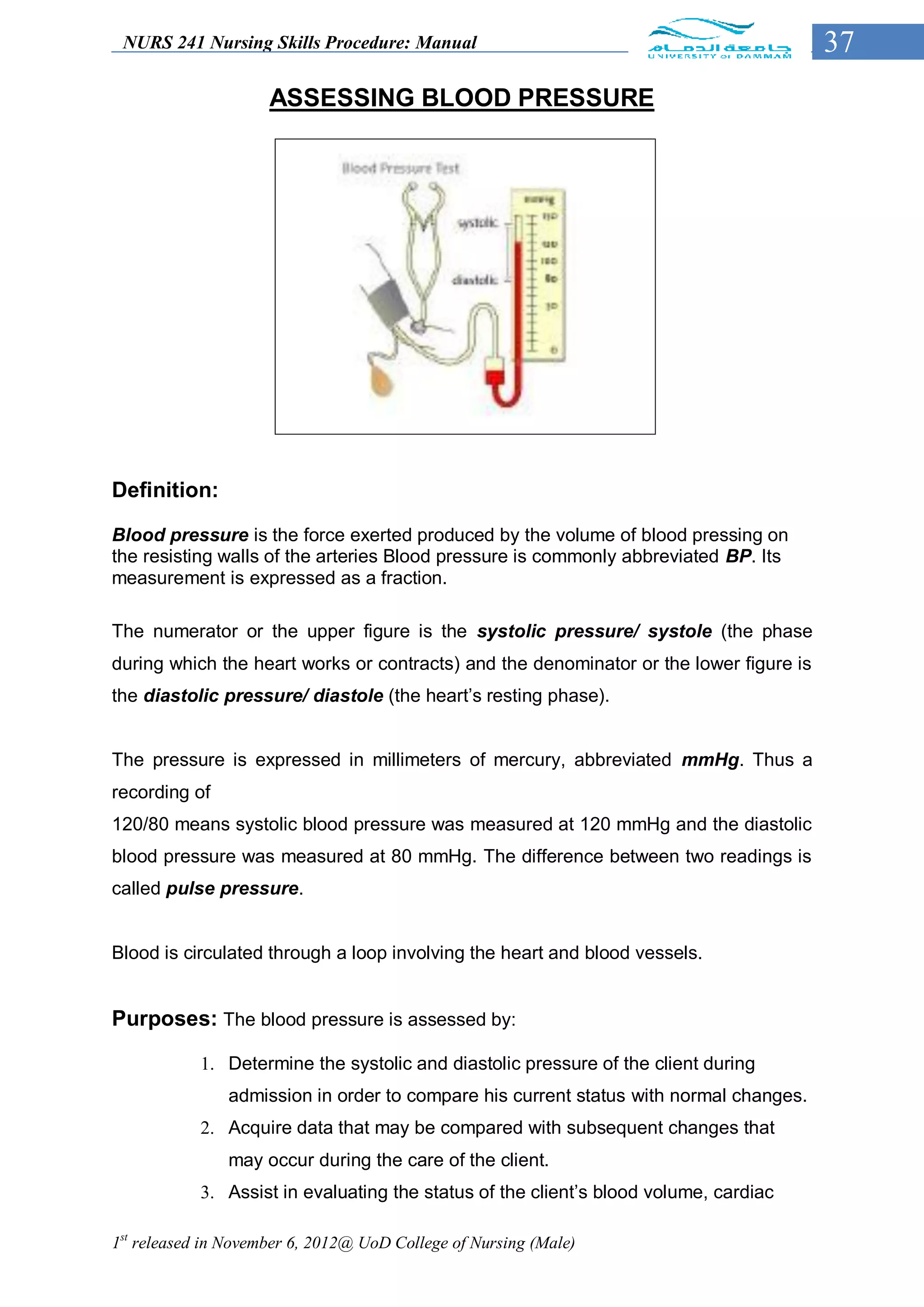
  • 123.
    NURS 241 NursingSkills Procedure: Manual 123 13 Wash hands. 14 Record reading. 15 Replace the thermometer in its charger or holder. Recording and reporting: TOTAL: Legend: % Scale Description Verbal Description 93-100 2 Excellent Demonstrated all the time or outstandingly 86-92 Very Satisfactory Demonstrated in the fullest sense, completely or absolutely 80-85 1 Satisfactory Demonstrated at a given time or good enough 75-79 Fair Demonstrated rarely or in a fair manner 72-74 0 Poor Not demonstrated at anytime COMMENTS: Evaluator Signature Student Signature 1st released in November 6, 2012@ UoD College of Nursing (Male)
  • 124.
    NURS 241 NursingSkills Procedure: Manual 124 RECTAL TEMPERATURE (ELECTRONIC ) Performance checklist Name: id# Date: Purpose:  To establish subsequent data for baseline evaluation.  to identify whether the core temperature is within normal range.  To determine changes in the core temperature in response to specific therapies(medication, surgeries, etc.)  To monitor clients at risk of imbalanced body temperature.(eg. infection, extremes of temperature exposure).  Assessment:  Clinical signs of fever/hyperpyrexia.  Clinical signs of hypothermia. Equipment:  Electronic Thermometer.  Thermometer sheath or cover.  Water soluble lubricant for rectal temperature.  Clean gloves for rectal temperature. Procedure: STEPS SCALE COMMENTS 0 1 2 1 Identify the patient 2 Prior to performing the procedure introduce self .Explain the procedure to the client, why it is necessary, and how he or she can participate. 3 Gather the equipment. 4 Perform hand wash . 5 Don gloves 6 Provide for client privacy. 7 Place client in semi- lateral position or Sims position. 8 Place disposable protective sheath over probe and lubricate it with a water soluble lubricant. 9 With the dominant hand, grasp the thermometer. With the other hand separate the buttocks so that the anal sphincter is seen clearly. 1st released in November 6, 2012@ UoD College of Nursing (Male)
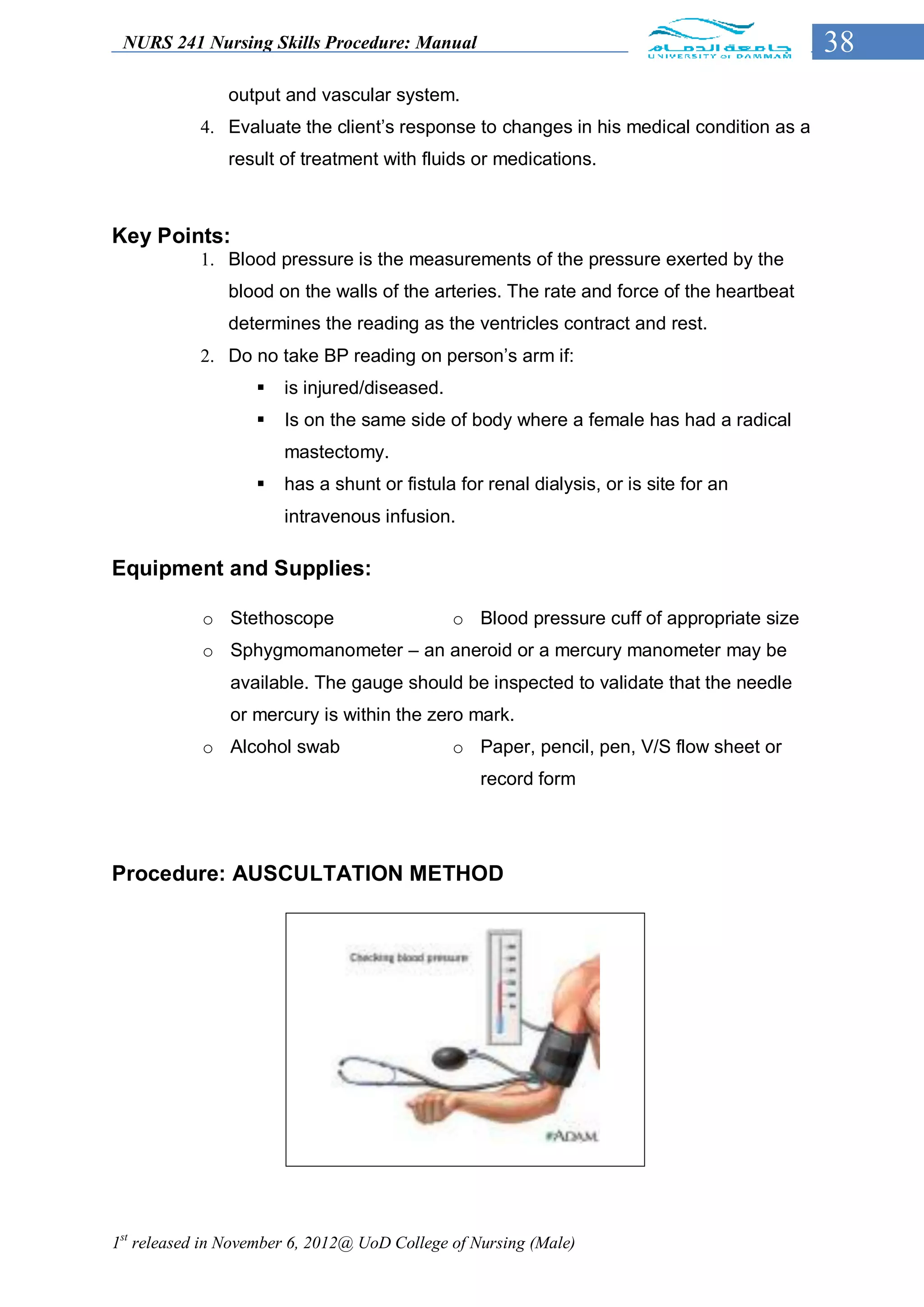
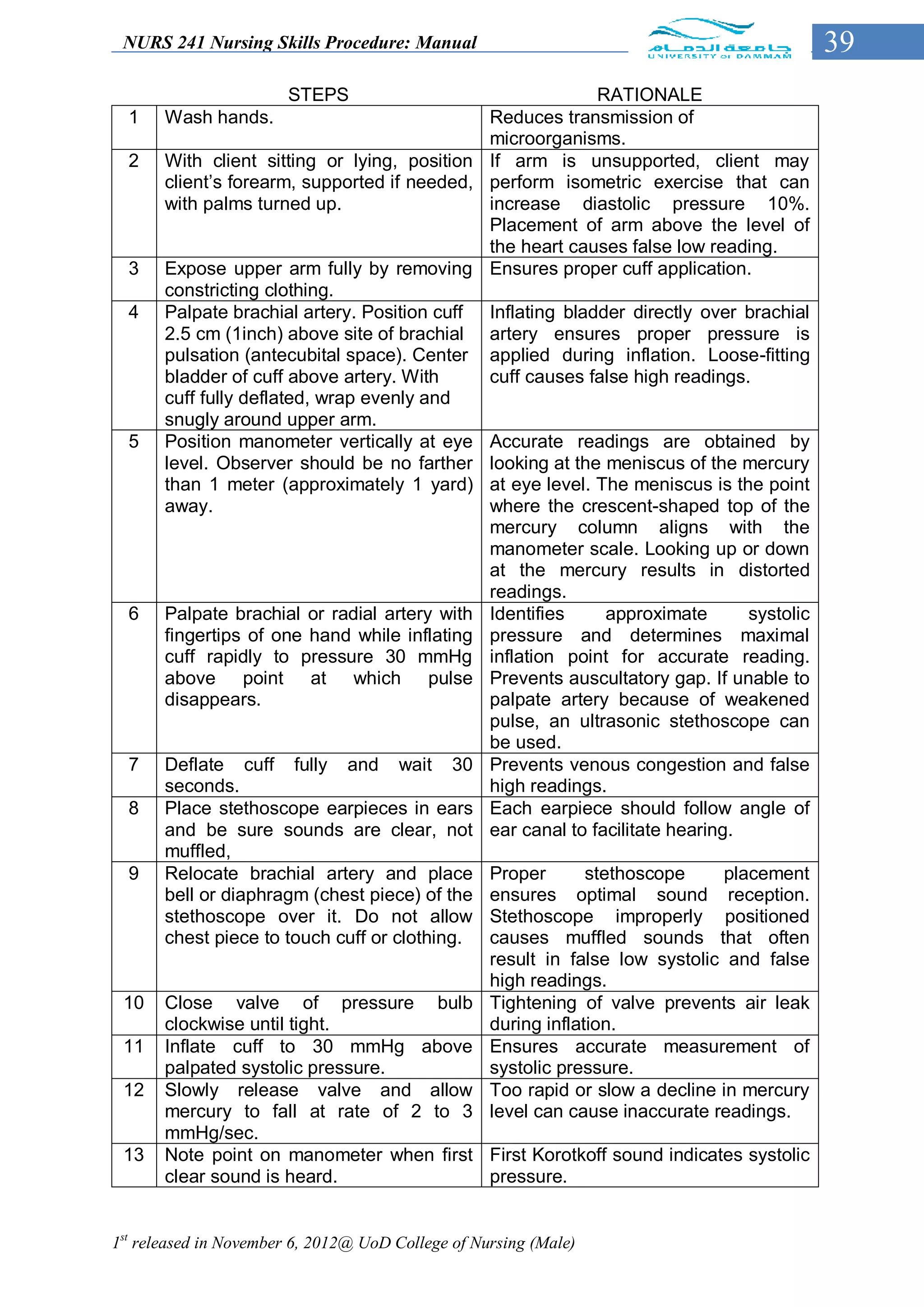
  • 125.
    NURS 241 NursingSkills Procedure: Manual 125 10 Instruct the client to take a deep breath and gently insert the thermometer into the anus.( about 3.8 cm in adult,2.5cm in child and 1.25cm in infants.) 11 Holding the thermometer in place ,let the buttocks fall into place, keep holding until audible signal of recording is heard. 12 Read the temperature reading dispose off the probe cover by pressing the probe release button. 13 Inform the client about the temperature reading. 14 Remove Gloves and wash hands. 15 Record reading. 16 Replace the thermometer in its charger or holder. Recording and reporting: TOTAL: Legend: % Scale Description Verbal Description 93-100 2 Excellent Demonstrated all the time or outstandingly 86-92 Very Satisfactory Demonstrated in the fullest sense, completely or absolutely 80-85 1 Satisfactory Demonstrated at a given time or good enough 75-79 Fair Demonstrated rarely or in a fair manner 72-74 0 Poor Not demonstrated at anytime COMMENTS: Evaluator Signature Student Signature 1st released in November 6, 2012@ UoD College of Nursing (Male)
  • 126.
    NURS 241 NursingSkills Procedure: Manual 126 ORAL TEMPERATURE (ELECTRONIC ) Performance Checklist Name: id# Date: Purpose:  To establish subsequent data for baseline evaluation.  To identify whether the core temperature is within normal range.  To determine changes in the core temperature in response to specific therapies(medication, surgeries, etc.)  To monitor clients at risk of imbalanced body temperature.(eg. infection, extremes of temperature exposure).  Assessment:  Clinical signs of fever/hyperpyrexia.  Clinical signs of hypothermia. Equipment:  Electronic Thermometer.  Thermometer sheath or cover. Procedure: STEPS SCALE COMMENTS 0 1 2 1 Identify the patient. 2 Prior to performing the procedure introduce self .Explain the procedure to the client, why it is necessary, and how he or she can participate. 3 Gather the equipment. 4 Perform hand wash . 5 Provide for client privacy. 6 Place disposable protective sheath over probe. 7 .Grasp top of the probe's stem and place the tip of the thermometer under the clients tongue and along the gum line. 8 Instruct the client to keep mouth closed around the probe. 9 Hold the probe in place until audible signal of recording is heard. 10 .Read the temperature reading dispose off the probe cover by pressing the probe release button. 11 . Inform the client about the temperature reading. 12 Wash hands. 13 Record reading. 1st released in November 6, 2012@ UoD College of Nursing (Male)
  • 127.
    NURS 241 NursingSkills Procedure: Manual 127 14 Replace the thermometer in its charger or holder. Recording and reporting: TOTAL: Legend: % Scale Description Verbal Description 93-100 2 Excellent Demonstrated all the time or outstandingly 86-92 Very Satisfactory Demonstrated in the fullest sense, completely or absolutely 80-85 1 Satisfactory Demonstrated at a given time or good enough 75-79 Fair Demonstrated rarely or in a fair manner 72-74 0 Poor Not demonstrated at anytime COMMENTS: Evaluator Signature Student Signature 1st released in November 6, 2012@ UoD College of Nursing (Male)
  • 128.
    NURS 241 NursingSkills Procedure: Manual 128 Heart Rate Performance Checklist Name: id# Date: Equipment:  Watch with a second hand or indicator.  If using Doppler/ultrasound stethoscope:  Transducer in the probe  Stethoscope headset  Transmission gel Procedure: STEPS 0 1 2 COMMENTS 1 Determine need to assess radial or apical pulse: c. Note risk factors for alterations in apical pulse Assess for signs and symptoms of altered SV (stroke volume) and CO such as dyspnea, fatigue, chest pains, orthopnea, syncope, palpitations, jugular venous distension, edema of dependent body parts, cyanosis or pallor of skin. 2 Assess for factors that normally influence apical pulse rate and rhythm: a. Age b. Exercise c. Position changes d. Medications e. Temperature f. Emotional Stress, anxiety, fear 3 Determines previous baseline balance apical site. 4 Explain that PR or HR is to be assessed 5 Wash hands 6 If necessary, draw curtain around bed and/or close door. 1st released in November 6, 2012@ UoD College of Nursing (Male)
  • 129.
    NURS 241 NursingSkills Procedure: Manual 129 7 Obtain pulse measurement. A. Radial Pulse 1.Assist client to assume supine position 2. If supine, place client’s forearm along side or across lower chest or upper abdomen with wrist extended straight. If sitting, bend client’s elbow 90 and support lower arm on chair on nurses’ arm. Slightly extend wrist with palms down. 3.Place tips of first two fingers of hand over groove along radial or thumb side of client’s inner wrist. 4.Lightly compress against radius, obliterate pulse initially, and then relax pressure so pulse becomes easily palpable. 5.Determine strength of pulse. Note whether thrust of vessel against fingertips is bounding, strong, weak or thready. 6.After pulse can be felt regularly, look at watch’s second and begin to count rate; when sweep hand hits number on dial, start counting with zero, then one, two, and so on. If pulse is regular, count rate for 30 seconds and multiply by 2, If pulse is regular, count rate for 60 seconds. Assess frequency and pattern if irregularity. B. Apical pulse 1 Assist client to supine or sitting position. Move aside bed linen and gown to expose sternum and left side of chest. 2 Locate anatomical landmarks to identify the points of maximal impulse (PMI), also called the apical impulse. Heart is located behind and to left of sternum with base at top and apex at bottom. Find angle of Louis just below suprasternal notch between sternal body and manubrium; can be felt as a bony prominence. Slip fingers down each side of angle to find second intercostal space. (ICS). Carefully move fingers down left side to the left midclavicular line (MCL). A light tap felt within an area 1 to 2 cm ( ½ to 1 inch) of the PMI is reflected from the apex of the heart 1st released in November 6, 2012@ UoD College of Nursing (Male)
  • 130.
    NURS 241 NursingSkills Procedure: Manual 130 3 Place diaphragm of stethoscope in palm of hand for 5 to 10 seconds. 4 Place diaphragm of stethoscope over PMI at the fifth ICS, at left MCL, and auscultate for normal S1 and S2 heart sounds (heard as “lub dub”). 5 When S1 and S2 are heard with regularity, use watch’s second hand and begin to count rate; when sweep hand hits number on dial, start counting with zero, then one, two, and so on. 6 If apical rate is regular, count for 30 seconds and multiply by 2. 7 If HR is irregular or client is receiving cardiovascular medications, count for 1 minute (60 seconds). 8 Discuss findings with client as needed. 9 Clean earpieces and diaphragm of stethoscope with alcohol swab as needed. 10 Wash hands. 11 Compare readings with previous baseline and/or acceptable range of heart rate for client’s age. 12 Compare peripheral pulse rate with apical pulse rate and note discrepancy. 13 Compare radial pulse equality and note discrepancy. 14 Correlate PR with data obtained from BP and related signs and symptoms (palpitations, dizziness). Recording and reporting: TOTAL: Legend: % Scale Description Verbal Description 93-100 2 Excellent Demonstrated all the time or outstandingly 86-92 Very Satisfactory Demonstrated in the fullest sense, completely or absolutely 80-85 1 Satisfactory Demonstrated at a given time or good enough 75-79 Fair Demonstrated rarely or in a fair manner 72-74 0 Poor Not demonstrated at anytime 1st released in November 6, 2012@ UoD College of Nursing (Male)
  • 131.
    NURS 241 NursingSkills Procedure: Manual 131 COMMENTS: Evaluator Signature Student Signature 1st released in November 6, 2012@ UoD College of Nursing (Male)
  • 132.
    NURS 241 NursingSkills Procedure: Manual 132 Respiratory Rate Performance Checklist Name: id# Date: Equipment:  Watch with second hand.  Paper, pencil  Vital signs record. Procedure: STEPS 0 1 2 COMMENTS 1 Determine need to assess client’s respirations:: A .Note risk factors for respiratory alterations. b. Assess for signs and symptoms of respiratory alterations such as bluish or cyanotic appearance of nail beds, lips, mucous membranes, and skin; restlessness, irritability, confusion, reduced level of consciousness; pain during inspiration; labored or difficult breathing; adventitious sounds, inability to breathe spontaneously; thick, frothy, blood-tinge, or copious sputum produced on coughing. 2 Assess pertinent laboratory values: ABGs, (SpO2, CBC, 3 Determine previous baseline respiratory rate (if available) from client’s record. 4 Be sure client is in comfortable position, preferably sitting or lying with the head of the bed elevated 45 to 60 degrees. 5 Wash hands 6 Draw curtain around bed and/or close door. Wash hands. 7 Be sure client’s chest is visible. If necessary, move bed linen or gown. 1st released in November 6, 2012@ UoD College of Nursing (Male)
  • 133.
    NURS 241 NursingSkills Procedure: Manual 133 8 Place client’s arm in relaxed position across the abdomen or lower chest, or place nurse’s hands directly over client’s upper abdomen. 9 Observe complete respiratory cycle (one inspiration and one expiration). 10 After cycle is observed, look at watch’ s second hand and begin to count rate: when sweep hand hits number on dial, begin time frame, counting one with first full respiratory cycle. 11 If rhythm is regular, count number of respirations in 30 seconds and multiply by 2. If rhythm is irregular, less than 12, or greater than 20, count for 1 full minute. 12 If rhythm is regular, count number of respirations in 30 seconds and multiply by 2. If rhythm is irregular, less than 12, or greater than 20, count for 1 full minute. 13 Note depth of respirations subjectively assessed by observing degree of chest wall movement while counting rate. Nurse can also objectively assess depth by palpating chest wall excursion after rate has been counted. Depth is shallow, normal, or deep. 14 Note rhythm of ventilatory cycle. Normal breathing is regular and uninterrupted. Sighing should not be confused with abnormal rhythm. 15 Replace bed linen and client’s gown. 16 Wash hands. 17 Discuss findings with client as needed. Recording and reporting: TOTAL: Legend: % Scale Description Verbal Description 93-100 2 Excellent Demonstrated all the time or outstandingly 86-92 Very Satisfactory Demonstrated in the fullest sense, completely or absolutely 80-85 1 Satisfactory Demonstrated at a given time or good enough 75-79 Fair Demonstrated rarely or in a fair manner 72-74 0 Poor Not demonstrated at anytime COMMENTS: Evaluator Signature Student Signature 1st released in November 6, 2012@ UoD College of Nursing (Male)
  • 134.
    NURS 241 NursingSkills Procedure: Manual 134 Moving the Client up in the Bed Performance Checklist Supplies and Equipment:  Turning sheet This is a bath blanket or sheet folded in half or quarters and positioned under the client and over the bottom bed liners. It is used for moving the client.  Trapeze Provides the client with a means to move in bed.  Siderails Procedure: 1. Introduce yourself, verify the client identity, explain to the client what you are going to do, why, how he-she can participate. 2. Perform hand hygiene. 3. Provide privacy STEPS 0 1 2 Comments 1 Adjust the bed of the client: a) Head of bed flat position or low as the client can tolerate. b) Raise the entire bed to the height necessary to avoid bending down when working with client. c) Lock the wheels of the bed and raise the rail on the side of the bed opposite to you. d) Remove the pillow from under the client’s head and place it upright against the headboard 2. For the client who is able to reposition without assistance: a) Stand by and instruct him to move his self. Assess if the client can move without friction of the skin. b) Ask if positioning device required (pillow) 3. For the client who is partially able to assist: a) For the client who weigh less than 90kg, use a friction reducing device and two to three assistants. b) For the client who weigh more than 90 kg use a friction reducing device and three assistants. 1st released in November 6, 2012@ UoD College of Nursing (Male)
  • 135.
    NURS 241 NursingSkills Procedure: Manual 135 c) Ask the client to flex the hips and knees and position the feet so that they can be used effectively for pushing. d) Position the client’s arms on chest, one arm folded on the other. Ask the client to flex the neck during the move and to keep the head off the bed surface. d. Use a friction reducing device and assistants to move the client up in the bed. Ask the client to push on the count of three. 1st released in November 6, 2012@ UoD College of Nursing (Male)
  • 136.
    NURS 241 NursingSkills Procedure: Manual 136 4 Position yourself appropriately: a) Stand at an angle to the side of the bed with your feet about 2 ft. apart, one foot on front of the other. Flex the hip knees and ankles. b) Tighten your gluteal, abdominal, leg and arm muscles and rock from the back leg to the front leg and back again. Then shift your weight on the front leg as the client pushes with heels so that the client moves toward the head of the bed. 5 For the client who is unable to assist: ( using turn sheet) a) Place a drawsheet or a full sheet folded in half under the shoulders to the thighs. Each person rolls up or fanfolds the turn sheet close to the clients body on either side. b) Both individuals grasp the sheet close to the shoulders and buttocks of the client. c) Assist the client to flex the knees. Place the arms across the chest. d) Position yourself as described previously. 6 Ensure client comfort  Elevate the head of the bed and provide appropriate support devices for the clients new position. 7 Document all relevant information, record: a) Time and change of position moved from and position moved to. b) Any signs of pressure ulcer. c) Use of support device. d) Ability of the client to assist in moving and turning. e) Response of the client to moving or turning (anxiety, discomfort, dizziness) TOTAL Legend: % Scale Description Verbal Description 93-100 2 Excellent Demonstrated all the time or outstandingly 86-92 Very Satisfactory Demonstrated in the fullest sense, completely or absolutely 1st released in November 6, 2012@ UoD College of Nursing (Male)
  • 137.
    NURS 241 NursingSkills Procedure: Manual 137 80-85 1 Satisfactory Demonstrated at a given time or good enough 75-79 Fair Demonstrated rarely or in a fair manner 72-74 0 Poor Not demonstrated at anytime COMMENTS: Evaluator Signature Student Signature 1st released in November 6, 2012@ UoD College of Nursing (Male)
  • 138.
    NURS 241 NursingSkills Procedure: Manual 138 Moving the Client to Lateral or Prone Position Performance Checklist Procedure STEPS 0 1 2 Comments 1 Position yourself and the client appropriately, other person stand on the opposite side of the bed: a) Adjust the bed of the client: b) Head of bed flat position or low as the client can tolerate. c) Raise the entire bed to the height necessary to avoid bending down when working with client. d) Lock the wheels of the bed and raise the rail on the side of the bed opposite to you. e) Move the client closer to the side of the bed opposite the side the client will face when turned. Use a friction reducing device to pull the client to the side of the bed. f) While standing on the side of the bed nearest the client; place the client near arm across the chest. Abduct the client’s far shoulder slightly from the side of the body and externally rotate the shoulder. g) Place the client’s near ankle and foot across the far ankle and foot. h) The person on the side of the bed toward which the client will positioned directly in the line with the clients waistline and as close to the bed as possible 2 Roll the client to the lateral position. The second person standing on the opposite side of the bed helps roll the client’s from the other side: a) Place one hand on the client’s far shoulder and the other hand on the client’s far hip. b) Position the client on his or her side with the arms and leg positioned and supported properly. 1st released in November 6, 2012@ UoD College of Nursing (Male)
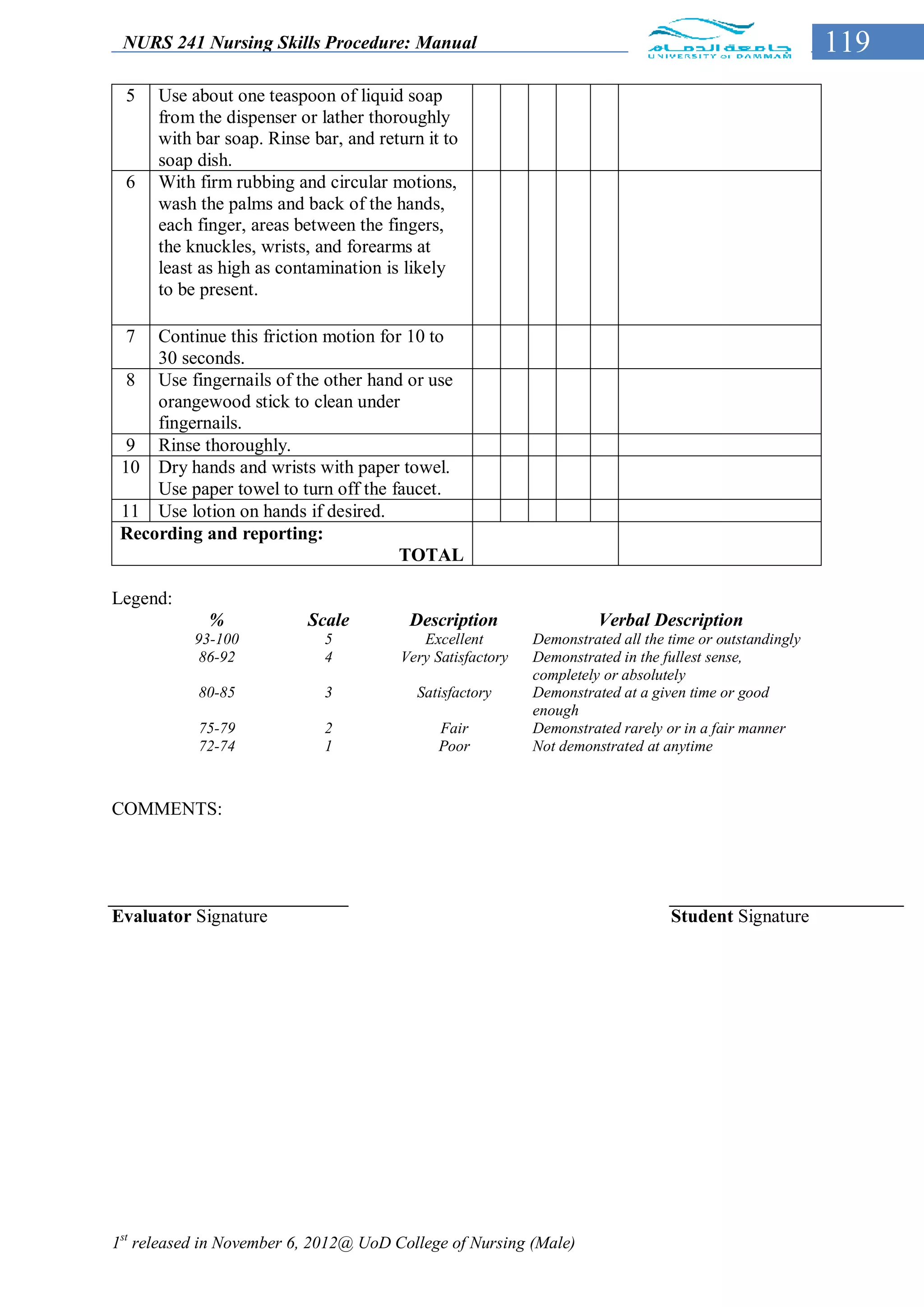
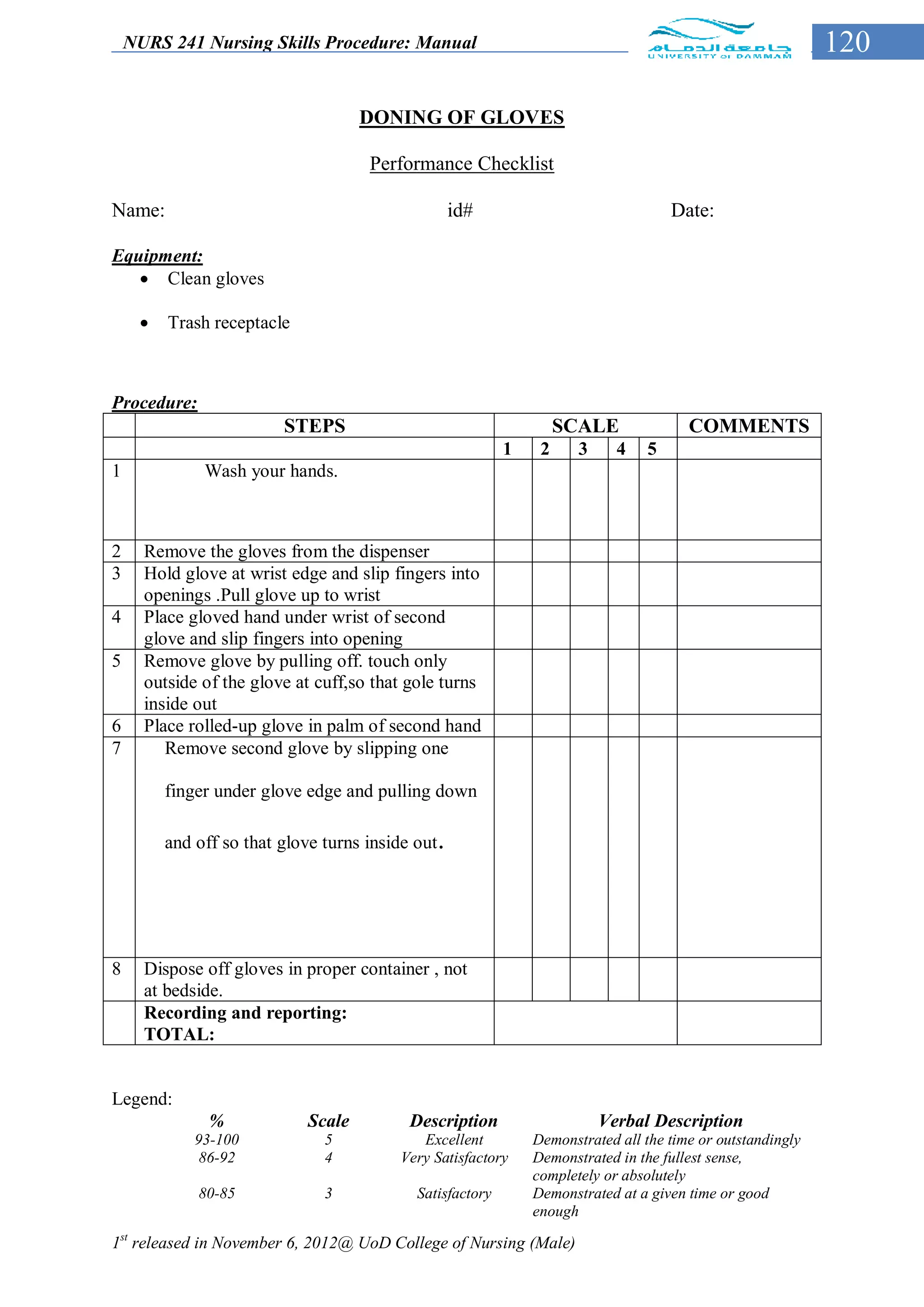
  • 139.
    NURS 241 NursingSkills Procedure: Manual 139 3 To turn the client to the prone position follow the preceding steps with two exception: a) Instead of abducting the arm, keep the client's arm alongside the body for the client to roll over b) Roll the client completely onto the abdomen. c) Never pull a client across the bed while the client is in the prone position 4 Document all relevant information: a) Time and change of position moved from and position moved to. b) Any signs of pressure ulcer. c) Use of support device. d) Ability of the client to assist in moving and turning. e) Response of the client to moving or turning (anxiety, discomfort, dizziness) TOTAL Legend: % Scale Description Verbal Description 93-100 2 Excellent Demonstrated all the time or outstandingly 86-92 Very Satisfactory Demonstrated in the fullest sense, completely or absolutely 80-85 1 Satisfactory Demonstrated at a given time or good enough 75-79 Fair Demonstrated rarely or in a fair manner 72-74 0 Poor Not demonstrated at anytime COMMENTS: Evaluator Signature Student Signature 1st released in November 6, 2012@ UoD College of Nursing (Male)
  • 140.
    NURS 241 NursingSkills Procedure: Manual 140 BODY MECHANICS Performance Checklist Score Steps of Procedure Comments 0 1 2 1 Collect your equipment 2 Wash your hands 3 Identify the patient 4 Provide privacy 5 Introduce yourself to patient LIFTING 6 Stand near object of the load to be lifted. 7 Put on internal girdle. Method 1 8 Bend toward object by flexing all the hips and partially flexing at the knees. Grasp object and bring it to thigh level by pulling 9 with arm and shoulder, muscles while thigh and leg muscles provide an upward thrust. Bring object to waist level by using the leg and 10 thigh muscles for greater thrust while beginning to straighten the back. Method 2 11 Position feet 18 inches apart with left foot forward. 12 Tuck chin in and squat down with back straight. Grasp object with both hands, tipping it if 13 necessary to attain balance. Rest left elbow on left thigh, just above knee and 14 apply pressure as needed to stand up. Straighten legs. 15 PUSHING Stand close to the object. Place feet in a walking position (one is in front of 16 the other) With hands placed on the object, flex elbows and 17 lean into the object. Place the weight from the flexor to the extensor 18 portions of the leg. 19 Apply pressure using leg muscles. 20 PULLING Stand close to the object. Place feet in a walking position (one is in front of 21 the other) Hold object and flex elbows and lean away from 22 the object. Shift weight from the extensor to the flexor 23 portions of the leg. 24 Avoid sudden, jerky movements. 1st released in November 6, 2012@ UoD College of Nursing (Male)
  • 141.
    NURS 241 NursingSkills Procedure: Manual 141 25 PIVOTING Place one foot slightly ahead of the other. Turn both feet at the same time, pivoting on the 26 heel of one foot and the toe of the other. Maintain a good center of gravity while holding 27 or carrying the object. 28 Squat (bending at the hips and knees). 29 Avoid stooping (bending at the waist). Use your leg muscles to return to an upright 30 position. TOTAL Legend: % Scale Description Verbal Description 93-100 2 Excellent Demonstrated all the time or outstandingly 86-92 Very Satisfactory Demonstrated in the fullest sense, completely or absolutely 80-85 1 Satisfactory Demonstrated at a given time or good enough 75-79 Fair Demonstrated rarely or in a fair manner 72-74 0 Poor Not demonstrated at anytime COMMENTS: Evaluator Signature Student Signature 1st released in November 6, 2012@ UoD College of Nursing (Male)
  • 142.
    NURS 241 NursingSkills Procedure: Manual 142 Logrolling a Client Performance Checklist Student Name: University ID Number: Procedure Date: STEPS 0 1 2 Feedback 1. Prior to performing the procedure, introduce self and verify the client’s identity using agency protocol. Explain to the client what you are going to do, why it is necessary, and how he or she can participate. 2. Perform hand hygiene and observe other appropriate infection control procedures. 3. Provide for client privacy. 4. Position yourselves and the client appropriately before the move. 1) Place the client’s arms across the chest 5. Pull the client to the side of the bed. 1) Use a turn sheet or friction-reducing device to facilitate logrolling. First, stand with another nurse on the same side of the bed. Assume a broad stance with one foot forward, and grasp half of the fanfolded or rolled edge of the turn sheet or friction-reducing device. On a signal, pull the client toward both of you. (A) 2) One nurse counts: “One, two, three, go.” Then, at the same time, all staff members pull the client to the side of the bed by shifting their weight to the back foot. 1st released in November 6, 2012@ UoD College of Nursing (Male)
  • 143.
    NURS 241 NursingSkills Procedure: Manual 143 6. Move to the other side of the bed, and place supportive devices for the client when turned. 1) Place a pillow where it will support the client’s head after the turn. 2) Place one or two pillows between the client’s legs to support the upper leg when the client is turned. 7. Roll and position the client in proper alignment. 1) Go to the other side of the bed (farthest from the client), and assume a stable stance. 2) Reaching over the client, grasp the far edges of the turn sheet or friction-reducing device, and roll the client toward you. (B) 3) One nurse counts: “One, two, three, go. “ Then, at the same time, all nurses roll the client to a lateral position. 4) The second nurse (behind the client) helps turn the client and provides pillow supports to ensure good alignment in the lateral position. 5) Support the client’s head, back, and upper and lower extremities with pillows. 6) Raise the side rails and place the call bell within the client’s reach. 7. Document all relevant information. Record: 1) Time and change of position moved from and position moved to 2) Any signs of pressure areas 3) Use of support devices 4) Ability of client to assist in moving and turning 5) Response of client to moving and turning (e.g., anxiety, discomfort, dizziness). Legend: % Scale Description Verbal Description 93-100 2 Excellent Demonstrated all the time or outstandingly 86-92 Very Satisfactory Demonstrated in the fullest sense, completely or absolutely 80-85 1 Satisfactory Demonstrated at a given time or good enough 75-79 Fair Demonstrated rarely or in a fair manner 72-74 0 Poor Not demonstrated at anytime COMMENTS: Evaluator Signature Student Signature 1st released in November 6, 2012@ UoD College of Nursing (Male)
  • 144.
    NURS 241 NursingSkills Procedure: Manual 144 Dangling A Client Performance Checklist Student Name: University ID Number: Procedure Date: STEPS 0 1 2 COMMENTS 1. Prior to performing the procedure, introduce self and verify the client’s identity using agency protocol. Explain to the client what you are going to do, why it is necessary, and how he or she can participate. 2. Perform hand hygiene and observe other appropriate infection control procedures. 3. Provide for client privacy. 4. Position yourself and the client appropriately before performing the move. 1) Assist the client to a lateral position facing you. 2) Raise the head of the bed slowly to its highest position. 3) Position the client’s feet and lower legs at the edge of the bed. 4) Stand beside the client’s hips and face the far corner of the bottom of the bed (the angle in which movement will occur). Assume a broad stance, placing the foot nearest the client and head of the bed forward. Lean your trunk forward from the hips. Flex your hips, knees, and ankles. 5. Move the client to a sitting position. 1st released in November 6, 2012@ UoD College of Nursing (Male)
  • 145.
    NURS 241 NursingSkills Procedure: Manual 145 1) Place the arm nearest to the head of the bed under the client’s shoulders and the other arm over both of the client’s thighs near knees. 2) Tighten your gluteal, abdominal, leg, and arm muscles. 3) Pivot on the balls of your feet in the desired direction facing the foot of the bed. 4) Keep supporting the client until the client is well balanced and comfortable. 5) Assess vital signs (e.g., pulse, respirations, and blood pressure) as indicated by the client’s health status. 6. Document all relevant information. Record: 1) Ability of client to assist in moving and turning 2) Response of client to moving and turning (e.g., anxiety, discomfort, dizziness). Legend: % Scale Description Verbal Description 93-100 2 Excellent Demonstrated all the time or outstandingly 86-92 Very Satisfactory Demonstrated in the fullest sense, completely or absolutely 80-85 1 Satisfactory Demonstrated at a given time or good enough 75-79 Fair Demonstrated rarely or in a fair manner 72-74 0 Poor Not demonstrated at anytime COMMENTS: Evaluator Signature Student Signature 1st released in November 6, 2012@ UoD College of Nursing (Male)
  • 146.
    NURS 241 NursingSkills Procedure: Manual 146 Applying and Removing Personal Protective Equipment (gloves, gown, mask) Performance checklist Name: ___________________________ ID# _________ Date: ___________ STEPS 0 1 2 COMMENTS 1 Verify client identity and introduce yourself, explain for the client what you are to do, why it is necessary, and how he or she can participate. 2 Perform hand hygiene. 3 Apply a clean gown: a. Pick up a clean gown, and allow it to unfold in front of you without allowing it to touch any area soiled with body substances. b. Slide the arms and the hands through the sleeves. c. Fasten the ties at the neck to keep the gown in place. d. Overlap the gown at the back as much as possible and fasten the waist ties 4 Applying the face mask: a. Locate the top edge of the mask; the mask usually has a narrow metal strip along the edge. b. Hold the mask by the top two strings. c. Place the upper edge of the mask over the bridge of the nose, and tie the upper ties at the back of the head or secure the loops around the ears. d. Secure the lower edge of the mask under the chin, and tie the lower ties at the nape of the neck. e. If the mask has a metal strip, adjust this firmly over the bridge of the nose f. Wear the mask only once g. Do not let a used mask hanging around the neck. 5 Apply clean gloves. If wearing gowns pull the gloves up to cover the cuffs of the gown 6 Remove the gloves first since they are the most soiled. If wearing gown that is tied in front undo ties before removing the gloves. 7 Perform hand hygiene 1st released in November 6, 2012@ UoD College of Nursing (Male)
  • 147.
    NURS 241 NursingSkills Procedure: Manual 147 8 Remove the gown when preparing to leave the room a. Avoid touching soiled parts on the outside of the gown. b. Grasp the gown along the inside of the neck and pull down over the shoulders. Do not shake the gown. c. Roll up the gown with the soiled part inside, and discard it in the appropriate container. 9 Remove the mask a) Remove the mask at the doorway to the client’s room. If using respirator mask, remove it after leaving the room and closing the door. a. If using mask with strings, first untie the lower strings b. Untie the top string and, while holding the ties securely, remove the mask from the face. If side loops are presents , lift the side loops up and away from the ears and face. Do not touch the front of the mask. c. Discard a disposable mask in the waste container. d. Perform proper hand hygiene again Verbal description Description - Able to perform 2 - Able to perform with assistance or 1 incomplete - Cannot PERFORM at any time 0 Legend: % Scale Description Verbal Description 93-100 2 Excellent Demonstrated all the time or outstandingly 86-92 Very Satisfactory Demonstrated in the fullest sense, completely or absolutely 80-85 1 Satisfactory Demonstrated at a given time or good enough 75-79 Fair Demonstrated rarely or in a fair manner 72-74 0 Poor Not demonstrated at anytime COMMENTS: Evaluator Signature Student Signature 1st released in November 6, 2012@ UoD College of Nursing (Male)
  • 148.
    NURS 241 NursingSkills Procedure: Manual 148 ASSESSING BLOOD PRESSURE Performance checklist Name: _________________________________________ ID# __________ Date: ______ PURPOSES: 1. To obtain a baseline measure of arterial blood pressure for subsequent evaluation 2. To determine the client’s hemodynamic status (e.g., stroke volume of the heart and blood vessel resistance) 3. To identify and monitor changes in blood pressure resulting from a disease process and medical therapy (e.g., presence or history of cardiovascular disease, circulatory shock, or acute pain; rapid infusion of fluids or blood products). ASSESSMENT 1. Signs and symptoms of hypertension (headache, ringing in the ears, flushing of face, nosebleeds, fatigue) 2. Signs and symptoms of hypotension ( e.g., tachycardia, dizziness, mental confusion, restlessness, and clammy skin, pale or cyanotic skin) 3. Factors affecting blood pressure (e.g., activity, emotional stress, pain, and time the client last smoked or ingested caffeine) PLANNING - Blood pressure measurement may be delegated to UAP (Unlicensed assistive personnel). The interpretation of abnormal blood pressure readings and determination of appropriate responses are done by the nurse. EQUIPMENT: 1. Stethoscope 2. Blood pressure cuff of the appropriate size 3. Sphygmomanometer IMPLEMENTATION Preparation 1. Ensure that the equipment is intact and functioning properly. Check for leaks in the rubber tubing of the sphygmomanometer. 2. Make sure that the client has not smoked or ingested caffeine within 30 minutes prior to measurement. 1st released in November 6, 2012@ UoD College of Nursing (Male)
  • 149.
    NURS 241 NursingSkills Procedure: Manual 149 STEPS SCALE COMMENTS 0 1 2 COMMENTS 1 Explain to the client what you are going to do? e. Why it is necessary, and how he or she can cooperate. f. Discuss how the results will be used in planning further care or treatments. 2 Observe appropriate infection control procedures. 3 Provide for client privacy. 4 Position the client appropriately. 5 Wrap the deflated cuff evenly around the upper arm.. a. Locate the brachial artery. b. Apply the center of the bladder directly over the artery. 6 If this is the client’s initial examination, perform a preliminary palpatory determination of systolic pressure. a. Palpate the brachial artery with the fingers. b. Close the knob clockwise. c. Pump up the cuff until you no longer feel the brachial pulse. d. Release the pressure completely in the cuff, and wait 1 to 2 minutes before making further measurements. 7 Position the stethoscope appropriately. d. Cleanse the earpieces with alcohol or recommended disinfectant. e. Insert the ear attachments of the stethoscope in your ears so that they tilt slightly forward. f. Ensure that the stethoscope hangs freely from the ears to the diaphragm. g. Place the bell side of the amplifier of the stethoscope over the brachial pulse. h. Hold the diaphragm with the thumb and index finger. 8 Auscultate the client’s blood pressure. e. Pump up the cuff until the sphygmomanometer reads 30 mm Hg above the point where the brachial pulse disappeared. f. Release the valve on the cuff carefully so that the pressure decreases at the rate of 2 to 3 mm Hg per second. g. As the pressure falls, identify the manometer reading at each of the five phases. h. Deflate the cuff rapidly and completely. i. Wait 1 to 2 minutes before making further determinations. 9 If this is the client’s initial examination, repeat the procedure on the client’s other arm. 10 Remove the cuff. 11 Wipe the cuff with an approved disinfectant. 1st released in November 6, 2012@ UoD College of Nursing (Male)
  • 150.
    NURS 241 NursingSkills Procedure: Manual 150 12 Document and report pertinent assessment data according to agency policy. Verbal description Description - Able to perform 2 - Able to perform with assistance or 1 incomplete - Cannot PERFORM at any time 0 Legend: % Scale Description Verbal Description 93-100 2 Excellent Demonstrated all the time or outstandingly 86-92 Very Satisfactory Demonstrated in the fullest sense, completely or absolutely 80-85 1 Satisfactory Demonstrated at a given time or good enough 75-79 Fair Demonstrated rarely or in a fair manner 72-74 0 Poor Not demonstrated at anytime COMMENTS: Evaluator Signature Student Signature 1st released in November 6, 2012@ UoD College of Nursing (Male)
  • 151.
    NURS 241 NursingSkills Procedure: Manual 151 Performance checklist CHANGING AN UNOCCUPIED BED Name:_________________________________________ID#____________Date:________ STEPS 0 1 1 If the client is in bed, prior to performing the procedure, introduce self and verify the client’s identity using agency protocol. Explain to the client what you are going to do, why it is necessary, and how he or she can cooperate. 2 Perform hand hygiene and observe other appropriate infection control procedures. 3 Provide for client privacy. 4 Place the fresh linen on the client’s chair or over bed table; do not use another client’s bed. 5 Assess and assist the client out of bed. a Make sure that this is an appropriate and convenient time for the client to be out of bed. b Assist the client to a comfortable chair. 6 Raise the bed to a comfortable working height. 7 Apply clean gloves if linens and equipment have been soiled with secretions and/or excretions. 8 Strip the bed. a Check bed linens for any items belonging to the client, and detach the call bell or any drainage tubes from the linen. b Loosen all bedding systematically, starting at the head of the bed on the far side and moving around the bed up to the head of the bed on the near side. c Remove the pillowcases, if soiled, and place the pillows on the bed-side near the foot of the bed. d Fold reusable lines, such as the bedspread and top sheet on the bed, into fourths, First, fold the linen in half by bringing the top edge even with the bottom edge, and then grasp it at the center of the middle fold and bottom edges. e Remove the waterproof pad and discard it if soiled. f Roll all soiled linen inside the bottom sheet, hold it away from your uniform, and place it directly in the linen hamper. g Grasp the mattress securely. Using the lugs if present, and move the mattress up to the head of the bed. h Remove and discard gloves if used. Perform hand hygiene. 9 Apply the bottom sheet and draw sheet. a Place the folded bottom sheet with its center fold on the center of the bed. Make sure the sheet is hem side down for a smooth foundation. Spread the sheet out over the mattress, and allow a sufficient amount of sheet at the top to tuck under the mattress. Place the sheet along the edge of the mattress at the foot of the bed and do not tuck it in (unless it is a contour or fitted sheet. b Miler the sheet at the top corner on the near side and tuck the sheet under the mattress, working from the head of the bed to the foot. c If a waterproof drawsheet is used, place it over the bottom sheet so that the centerfold is at the centerline of the bed and the top and bottom edges extend from the middle of the client’s back to the area of the midthigh or knee. Fanfold the uppermost half of the folded draw sheet at the center or far edges of the bed and tuck in the edge. d OPTIONAL: before moving to the other side of the bed, place the top linens on the hemside up, unfold them, tuck them in, and miter the bottom corners. 10 Move to the other side and secure the bottom linens. a Tuck in the bottom sheet under the head of the mattress, pull the sheet firmly, and miter the corner of the sheet. b Pull the remainder of the sheet firmly so that there are no wrinkles. Tuck the sheet in at the side. 1st released in November 6, 2012@ UoD College of Nursing (Male)
  • 152.
    NURS 241 NursingSkills Procedure: Manual 152 c Tuck in the drawsheets, if appropriate. 11 Apply or complete the top sheet, blanket, and spread. a Place the top sheet, hem side up; on the bed so that its centerfold is at the center of the bed and the top edge is even with the top edge of the mattress. b Unfold the sheet over the bed. c Follow the same procedure for the blanket and the spread, but place the top edges about 15 cm (6 in.) from the head of the bed to allow a cuff of sheet to be folded over them. d Tuck in the sheet, blanket, and spread at the foot of the bed, and miter the corner, using all three layers of linen. Leave the sides of the top sheet, blanket, and spread hanging freely unless toe pleats were provided. e Fold the top of the top sheet down over the spread, providing a cuff. f Move to the other side of the bed and secure the bedding in the same manner. 12 Put clean pillowcases on the pillows as required. a Grasp the closed end of the pillowcase at the center with one hand. b Gather up the sides of the pillowcase and place them over the hand grasping the case. Then grasp the center of one short side of the pillow through the pillowcase. c With the free hand, pull the pillowcase over the pillow. d Adjust the pillowcase so that the pillow fits into the corners of the case and the seams are straight. e Place the pillows appropriately at the head of the bed. 13 Provide for client comfort and safety. a Attach the signal cord so that the client can conveniently reach it. Some cords have clamps that attach to the sheet or pillowcase. Others are attached by safety pin. Most bed now have call light bottom on the side rail. b If the bed is currently being used by a client, either fold back the top covers at one side or fanfold them down to the center of the bed. c Place the bedside table and the overbed table so that they are available to the client. d Leave the bed in the high position if the client is returning by stretcher, or place in the low position if the client is returning to bed after being up. 14 Document and report pertinent data. a Bed-making is not normally recorded. b Recording any nursing assessments, such as the client’s physical status and pulse and respiratory rates before and after being out of bed, as indicated. Legend: % Scale Description Verbal Description 93-100 2 Excellent Demonstrated all the time or outstandingly 86-92 Very Satisfactory Demonstrated in the fullest sense, completely or absolutely 80-85 1 Satisfactory Demonstrated at a given time or good enough 75-79 Fair Demonstrated rarely or in a fair manner 72-74 0 Poor Not demonstrated at anytime COMMENTS: Evaluator Signature Student Signature 1st released in November 6, 2012@ UoD College of Nursing (Male)
  • 153.
    NURS 241 NursingSkills Procedure: Manual 153 Performance checklist CHANGING AN OCCUPIED BED Performance checklist Name:_______________________________________ID#_______________________Date:_______________ _ STEPS 0 1 1 Prior to performing the procedure, introduce self and verify the client’s identity using agency protocol. Explain to the client what you are going to do, why it is necessary, and how he or she can cooperate. 2 Perform hand hygiene and observe other appropriate infection control procedures. Apply clean gloves if linens are soiled with body fluids. 3 Provide for client privacy. 4 Remove the top bedding. a Remove any equipment attached to the linen, such as signal light. b Loosen all top linen at the foot of the bed, and remove the spread and the blanket. c Leave the top sheet over the client (the top sheet can remain over the client if it is being changed and if it will provide sufficient warmth), or replace it with a bath blanket as follows: a Spread the bath blanket over the top sheet. b Ask the client to hold the top edge of the blanket. c Reaching under the blanket from the side, grasp the top edge of the sheet and draw it down to the foot of the bed. Leaving the blanket in place. d Remove the sheet from the bed and place it in the soiled linen hamper. 5 Change the bottom sheet and draw sheet. a Raise the side rail that the client will turn toward. If there is no side rail, have another nurse support the client at the edge of the bed. b Assist the client to turn on the side away from the nurse and toward the raised side rail. c Loosen the bottom linens on the side of the bed near the nurse. d Fanfold the dirty linen (e.g., draw sheet and the bottom sheet toward the center of the bed. As close to and under the client as possible. e Place the new bottom sheet on the bed, and vertically fanfold the half to be used on the far side of the bed as close to the client as possible. Tuck the sheet under the near half of the bed and miter the corner if a contour sheet is not being used. f Place the clean drawsheet on the bed with the center fold at the center of the bed. Fanfold the uppermost half vertically at the center of the bed and tuck the near side edge under the side of the mattress. g Assist the client to roll over toward you, over the fanfold bed linens at the center of the bed, onto the clean side of the bed. h Move the pillows to the clean side for the client’s use. Raise the side rail before leaving the side of the bed. i Move to the other side of the bed and lower the side rail. j Remove the used linen and place it in the portable hamper. k Unfold the fanfold bottom sheet from the center of the bed. l Facing the side of the bed, use both hands to pull the bottom sheet so that it is smooth and tuck the excess under the side of the mattress. m Unfold the drawsheet fanfold at the center of the bed and full it tightly with both hands. Pull the sheet in three divisions: (a) face the side of the bed to pull the middle division, (b) face the far top corner to pull the bottom division, and (c) face the far bottom corner to pull top division. n Tuck the excess drawsheet under the side of the mattress. 6 Reposition the client in the center of the bed. a Reposition the pillows at the center of the bed. b Assist the client to the center of the bed. Determine what position the client requires or prefers and assist the client to that position. 7 Apply or complete the top bedding. a Spread the top sheet over the client and either ask the client to hold the top edge of the sheet or tuck it under the shoulders. The sheet should remain over the client when the bath blanket or used sheet is removed. b Complete the top of the bed. 8 Ensure continued safety of the client. a Raise the side rails. Place the bed in the low position before leaving the bedside. b Attach the call light bed linen within the client’s reach c Put items used by the client within easy reach. 9 EVALUATION COMMENTS: ……………………………………………………………………………………………………………………………… Evaluator Signature: ____________________ Students' signature: _________________________ 1st released in November 6, 2012@ UoD College of Nursing (Male)
  • 154.
    NURS 241 NursingSkills Procedure: Manual 154 REFERENCES: 1. Kozier & Erbs, (2011). Fundamentals of Nursing. 9th Edition. 2. Potter & Perry, (2009). Fundamentals of Nursing, 7th Edition, by Elsevier Faculty Development and Training. 3. Delaune S.C., & Ladner P.K. (2002). Fundamentals of Nursing/ Standards & Practice. 2nd Edition. Published by Delmar & Thomson Learning. 4. Gaylene Bouska Altman.(2005). Delmars Fundamental & Advanced Nursing Skills. 2nd Ed. Thomson and Delmar Learning. 5. Carol R. Taylor, (2009). Fundamentals of Nursing: The Art and Science of Nursing Care (Fundamentals of Nursing: The Art & Science of Nursing Care) 6. Kozier & Erb's, (2011). Fundamentals of Nursing with My Nursing Lab and Pearson e-Text (Access Card) (9th Edition) 7. Potter &Perry, (2009). Clinical Nursing Skills and Techniques, 7th Edition By Anne Griffin Perry, Patricia A. Potter. 8. Springhouse, (2006). Fundamentals of Nursing Made Incredibly Easy! (Incredibly Easy! Series). 9. Burton & Ludwig, (2010). Fundamentals of Nursing Care: Concepts, Connections & Skills. 10. Mosby's Medical Dictionary, 9th Edition., ISBN: 978-0-323-08541-0. 11. Lippincott & Williams, (2006). Lippincott Manual of Nursing Practice: Handbook, 3rd edition. 12. Kaplan Nursing, (2002). Th Basics; Essential Conten for International Nurses. 2nd Edition. 1st released in November 6, 2012@ UoD College of Nursing (Male)