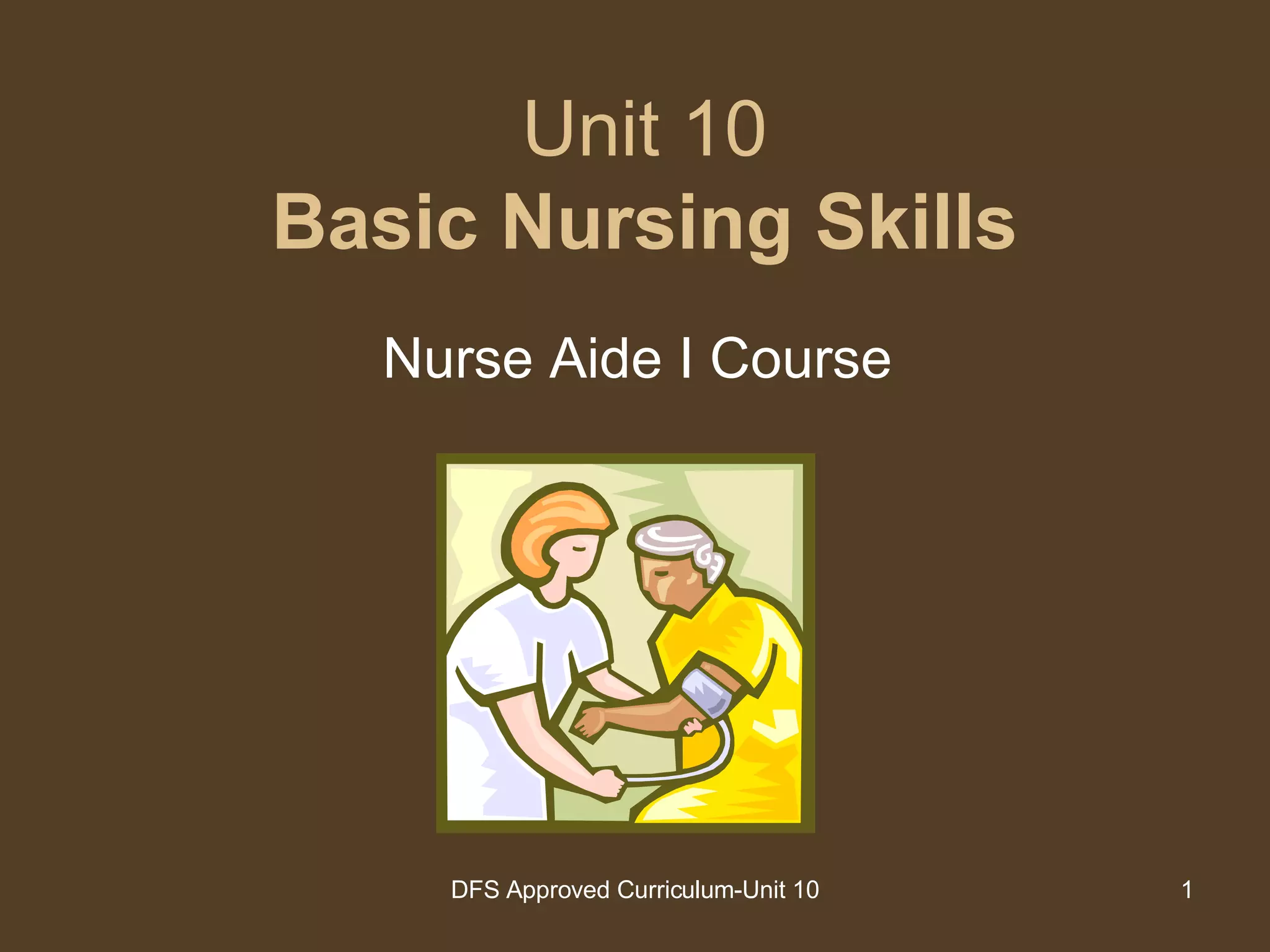
Unit 10 Basic Nursing Skills Nurse Aide I Course
Basic Nursing Skills Introduction This unit introduces the basic nursing skills the nurse aide will need to measure and record the resident’s vital signs, height and weight, and intake and output.  The vital signs provide information about changes in normal body function and the resident’s response to treatment.
Basic Nursing Skills Introduction (continued) The resident’s weight, compared with the height, gives information about his/her nutritional status and changes in the medical condition.  Intake and output records provide information on fluid balance and kidney function.
Vital Signs
10.0 Provide basic nursing skills. Objective
Vital Signs Reflect the function of three body processes that are essential for life. Regulation of body temperature Heart function Breathing
10.1 Explain the meaning of vital signs and the abbreviations used for each vital sign. Objective
Vital Signs (continued) Abbreviations: Temperature – T Pulse – P Respirations – R Blood Pressure – BP Vital signs - TPR and BP
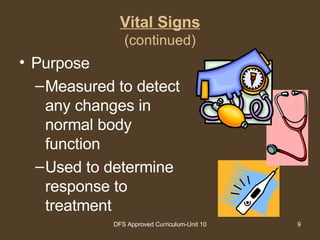
Vital Signs (continued) Purpose Measured to detect any changes in normal body function Used to determine response to treatment
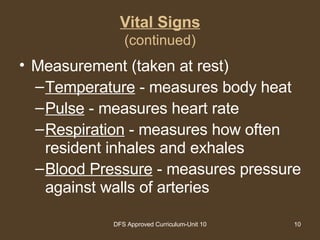
Vital Signs (continued) Measurement (taken at rest) Temperature  - measures body heat Pulse  - measures heart rate Respiration  - measures how often resident inhales and exhales Blood Pressure  - measures pressure against walls of arteries
Measurement Of Body Temperature
10.2 Define body temperature and discuss the way it is measured. Objective
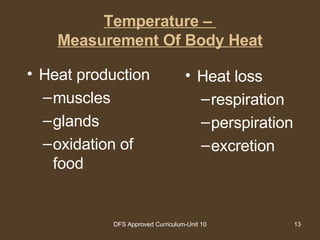
Temperature –  Measurement Of Body Heat Heat production muscles glands oxidation of food Heat loss respiration perspiration excretion
Temperature –  Measurement Of Body Heat (continued) Balance between heat production and heat loss is body temperature
10.2.1 List the factors that affect temperature. Objective
Factors Affecting Temperature Exercise Illness Age Time of day Medications Infection Emotions Hydration Clothing Environmental temperature/air movement
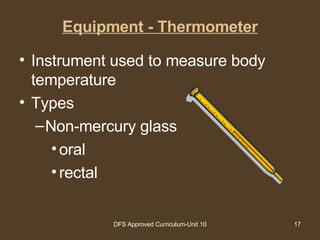
Equipment - Thermometer Instrument used to measure body temperature Types Non-mercury glass oral rectal
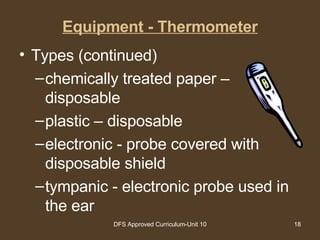
Equipment - Thermometer Types (continued) chemically treated paper – disposable plastic – disposable electronic - probe covered with disposable shield tympanic - electronic probe used in the ear
10.2.2 Identify the normal temperature range, and the normal body temperature. Objective
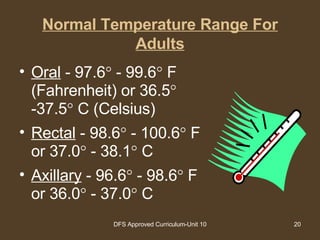
Normal Temperature Range For Adults Oral  - 97.6   - 99.6   F (Fahrenheit) or 36.5   -37.5   C (Celsius) Rectal  - 98.6   - 100.6   F or 37.0   - 38.1   C  Axillary  - 96.6   - 98.6   F or 36.0   - 37.0   C
10.2.3 Read a non-mercury glass thermometer. Objective
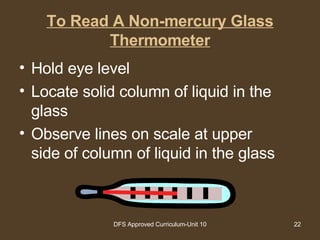
To Read A Non-mercury Glass Thermometer Hold eye level Locate solid column of liquid in the glass Observe lines on scale at upper side of column of liquid in the glass
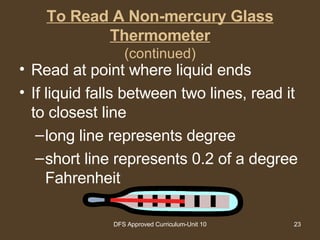
To Read A Non-mercury Glass Thermometer (continued) Read at point where liquid ends If liquid falls between two lines, read it to closest line long line represents degree short line represents 0.2 of a degree Fahrenheit
10.2.4 List and discuss the sites used to take a temperature. Objective
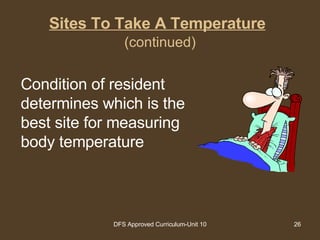
Sites To Take A Temperature   Oral – most common Rectal – registers one degree Fahrenheit higher than oral Axillary – least accurate; registers one degree Fahrenheit lower than oral Tympanic – probe inserted into the ear canal
Sites To Take A Temperature   (continued) Condition of resident determines which is the best site for measuring body temperature
10.2.5 Review safety precautions that should be considered when using a thermometer. Objective
Temperature: Safety Precautions Hold rectal and axillary thermometers in place  Stay with resident when taking temperature  Check glass thermometers for chips  Prior to use, shake liquid in glass down  Shake thermometer away from resident and hard objects 
Temperature: Safety Precautions (continued) Wipe from end to tip of thermometer prior to reading  Delay taking oral temperature for 10 - 15 minutes if resident has been smoking, eating or drinking hot/cold liquids.
Demonstration and Return Demonstration
10.3 Demonstrate the procedure for measuring an oral temperature using a non-mercury glass thermometer. Objective
10.4 Demonstrate the procedure for measuring an axillary temperature using a non-mercury glass thermometer. Objective
10.5 Demonstrate the procedure for measuring a rectal temperature using a non-mercury glass thermometer. Objective
10.6 Demonstrate measuring temperature using an electronic or tympanic thermometer. Objective
Measurement Of Pulse
10.7 Define pulse and discuss the way it is measured. Objective
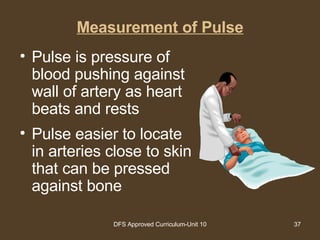
Measurement of Pulse Pulse is pressure of blood pushing against wall of artery as heart beats and rests Pulse easier to locate in arteries close to skin that can be pressed against bone
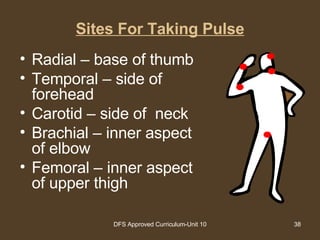
Sites For Taking Pulse Radial – base of thumb Temporal – side of forehead Carotid – side of  neck Brachial – inner aspect of elbow Femoral – inner aspect of upper thigh
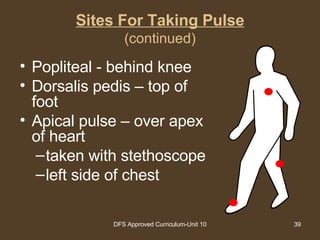
Sites For Taking Pulse (continued) Popliteal - behind knee Dorsalis pedis – top of foot  Apical pulse – over apex of heart taken with stethoscope left side of chest
10.7.1 List the factors that affect the pulse. Objective
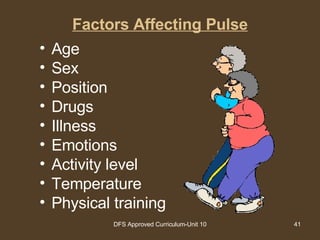
Factors Affecting Pulse Age Sex Position Drugs Illness Emotions Activity level  Temperature Physical training
10.7.2 Identify the normal pulse range and characteristics. Objective
Measurement of Pulse Normal pulse range/characteristics:  60 -100 beats per minute and regular Documenting pulse rate Noted as number of beats per minute Rhythm - regular or irregular Volume - strong, weak, thready, bounding
Demonstration and Return Demonstration
10.8 Demonstrate counting the radial pulse rate. Objective
10.9 Demonstrate measuring the apical pulse. Objective
Measuring Respirations
10.10 Define respiration and discuss how the respiratory rate is measured. Objective
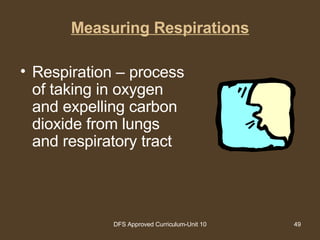
Measuring Respirations Respiration – process of taking in oxygen and expelling carbon dioxide from lungs and respiratory tract
10.10.1 List the factors that affect the respiratory rate.  Objective
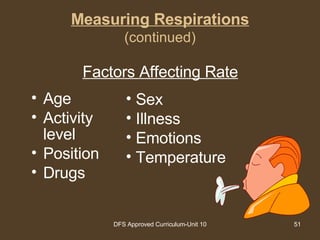
Measuring Respirations (continued) Age Activity level Position Drugs Sex Illness Emotions Temperature Factors Affecting Rate
10.10.2 Identify the qualities of normal respirations. Objective
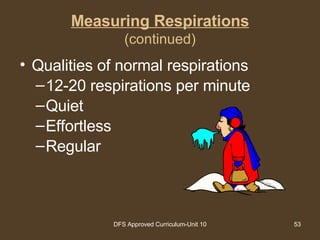
Measuring Respirations (continued) Qualities of normal respirations 12-20 respirations per minute Quiet Effortless Regular
Measuring Respirations (continued) Documenting respiratory rate Noted as number of inhalations and exhalations per minute (one inhalation and one exhalation equals one respiration) Rhythm – regular or irregular Character:  shallow, deep, labored
Demonstration and Return Demonstration
10.11 Demonstrate counting respirations. Objective
Measuring Blood Pressure
10.12 Define blood pressure and discuss how it is measured. Objective
Measuring Blood Pressure Blood pressure is the force of blood pushing against walls of arteries Systolic pressure: greatest force exerted when heart contracting Diastolic pressure: least force exerted as heart relaxes
10.12.1 List factors that influence blood pressure. Objective
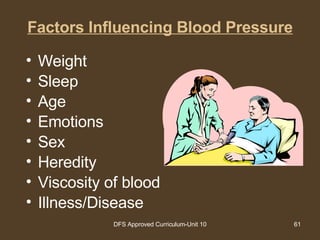
Factors Influencing Blood Pressure Weight Sleep Age Emotions Sex Heredity Viscosity of blood Illness/Disease
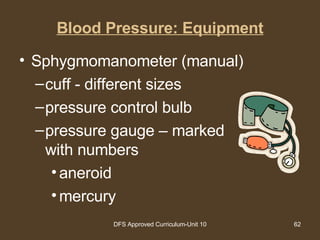
Blood Pressure: Equipment Sphygmomanometer (manual) cuff - different sizes pressure control bulb pressure gauge – marked with numbers aneroid mercury
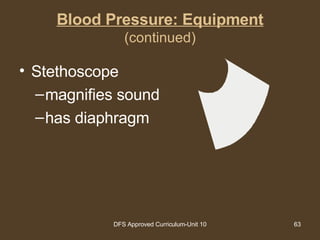
Blood Pressure: Equipment (continued) Stethoscope magnifies sound has diaphragm
10.12.2 Identify the normal blood pressure range. Objective
Measuring Blood Pressure Normal blood pressure range Systolic:  90-140 millimeters of mercury Diastolic:  60-90 millimeters of mercury
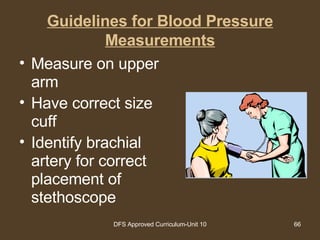
Guidelines for Blood Pressure Measurements Measure on upper arm  Have correct size cuff  Identify brachial artery for correct placement of stethoscope
Guidelines for Blood Pressure Measurements (continued) First sound heard – systolic pressure Last sound heard or change - diastolic pressure
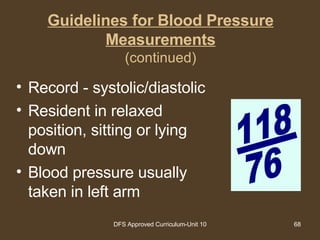
Guidelines for Blood Pressure Measurements (continued) Record - systolic/diastolic Resident in relaxed position, sitting or lying down Blood pressure usually taken in left arm 118 76
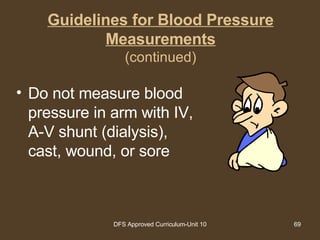
Guidelines for Blood Pressure Measurements (continued) Do not measure blood pressure in arm with IV, A-V shunt (dialysis), cast, wound, or sore
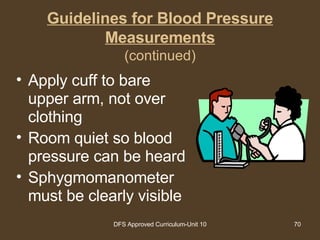
Guidelines for Blood Pressure Measurements (continued) Apply cuff to bare upper arm, not over clothing Room quiet so blood pressure can be heard Sphygmomanometer must be clearly visible
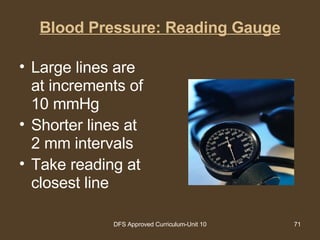
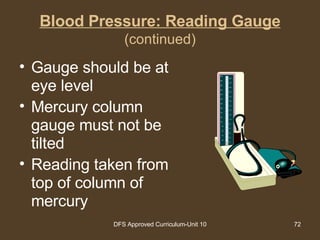
Blood Pressure: Reading Gauge Large lines are at increments of 10 mmHg Shorter lines at 2 mm intervals Take reading at closest line
Blood Pressure: Reading Gauge (continued) Gauge should be at eye level Mercury column gauge must not be tilted Reading taken from top of column of mercury 300 280 260 240 220 200 180 160 140 120 100 80 60 40 20 290 270 250 230 210 190 170 150 130 110 90 70 50 30 10
Demonstration and Return Demonstration
10.13 Demonstrate the procedure for measuring blood pressure. Objective
10.14 Demonstrate the procedure for taking combined vital signs. Objective
Measuring Height And Weight
10.15 Discuss height and weight and how it is measured. Objective
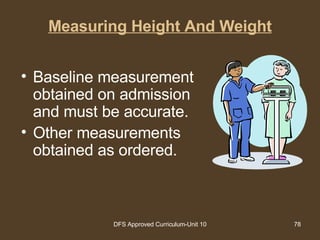
Measuring Height And Weight Baseline measurement obtained on admission and must be accurate.  Other measurements obtained as ordered.
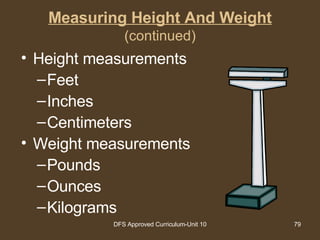
Measuring Height And Weight (continued) Height measurements Feet Inches  Centimeters Weight measurements Pounds Ounces Kilograms
Measuring Height and Weight (continued) Reasons for obtaining height and weight Indicator of nutritional status Indicator of change in medical condition Used by doctor to order medications
10.15.1 List three guidelines for weighing residents. Objective
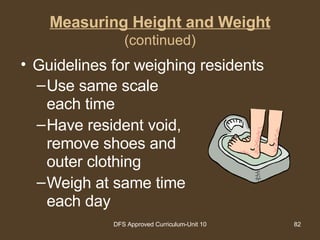
Measuring Height and Weight (continued) Use same scale each time Have resident void, remove shoes and outer clothing Weigh at same time each day Guidelines for weighing residents
Measuring Height and Weight (continued) Scales Remain more accurate if moved as little as possible. Various types of scales bathroom scale standing scale scales attached to hydraulic lifts wheelchair scales bed scales
Demonstration and Return Demonstration
10.16 Demonstrate the procedure for measuring height and weight. Objective
Measuring Intake And Output
10.17 Discuss measuring and recording intake and output, and conditions for which this procedure would be ordered. Objective
Measuring Intake and Output Fluid Balance Consume 2-1/2 to 3-1/2 quarts daily eating drinking Eliminate 2-1/2 to 3-1/2 quarts daily urine perspiration  water vapor through respirations stool
10.17.1 Identify five symptoms of edema. Objective
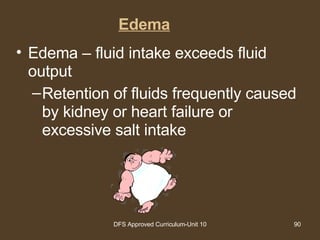
Edema Edema – fluid intake exceeds fluid output Retention of fluids frequently caused by kidney or heart failure or excessive salt intake
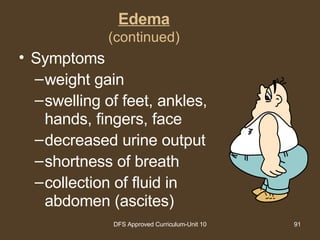
Edema (continued) Symptoms weight gain swelling of feet, ankles, hands, fingers, face decreased urine output shortness of breath collection of fluid in abdomen (ascites)
10.17.2 List eight symptoms of dehydration. Objective
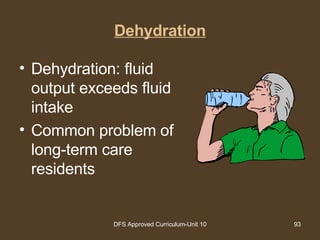
Dehydration Dehydration: fluid output exceeds fluid intake  Common problem of long-term care residents
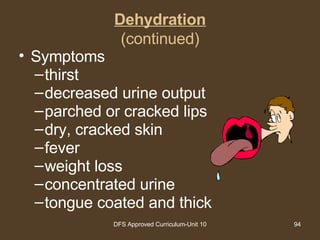
Dehydration (continued) Symptoms thirst decreased urine output parched or cracked lips dry, cracked skin fever weight loss concentrated urine tongue coated and thick
Dehydration (continued) Causes of dehydration poor fluid intake diarrhea bleeding  vomiting excessive perspiration
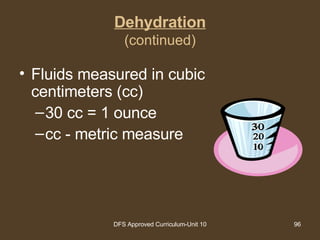
Dehydration (continued) Fluids measured in cubic centimeters (cc) 30 cc = 1 ounce cc - metric measure 30 20 10
Measuring and Recording Intake/Output
10.18 Identify the liquids that would be measured and recorded as fluid intake. Objective
Measuring and Recording Intake/Output Physician orders intake and output Intake includes: All liquid taken by mouth Food items that turn to liquid at room temperature Tube feedings into stomach through nose or abdomen Fluids given by intravenous infusion
10.18.1 List the liquids that would be measured and recorded as fluid output. Objective
Measuring and Recording Intake/Output (continued) Output includes Urine Liquid stool Emesis Drainage Suctioned secretions Excessive perspiration
Demonstration and Return Demonstration
10.19 Demonstrate measuring and recording fluid intake and output. Objective
The End

Unit 10 Basic Nursing Skills

  • 1.
    Unit 10 BasicNursing Skills Nurse Aide I Course
  • 2.
    Basic Nursing SkillsIntroduction This unit introduces the basic nursing skills the nurse aide will need to measure and record the resident’s vital signs, height and weight, and intake and output. The vital signs provide information about changes in normal body function and the resident’s response to treatment.
  • 3.
    Basic Nursing SkillsIntroduction (continued) The resident’s weight, compared with the height, gives information about his/her nutritional status and changes in the medical condition. Intake and output records provide information on fluid balance and kidney function.
  • 4.
  • 5.
    10.0 Provide basicnursing skills. Objective
  • 6.
    Vital Signs Reflectthe function of three body processes that are essential for life. Regulation of body temperature Heart function Breathing
  • 7.
    10.1 Explain themeaning of vital signs and the abbreviations used for each vital sign. Objective
  • 8.
    Vital Signs (continued)Abbreviations: Temperature – T Pulse – P Respirations – R Blood Pressure – BP Vital signs - TPR and BP
  • 9.
    Vital Signs (continued)Purpose Measured to detect any changes in normal body function Used to determine response to treatment
  • 10.
    Vital Signs (continued)Measurement (taken at rest) Temperature - measures body heat Pulse - measures heart rate Respiration - measures how often resident inhales and exhales Blood Pressure - measures pressure against walls of arteries
  • 11.
  • 12.
    10.2 Define bodytemperature and discuss the way it is measured. Objective
  • 13.
    Temperature – Measurement Of Body Heat Heat production muscles glands oxidation of food Heat loss respiration perspiration excretion
  • 14.
    Temperature – Measurement Of Body Heat (continued) Balance between heat production and heat loss is body temperature
  • 15.
    10.2.1 List thefactors that affect temperature. Objective
  • 16.
    Factors Affecting TemperatureExercise Illness Age Time of day Medications Infection Emotions Hydration Clothing Environmental temperature/air movement
  • 17.
    Equipment - ThermometerInstrument used to measure body temperature Types Non-mercury glass oral rectal
  • 18.
    Equipment - ThermometerTypes (continued) chemically treated paper – disposable plastic – disposable electronic - probe covered with disposable shield tympanic - electronic probe used in the ear
  • 19.
    10.2.2 Identify thenormal temperature range, and the normal body temperature. Objective
  • 20.
    Normal Temperature RangeFor Adults Oral - 97.6  - 99.6  F (Fahrenheit) or 36.5  -37.5  C (Celsius) Rectal - 98.6  - 100.6  F or 37.0  - 38.1  C Axillary - 96.6  - 98.6  F or 36.0  - 37.0  C
  • 21.
    10.2.3 Read anon-mercury glass thermometer. Objective
  • 22.
    To Read ANon-mercury Glass Thermometer Hold eye level Locate solid column of liquid in the glass Observe lines on scale at upper side of column of liquid in the glass
  • 23.
    To Read ANon-mercury Glass Thermometer (continued) Read at point where liquid ends If liquid falls between two lines, read it to closest line long line represents degree short line represents 0.2 of a degree Fahrenheit
  • 24.
    10.2.4 List anddiscuss the sites used to take a temperature. Objective
  • 25.
    Sites To TakeA Temperature Oral – most common Rectal – registers one degree Fahrenheit higher than oral Axillary – least accurate; registers one degree Fahrenheit lower than oral Tympanic – probe inserted into the ear canal
  • 26.
    Sites To TakeA Temperature (continued) Condition of resident determines which is the best site for measuring body temperature
  • 27.
    10.2.5 Review safetyprecautions that should be considered when using a thermometer. Objective
  • 28.
    Temperature: Safety PrecautionsHold rectal and axillary thermometers in place  Stay with resident when taking temperature  Check glass thermometers for chips  Prior to use, shake liquid in glass down  Shake thermometer away from resident and hard objects 
  • 29.
    Temperature: Safety Precautions(continued) Wipe from end to tip of thermometer prior to reading  Delay taking oral temperature for 10 - 15 minutes if resident has been smoking, eating or drinking hot/cold liquids.
  • 30.
  • 31.
    10.3 Demonstrate theprocedure for measuring an oral temperature using a non-mercury glass thermometer. Objective
  • 32.
    10.4 Demonstrate theprocedure for measuring an axillary temperature using a non-mercury glass thermometer. Objective
  • 33.
    10.5 Demonstrate theprocedure for measuring a rectal temperature using a non-mercury glass thermometer. Objective
  • 34.
    10.6 Demonstrate measuringtemperature using an electronic or tympanic thermometer. Objective
  • 35.
  • 36.
    10.7 Define pulseand discuss the way it is measured. Objective
  • 37.
    Measurement of PulsePulse is pressure of blood pushing against wall of artery as heart beats and rests Pulse easier to locate in arteries close to skin that can be pressed against bone
  • 38.
    Sites For TakingPulse Radial – base of thumb Temporal – side of forehead Carotid – side of neck Brachial – inner aspect of elbow Femoral – inner aspect of upper thigh
  • 39.
    Sites For TakingPulse (continued) Popliteal - behind knee Dorsalis pedis – top of foot Apical pulse – over apex of heart taken with stethoscope left side of chest
  • 40.
    10.7.1 List thefactors that affect the pulse. Objective
  • 41.
    Factors Affecting PulseAge Sex Position Drugs Illness Emotions Activity level Temperature Physical training
  • 42.
    10.7.2 Identify thenormal pulse range and characteristics. Objective
  • 43.
    Measurement of PulseNormal pulse range/characteristics: 60 -100 beats per minute and regular Documenting pulse rate Noted as number of beats per minute Rhythm - regular or irregular Volume - strong, weak, thready, bounding
  • 44.
  • 45.
    10.8 Demonstrate countingthe radial pulse rate. Objective
  • 46.
    10.9 Demonstrate measuringthe apical pulse. Objective
  • 47.
  • 48.
    10.10 Define respirationand discuss how the respiratory rate is measured. Objective
  • 49.
    Measuring Respirations Respiration– process of taking in oxygen and expelling carbon dioxide from lungs and respiratory tract
  • 50.
    10.10.1 List thefactors that affect the respiratory rate. Objective
  • 51.
    Measuring Respirations (continued)Age Activity level Position Drugs Sex Illness Emotions Temperature Factors Affecting Rate
  • 52.
    10.10.2 Identify thequalities of normal respirations. Objective
  • 53.
    Measuring Respirations (continued)Qualities of normal respirations 12-20 respirations per minute Quiet Effortless Regular
  • 54.
    Measuring Respirations (continued)Documenting respiratory rate Noted as number of inhalations and exhalations per minute (one inhalation and one exhalation equals one respiration) Rhythm – regular or irregular Character: shallow, deep, labored
  • 55.
  • 56.
    10.11 Demonstrate countingrespirations. Objective
  • 57.
  • 58.
    10.12 Define bloodpressure and discuss how it is measured. Objective
  • 59.
    Measuring Blood PressureBlood pressure is the force of blood pushing against walls of arteries Systolic pressure: greatest force exerted when heart contracting Diastolic pressure: least force exerted as heart relaxes
  • 60.
    10.12.1 List factorsthat influence blood pressure. Objective
  • 61.
    Factors Influencing BloodPressure Weight Sleep Age Emotions Sex Heredity Viscosity of blood Illness/Disease
  • 62.
    Blood Pressure: EquipmentSphygmomanometer (manual) cuff - different sizes pressure control bulb pressure gauge – marked with numbers aneroid mercury
  • 63.
    Blood Pressure: Equipment(continued) Stethoscope magnifies sound has diaphragm
  • 64.
    10.12.2 Identify thenormal blood pressure range. Objective
  • 65.
    Measuring Blood PressureNormal blood pressure range Systolic: 90-140 millimeters of mercury Diastolic: 60-90 millimeters of mercury
  • 66.
    Guidelines for BloodPressure Measurements Measure on upper arm Have correct size cuff Identify brachial artery for correct placement of stethoscope
  • 67.
    Guidelines for BloodPressure Measurements (continued) First sound heard – systolic pressure Last sound heard or change - diastolic pressure
  • 68.
    Guidelines for BloodPressure Measurements (continued) Record - systolic/diastolic Resident in relaxed position, sitting or lying down Blood pressure usually taken in left arm 118 76
  • 69.
    Guidelines for BloodPressure Measurements (continued) Do not measure blood pressure in arm with IV, A-V shunt (dialysis), cast, wound, or sore
  • 70.
    Guidelines for BloodPressure Measurements (continued) Apply cuff to bare upper arm, not over clothing Room quiet so blood pressure can be heard Sphygmomanometer must be clearly visible
  • 71.
    Blood Pressure: ReadingGauge Large lines are at increments of 10 mmHg Shorter lines at 2 mm intervals Take reading at closest line
  • 72.
    Blood Pressure: ReadingGauge (continued) Gauge should be at eye level Mercury column gauge must not be tilted Reading taken from top of column of mercury 300 280 260 240 220 200 180 160 140 120 100 80 60 40 20 290 270 250 230 210 190 170 150 130 110 90 70 50 30 10
  • 73.
  • 74.
    10.13 Demonstrate theprocedure for measuring blood pressure. Objective
  • 75.
    10.14 Demonstrate theprocedure for taking combined vital signs. Objective
  • 76.
  • 77.
    10.15 Discuss heightand weight and how it is measured. Objective
  • 78.
    Measuring Height AndWeight Baseline measurement obtained on admission and must be accurate. Other measurements obtained as ordered.
  • 79.
    Measuring Height AndWeight (continued) Height measurements Feet Inches Centimeters Weight measurements Pounds Ounces Kilograms
  • 80.
    Measuring Height andWeight (continued) Reasons for obtaining height and weight Indicator of nutritional status Indicator of change in medical condition Used by doctor to order medications
  • 81.
    10.15.1 List threeguidelines for weighing residents. Objective
  • 82.
    Measuring Height andWeight (continued) Use same scale each time Have resident void, remove shoes and outer clothing Weigh at same time each day Guidelines for weighing residents
  • 83.
    Measuring Height andWeight (continued) Scales Remain more accurate if moved as little as possible. Various types of scales bathroom scale standing scale scales attached to hydraulic lifts wheelchair scales bed scales
  • 84.
  • 85.
    10.16 Demonstrate theprocedure for measuring height and weight. Objective
  • 86.
  • 87.
    10.17 Discuss measuringand recording intake and output, and conditions for which this procedure would be ordered. Objective
  • 88.
    Measuring Intake andOutput Fluid Balance Consume 2-1/2 to 3-1/2 quarts daily eating drinking Eliminate 2-1/2 to 3-1/2 quarts daily urine perspiration  water vapor through respirations stool
  • 89.
    10.17.1 Identify fivesymptoms of edema. Objective
  • 90.
    Edema Edema –fluid intake exceeds fluid output Retention of fluids frequently caused by kidney or heart failure or excessive salt intake
  • 91.
    Edema (continued) Symptomsweight gain swelling of feet, ankles, hands, fingers, face decreased urine output shortness of breath collection of fluid in abdomen (ascites)
  • 92.
    10.17.2 List eightsymptoms of dehydration. Objective
  • 93.
    Dehydration Dehydration: fluidoutput exceeds fluid intake Common problem of long-term care residents
  • 94.
    Dehydration (continued) Symptomsthirst decreased urine output parched or cracked lips dry, cracked skin fever weight loss concentrated urine tongue coated and thick
  • 95.
    Dehydration (continued) Causesof dehydration poor fluid intake diarrhea bleeding vomiting excessive perspiration
  • 96.
    Dehydration (continued) Fluidsmeasured in cubic centimeters (cc) 30 cc = 1 ounce cc - metric measure 30 20 10
  • 97.
  • 98.
    10.18 Identify theliquids that would be measured and recorded as fluid intake. Objective
  • 99.
    Measuring and RecordingIntake/Output Physician orders intake and output Intake includes: All liquid taken by mouth Food items that turn to liquid at room temperature Tube feedings into stomach through nose or abdomen Fluids given by intravenous infusion
  • 100.
    10.18.1 List theliquids that would be measured and recorded as fluid output. Objective
  • 101.
    Measuring and RecordingIntake/Output (continued) Output includes Urine Liquid stool Emesis Drainage Suctioned secretions Excessive perspiration
  • 102.
  • 103.
    10.19 Demonstrate measuringand recording fluid intake and output. Objective
  • 104.